A lot of St. Paul companies end up in the same spot. An office refresh is underway, a clinic is replacing workstations, or a warehouse admin team is clearing a storage room, and suddenly there's a pile of laptops, monitors, phones, docking stations, printers, and old network gear with nowhere obvious to go.
That's where electronics disposal in St. Paul, MN stops being a janitorial task and becomes an IT, compliance, and operations issue. For a business, the question isn't just how to get devices out of the building. It's how to move them with documentation, protect data, handle regulated items correctly, and avoid using a residential program that was never designed for commercial volumes or business liability.
The E-Waste Challenge for St. Paul Businesses
A typical cleanout starts small. One department upgrades laptops. Facilities pulls a few old monitors from a locked closet. Then someone finds retired phones, a shelf of hard drives, aging printers, and a server that should have been removed last year. What looked like a simple disposal task turns into a mixed stream of assets with different risks attached.
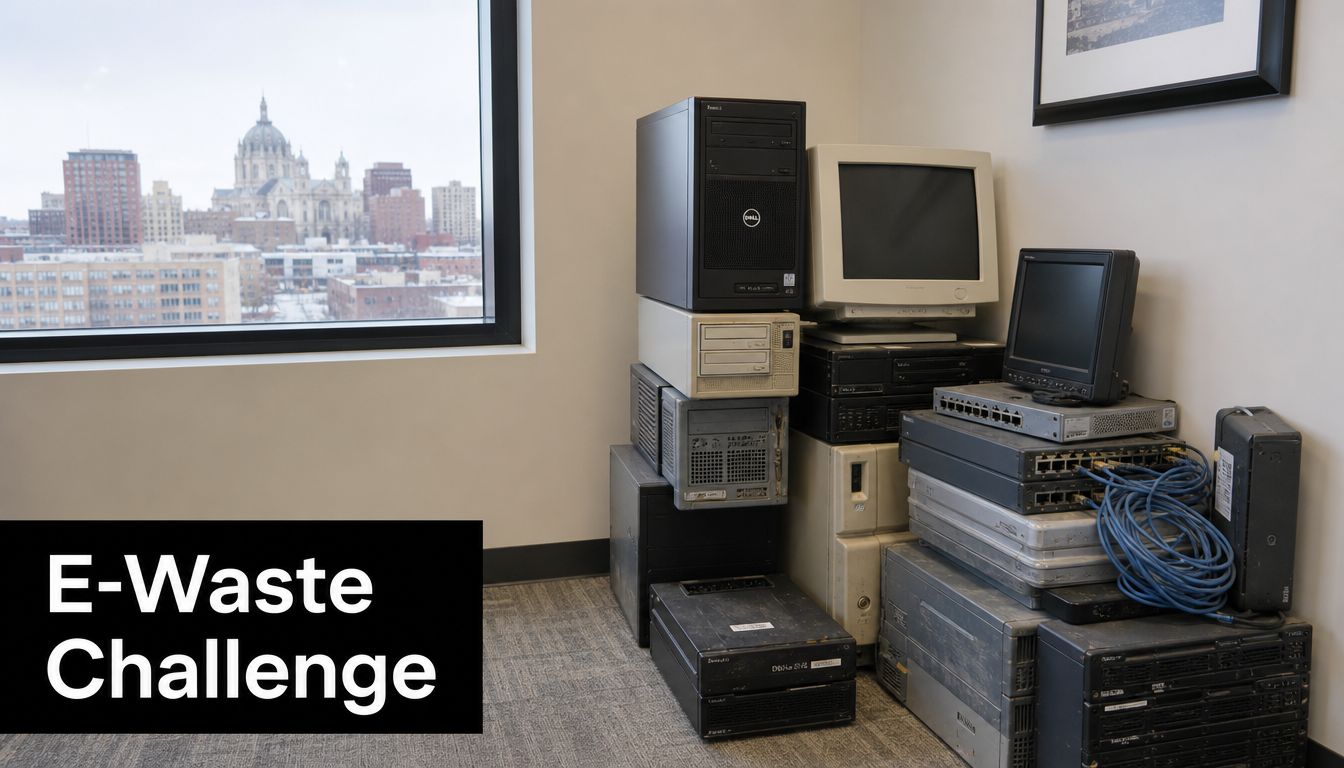
In St. Paul, that situation comes up across offices, healthcare settings, schools, light industrial sites, and nonprofit organizations. The hardware may be different, but the pattern is the same. Some devices still hold sensitive information. Some contain components that can't go into ordinary trash. Some may still have reuse value if they're handled through a proper IT asset disposition process instead of being treated as junk.
Why old equipment becomes a business risk fast
Discarding electronics casually creates two immediate problems. First, storage media can still contain business records, user credentials, patient information, or internal files. Second, many devices include materials that require specialized handling, especially older display equipment and other regulated components.
The broader backdrop makes that local problem more urgent. Global e-waste reached 62 million tonnes in 2022, yet only 22.3% was formally recycled, according to this St. Paul e-waste overview. For business managers, that's more than an environmental headline. It shows how easily retired electronics slip into the wrong channels when disposal decisions are made late or without a clear process.
Practical rule: If your team is stacking retired devices in a closet because no one is sure what to do next, you already have an ITAD problem.
What works better than ad hoc disposal
The companies that handle electronics disposal well usually do three things:
- Separate assets by risk: Data-bearing devices, battery-powered devices, and display equipment shouldn't all move through the same casual cleanout flow.
- Assign ownership: IT, facilities, compliance, and operations need one decision-maker for pickup, documentation, and final disposition.
- Use a defined pathway: Pickup scheduling, chain of custody, secure data handling, and downstream recycling or reuse all need to be decided before the load leaves the building.
For Twin Cities organizations sorting through local options, this Ramsey County electronics recycling business guide is useful because it frames disposal as an operational process, not a one-time errand.
That shift matters. Once electronics disposal is treated as part of sustainable recycling, secure computer recycling, and broader IT equipment disposal, it becomes much easier to manage office cleanouts, facility cleanouts, data center decommissioning, product destruction, and corporate donation programs without improvising every step.
Why City Programs Fall Short for Business E-Waste
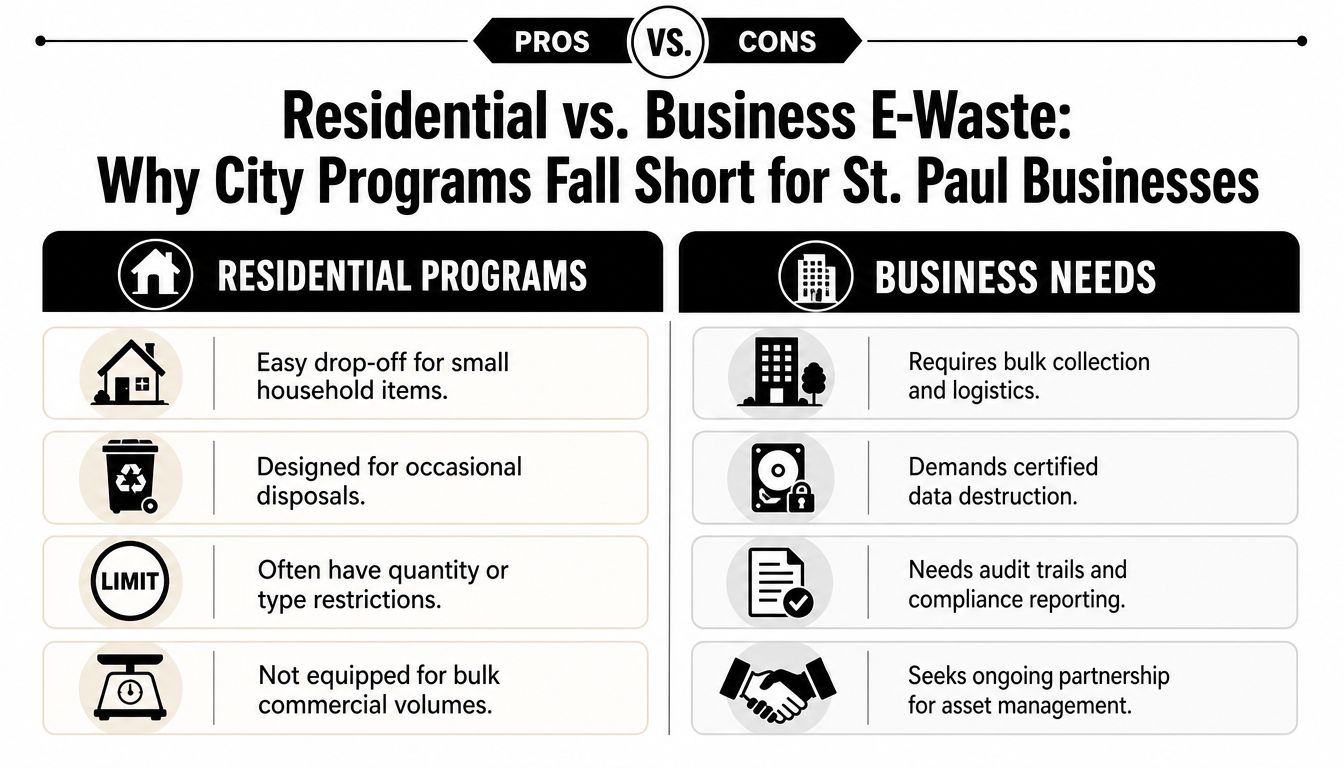
Many St. Paul managers start by checking city or county recycling pages. That makes sense. The problem is that those programs solve a household disposal issue, not a business compliance issue.
The access problem is built into the rules
The most important limitation is explicit. Ramsey County's program states "No-cost electronic recycling for Ramsey County residents (no businesses)," and Saint Paul's citywide program limits free disposal to "1-4 unit homes," creating a service gap for the 50,000+ small and mid-sized businesses in the metro area, as noted in this local program summary.
That means a St. Paul office manager can't assume the city's free or resident-focused pathway applies to company property just because the equipment is physically small enough to fit in a car.
Residential convenience doesn't equal commercial suitability
The mismatch is bigger than eligibility. Business disposal usually requires a different operating model.
| Program type | Works for households | Falls short for businesses |
|---|---|---|
| City drop-off rules | Fine for occasional personal electronics | Not built for recurring office cleanouts |
| Quantity allowances | Manageable for home users | Weak fit for multi-device refreshes |
| Standard public guidance | Covers basic disposal instructions | Rarely addresses audit trails, asset lists, or chain of custody |
| Self-transport | Simple for one TV or monitor | Risky and inefficient for bulk business equipment |
A city program can be perfectly valid for residents and still be the wrong tool for a business. That's the core trade-off.
What businesses usually need instead
Commercial electronics disposal tends to involve logistics that municipal guides don't address in depth:
- Bulk pickup coordination: Businesses need equipment removed from offices, storage rooms, clinics, warehouses, or multiple sites.
- Asset control: Someone has to document what left, when it left, and where it went.
- Secure handling: Drives, laptops, and servers can't be treated like ordinary scrap.
- Ongoing support: A company rarely has one disposal event. It has refresh cycles, relocations, cleanouts, and decommissions.
City recycling guidance helps residents dispose of occasional items. It doesn't solve the operational reality of a business retiring equipment at scale.
That's why companies looking beyond household options often compare broader regional guidance too, such as this page on electronics recycling programs in Minneapolis. The rules vary by locality, but the same pattern holds. Public programs are narrow by design. Business needs are not.
For electronics recycling, medical equipment disposal, laptop disposal, and larger facility cleanout projects, trying to force a residential system to carry a commercial load usually creates delay, confusion, and unnecessary exposure.
Ensuring Ironclad Data Security Before Disposal
Most business managers already know old devices can contain sensitive data. The bigger issue is knowing what evidence you'll have after the devices are gone.
Wiping a drive and proving destruction aren't the same thing
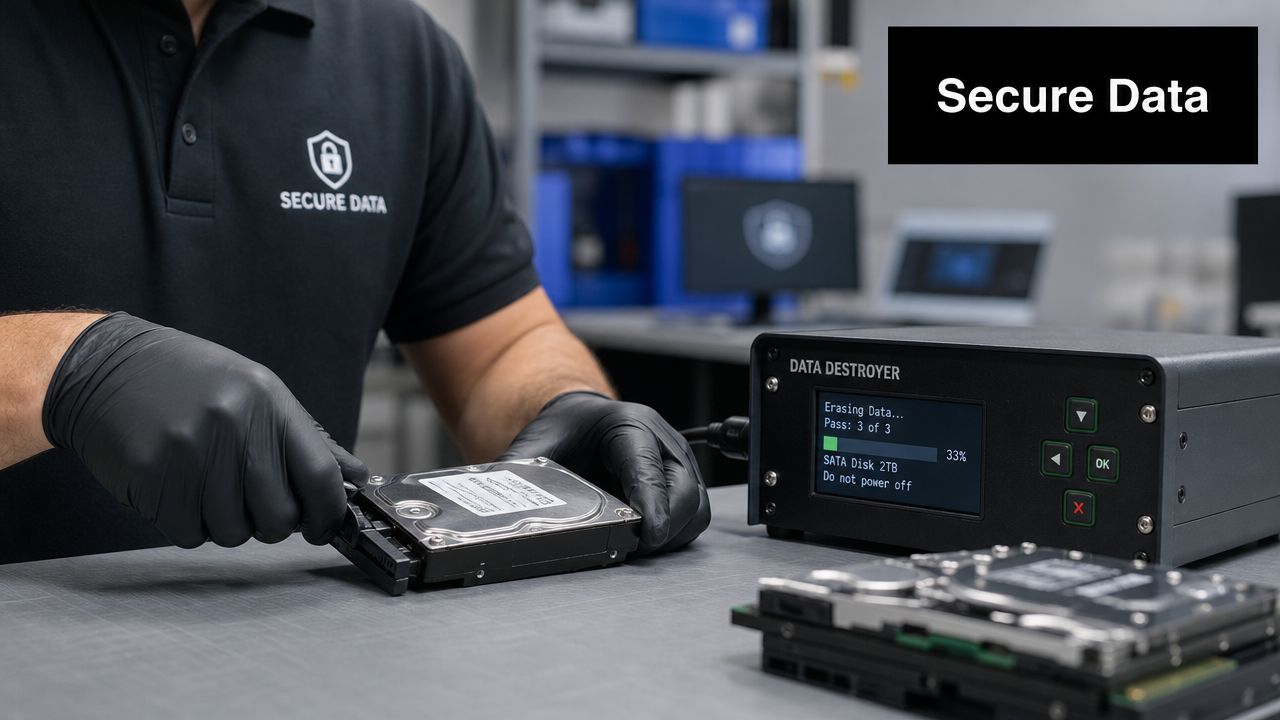
There's a major difference between a recycler saying it offers “data wiping” and a business receiving verifiable documentation that supports compliance review. That gap matters for organizations dealing with internal privacy obligations, regulated records, customer information, or audit scrutiny.
A 2025 industry report indicates that 40% of e-waste firms fail to provide verifiable Certificates of Destruction for hard drives, according to Repowered's discussion of the compliance gap. If your vendor can't show a clear chain of custody and a defensible destruction record, your organization may still carry the risk even after the hardware has left your site.
Questions worth asking before pickup day
Ask these before any truck is scheduled:
- What method is used for each device category? Laptops, desktops, servers, and loose drives may not all follow the same process.
- Will you receive a Certificate of Destruction when appropriate? “We wipe drives” isn't the same as formal documentation.
- How is chain of custody maintained? Pickup, transport, intake, and final processing should all be controlled.
- What happens to reusable equipment? Refurbishment can be appropriate, but only after secure data handling is completed.
- Who can answer compliance questions in writing? If no one can, that's a warning sign.
Compliance insight: The weak point in electronics disposal usually isn't the truck. It's the missing documentation after the truck leaves.
For managers who want a plain-language refresher on user-side sanitization, this guide on how to prevent identity theft with data wiping is a useful companion resource. It helps explain why deletion, formatting, and true erasure aren't interchangeable.
A business recycling partner should be able to go further than educational advice. It should provide operational process, evidence, and accountability. For teams comparing vendors, Reworx Recycling outlines that service scope in its secure data destruction services page, including how secure data destruction fits into broader IT asset disposition, product destruction, and end-of-life computer recycling workflows.
Partnering for Compliant IT Asset Disposition
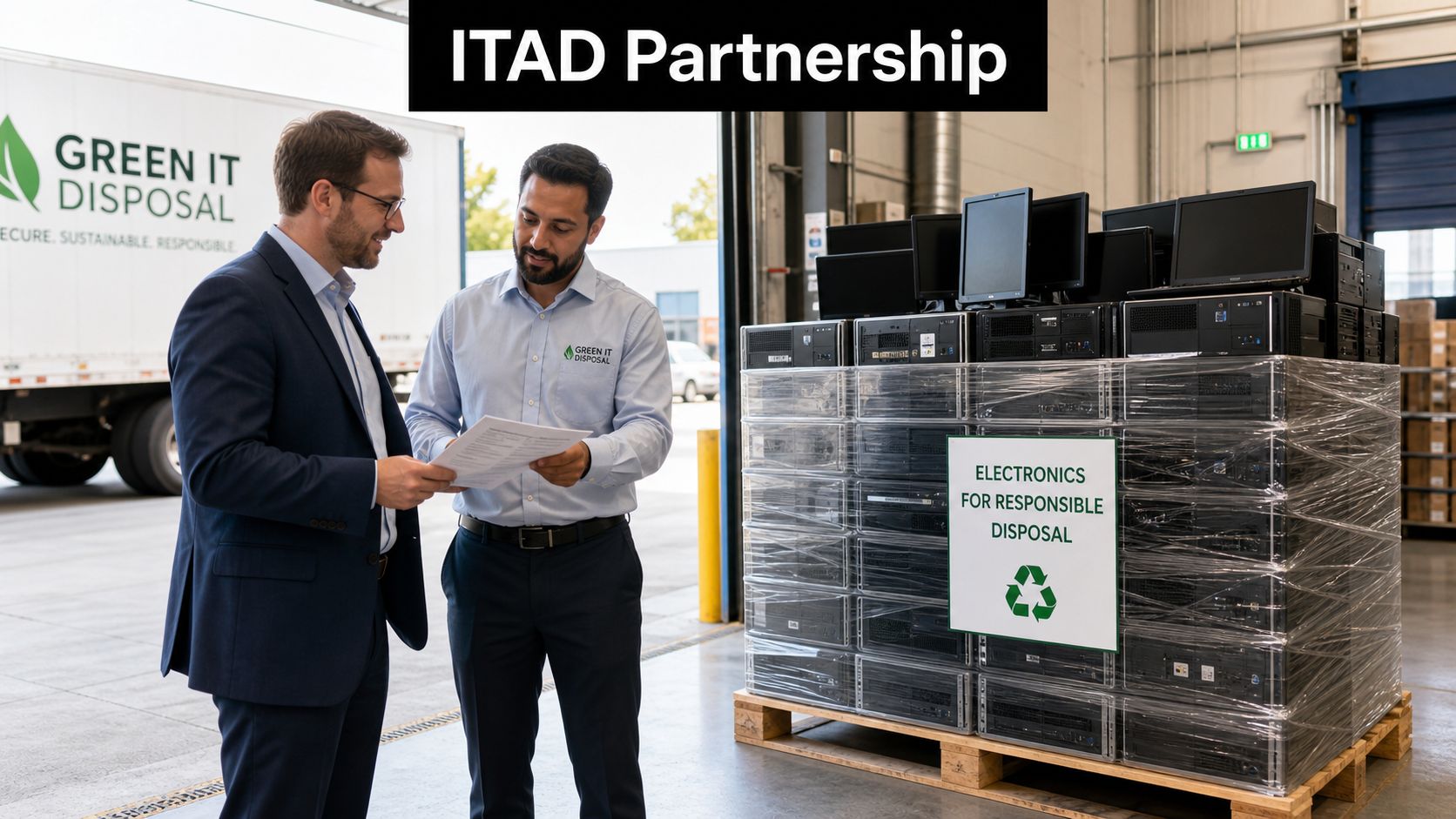
Once a business accepts that city programs aren't built for commercial disposal and that data handling needs proof, the decision becomes more practical. You need a partner that can manage pickup, sorting, documentation, and lawful downstream processing without making your staff improvise.
The legal baseline in Minnesota matters
Some categories of equipment leave no room for casual disposal. Minnesota law prohibits placing devices containing cathode ray tubes, such as older TVs and computer monitors, into mixed municipal solid waste, a ban that has been in effect since 2006, according to the Minnesota Pollution Control Agency electronics collection guidance.
That's one reason a structured IT asset disposition program matters. Older monitors, legacy lab displays, and certain specialized equipment can't be handled as ordinary trash during an office cleanout or warehouse purge.
What a real ITAD partnership should include
A workable business process usually has these elements:
- Pickup logistics tied to your site reality: Dock access, building rules, packing needs, and internal scheduling all affect how cleanly a project runs.
- Chain-of-custody documentation: If the asset list matters, the handoff record matters too.
- Sorting by downstream path: Some assets are recycled, some are refurbished, some require destruction.
- Coverage for specialized streams: That includes laboratory equipment disposal, medical equipment disposal, data center decommissioning, and general office cleanout support.
Not every recycler is set up for all of that. Some are primarily drop-off processors. Others can function as operational partners.
Why vendor selection changes the outcome
The wrong vendor creates hidden work for your team. Facilities ends up coordinating freight details. IT has to chase destruction records. Finance asks what happened to decommissioned assets. Compliance wants proof no one thought to request at the start.
That's where selection criteria matter more than marketing language. A strong evaluation process should review service scope, documentation practices, handling of regulated materials, and how the vendor supports repeat programs such as recurring IT equipment disposal and sustainable recycling initiatives. This guide to ITAD vendor selection criteria is a useful framework for making that comparison.
For organizations that want pickup support, secure processing, and a social impact component in one channel, Reworx Recycling is one available option. Its model aligns electronics recycling, secure data destruction, business pickups, decommissioning support, and donation-oriented reuse into a single service pathway for organizations retiring equipment.
A disposal vendor removes equipment. An ITAD partner removes equipment and closes the compliance loop.
Turn Surplus Tech into Community Impact Through Donation
A disposal project doesn't have to end with shredding and scrap. In many business environments, a meaningful share of retired hardware is obsolete for internal standards but still viable for reuse after proper processing. That's where donation-based recycling becomes more than a sustainability slogan.
Reuse can support both policy and purpose
When equipment is suitable for refurbishment, donation creates a different kind of outcome. The business still clears space, reduces clutter, and follows a structured end-of-life process. At the same time, devices can support digital access, training, and community use instead of moving directly to material recovery.
That matters for organizations building ESG programs, internal sustainability reporting, or broader corporate social responsibility efforts. Social enterprise recycling gives those goals a practical outlet. It connects laptop disposal, computer recycling, and corporate donation programs to a visible community result.
The strongest donation programs still start with controls
Donation should never mean informal handoff. A sound process still requires:
- Data security first: Reuse only works when information security is handled before the device changes hands.
- Equipment triage: Some devices belong in refurbishment workflows. Others belong in recycling streams.
- Clear records: Internal teams should know what was donated, what was recycled, and what was destroyed.
This is one reason donation-based models are often stronger when they operate inside an ITAD framework rather than outside it. The organization doesn't have to choose between compliance and social benefit. It can pursue both in the same program.
Businesses that want to direct retired devices into a community-focused pathway can review what that looks like through Reworx Recycling's laptop donation program. For companies managing office refreshes, school technology turnover, or surplus from relocation projects, that approach turns a routine disposal event into a more useful part of a social enterprise recycling strategy.
Your Strategic Electronics Disposal Questions Answered
Business leaders in St. Paul usually ask the same core questions once a cleanout starts. The answers shape whether the project stays simple or turns into a compliance headache.
Can we put old electronics in normal trash or recycling carts
No. Some electronics are restricted by law or require specialized handling, and battery-powered devices need separate attention. A common technical pitfall is putting items with rechargeable batteries into standard carts, even though these batteries pose a high fire risk and require handling by professional recyclers, as explained by the Minnesota electronics recycling discussion at IRPS.
Is a residential program good enough if the quantity is small
Not for business property. Eligibility, documentation, and logistics are different. Even a small batch of office laptops can create data security and chain-of-custody issues that household programs weren't designed to address.
What should an IT manager ask before approving a recycler
Start with three points:
- How will data-bearing assets be handled?
- What records will we receive after processing?
- How are pickups and downstream disposition documented?
If those answers are vague, keep looking.
What about future Minnesota policy changes
Proposed Minnesota legislation, SF 1690/HF 1426, would require electronics manufacturers to fund collection and recycling, shifting financial responsibility from municipalities to producers, according to this report on the proposed bill. That could reshape how e-waste programs are funded. It does not remove the immediate need for businesses to manage data security, pickup logistics, and documentation correctly today.
What's the practical decision for a St. Paul business
Use a partner that can manage the full chain. That means pickup, secure handling, lawful recycling channels, documentation, and, when appropriate, donation-oriented reuse. For most companies, that's the difference between merely getting electronics out of the building and closing the operational risk around them.
If your team is planning an office cleanout, laptop refresh, facility closure, data center decommissioning, or ongoing electronics recycling program, Reworx Recycling is a practical next step to evaluate. Businesses can use Reworx to donate old equipment, schedule a pickup, and build a more secure, compliant, and community-minded electronics disposal process.