You're probably staring at a room, cage, or storage closet full of retired laptops, monitors, printers, docking stations, and loose hard drives. Procurement wants the space back. Security wants the drives gone. Facilities wants the pallet moved. Legal wants documentation. And you're the person who has to make sure nothing leaves the building in a way that creates an audit problem six months from now.
That's where public sector compliance gets real. It stops being a policy binder and becomes a disposal project with chain-of-custody gaps, inconsistent serial number records, and vendors who sound polished until you ask for proof. The hard part isn't knowing that rules exist. The hard part is translating FISMA, NIST, state e-waste laws, and internal procurement controls into a process your team can run.
The High Stakes of Public Sector IT Asset Disposition
Old equipment becomes a compliance issue the moment it contains data, enters a loading dock, or changes hands. A desktop scheduled for disposal can trigger privacy, records, cybersecurity, and environmental obligations all at once. That's why IT asset disposition in government settings has to be managed like a controlled operation, not a cleanup exercise.
The risk is no longer theoretical. In 2025, a €530 million penalty was issued for data protection failures, and 84% of public sector organizations expect regulatory scrutiny to escalate according to Bright Defense's compliance statistics roundup. If scrutiny is rising, disposal workflows need the same discipline agencies apply to access control, patching, and incident response.
What catches first-time IT managers off guard
Most first major ITAD projects fail in ordinary places:
- Inventory drift: Devices in spreadsheets don't match what's in storage.
- Mixed ownership: Agency assets, contractor devices, and grant-funded equipment get piled together.
- Unclear media handling: Staff know equipment is leaving, but no one has specified whether drives will be wiped, shredded, or both.
- Weak documentation: The vendor provides a summary receipt instead of item-level proof.
A useful starting point is to treat disposition as part of the asset lifecycle, not a separate errand. This guide to facility asset lifecycle planning is helpful because it forces IT, facilities, and compliance teams to work from the same operational map.
Practical rule: If your disposal process begins when the truck arrives, you started too late.
Public agencies usually have enough policy language already. What they often lack is an execution model. That means identifying who approves release, who verifies serials, who witnesses destruction if required, and what records must be retained. If you need a benchmark for agency-specific recycling workflows, review government electronics recycling services in Washington DC and compare it against your current handoff process.
What works and what does not
What works is boring, repeatable control. Tagged assets. approved pickup windows. sealed transport. itemized reporting. destruction evidence. exception handling for missing devices.
What doesn't work is relying on verbal assurances such as “we wipe everything” or “we'll send a certificate later.” In public sector compliance, undocumented work might as well not have happened.
Decoding Key E-Waste and Data Security Regulations
Public sector ITAD sits under two rule sets at the same time. One governs how equipment is discarded or recycled. The other governs how data is protected before that equipment leaves control. If you separate those domains too much, you create blind spots. If you blend them carelessly, you confuse your team.
Environmental rules you need to map first
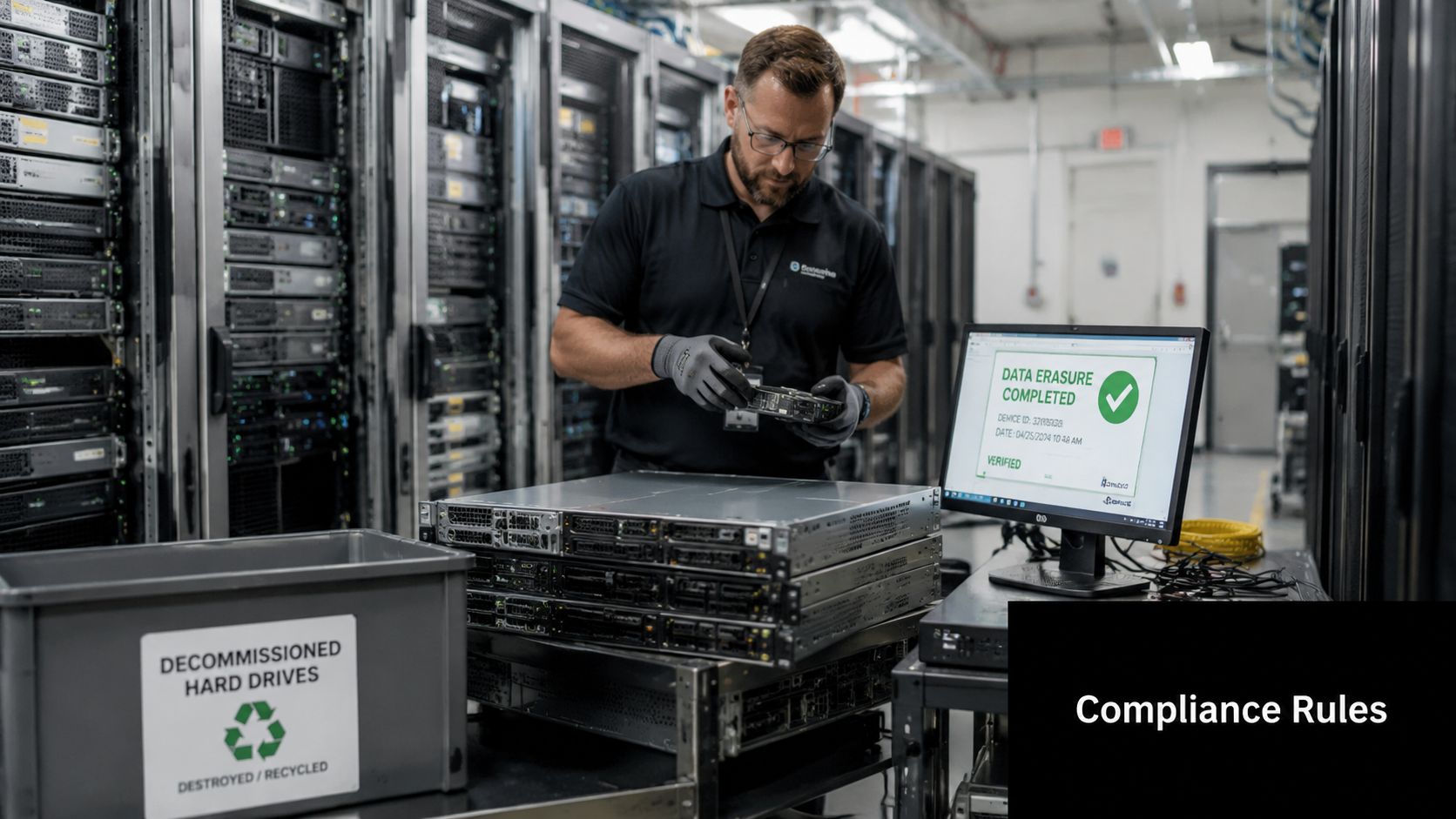
State e-waste rules vary enough that a disposal program that works in one jurisdiction may be incomplete in another. As of 2026, 25 U.S. states plus the District of Columbia have mandatory e-waste laws, and California requires certain businesses that generate significant waste to follow strict recycling mandates under RCRA-enforced state regulations, as outlined in this overview of electronic disposal laws by state.
That matters for agencies with regional offices, school systems with multiple campuses, and contractors operating across state lines. Environmental compliance isn't only about where the recycler is located. It also affects how equipment is stored, transferred, and documented before processing. If your team also handles batteries, lamps, or mixed electronics streams, it helps to align disposal planning with universal waste handling guidance.
A few practical checks make a difference:
- Map jurisdiction first: Confirm the state rules that apply where the assets are generated, not just where the vendor processes them.
- Separate data-bearing from non-data-bearing items: Monitors and keyboards aren't handled the same way as laptops and servers.
- Review storage conditions: A compliant recycler can still inherit a noncompliant load if your staging area is uncontrolled.
Data security rules that follow the device
Once a device can store agency, citizen, patient, student, or employee information, disposal turns into a security event. That's where FISMA, NIST practices, HIPAA-related handling requirements where applicable, and internal security policy all converge. The device may be headed for recycling, but the data obligations stay in force until you can prove sanitization or destruction.
A retired drive is still a regulated asset until the data is rendered unreadable and unusable.
This is also why disposal planning should be coordinated with continuity planning. Teams that already maintain backup, restoration, and recovery procedures usually document systems and media more carefully. If your broader infrastructure planning needs work, this primer on IT disaster recovery solutions is a useful operational companion because recovery discipline and disposal discipline often rise or fall together.
The simplest way to organize your obligations
Use two compliance tracks:
| Track | Core question | Typical owner |
|---|---|---|
| Environmental compliance | Can this equipment be transported and recycled lawfully in this jurisdiction? | Facilities, sustainability, procurement |
| Data security compliance | Can we prove data was sanitized or destroyed before final disposition? | IT, security, compliance |
When teams assign both tracks to one person without support, details get missed. Public sector compliance improves when each track has a named owner and a shared approval point before pickup.
Mastering NIST 800-88 Data Destruction Standards
NIST Special Publication 800-88 Rev. 1 is the standard most public sector managers need to know cold. It gives agencies a framework for media sanitization that auditors, security teams, and courts routinely expect organizations to understand. The important point is simple: the method has to match the media, the sensitivity of the data, and your risk tolerance.
According to guidance summarized by Living Green Technology for government and public sector media sanitization, federal agencies must use one of three approved methods under NIST SP 800-88 Rev. 1: Clear, Purge, or Destroy. For public sector compliance, physical destruction is the most foolproof method.
What Clear, Purge, and Destroy mean in practice
Clear is logical overwriting. It's appropriate when the media type supports it and your process can verify completion. Clear is often treated too casually by inexperienced teams. If the device can't be reliably overwritten, or if verification is weak, Clear becomes a paperwork exercise instead of a security control.
Purge goes further. It aims to make data unrecoverable through more effective physical or logical methods. On some media, Purge can be defensible. On others, especially with aging fleets or mixed device conditions, it introduces too many exceptions.
Destroy means the media is physically rendered unusable. Shredding and pulverizing are the methods commonly associated with destruction, and for many public agencies, that's the answer that eliminates debate.
Why many agencies default to destruction
The trade-off is straightforward:
- Reuse goals favor sanitization.
- Risk reduction favors destruction.
That tension has to be resolved at policy level before the project starts. If your agency wants donation, resale, or redeployment for some assets, define which classes can be sanitized and which must be destroyed. Don't let the vendor make that policy decision on the dock.
If the media classification is unclear, choose the method that removes ambiguity, not the method that preserves theoretical value.
For data-bearing devices that require the highest confidence level, insist on a process aligned with certified hard drive destruction. The phrase to listen for from vendors isn't “secure disposal.” It's whether they can explain, in operational terms, how they separate non-working media, how they verify serials before destruction, and what evidence they issue afterward.
The vendor red flag list
A vendor is not ready for public sector work if they:
- Speak only in marketing terms: “bank-grade,” “military-level,” or similar phrases without process detail.
- Avoid media-specific answers: SSDs, HDDs, mobile devices, and embedded storage don't behave the same way.
- Can't explain exception handling: Missing serial numbers and damaged labels happen. They need a documented path for both.
NIST 800-88 isn't difficult once you stop treating it like abstract policy. It's a decision tree tied to asset type, data sensitivity, and audit proof.
Building an Ironclad Chain of Custody for Audits
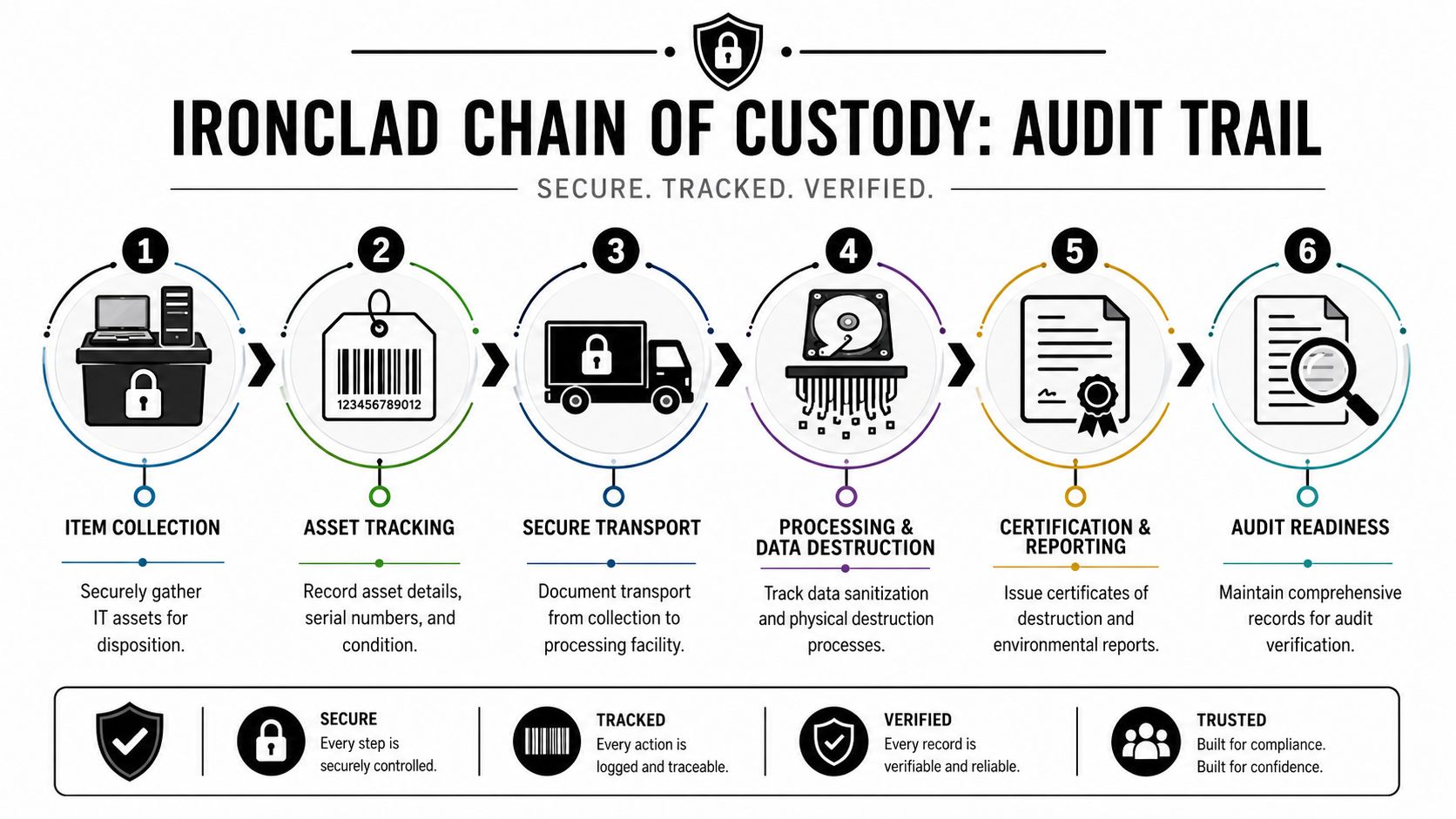
A compliant ITAD project produces evidence at every transfer point. Chain of custody is that evidence trail. It shows where the asset was, who controlled it, when it moved, what happened to it, and what proof exists for the final outcome.
Follow one asset from office to final disposition
Take a single retired laptop. The chain starts when your staff tags it and records the serial number. It continues when the device is placed in a secure collection area, transferred to a pickup manifest, loaded for transport, received at the processor, and then sanitized, destroyed, or recycled. Every handoff should leave a record.
The most common gap appears at the beginning. Teams often know how many “units” are being removed but haven't reconciled exact device identities. Auditors don't care that twelve laptops were picked up if your records can't show which twelve.
The document set you should demand
At minimum, require these records:
- Asset inventory export: Serial number, asset tag, device type, location, and disposition category.
- Transfer log: Date, pickup personnel, releasing staff member, and container count.
- Transport receipt: Confirmation that the load entered secure transport.
- Processing report: What was recycled, what was destroyed, and any exceptions.
- Certificate of Destruction: Item-level proof for data-bearing media where destruction is required.
Illinois provides a useful benchmark. In states like Illinois, courts expect alignment with NIST SP 800-88, and compliant vendors must issue a Certificate of Destruction listing individual device serial numbers, according to this summary of Illinois disposal and data destruction requirements.
Audit note: A certificate that lists only pallet counts or generic equipment categories won't carry the same evidentiary value as serialized documentation.
If your team needs a model for what complete proof should look like, review examples of chain of custody documentation and compare them to what your current vendor provides.
What a strong chain of custody actually looks like
| Stage | Minimum proof |
|---|---|
| Internal collection | Asset list with serials and release approval |
| Pickup | Signed manifest and timestamp |
| Transport | Documented custody transfer |
| Processing | Method applied to each asset class |
| Final closure | Certificate and supporting report |
Weak programs treat chain of custody as a final PDF. Strong programs build it from the first touch.
How to Vet and Select a Certified ITAD Partner
Vendor choice is where many compliance programs subtly fail. Your internal controls can be solid, but if the downstream handling model is vague, your agency inherits the risk. That's especially true when subcontractors, logistics firms, or downstream recyclers enter the chain.
The vendor risk is documented. A 2024 Gartner report found that 68% of public sector organizations face audit failures due to undefined data handling protocols for third-party vendors during ITAD, as cited in this public sector compliance overview from Commvault. That should change how you evaluate proposals. Price and pickup speed matter, but they come after control clarity.
Start with certifications, then go past them
Certification matters because it signals that a vendor has submitted to an external standard. It does not eliminate the need to ask hard questions. In practice, I treat certification as the opening screen, not the final answer.
Here's a simple comparison point for procurement teams.
R2 vs. e-Stewards Certification at a Glance
| Feature | R2 (Responsible Recycling) | e-Stewards |
|---|---|---|
| Focus | Structured electronics recycling controls and downstream accountability | Strong environmental and worker protection expectations with recycling controls |
| Data security relevance | Useful when paired with documented sanitization and destruction procedures | Useful when paired with documented sanitization and destruction procedures |
| Procurement value | Commonly recognized in enterprise and institutional recycling programs | Commonly recognized for organizations seeking stricter environmental positioning |
| What you still need to verify | Serial-level reporting, subcontractor use, insurance, chain of custody, NIST-aligned media handling | Serial-level reporting, subcontractor use, insurance, chain of custody, NIST-aligned media handling |
The table helps procurement, but your vetting has to go deeper.
Questions that expose weak vendors quickly
Ask these in writing:
- Who touches the equipment after pickup? If they use downstream partners, require names and roles.
- How do you handle serial reconciliation? A credible vendor explains discrepancy management without hesitation.
- What happens to failed media or unreadable drives? You want a defined exception process.
- What proof do you issue? Ask for sample manifests and destruction certificates.
- Can you support government-specific requirements? This includes secure pickup, witness options, and itemized reporting.
A practical procurement aid is to compare candidate answers against a formal vendor selection criteria checklist. It helps separate polished sales language from operational maturity.
A vendor that can't describe its downstream chain is asking you to accept blind risk.
What usually works best
For public sector compliance, the best vendor isn't always the cheapest recycler or the fastest truck. It's the partner whose process survives scrutiny. Clear intake controls, documented media handling, serialized reporting, and contract discipline beat broad capability statements every time.
Writing Compliant RFP and Contract Language
Most IT managers know what they want a vendor to do. Fewer translate that into language procurement and legal can enforce. That's where projects get soft. If your RFP says “secure disposal” without defining methods, records, timelines, and liability, you've left too much open to interpretation.
Clauses worth putting in writing
Use direct language such as:
- Media sanitization requirement: Vendor shall sanitize or destroy data-bearing media in accordance with NIST SP 800-88 Rev. 1. Agency may designate destruction as the required method for specified asset classes.
- Documentation requirement: Vendor shall maintain a complete chain of custody from pickup through final disposition and provide serialized reporting for all covered assets.
- Certificate requirement: Vendor shall issue a Certificate of Destruction for applicable media, including device serial numbers where available.
- Subcontracting restriction: Vendor shall not transfer agency assets to downstream processors without prior written approval and documented controls.
- Incident notification: Vendor shall notify the agency promptly of any lost asset, chain-of-custody break, or suspected unauthorized access.
What procurement teams often miss
The contract should answer four questions before award:
| Contract point | Why it matters |
|---|---|
| What method is required | Prevents disputes over wiping versus shredding |
| What proof must be delivered | Avoids vague end-of-project summaries |
| Who is liable for failures | Clarifies breach and loss responsibility |
| Whether subcontractors are allowed | Stops hidden downstream risk |
If your team builds proposals repeatedly, tools for structured drafting can help. Some agencies use platforms similar to government proposal software to standardize required clauses and reduce version drift across departments.
The safest RFP language removes discretion from the moments where vendors usually improvise.
A practical drafting habit
Write your RFP so a different employee could administer the contract without calling you. If a requirement depends on your memory or a kickoff meeting, it isn't written tightly enough.
Your Practical ITAD Compliance Checklist
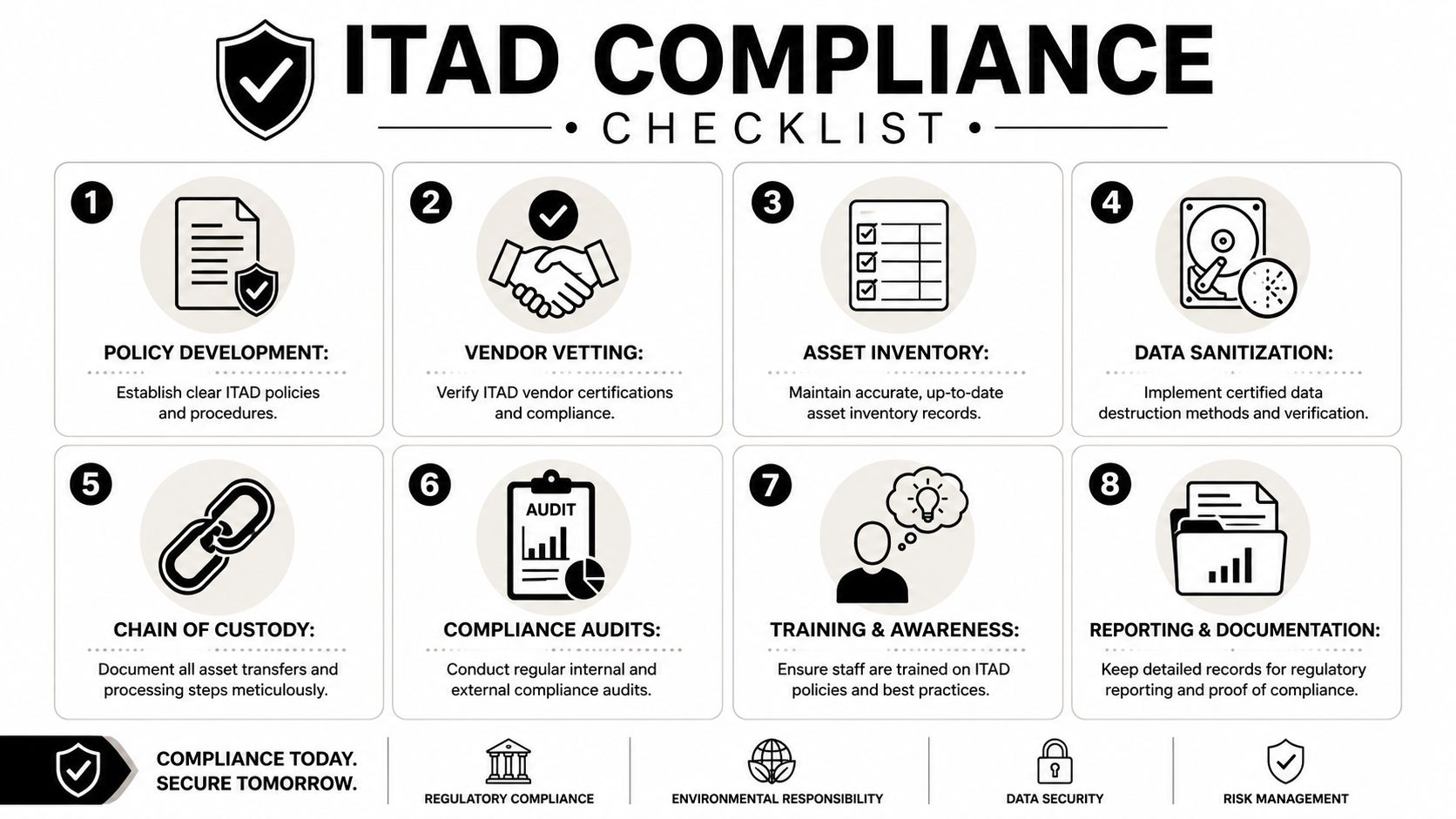
A good disposal plan is simple enough to run under pressure and strict enough to survive an audit. The checklist below is the version I'd hand a new public sector IT manager before the first pickup is scheduled.
Pre-project controls
Confirm policy ownership
Identify who signs off on disposal, who owns security decisions, and who retains records.Separate asset categories
Split data-bearing devices from peripherals and non-data-bearing equipment before pickup planning starts.Validate the inventory
Reconcile serial numbers, asset tags, locations, and custody status. Resolve missing-device exceptions before release.
Vendor and contract controls
Vet the ITAD partner thoroughly
Review certifications, downstream handling, insurance, and sample reporting. Don't rely on marketing summaries.Lock requirements into the contract
State the required sanitization or destruction method, reporting format, chain-of-custody expectations, and incident obligations.Define pickup conditions
Set secure staging, pickup windows, authorized signatories, and transport expectations in advance.
Execution and audit controls
Track every custody handoff
Use manifests, timestamps, named personnel, and serialized records at each transfer point.Verify final proof before closing the project
Match destruction certificates and processing reports back to your original inventory. Any mismatch stays open until resolved.
Good public sector compliance doesn't depend on heroic effort. It depends on repeatable controls that work on a busy day.
One more operational point matters. If your agency intends to combine secure disposal with reuse, donation-based recycling, or broader sustainability goals, build those decisions into the workflow at the start. Public sector compliance is much easier when the team knows which devices are designated for secure data destruction, which may be eligible for refurbishment, and which belong in standard electronics recycling channels. That's also where broader planning for office cleanout, facility cleanout, laptop disposal, computer recycling, medical equipment disposal, laboratory equipment disposal, product destruction, and data center decommissioning becomes easier to govern under one documented process.
A mature program also supports corporate donation programs and sustainable recycling without weakening security. The key is sequence. First control the data. Then document the disposition path. Then confirm the environmental outcome. That order keeps social enterprise recycling and operational accountability aligned instead of competing with each other.
If your team needs a partner that understands electronics recycling, donation-based recycling, secure data destruction, and compliant IT asset disposition from a public sector perspective, Reworx Recycling is a practical place to start. Agencies, schools, and businesses can donate old equipment, schedule a pickup, or explore a responsible recycling partnership that supports environmental goals, technology donations, digital inclusion, and workforce development.