An office move gets approved. A laptop refresh lands at the same time. The infrastructure team wants old gear out before new hardware arrives. Finance wants an inventory trail. Legal wants proof that data was destroyed. Sustainability wants diversion from landfill. Facilities just wants the loading dock clear.
That's when many companies realize IT retirement isn't a disposal task. It's a business project with operational, security, and compliance exposure attached to every pallet.
In practice, the hardest part isn't deciding that equipment is obsolete. The hard part is retiring it without losing asset visibility, breaking chain of custody, disrupting business operations, or sending hazardous material into the wrong downstream channel. For organizations handling servers, laptops, networking gear, medical devices, lab electronics, or mixed office equipment, strong project management services turn a messy cleanout into a controlled IT asset disposition process.
The Hidden Complexity of Retiring IT Assets
A typical electronics retirement project starts with what looks like a simple question: who's picking up the old equipment?
That question quickly branches into harder ones. Which assets still contain regulated data? Which devices belong to employees, departments, or leased programs? What has resale value? What must be shredded, wiped, donated, recycled, or documented for audit purposes? In a data center decommissioning or office cleanout, those questions arrive fast and usually all at once.
The environmental side raises the stakes even further. The United States generates approximately 6.9 million tons of electronic waste annually, yet only 15% of this e-waste in North America was formally collected and recycled as of 2019, meaning 85% ends up in locations other than licensed recycling facilities according to this e-waste statistics overview. That's not just a recycling problem. It's a risk management problem for any business that needs defensible disposal practices.
Why routine refreshes become high-risk projects
An enterprise laptop disposal program can involve remote workers, shipping coordination, serialized asset matching, and secure data destruction. A facility cleanout may include monitors, printers, access control hardware, VoIP phones, and storage closets full of undocumented devices. A hospital or lab environment adds equipment triage, internal approvals, and tighter handling requirements.
Many teams still underestimate the reverse workflow. New technology deployments usually have a plan, owners, budget controls, and milestone reviews. Retiring old technology often gets pushed to the end, when internal teams are already overloaded.
Practical rule: If your team can't answer who has custody of each asset at every handoff, the project isn't under control yet.
That's why companies benefit from understanding what IT asset disposition involves before the first cart is rolled out of a server room. The disposal decision is only the starting point. The actual work is coordinating secure pickup, validated processing, audit-ready reporting, and sustainable recycling without letting one missed step create a legal or operational problem later.
Defining Project Management for ITAD and E-Waste
General project management focuses on scope, timeline, budget, and stakeholder communication. ITAD project management includes all of that, but it adds a reverse logistics layer that most standard PM playbooks don't address well.
In an e-waste program, the project manager acts less like a scheduler and more like a reverse supply chain conductor. They coordinate decommissioning crews, packing protocols, transportation timing, chain-of-custody controls, data destruction workflow, downstream processing, and final documentation. The sequence matters because one weak handoff can undermine the entire project.
The business case for disciplined execution is strong. The average project performance rate across organizations is 73.8%, meaning roughly 26% of projects fail to meet business goals, and businesses that invest in proven project management methods lose 28 times less money due to more successful strategic initiatives, as summarized in these project management statistics.
What specialized project management services actually coordinate
For IT equipment disposal, project management services usually cover:
- Asset intake planning that defines what's being removed, from where, and under what handling rules.
- Operational sequencing so live environments stay stable while retired assets are disconnected.
- Security controls for serialized tracking, sealed transport, and verified data destruction.
- Compliance documentation that supports internal audit, sustainability reporting, and vendor accountability.
A useful outside perspective on the environmental side is this responsible electronics recycling guide, which helps frame why electronics recycling requires more structure than general junk removal.
What this looks like in real operations
The difference between a smooth project and a chaotic one usually shows up early. A strong provider sets milestones, confirms site readiness, assigns ownership for exceptions, and defines the reporting package before pickup day. A weak provider talks mostly about trucks and weight.
If you're comparing providers, one of the clearest signs of maturity is whether they can explain implementation timelines for complex retirements in operational terms, not vague promises. Mature ITAD planning accounts for approvals, on-site dependencies, asset segregation, and reporting turnaround. It doesn't rely on improvisation after the equipment leaves the building.
Mapping the Scope of Work for an E-Waste Project
Most failed IT retirement projects don't collapse because one task was impossible. They fail because small misses pile up across inventory, access, packing, transit, and downstream processing.
This is the workflow experienced teams use to keep that from happening.
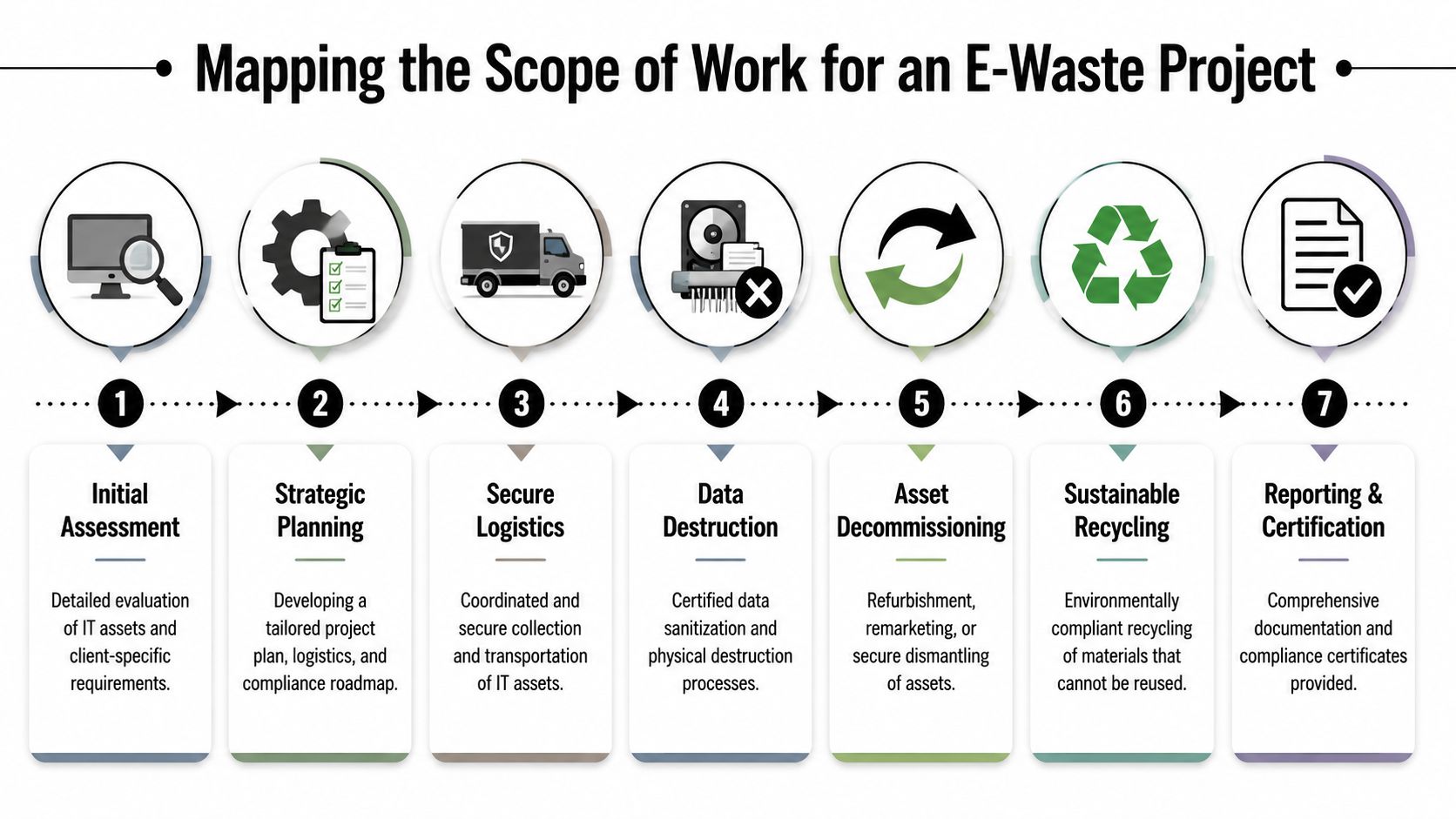
Phase one assessment and planning
Before anyone unplugs a server or stacks monitors on a pallet, the provider needs a usable scope. That starts with asset inventory, site conditions, access constraints, loading requirements, data-bearing device identification, and any special handling for items such as laboratory equipment disposal or medical equipment disposal.
This phase also sets decision rules. Which assets go to remarketing, donation-based recycling, product destruction, or material recovery? Which business units approve release? Which records must be preserved for accounting or internal controls?
A team that skips this stage usually pays for it later in relabeling, disputed counts, and incomplete reporting.
Phase two on-site decommissioning and secure movement
On-site work should follow a controlled sequence, especially in offices, warehouses, labs, schools, and data centers where retired equipment may still be physically mixed with active equipment.
Core tasks often include:
- Disconnecting equipment safely without affecting production systems.
- Tagging and reconciling assets to the approved inventory list.
- Packing by disposition path so devices for donation, recycling, shredding, or resale don't get mixed.
- Preparing outbound loads with chain-of-custody controls already in place.
For teams reviewing transportation strategy, this article on optimizing product returns is a useful reference because reverse logistics principles apply directly to IT asset disposition. The route back matters just as much as the route in.
Phase three off-site processing and final reporting
Once equipment leaves the site, the project isn't done. It has moved into a more documentation-heavy phase.
A complete off-site process typically includes:
| Stage | What happens |
|---|---|
| Receiving | Assets are checked against pickup records and intake controls |
| Testing and triage | Reusable devices are separated from end-of-life material |
| Secure data destruction | Data-bearing media are sanitized or physically destroyed under defined protocols |
| Recycling and donation routing | Equipment follows approved downstream paths |
| Reporting | Certificates, inventories, and disposition summaries are issued |
Asset visibility is strongest when the provider uses structured asset tracking systems instead of relying on generic warehouse notes or manual spreadsheets. If the chain of information breaks, the chain of custody usually breaks with it.
A strong ITAD scope of work doesn't just describe pickup. It defines how assets move, how exceptions are handled, and what proof the client receives at the end.
Key Deliverables Decommissioning Logistics and Data Destruction
A project isn't complete when the truck departs. It's complete when the organization has the records to prove what happened to every relevant asset and every sensitive data-bearing device.
That's the point many companies miss when evaluating IT equipment disposal vendors. Price matters, but documentation protects the business long after the physical work ends.
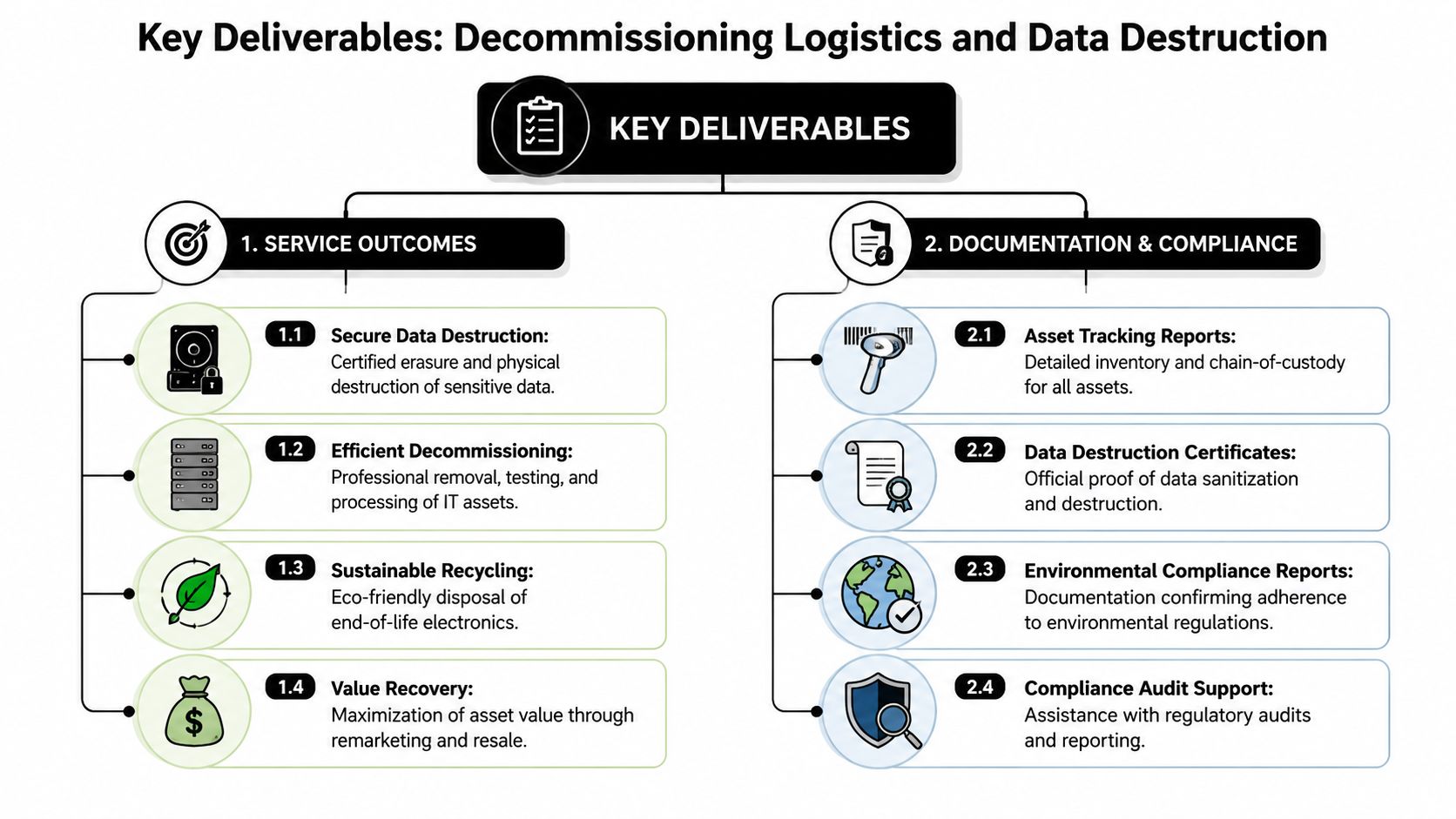
The documents that matter most
For a serious electronics recycling or data center decommissioning engagement, I look for four deliverable categories.
- Asset inventory reports that identify what was received, how it was classified, and where it entered the disposition workflow.
- Data destruction certificates that confirm secure data destruction was completed for eligible media.
- Environmental or donation documentation that shows whether assets were recycled, remarketed, or directed into a social enterprise recycling pathway.
- Value recovery reporting that separates recovered value from processing cost so finance can understand net outcomes.
These records serve different internal teams. IT needs device-level accountability. Compliance needs defensible records. Sustainability teams need support for donation-based recycling and landfill diversion narratives. Finance needs reconciliation.
Why deliverables are more than paperwork
The practical value of documentation shows up during uncomfortable moments. An auditor asks for evidence that a retired laptop was handled correctly. Security reviews a batch of decommissioned drives. Leadership wants to know whether a facility cleanout recovered any reusable hardware. If the provider can't produce clean records, the organization is left answering difficult questions with partial information.
A mature reverse logistics workflow should also tie these deliverables together. Chain-of-custody logs should align with intake records. Intake records should align with data destruction outputs. Those outputs should align with the final disposition summary.
That's why the logistics side can't be separated from the reporting side. Strong providers treat them as one system. A useful operational reference is this guide to optimizing e-waste management with reverse logistics, because it reflects that movement, security, and documentation have to stay synchronized.
What weak deliverables usually look like
Poor providers tend to hand over broad summary statements instead of audit-grade records. They may say equipment was recycled responsibly but can't produce asset-level detail. They may promise secure destruction but provide generic confirmation instead of traceable certification.
Field note: If a vendor's reporting package wouldn't satisfy your legal, security, and finance teams at the same time, it isn't complete enough.
In B2B environments, especially those managing laptop disposal, office cleanout, medical equipment disposal, or laboratory equipment disposal, final deliverables are what convert a vendor service into a defensible business process.
Navigating Critical Compliance and Security Mandates
The fastest way to create risk in an IT retirement project is to treat old electronics like ordinary surplus.
They aren't. E-waste is classified as hazardous waste because it contains toxic materials such as lead and mercury, which are known neurotoxicants linked to adverse neonatal outcomes, neurodevelopmental issues in children, and reduced lung function in communities near informal recycling sites, according to the World Health Organization's e-waste fact sheet).

Compliance risk isn't limited to environmental handling
For many organizations, data is the more immediate exposure. Healthcare entities have HIPAA concerns. Financial and consumer-facing organizations may face FACTA obligations. Companies handling personal data across borders may also need to account for GDPR expectations. The specific legal framework varies, but the operational question is the same: can you prove that devices were controlled, transported, and processed in a way that protects sensitive information?
That proof depends on repeatable controls, not assumptions.
A reliable project model usually includes:
- Controlled pickup procedures with documented custody transfer
- Segregation of data-bearing assets from non-sensitive peripheral equipment
- Auditable downstream processing so material doesn't disappear into opaque channels
- Complete retention of records for internal review, vendor oversight, and regulatory response
For teams evaluating the environmental side of that risk, this hazardous waste disposal guide is a useful supplementary read because it reinforces how regulated waste handling depends on documented process, not good intentions.
Chain of custody is the control that ties it together
I've seen organizations focus heavily on destruction methods while paying too little attention to custody. That's backward. If custody fails, every later control becomes less trustworthy.
A defensible project tracks who handled the equipment, when they handled it, and how it moved from origin to final processing. That's why chain-of-custody documentation belongs near the center of any provider review. It's the record set that connects onsite removal, transportation, receiving, and final disposition into a coherent audit trail.
The partner decision has reputational consequences
Improper disposal can expose a company in ways that go beyond regulation. Public-sector agencies, schools, healthcare systems, and enterprise brands all face scrutiny when retired equipment surfaces in the wrong place or moves through informal recycling channels.
The safest provider isn't the one with the simplest quote. It's the one that can show exactly how risk is controlled from rack removal to final reporting.
That matters for electronics recycling, secure data destruction, and corporate donation programs alike. If a provider can't explain its process clearly, it probably can't defend it clearly either.
Measuring Success KPIs and Understanding Cost Drivers
A smart buyer doesn't judge an ITAD project only by the pickup price.
The better question is whether the project delivered secure execution, accurate reporting, operational efficiency, and appropriate value recovery. That's where project management services earn their keep.
Project management services cost approximately 6% of a project's total revenues, a benchmark established by PMI, and metrics such as the Cost Performance Index, calculated as earned project value divided by actual project costs, help firms isolate gaps between planned and actual financial efficiency in a structured way, as described in PMI's guidance on benchmarking project management organizations.
The KPIs worth tracking
In IT asset disposition, the most useful scorecard usually combines operational and governance measures.
| KPI | Why it matters |
|---|---|
| Chain-of-custody accuracy | Confirms assets were tracked through each handoff |
| Data destruction completion | Shows whether all in-scope media reached verified processing |
| Disposition mix | Helps separate remarketing, donation, recycling, and destruction outcomes |
| Schedule adherence | Measures whether pickup, processing, and reporting happened when promised |
| Client satisfaction | Captures whether communication and execution met business needs |
These aren't abstract metrics. They expose where projects drift. If schedule adherence is weak, internal moves and refresh cycles get delayed. If custody accuracy is weak, audit confidence drops. If disposition mix is unclear, finance and sustainability teams lose visibility.
What actually drives cost
Cost usually rises or falls based on scope conditions rather than vendor marketing.
The main drivers tend to be:
- Asset profile because servers, laptops, networking gear, and mixed peripherals require different handling.
- Site complexity including stairs, loading constraints, distributed offices, and active production areas.
- Service depth such as onsite decommissioning, hard drive shredding, packing labor, or serialized reporting.
- Geography and routing because transportation and local processing access affect reverse logistics effort.
- Security requirements when secure data destruction and additional documentation standards are required.
The mistake I see most often is comparing quotes without normalizing scope. One proposal may include detailed inventory reconciliation, product destruction, and reporting. Another may include basic haul-away service dressed up as ITAD. Those aren't equivalent services, even if both mention computer recycling or sustainable recycling.
Your Provider Selection Checklist and Next Steps with Reworx
Choosing an ITAD partner isn't just a procurement exercise. It's a control decision.
The strongest providers can explain how they manage people, prerequisites, logistics, and downstream accountability before the project begins. That matters because 48% of project failures stem from poor stakeholder engagement and unclear prerequisites, not just technical flaws, according to the Three P's framework discussed in this Adobe business article. In practice, that means technical certifications matter, but so does the provider's ability to coordinate internal stakeholders, site contacts, security teams, and reporting expectations.
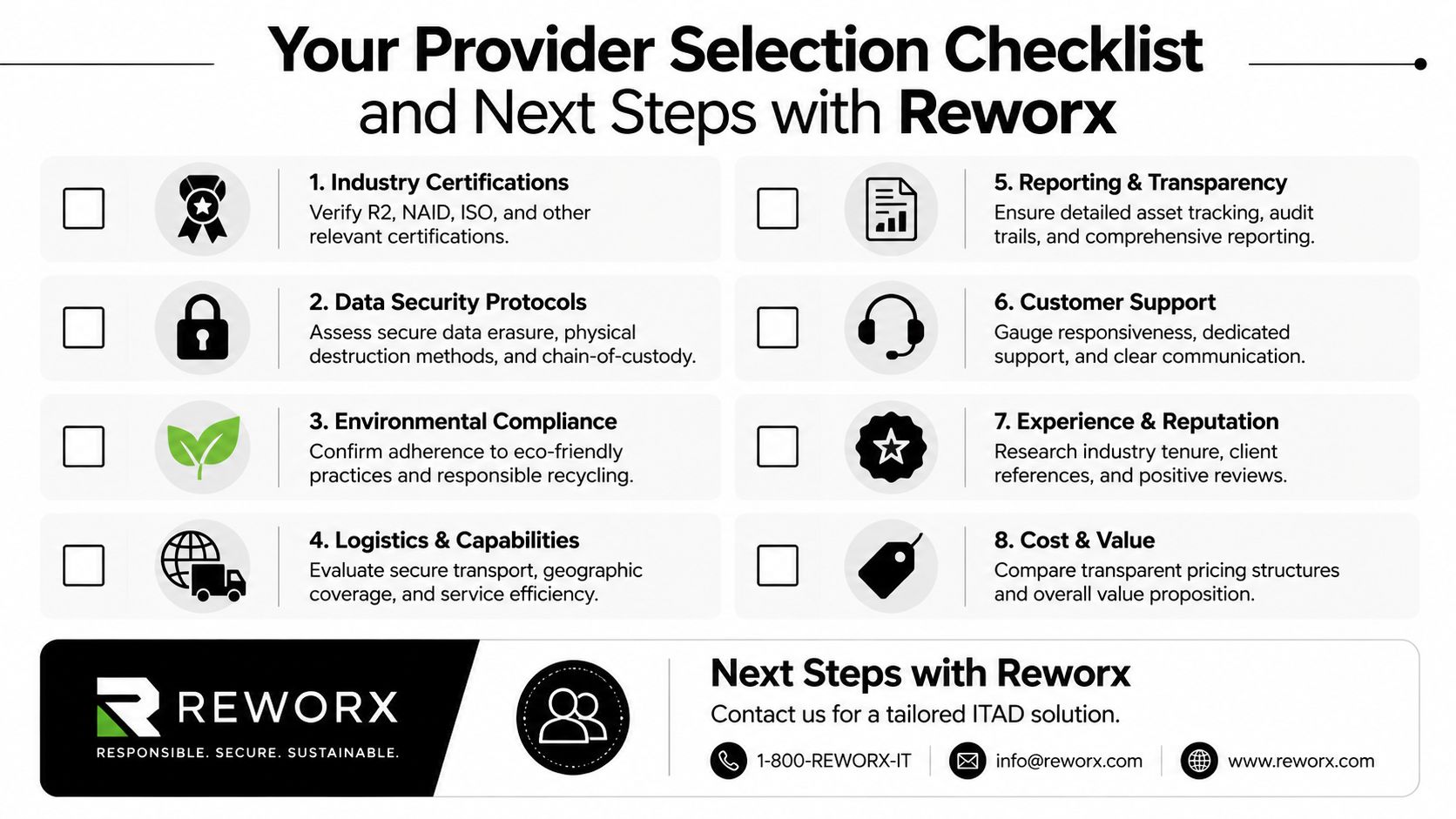
The shortlist questions I'd ask any provider
Use this checklist before approving electronics recycling, computer recycling, facility cleanout, or data center decommissioning work:
- Security controls: Can they explain secure data destruction methods, media segregation, and custody handoffs clearly?
- Downstream transparency: Will they identify where assets go after pickup, including recycling, resale, donation, or destruction paths?
- Reporting quality: Do they provide asset-level documentation, destruction certificates, and compliance-ready summaries?
- Operational readiness: Can they handle office cleanout, medical equipment disposal, laboratory equipment disposal, or product destruction without improvising onsite?
- Communication discipline: Do they assign clear contacts, escalation paths, and milestone expectations?
- Social and environmental fit: Can they support sustainable recycling and corporate donation programs in a way that aligns with your ESG or community goals?
Why the social enterprise model stands out
For many organizations, the best-fit partner isn't just one that removes retired hardware securely. It's one that can turn portions of that retired inventory into community benefit through donation-based recycling and digital inclusion efforts while still maintaining enterprise-grade controls.
That's where a social enterprise recycling model can outperform a basic haul-and-process vendor. It supports compliance and secure handling, but it also gives sustainability leaders and business owners a stronger story around community impact, technology donations, and responsible resource use.
Choose the provider that can protect your data, document your outcomes, and make your retired equipment do more than disappear.
For companies that need IT equipment disposal, laptop disposal, secure pickup scheduling, and a partner that understands both risk reduction and social impact, that combination matters.
If your business is planning an office move, hardware refresh, facility cleanout, data center decommissioning, or corporate donation program, Reworx Recycling can help you manage retired electronics responsibly. Businesses can donate old equipment, schedule a pickup, or explore a customized ITAD partnership that supports secure data destruction, sustainable recycling, digital inclusion, and community impact.