84 Upland Way is the address of the Barrington, Rhode Island Recycling Center, and its core public drop-off hours are Monday, Tuesday, Friday, and Saturday from 8 a.m. to 4 p.m. It's also open Sunday from 8 a.m. to 12 p.m., and closed Wednesday and Thursday.
If you're staring at a pile of retired office laptops, a few old monitors, and maybe a networking closet that hasn't been touched in years, that's probably the first answer you needed. For residents, the Barrington Recycling Center is a useful local option. For a business, though, the better question isn't just where to bring electronics. It's whether a public drop-off site is built for data risk, chain of custody, audit needs, and bulk removal.
A lot of local companies start in the same place. The office is upgrading devices. Someone in operations wants space back. IT wants old hardware gone, but not at the cost of security. Facilities may also be coordinating furniture changes, moves, or services for office cleanouts and setup at the same time, which makes electronics disposal part of a much bigger transition.
That's where confusion usually starts. Public recycling information is designed for households. Business technology retirement is a different process entirely.
Your Barrington Business and Electronics Recycling
Individuals interested in the Barrington Recycling Center often seek quick, straightforward details. Where is it? What are the hours? Can they bring electronics? For a resident cleaning out a basement, those are the right questions.
For a business owner or IT manager, they're only the beginning.
An office upgrade creates a mixed stream of assets. You might have laptop disposal, computer recycling, printer removal, surplus monitors, dock stations, phones, and a few devices no one can clearly identify anymore. If the project is larger, it may also include a partial facility cleanout or end-of-life gear from a server room. In that situation, convenience matters, but so do documentation, scheduling, and how sensitive devices are handled from pickup through final processing.
What businesses often miss
A public site helps the community. It usually isn't designed around commercial workflows.
That means a business has to think beyond a single drop-off trip:
- Data risk: Old desktops, laptops, and drives may still contain customer, employee, financial, or operational data.
- Operational drag: Staff time spent sorting, loading, transporting, and unloading equipment is still a business cost.
- Asset visibility: Finance and IT teams often need a record of what left the building and when.
- Project scale: A public center can be fine for a few household items. It may not fit a planned office technology refresh.
Practical rule: If your equipment came from a workplace, treat disposal like part of your IT process, not just your trash process.
For companies comparing options, it helps to start with a business-focused resource on electronics recycling for organizations. That framework makes it easier to separate public recycling questions from IT equipment disposal, IT asset disposition (ITAD), and secure retirement of business-owned devices.
A Guide to the Barrington RI Recycling Center
For local residents, Barrington's public recycling program is straightforward once you know the schedule and location.
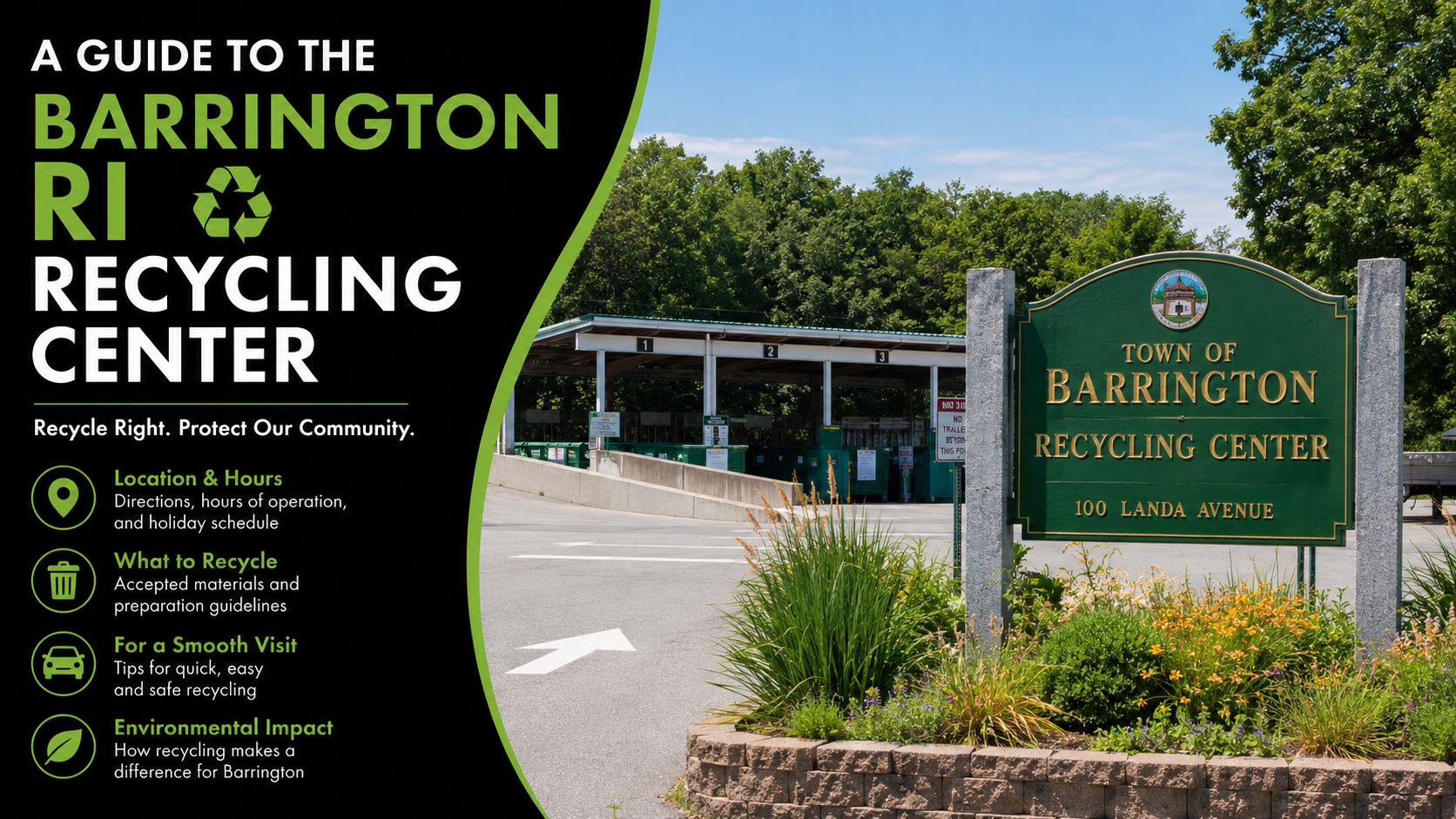
The Barrington, Rhode Island Recycling Center is located at 84 Upland Way and accepts e-waste items. Its published hours are Monday, Tuesday, Friday, and Saturday from 8 a.m. to 4 p.m., and Sunday from 8 a.m. to 12 p.m. It's closed Wednesday and Thursday, and the Department of Public Works at the same location can be reached at 401-247-1907, according to the town recycling information published by the Rhode Island Resource Recovery Corporation for Barrington.
What you can typically bring
The town information lists a broad range of accepted electronics. That includes common items many people have at home or in a small office:
- Display devices: televisions and computer monitors
- Computers: desktops, laptops, and tablets
- Peripherals: keyboards, mice, and printers
- Consumer electronics: stereo equipment, DVD players, and telephones
That makes the public center a practical option for someone retiring a few devices from a home office, cleaning out a spare room, or helping a family member get rid of aging electronics responsibly.
How to use the center efficiently
Before loading your car, it helps to think through the visit like a short errand rather than a cleanup day.
| Need | Best move |
|---|---|
| Confirm current acceptance | Call the DPW contact before visiting |
| Avoid a wasted trip | Go during listed open days only |
| Simplify unloading | Group similar items together in your vehicle |
| Handle mixed materials | Separate electronics from other recycling streams |
Residents who only need a legal, local drop-off option often find the public center is enough.
Businesses that need broader regional support can also review Rhode Island electronics recycling options to understand how municipal drop-off differs from commercial pickup and managed disposition services.
The key distinction is purpose. The Barrington site is a public resource. That matters. It also means its design priorities are public access and standard collection, not enterprise workflow.
Why Public Recycling Centers Fall Short for Businesses
Public recycling centers solve one problem well. They give people a place to bring unwanted electronics instead of throwing them away.
They don't solve the full set of problems a business faces when retiring equipment.
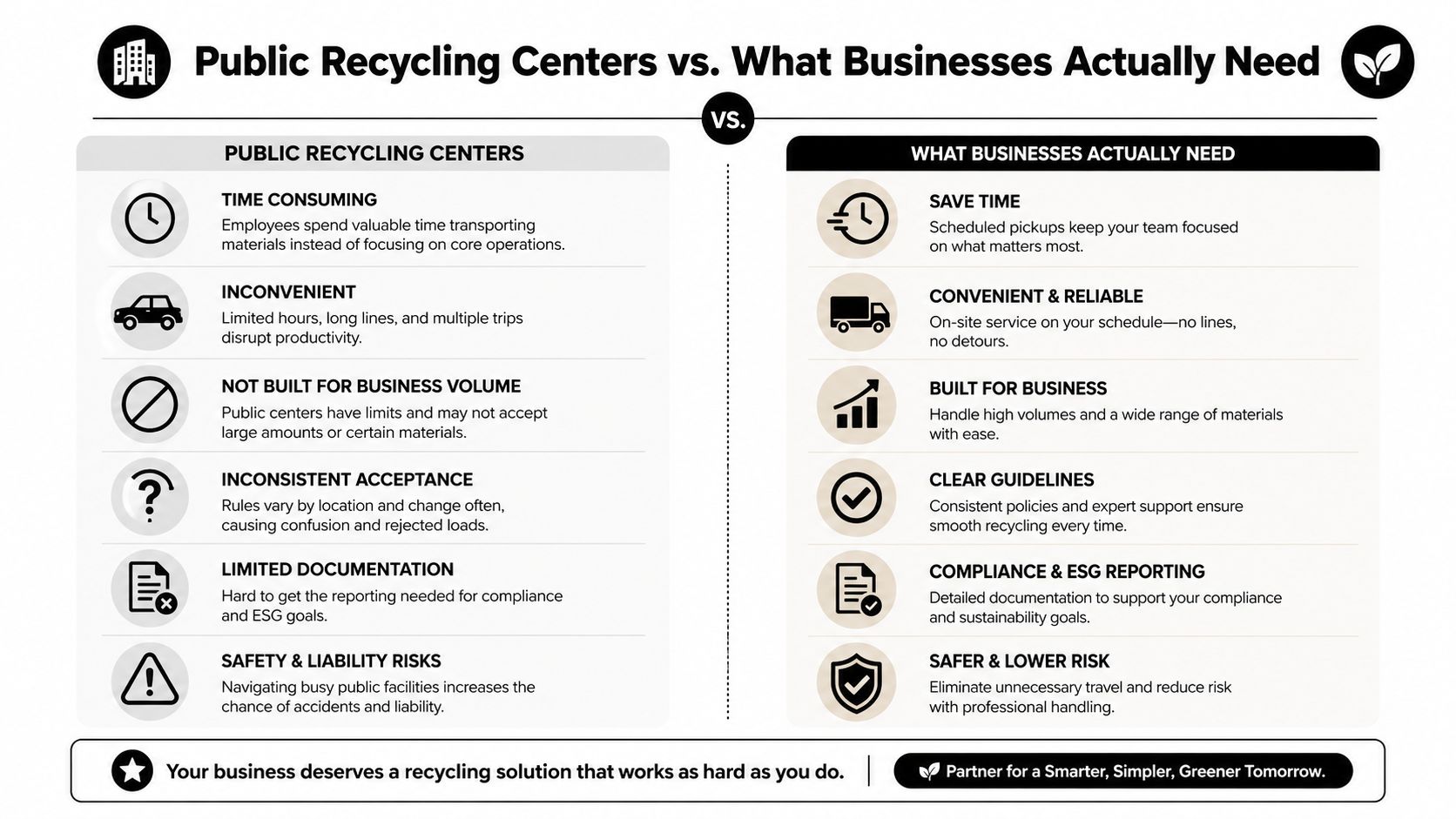
Across the United States, 6.9 million metric tons of electronic waste are generated annually, and only 15% is formally recycled. That leaves 5.865 million metric tons going to landfills or unauthorized disposal channels, a gap that raises environmental and regulatory concerns for companies handling technology at scale, according to this electronic waste overview.
The business gap isn't about location
A public site may be nearby. That doesn't make it a business disposal system.
A company usually needs answers to questions a municipal drop-off program doesn't center:
- Who tracked the assets out of the building?
- How were storage devices handled?
- Is there documentation for internal records?
- Can someone pick up equipment from multiple departments?
- Can the recycler support an office move, warehouse cleanup, or decommissioning project?
Those aren't edge cases. They're routine parts of ITAD, office cleanout planning, and end-of-life equipment management.
A simple comparison
| Business need | Public recycling center | Specialized commercial solution |
|---|---|---|
| Household-style drop-off | Yes | Sometimes |
| Bulk pickup from office | Limited | Yes |
| Chain of custody for devices | Not the core function | Core function |
| Secure data destruction workflow | Not the core function | Core function |
| Reporting for business records | Limited | Yes |
| Help with decommissioning projects | Limited | Yes |
Decision test: If your team needs proof, scheduling, or security, you're no longer dealing with ordinary recycling.
There's also the labor issue. When businesses use a public center, employees often become the logistics team. Someone has to gather equipment, verify what can leave, transport it, wait in line, unload it, and hope nothing sensitive was missed in the process. That's not a sustainable recycling strategy. It's an improvised one.
For companies building a more formal process, this guide on why an office needs a recycling plan is useful because it treats electronics disposal as an operational system rather than a one-time errand.
That's the primary limitation of the Barrington Recycling Center for commercial use. It isn't failing businesses. It was not built for business risk.
Reworx Recycling A Specialized Partner for Barrington Businesses
A business that needs more than drop-off convenience usually needs a service model built around pickup, accountability, and end-of-life planning. That's where a specialized electronics recycler changes the equation.
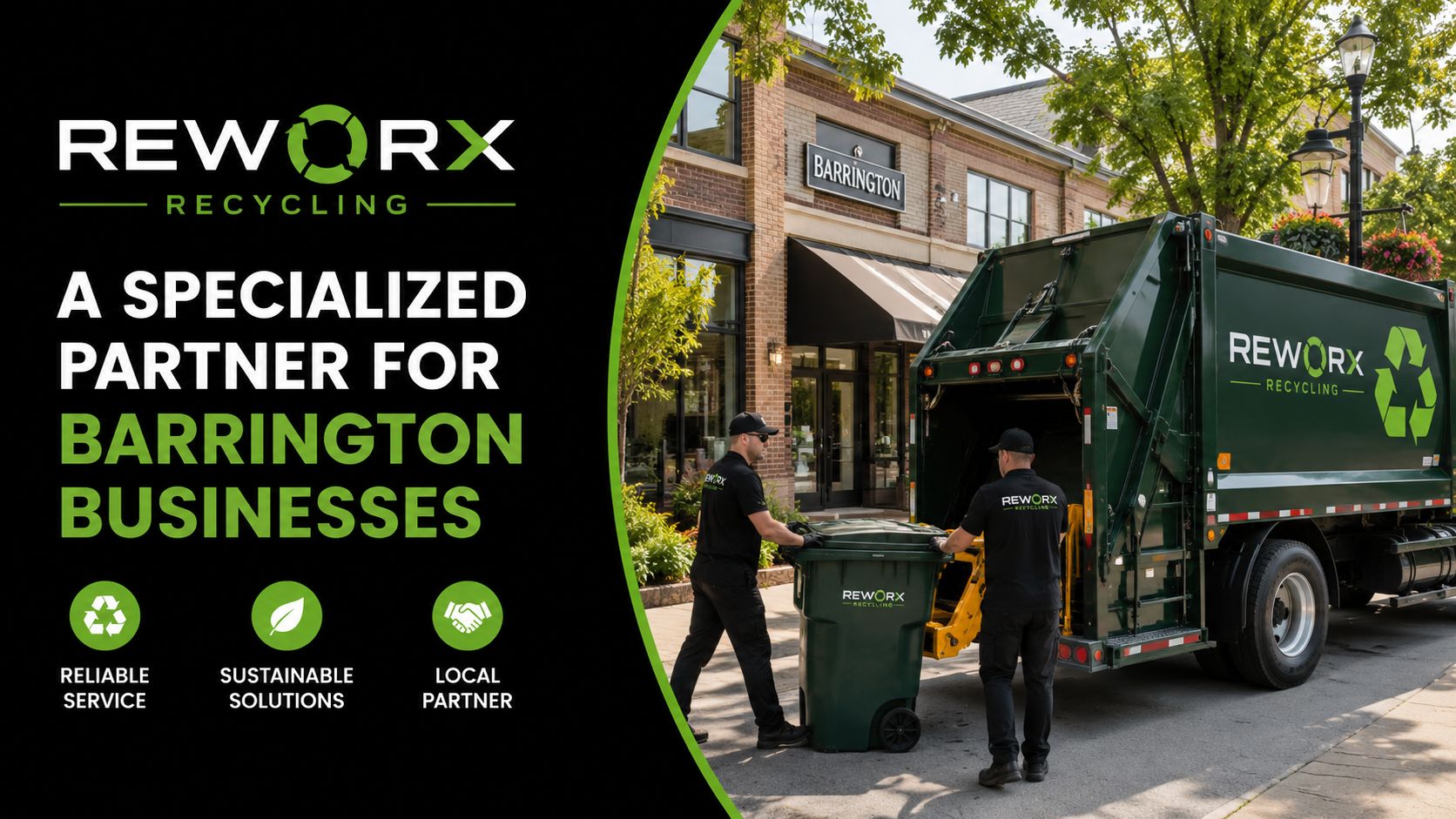
For commercial entities, one practical threshold stands out. Businesses with at least 10 eligible electronic items, including laptops, servers, and network switches, can qualify for free e-waste pickup services, according to Reworx Recycling's page on electronics recycling for businesses in Smyrna. The page describes this as a business-focused convenience for offices, warehouses, and schools.
That kind of model fits how organizations work. Instead of assigning staff to make repeated runs to a public site, the recycler comes to the equipment.
What a specialized partner handles better
Commercial e-waste rarely arrives in neat, identical piles. It tends to be mixed across departments and use cases.
A specialized provider can support:
- Office technology refreshes: old laptops, monitors, docking stations, and phones
- Server room and network cleanup: switches, racks, related hardware, and accessories
- Corporate donation programs: redirecting usable equipment into community benefit channels when appropriate
- Product destruction: retiring branded or obsolete hardware in a controlled way
- Specialized streams: projects involving medical equipment disposal, laboratory equipment disposal, or unique business hardware
Why the social enterprise model matters
Many businesses don't want recycling to be only a compliance task. Sustainability leaders often want a result that aligns with company values too.
That's why donation-based recycling, social enterprise recycling, and corporate donation programs have become important terms in this space. A social enterprise model can connect electronics recycling with wider community outcomes such as technology access, digital inclusion, and workforce development. For companies with ESG or community-impact goals, that creates a stronger story than “we got rid of some old gear.”
A strong recycling partner should help you reduce landfill risk and increase community value from the same project.
What this means in practice for Barrington companies
A Barrington business doesn't need to settle for consumer-style disposal just because the local public center is the most visible option in search results. If you're handling a planned facility cleanout, data center decommissioning, staged laptop disposal, or a broader computer recycling initiative, the better fit is a partner built around business logistics and secure retirement processes.
That's especially true when multiple teams are involved. IT wants control. Facilities wants speed. Finance wants records. Sustainability wants a responsible outcome. A specialized recycler can support all four at once, which is why this category sits closer to operations and risk management than to ordinary curbside recycling.
Ensuring Secure Data Destruction and Compliance
For most IT managers, the hardest part of electronics disposal isn't recycling. It's trust.
A laptop can look empty and still contain recoverable data. The same goes for desktops, servers, external drives, and storage media that sat untouched in a closet for years. Deleting files or reformatting a device may feel final to an end user, but compliance decisions shouldn't rely on that assumption.
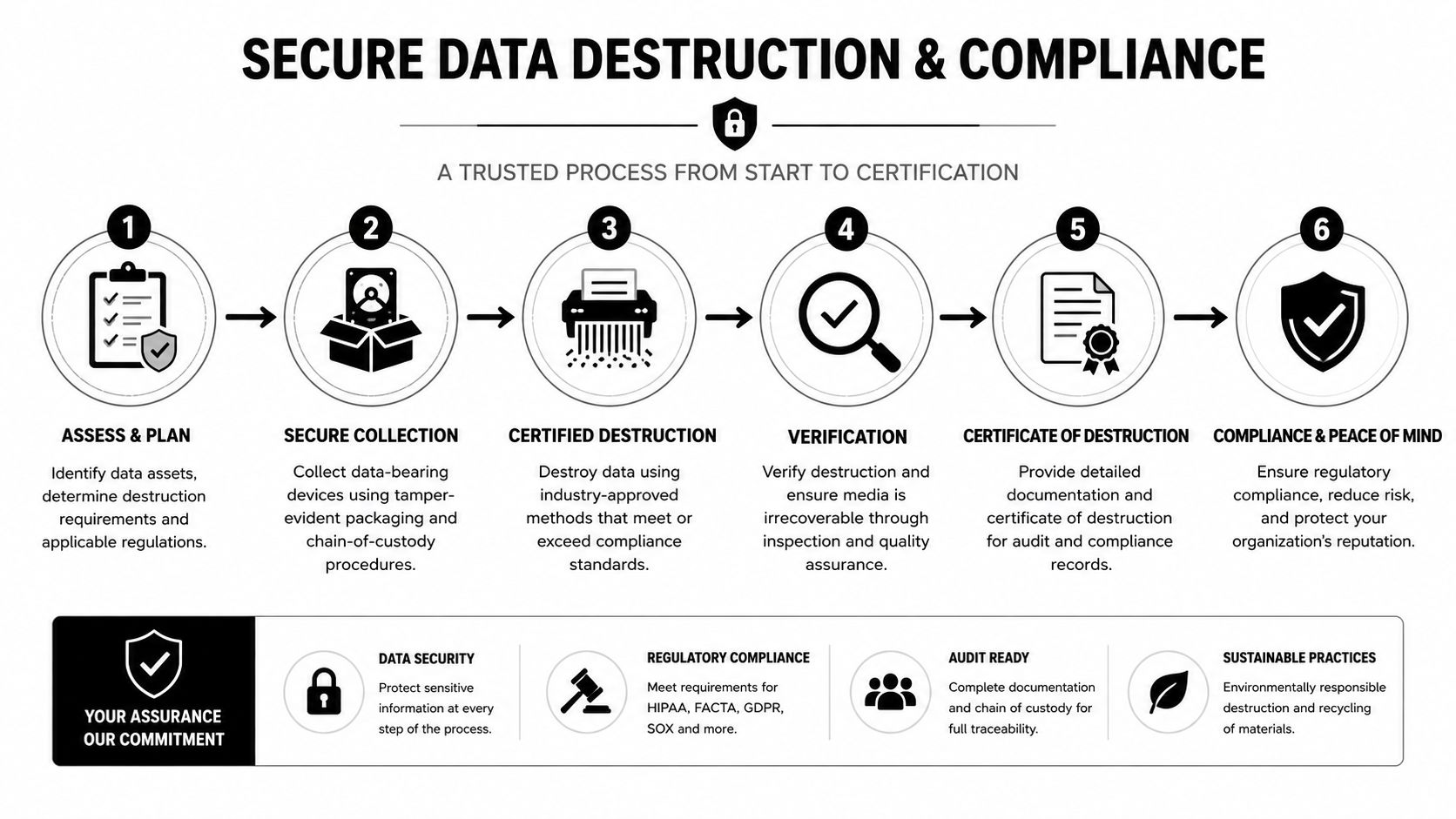
A clear example of how seriously regulators can treat this issue comes from Georgia. State law requires data storage devices containing sensitive information to undergo secure data destruction before disposal, with potential penalties of up to $10,000 per violation for non-compliant businesses, as described on Reworx Recycling's page about the Smyrna recycling center and secure destruction requirements.
What secure destruction actually means
A sound process is more than “we recycled the equipment.” It should include documented handling of the data-bearing components.
In practice, businesses should look for:
- Identified media: devices containing hard drives, SSDs, or other storage are separated from general equipment
- Controlled handling: assets are managed so the business knows where they went after removal
- Physical destruction when needed: hard drive shredding and similar methods make data unrecoverable
- Final documentation: a record that supports legal, audit, and internal governance needs
One of the most useful habits before disposal is tightening your broader lifecycle controls. Teams that want to improve security with IT asset management often find that end-of-life mistakes begin much earlier, when assets aren't consistently tracked from deployment through retirement.
Why documentation matters as much as destruction
If a company can't show what happened to a retired drive, it may struggle to prove due diligence later.
That's why many IT teams ask for a Certificate of Destruction or similar record. The paper trail matters because compliance isn't just about doing the right thing. It's about being able to demonstrate that the organization followed a defined process. A secure service should be able to support that expectation through documented data destruction services for business devices.
Security reminder: The safest recycling decision is the one your IT team can explain clearly to legal, leadership, and auditors.
The public Barrington Recycling Center plays an important community role. It isn't positioned as a secure data destruction program for commercial hardware. Businesses with regulated information, client records, employee data, or internal IP need a tighter standard.
Schedule Your Business E-Waste Pickup Today
The Barrington Recycling Center is a helpful public asset for residents who need a local place to drop off electronics. That's the right tool for household e-waste.
Business equipment is different. Once devices come from offices, schools, government departments, healthcare settings, labs, or distributed teams, the job expands into secure data destruction, IT equipment disposal, ITAD, and project logistics. A pickup-based solution is usually the cleaner choice for companies that need accountability and less disruption.
Three smart next steps
- If you have a stack of devices ready to go: arrange a business pickup instead of assigning staff to transport equipment.
- If you're planning a larger refresh: ask for guidance on office cleanout, computer recycling, product destruction, or data center decommissioning needs.
- If your sustainability team wants added impact: explore donation-based recycling, sustainable recycling, and social enterprise recycling options that can align disposal with community benefit.
Barrington businesses that want a simpler process can start with pickup scheduling for business electronics. That route makes sense when you need equipment out of the building, handled professionally, and moved through a process built for organizations rather than households.
The best outcome is straightforward. Your team clears space, reduces risk, supports responsible recycling, and avoids turning a technology upgrade into an informal side project for employees.
If your organization is ready to retire outdated devices responsibly, connect with Reworx Recycling to donate old equipment, schedule a pickup, or build a long-term partnership for secure, community-minded electronics recycling.