A facilities manager usually notices the problem late. The office refresh is already underway, pallets of laptops are waiting at the dock, legal assumes procurement used a solid vendor agreement, and IT assumes the recycling partner will “handle the rest.” Then someone asks a simple question: where, exactly, does the contract require verified data destruction, downstream recycling documentation, or proof that the load didn't disappear into an opaque chain of subcontractors?
That's where generic service level agreements break down. A standard IT SLA may tell you how quickly a support team answers a ticket. It usually says very little about custody of retired hardware, destruction standards for storage media, pickup windows for a facility cleanout, or what happens if a recycler mishandles devices that still contain sensitive data. Those gaps matter for business owners, IT managers, sustainability directors, and public sector teams alike.
For organizations handling office cleanouts, laptop disposal, computer recycling, data center decommissioning, medical equipment disposal, laboratory equipment disposal, and broader IT asset disposition (ITAD), the contract has to reflect physical risk. If it doesn't, you're relying on vendor goodwill where you need enforceable obligations. That's especially true when the program also touches donation-based recycling, product destruction, secure data destruction, and corporate donation programs that support community reuse.
Introduction The Hidden Risks in Your E-Waste Contract
A common scenario looks routine until it isn't. An IT manager signs off on an electronics recycling vendor because the pricing is acceptable and the agreement includes standard response language, support contacts, and general liability terms. A month later, the company needs proof that a batch of retired drives was destroyed according to policy, and the paperwork turns out to be vague, delayed, or incomplete.
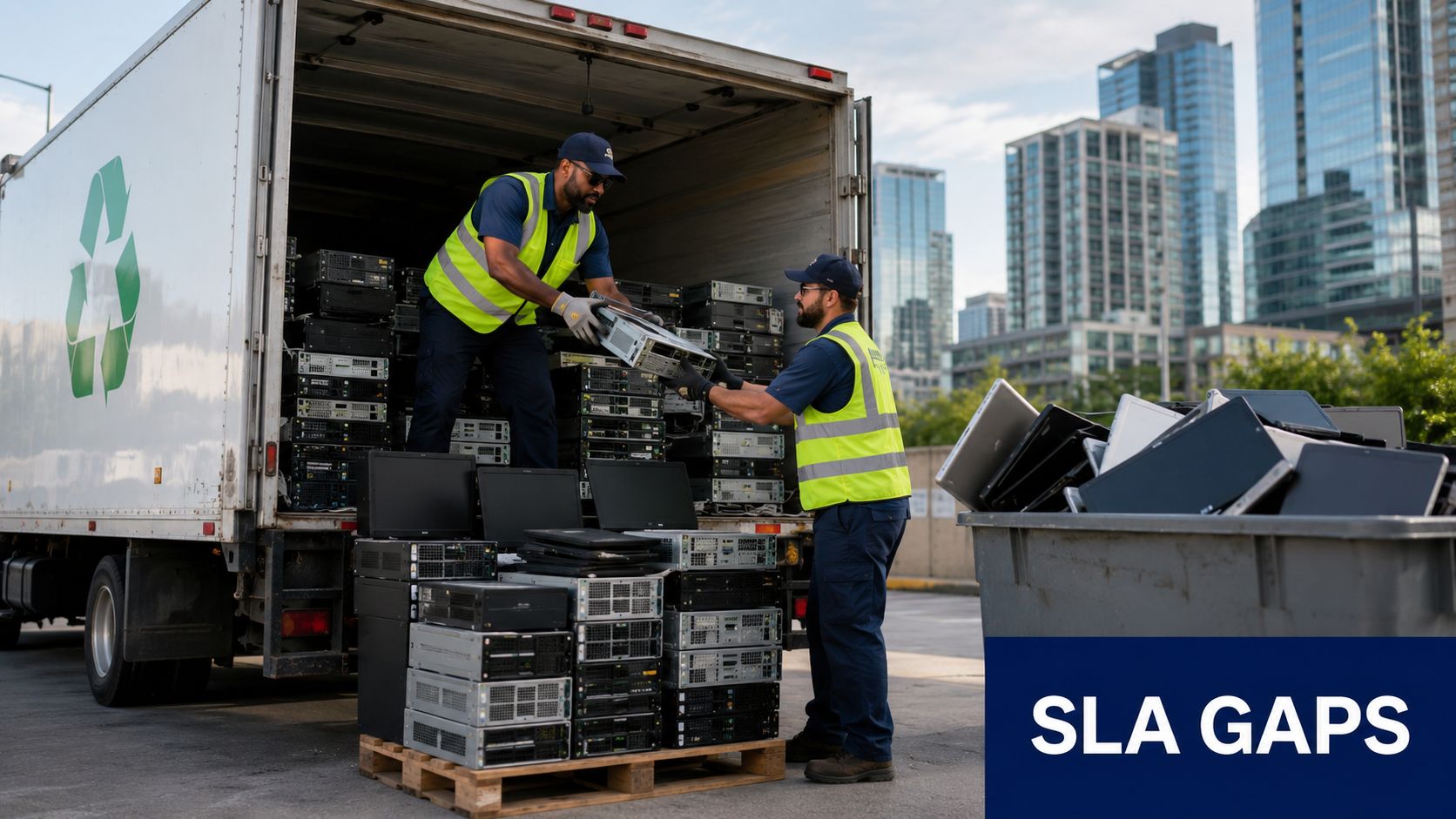
That isn't a rare drafting issue. Most existing SLA content focuses on IT service uptime and response times for software providers, but critically underserves how SLAs should be structured for physical asset disposition and e-waste recycling where metrics involve environmental compliance, data destruction certification, and logistics turnaround, not just server availability, as noted in this discussion of service level agreement gaps in physical asset workflows. In practice, that means many contracts sound professional while failing to create enforceable standards for what happens after pickup.
Where the exposure starts
The hidden risk usually begins with language that is broad enough to look safe:
- “Secure handling” without naming a destruction method
- “Environmentally responsible recycling” without chain-of-custody records
- “Timely pickup” without a documented recovery window
- “Reporting available upon request” without mandatory reporting deadlines
Those phrases might be acceptable in a lightweight services contract. They aren't strong enough for IT equipment disposal.
Practical rule: If the agreement can't tell you who handled the asset, when they handled it, how data was destroyed, and what evidence you'll receive, the SLA is incomplete.
Facilities and sustainability teams also get pulled into this late because e-waste sits at the intersection of departments. Procurement looks at commercial terms. IT looks at hardware and drives. Legal looks at boilerplate. Sustainability looks at diversion and responsible recycling. No one owns the full lifecycle unless the contract forces clarity.
A better starting point is to review the vendor agreement as an operational control, not just a procurement form. That's the approach behind these contract negotiation tips for recycling vendors. The right SLA doesn't just describe a relationship. It sets measurable obligations for electronics recycling, ITAD, and sustainable recycling work that can affect your compliance posture long after the truck leaves your site.
Why Standard SLAs Fail for Electronics Recycling
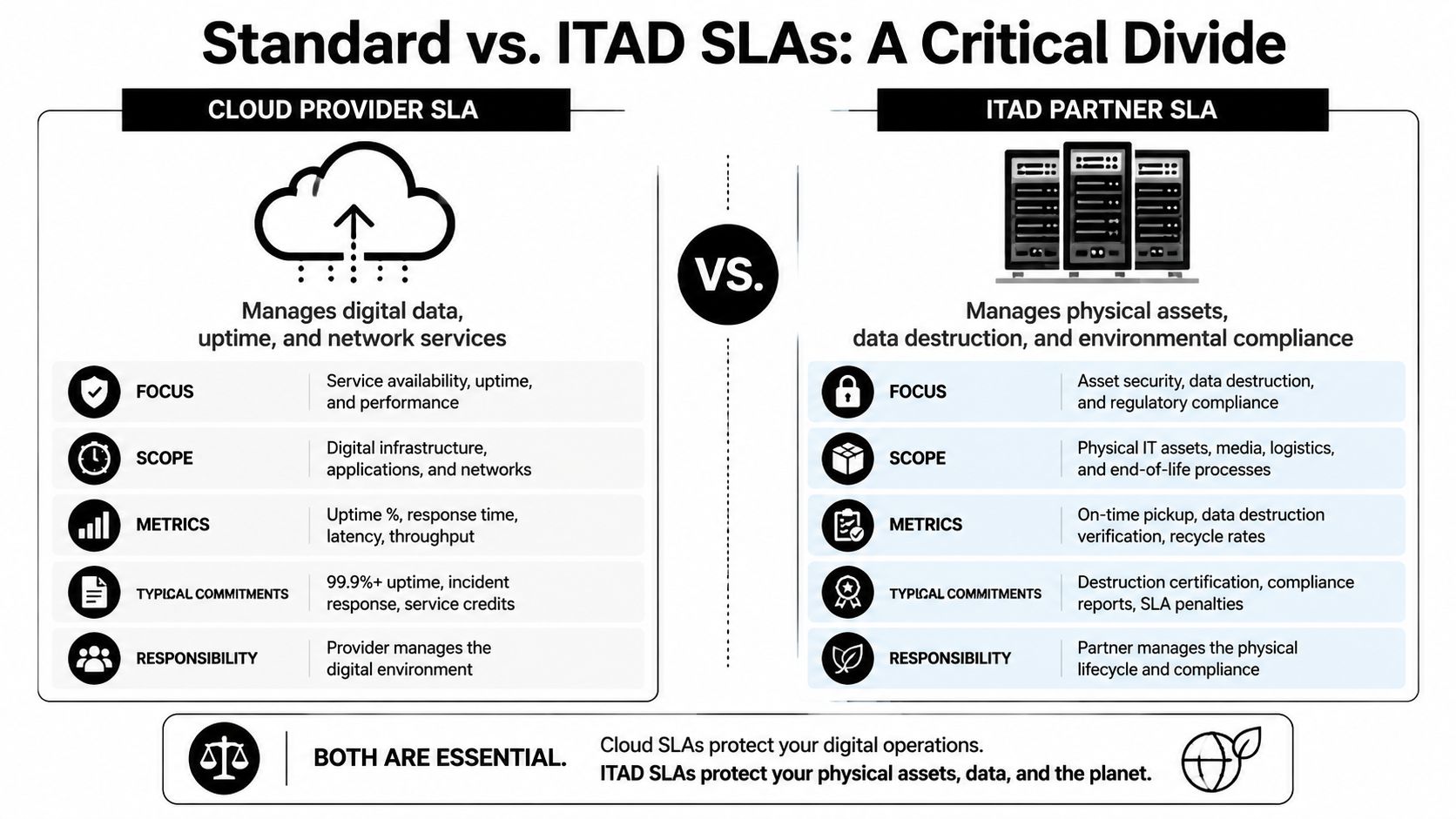
A cloud SLA manages digital performance. An ITAD SLA manages physical assets, residual data, transportation, environmental exposure, and documentation. Treating them as equivalent is one of the fastest ways to inherit avoidable risk.
Software metrics don't answer physical custody questions
A software-oriented SLA usually emphasizes uptime, ticket response, escalation, and maintenance windows. Those terms matter in managed IT services, but they don't answer the questions that matter in electronics recycling:
- Where were the devices stored after pickup?
- Was data-bearing media destroyed, wiped, or resold?
- Which party documented the chain of custody?
- Did downstream vendors process the material lawfully?
- When will the client receive destruction and recycling records?
That mismatch is why standard templates fail during office moves, hardware refreshes, and data center decommissioning projects. A server outage creates operational downtime. A mishandled pallet of retired laptops can create data exposure, audit problems, and environmental liability.
The volume of e-waste raises the stakes
The need for verifiable controls isn't theoretical. The United States generates approximately 6.9 million metric tons of electronic waste annually, and only about 15% is formally recycled, according to the EPA data summarized in this article on e-waste and service level agreement context. When formal processing rates are that limited, vendor verification matters. You can't assume retired equipment enters a transparent recycling stream just because a contract says “recycle.”
A generic SLA promises effort. A usable ITAD SLA creates evidence.
What the comparison looks like in practice
| Contract Type | Typical Focus | Missing for ITAD | What You Need Instead |
|---|---|---|---|
| Cloud or software SLA | Availability, response time, support severity | No physical custody language | Pickup controls, chain of custody, site handling |
| Managed service desk SLA | Ticket closure, service windows, escalation | No destruction verification | Media sanitization method and proof requirements |
| General vendor services agreement | Broad commercial terms | No environmental processing standards | Downstream accountability and recycling documentation |
| ITAD-specific SLA | Asset handling, secure data destruction, reporting | Built for physical workflows | Operational accountability from pickup to final disposition |
That's why vendor selection has to start with the workflow, not the template. A provider that understands laptop disposal, product destruction, office cleanout support, and social enterprise recycling should be able to explain exactly how its contract handles those events. If the language still reads like software support, use stronger vendor selection criteria for recycling partners before you sign.
Core Components of a Bulletproof ITAD SLA
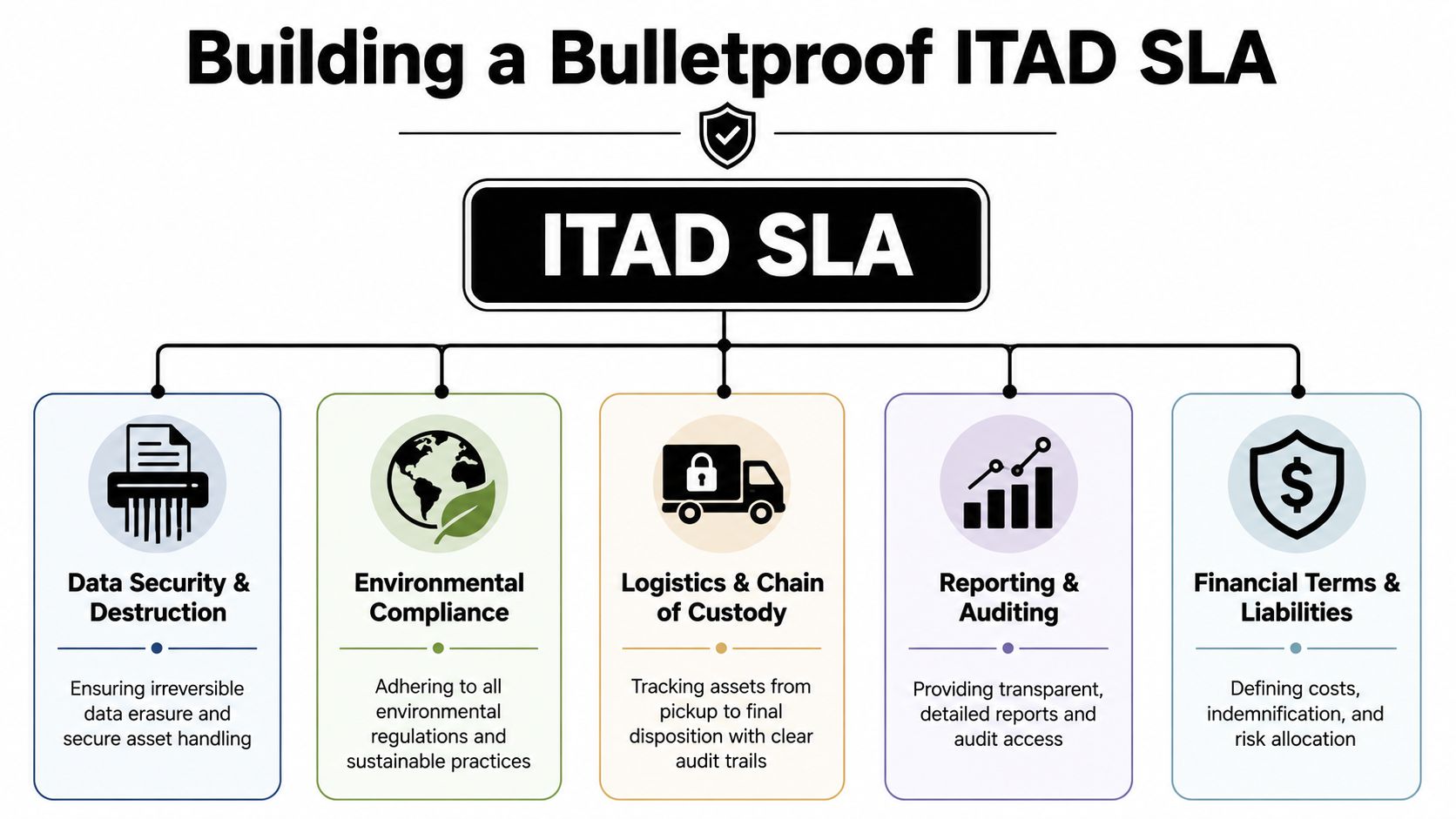
A strong ITAD agreement covers the whole lifecycle of retired assets. It doesn't stop at pickup scheduling, and it doesn't hide operational detail inside broad legal language.
Scope and service boundaries
Start with scope. The contract should define exactly what services the vendor will perform and where those services begin and end. That sounds basic, but weak agreements create operational confusion precisely here.
Your scope language should identify whether the vendor handles:
- On-site pickup for business locations, warehouses, labs, and satellite offices
- Equipment decommissioning before removal
- Asset sorting for resale, donation-based recycling, destruction, or commodity recovery
- Packaging and transport responsibilities
- Special handling for medical equipment disposal, laboratory equipment disposal, or hazardous peripherals
- Final reporting and document retention
If your organization expects support for corporate donation programs or reusable device recovery, that should appear in the scope too. Otherwise, devices that could support digital inclusion may be treated like scrap by default.
Data security and destruction standards
This is the clause most companies underwrite poorly. If media is being discarded, the destruction requirement needs to be explicit. NIST Special Publication 800-88 Rev. 1 states that “destruction,” including physical shredding, is the only method that provides a 100% guarantee of data irrecoverability for media being discarded, as summarized in this guide to SLA contract requirements and NIST standards.
That requirement should be translated into contract language, not left as policy intent.
If your internal policy says drives must be destroyed, the SLA should name destruction, define the evidence required, and state when the certificate must be delivered.
At minimum, this section should specify the approved sanitization paths, the evidence format, exception handling, and who authorizes deviations. If a vendor wants the option to remarket devices, the agreement must separate reusable systems from discarded media and define the chain of approval for each path.
A good general reference for structuring these obligations is SheetMergy's business contract guide, especially for defining responsibilities, exceptions, and remedies in plain terms before legal review turns everything into boilerplate.
Environmental compliance and downstream accountability
A compliant ITAD SLA also has to describe environmental handling. “No landfill” language may sound strong, but it isn't enough unless your vendor can document what happened downstream. That matters for electronics recycling, computer recycling, product destruction, and sustainable recycling programs that need credible reporting.
Look for language covering:
- Approved downstream processors
- Documentation requirements for recycling, resale, or destruction
- Handling of batteries, displays, and mixed peripheral loads
- Material recovery and non-conforming item procedures
- Retention of records for audit and compliance support
The contract should also make it clear whether the vendor can subcontract any part of processing and what approvals are required before they do.
Reporting rights and liability allocation
An SLA becomes enforceable when the reporting cadence is mandatory and audit rights are usable. Monthly or quarterly reporting should be required, not optional. Certificates of destruction, serialized asset reports, exception logs, and recycling summaries should have named delivery windows and defined formats.
A separate clause should address indemnification, breach notification, and dispute handling. If a vendor mishandles data-bearing equipment or uses an undisclosed downstream processor, your organization needs more than service apologies. It needs documented liability allocation.
One operationally useful benchmark is whether the vendor can support formal chain of custody documentation for retired electronics without improvising the process after pickup. If they can't, the SLA probably isn't mature enough for regulated or high-volume environments.
Key Performance Indicators You Must Track
An SLA fails when its promises can't be measured. In ITAD, the risk is even higher because vague language doesn't just create service frustration. It weakens your evidence trail.
Robust ITAD SLAs must define data destruction metrics with forensic validation, such as Mean Time to Destroy and NIST 800-88 compliant certificates, and SLAs lacking these specifics have a 34% higher risk of data breach incidents during the reverse logistics chain, according to this overview of SLA metrics in IT asset disposition. That's why KPI design matters.
What to measure first
The best KPI sets follow the asset through the operational workflow. Don't start with high-level vendor promises. Start with the operational handoffs that can fail.
Three categories usually matter most:
- Logistics performance such as pickup timing, arrival confirmation, and exception handling
- Security performance such as destruction completion, certificate delivery, and unresolved custody gaps
- Disposition performance such as reuse, donation, recycling, and documentation completeness
Operational advice: Every KPI in an ITAD SLA should answer one of three questions. Where is the asset, what happened to the data, and what proof do we have?
Sample ITAD KPIs for Your Service Level Agreement
| KPI Category | Metric | Example Target | Why It Matters |
|---|---|---|---|
| Logistics | Time to pickup | Defined pickup window by service class | Reduces storage backlog and exposure on site |
| Chain of custody | Asset intake confirmation | Serialized confirmation after receipt | Verifies transfer from your facility to the vendor |
| Data destruction | Mean Time to Destroy | Defined time from receipt to destruction | Prevents long holding periods for data-bearing media |
| Data destruction | Certificate delivery | Certificate required after destruction event | Supports audit readiness and policy compliance |
| Exceptions | Unaccounted asset exceptions | Immediate escalation and documented resolution | Prevents silent loss in transit or processing |
| Reporting | Monthly disposition report | Required recurring report | Lets facilities, IT, and sustainability teams reconcile records |
| Environmental handling | Non-compliant item resolution | Defined turnaround for restricted or damaged items | Keeps hazardous items from sitting outside process |
| Value recovery | Buyback settlement timing | Defined payment or credit window | Avoids disputes over equipment buyback value |
The mistake to avoid
Many teams ask for dashboards before they ask for definitions. That's backwards. A dashboard is only useful when terms such as “received,” “destroyed,” “recycled,” “resold,” and “donated” have exact operational meanings. If the vendor can revise those meanings after the fact, the KPI is cosmetic.
This is also where asset serialization matters. If your organization retires large volumes of laptops, desktops, networking gear, or mixed peripherals, your reporting system should support item-level traceability wherever practical. That's easier to enforce when the vendor already operates with formal asset tracking systems for ITAD workflows.
Penalties Remedies and Negotiation Tactics
A service level agreement without consequences is just polished language. If a recycler misses pickup windows, delays destruction, or fails to produce required records, your contract should trigger a defined remedy.
For enterprise and government agencies, SLAs must establish precise Time to Recover objectives for asset disposition, and a defined indemnification clause for third-party litigation resulting from data leakage is a critical component, as noted in this article on implementing effective service level agreements. That point applies well beyond public agencies. If your vendor causes a downstream problem, the commercial agreement should say who pays and how disputes are handled.
What remedies belong in the contract
Service credits can help, but they aren't the main protection in ITAD. If the vendor fails to destroy drives correctly or can't account for an asset, a small credit won't offset legal, operational, or reputational damage.
Use a layered remedy structure:
- Service credits for missed turnaround commitments, reporting failures, or missed pickup windows
- Corrective action obligations that require a written remediation plan after a material miss
- Escalation rights that move unresolved issues to named managers or executives
- Indemnification language tied to data leakage, improper disposal, and third-party claims
- Termination rights if breaches are repeated or records remain incomplete
How to negotiate without getting trapped in boilerplate
Most vendors start with a standard contract built for their own convenience. Your job is to test whether the language matches the operational reality of your sites, equipment volumes, and risk profile.
Ask direct questions:
- Who handles the assets after pickup? If subcontractors are involved, name them.
- What evidence is automatic? Don't accept “available upon request” for core records.
- What happens when an asset can't be processed normally? Exception handling should be written down.
- When does liability transfer? That point must be tied to custody, not assumptions.
- Can you audit the process? If not, the contract is asking for trust where evidence is required.
A useful parallel exists outside recycling. This article on managing PEO service level agreements shows the same enforcement lesson: contractual standards work only when ownership, reporting, and consequences are explicit. The context is different, but the negotiation principle is the same.
One practical option in this market is Reworx Recycling, which provides electronics recycling, secure data destruction, pickups, equipment decommissioning, and ITAD support for organizations that need donation-based recycling and documented end-of-life handling. What matters in any vendor discussion, including with Reworx, is whether the SLA language matches the actual workflow from collection through final disposition.
How to Monitor Your ITAD Partner for Compliance
Signing the contract isn't the control. Monitoring is the control. The organizations that treat service level agreements as living operating documents usually catch problems earlier than the ones that file the contract away and revisit it only during an audit or incident.
Build a review rhythm
Set a regular cadence for performance reviews. Monthly reviews work well for active programs. Quarterly business reviews work for lower-volume environments, provided the reporting is still delivered on time.
Use those reviews to compare actual vendor performance against the SLA, not against informal expectations. Focus on open exceptions, missing certificates, unresolved asset counts, delayed pickups, and any mismatch between asset records and final disposition reports.
Review meetings should end with owners, dates, and unresolved exceptions. If the discussion stays at the level of “overall things look fine,” the review isn't doing its job.
Exercise your audit rights
Audit rights need to be practical. If the contract allows an audit but makes the process difficult, expensive, or indefinite, the right has limited value. Make sure your team knows what records can be requested, how site visits are arranged, and which downstream processors fall within review scope.
A workable monitoring checklist includes:
- Reconcile inventory against pickup manifests and intake reports
- Review destruction records for completeness and timing
- Check exception logs for non-standard items or custody breaks
- Validate environmental reports against what was shipped
- Confirm document retention for internal audit and regulatory needs
Documentation management matters just as much as field operations. If your internal stakeholders need organized reporting for governance, these compliance reporting practices for electronics recycling programs are the kind of process detail you want mirrored in the vendor relationship.
Your ITAD SLA Checklist and Next Steps with Reworx
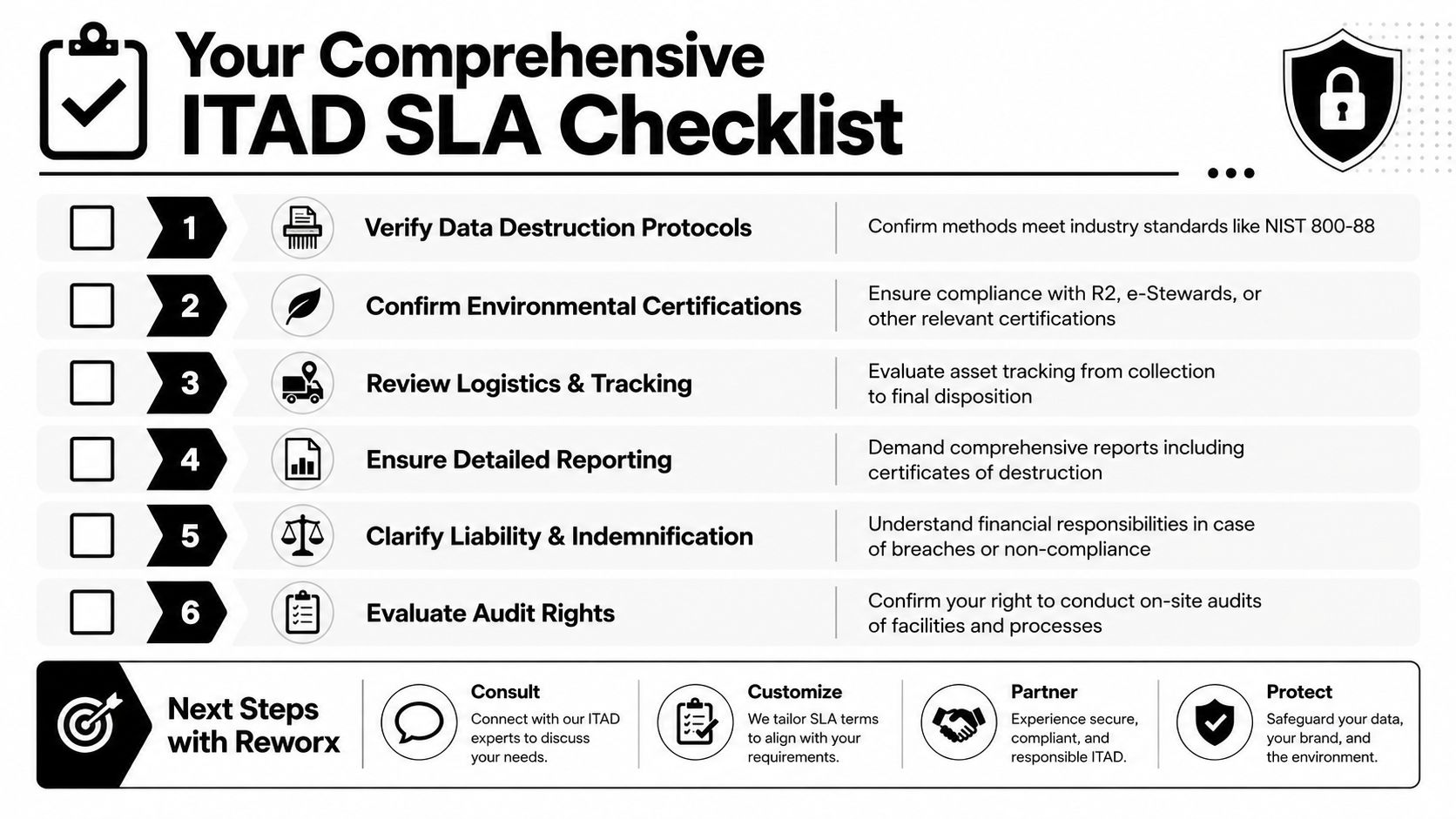
A solid ITAD SLA doesn't read like a generic services contract with a recycling label attached. It reflects the actual operational path of retired assets, from collection and custody through data destruction, resale, donation, recycling, and reporting. If your current agreement can't do that, it needs revision.
Use this checklist before you sign
- Define the scope clearly so office cleanout work, laptop disposal, product destruction, and specialized disposal streams aren't left to assumption.
- Name the data destruction method and the proof required for discarded media.
- Set measurable KPIs for pickup, intake, destruction, exception handling, and reporting.
- Require chain-of-custody records that follow the asset through each handoff.
- Write in remedies and indemnification so missed obligations have consequences.
- Preserve audit rights that your team can realistically exercise.
For sustainability leads, this is also where mission and compliance meet. A vendor may support social enterprise recycling, donation-based recycling, and community reuse goals, but those outcomes still need documentation. Good intentions don't replace enforceable controls.
For facilities and IT teams, the practical takeaway is simple. If the contract can't prove what happened to the equipment, it can't protect the organization. Service level agreements in ITAD have to do more than describe service. They have to create accountability that stands up under audit, procurement review, and internal governance.
If your organization is planning electronics recycling, IT equipment disposal, computer recycling, a facility cleanout, or a broader IT asset disposition program, Reworx Recycling can help you evaluate vendor requirements, schedule a pickup, and build a documented process for secure data destruction, sustainable recycling, and donation-based equipment recovery.