
A lot of organizations are in the same place right now. The CFO wants a practical sustainability plan. The IT manager is preparing for a hardware refresh. The facilities lead is dealing with storage rooms full of retired monitors, laptops, lab devices, and networking gear. Everyone agrees carbon footprint reduction matters, but no one wants another vague initiative that produces a report and little else.
That's where organizations commonly falter. They treat carbon planning as a separate ESG project when it's really an operating model question. How do you buy equipment, use it longer, retire it securely, reduce waste, and document the result in a way leadership can trust?
Introduction The Path to Net-Zero
A sustainability director at a growing company usually doesn't start with a blank sheet of paper. They inherit fragmented data, separate departmental priorities, and a long list of expectations. Leadership wants lower emissions. IT wants secure data destruction. Procurement wants cost control. Compliance wants documentation. The challenge isn't just environmental. It's organizational.
The climate context makes that pressure hard to ignore. The average person in the United States has a carbon footprint of 16 tons of CO₂, which is four times the global average, and the global average must fall to under 2 tons by 2050 to support the Paris goal of limiting warming, according to NYSERDA's guidance on lowering your carbon footprint. Businesses operating in a high-emission economy can't assume small adjustments will be enough.
What helps is a framework that connects climate goals to day-to-day operations. That includes fleet decisions, building energy, supplier standards, and one area many teams underestimate: technology lifecycle management. If your company buys hundreds of devices, replaces servers, runs office cleanouts, or decommissions old infrastructure, your carbon plan already runs through IT.
For teams sorting through first steps, a useful companion resource is this guide on implementing eco-friendly technology. It approaches the same challenge from the technology adoption side, which is often where carbon strategy becomes real inside a business.
Carbon footprint reduction becomes manageable when you stop treating it as a slogan and start treating it as an asset, procurement, and operations issue.
Understanding Your Corporate Carbon Footprint
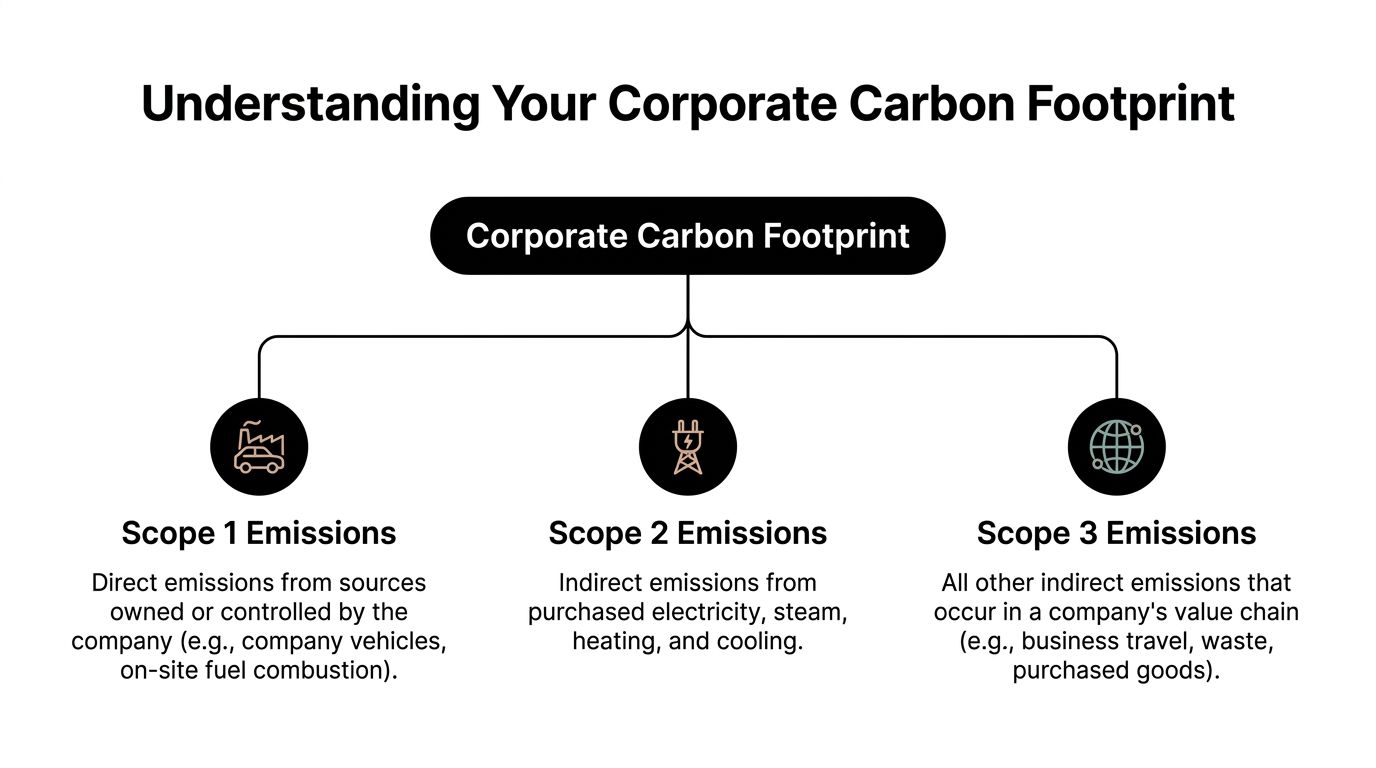
The simplest way to understand a corporate carbon footprint is to think about control. Some emissions come from things your company directly operates. Others come from energy you purchase. The rest come from the wider chain of business activity that supports your work.
The three scopes in plain language
Scope 1 covers direct emissions from assets your organization owns or controls. If your company runs delivery vans, service trucks, backup generators, or on-site fuel-burning equipment, those emissions sit here.
Scope 2 covers purchased energy. Your office electricity, purchased steam, heating, and cooling fall into this category. You don't create the power on-site, but your operations depend on it.
Scope 3 is where many businesses find the largest blind spots. This category includes indirect emissions across the value chain, such as purchased goods, employee travel, shipping, waste handling, and disposal decisions. Old IT equipment often lands here because disposal, recycling, refurbishment, and replacement all connect to outside vendors and upstream manufacturing impacts.
Why Scope 3 causes confusion
Teams often understand fuel and electricity first because they already track utility bills and vehicle expenses. Scope 3 feels harder because the data lives across departments. Procurement has vendor records. IT has asset inventories. Facilities manages waste pickups. Finance sees purchasing history. None of those systems were built solely for carbon accounting.
That doesn't mean Scope 3 is optional. It means your process has to be cross-functional.
A practical first move is to map business activities before chasing precision. List where emissions likely arise, then identify who owns the records. For many organizations, one of the most actionable places to start is retired electronics because the assets are countable, the disposal pathways are visible, and the governance implications are clear.
Practical rule: If your company replaces, stores, ships, donates, destroys, or recycles devices, you already have an emissions management issue tied to IT.
A working model for business teams
Use this quick lens:
| Scope | Business question | Common owner |
|---|---|---|
| Scope 1 | What do we burn or operate directly? | Facilities, fleet, operations |
| Scope 2 | What energy do we buy to run buildings and systems? | Facilities, finance |
| Scope 3 | What do we buy, move, discard, and outsource? | Procurement, IT, sustainability |
If you need a practical reference point for estimating the impact of retired hardware and related activities, this carbon offset calculation resource can help frame the conversation in operational terms.
Key Strategies for Enterprise Emission Reductions
Most organizations don't need more ideas. They need a way to prioritize them. The strongest carbon footprint reduction programs usually combine three levers that reinforce one another: policy, procurement, and operations.
Policy creates the rules of the game
Policy sounds abstract until you see what happens without it. One team buys efficient equipment. Another team replaces devices too early. One office uses a documented secure data destruction process. Another sends surplus hardware to general waste channels. The result is inconsistency, extra cost, and weak reporting.
The long-term value of coordinated action is visible at the regional level. The European Union's sustained policy efforts led to a 35% decrease in greenhouse gas emissions between 1990 and 2024, according to the EDGAR 2025 emissions report. That record shows that organized policy and technology choices can reduce emissions over time, while the U.S. has seen a more modest decline over the same period.
Inside a company, useful policy questions include:
- Asset lifespan rules. When should laptops, servers, and networking gear be replaced?
- Disposition standards. What qualifies as approved electronics recycling, donation-based recycling, or IT asset disposition?
- Vendor requirements. Which partners must provide documentation for chain of custody, recycling, and secure data destruction?
Procurement shapes future emissions
Procurement often determines tomorrow's footprint long before sustainability reporting catches up. If purchasing teams prioritize repairability, reuse potential, energy-efficient models, and vendors with responsible end-of-life programs, future disposal becomes simpler and lower risk.
This is also where circular thinking starts to matter. A purchasing decision isn't complete when equipment arrives. It's complete when the organization knows how that equipment will be maintained, redeployed, donated, resold, or recycled.
For technology teams evaluating infrastructure choices, Cloudvara's green hosting guide is useful because it links data decisions to environmental performance in a way IT leaders can apply directly.
Operations turn goals into results
Operations is where carbon footprint reduction stops being theoretical. This includes building energy upgrades, route planning, heating and cooling choices, waste segregation, and equipment retirement workflows. It also includes practical projects that don't always get labeled as sustainability work, such as office cleanouts, facility cleanouts, laptop disposal, data center decommissioning, and product destruction.
A good operating model usually has these traits:
- Clear ownership. IT owns inventory accuracy. Facilities owns collection logistics. Security owns data handling. Sustainability consolidates reporting.
- Repeatable workflows. Hardware refreshes, moves, and closures should follow a standard process rather than ad hoc disposal.
- Documented outcomes. Teams need records that show what was reused, donated, recycled, or destroyed.
If your organization is building a broader plan around Green IT and device lifecycle controls, this Green IT strategy resource offers a practical planning lens.
Good policy reduces confusion. Good procurement reduces future waste. Good operations make both measurable.
The High-Impact Role of ITAD in Your Carbon Goals
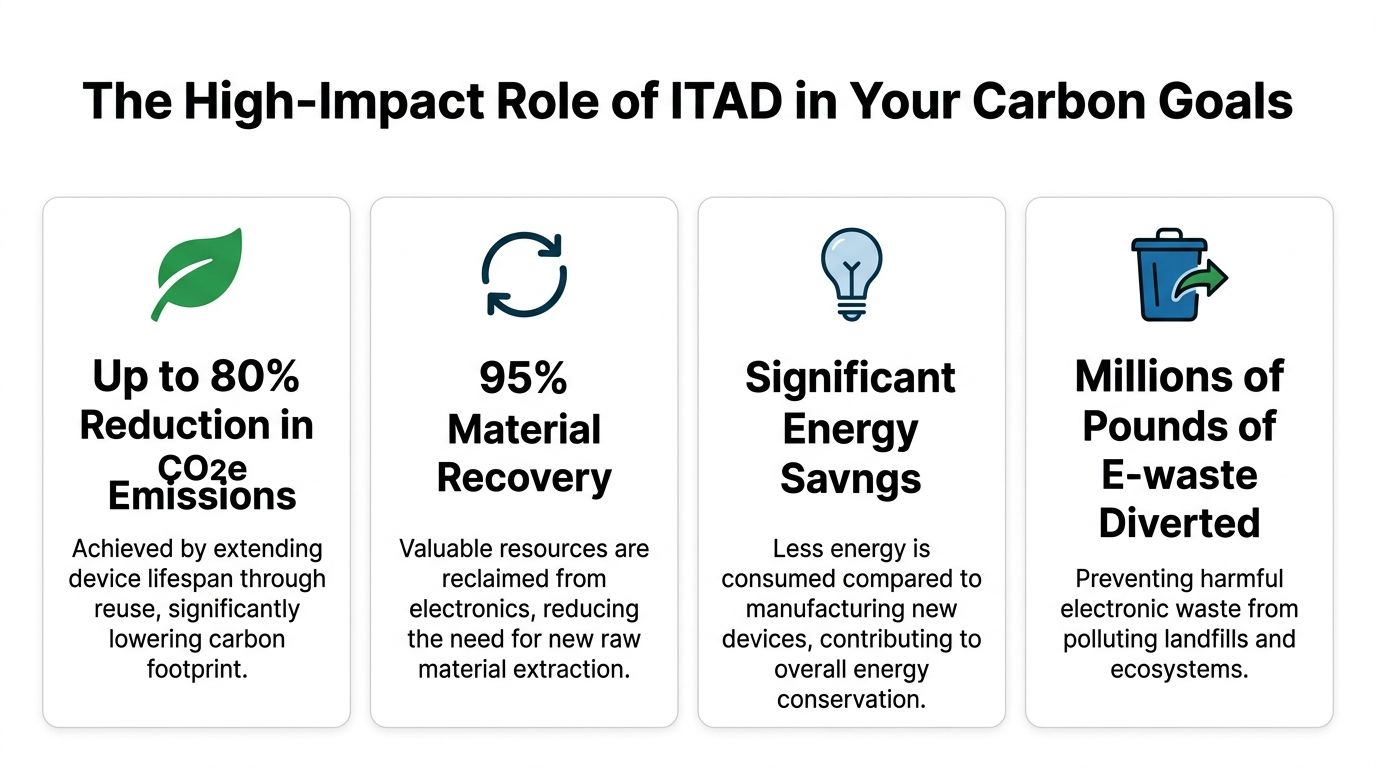
For many organizations, IT asset disposition (ITAD) sits in the wrong mental category. Teams treat it as a cleanup task at the end of a device's life. In practice, it's a carbon decision, a data security decision, and a resource recovery decision at the same time.
That matters because digital infrastructure carries hidden environmental weight. Every laptop, desktop, server, and monitor represents mined materials, manufacturing energy, transportation, packaging, use, and eventual disposal. If you only look at what happens inside your office, you'll miss most of the lifecycle story.
Why retired electronics matter more than most guides admit
General carbon advice often focuses on lighting, recycling bins, and employee habits. Those are visible actions, but they can distract from higher-impact business systems. Electronics waste is one of them.
The U.S. generates approximately 6.9 million tons of e-waste annually, and only 15% is formally collected and recycled in North America as of 2019, according to this summary of e-waste facts and statistics. That means most retired equipment doesn't move through licensed recycling channels.
The consequence for businesses is straightforward. If you don't have a disciplined process for computer recycling, laptop disposal, medical equipment disposal, laboratory equipment disposal, and secure data destruction, you're not just increasing compliance risk. You're likely missing a significant Scope 3 reduction opportunity.
The carbon logic behind ITAD
One verified data point makes the case clearly. Recycling a single desktop computer can avoid up to 89 kg of CO₂e emissions, directly affecting Scope 3 reporting, as explained in this article on sustainability KPIs for electronics recycling. That same source also notes the scale of e-waste as a missed carbon reduction opportunity.
There's a second reason this matters. Electronics manufacturing is resource-intensive, so extending device life, redeploying equipment internally, and recovering materials through responsible recycling all help avoid the need for additional virgin production. That's why ITAD should be discussed alongside procurement and not after it.
Consider the business scenarios where this shows up:
- Laptop refresh cycles that retire usable machines too early.
- Server upgrades that leave racks of aging equipment in storage rooms.
- Office relocations where mixed waste containers become the default disposal path.
- Mergers and closures that generate large volumes of monitors, desktops, phones, and peripherals with inconsistent chain-of-custody controls.
What a stronger ITAD program looks like
A mature ITAD approach usually combines several lanes instead of a single “recycle everything” instruction.
- Reuse first. If equipment is still viable, redeployment or donation can preserve value and delay replacement demand.
- Certified handling. Devices containing data need secure data destruction before any reuse, resale, or recycling path.
- Material recovery. Non-reusable assets should move into sustainable recycling channels that recover metals and components responsibly.
- Documentation. Finance, IT, compliance, and sustainability teams all need records for what left the organization and how it was handled.
Therefore, vendor selection is key. A service partner should be able to support IT equipment disposal, hard drive shredding, donation workflows, chain of custody, and reporting in one operating process. Reworx Recycling's sustainable IT asset disposition services are one example of that type of structured workflow, especially for organizations managing office cleanouts, secure data destruction, and donation-based recycling as part of broader ESG goals.
The mistake isn't thinking electronics recycling matters. The mistake is treating it as a janitorial issue instead of a strategic asset management issue.
Why this also helps the business side
The environmental case is strong, but most corporate clients also need operational reasons to act.
A better ITAD process can help teams:
| Business need | ITAD contribution |
|---|---|
| Data security | Devices are inventoried and handled through secure destruction workflows |
| Space recovery | Stored surplus hardware is removed from offices, warehouses, and server rooms |
| Budget discipline | Reuse, buyback, or donation decisions become more structured |
| ESG reporting | Disposal and recycling records are easier to document and review |
That's why carbon footprint reduction in a digital business increasingly runs through electronics lifecycle management. If your footprint review ignores surplus technology, it's incomplete.
Creating Your Carbon Reduction Implementation Roadmap
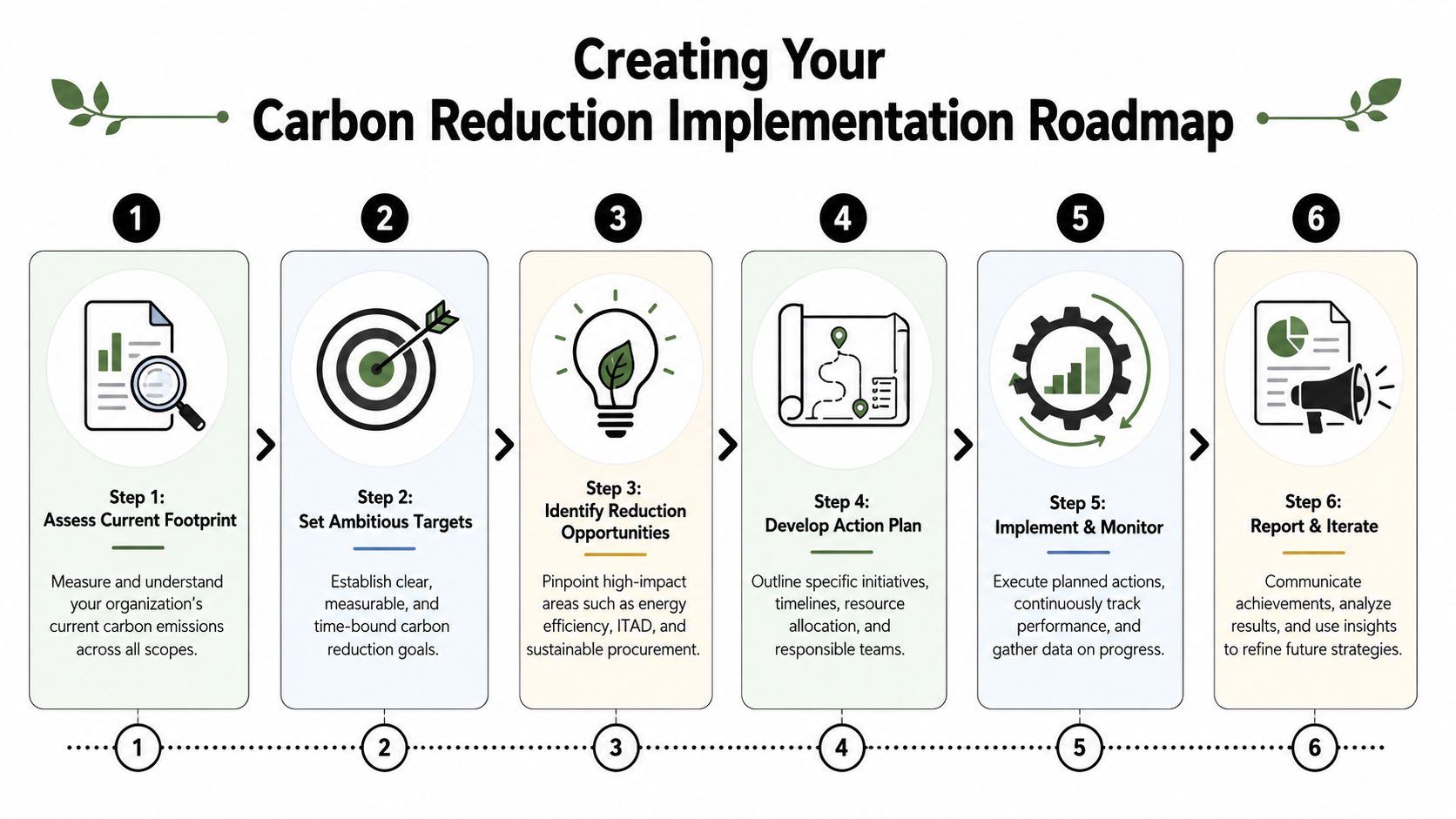
A workable roadmap starts with discipline, not perfection. Most companies already have enough information to begin. What they need is a sequence that turns scattered efforts into a managed program.
Start with a usable baseline
Begin by identifying where your organization creates emissions across operations, procurement, travel, facilities, and technology. Don't wait for every data source to be perfect. Build a first-pass inventory of activities and asset flows.
For IT-related emissions, ask practical questions:
- What equipment do we own now?
- What equipment is in storage or awaiting disposal?
- How often do we refresh devices and why?
- Which vendors handle pickup, recycling, donation, or destruction?
Many organizations discover that their hardware records are incomplete. Before launching a disposal project, an inventory review can prevent lost assets, inconsistent handling, and reporting gaps. This guide on why IT inventory audits matter before recycling is useful for tightening that first step.
Set targets that people can actually use
Targets should guide decisions, not just decorate an ESG report. Teams need goals tied to functions they control. Facilities may own building energy actions. IT may own device lifespan, laptop disposal standards, and data center decommissioning planning. Procurement may own supplier screens and product specifications.
A practical target framework usually includes:
- A business boundary. Which sites, departments, and asset classes are included?
- A decision horizon. Are you planning around the next refresh cycle, lease cycle, or reporting year?
- An accountability model. Who approves changes, who executes them, and who verifies results?
Decision filter: If a target doesn't change purchasing, usage, or disposal behavior, it isn't operational yet.
Prioritize initiatives by impact and feasibility
Not every idea should happen at once. The useful question isn't “What could we do?” It's “What should we do first based on control, effort, and business value?”
A simple prioritization approach:
| Priority type | Typical examples |
|---|---|
| Fast operational wins | Device collection drives, office cleanout workflows, approved electronics recycling channels |
| Medium-term process changes | Procurement standards, refresh policy updates, donation-based recycling rules |
| Longer-cycle projects | Fleet changes, HVAC transitions, major facility upgrades |
Technology deserves a place near the top because it's visible, manageable, and often overdue for process discipline.
Implement with cross-functional ownership
This part usually fails when sustainability owns the goal but no one owns execution. A stronger structure gives each department a defined role.
- IT manages asset tracking, secure data destruction requirements, and redeployment decisions.
- Facilities coordinates pickups, staging areas, and facility cleanout logistics.
- Finance and procurement align depreciation, vendor terms, and disposition records.
- Leadership resolves policy conflicts and funds process changes.
Once the process is live, track outcomes consistently. Record what was reused, donated, recycled, or destroyed. Keep supporting documentation. Use the findings to improve the next cycle instead of starting from scratch each year.
Real-World Examples of Carbon Reduction Success
The easiest way to see how this works is to look at familiar operational situations.
A mid-sized business during a technology upgrade
A regional business replaces aging laptops, desktops, and several servers during a broader office modernization project. The immediate concern is continuity. The second concern is secure data destruction. Carbon impact enters the conversation only after the team realizes the old hardware can't just sit in storage.
By treating the project as both IT equipment disposal and carbon footprint reduction work, the company can separate reusable devices from scrap, document secure handling, and move retired equipment into a structured computer recycling process. That's far more useful than a generic “green office” campaign because the emissions decision is tied directly to asset retirement.
A school district handling outdated classroom equipment
A district updates computer labs and clears surplus devices from multiple campuses. Some equipment still has educational value. Other items belong in electronics recycling or laboratory equipment disposal channels.
Donation-based recycling changes the outcome. Instead of seeing all surplus devices as waste, the district can sort assets by reuse potential, support community access to technology where appropriate, and reduce the burden on storage space and maintenance staff. That approach fits a broader reality in the market. Most carbon footprint content overemphasizes household recycling while neglecting the disproportionate impact of corporate electronics waste, and the global carbon footprint reduction market is projected to reach USD 28.55 Bn by 2033, as noted in this discussion of major lifestyle choices and carbon footprint reduction.
A government agency with compliance and sustainability mandates
A public sector office closes a facility and must manage product destruction, records protection, and facility cleanout requirements at the same time. The project touches procurement rules, legal obligations, and sustainability reporting.
The successful agencies don't separate these issues. They build one controlled process for inventory review, secure data destruction, pickup scheduling, and final disposition records. That keeps the project auditable while also supporting environmental goals.
The common thread in all three examples is operational clarity. Carbon progress happens when disposal, security, and reporting are handled together.
Partnering for a Sustainable and Secure Future
Carbon footprint reduction is easier to manage when you stop chasing abstract perfection and start improving real business systems. Measure what you control. Build policies people can follow. Align procurement with lifecycle thinking. Treat retired electronics as a strategic issue, not leftover clutter.
For business owners, IT managers, and sustainability leaders, the biggest missed opportunity is often sitting in storage rooms, server closets, and unused office space. Laptops waiting for pickup. Hard drives awaiting destruction. Medical devices, monitors, printers, and networking gear with no documented end-of-life plan. Those assets affect security, space, reporting, and emissions at the same time.
Vendor selection matters because the process has to hold up operationally. If you're evaluating service providers, this vendor selection criteria guide is a practical place to start when comparing disposal, recycling, and ITAD support.
The strongest programs don't rely on one dramatic initiative. They rely on repeatable decisions. Better inventory discipline. Better disposition workflows. Better recovery of usable equipment. Better documentation. That's how carbon goals move from aspiration to routine business practice.
If your organization is planning an office cleanout, laptop disposal project, data center decommissioning, or broader IT asset disposition program, Reworx Recycling offers a practical next step. Businesses can donate old equipment, schedule a pickup, or explore a partnership that supports responsible electronics recycling, secure data destruction, and community-focused technology reuse.