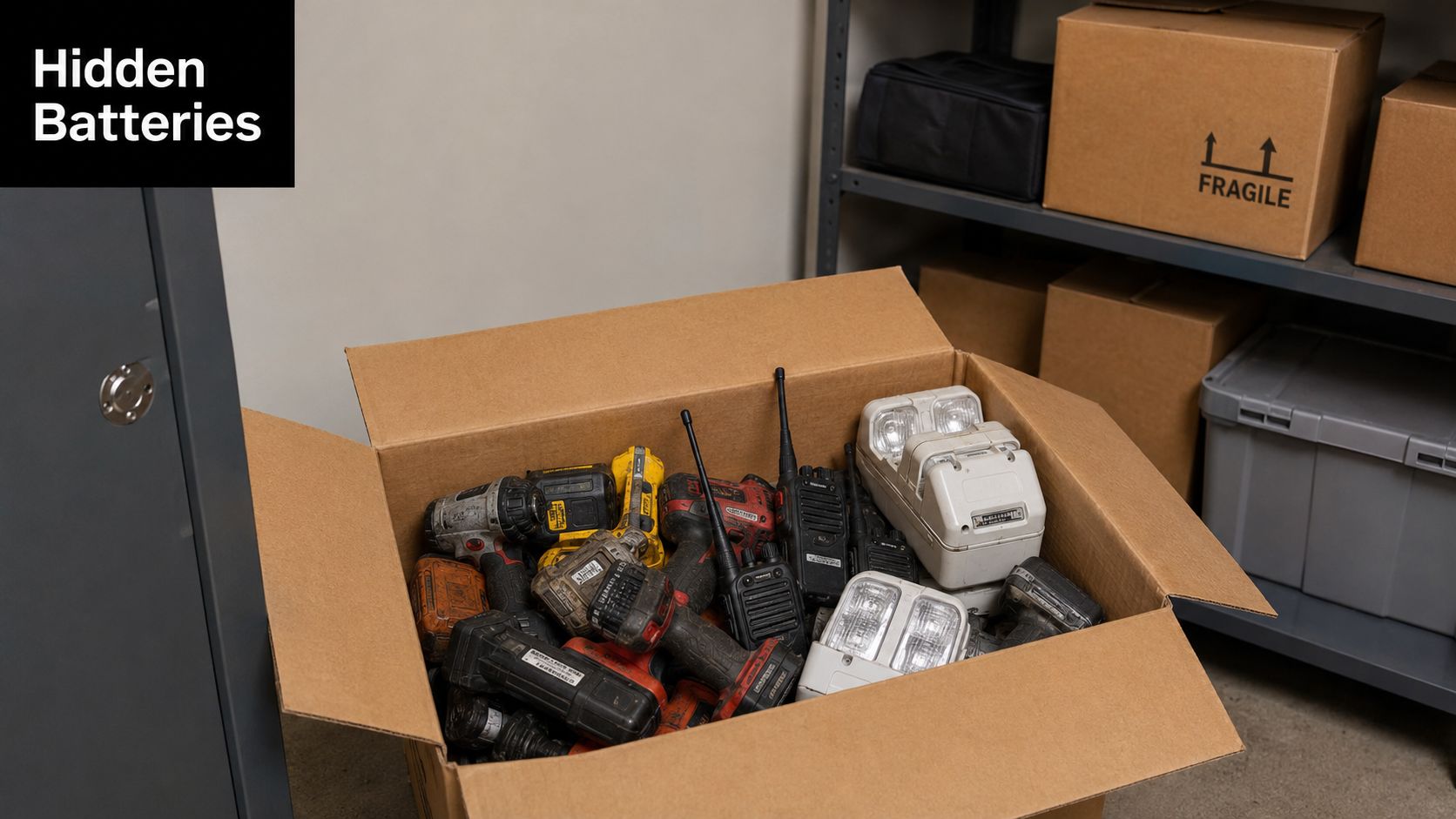
A lot of nickel cadmium battery disposal projects start the same way. A facilities team is cleaning out a telecom closet, a maintenance cage, or an old IT storage room, and someone opens a box full of cordless drills, emergency light packs, radios, backup packs, and legacy gear nobody has touched in years.
At that moment, the job changes. What looked like ordinary clutter is now a regulated waste stream with handling, storage, transportation, and recycling requirements. For business owners, IT managers, sustainability leads, and facilities directors, that means risk moves from housekeeping into compliance.
NiCd batteries still show up during office cleanouts, facility cleanouts, medical equipment disposal projects, and data center decommissioning work tied to older systems. They're common in cordless power tools, cordless phones, digital and video cameras, two-way radios, and biomedical equipment, as noted in Eurostat's battery recycling overview. If your company handles electronics recycling, IT equipment disposal, computer recycling, laptop disposal, laboratory equipment disposal, or secure data destruction, NiCd usually appears alongside other retired assets.
The operational challenge is straightforward. Keep people safe, keep the waste stream compliant, and keep the paperwork clean enough to stand up in an audit.
The Hidden Risk in Your Storage Closet
A storage closet full of old batteries rarely announces itself as a problem. It shows up buried inside a larger project. A branch office closes. A maintenance department upgrades tools. A hospital wing replaces emergency lighting. A warehouse clears shelves before a move. Then someone finds the old packs.
NiCd batteries aren't just another item in the office cleanout pile. They contain cadmium, and cadmium is the reason this stream gets treated differently from ordinary scrap or mixed e-waste. Once a team identifies these batteries, the right question isn't “How fast can we get rid of them?” It's “How do we control this from pickup through final recycling?”
What businesses usually uncover
In practice, the batteries often come attached to or stored near other retired equipment:
- Maintenance gear such as cordless power tools and backup lighting units
- Communications hardware including two-way radios and older cordless phones
- Specialized devices from medical, security, or field-service operations
- Mixed electronics lots generated during IT asset disposition (ITAD), product destruction, or donation-based recycling sorting
That mix is what causes trouble. Staff members assume all old electronics can move through the same path. They can't.
Practical rule: If a battery pack says Ni-Cd or NiCad, stop treating it like ordinary e-waste and move it into a controlled battery process.
A good first move is to brief the team before the cleanout starts. Tell them what to pull aside, what not to dismantle, and who owns the decision once NiCd shows up. That single step prevents the most common mistake, which is letting batteries ride out in gaylords or carts with servers, monitors, cables, and general electronics.
There's also a larger sustainability angle here. Companies that take battery segregation seriously usually improve the rest of their electronics recycling workflow too. Teams get better at separating reusable equipment, donation candidates, and regulated materials. If you need a broader business case for leadership, Reworx has a useful overview of the impact of e-waste on the environment that helps connect this small closet problem to a wider environmental responsibility program.
Why this matters beyond compliance
NiCd disposal sits at the intersection of EHS, operations, and corporate social responsibility. The compliance side is obvious. The less obvious part is that disciplined handling protects your workforce, reduces downstream liability, and supports sustainable recycling instead of landfill exposure.
That's the standard to work toward. Not quick removal. Controlled removal.
Safe Handling and Segregation of NiCd Batteries
The first job on site is simple. Identify the batteries correctly and keep them from becoming a bigger problem.
How to identify them
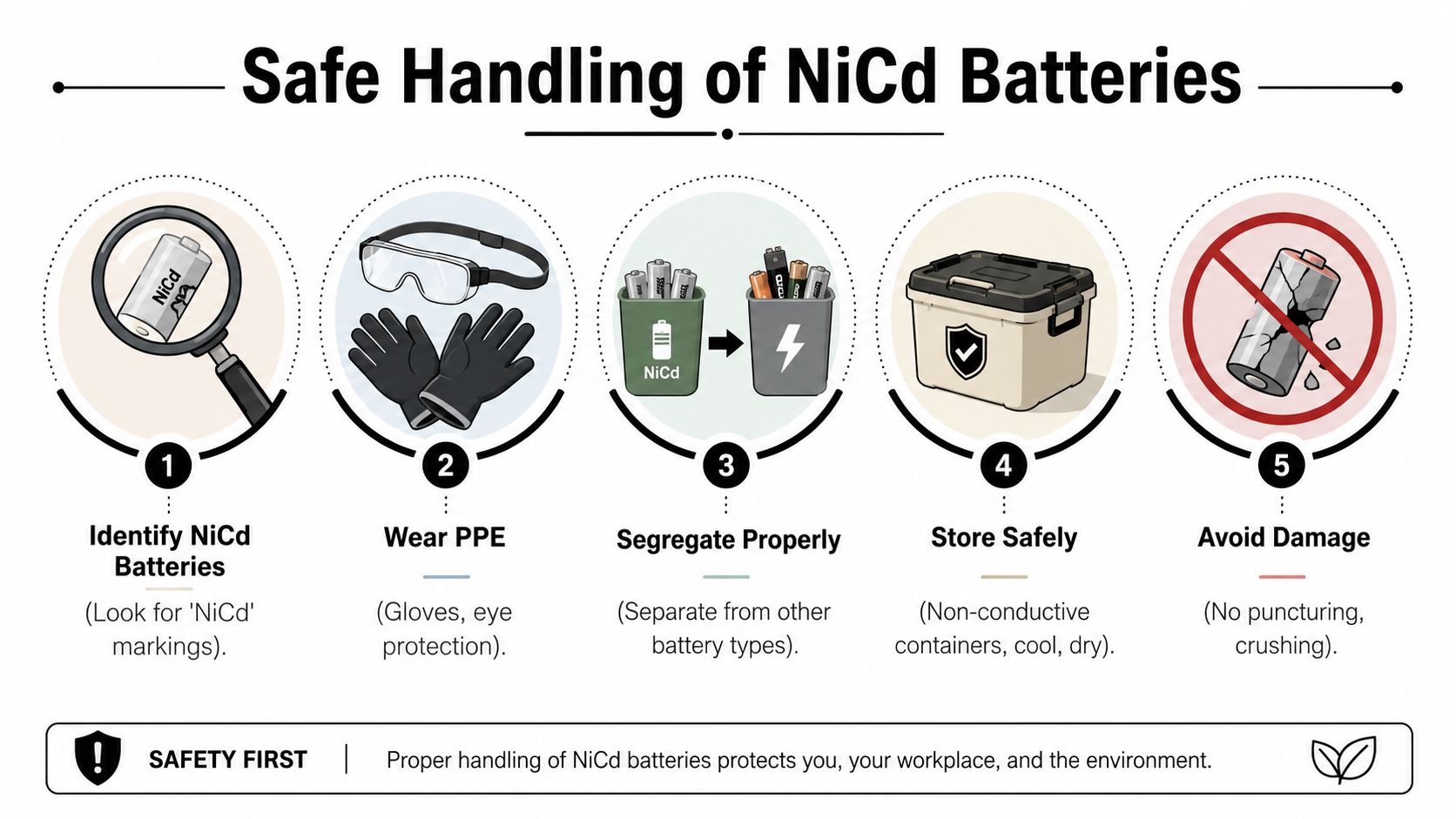
Look for markings on the battery housing or device label such as Ni-Cd or NiCad. You'll often find them in older tool packs, emergency lighting units, radios, portable cameras, and certain legacy medical or industrial devices.
If the battery type isn't clear, don't guess. Set the item aside for review. A mixed battery pile creates handling and transport headaches fast, especially when lithium batteries get mixed into the same container.
A modern recycling workflow also depends on segregation. A hybrid mechanical and hydrometallurgical process can recover over 95% of both nickel and cadmium, but improper pre-processing such as crushing, puncturing, or mixing NiCd with lithium batteries can reduce success rates by 5 to 10%, according to this overview of NiCd battery recycling techniques and best practices.
What your staff should do immediately
Use a short, repeatable handling standard:
- Wear basic PPE. Gloves and eye protection are the minimum for collection and sorting.
- Don't crush, puncture, or pry open packs. Staff should never test cells by disassembling them.
- Tape exposed terminals. This reduces short-circuit risk during storage and transit.
- Keep batteries in a cool, dry area. Heat and moisture make a manageable stream harder to control.
- Separate NiCd from other chemistries. Don't toss them into mixed battery drums.
If you're building a facility-wide process, a dedicated Universal Waste system gives teams a cleaner handoff point than ad hoc storage bins scattered across departments.
Damaged batteries are where routine battery management turns into an incident-prevention exercise.
How to handle damaged or leaking units
This is the gap that many disposal guides skip, and it's where businesses make avoidable mistakes. As First America notes, leaking or damaged NiCd batteries must be managed with extreme care. Use non-flammable containers such as ones filled with sand or kitty litter, tape exposed terminals, and store them separately from intact batteries to comply with transport rules and prevent hazardous reactions, as explained in this guidance on recycling nickel cadmium batteries.
Use this field protocol:
- Isolate first: Move the battery out of the general collection stream.
- Contain second: Place it in a non-flammable container with absorbent, non-conductive fill.
- Label clearly: Mark the container so receiving staff and transport personnel know it contains damaged battery material.
- Protect handlers: Keep unnecessary staff away from the area and avoid repeated movement.
- Escalate quickly: Notify EHS or the designated waste coordinator before scheduling pickup.
What doesn't work is casual “bench fixing,” hobby charging, or opening battery casings to see if a pack can be reused. Once a NiCd pack is damaged, the safe path is controlled containment and licensed recycling.
Setting Up a Compliant On-Site Collection Point
A compliant collection point doesn't need to be elaborate. It needs to be consistent, secure, and easy for staff to use correctly.
The best setups are boring on purpose. One defined area. One container standard. One labeling method. One owner.
Where to place it
Pick a location that stays cool, dry, and out of routine traffic. Don't set battery containers beside loading docks with direct weather exposure, janitorial chemical shelves, welding areas, or mixed scrap cages.
Also keep NiCd away from incompatible battery streams. Mixing chemistries creates confusion during packaging and can complicate transport readiness. If your facility already stages lead-acid batteries separately, use that same discipline here and keep this NiCd point distinct from the stream described on Reworx's page about lead-acid battery recycling.
What the collection point should include
Use durable, closable containers that won't tip easily. Many facilities use plastic pails or lidded tubs that are dedicated to batteries only. The container should prevent casual access and support orderly loading when the recycler arrives.
Your collection point should also include:
- A posted acceptance rule that tells staff which batteries belong there
- Terminal control materials such as tape for exposed contacts
- A separate damaged-battery container rather than one mixed bin
- A visible label identifying the battery waste stream
- A log or accumulation record so the area doesn't become permanent storage by neglect
If staff have to ask where a battery goes every time, the system isn't finished yet.
NiCd Battery On-Site Storage Compliance Checklist
| Requirement | Check |
|---|---|
| Dedicated storage area is cool, dry, and secure | ☐ |
| NiCd batteries are separated from lithium and other battery types | ☐ |
| Containers are durable, non-conductive, and kept closed when not in use | ☐ |
| Exposed terminals are taped before storage | ☐ |
| Damaged or leaking batteries are isolated in separate non-flammable containers | ☐ |
| Containers are clearly labeled for battery waste management | ☐ |
| Staff know who to contact for pickup and incident response | ☐ |
| Accumulation dates or internal tracking records are maintained | ☐ |
| Area is inspected routinely for loose batteries or damaged packaging | ☐ |
| Pickup documentation process is assigned to one accountable person | ☐ |
What usually breaks the system
Most failures are operational, not technical.
One department starts a battery pail, another drops loose batteries into a cardboard box, and a third stores old packs in desk drawers because nobody told them otherwise. By the time pickup is scheduled, the site has three undocumented collection points and no confidence that the stream is segregated.
A strong collection point fixes that. It gives office cleanout crews, maintenance teams, IT staff, and sustainability managers one place to send NiCd batteries before the material enters transport.
Understanding the Regulatory Landscape
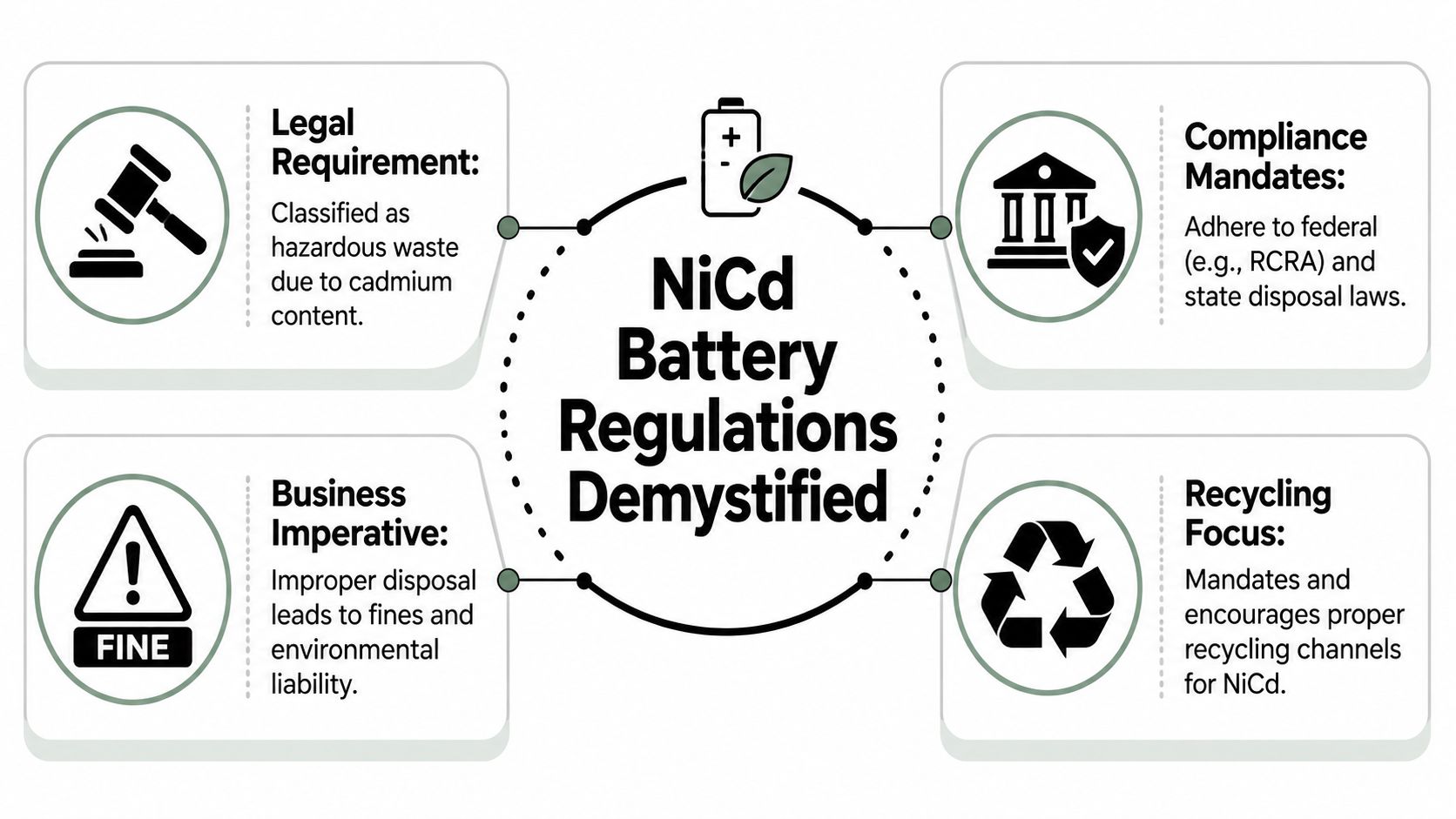
Businesses don't need to become battery lawyers. They do need to understand the basic rule: NiCd batteries can't go in the regular trash.
Why NiCd gets regulated differently
NiCd batteries are classified as hazardous waste globally because they contain 6 to 18% cadmium by weight, and cadmium is a toxic heavy metal that requires licensed recycling programs for safe isolation and recovery, according to this summary on NiCad battery recycling.
That's why disposal rules are stricter than they are for ordinary office debris or mixed electronics. The law is trying to prevent cadmium from moving into the wrong waste channel, not make your cleanout harder.
What Universal Waste means in practice
For most businesses, the key framework is Universal Waste. In plain English, it's a set of rules designed to make collection and recycling more manageable than full hazardous waste handling, while still keeping the material controlled.
Under federal Universal Waste regulations in 40 CFR Part 273, businesses are explicitly prohibited from disposing of nickel-cadmium batteries in regular waste streams. They must be managed as Universal Waste and sent for recycling through approved channels, as explained in this guide to battery recycling regulations and compliance.
That means three practical things for facility teams:
- Trash disposal is out
- Uncontrolled storage is out
- Approved recycling is required
The laws behind the workflow
Federal law has reinforced this direction for years. Public Law 104-142, the Mercury-Containing and Rechargeable Battery Management Act, created the foundational U.S. framework for phasing out certain batteries and requiring recycling pathways for NiCd and other rechargeable battery types, as noted earlier in the Eurostat-linked regulatory summary.
Transport also matters. Once batteries leave your site, packaging, labeling, and condition affect whether the shipment is compliant. If your team needs a plain-language primer on the transport side, this overview of hazmat shipping regulations is a useful reference before pickup is arranged.
Compliance isn't just about the battery leaving your building. It's about whether it leaves in a condition and package that a transporter can legally move.
If you manage multiple regulated streams, it helps to map NiCd into your larger Universal Waste program. That reduces the chance that batteries get handled one way in maintenance, another way in IT, and a third way in operations.
The business takeaway
The regulatory environment isn't abstract. It affects who can touch the material, where it can sit, how it must be labeled, and what records you need after pickup. That's why nickel cadmium battery disposal belongs in an EHS-controlled process, even when the project begins as a simple cleanup.
Choosing the Right Disposal and Recycling Partner
Once the batteries are contained and documented, the next decision is who takes custody. At this stage, many companies either reduce risk or create a new one.
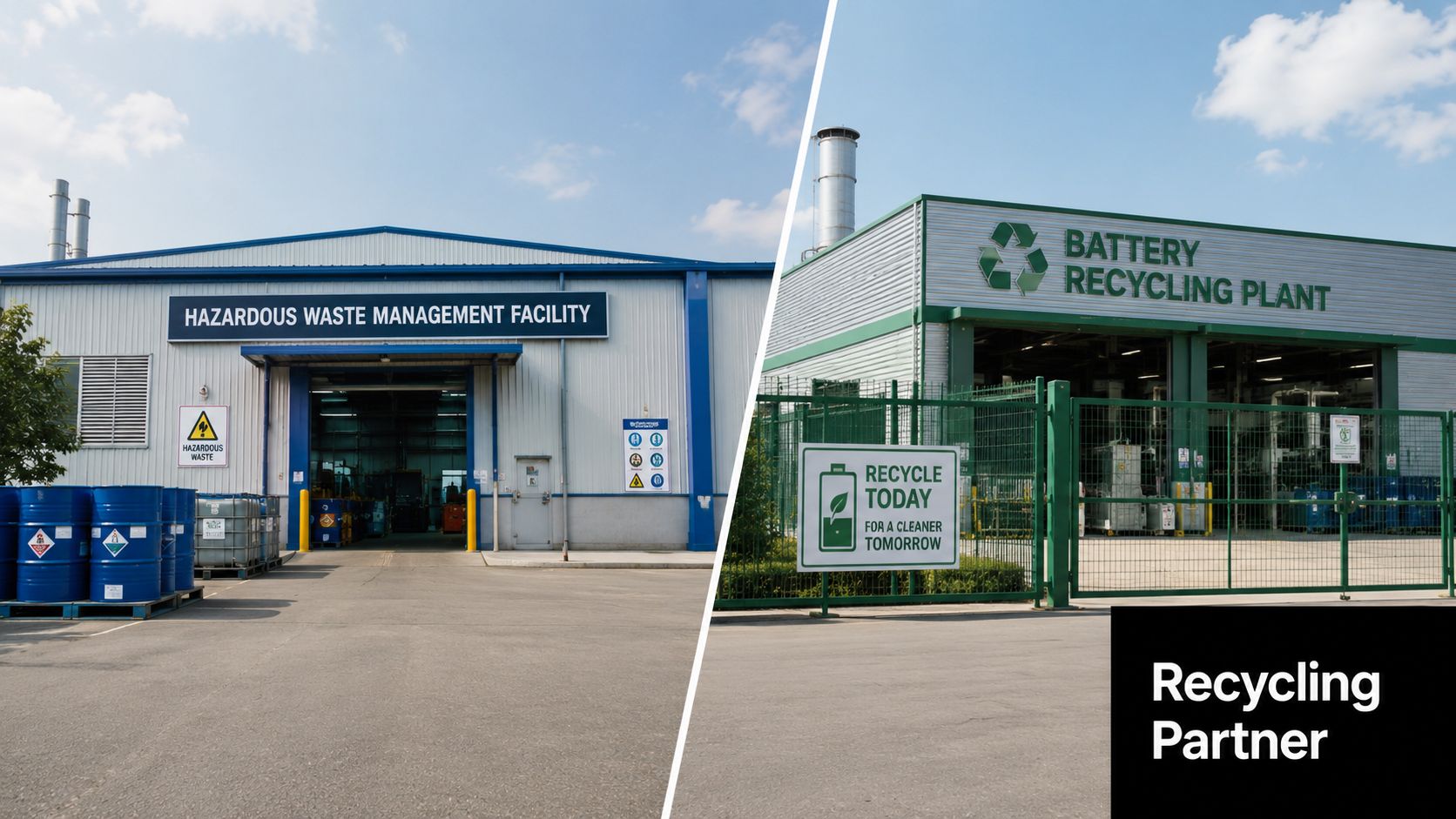
There are two broad paths. One is a conventional hazardous waste outlet focused mainly on lawful removal. The other is a recycler that can manage batteries within a larger electronics recycling and IT asset disposition workflow.
Why recycling is the stronger outcome
For NiCd, recycling isn't only about legal compliance. It's also the more resource-efficient path. According to Cadmium.org's recycling data, recycling cadmium uses 46% less energy and recycling nickel uses 75% less energy compared to producing those metals from virgin ore. The overall recovery rate can exceed 75% by weight.
That matters for companies building real sustainable recycling programs. Battery disposal can support broader corporate donation programs, social enterprise recycling goals, and environmental reporting when the material goes into a documented recovery stream instead of being treated as a generic waste burden.
What to ask before you hand over material
Don't select a partner on pickup availability alone. Ask questions that test process quality.
Questions worth asking
- What happens downstream? You want a clear answer about where batteries go and how they're processed.
- How do you handle mixed loads? Many cleanouts include batteries plus laptops, servers, peripherals, and network gear.
- Can you support secure data destruction? Battery projects often overlap with laptop disposal, computer recycling, or data center decommissioning.
- What documentation will you provide? Certificates, shipping records, and recycling confirmation matter.
- How do you handle damaged units? A serious partner should have a defined intake procedure for leaking or compromised batteries.
Matching the partner to the job
A facilities-only vendor may be fine for a narrow battery pickup. But if your project includes office cleanout work, medical equipment disposal, laboratory equipment disposal, product destruction, or IT equipment disposal, a recycler with broader service capability is usually easier to manage.
That's one reason companies fold battery pickups into larger ITAD and electronics recycling projects. It reduces vendors, simplifies scheduling, and keeps documentation more centralized.
For businesses that need that broader scope, Reworx Recycling's battery recycling service is one example of a service model that fits battery disposal into a larger chain that can also include pickups, device handling, and related e-waste workflows. That's useful for organizations trying to align compliance with social enterprise recycling, donation-based recycling, and community impact goals rather than treating every waste stream as a separate transaction.
The right partner doesn't just remove the batteries. They help you avoid creating the same unmanaged pile six months later.
What doesn't work
The weak options are predictable:
- General junk removal with no battery-specific process
- Mixed scrap handling that treats batteries like metal odds and ends
- Unverified downstream chains where nobody can explain final disposition
- One-off pickups with no records sufficient enough for audit support
A partner should make nickel cadmium battery disposal more controlled after the first project, not less.
Documentation and Building a Sustainable E-Waste Policy
The truck leaves, the closet is clean, and the batteries are offsite. Your work still isn't finished.
If regulators, auditors, internal compliance teams, or customers ask how your company managed that battery stream, your answer has to be more than “a vendor picked it up.” You need records.
What to collect after pickup
Request documentation that proves what left your site and where it went in the process. Depending on the job, that can include shipping records, internal chain-of-custody notes, recycling certificates, destruction records for data-bearing devices, and any related service summary.
Review the paperwork before filing it away. Confirm that the material description matches the actual stream and that the pickup date aligns with your internal logs. If the load included devices as well as batteries, keep those records tied together so the office cleanout, computer recycling, and battery disposal story stays intact.
Turn one cleanup into a repeatable policy
A single NiCd project is a good trigger for a broader policy refresh. Most companies don't need a separate policy for every battery chemistry and every electronic asset. They need one clear e-waste and universal-waste procedure that tells staff:
- What to segregate
- Who owns approval
- Where items go on site
- How pickups get scheduled
- Which records must be retained
- When secure data destruction is required
That policy should cover more than old batteries. It should also account for laptop disposal, medical equipment disposal, laboratory equipment disposal, IT equipment disposal, facility cleanout work, and product destruction where electronics are involved.
Tie compliance to CSR, not just waste removal
This is the part many organizations miss. A battery program can support more than legal compliance. It can reinforce sustainable recycling targets, improve internal waste discipline, and create cleaner pathways for donation-based recycling and corporate donation programs where reusable electronics are separated from regulated material early.
That's how a hazardous waste task starts supporting broader ESG and community goals. The compliance work remains the foundation. The policy turns it into a system.
Keep the standard simple. Segregate correctly. Store safely. Use approved recycling channels. Retain proof.
If your organization is clearing legacy equipment, planning an office cleanout, retiring backup systems, or building a more consistent ITAD and electronics recycling process, Reworx Recycling can be part of that workflow. Businesses can use Reworx to donate old equipment, schedule a pickup, and support responsible recycling practices that also contribute to technology reuse, digital inclusion, and community impact.