Your quarterly sustainability update is due. Procurement wants a cleaner vendor list. Legal wants proof that retired laptops were handled properly. Your IT team has a storage room full of old desktops, failed drives, networking gear, and monitors waiting for a decision.
That situation is where environmental impact reporting stops being abstract.
For many companies, old tech sits in the gap between operations and reporting. It's physical clutter, a security risk, and a compliance question at the same time. If you manage IT, facilities, procurement, or sustainability, the way you handle that equipment affects what your company can credibly say about waste, circularity, data security, and community impact.
Why Environmental Reporting Matters for Your Old Tech
A common scenario looks like this. A company upgrades employee laptops, refreshes a server room, or closes a satellite office. The technology rollout goes smoothly, but the retired equipment piles up. Then an investor questionnaire arrives, a customer asks about sustainable recycling practices, or an internal ESG committee asks for evidence that the business is managing electronics responsibly.
That's when environmental impact reporting becomes operational.
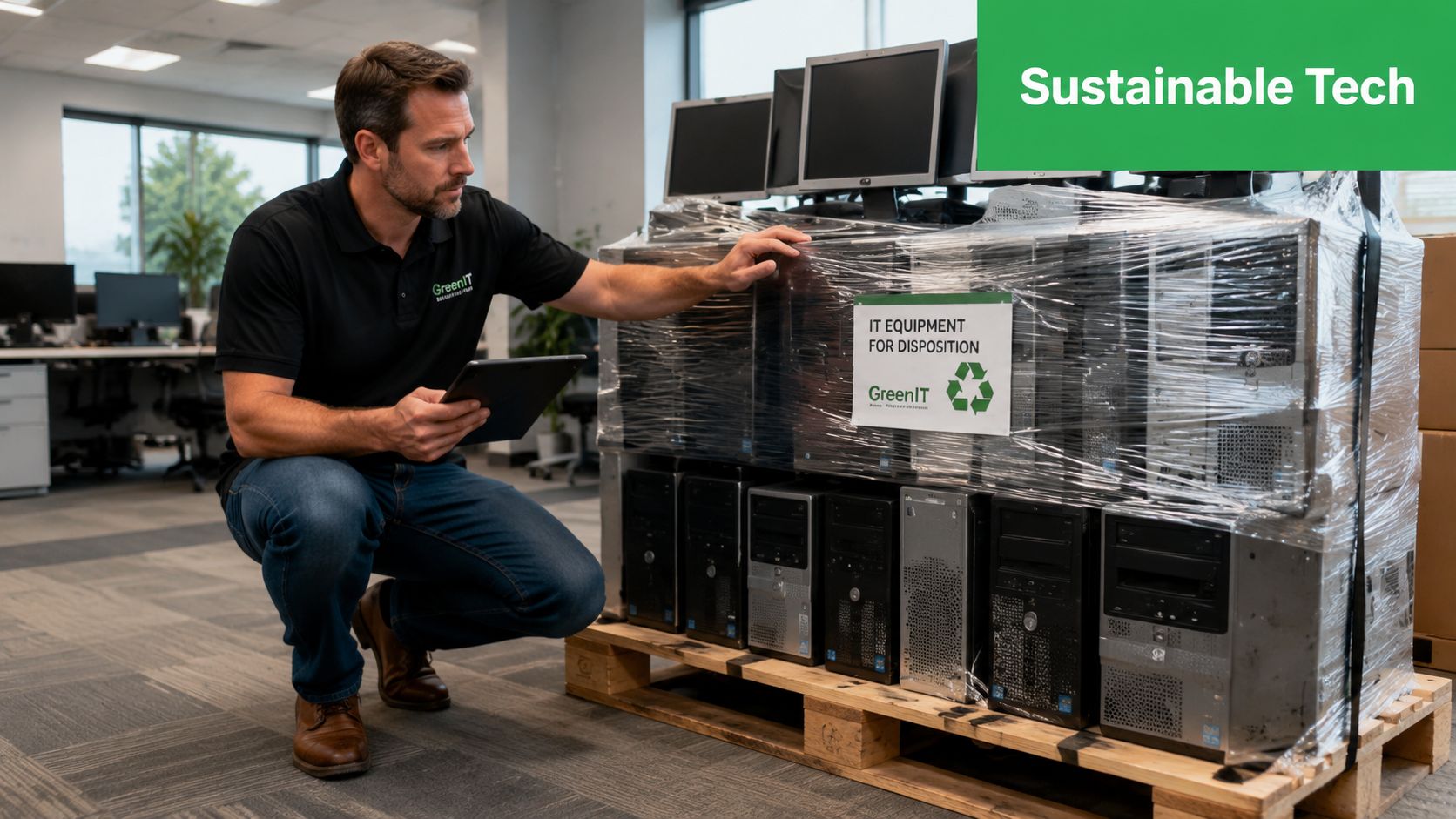
Old equipment is a reporting issue, not just a cleanup task
When people hear environmental reporting, they often think of smokestacks, fuel use, or factory emissions. But most businesses now run on technology. Laptops, phones, servers, displays, switches, medical devices, lab equipment, and office electronics all have an environmental footprint across their lifecycle.
The broad climate context makes that clear. The Electricity and Heat Production sector accounted for 34% of global greenhouse gas emissions in 2019, making it the largest single source and a primary focus for disclosures, according to the EPA's global greenhouse gas overview. The same source also highlights why the technology using that electricity matters. Its lifecycle, from manufacturing through disposal, is becoming a larger part of many companies' environmental footprint.
If your business uses a lot of equipment, your end-of-life decisions matter. That includes:
- Electronics recycling for obsolete devices
- Computer recycling during hardware refreshes
- Secure data destruction for storage media
- IT asset disposition (ITAD) for retired enterprise equipment
- Donation-based recycling when equipment can still serve a useful purpose
Reporting turns a liability into usable evidence
Old hardware can create three problems at once. First, it ties up space and staff time. Second, it creates risk if drives or embedded storage aren't handled correctly. Third, it leaves a reporting gap if no one can show what happened to the assets.
Practical rule: If your company can't trace where retired equipment went, it can't report that impact with confidence.
That's why businesses increasingly treat retired IT equipment as part of environmental governance. A documented process helps teams show landfill diversion, reuse activity, product destruction where needed, and support for circular economy goals. It also gives managers something concrete to include in sustainability disclosures, customer questionnaires, and internal board updates.
A useful starting point is understanding how environmental impact recycling practices connect to reporting. Once you see old tech as a measurable business input and output, reporting gets much more practical.
Understanding Environmental Impact Reporting
Environmental impact reporting is easiest to understand if you treat it like a financial report for your company's relationship with the environment.
A financial report tells stakeholders what came in, what went out, what changed, and where the risks are. Environmental impact reporting does something similar. It tracks resources used, waste generated, emissions linked to operations, and the actions a company takes to reduce harm.
What the report is really answering
Busy managers usually want to know what questions the report must answer. In plain language, those questions are:
- What environmental effects does our operation create
- What evidence do we have
- What actions are we taking to reduce those effects
- What risks remain
For an IT department, that can include server energy use, purchasing choices, office cleanout practices, laptop disposal, data center decommissioning, and how obsolete electronics move through secure downstream channels.
Why companies are paying more attention
This isn't just a paperwork exercise. Businesses use environmental impact reporting to support decisions in several areas:
| Business need | Why reporting matters |
|---|---|
| Customer due diligence | Buyers increasingly ask how vendors manage waste, recycling, and data-bearing devices |
| Legal and policy review | Teams need records that support compliance across different locations |
| Brand credibility | Claims about sustainable recycling need documentation behind them |
| Budget planning | Better asset tracking helps identify reuse, donation, resale, and recycling options earlier |
A strong report doesn't just say your company cares. It shows what happened, who handled it, and what records back it up.
Where readers often get confused
Many people mix up three different activities:
- Compliance documentation, such as records for disposal or data destruction
- Environmental reporting, which summarizes impact in a structured way
- Marketing claims, which describe outcomes publicly
They overlap, but they aren't the same. You can recycle responsibly and still report poorly. You can also publish sustainability language that sounds polished but lacks documentation. The companies that avoid problems are the ones that connect operations, records, and reporting from the start.
Key Reporting Frameworks and Standards Explained
The reporting world has too many acronyms. Not every team needs to memorize all of them. They do need to understand what each framework is trying to do, and how it affects technology operations.
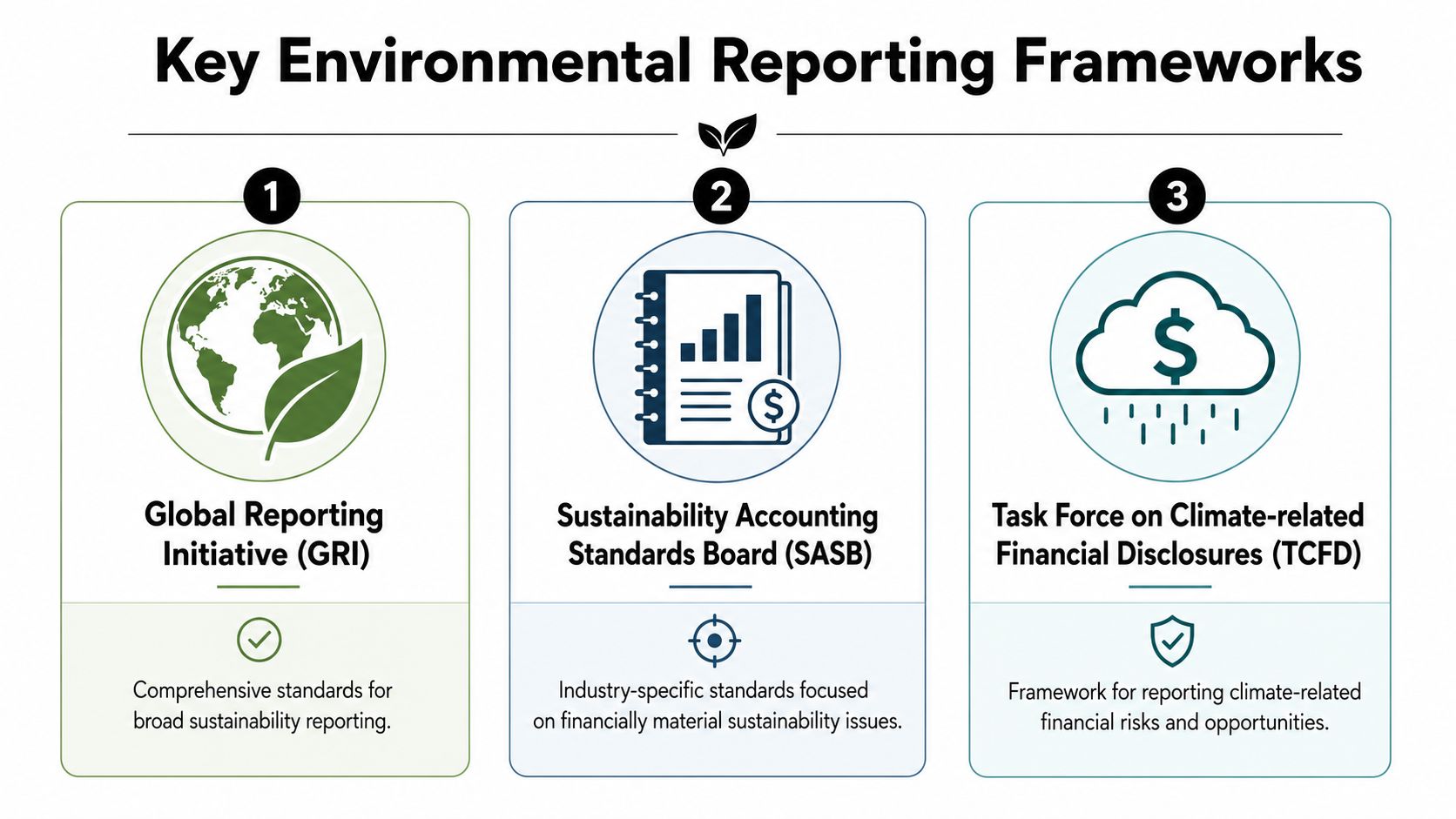
The current situation has shifted toward a common center. The dominant global standards, including the EU's CSRD and the ISSB's IFRS, now require quantitative KPIs and integrate standards from CDP, GRI, and SASB, with an explicit focus on circular economy metrics like e-waste diversion and IT asset disposition impacts, according to this overview of sustainability reporting standards. That same source states that CDP is used by over 23,000 companies.
GRI, SASB, and CDP in plain language
GRI is broad. It helps companies report their impacts on the economy, environment, and society. If your organization wants to explain waste streams, circularity, and community outcomes in a fuller narrative, GRI is often relevant.
SASB is narrower and more financially focused. It pushes companies to report sustainability issues that could affect enterprise value. For an IT-heavy business, that often means managing operational risk, resource use, hardware lifecycle practices, and disposal controls.
CDP is a disclosure system that many companies use for climate-related and environmental data collection. In practice, CDP often drives more discipline in how organizations gather numbers, define boundaries, and document methodologies.
Key Environmental Reporting Frameworks at a Glance
| Framework | Primary Focus | Best For | E-waste & ITAD Relevance |
|---|---|---|---|
| GRI | Broad sustainability impacts | Companies that want a comprehensive environmental and social picture | Useful for reporting electronics recycling, donation-based recycling, and circular economy activity |
| SASB | Financial materiality by industry | Teams aligning sustainability with investor and risk priorities | Useful when retired equipment affects operational risk, procurement controls, or asset recovery |
| CDP | Structured environmental disclosure | Organizations responding to stakeholder and climate-related disclosure expectations | Useful for building disciplined data collection around waste streams and lifecycle impacts |
What matters for IT managers
The practical takeaway is simple. Frameworks don't want vague statements like “we recycle responsibly.” They push companies toward traceable metrics and consistent methodology.
That matters for:
- Office cleanout projects where mixed electronics leave a site quickly
- Facility cleanout planning during relocation or consolidation
- Medical equipment disposal when devices contain both regulated components and data
- Laboratory equipment disposal when asset records are fragmented
- Data center decommissioning where chain of custody must stay intact
Key takeaway: If your IT disposition process produces only pickup receipts and no structured impact data, it will be hard to map that activity into a serious reporting framework.
Teams that need a practical bridge between operations and disclosure often start by reviewing what sustainability reporting means for electronics programs. That helps translate framework language into decisions an IT manager can control.
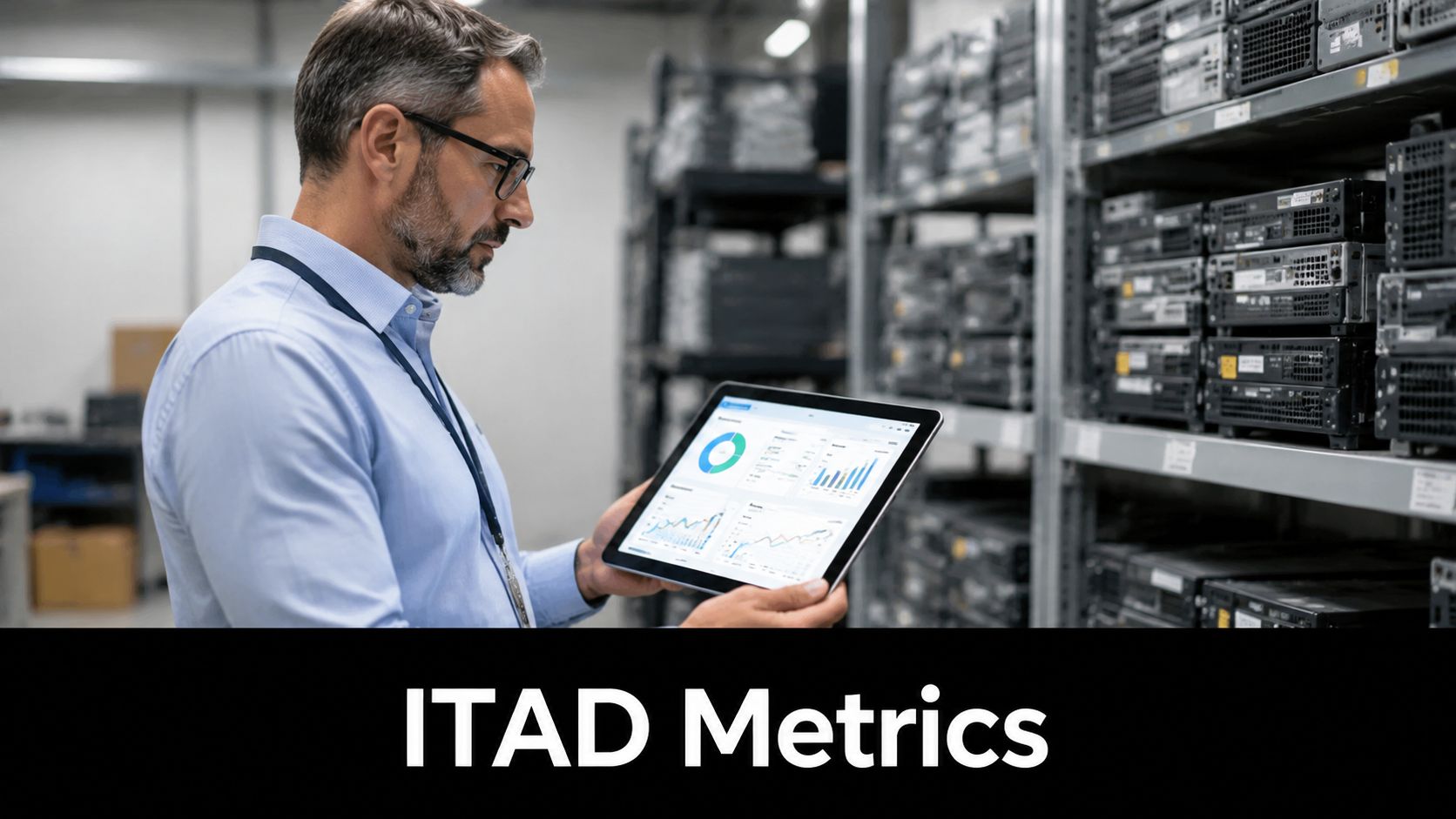
Essential Metrics for E-Waste and ITAD Reporting
Once you understand the frameworks, the next challenge is deciding what to measure. Many programs often stall at this point. Teams collect a few weights, save a certificate, and assume they have enough. Usually they don't.
A credible electronics recycling or IT asset disposition program tracks both environmental and operational data. It should also capture social outcomes when donation or reuse is part of the process.
The metrics that actually help
Use this as a working checklist.
Asset count by type
Track how many laptops, desktops, servers, monitors, mobile devices, peripherals, and specialty assets enter the disposition stream. This helps separate routine laptop disposal from larger projects like product destruction or facility cleanout.Disposition path
Record whether equipment was reused, donated, remarketed, dismantled for parts, or recycled. This is one of the clearest ways to support circular economy reporting.Data-bearing asset handling
Flag every item with storage media and document whether it went through secure data destruction, hard drive shredding, wiping, or another approved process. This protects both compliance and reporting credibility.Weight and material stream records
Capture total outbound e-waste weight and, where your partner can provide it, downstream material categories. That gives sustainability teams something more useful than a generic “disposed” label.
Metrics that get overlooked
The most useful reports also track context, not just volume.
Business unit source
Which office, department, or site generated the equipment? That helps identify recurring refresh cycles and weak spots in inventory control.Project category
Was this routine computer recycling, a one-time office move, medical equipment disposal, or data center decommissioning? Project labels make year-over-year analysis much easier.Donation and community outcomes
If devices are suitable for reuse, track what was set aside for corporate donation programs or donation-based recycling. This is often where social enterprise recycling creates measurable value beyond basic waste handling.
If a metric won't help you answer a customer questionnaire, support an audit trail, or improve next quarter's process, it probably doesn't belong in your core dashboard.
Keep the method consistent
Consistency matters more than complexity. Define your reporting period, your asset categories, and your approved disposition labels once. Then keep them stable.
That discipline makes it easier to calculate avoided impacts and program trends over time. For teams trying to connect retired equipment to broader climate accounting, a practical reference point is this carbon offset calculation resource for electronics programs.
Your Data Collection and Reporting Workflow
A workable reporting process doesn't need to be complicated. It does need clear ownership. Most failures happen because IT, facilities, procurement, legal, and sustainability all assume someone else is tracking the details.
The regulatory environment makes that risky. There is no U.S. federal law that mandates the recycling of electronic waste, according to Wharton's review of U.S. e-recycling and reuse laws. That patchwork means businesses often operate across different state rules, contract requirements, and customer expectations.
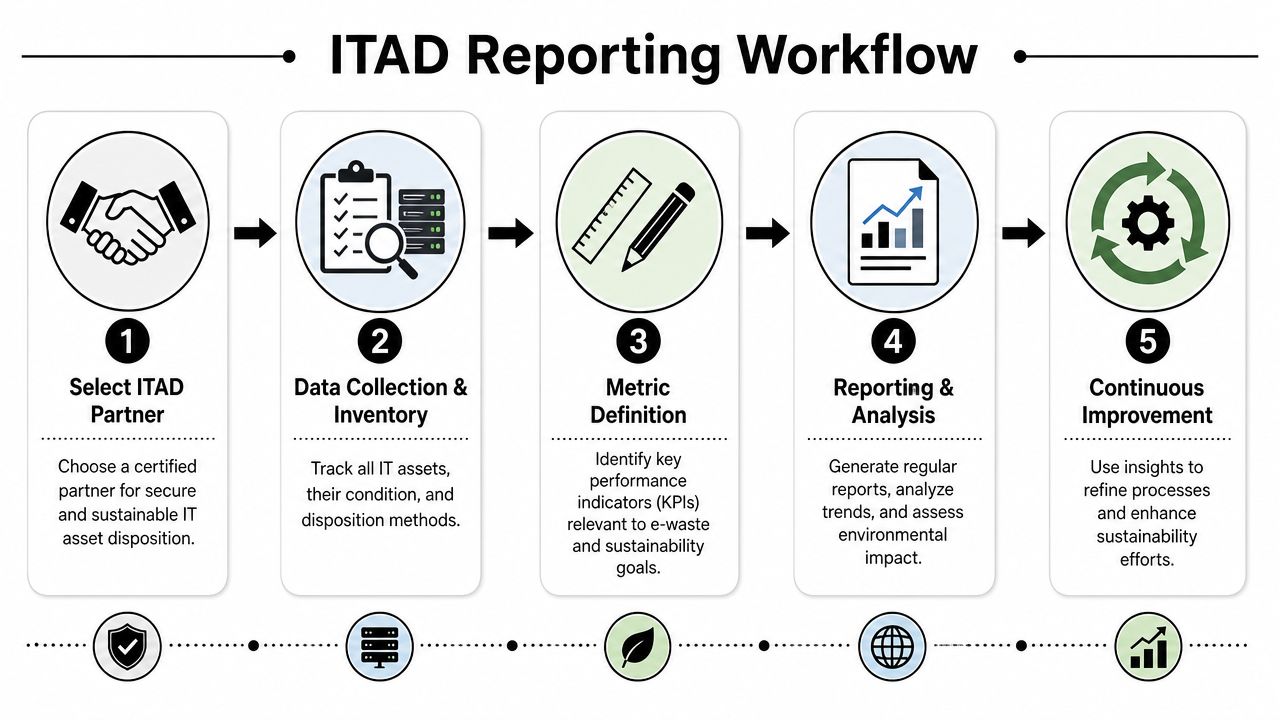
A simple five-step workflow
Choose a qualified ITAD or recycling partner
Start with documentation standards, not marketing claims. Ask what records they provide for electronics recycling, pickup, secure data destruction, and downstream processing. If your company operates in multiple states, national consistency matters.Build a complete inventory before pickup
Don't send out “miscellaneous electronics.” Create an asset list by device type, location, serial number where available, and data-bearing status. This single step reduces reporting problems later.Define the metrics before the project starts
Decide what your sustainability or compliance team wants to report. That could include donation-based recycling outcomes, office cleanout volumes, laptop disposal counts, or proof of product destruction.Collect certificates and impact records immediately after processing
Waiting until annual reporting season is where documentation gets lost. Gather destruction records, settlement reports if relevant, and environmental records while the project is still fresh.Review the data for process improvement
Don't just file the paperwork. Use it to spot recurring issues such as excess storage time, poor return logistics, or inconsistent tagging of retired assets.
What good documentation looks like
A strong record set usually includes chain-of-custody detail, data destruction confirmation where needed, and enough disposition information to support sustainability narratives. It should let a manager answer basic questions without chasing emails months later.
One practical example is chain of custody documentation for electronics handling. That kind of record helps bridge security, operations, and environmental reporting in one system.
Good reporting starts before the truck arrives. Once equipment leaves your site without a clean inventory and custody record, you may never recover the detail you need.
Where this applies in daily operations
This workflow isn't just for annual cleanouts. It applies to:
- Routine hardware refreshes
- Branch closures and relocations
- Secure disposal of failed drives
- Medical and laboratory equipment retirement
- Large decommissioning projects with mixed equipment classes
A company can keep this lightweight. The key is repeating the same process every time.
Communicating Your Impact and Ensuring Compliance
A report only matters if stakeholders can understand it and trust it. That means your company needs more than a spreadsheet of weights and pickup dates. It needs a clear story about what happened to the equipment, why the process was chosen, and what outcomes the business can verify.
The strongest reporting also avoids a common blind spot. Social impact often gets left out of environmental discussions, especially in technology disposal programs.
Compliance is only the baseline
Many companies stop at proving that devices were collected and data was destroyed. That's necessary, but it isn't enough if your customers, board, or procurement team wants to understand broader environmental and social impact.
A stronger narrative might connect:
- Sustainable recycling with documented downstream handling
- IT asset disposition with secure chain of custody
- Corporate donation programs with digital inclusion outcomes
- Social enterprise recycling with workforce and community benefits
A useful supporting resource for teams trying to strengthen the quality of their nonprofit and impact reporting is this guide to nonprofit financial insights. It helps frame how organizations can present mission-linked results in a way that decision-makers can put to use.
Don't ignore equity outcomes
The equity side matters more than many companies realize. A 2021 EPA analysis found that racial and ethnic minority communities face the greatest climate change harms, according to the EPA's release on disproportionate impacts. Standard corporate reporting often misses that. Donation-based ITAD can help companies report a more direct social outcome when equipment is reused in ways that help bridge the digital divide.
That doesn't mean every retired asset should be donated. It does mean your reporting should distinguish between devices that require recycling and devices that can still create community value through responsible reuse.
If your report talks about circularity but says nothing about who benefits from reuse, you're probably telling only half the story.
How to communicate without drifting into greenwashing
Keep the message grounded in records. State what happened, what documentation supports it, and what limits remain. If you don't have exact tracking for a category, say so plainly and fix the process for the next cycle.
That approach builds more trust than polished language with weak backup. For IT managers, that's good news. Accurate reporting usually starts with operational discipline, not fancy copy.
How Reworx Recycling Powers Your Reporting
When reporting requirements get translated into day-to-day operations, most businesses need the same things. They need secure handling, clear documentation, repeatable processes, and reporting outputs they can use.
That's where Reworx Recycling fits as one operational option. The company handles electronics recycling, IT equipment disposal, pickup coordination, data-bearing devices, and donation-based recycling while providing records that support compliance and environmental reporting. For teams managing computer recycling, office cleanout projects, product destruction, or data center decommissioning, that kind of documentation is what turns activity into reportable evidence.
What that support looks like in practice
A reporting-friendly partner should help your team capture:
- Disposition records that show whether assets were reused, donated, or recycled
- Secure data destruction documentation for drives and devices with storage
- Operational reporting inputs that sustainability teams can map into broader disclosures
- Community impact information when reusable equipment supports donation pathways
If your organization needs a tighter connection between retired equipment and formal disclosure processes, this compliance reporting resource shows the kind of reporting support that can make annual reviews much easier.
Environmental impact reporting gets simpler when your IT disposition process is built to produce evidence from the start.
If your business is clearing out old laptops, retiring servers, planning a facility cleanout, or tightening its environmental impact reporting process, Reworx Recycling is a practical place to start. You can donate old equipment, schedule a pickup, or explore a partnership that supports secure IT asset disposition, responsible electronics recycling, and community-focused technology reuse.