Most companies don't think about state data breach laws when they're swapping out laptops, clearing a storage room, or shutting down an old server closet. They should. The legal risk often sits in the devices nobody wants anymore. An outdated desktop under a reception desk, backup tapes in a file cabinet, retired tablets in a warehouse cage, or a box of loose hard drives waiting for "someone in IT" to deal with them can all hold regulated data.
That risk gets worse during ordinary business transitions. Office moves, post-merger consolidations, Windows refresh cycles, medical equipment replacement, and data center decommissioning all create a surge of end-of-life assets. If those assets leave custody without a controlled process, the business may discover too late that disposal was a security event waiting to happen.
For business leaders, the practical question isn't just whether legal notice is required after a breach. It's whether your disposal process helps prevent one in the first place. That is where secure IT asset disposition (ITAD), auditable chain of custody, and defensible data destruction become compliance tools rather than recycling afterthoughts.
The Hidden Risk in Your Old Office Electronics
A familiar scenario: facilities is planning an office cleanout, finance wants old equipment off the books, and IT is already busy with the new deployment. A pile of retired laptops appears in a conference room. Someone suggests donating some devices, recycling the rest, and sending the obsolete storage media out with the next pickup.
That sounds routine. Legally, it isn't.

Why old devices create live legal exposure
Retired electronics often contain more than active production data. They may hold cached credentials, archived HR files, patient scheduling records, vendor banking information, scans of IDs, or years of emails. Even equipment that "should be wiped" may not be, especially when businesses are moving fast.
State breach-notification law became effectively universal when all 50 states, plus the District of Columbia, Puerto Rico, Guam, and the Virgin Islands, enacted breach notification laws requiring notice after certain security incidents, according to the 2023 empirical study on breach notification laws. That same study found no systemic correlation between enactment of these laws and reductions in breach counts or breach magnitude, and reported that none of the estimated policy effects approached conventional statistical significance.
That matters because it reframes what these laws were built to do. They are largely disclosure laws. They push companies to notify affected people and regulators after a qualifying event. They do not, by themselves, stop a hard drive from leaving your dock with readable data on it.
Practical rule: If your disposal process relies on trust, memory, or handwritten labels, it isn't a security control.
Disposal is part of incident prevention
A compliance officer and an ITAD manager usually need to align. Legal teams think in terms of notice triggers, protected data, and document retention. Operations teams think in terms of pickups, pallets, serialized inventory, and downstream handling. Breach risk sits right in the overlap.
A disciplined process for electronics recycling, computer recycling, laptop disposal, and secure data destruction closes one of the most avoidable gaps in the asset lifecycle. Donation-based recycling can also fit, but only after data sanitization, asset tracking, and approval controls are in place.
In practice, the companies that handle this well treat end-of-life equipment like any other regulated workflow. They inventory it. They segregate data-bearing assets. They control transport. They require proof of destruction or verified sanitization. They don't wait for a breach coach to explain why that should have happened earlier.
Understanding Core Data Breach Law Concepts
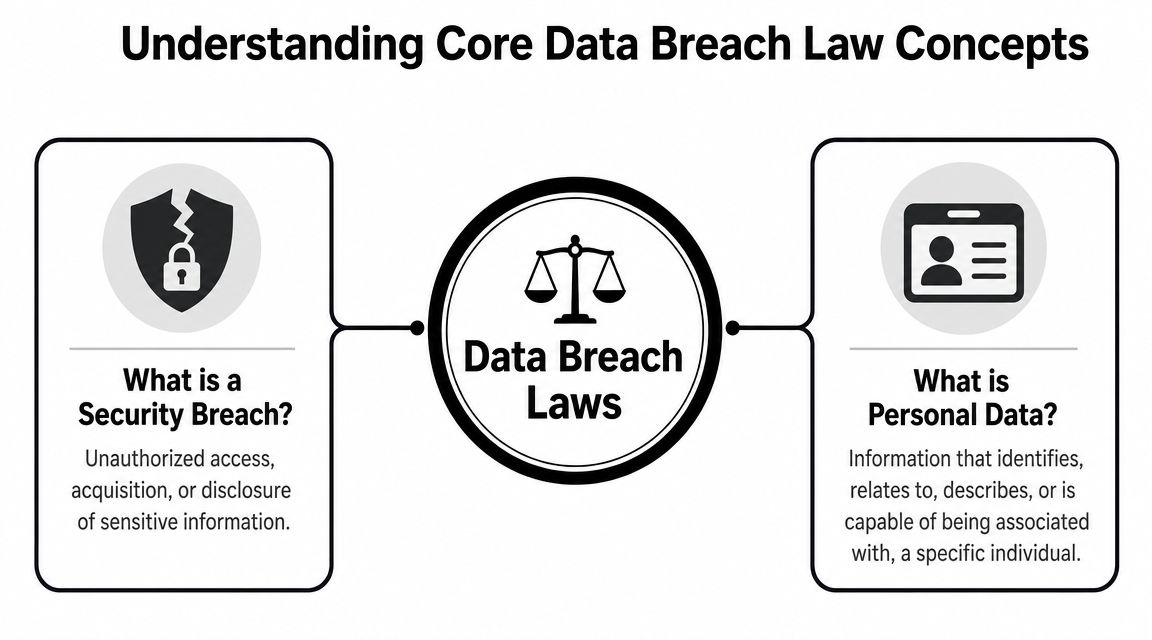
Most confusion starts with two terms: security breach and personal information. Business leaders often assume both are narrower than they really are. That assumption causes problems during office cleanouts, facility cleanouts, and device retirement projects.
What a security breach usually means in business terms
Across state laws, the exact wording varies, but the working concept is straightforward. A breach usually involves unauthorized access to, acquisition of, or disclosure of protected information. That can happen through hacking, theft, accidental release, or poor disposal controls.
For ITAD planning, one point matters more than legal phrasing. A breach doesn't require a dramatic ransomware event. If a retired device leaves your possession and readable sensitive data is still on it, you may be dealing with the same legal framework as a more obvious cyber incident.
That is why secure data destruction belongs in the same conversation as incident response. A loading dock mistake can become a privacy issue just as fast as a phishing attack.
Personal information is broader than many teams expect
Businesses often focus on obvious data elements such as account numbers or Social Security numbers. That is too narrow for modern compliance. Depending on the state, protected information can extend to combinations of identifiers, online account credentials, medical information, or biometric data.
A simple way to think about it during IT equipment disposal is to ask what categories of people your systems touch and what kinds of records may live on those devices:
- Employee data can include payroll records, benefits files, tax forms, onboarding documents, and performance records.
- Customer data may include billing details, contact information tied to account access, service histories, and support logs.
- Patient or client data often reaches into medical, behavioral, or other sensitive records.
- Operational data can hide in old servers, multifunction printers, phones, and portable drives, even when the device looks inactive.
A copier hard drive, a lab workstation, and an executive laptop don't create the same risk profile. Treating them the same is where disposal programs break down.
For teams building internal rules, it helps to review examples of privacy practices for legal AI tools because those frameworks force organizations to think clearly about what data they collect, where it flows, and who can access it. The same discipline applies to retired hardware.
The practical test before anything leaves the building
Before approving donation, resale, recycling, or product destruction, ask three questions:
Does the asset store data directly or indirectly?
Servers and laptops are obvious. Network appliances, printers, medical devices, test equipment, and phones are often overlooked.What kind of people-related information may be on it?
HR, patient, customer, student, donor, and vendor data all matter.Can the business prove the data was rendered unreadable?
If the answer depends on verbal assurance, your process isn't mature enough.
Navigating the Patchwork of State Law Variations
The biggest operational mistake is building a disposal policy as if one breach standard applies everywhere. It doesn't. The patchwork isn't just annoying legal theory. It changes how fast you must act, what data triggers obligations, and what kinds of records count in the first place.
Where state laws diverge
The 2026 50-state survey from Privacy Rights Clearinghouse shows that 20 states (39%) specify a numeric deadline for consumer breach notification, with deadlines ranging from 30 to 60 days, while the remaining 31 states use softer language such as “without unreasonable delay.” The same survey shows that 22 states explicitly cover biometric identifiers, 24 states cover medical or health data, and only 9 states (18%) cover paper-record breaches.
For multi-state businesses, that means one disposal failure can produce very different legal analyses depending on where affected individuals live and what type of information sat on the asset.
Why this matters for physical asset retirement
An IT team might think, "We only moved surplus equipment." Legal may ask different questions:
| Issue | Why it changes the response |
|---|---|
| Notification timing | Some states expect action within a defined window. Others use a reasonableness standard that still requires fast, documented judgment. |
| Data category | A biometric timeclock, medical workstation, or HR laptop may trigger different obligations than a generic office PC. |
| Record format | Businesses with mixed digital and paper workflows can't assume disposal risk is limited to electronic media. |
A one-size-fits-all incident playbook usually fails at the edges. The more locations, business units, and data types you have, the more dangerous "standard recycling" becomes as a control model.
The cleanest operational answer is to make disposal security stricter than the minimum legal standard, not tailored to the weakest one.
That is one reason many organizations standardize on a single national ITAD process even when state law varies. If you operate in more than one jurisdiction, your disposal workflow should assume broad data definitions, strict handling, and documented proof. Businesses looking at regional disposal planning can see how this plays out in practice through a market-specific example such as California electronics recycling services, where operational volume and privacy expectations often collide.
What doesn't work
Three habits create repeat problems:
- Using local junk removal logic for regulated devices
- Letting each office choose its own recycling vendor
- Separating legal review from facilities and IT execution
Those shortcuts save time at the front end and create expensive ambiguity later.
What Counts as Reasonable Security in Practice
"Reasonable security" sounds flexible. Sometimes that helps. Often it gives companies false comfort. If nobody translates that phrase into operating controls, it becomes a policy statement with no effect on what happens in storage rooms, loading areas, and decommissioning projects.
Massachusetts shows what concrete expectations look like
Massachusetts is the most technically prescriptive state model in this area. According to EPIC's overview of state consumer data security policy, Chapter 93H and 201 CMR 17.00 require an information security program adapted to business size and data sensitivity, along with controls such as employee security training, third-party service-provider oversight, annual risk-review cycles, strong user authentication, access restrictions, secure storage, and encryption for data in transit and on portable devices.
That framework matters because it treats compliance as an ongoing governance duty. It isn't limited to what happens after a breach.
How to translate that into ITAD controls
In practice, a reasonable security program should reach the end of the asset lifecycle. That includes:
- Role-based approvals so nobody can dispose of data-bearing equipment informally
- Asset inventory controls that identify devices, media, ownership, and disposition path
- Vendor oversight that verifies how downstream handlers transport, sanitize, shred, and document assets
- Secure storage before pickup so retired hardware isn't left in hallways or unsecured cages
- Portable media controls because thumb drives, backup drives, and removable media are frequently mishandled
If a business wants a benchmark for downstream handling expectations, reviewing standards tied to NAID AAA certification for secure destruction providers is a practical start. It helps procurement and compliance teams ask sharper questions about process discipline, not just pricing.
A related operational lens is vendor risk. The weak point is often not your internal policy but the outside party touching assets after pickup. A concise vendor exposure handbook can help teams think through transport, subcontracting, and documentation failures before they show up in an incident review.
Reasonable security isn't abstract. It is employee behavior, storage controls, authentication discipline, encryption, vendor management, and disposal proof working together.
Key Exemptions That Limit Your Liability
Not every security event leads to the same notification outcome. That distinction matters because businesses often spend heavily on incident response after neglecting the controls that could have narrowed the issue at the start.
Why unreadable data changes the equation
A common principle in state breach analysis is that data rendered unreadable, unusable, or otherwise protected may not trigger the same reporting obligations as exposed readable data. The exact legal wording varies by state, but the business takeaway is consistent. Encryption and other effective protective measures can materially change your exposure.
This is one of the few areas where technical controls and legal outcomes line up cleanly. If an asset is lost, stolen, or mishandled, the first question isn't only "What was on it?" It is also "Could anyone use what was on it?"
Disposal is where this principle becomes operational
For end-of-life electronics, there are two practical paths:
- Certified sanitization for assets that will be reused, donated, remarketed, or redeployed
- Physical destruction for media that should never leave the chain of custody in readable form
This is why professional hard drive shredding, degaussing where appropriate, and documented destruction aren't overhead. They are legal risk controls. They help a business argue that the information was not accessible in a meaningful way.
What doesn't work is partial wiping, informal reformatting, or reliance on an employee saying a device was "cleaned off." That kind of language collapses under audit, litigation, and regulator inquiry.
Where businesses usually miscalculate
They focus on the visible cost of secure destruction and ignore the downstream cost of uncertainty. If you can't prove a drive was encrypted, wiped to an appropriate standard, or physically destroyed, you may have to proceed as if the data remained exposed.
A better approach is to set clear rules by asset class. For example, devices leaving through donation-based recycling may be eligible for reuse, but only after approved sanitization and documentation. Failed drives, legacy media, and high-risk systems should move directly to destruction.
The point isn't to destroy everything. It's to ensure that every asset has a defensible disposition path tied to actual risk.
How Proactive Compliance Can Create an Affirmative Defense
Some state developments are shifting the conversation from pure notification toward proof of preparation. That is a meaningful change for executives deciding whether cybersecurity governance, recordkeeping, and secure disposal controls are worth the investment.
Written programs can matter after an incident
According to Jackson Lewis on the patchwork of state breach notification laws, an increasing number of states have moved toward reasonable-safeguards rules and affirmative defenses tied to written cybersecurity programs. The same analysis notes that Connecticut now limits punitive damages for entities with a documented cybersecurity program aligned to recognized frameworks, and that Utah's Cybersecurity Affirmative Defense Act allows a defense for certain breach-related claims if a business maintains and reasonably follows a qualifying written program.
This is a practical legal point, not a theoretical one. When a business can show that it had a documented program, trained staff, controlled vendors, and followed its own procedures, it stands in a stronger position than a business whose policy binder never matched its operations.
Why ITAD documentation belongs in that program
A written cybersecurity program that ignores asset retirement has a visible hole. Regulators, plaintiffs' counsel, and internal investigators all know that data doesn't disappear just because the business replaced the device.
That is why chain-of-custody records, serialized pickup logs, sanitization records, and certificates of destruction matter. They help prove that the company didn't just write a policy. It executed one.
For teams building that evidentiary trail, controls around chain of custody documentation for IT assets are especially relevant because they show who handled the equipment, when custody changed, and what happened to the data-bearing components.
A documented program only helps if the records show the business followed it under real operating conditions.
Compliance, insurance, and defensibility
Cyber insurance and legal defense strategy often turn on the same question: can the business demonstrate mature controls? That includes endpoint security, training, access management, vendor diligence, and disposal governance. Organizations reviewing business security coverage options should read the fine print with that in mind. Insurers and counsel both care about what the company can prove.
The strategic lesson is simple. Secure ITAD isn't just housekeeping. It can become part of the factual record that supports reduced liability, stronger defenses, and a more credible response after an incident.
Your Step-by-Step Guide to Secure ITAD Compliance
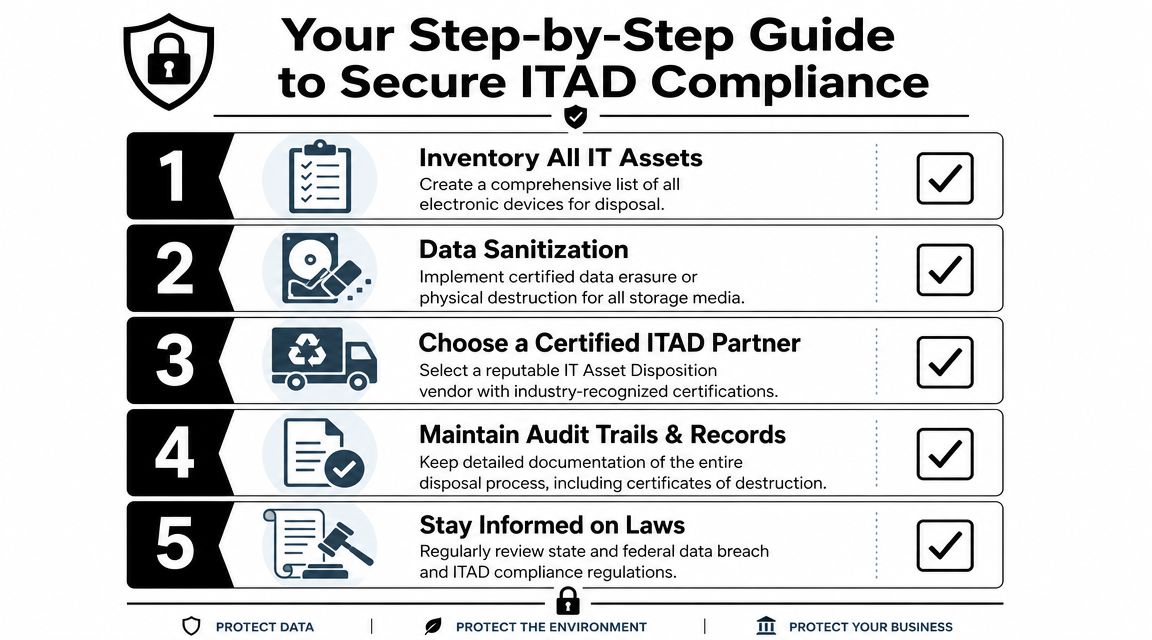
Policy only helps if staff can run it the same way every time. A workable disposal process should be simple enough for operations and strong enough for legal review.
Build the workflow before the pickup date
Use a repeatable sequence, not an ad hoc cleanup sprint.
Create a full asset inventory
Include laptops, desktops, servers, phones, networking gear, printers, removable media, storage arrays, lab systems, and medical devices. Flag anything that stores or may cache data.Classify by risk and disposition path
Some assets can be sanitized and reused. Others should be physically destroyed. Decide this before equipment moves.Lock down interim storage
Retired devices shouldn't sit in common areas, open bins, or unsecured docks. Assign custody and restrict access.
Vet the downstream process
Vendor selection is where many programs become either defensible or fragile.
Ask for specifics on sanitization standards, shredding procedures, transport security, serialized tracking, subcontractor use, and final reporting. If your program includes secure data destruction, the operational benchmark should be documented and auditable. Businesses evaluating providers for this stage should review secure data destruction services as part of a broader ITAD checklist.
One practical option in this space is Reworx Recycling, which handles electronics recycling, secure data destruction, pickup logistics, and donation-based recycling workflows for organizations retiring business equipment. The useful point for compliance teams isn't branding. It's whether the provider's process supports documented custody, verified destruction, and sustainable routing for non-data-bearing assets.
Keep the records that matter
A compliant process usually produces several records, not one:
- Inventory logs that tie assets to business units or locations
- Pickup records showing date, quantity, and transfer of custody
- Destruction or sanitization evidence tied to serial numbers where available
- Internal approvals confirming the disposition method was authorized
- Exception logs for missing assets, damaged labels, or unscannable media
If a regulator, insurer, or attorney asks what happened to a retired drive six months later, "we think it was recycled" is not a usable answer.
Review and improve after each project
Treat every office cleanout, laptop refresh, or data center decommissioning job as a test of the process. Look for missed serial numbers, unauthorized staging, incomplete forms, or assets discovered after the pickup. Those are warning signs.
A strong ITAD compliance program gets better with repetition. It doesn't depend on the same two careful employees remembering all the details.
Partnering for Compliance and Community Impact
Most companies don't need more theory about cyber risk. They need a disposal process that is effective in practice. State data breach laws are complex, definitions vary, and legal exposure doesn't begin and end with malware or phishing. Old electronics can become the breach vector if the last mile of the asset lifecycle is poorly controlled.
The most reliable response is disciplined and boring in the best sense. Inventory the assets. Restrict custody. Sanitize or destroy data properly. Document every handoff. Vet the downstream vendor. Keep records you can produce later.

Why vendor choice affects more than disposal
A recycling partner isn't just moving surplus gear offsite. That provider may be handling the part of your security program that is easiest to overlook and hardest to reconstruct after something goes wrong.
That means selection criteria should include more than pickup availability or commodity value. Procurement, IT, compliance, facilities, and sustainability teams should align on handling controls, documentation, data destruction methods, reuse standards, and community or environmental outcomes. A structured set of vendor selection criteria for ITAD and recycling providers helps make that evaluation more consistent.
Compliance and mission can work together
There is no conflict between security and sustainability when the process is built correctly. Secure sanitization can support reuse. Controlled destruction can protect sensitive data. Donation-based recycling can extend device life where appropriate. Corporate donation programs can also support digital inclusion when equipment is suitable for redeployment.
That combination is useful for business leaders under pressure from multiple directions. Legal wants defensibility. IT wants certainty. Facilities wants clean execution. Sustainability wants responsible recycling. Leadership wants reduced risk and a process that reflects company values.
The strongest programs satisfy all of those demands with one workflow instead of five separate ones.
If your business is planning a technology refresh, office cleanout, medical equipment disposal project, or data center decommissioning effort, Reworx Recycling can be part of a practical next step. Review your current disposal process, identify where data-bearing assets create unnecessary exposure, and line up a documented path for pickup, secure data destruction, sustainable recycling, or corporate donation. The right process protects your business and puts retired equipment to work in a way that supports communities too.