The usual advice for recalled electronics is to hire a destruction vendor and collect a certificate. That's not enough. A pallet count proves quantity, not serial-level disposition, and a certificate listing only a total can't establish which affected devices were destroyed.
Serialized recalled product destruction requires an evidence trail from the affected-population file to each unit's final disposition. For a Smyrna, Georgia, business planning an office cleanout, or an Atlanta-area organization managing medical equipment disposal, the critical distinction is the same: ordinary surplus equipment and recalled products need different release decisions.
Reworx Recycling's environmental and community mission supports responsible equipment retirement. But donation, refurbishment, and material recovery must never override a recall's authorized remedy. The paperwork must establish what happened to each affected unit before anyone closes the file.
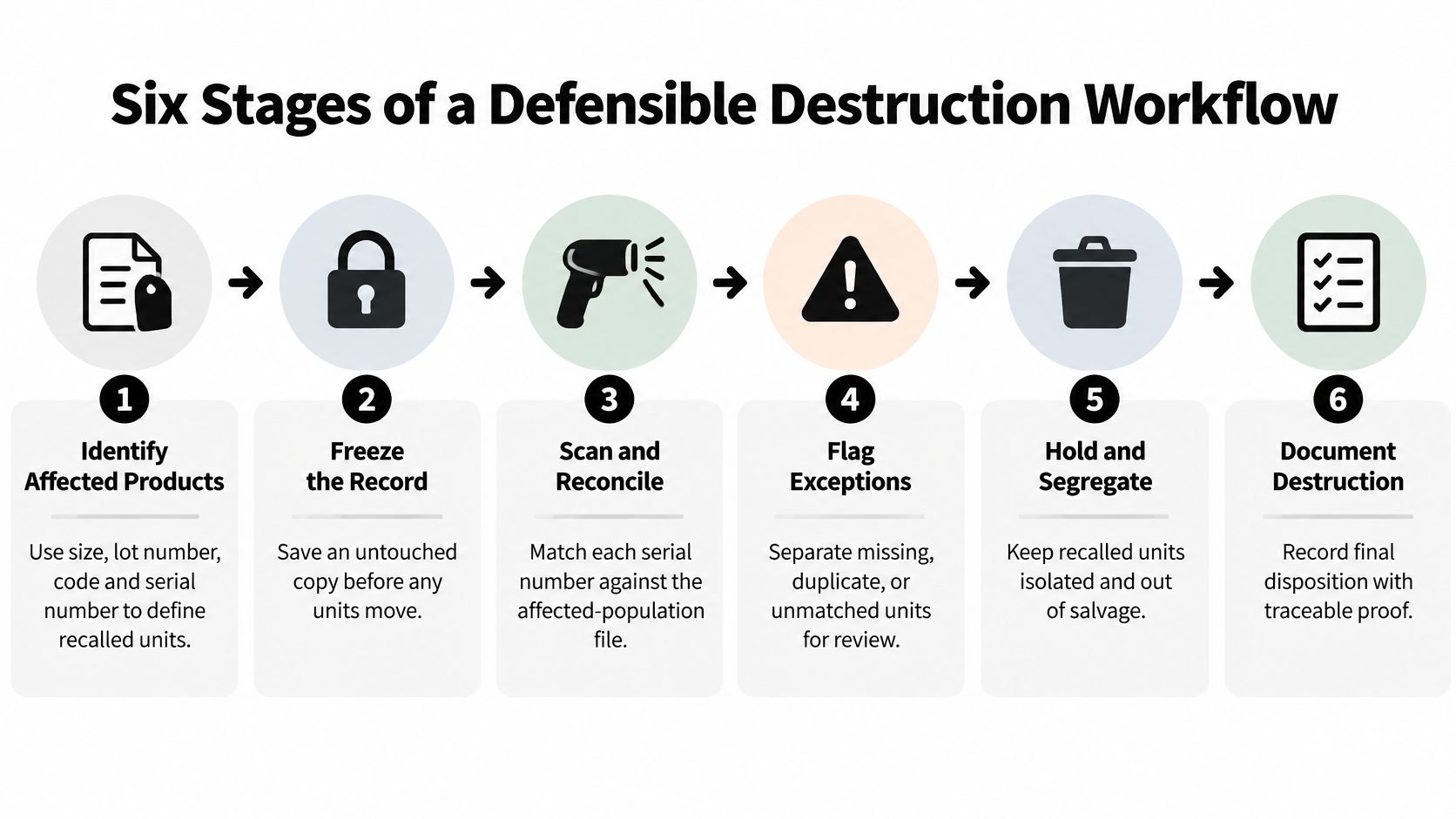
Six Stages of a Defensible Destruction Workflow
Serial numbers determine whether you can connect the product on a destruction record to the product named in a recall. The FDA's device-recall guidance calls for clear identification through details such as size, lot number, code, and serial number, together with distribution records that help locate recalled products.
That framework isn't an electronics-recycling standard. It does provide a useful model: track the unit from manufacturer or distributor through customer, warehouse, or service location, then record its authorized disposition.
Controls that connect identity to outcome
Six stages of serialized recalled product destruction
| Stage | Key control | What it proves | Common failure |
|---|---|---|---|
| 1. Define the recall population | UDI, GTIN, lot, serial, software revision, expiration date | Exactly which units are affected | Matching on lot number alone |
| 2. Quarantine | Physical and electronic segregation from acceptable stock | Recalled units never re-enter inventory | Returns mixed with good product |
| 3. Reconcile | Received units matched to shipment, return and exception records | No unexplained units | Reconciling by pallet or bulk count |
| 4. Approve method and notify | Regulator notice or approval of method, date, location and witnesses | Destruction was authorized before it happened | Destroying first and documenting later |
| 5. Destroy | Method that prevents reuse or recovery | Units cannot be recovered or resold | Vague shredded labels with no defined criteria |
| 6. Record disposition | Serial, quantity, date, method, location, operator, final disposition | Every serial has a closed record | Certificate with totals but no serial detail |
Treat these as release gates, not tasks that staff can complete retrospectively. The recall coordinator determines the applicable authorization requirements; warehouse staff shouldn't infer permission from a pickup booking.
The supporting chain-of-custody record should carry the recall reference and unique identifier through every handoff. For data-bearing equipment, also distinguish product destruction from verification that stored information is irrecoverable.
A warehouse status such as shipped isn't a final outcome. Neither is received by recycler. Assign explicit statuses, including quarantined, authorized for destruction, destroyed pending verification, and disposition closed.
Practical rule: For any serial number, the record must answer where it was, what happened to it, and who recorded the event.
Intake, Serial Reconciliation and Exception Handling
Build intake around the affected-population file, not the delivery truck's manifest. A manifest describes what the sender says it shipped; receiving staff must establish what arrived.
- Freeze the population file. Save an untouched, access-controlled copy before movement begins. Keep later amendments separately, with their approval history.
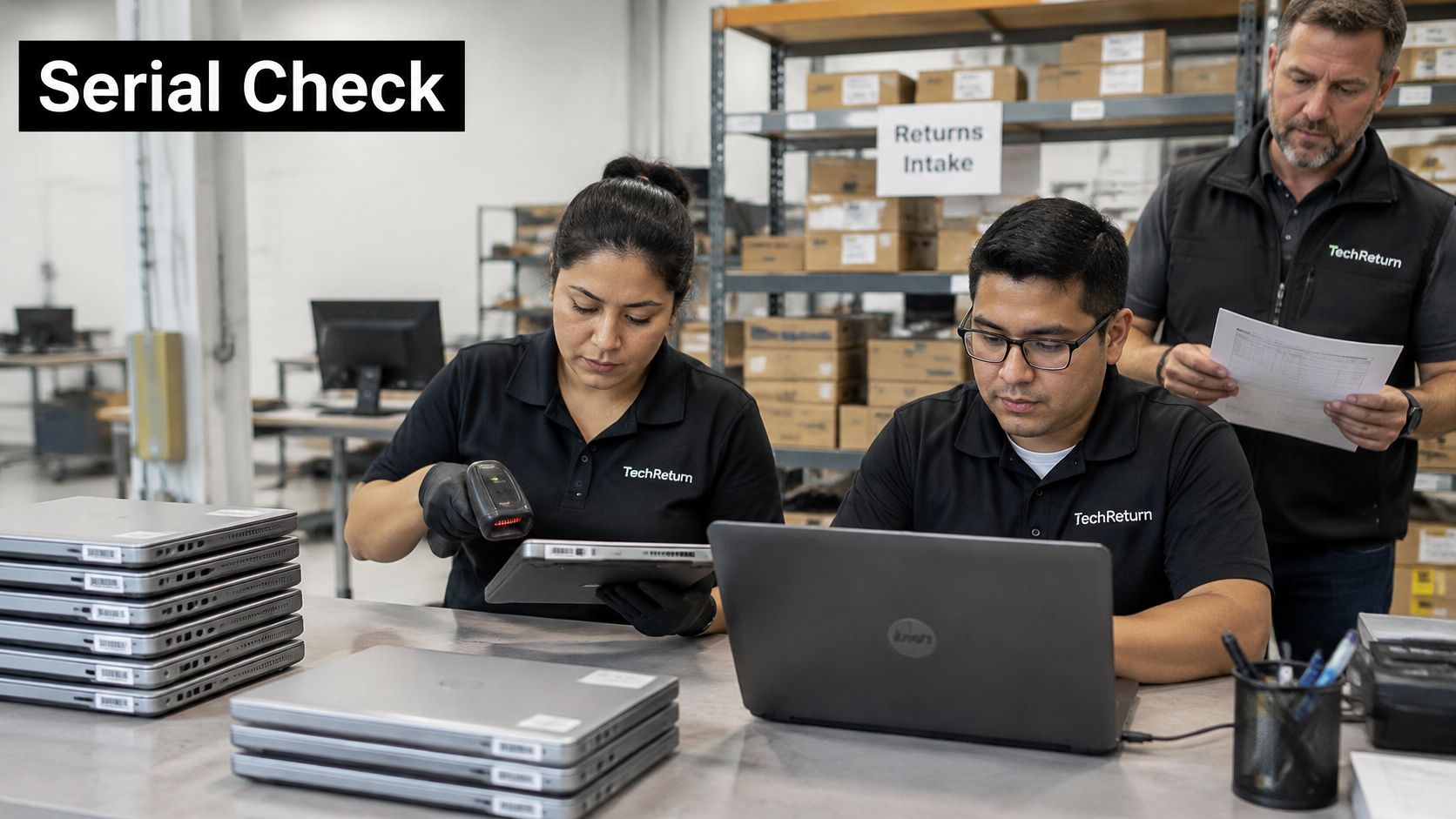
- Scan each unit at receipt. Match the barcode or entered serial against the recall file. Capture the lot, product identifier, receipt date, location, operator, and status.
- Apply physical and electronic holds. Attach a quarantine tag and place the unit in a locked, labeled area. Block picking, resale, donation, and ordinary inventory transfers in the system.
- Reconcile movements. Match receipts to shipment, return, and transfer records. Use the balance received + net transferred − destroyed − approved exceptions = zero unexplained units, with inbound and outbound transfers assigned consistent signs.
- Route exceptions for dual-person approval. Name a resolver and an independent reviewer. Don't let the person correcting an identifier approve their own correction.
The FDA's destruction-planning guidance supports prompt inventory, segregation, product-identifying records, and documentation of destruction arrangements. Barcode scans and controlled exception approvals make those principles workable during a busy receiving shift.
Resolve exceptions without inventing identities
Exception types, causes and required actions
| Exception | Likely cause | Required action | Record kept |
|---|---|---|---|
| Unreadable serial | Damaged label or poor scan | Verify visually, enter by hand and flag for dual approval | Exception log entry with reviewer initials |
| Duplicate serial | Two units share an identifier or a data-entry error | Hold both units and trace them to the shipment record | Exception log entry and resolution note |
| Serial not on recall list | Wrong lot or unrelated return | Remove from the recalled batch and confirm against the recall file | Reconciliation note with reason |
| Count mismatch | Missing or unrecorded transfer | Recount, check transfer records, then escalate if unresolved | Variance report with owner and date |
| Unit held for investigation | Diverted for root-cause testing | Keep separate and log custody until released | Custody transfer entry |
| Bulk container without serials | Pallet or gaylord arrives unscanned | Scan each unit before destruction or refuse the bulk count | Itemized scan log |
If visual inspection still can't recover a serial, photograph the label and retain an exception identifier. The recall coordinator must approve the alternative identification evidence; staff shouldn't guess a missing character.
Greater serialization exposes problems that lot-level tracking can conceal: truncated scans, duplicate identifiers, inconsistent formatting, and undocumented transfers. Configure asset tracking systems to preserve the original scan alongside any normalized value.
At Reworx Recycling, our process has four steps: schedule a drop-off or pickup, prepare the electronics, securely wipe or shred data-bearing devices, and recycle responsibly. Our team handles a single item or a bulk load, but shipment size doesn't replace the identification controls needed for a recall.
A sealed pallet can be accepted into quarantine without being accepted as reconciled inventory. No serial moves to destruction without a matched, authorized record.
Approved Destruction Methods and Proof of Irrecoverability
Destruction methods by media type and proof required
| Method | Best for | Proof to request | Main limit |
|---|---|---|---|
| Hard drive shredding | Hard drives, solid-state drives, tape, using media-appropriate equipment | Shred size criteria in writing and inspection of sample output | Particle size must be defined in writing |
| Degaussing | Magnetic hard drives and tape | Degaussing record per media serial | Does not reliably cover flash-based solid-state drives |
| Software erasure | Units that stay in your control and are not recalled | Erasure report with verification result per serial | Often insufficient alone where reuse must be prevented |
| Physical destruction of chips and boards | Circuit boards and memory modules | Inspection evidence of destroyed components | Requires defined inspection sample size |
| Recycling after verified destruction | Electronics with no remaining storage media | Recycling record linked to each serial | Only after destruction is verified |
Select the method for both the recall remedy and the storage medium. Degaussing targets magnetic media, not flash memory; an SSD therefore needs an appropriate alternative. Software erasure may address information risk while leaving the recalled product usable, so it can't automatically satisfy a destruction instruction.
Our data destruction methods include hard drive shredding and data erasure to remove information beyond recovery. At Reworx Recycling, we securely wipe or shred data-bearing devices to protect customers' information; recall-specific acceptance criteria still need to be established before processing.
Verification is a separate decision
NIST's media-sanitization guidance distinguishes performing sanitization from verifying its outcome. For destructive methods, inspection of remnants or equipment helps establish that destruction occurred, rather than merely that a machine ran.
Use this verification sequence:
- Record device and media serials. Link a removable drive to its parent laptop, server, or instrument before separation.
- Choose by media type and risk. Document why the technique addresses the storage technology and authorized recall outcome.
- Control processing access. Identify the operator, processing location, and released batch.
- Inspect representative output. Follow the applicable sampling plan and check for intact platters, chips, or recoverable assemblies.
- Rework failed units. Record the failure, additional processing, and subsequent inspection result.
- Attach verification evidence. Associate the result with each serial or an explicitly justified batch.
There's a trade-off between individual observation and batch verification. Individual observation offers tighter attribution but takes more handling; batch verification needs a defensible sampling plan and reliable batch membership. Don't choose a sample size just because it makes the job faster.
A successful machine cycle is processing evidence. It isn't, by itself, proof of irrecoverability.
Review data sanitization methods against the actual media inventory. For laboratory equipment disposal, that inventory may include embedded memory as well as an obvious removable drive.
Reject paperwork that says shredded without defining acceptable output. Also challenge certificates disconnected from serial reconciliation, mixed recalled and acceptable units, or investigation samples removed without authorization. Before release, ask: What particle-size criterion applies, what inspection sample size will be used, and where will verification failures and reprocessing appear in the records?
Regulator Notice, Certificates and Audit Trail
Use the certificate as an index to supporting evidence, not as a substitute for it. A concise certificate can work if its referenced serial file, custody logs, and verification records remain available together.
Certificate of destruction fields and what auditors check
| Field | What to record | Audit check |
|---|---|---|
| Recall reference | Campaign identifier and affected product | Matches the recall notice |
| Serial list | Itemized serial numbers or a referenced itemized file | Every serial assigned to the event appears once and reconciles to the population |
| Quantity destroyed | Units destroyed, counted against received units | Reconciles to zero unexplained units |
| Destruction date | Date of the destruction event | Falls after required regulator notice and before the file closes |
| Method | Shredding, degaussing, erasure or physical destruction | Method is the one approved or notified |
| Location | Facility address where destruction occurred | Matches custody transfer records |
| Operator and witness | Name of employee and witness with signature | Signatures present and consistent with logs |
| Verification result | Inspection outcome and any reprocessing | Failed units are documented and reprocessed |
| Custody reference | Link to transfer and scan logs | Chain of custody is unbroken |
| Final disposition | Destroyed, recycled, returned or held | Matches inventory system update |
| Vendor certification | Signed statement from the destruction provider | Covers the same serials as the certificate |
A returned or held unit belongs in the disposition register, not in the certificate's destroyed total. Likewise, a serial still awaiting return must remain open rather than being omitted to make the reconciliation appear complete.
Authorization and event records
Document the notice decision before processing. Have the recall coordinator confirm the governing agency, proposed method, date, location, and witness arrangements. Keep the notification and any response with the destruction authorization, rather than relying on an email reference in the vendor's booking system.
Prepare the appropriate event statement. The CPSC Recall Handbook says approved on-site destruction documentation should identify the recalled products, unit count, destruction date, and employee performing the work, with employee and witness signatures; an affidavit is preferred. For off-site work, its recommendations include written vendor instructions, marked boxes and pallets, no commingling or salvage, certification after completion, and an inventory update.
Assemble the audit log. Retain timestamped receipt and destruction scans, custody transfers showing names and times, exception approvals, and the reconciliation report. Preserve corrections as amendments rather than overwriting the original entry.
Use certificate requirements to agree on deliverables before shipment. At Reworx Recycling, our third step, Certification & Reporting, provides detailed reports and a Certificate of Destruction; the recall file should specify how those deliverables connect to its itemized inventory.
Reporting ownership and closure
Assign accountable owners. The recall coordinator maintains regulatory status reporting and authorizes disposition. The warehouse custodian controls physical inventory and transfers, while the destruction vendor supplies processing and verification evidence. Give unresolved variances a named owner rather than a shared inbox.
Separate job completion from recall termination. Under FDA recall regulations, a firm requesting termination submits a written request with its latest recall status report and a description of disposition; FDA considers removal or correction efforts and disposition in proportion to the hazard. A completed destruction shipment doesn't establish that the entire recall qualifies for termination.
Set retention for the applicable product regime. For pharmaceutical products within the DSCSA framework, preserve tracing and disposition records for at least six years, as described in FDA's DSCSA guidance. Don't apply that period automatically to every electronics recall; have the coordinator confirm applicable retention obligations and legal holds.
Make the closed file portable. Export the serial register, signed certificate, exception history, and attachments in readable formats rather than relying exclusively on a vendor portal that staff may later lose access to.
The audit test is straightforward: can an auditor choose any serial and trace it to its authorized disposition, destruction evidence where applicable, and signed documentation in minutes? If retrieval requires reconstructing events from personal inboxes, the file isn't ready to close.
Choosing and Overseeing a Destruction Vendor
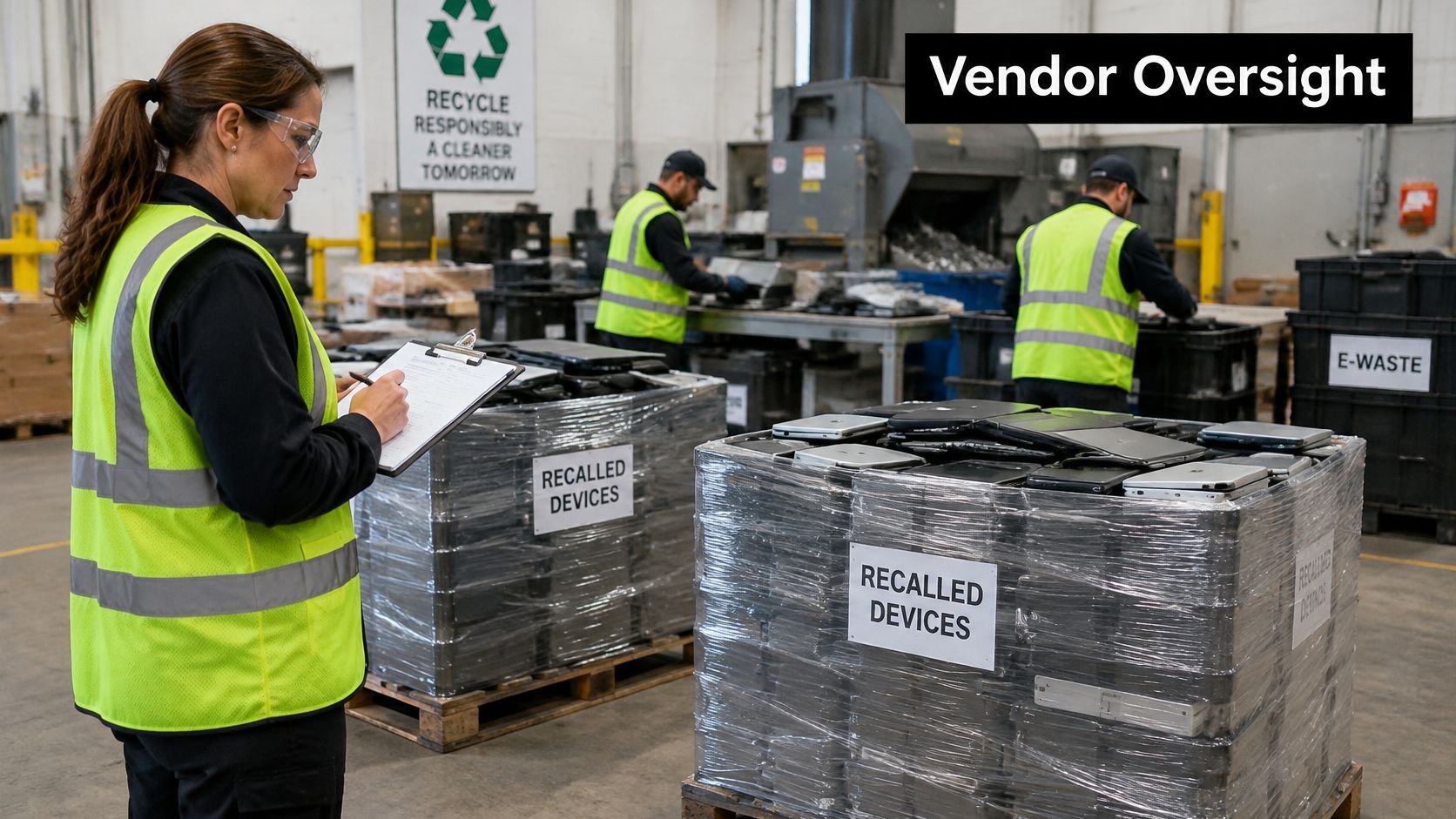
A pallet count proves quantity, not serial-level disposition. The CPSC's Regulated Products Handbook says recalling firms should monitor third-party disposal, maintain segregation, prevent commingling and salvage, and notify agency staff before destruction, disposal, or recycling. Staff may witness the event or require an affidavit with photographic evidence.
Turn those responsibilities into written purchasing requirements. For Smyrna businesses arranging IT equipment disposal or Atlanta-area teams managing data center decommissioning, convenient transport matters, but it does not replace traceable records.
Questions for the buyer's call
- Written scope: Does the work order identify the recall, serial file, permitted processing, and prohibited dispositions?
- Site control: Who can access quarantine and processing areas, and which monitoring records will be retained?
- Subcontractors: Which transporters and downstream processors will handle the units?
- Intake evidence: Can the provider reconcile individual serials rather than report pallet totals?
- Acceptance criteria: Are the destruction method and verification requirements specified in writing?
- Certification: Will the provider issue a signed certificate covering the completed work?
- Transport custody: Will sealed, labeled loads have documented handoffs and discrepancy reporting?
- Risk controls: Can the provider furnish relevant insurance information and a documented data-security policy?
- Deadlines: When are receipt discrepancies, processing results, and final reports due?
Ask for a redacted sample certificate and a demonstration using a sample serial. Agree on a retrieval deadline. The provider should be able to connect that serial to intake, authorized transfers, processing evidence, and its final record.
A lower-cost batch report may suit ordinary computer recycling, but it leaves a traceability gap when the recall requires unit-level proof. Put the vendor selection criteria into the purchase order so the agreed evidence becomes a deliverable.
Apply the same standard to mission-led recycling
Reworx Recycling is an electronics recycling and IT asset disposition partner based in Smyrna, Georgia. Ask any provider for its serial-traceability approach, verification documentation, and subcontractor disclosures before authorizing release.
Evaluate the records against the authorized disposition. Recalled equipment must follow its approved remedy; eligible non-recalled assets can be considered for other dispositions.
Schedule a Compliant Destruction Pickup for Your Recall
A pallet count proves quantity, not serial-level disposition. Before booking a pickup or drop-off, reconcile the affected-product file and resolve any intake exceptions. The movement should follow an approved plan, not force a rushed decision.
Confirm that the recall coordinator has authorized the disposition and destruction method. Then arrange a Reworx Recycling pickup or drop-off, and specify the records needed to connect each processed serial to its intake record. A Certificate of Destruction is provided for every task fulfilled and serves as documentation for audits and legal matters.
Keep non-recalled equipment separate from the recall load until its disposition is decided. Reworx offers responsible electronics recycling, free data destruction, and equipment buyback options for surplus hardware. These services do not replace the recall's approved destruction path.
Reworx Recycling also reports that 99.9% of the electronics it processes are saved from landfills. To arrange service, contact Reworx to schedule a pickup or drop-off and identify the equipment and data-destruction needs.