Your team has pulled recalled laptops from service, the carrier is booked, and someone wants the storage room cleared before the next delivery. Then the questions start: Does the pallet contain every affected device? Who signed for the loose drives? Will the final certificate identify the equipment you handed over?
For an IT or logistics manager in Smyrna, Georgia, those questions belong in the pickup plan, not in an investigation afterward. Product recall chain of custody services connect the affected inventory to controlled collection, transport, treatment, and final disposition. The measure of success isn't how many messages you sent. It's whether you can prove what happened to each unit.
Custody Records Every Recall Needs at Each Handoff
Product-recall chain of custody is the documented, unbroken trail showing who held each recalled unit, when they held it, its condition, and where it ended. Think of a police property-room log: a missing entry weakens the evidence even if the item is still on the shelf.
An asset tag, serial number, IMEI, or MAC address connects the entries. Use the manufacturer's serial as the primary identifier where available, and associate internal asset tags with it rather than replacing it. A pallet number identifies a shipment container, not necessarily its contents.
Required records and evidence by custody stage
| Custody stage | Record to capture | Evidence to keep |
|---|---|---|
| Collection at site | Asset tag or serial, quantity, collecting person, timestamp | Photographs, signed collection sheet |
| Transport | Carrier name, consignment note, departure time | Tamper-evident seal number, driver ID |
| Receiving and quarantine | Scanned count, reconciliation to manifest, quarantine location, authorized user | Scan log, exception report |
| Processing | Repair, refurbish or recycle decision, technician ID | Work order, condition notes |
| Sanitization or destruction | Method, operator, verification result | Verification record, sanitization certificate |
| Final disposition | Destination facility, closing date | Certificate of destruction or recycling receipt, certificate number |
Separate the entry from its supporting evidence
The record says what happened. The evidence supports that statement. A receiving entry showing accepted equipment is stronger when it connects to a scan log, a signed receipt, and photographs of the container's seal.
Custody commonly breaks when staff substitute a container count for an asset count, sign before unloading, or store photographs without identifying the equipment pictured. Make those connections explicit in your chain-of-custody documentation. Record discrepancies while both parties can inspect the load, rather than accepting an unexplained shortage for later investigation.
Practical rule: A signature confirms only what the accompanying record actually describes.
Run a simple retrieval test before collection: choose any unit from the recall list and follow its identifier through the planned records to a final status. If the trail stops, create an exception with a named owner and required evidence. Don't hide the gap in a shipment note or mark the device resolved because the truck departed.
Why Recall Custody Matters for Legal and Regulatory Risk
A shipping receipt proves a transfer occurred. It doesn't prove that a recalled device stayed out of resale inventory, that its storage was sanitized, or that the receiving facility completed the authorized remedy.
The National Institute of Standards and Technology's original Special Publication 800-88, issued in 2006, established guidance for making residual data on retired or transferred media infeasible to recover. That's a technical foundation for documented disposal controls, not a universal statute requiring every business to use an identical process. The operational implication is clear: delivery evidence and data-treatment evidence answer different questions.

International movement adds another evidence requirement
The Basel Convention implementation review identifies May 5, 1992, as the treaty's entry-into-force date and explains its foundation in controlling cross-border waste movements. For an electronics recall, don't assume a domestic collection address means every downstream movement remains domestic.
The Basel Convention's e-waste amendments guidance explains that transboundary e-waste movements are subject to prior informed consent, including notification, applicable written consents, and movement documentation. Establish whether material is waste, where it will travel, and which approvals apply before authorizing an international downstream route.
Build records around the questions you'll face
Weak evidence leaves different people asking different questions:
- Regulator: Which affected units reached which facility, and what happened there?
- Insurer: When did custody transfer, and who controlled the equipment when the loss occurred?
- Customer: How was stored information protected before the device left your control?
- Board or executive team: What remains unresolved, and who authorized closure?
Your data security and compliance planning should give each question an evidence owner. Don't wait for a future traceability mandate or a replacement ERP to create that responsibility.
Custody records are receipts an auditor reads backward, from the final outcome to the initial collection. Test whether your team can assemble those answers within a working day. Treat that as an internal readiness exercise, not a regulatory deadline.
Choosing a Sanitization or Destruction Method for Each Device
Choose the data-treatment method before equipment leaves the site. Device condition, storage technology, information sensitivity, and the recall remedy should determine the route, not the remaining resale value.
The NIST media-sanitization framework distinguishes sanitization, which makes access to target data infeasible, from destruction, which makes the medium permanently unusable. It identifies disintegration, pulverization, melting, and incineration as destruction techniques typically handled by specialized facilities.
Sanitization outcome by device condition
| Device condition | NIST outcome | Typical method | Final disposition |
|---|---|---|---|
| Working drive, low sensitivity, reuse planned | Clear | Overwrite with verification sample | Reuse or donate after recall clearance |
| Working SSD or drive, sensitive data, reuse planned | Purge | Cryptographic erase where supported; degaussing only for appropriate magnetic media, with verification record | Reuse, donate or resell only if the method preserves usability and verification succeeds |
| Failed or damaged drive, any sensitivity | Destroy | Shredding or pulverization with certificate | Recycle as scrap |
| Highly sensitive media, any condition | Destroy | Physical destruction by a licensed facility | Recycle as scrap with certificate |
Match the technique to the storage
Degaussing isn't an SSD treatment, and it generally doesn't preserve a modern hard drive for reuse. Cryptographic erase requires suitable encryption and key-management conditions; an encryption setting alone isn't proof of successful sanitization.
Say a laptop has an encrypted SSD and supports a validated cryptographic-erase process. It may enter corporate donation programs after verified sanitization and recall clearance. A drive returning read errors should follow a destruction route when reliable sanitization can't be demonstrated; a point-of-sale terminal with embedded flash needs a verified purge or physical destruction of its storage.
Reworx Recycling offers secure data destruction. For IT equipment decommissioning, we use hard drive shredding and degaussing to eliminate retrieval risk, selecting the applicable treatment for the media rather than treating those methods as interchangeable.
Use our data sanitization methods guidance when defining the work order. For staff managing devices before retirement, Steel City IT's data protection tips for everyday computing provide useful complementary guidance, but everyday security controls don't replace disposition verification.
Assign each device to a treatment row, document the approval, and keep recall clearance separate from data clearance. Neither substitutes for the other.
How to Run a Recall Custody Workflow Step by Step
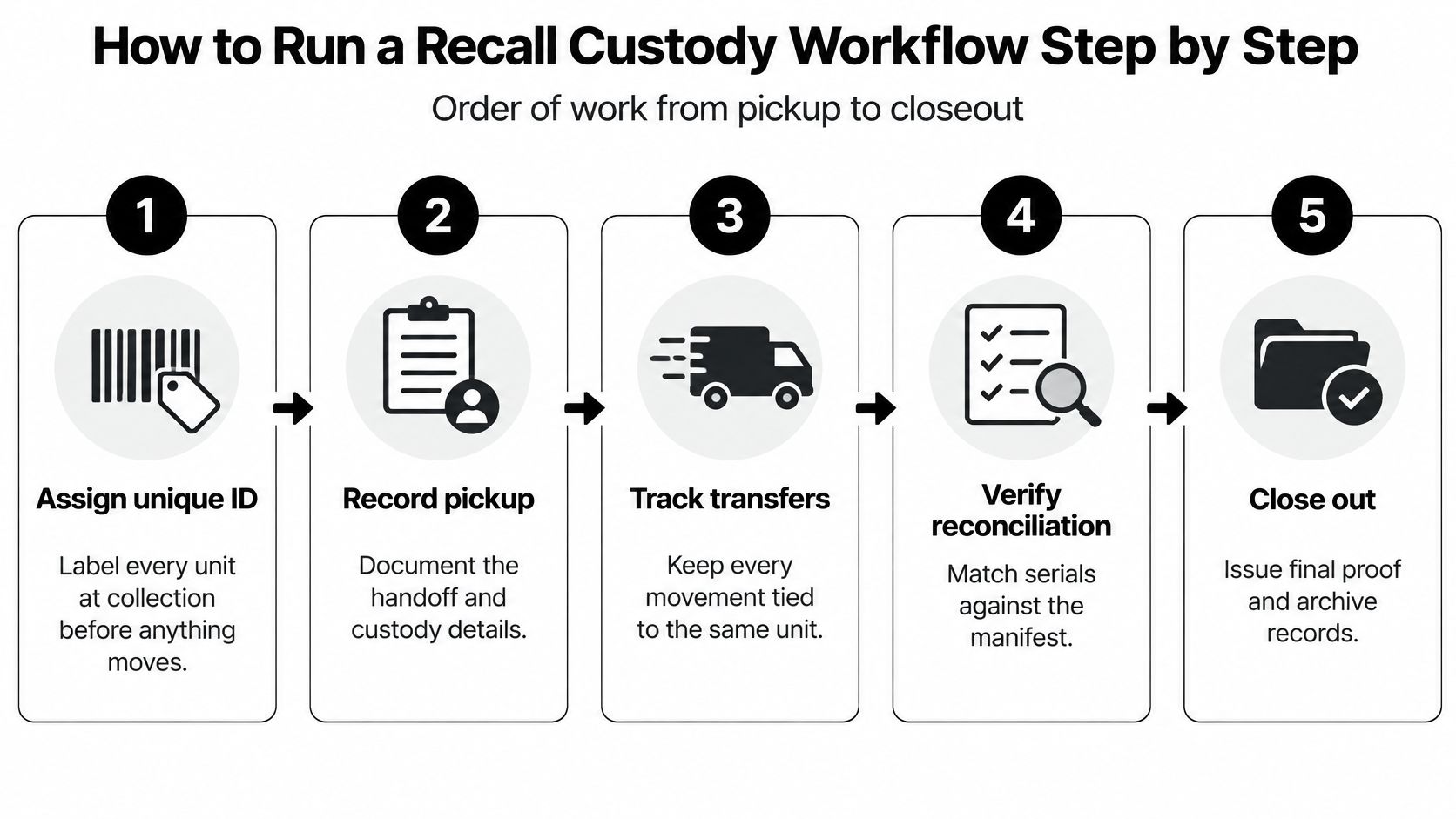
Start with the recall notice and the affected asset population, then work through collection without allowing unidentified equipment to bypass intake. The GS1 Global Traceability Checklist emphasizes traceability records and representative, time-stamped samples connected to manufacturing batches or lots. For electronics, apply that discipline to unit identifiers and each custody event.
Execute the collection and containment sequence
Assign identity before movement. Capture the serial number and associate it with the recall reference at collection. If the label is unreadable, issue a temporary identifier, photograph distinguishing features, and hold the identity question open rather than guessing.
Scan items into the manifest and seal each container with a numbered tamper-evident seal. Record the seal immediately, because a loose note completed after loading can connect the wrong number to the wrong pallet.
Document both sides of every transfer. Record the releasing person, receiving person, timestamp, location, quantity, and observed condition. A driver's recollection won't establish whether a loose accessory or damaged device was present at pickup.
Scan at arrival and move affected units into a locked, labeled quarantine area. Restrict status changes to authorized users, and prohibit picking from quarantine for repairs elsewhere, since informal borrowing can mix recalled assets with unaffected stock.
Apply the authorized treatment. Route each unit to manufacturer return, repair, recycling, or destruction, and document the storage-treatment decision. Don't let a technician's reusable-hardware assessment override the recall instructions.
Reconcile identifiers against the manifest at processing and final disposition. Open exceptions for missing, duplicate, substituted, or reclassified units, assigning each an owner, required evidence, and escalation date.
Assemble the closeout package. Preserve the original manifest, transfer history, photographs, work orders, verification results, and final certificates together. An edited spreadsheet without its original supporting records isn't a complete audit file.
Keep logistics planning distinct from authorization
For projects involving air transport, cargo logistics guidance from Approved Jets can help a coordinator frame freight-planning questions. It doesn't establish that a particular recalled device or battery is accepted for shipment; obtain the carrier's specific acceptance and packaging requirements.
Our reverse logistics services can support equipment-retirement planning. In our service sequence, Data Destruction & Recycling is the second step, where our team handles secure data destruction and responsible recycling; Certification & Reporting follows with detailed reports and a Certificate of Destruction.
A complete operational file connects the first scan to the authorized final status. If unresolved assets remain, report the recall as open, with assigned owners and next-action dates, rather than using a completed pickup as the closure event.
Vendor Selection Criteria and KPIs to Track
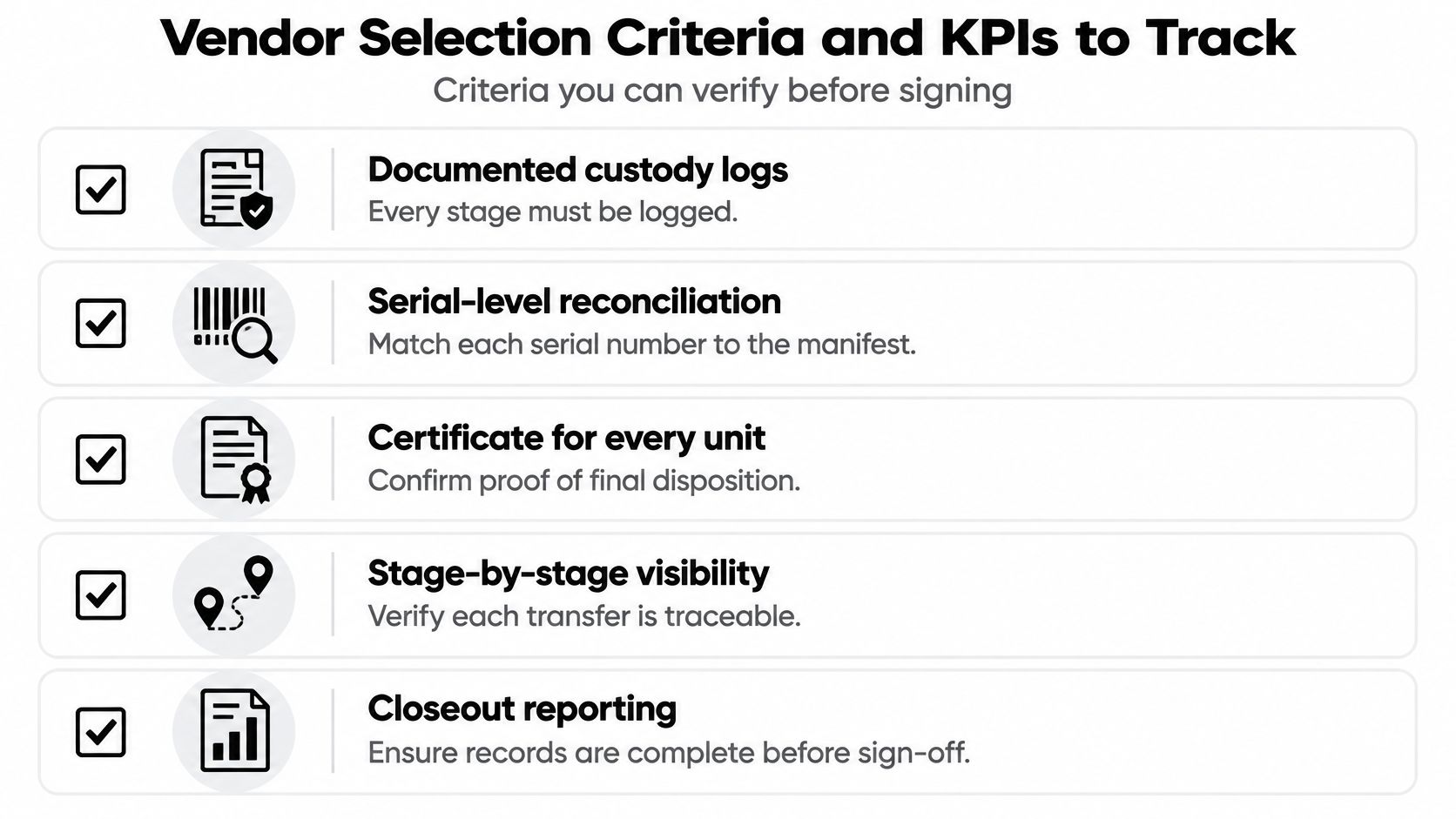
A vendor's transport capacity does not prove that recalled equipment reached its final disposition. Before signing, review sample custody logs, serial-level reconciliation, treatment records, carrier authorization, insurance terms for data-bearing equipment, and references from comparable projects. Check where responsibility transfers between the customer, carrier, and processor.
Request a sample closeout package with identifiers visible or consistently anonymized. Ask the bidder to show how records can be retrieved, then specify the required delivery interval in the contract.
Measure physical resolution separately from outreach
Under FDA recall guidance in the federal regulations, effectiveness checks verify notification and appropriate action within the specified recall depth. Coverage ranges from 100% of consignees at Level A to 2% at Level D. Choose the applicable check level based on the recall circumstances and strategy; these provisions are not a universal electronics-recall mandate.
The targets below are contract requirements to negotiate, not claims about industry averages. Track physical resolution separately from notification: recall success depends on documenting each unit's final status, not just outreach or consumer responses.
Custody KPIs and target values
| KPI | How it is measured | Target |
|---|---|---|
| Serial-level reconciliation | Scanned units matched to manifest at each handoff | 100% before closeout |
| Untraced units at closeout | Units with no documented path to a final status | Zero |
| Effectiveness check coverage | Recipients or sites verified against recall depth and the selected strategy | Applicable FDA level and coverage identified above, when relevant |
| Exception closure time | Days from exception logged to owner sign-off | Agreed number of days, set in contract before collection |
| Certificates issued | Completed tasks with a certificate of destruction | 100% of completed tasks |
Verify what a certificate covers
A batch certificate can cover multiple assets if its attached schedule identifies them unambiguously. A certificate naming only a customer and collection date leaves the processed population unclear.
Reworx Recycling is a full-service electronics recycling and IT asset disposition partner offering nationwide services across the U.S. It specializes in secure data destruction and provides a Certificate of Destruction for every task fulfilled, supporting audits and legal documentation. Confirm the scope and terms for your recall, including any special transport or downstream requirements.
Use these vendor selection criteria for electronics recycling and ITAD to align procurement, IT, and sustainability reviewers.
Contract safeguard: Name the required closeout documents, the exception-response interval, and the person authorized to approve any change in disposition.
Set zero untraced units as the closure target. If a device remains missing, keep the exception open and record an explicit management decision rather than removing it from the denominator.
Template Chain-of-Custody Form for Electronics Recalls
Use a form that connects the recall notice, physical equipment, custody transfer, and final evidence. The entries below are illustrative field values, not records from an actual customer project.
Template custody form fields for electronics recalls
| Field | Example entry | Why it matters |
|---|---|---|
| Recall reference | Manufacturer recall notice identifier | Ties every unit to the recall notice |
| Asset identifier | Serial number, IMEI, MAC address or asset tag | Provides item-level identity |
| Model and condition | Laptop model code, working or damaged | Informs treatment selection alongside media type and sensitivity |
| Quantity | Scanned device count attached to sealed-container manifest | Supports reconciliation against the manifest |
| Releasing party and time | Site custodian's printed name, signature and departure timestamp | Proves the handoff |
| Receiving party and time | Carrier driver name, signature and arrival timestamp | Proves the transfer was received |
| Seal number | Tamper-evident seal ID, checked intact at receipt | Helps detect possible opening in transit |
| Sanitization method and verification | Cryptographic erase, verification result and verifier initials | Documents the data exposure control |
| Final disposition and certificate | Recycled, destination facility, closing date and certificate number | Closes the record |
Completion rules that preserve the record
Use a separate row for each unit, or a sealed-container entry linked to its complete unit-level manifest. A container-only entry without a contents schedule can't establish which devices were inside.
Require printed names and signatures or authenticated electronic approvals at release and receipt. Correct errors through a signed, dated amendment that preserves the original entry, not by overwriting the previous value.
- Photo references: Attach collection and quarantine images to the asset or container identifier.
- Exception notes: Describe damaged labels, broken seals, rejected units, and quantity differences.
- Supporting schedules: Include storage components removed from a device and retain their parent-device relationship.
The form travels with the load, electronically or physically, while the master log stays in the controlled system. Synchronize the signed transfer evidence with that log after each handoff.
For laptops, phones, drives, and networking gear, change the identifier field to fit the equipment. Keep the custody structure consistent so receiving staff don't need a different process for every hardware category.
Real-World Recall Custody Scenarios for Electronics
These illustrative scenarios show how a practical custody decision resolves a specific gap. For Smyrna organizations coordinating school technology, retail systems, or healthcare IT equipment disposal, the useful distinction is between finding equipment and proving its authorized outcome.
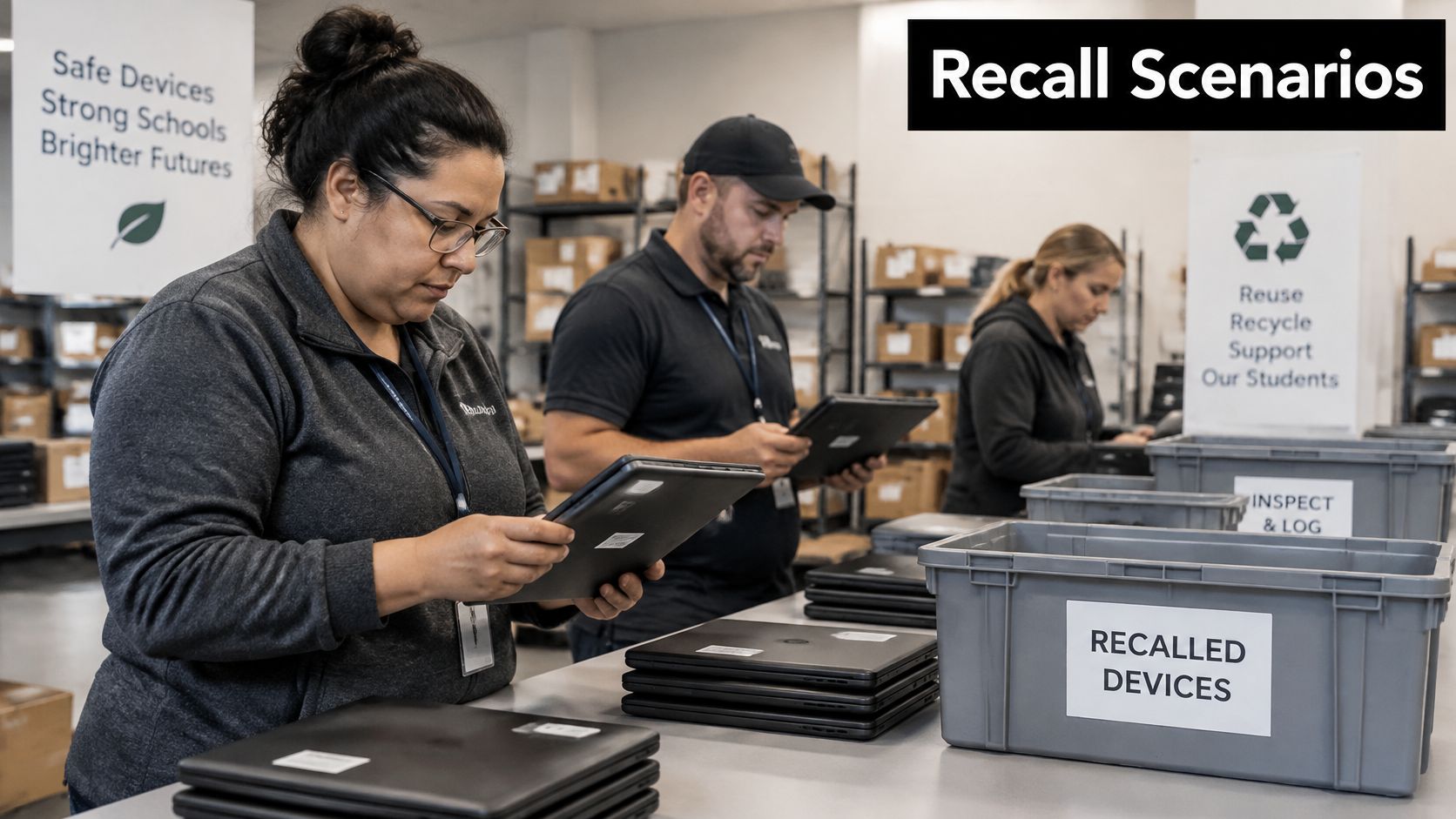
School laptops with a battery defect
A district collects affected laptops from classrooms, but the scanned inventory falls short of the asset list. Another email won't explain whether the missing equipment is in a repair cupboard, assigned to a student, or already transferred.
The coordinator assigns a serial-level sweep, names an exception owner, and records a follow-up date. Returned units receive controlled quarantine; each remaining discrepancy stays visible until evidence establishes its status.
The Consumer Product Safety Commission reported a 44.55% response rate across consumer-product recalls in fiscal year 2025. That measure concerns consumer responses through the measured channels, not verified physical disposition, which is why a notification dashboard can't establish containment.
Retail terminals on mixed pallets
A retailer returns point-of-sale terminals from different model lines on the same pallet. Receiving staff separate them by model and serial before assigning treatment, preventing unaffected stock from inheriting a recalled status or affected units from entering refurbishment.
In this scenario, the approved route requires destruction of embedded storage. The closing evidence is the model-level reconciliation plus storage-destruction records, not the pallet's arrival receipt.
Hospital networking equipment with retained configurations
During a hospital equipment-retirement project, networking devices contain configuration data and credentials. The team documents condition, verifies the approved erasure process for reusable units, and sends failed storage-bearing equipment for destruction with certificates tied to identifiers.
An ordinary retirement isn't automatically a recall, but the same evidence discipline supports medical equipment disposal planning and related IT assets. Medical and laboratory equipment disposal also require separate acceptance and decontamination assessments where applicable.
The gap determines the action: locate missing school assets, separate mixed retail models, and verify configuration removal on hospital networking gear.
Only cleared, sanitized equipment should enter donation inventory. Community value doesn't justify bypassing an unresolved safety remedy.
Confirm Your Recall Custody Plan Before the Next Event
A recall is closed only when records show the physical control and final disposition of every affected unit. Notifications sent and consumer responses received do not prove where equipment went or what happened to it.
Before an event, tag in-service equipment covered by recall notices and link each identifier to its responsible department. Adapt the custody form, then run a mock recall to test reconciliation and identify handoffs where staff cannot produce supporting records. Have prospective vendors provide sample closeout packages, and agree in writing who owns exceptions, transport, acceptance, and documentation.
Customers can arrange a free drop-off or pickup by contacting Reworx Recycling. Its Secure Pickup service is a no-cost electronics pickup, with Reworx handling transportation logistics. Confirm that the recall material is accepted before scheduling.
Whether you're planning laptop disposal, computer recycling, data center decommissioning, an office cleanout, or a facility cleanout, separate restricted assets and document them from the start.
Reworx Recycling offers business pickups, secure data destruction, and responsible electronics recycling. Contact the team to arrange pickup and clarify the data-destruction and recycling steps for your equipment. Reworx Recycling provides nationwide services for organizations managing end-of-life electronics.