“Wipe it and recycle it” is incomplete advice for recalled hardware. A recalled device is an evidence and liability problem before it's a waste problem. Destroy it too early, and you may lose the identifiers, components, or physical evidence the manufacturer needs to approve a remedy or investigate a failure.
For IT teams in Smyrna, Georgia, and the wider Atlanta business community, recalled IT equipment disposal services should connect recall verification, data protection, and approved disposition. Whether you're managing office laptops, school equipment, or a data center decommissioning, the objective isn't to empty the holding area. It's to account for every affected asset without releasing unsafe equipment or confidential information.
Recalled Equipment Workflow at a Glance
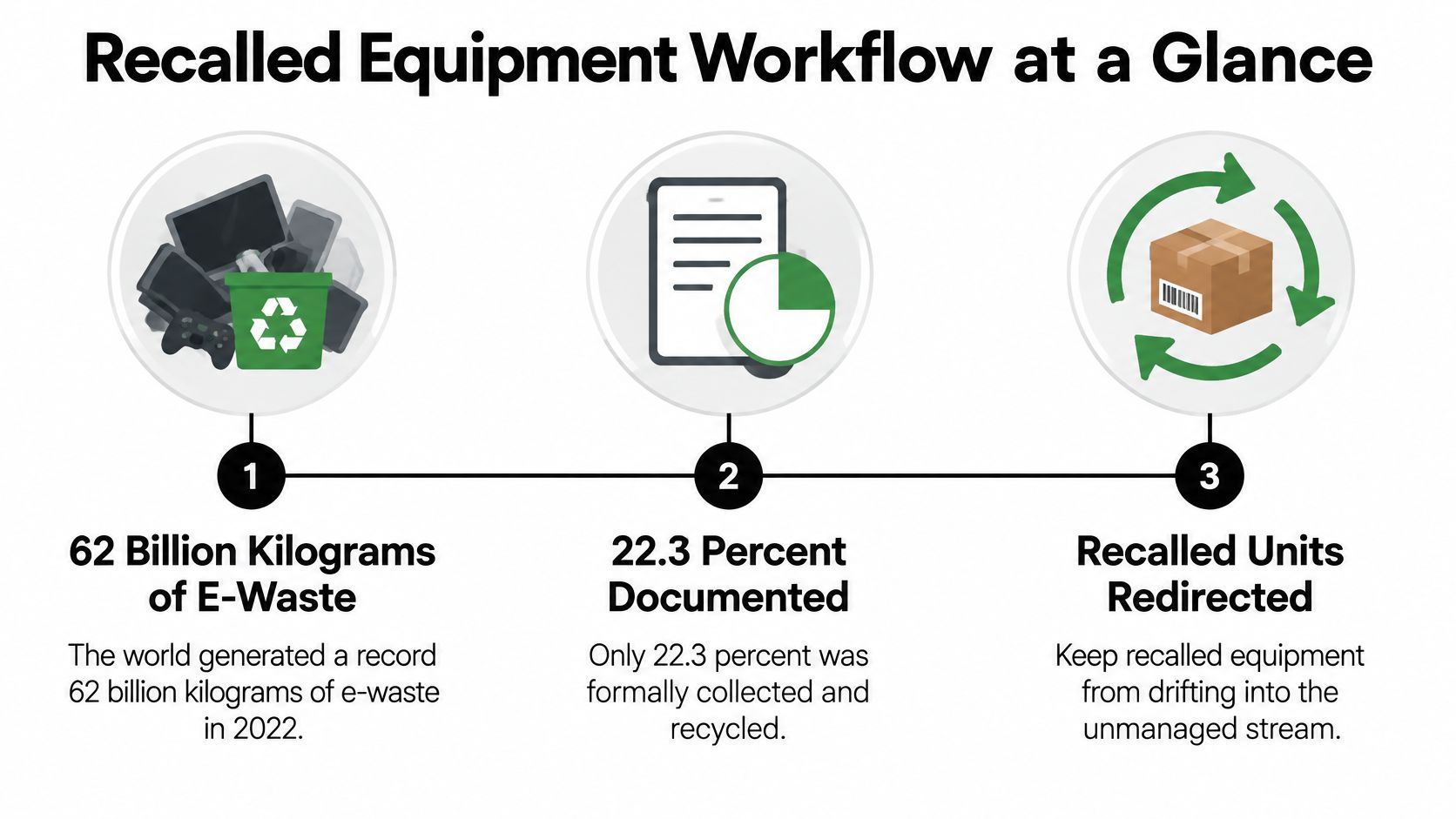
The world generated 62 billion kilograms of e-waste in 2022, but only 22.3% was documented as formally collected and recycled, according to the Global E-waste Monitor.
Recalled equipment disposal workflow
| Phase | Core action | Evidence to keep |
|---|---|---|
| 1. Verify recall | Match serial numbers against the manufacturer notice and CPSC listings | Serial list with recall status |
| 2. Quarantine | Physically separate units from saleable inventory and returns | Tagged, locked holding log |
| 3. Sanitize | Select clear, purge or destroy for each device by data risk | Method and verification record per device |
| 4. Authorize | Two-person release before any movement | Signed release form |
| 5. Partner | Confirm certifications and downstream routing | Contract and current certificate copies |
| 6. Transport | Use tracked carriers with manifests and export checks | Bills of lading and shipping records |
| 7. Close out | Reconcile every serial number to one disposition | Certificate of destruction or return proof |
Treat this as an approval sequence, not permission to sanitize immediately. Confirm manufacturer restrictions before changing a device, and place any unit needed for inspection on hold. Partner due diligence must also be complete before equipment leaves your control.
Assign an owner to every release
IT should identify storage media and information risk. Facilities should control the holding area and physical handoff. Procurement should approve the processor, while legal or the designated recall owner resolves manufacturer and regulatory conditions.
The phases matter because destruction is irreversible. You can correct an incomplete spreadsheet while equipment remains quarantined. You can't recover a missing serial label or restore a shredded component for failure analysis.
Practical rule: No employee should have to infer whether an asset is cleared for movement. Put the decision, conditions, and authorizer in the asset record.
Keep verification, sanitization, custody, partner approval, and transportation evidence together. A single controlled case file is more useful than disconnected emails held by different departments.
How to Verify Recalls and Quarantine Affected Units
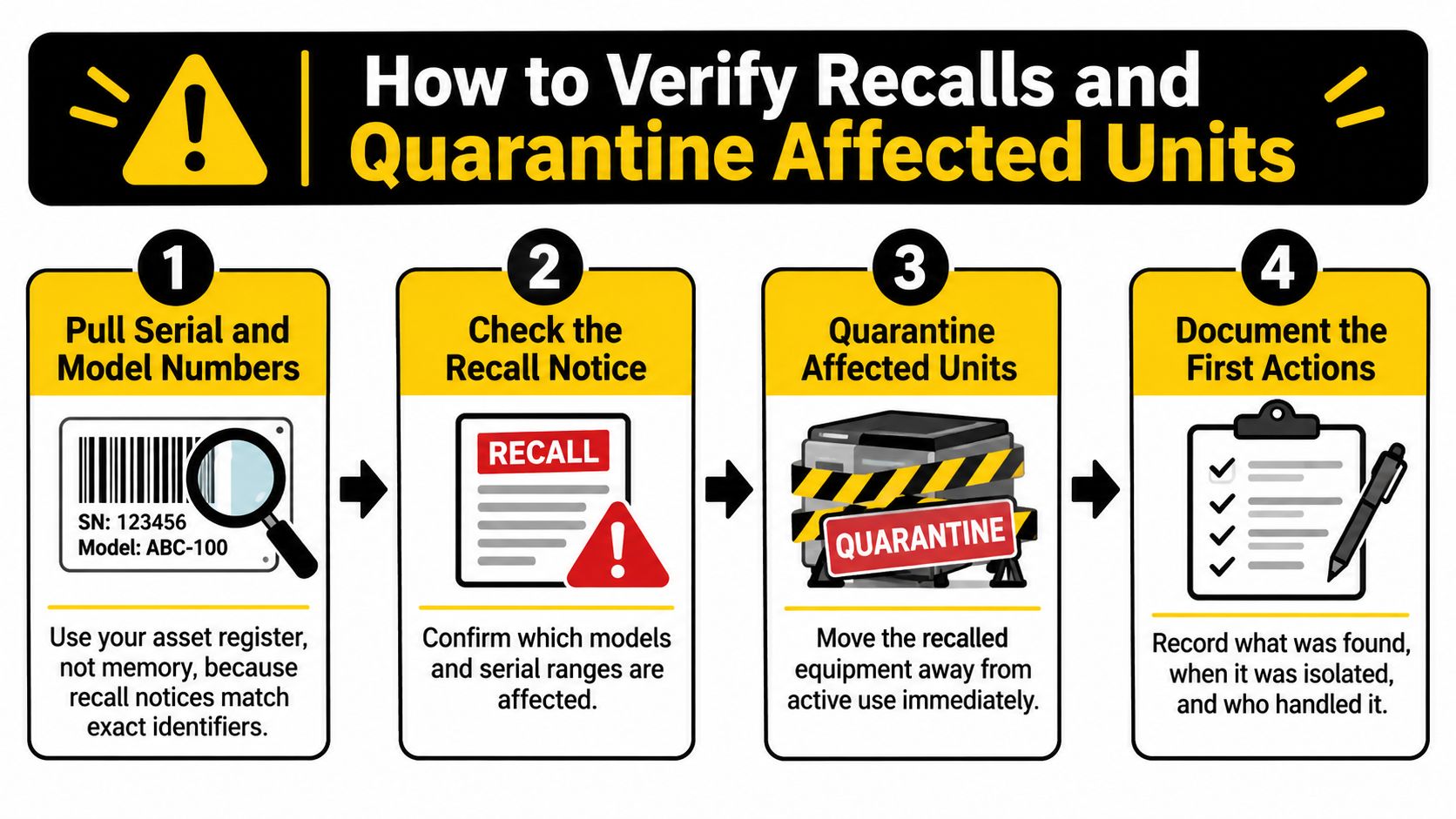
Start with identifiers and physical control, not a recycling booking. CPSC recall guidance calls for recalled products to remain segregated throughout the distribution chain and for organizations to monitor third parties handling destruction or disposal.
Pull exact identifiers. Export model and serial numbers from your asset register, then compare them with the physical labels. A purchasing description such as “business laptop” won't establish whether a particular production range is affected.
Confirm recall status. Match each identifier against the manufacturer's recall notice and applicable CPSC listings. Save the notice and record the result, including units checked and found outside the affected range.
Tag and isolate affected equipment. Record the location, custodian, and quarantine status before moving the device to a locked, labelled holding area. Follow the recall's handling instructions rather than powering equipment on merely to collect more information.
Block secondary routes. Remove quarantined assets from resale, ordinary returns, spare-parts, and refurbishment pools. Put the restriction in the inventory system as well as on the shelf.
Request written disposition instructions. Send the manufacturer your identifiers and ask whether the remedy requires return, inspection, component replacement, or approved destruction. Preserve packaging and identifying labels until those conditions are settled.
Require a separate release authorization. Have one employee confirm the asset and recall decision, then another authorize the approved movement. Record both names and the destination.
Prevent the ordinary-returns mistake
Commingling is a particularly easy failure during an office cleanout. Someone sees unused hardware, assumes it belongs on the collection pallet, and removes it from controlled storage. A visible tag helps, but an inventory block and restricted access provide stronger protection.
Other avoidable failures include destroying equipment before manufacturer approval and accepting a vendor certificate with no serial numbers or identifiable asset attachment. Where a remedy is unavailable, disposal still needs to comply with applicable state and local requirements. Notify CPSC before destruction when applicable, and preserve any confirmation.
At Reworx Recycling, customers gather their unwanted electronics and note devices containing sensitive data. Apply that same intake habit internally so the recall owner knows which units also require information-security review.
Your quarantine log should contain date, model, serial number, tag number, location, holder, recall reference, and release approval. Make it the opening record in the evidence file, not a document reconstructed after pickup.
Choosing Between Clear, Purge and Destroy
Choose sanitization by data risk, media technology, and recall restrictions, not by convenience. Classify the information first, then select the least destructive approved method that meets the requirement. A reusable drive may retain value, but that value doesn't justify a method that leaves sensitive information recoverable.
The current NIST media-sanitization guidance emphasizes an organization-wide program that matches sanitization controls to information sensitivity and the conditions of reuse or disposal. It also supports separating the storage decision from the physical product's disposition.
Sanitization method by device and risk
| Method | Typical use | Device reusable | Evidence to keep |
|---|---|---|---|
| Clear | Ordinary software overwrite against basic recovery | Yes | Overwrite log and verification sample |
| Purge | Recovery resistance against laboratory techniques | Often yes | Tool, method and verification record |
| Purge (cryptographic erase) | Encrypted drives where the key can be destroyed | Usually yes | Key destruction record per serial |
| Destroy | Failed, damaged or highly sensitive media | No | Destruction certificate tied to serial numbers |
| Hold for analysis | Units needed for manufacturer failure investigation | Not until released | Written hold instruction and release date |
Hold for analysis isn't a sanitization method. It's a stop condition that prevents the other actions from compromising an investigation.
Cryptographic erase also needs more than an encryption checkbox. Confirm that the implementation, key handling, and device history support the intended outcome. Don't assume deleting a user account or resetting a password destroys every relevant key.
Verify the outcome, not just the tool status
The earlier NIST sanitization guidance distinguishes clear, purge, and destroy and describes verification using pseudorandom sampling across user-addressable and reserved areas. A successful job message alone doesn't establish that the selected process reached all relevant storage.
For SSDs, document how the method addresses areas a generic overwrite tool may not reach. Where direct inspection is technically unavailable, require a supported verification approach and record the limitation. Then validate whether the completed work satisfies organizational policy.
Avoid treating a factory reset as universal erasure, skipping reserved storage, or physically destroying media without trained staff and appropriate safety controls. A generic certificate cannot substitute for an asset-level method and verification record.
Our decommissioning services use hard drive shredding and degaussing to prevent data retrieval, and we securely wipe or shred data-bearing devices. Degaussing must match the media technology; it isn't an SSD sanitization method. Our data sanitization methods guide provides a starting point for specifying the required process.
Set rules by device class
- Laptops: Match the storage serial to the chassis and confirm whether removal would affect the recall remedy.
- Servers: Inventory every drive and storage module, not just the server enclosure.
- Networking equipment: Address configurations, credentials, certificates, and embedded storage.
- Printers: Check for internal drives and stored documents rather than assuming the device holds no data.
If the manufacturer needs the product intact, don't shred it to solve the data problem. Obtain approval to separate the media, use a compatible non-destructive method, or retain the equipment under controlled access until authorized. Require the processing plan to state the method and verification approach for each device class.
Chain of Custody and Records That Hold Up in an Audit
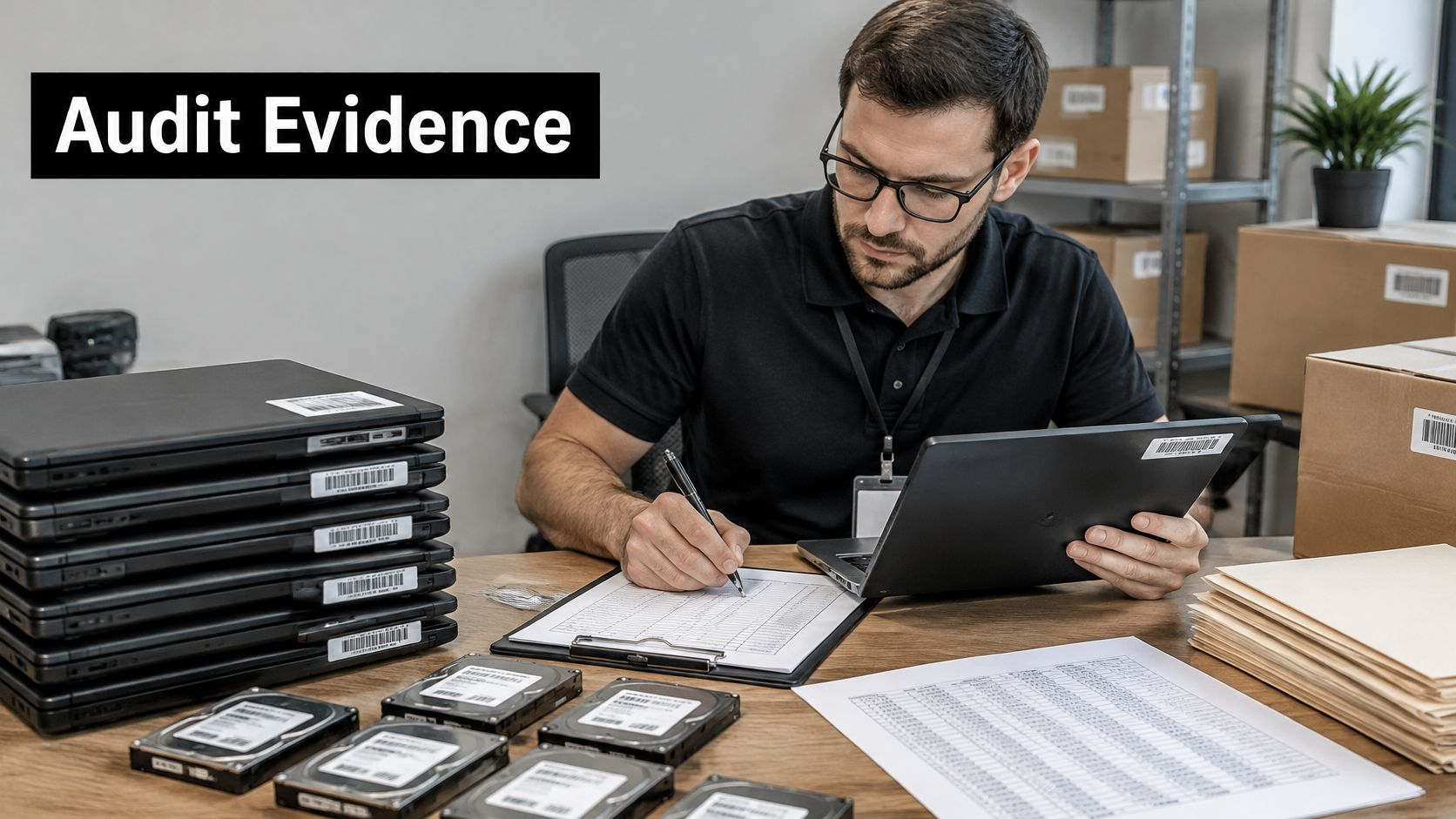
An evidence file should let someone who wasn't present reconstruct what happened. A pickup receipt proves a handoff occurred. It doesn't, by itself, prove which recalled assets were received or what ultimately happened to them.
Maintain these records against each asset:
- Inventory and recall reference: Model, serial, organizational asset tag, affected status, and approved route.
- Photographic evidence: Tagged units before movement and identifying images at receipt where the receiving arrangement permits.
- Transfer records: Names, signatures, dates, times, locations, and any container or seal identifiers.
- Shipping evidence: Bills of lading, carrier receipts, and receiving discrepancies.
- Sanitization evidence: Media identity, method, result, verifier, and any exception.
- Final disposition: Manufacturer return proof, destruction certificate, or documented processing as material.
Test the certificate against the inventory
Say a certificate reports that a pallet of laptops was destroyed but contains no serial-level attachment. An auditor can't establish whether the recalled units were included, whether a substitute batch was processed, or whether a held device left custody by mistake.
A useful certificate identifies each asset directly or references a controlled inventory attachment. It should distinguish the chassis from separately processed storage media and identify exceptions rather than implying the whole batch followed the same route.
We provide a certificate of destruction for every task fulfilled as documentation for audits and legal matters. Define the required asset-level fields before processing, using the chain-of-custody documentation guide to structure the handoffs.
Audit test: Could a reviewer match the original asset to its final outcome without calling the employee who arranged pickup?
Reconcile at pickup, receiving, and certificate issuance. Set a written discrepancy-resolution deadline in the contract rather than allowing exceptions to remain open indefinitely. Preserve affidavits and any required destruction-verification records for the retention period legal establishes, including litigation or investigation holds.
When a serial is missing, stop closure of the affected batch. Search the holding area and transfer records, document the discrepancy, and notify the asset owner and security or legal team as appropriate. Never backfill an assumed disposition to make the totals agree.
Certifications to Require from Your Recycling Partner
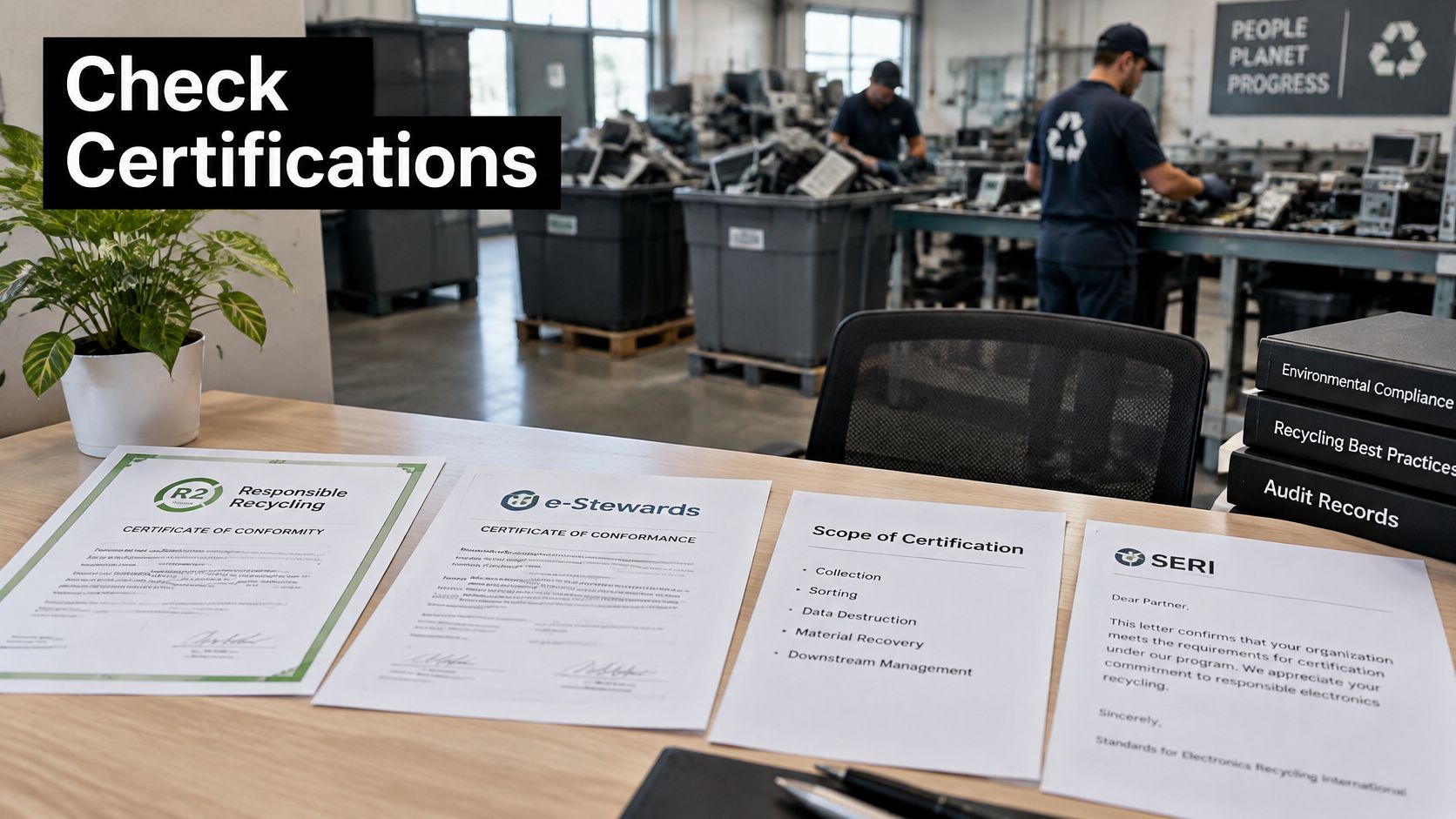
A certificate is useful only if it covers the facility and work handling the recalled equipment. Check the legal entity, processing address, covered activities, certifying body, and current status. A credential for one site does not automatically extend to a subcontractor or another location.
| Certification or standard | What it can indicate | Ask for |
|---|---|---|
| R2 (R2v3) | Environmental controls and downstream handling practices | Current certificate and facility list |
| e-Stewards | Controls for hazardous-waste exports and downstream tracking | Current certificate and audit scope |
| NAID AAA | Audited processes for secure data destruction | Certificate and scope of service |
| NIST SP 800-88 aligned process | A documented approach to selecting and verifying sanitization methods | Written sanitization procedure |
ISO 14001 and ISO 27001 address environmental management and information security management, respectively. They can support a procurement review, but they do not replace recall-specific handling instructions. NIST alignment describes a sanitization approach, not a recycler certification.
The NIST guidance on sanitization documentation supports matching sanitization methods to information sensitivity and retaining evidence, including sanitization certificates. Ask for the written procedure and a redacted sample record. A logo or general claim of NIST alignment does not show how a particular device will be handled.
Put operational questions in the contract
- Processing location: Which facility receives each device, and is it owned or subcontracted?
- Destruction location: Does product destruction happen at your site, the processor, or another stop?
- Certificate detail: Will the final evidence identify serial numbers and unresolved exceptions?
- Transit coverage: What insurance responds to data loss or physical loss during transport?
- Recall separation: How will staff prevent restricted units from entering resale or donation stock?
Reworx Recycling is a full-service electronics recycling and IT asset disposition partner based in Smyrna, Georgia. Its corporate e-waste management and IT asset disposition are customized for each business customer. Use the environmental certifications guide to organize your review of a partner's environmental credentials and documentation.
Reworx's services include IT Asset Disposition, IT Asset Management, Recycling Consultation, Hard Drive Shredding, Equipment Decommission, Equipment Buyback, Electronics Recycling, and Recycle By Mail. It also offers a nationwide equipment buyback program for businesses. Keep buyback eligibility separate from recall release approval.
A partner that cannot explain its custody, processing, and exception procedures in writing leaves key risks unresolved, regardless of the logos displayed on its website.
Transport, Export Rules and Liability Controls
Booking the earliest truck can be the wrong decision. If a load leaves before disposition approval or carrier acceptance, the business may have transferred the equipment without resolving who can handle it, where it can go, or what evidence must survive.
Use labelled containers appropriate to the recall instructions and equipment condition. Keep asset identifiers readable or map them to a controlled container inventory, record seals where used, and keep recalled loads distinct from general e-waste. Damaged batteries or other hazardous components require a transport assessment rather than ordinary pallet wrapping.
For networking equipment, we perform a detailed assessment before secure transportation and data erasure, then determine recycling or refurbishment according to condition. Recall restrictions must still govern whether refurbishment is an available route.
Verify the complete destination
The Basel Convention technical guidance states that the Convention entered into force on May 5, 1992, requires movement documents for approved covered consignments through the disposal destination, and generally restricts movements between Parties and non-Parties unless an applicable arrangement exists.
That isn't a reason to assume every international shipment is prohibited or permitted. Have a qualified compliance reviewer determine how the relevant countries, material classification, and applicable arrangements affect the proposed route.
- Identify the destination: Obtain the receiving facility and downstream treatment locations, not just the broker's address.
- Confirm the route: Review importing and transit-country requirements and any required permissions.
- Retain shipment records: Match transport documents to the asset or material inventory.
- Check treatment: Require evidence of environmentally sound downstream management.
The Basel e-waste amendments guidance explains prior informed consent procedures for covered transboundary e-waste movements. Don't accept “sent for reuse” as a substitute for a documented classification and destination review.
Allocate loss and notification duties
Use the transportation compliance guide to frame the movement review. Obtain current insurance evidence, written subcontractor disclosure, and contract language addressing data loss, recall-related losses, missing shipments, and incident notification.
Have legal review indemnities and coverage exclusions rather than assuming a broad promise covers every event. Rushing recalled hardware into recycling can compromise warranty evidence and safety controls. The defensible route is the one whose approvals and responsibilities are settled before departure.
Communication Templates and Notification Checklists
Use a common notice header: recall reference, serial count, date, organization, named contact, and requested response. Describe equipment as potentially affected or confirmed within the recall scope; don't independently declare it safe or unsafe.
Send notices in operational order
Manufacturer notice
“Attached is the asset list associated with this recall reference. Please confirm eligibility, evidence-preservation requirements, handling instructions, and authorized disposition.” Record the written response before approving irreversible work.CPSC notice when applicable
Identify the proposed destruction or disposal, location, responsible processor, and evidence package. Request confirmation of any witnessing or verification conditions and retain the correspondence.Internal stakeholder notice
Brief legal, finance, information security, and the asset owner. Include the quarantine count, operational impact, proposed release date, approval dependencies, and the person authorized to resolve exceptions.Processing-partner instruction
Supply the controlled serial list, approved sanitization method by device class, transport mode, and required certificate format. State which assets remain on hold and prohibit substitutions without written authorization.Carrier confirmation
Confirm the pickup window, manifest reference, handling restrictions, receiving contact, and escalation route for delivery failure. Complete the applicable state e-waste and transport review before dispatch.
Document exceptions without guessing
Use a separate gap notice: “The attached asset is unaccounted for at reconciliation. The discrepancy was discovered on [date]; the last confirmed custody event, search performed, owner notified, and next action are recorded below.”
Replace bracketed fields with actual information before sending. Distinguish the discovery date from the last confirmed location; neither proves when a loss occurred.
Release check: Record that each required notice was sent, acknowledged where necessary, and cleared before the next irreversible action.
Keep the communications register alongside the asset inventory. An unanswered email isn't approval, and a planned release date doesn't override an unresolved hold.
Next Steps and Partner Call to Action
A recalled device is first an evidence and liability problem, then a waste problem. Start with the serial list and recall reference. Keep affected equipment segregated until its recall status and approved disposition route are clear. Before arranging service, agree on the evidence-file format and sanitization approach for each device class. Use the vendor selection criteria to assess whether a proposal addresses your recall requirements.
For offices and organizations, keep ordinary surplus separate from restricted hardware. This distinction matters during an office or facility cleanout, especially when computers, laptops, medical equipment, or laboratory equipment contain storage media or remain subject to recall controls.
Keep community reuse separate from recall clearance
Equipment should enter a reuse route only after its product status and data-protection requirements have been addressed. Record the actual disposition for each unit so the evidence file distinguishes recycling, refurbishment, and other approved outcomes.
Reworx Recycling provides electronics recycling, free data destruction, business pickups, and equipment buyback. A complete evidence file helps your team move promptly while preserving a record of the decisions and handoffs. It also gives procurement a clearer basis for comparing pickup cost with the services and documentation included.
Send Reworx Recycling your serial list and recall reference to discuss electronics recycling, data destruction, a business pickup, or equipment buyback. These details help clarify the affected equipment and the service needed. Visit Reworx Recycling to learn more.