A lot of companies don't realize they have an asset tracking problem until a routine task turns into a scramble. A laptop can't be located before an audit. A spare monitor was purchased because nobody knew three were sitting in storage. A retired server is still on the books, but nobody can say where it went or whether the drives were wiped.
Those aren't isolated admin headaches. They're signs that the organization can't see its own equipment clearly across procurement, use, transfer, storage, and retirement.
That's why asset tracking systems matter. At their simplest, they help teams find things. At their best, they support better utilization, cleaner audits, tighter chain of custody, and smarter end-of-life decisions. For IT, facilities, operations, and sustainability leaders, the ultimate value isn't the tag on the device. It's the quality of decisions that tag makes possible over the full lifecycle.
The Hidden Costs of Unseen Assets
A familiar scenario plays out in many offices. Finance asks for an equipment list. IT exports one report from a service desk platform. Facilities has another list for shared equipment. Department managers keep their own spreadsheets. None of them match. By the time someone starts walking the floor, people have moved desks, loaner devices changed hands, and a few assets have already drifted into storage closets with no clear owner.
The direct loss is easy to understand. The indirect loss is usually larger.
When teams can't trust their records, they buy replacement equipment too early, spend labor chasing missing items, and carry more security risk than they think. A missing laptop isn't just a procurement issue. It can become a data-handling issue, a compliance issue, and later an IT asset disposition issue if the device disappears from the retirement process.
Where costs show up first
Most organizations see the problem in four places:
- Procurement waste: Teams reorder assets they already own because available stock isn't visible.
- Operational friction: Staff lose time searching for devices, carts, tools, loaners, and test equipment.
- Audit exposure: Records don't match physical reality, which creates exceptions and cleanup work.
- Disposal risk: End-of-life equipment leaves circulation informally, without documented transfer or destruction.
That last point gets overlooked. If you don't know where an asset is during active use, you probably won't have a clean record when it leaves service either.
Practical rule: If an asset can move, be reassigned, or hold data, it needs a documented identity and status history.
Asset tracking transitions from a labeling exercise to an operating discipline. Good systems don't just answer “Where is it?” They answer “Who had it, what state is it in, when should it be replaced, and what happens when it's retired?”
For teams trying to clean up fragmented records before selecting a platform, Reworx has a useful guide to inventory management best practices that aligns well with the groundwork asset tracking systems require.
Understanding Your Asset Tracking System
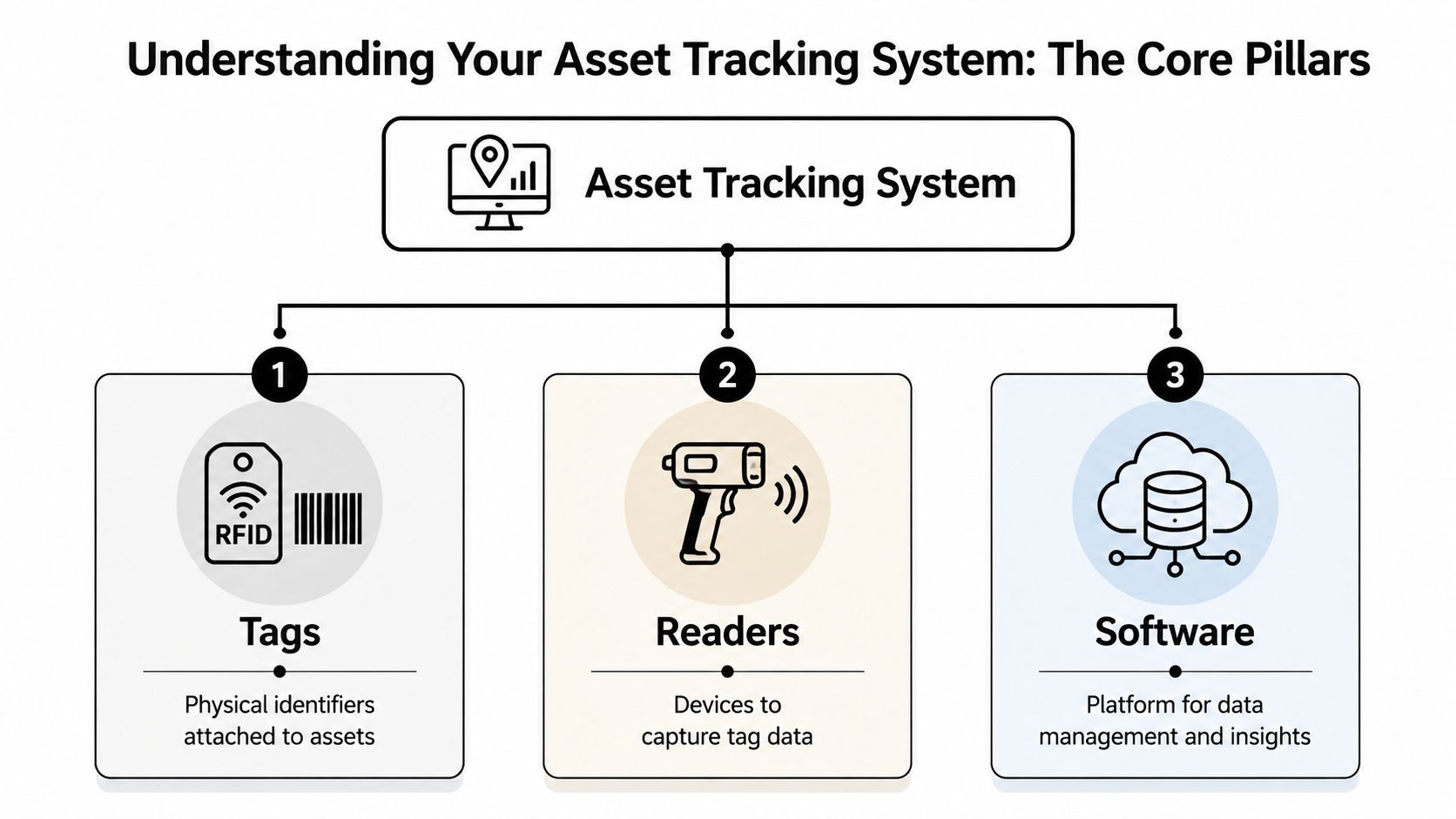
Think of an asset tracking system as a digital librarian for physical equipment. The librarian needs a unique identifier for every item, a way to detect when that item moves, and a reliable catalog that stores the history. In practice, those are tags, readers or sensors, and software.
According to Airista Flow's overview of asset tracking, a modern asset-tracking architecture combines tags, readers or sensors, and software. Tags uniquely identify the asset, readers capture movement or status changes, and software centralizes location history, audit trails, and alerts across the asset lifecycle.
Tags identify the asset
A tag is the asset's identity layer. It might be a barcode label on a laptop, an RFID tag on a tool cabinet, or a location-aware badge attached to mobile medical equipment.
The key isn't the form factor. The key is consistency. Each tag should tie to one record, one asset class, and one ownership model. If teams create duplicate IDs or relabel equipment casually, the system becomes noisy fast.
Readers capture events
Readers and sensors are how the system notices what's happening in the physical world. A handheld scanner can support inventory audits. A fixed reader at a doorway can detect movement between rooms. A mobile device can confirm check-out and return.
This is where architecture matters. If the environment is busy, the equipment is mobile, and multiple systems depend on the data, the tracking design needs to be deliberate. Teams working on broader device ecosystems often run into the same design questions discussed in this piece on architecting reliable connected products. The principle is the same. Data is only useful if capture is dependable.
Software turns activity into control
Software is the part executives usually care about most, even if they don't say it that way. Within it, you get search, audit trails, alerts, utilization history, assignment records, and workflow triggers.
A mature platform should support more than location. It should connect asset movement to service events, check-out rules, maintenance, transfer approvals, and retirement decisions. That's the difference between a gadget-driven pilot and an operating system for asset control.
For IT teams tightening policy and ownership standards before implementation, Reworx also publishes guidance on IT asset management best practices that complements this operating model.
Core Technologies That Power Asset Tracking
Not every asset needs the same tracking method. The right choice depends on mobility, value, physical environment, and what decision you need the data to support. A laptop pool in an office, a vehicle fleet, a hospital infusion pump, and a rack-mounted server don't belong in the same technology bucket.
Start with the business question
If the question is “Can staff confirm this asset during a periodic audit?” a simple label may be enough. If the question is “Which room is this item in right now?” you need something stronger. If the question is “Did this device leave the site?” you may need a portal, a geolocation layer, or both.
IBM notes that modern asset tracking spans fixed asset management and IT asset management and uses technologies such as barcodes, QR codes, and RFID to monitor physical assets including delivery vehicles, laptops, and heavy machinery in real time through IBM's asset tracking overview.
Asset tracking technology comparison
| Technology | Typical Cost | Read Range | Accuracy | Best Use Case |
|---|---|---|---|---|
| Barcodes and QR codes | Lower cost relative to sensor-based options | Short, scan-based | Depends on human scan and label condition | Periodic audits, desk-side inventory, lower-complexity environments |
| RFID | Varies by deployment design | Longer than scan-only methods | Good for identification and movement detection | Warehouses, IT rooms, tool tracking, portal-based movement logging |
| BLE | Moderate relative to simple labels | Suitable for indoor presence and proximity use cases | Better for broad location awareness than exact room precision | Mobile assets in offices, hospitals, and mixed indoor spaces |
| GPS | Higher fit for outdoor mobile assets | Wide-area outdoor coverage | Best for outdoor positioning, not detailed indoor placement | Vehicles, trailers, field equipment |
| UWB | Higher fit where precision matters most | Indoor precision deployment | Inches-level location accuracy | Dense indoor spaces where exact room or zone matters |
The critical outlier is UWB. The Association for Supply Chain Management notes that UWB-based asset tracking can achieve inches-level location accuracy, making it better suited than BLE or RFID for high-density indoor environments where precise zone-level or room-level tracking matters operationally.
In practice, the cheapest tag is often the most expensive choice if it can't support the workflow you actually need.
Match the tool to the control objective
Use a lightweight system when manual confirmation is acceptable. Use RFID or BLE when movement and presence matter. Use UWB when mistakes inside a building are expensive. Use GPS when the asset spends its life outside.
One more consideration often gets missed. The tracking method should support end-of-life accountability too. If your team needs a documented retirement trail, your field process should preserve handoff history, not just current location. That's why disposal planning and chain of custody documentation should be part of the technology discussion from the start.
The Business Case Benefits Beyond Finding Things
The best argument for asset tracking systems isn't that they help recover missing items. It's that they improve how organizations buy, use, maintain, secure, and retire equipment.

Better utilization changes purchasing decisions
Many organizations have more equipment than they think and less visibility than they need. A good tracking system makes idle inventory visible. That changes replacement timing, redeployment decisions, and purchasing requests.
This matters at market scale too. Fortune Business Insights estimates the global asset tracking market at USD 28.97 billion in 2026 and projects it will reach USD 71.55 billion by 2034, with a 11.97% CAGR over the forecast period. The same source states that North America held the largest share, at 36.27% of the global market in 2025, as detailed in Fortune Business Insights' asset tracking market analysis. That growth suggests asset tracking has moved well beyond niche inventory control.
Compliance gets easier when records are generated by workflow
Manual logs break down because people are busy. They forget to update spreadsheets. They skip check-in steps. They move equipment with good intentions and no paperwork.
Automated event capture fixes part of that problem. It creates a usable audit trail. For regulated organizations, that means less reconstruction during audits and fewer questions about where an asset was, who had it, and when it changed status.
- Fewer blind spots: Movement, assignment, and retirement events are easier to verify.
- Cleaner audits: Records are produced from actual operational steps, not after-the-fact cleanup.
- Lower security risk: Missing or unreturned devices surface sooner.
For mobile operations, the same logic applies outside the building. Teams comparing vehicle visibility models may find value in this overview of fleet dispatching with GPS trackers, especially when route control and asset control overlap.
Operational takeaway: If the system only tells you where assets are, you're getting partial value. If it changes how you purchase, maintain, and retire them, you're getting the real return.
That's also why recovery planning matters. Once visibility improves, organizations usually discover they can redeploy some assets, service others, and retire a smaller set with better timing. Reworx's information on asset recovery is relevant here because recovery value depends on knowing what equipment you have, its condition, and where it sits in the lifecycle.
Integrating Tracking with ITAD and E-Waste Management
Most companies separate asset tracking from disposal planning. That's a mistake. If tracking data stops being useful the moment a device is retired, the organization loses one of the strongest controls it has over ITAD, e-waste handling, and data security.
The handoff to end of life should be traceable
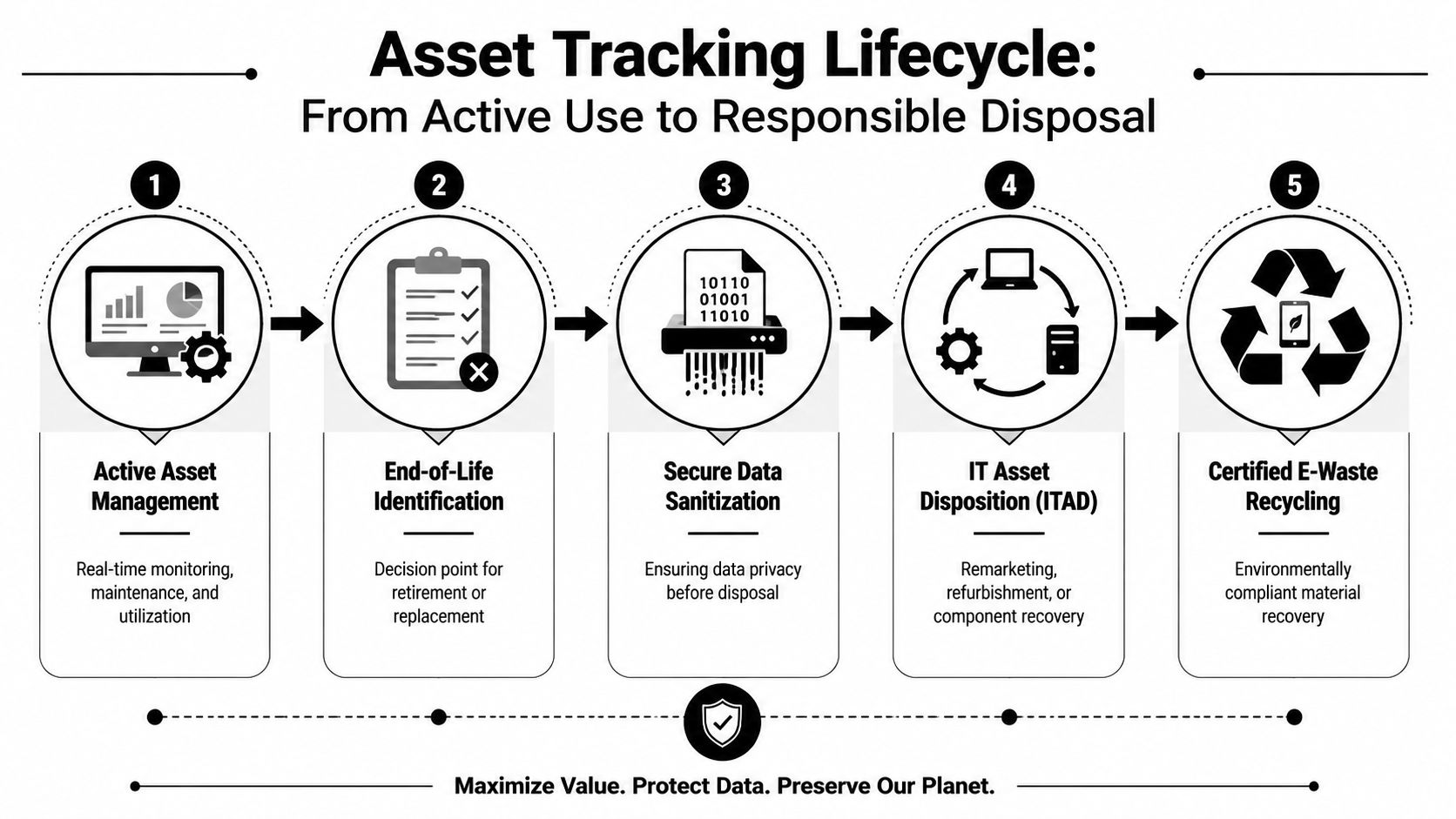
Retirement starts with a decision. The asset is obsolete, failed, surplus, replaced, or no longer compliant with internal standards. A strong tracking system records that change in status, identifies the current custodian, and confirms where the asset physically sits before pickup or internal consolidation.
That gives the business a cleaner handoff into disposition. Instead of a pile of unlabeled devices in a storage room, the organization has a retirement queue with asset IDs, ownership history, and disposition intent.
Tracking data supports secure and sustainable outcomes
Sustainability and compliance no longer need to compete. A device with documented status, model data, and custody history is easier to route correctly. Some assets can be reused internally. Some may be candidates for refurbishment or donation. Others require secure destruction and downstream recycling.
For organizations formalizing that process, IT asset disposition should be treated as part of the asset lifecycle, not a separate cleanup project.
A hospital-focused discussion cited in the background material makes an important point: tracking technology helps only when it becomes part of day-to-day operations rather than a standalone hardware install. That lesson applies directly to ITAD. The disposal outcome is better when retirement status, sanitization requirements, pickup logistics, and reporting are built into the same workflow discipline.
Why selective tracking can be smarter than blanket tracking
Not every item deserves the same level of instrumentation. High-value, high-mobility, and compliance-sensitive assets usually benefit most from active tracking. Low-risk items may only need periodic inventory control.
That distinction matters for e-waste strategy too. The best programs don't just track more assets. They track the right assets well enough to support defensible retirement decisions.
One practical option in that workflow is Reworx Recycling, which provides electronics recycling and IT asset disposition services, including pickups, decommissioning support, secure hard drive shredding, and reporting that can fit into an organization's end-of-life process. In a mature program, that kind of partner sits downstream of good asset data, not in place of it.
How to Choose and Implement Your System
Buying software is easy. Building a tracking discipline that survives past the pilot is harder.
A common failure pattern looks like this: one department launches a promising test, tags a subset of equipment, proves that the technology works, and then stalls when another site uses different naming rules, another team creates duplicate records, and nobody owns the process changes needed for scale.
Research on healthcare RTLS implementation highlights a similar issue. A key challenge in scaling asset tracking is moving from a single-department pilot to multi-site adoption without creating duplicate records or workflow conflicts, which requires governance and change management, not just technology, as discussed in this PMC study on RTLS implementation challenges.
Choose based on operating fit
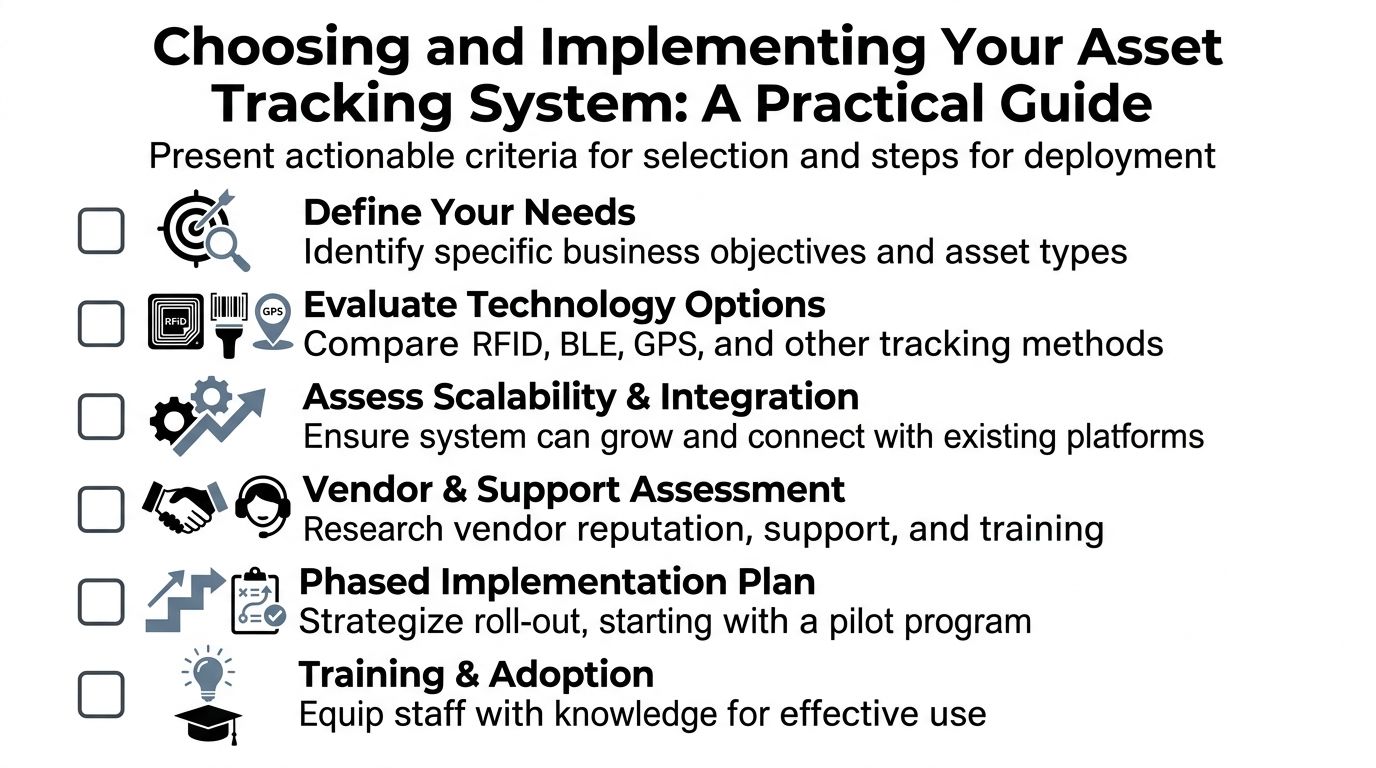
Use these criteria before you compare vendors:
- Asset scope: Define which assets need active tracking, which need periodic inventory, and which don't justify instrumentation.
- Workflow fit: Check whether the system supports check-out, transfer, maintenance, retirement, and exception handling.
- Integration needs: Confirm how records will align with service management, procurement, ERP, facilities, or security workflows.
- Governance model: Decide who owns naming standards, status definitions, tag issuance, and duplicate resolution.
A relocation or consolidation project is often the best moment to get this right. If your team is preparing for a move, these pre-relocation asset survey details are useful because they show how physical inventory discipline affects downstream planning.
Implement in phases that force clarity
The strongest deployments usually follow a sequence like this:
- Pick a narrow but valuable pilot. Choose one asset class with clear pain points, such as loaner laptops, shared medical devices, or mobile IT equipment.
- Set naming and status rules early. Don't wait for scale to clean up taxonomy. You won't.
- Define event ownership. Someone must own tagging, assignment changes, returns, and retirement status updates.
- Train the people touching the assets. Good systems fail when the check-out desk, field tech, or department coordinator doesn't follow the same process.
- Measure exceptions, not just scans. Missing tags, duplicate records, and unclosed transfers tell you more than raw activity.
Field advice: If nobody can explain who updates the record when an asset changes hands, the rollout isn't ready.
Tailor the model to your organization
A small business may only need barcode-driven accountability with a simple repository and disciplined retirement workflow. A multi-site enterprise may need integrated readers, assignment controls, and stronger location intelligence. Public sector and education environments often need clearer chain of custody, broader stakeholder alignment, and more durable audit records.
The wrong implementation choice is usually overbuilding the tech and underbuilding the process.
Completing the Asset Lifecycle with Smart Disposal
A mature asset program ends with proof, not assumptions. You should be able to see when equipment entered service, where it moved, who used it, when it became surplus, how it was sanitized, and where it went next.
That's the core payoff of connecting tracking, operations, and disposal. Finance gets cleaner records. IT gets better control over data-bearing devices. Facilities gets fewer orphaned assets. Sustainability teams get a more credible view of reuse, recycling, and responsible retirement.
The strongest asset tracking systems also improve decision quality before disposal. Teams can separate reusable assets from scrap, identify devices that should be redeployed instead of replaced, and avoid sending mixed, poorly documented loads into an ITAD process. That reduces confusion and helps preserve both value and accountability.
There's also a social and environmental dimension that many businesses now take more seriously. When organizations maintain good records through the active life of a device, they're in a better position to support reuse, donation-based recycling, and responsible electronics recycling instead of treating everything as waste. That's especially relevant for office cleanouts, data center refreshes, laptop disposal, medical equipment disposal, and broader facility transitions.
Smart disposal starts long before pickup day. It starts when the asset record stays accurate during daily use.
A business that tracks well disposes well. That's the closing loop.
If your organization is upgrading equipment, planning an office cleanout, handling secure data destruction, or building a more sustainable ITAD process, Reworx Recycling is one practical resource to consider. Businesses can use Reworx for electronics recycling, donation-based recycling, computer recycling, pickup coordination, and end-of-life planning that supports environmental responsibility and community impact. If you're ready to retire old equipment with better documentation and a cleaner chain of custody, schedule a pickup or explore a partnership that turns surplus technology into a more secure and sustainable outcome.