Your team just finished a laptop refresh, cleared out a storage room of old monitors, and scheduled a pickup for retired servers. Then the CFO asks a simple question: what did all of that achieve?
Most IT managers can answer the operational part. Devices were removed. Drives were destroyed. Equipment avoided the trash. The hard part comes next. How much environmental benefit did the program create? What risks were prevented? Which outcomes came from your recycler's process, and which would have happened anyway?
That's where impact measurement stops being a reporting buzzword and starts becoming a practical management tool. In electronics recycling and IT asset disposition, it helps you move from “we recycled a lot” to “we can show what changed because we did it this way.” If you're trying to connect sustainability goals, secure data destruction, office cleanout planning, or data center decommissioning to business decisions, that shift matters.
Why impact measurement matters for e waste and ITAD
A common situation looks like this. An IT manager runs a clean, compliant recycling program. Assets are boxed, serialized, removed, and processed. The sustainability lead wants to include the effort in ESG or annual reporting. Procurement wants proof the vendor supports responsible outcomes. Leadership wants a reason to keep funding donation-based recycling instead of treating end-of-life equipment as a basic hauling task.
Without measurement, the story stays vague.
You can say devices were collected. You can say the company cared about responsible disposal. But stakeholders usually want more than good intentions. They want evidence that electronics recycling and IT equipment disposal created measurable environmental or social value, and that the chosen process reduced risk.
That's especially important in e-waste, where the environmental stakes are high. Americans generate approximately 6.9 million tons of electronic waste annually, roughly 46 pounds per person, and only about 15% is officially recycled. The remainder goes to landfills, where electronics account for less than 2% of total waste volume but an estimated two-thirds of all heavy metals, according to this e-waste disposal report card. For business leaders, those numbers make one point clear. Handling retired technology responsibly has consequences beyond housekeeping.
When teams review the broader environmental impact of electronic waste, they usually realize the same thing. Output alone isn't enough. Real impact measurement helps defend budgets, improve vendor decisions, and explain why one ITAD approach creates more value than another.
Understanding impact measurement basics
Impact measurement isn't the same as counting activity. Counting tells you what happened. Impact measurement asks what changed because of what happened.
The formal definition is useful here. Impact measurement is defined as the process of measuring and monitoring the amount of societal and environmental change created by an organization or investor's activities, serving three critical purposes: ensuring limited funds are directed to highest-impact opportunities, assessing past investment impacts, and holding companies accountable for impact performance. The methodology relies heavily on rigorous evidence-based research, with RCTs recognized as the most respected method, according to the OECD guidance on harmonised management and measurement of impact.
Output versus impact
In recycling, an output might be the number of laptops collected during an office cleanout. An impact is the environmental and social change linked to processing those laptops through a defined pathway such as reuse, donation-based recycling, parts harvesting, or material recovery.
A simple analogy helps. Think of electronics recycling the way finance teams think about capital allocation.
- Output tracking is like recording that you invested cash.
- Impact measurement is like evaluating the return, risk, and downstream effect of that investment.
- Better measurement helps you decide where to allocate the next round of resources.
That's why mature programs don't stop at shipment receipts and weights. They look for evidence that the process produced meaningful outcomes.
Why baseline data matters
The biggest confusion point for many teams is timing. They try to measure impact only at the end of a project. That usually creates weak reporting because there's no baseline.
A stronger approach uses data from multiple points in time. In practical terms, that means documenting conditions before, during, and after the recycling or ITAD effort. Before the project, you define what equipment exists and what risks or environmental burdens are present. During the project, you track what is processed and how. Afterward, you review what changed.
Practical rule: If you didn't define the starting point, it's hard to prove that your program caused the result.
For IT managers, this can look surprisingly familiar. You already do versions of this in asset inventories, chain-of-custody logs, and decommission planning. Impact measurement expands that discipline so it captures environmental and community outcomes too.
Two levels of measurement
Many organizations also mix up program-level and population-level measurement.
Program-level measurement looks at the effect of a single recycling or ITAD initiative on the people or assets directly involved. Population-level measurement asks how many combined efforts influence a broader community or region. For most businesses, program-level work comes first because it's closer to the data you already control.
If your team is building ESG documentation around electronics recycling, sustainability reporting practices become much easier once that distinction is clear.
Comparing common impact measurement frameworks
Different frameworks answer different questions. In electronics recycling, three often come up first: Life Cycle Assessment, Social Return on Investment, and GHG accounting.

A side by side view
| Framework | What it focuses on | Strong use in electronics recycling | Main limitation |
|---|---|---|---|
| Life Cycle Assessment LCA | Environmental effects across a product life cycle | Useful for understanding material recovery, reuse, and disposal pathways | Can become data-heavy quickly |
| Social Return on Investment SROI | Social, environmental, and economic value created by an activity | Helpful for donation-based recycling, digital inclusion, and workforce development programs | Social outcomes can be harder to monetize credibly |
| GHG accounting | Direct and indirect greenhouse gas emissions | Strong for carbon reporting and avoided emissions claims | Often misses broader social and material recovery outcomes |
When LCA makes sense
LCA is a good fit when your team wants to understand the environmental footprint of a device or process from raw material extraction to end of life. In an ITAD setting, it helps answer questions like whether reuse creates more environmental value than destruction and material recovery alone.
That makes LCA especially relevant for computer recycling, facility cleanout planning, and medical equipment disposal where equipment pathways differ. If one group of devices can be refurbished and another must be dismantled, LCA helps separate those impacts instead of blending everything into one total.
Where SROI helps
SROI is useful when the organization wants to show that retired equipment created value beyond diversion. For example, a social enterprise recycling model may route suitable devices into donation channels, digital inclusion efforts, or workforce development programs. SROI gives teams a structured way to discuss that wider value.
Good impact reporting in recycling usually needs both a technical lens and a human one.
The challenge is that SROI can drift into weak assumptions if the inputs aren't disciplined. If your organization can't support a financial valuation of social outcomes, it's better to report those outcomes clearly in qualitative terms than to force precision.
Why GHG accounting matters more in e-waste now
GHG accounting remains central because many stakeholders start with carbon. For electronics recycling, that conversation has become more specific. Expert-level impact measurement for electronics recycling now requires quantifying Scope 4 carbon avoidance. The ISO-approved Bloom + e-Stewards ITAD Environmental Benefits Calculator provides a standardized, independently verified methodology to measure this metric, enabling companies to demonstrate exact carbon footprint reduction achieved by diverting devices from landfills, as described in the EWASA coverage of the Bloom + e-Stewards calculator.
That matters because standard emissions reporting often tells only part of the story. Scope 4 focuses on avoided emissions, which is often exactly what recycling and reuse programs are trying to prove.
A practical selection method
If you're choosing among frameworks, use the business question to guide the method.
- Choose LCA when procurement or sustainability teams need a process-level environmental view.
- Use SROI when leadership wants to understand community value from donation-based recycling or corporate donation programs.
- Lean on GHG accounting when stakeholder pressure centers on climate metrics, carbon avoidance, or environmental disclosures.
For many organizations, the best answer isn't one framework. It's a small combination, documented clearly in environmental impact reporting workflows.
Key KPIs and data sources for electronics recycling
The strongest measurement programs use a short list of KPIs tied to real data systems. In electronics recycling, that means choosing indicators that reflect environmental benefit, material recovery, and avoided harm, then identifying where each number comes from.
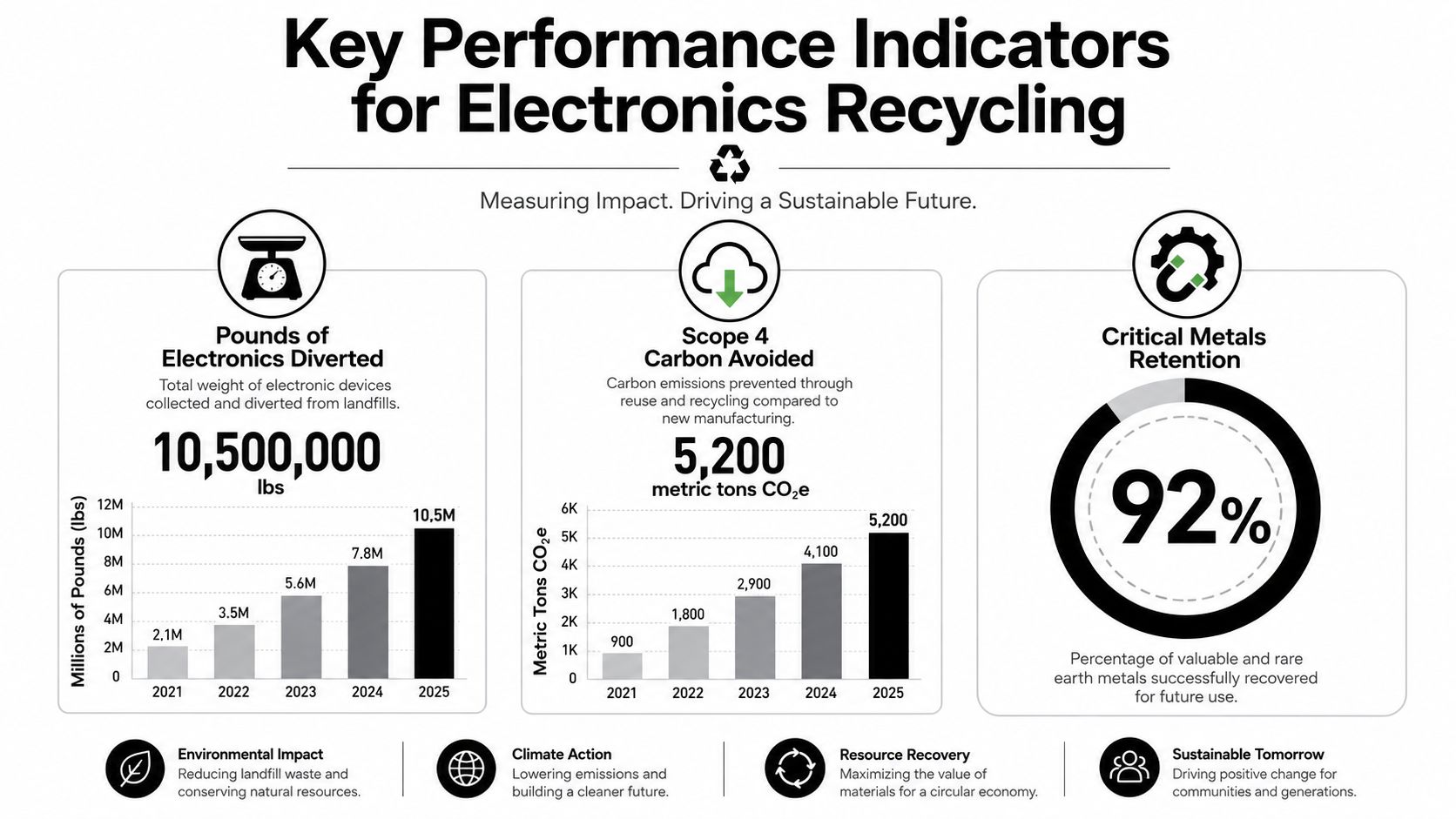
One useful warning first. The infographic above contains example figures for visualization, not citable benchmarks for your reporting. Your own program should use measured values from your systems and approved tools.
The KPIs that usually matter most
For ITAD, these indicators are often the most practical starting set:
- Electronics diverted from landfill: Pull this from asset manifests, pickup records, and certified downstream processing reports.
- Scope 4 carbon avoidance: Use an approved methodology rather than a homemade estimate.
- Critical metals retention: Track whether valuable materials are being recovered in a way that supports circular use.
- Reuse and donation pathway rates: Separate devices reused, donated, dismantled, and destroyed.
- Data security risk prevention indicators: Document secure data destruction steps, chain of custody, and proof of destruction.
- Community benefit outputs: For social enterprise recycling programs, log devices routed into donation or digital access efforts.
Why critical metals deserve their own KPI
Many teams stop at total pounds processed. That misses one of the most meaningful parts of electronics recycling. Technical impact measurement must include critical metals retention metrics (cobalt, lithium, rare earth elements) quantified using primary smelter data, as these materials represent the highest-value circular economy inputs and their recovery directly reduces virgin resource extraction, according to Bloom ESG's discussion of critical metals metrics.
That point is easy to overlook because weight can be misleading. A heavy, low-value component may dominate the scale ticket, while smaller components contain the metals that matter most for circular economy reporting.
Matching KPIs to data sources
| KPI | Primary data source | Why it matters |
|---|---|---|
| Diversion volume | Pickup logs, receiving weights, serialized inventories | Confirms basic flow of material |
| Carbon avoided | ISO-aligned calculator outputs | Supports climate and ESG reporting |
| Critical metals retention | Downstream processor data, smelter-based methodology | Shows resource recovery quality |
| Secure destruction evidence | Chain-of-custody forms, destruction certificates | Supports compliance and risk communication |
| Donation and reuse outcomes | Program intake logs, disposition coding | Connects ITAD to social impact |
Data discipline matters: A KPI is only as credible as the system behind it. If a number can't be traced to a log, calculator, manifest, or documented method, don't put it in an executive report.
A useful crossover lesson from other social programs
If your organization also tracks volunteerism or employee engagement around device drives, the structure used in best practices for volunteer tracking is worth reviewing. The lesson isn't about recycling specifically. It's about making sure each reported outcome ties back to a consistent record, owner, and collection process.
For electronics recycling and IT equipment disposal, the same rule applies. A clean waste stream analysis process helps you avoid mixing unlike materials, duplicate counts, or unsupported claims.
Implementing impact measurement step by step
A workable program doesn't start with a dashboard. It starts with operational discipline. If your organization already manages laptop disposal, secure data destruction, laboratory equipment disposal, or data center decommissioning, you have many of the building blocks already.
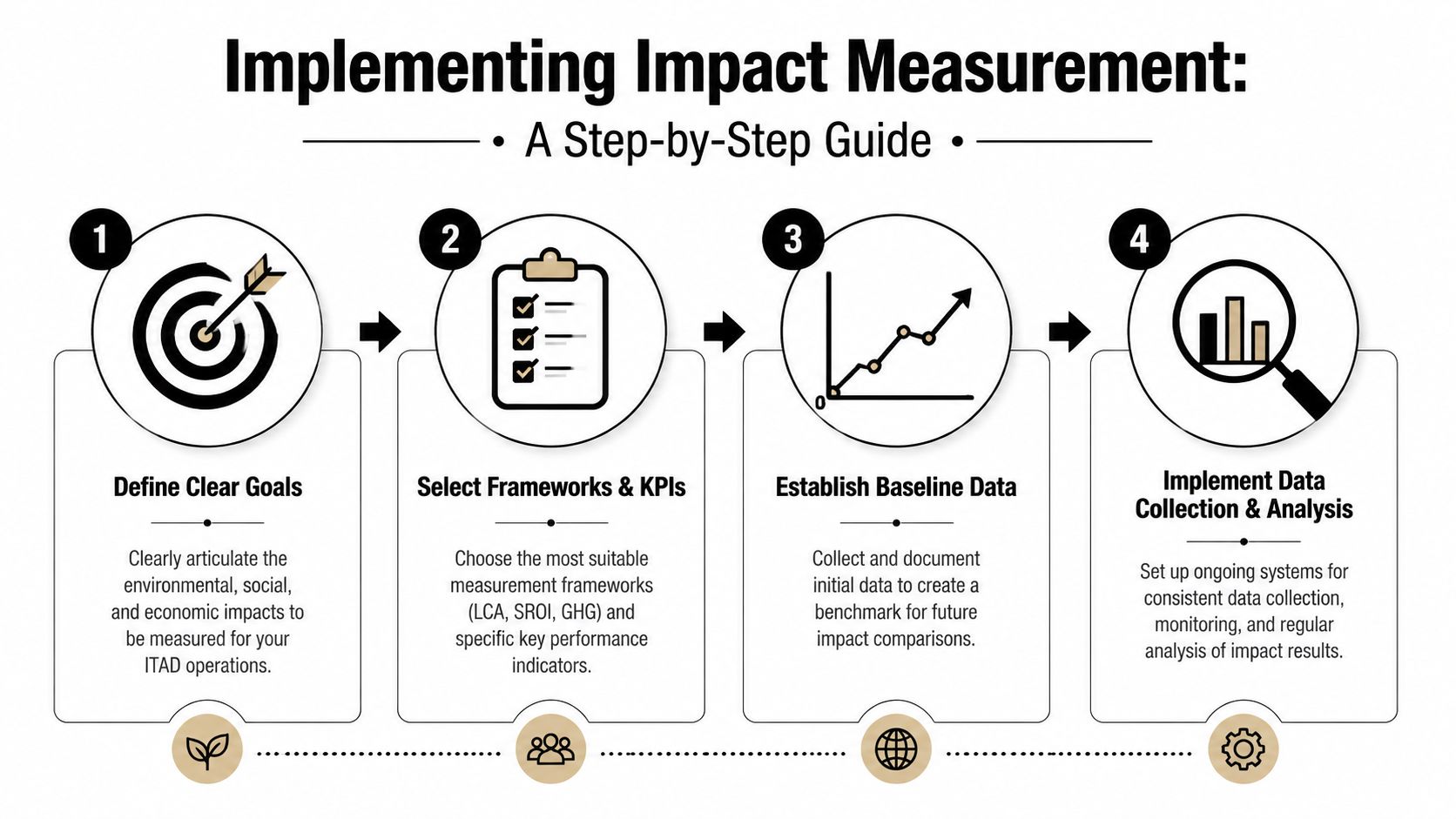
Step 1 Define the decision you need to support
Start by asking what decision the measurement must inform.
Do you need to justify budget for an office cleanout program? Compare vendors for product destruction and computer recycling? Report community benefit from corporate donation programs? Defend a policy for medical equipment disposal? The answer shapes the metrics.
A vague goal like “show our recycling impact” creates weak reporting. A focused goal like “demonstrate avoided emissions, material recovery quality, and secure disposition outcomes from our annual IT refresh” gives the project a boundary.
Step 2 Choose metrics that close the attribution gap
One of the biggest blind spots in this field is attribution. Most impact measurement frameworks fail to address the attribution gap in e-waste recycling: organizations track pounds diverted but rarely quantify carbon reduction or data-security risk mitigation directly attributable to their partner versus general waste streams, as discussed in the OECD policy guide on social impact measurement.
That sounds academic, but the operational meaning is simple. If you want to show that your recycling partner created a better outcome than generic disposal, you need metrics that isolate that difference.
A practical protocol looks like this:
- Define the alternative path. Would the assets otherwise be stored, landfilled, sold without traceability, or sent into mixed waste streams?
- Document the partner-specific process. Record secure data destruction, reuse sorting, downstream processing, and material recovery steps.
- Measure net difference. Compare what your selected pathway produces versus the defined alternative.
Step 3 Build a before during after record
Here, many programs become credible.
Before the project, capture inventory condition, device categories, storage status, and intended disposition route. During the project, log weights, serials, chain of custody, and processing milestones. After the project, attach environmental outputs, destruction documentation, reuse results, and any donation outcomes.
Step 4 Assign ownership and validation
Impact measurement fails when everyone thinks someone else owns the data.
A stronger setup divides responsibility across roles:
- IT team: Asset list accuracy, serial control, decommission status
- Facilities or operations: Pickup coordination, physical consolidation, site logistics
- Sustainability lead: KPI definitions, report assembly, internal approvals
- Recycler or ITAD partner: Processing documentation, downstream transparency, certificates
- Finance or audit contact: Review of assumptions before external use
The easiest way to lose trust in a report is to publish a number that operations can't trace back to a real process.
Step 5 Use a simple evidence file
You don't need expensive software on day one. A disciplined spreadsheet, a shared folder, and a clear naming convention can support the first version of an impact measurement process.
Store source files by project. Include manifests, pickup records, destruction certificates, calculator outputs, and final summaries. If a sustainability manager asks where a reported outcome came from, your team should be able to answer in minutes, not weeks.
For teams creating standard operating procedures, a compliance checklist template can help turn measurement into a repeatable routine rather than a one-off exercise.
Best practices for reporting impact results
A good report doesn't drown stakeholders in raw detail. It gives each audience the level of depth they need, without hiding the assumptions.
Executives want a short summary. Sustainability teams want methods. IT and compliance teams want chain-of-custody evidence and process clarity. The best reports serve all three.
Start with the decision maker's view
Your opening page should answer three questions quickly:
- What was processed
- What changed because of the program
- What evidence supports those claims
That structure works better than a long narrative. It also keeps the report focused on outcomes rather than activity alone.
If you need a mental model, the logic isn't far from how to calculate marketing ROI. In both cases, stakeholders want to connect an input to a result through a method they can understand. The categories differ, but the discipline is similar.
Separate outputs from outcomes
One easy reporting improvement is to divide the document into two columns or two sections.
| Report element | Example content |
|---|---|
| Outputs | Devices collected, pickups completed, assets processed, destruction certificates issued |
| Outcomes | Avoided emissions, material recovery quality, documented reuse pathways, prevented risk narrative |
That separation prevents a common mistake. Teams often present operational throughput as if it were impact. It's useful, but it isn't the same thing.
Explain avoided harm carefully
The unique challenge in e-waste reporting is that some of the most important benefits are things that didn't happen. Data wasn't exposed. Hazardous materials didn't end up in unmanaged disposal. Recoverable metals didn't go to waste.
Those outcomes matter, but they need careful wording. If you can quantify them with a documented method, report them. If you can't, describe them qualitatively and explain the controls that reduced risk.
Clear reporting builds confidence faster than inflated reporting.
Make methods visible, not hidden
A short methods appendix often makes the difference between a report that gets trusted and one that gets questioned. Include the framework used, the data systems consulted, the time period covered, and any exclusions.
If your team aligns with broader reporting standards, say so plainly. If the report includes assumptions, list them in ordinary language. Stakeholders usually accept uncertainty when the organization is transparent about where it comes from.
Case studies and recommended measurement tools
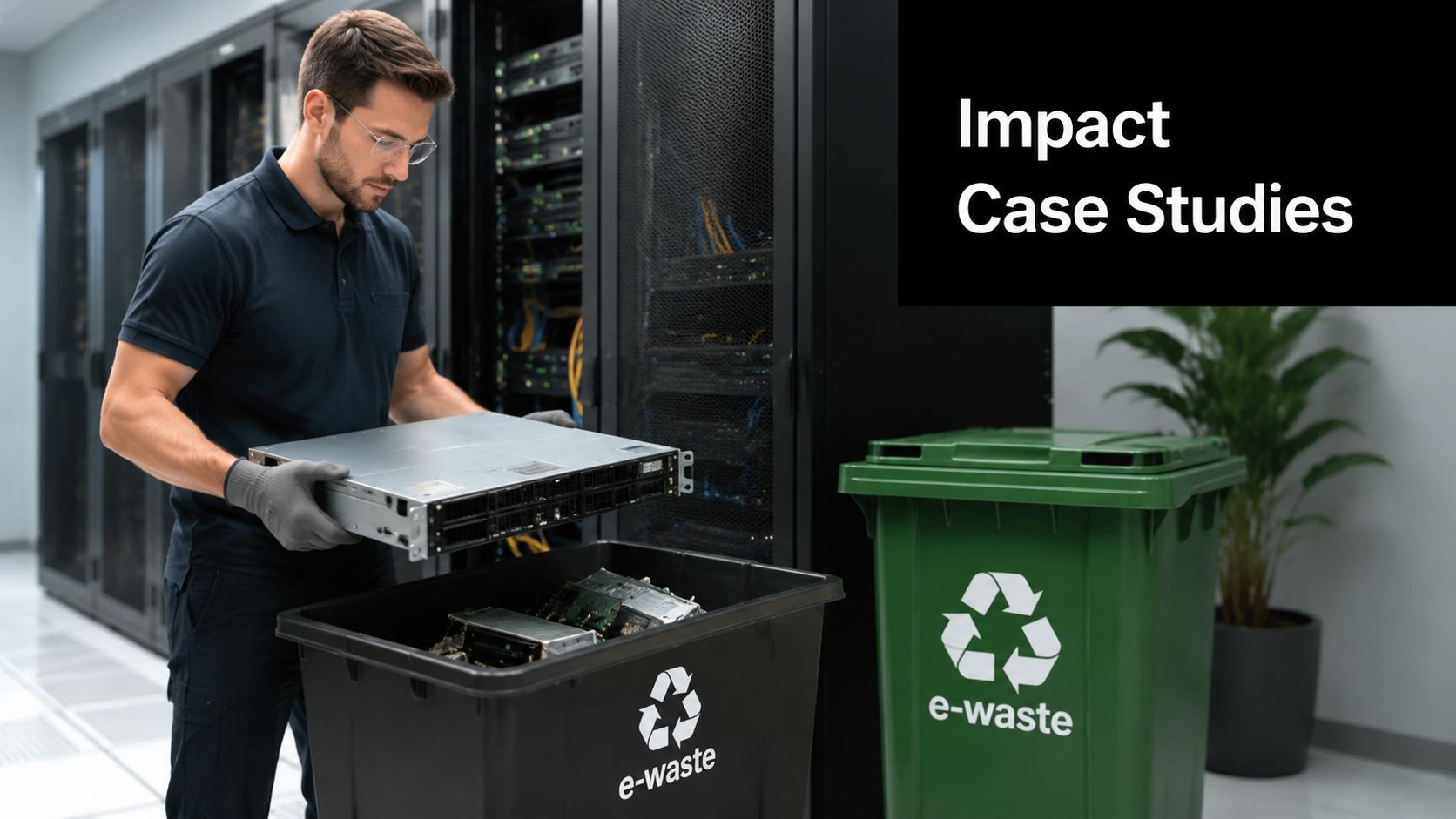
A familiar scene: an IT manager finishes a refresh project, sends over the recycling totals, and gets a follow-up question from leadership. How much harm did this avoid? How much value came from reuse instead of shredding or bulk recycling? That is the attribution gap in e-waste reporting. Case examples help close it because they show how teams connect operational records to defensible environmental and risk-reduction outcomes.
Example 1 A midsize office refresh
A regional business retires laptops, monitors, and networking gear during a workplace upgrade. The first report shows only total weight collected, which is like grading a library by the number of books moved without asking which books were preserved, donated, or destroyed.
A better protocol sorts the inventory by device type, condition, and final path. Reuse candidates are tracked separately from equipment sent for material recovery. Storage-bearing devices are matched with data destruction records. If the team applies a documented method for avoided emissions, it can estimate environmental benefit by pathway instead of presenting one blended recycling figure.
That change gives leadership a clearer answer. The report no longer says only what left the building. It shows what was reused, what was recycled, and where the organization can reasonably claim avoided harm.
Example 2 A school district device turnover
A public-sector technology team replaces student devices and wants to report environmental care alongside community benefit. The hard part is not collection logistics. The hard part is attribution.
Here, a sector-specific protocol matters. The district tracks asset class, working condition at pickup, chain of custody, refurbishment status, and final disposition. For devices that enter reuse or donation, the team records recipient program details only if that information is available and permitted to be shared.
This approach prevents overclaiming. If the district can document that devices were refurbished and redistributed, it can report that outcome. If it cannot verify longer-term educational benefit, it should stop short of claiming it. That discipline strengthens trust.
Example 3 A server room decommission
A server room decommission has a different risk profile. Weight still matters, but the reporting burden usually centers on traceability, secure destruction, and material-specific downstream processing.
The measurement model works like a chain-of-evidence file. One layer tracks removed assets and serial-numbered equipment. Another records destroyed drives and destruction certificates. A third links each asset group to its final processing route so environmental benefits are tied to documented handling, not assumed from pickup alone.
That structure is useful in ITAD because the largest benefit may come from avoided exposure or from extending equipment life through reuse. A single tonnage number cannot show that.
Recommended tools
The right tool depends on what your team is trying to prove.
- Bloom + e-Stewards ITAD Environmental Benefits Calculator: Useful for organizations that want a recognized method for estimating environmental benefits tied to ITAD processing pathways.
- SROI templates: Helpful when reuse, donation, digital access, or workforce programs are part of the project and the team needs a disciplined way to separate documented social value from broad assumptions.
- Internal asset and logistics systems: Often the starting point for strong measurement because they contain serial numbers, device classes, pickup dates, and disposition records.
- Document libraries and evidence folders: Good for storing certificates, downstream vendor records, audit files, and methodology notes in one place.
One practical option in this workflow is Reworx Recycling, which provides electronics recycling, IT asset disposition support, secure data destruction, and environmental impact reporting documentation as part of processed e-waste records. For IT managers trying to bridge the gap between activity counts and attributable outcomes, that kind of documentation can make measurement much easier to defend.
Conclusion and next steps
A useful impact measurement program answers a simple leadership question: what changed because we handled these devices this way?
For IT managers, that question matters during budget reviews, ESG reporting, vendor selection, and audit preparation. A pickup count or weight total shows activity. It does not show whether equipment was reused, whether hazardous exposure was prevented, or whether your process created documented environmental benefit instead of a disposal record with better packaging.
The next step is to treat measurement like chain of custody for outcomes. You would not accept a vague statement that a hard drive was "probably destroyed." Impact works the same way. Teams need a method that connects each device stream to a documented result, with clear limits on what can and cannot be credited to the program. That is how you narrow the attribution gap in e-waste. You stop reporting only what left the building and start showing what harm was avoided, what materials were recovered under verified handling, and what value came from reuse where reuse was documented.
Keep the first version practical. Start with one disposal stream, one framework, and a small set of defensible KPIs. Build evidence from your existing ITAD records, then improve the process each cycle as data quality gets better.
Reworx Recycling can support that process with electronics recycling, IT asset disposition, secure data destruction, and impact documentation tied to processed e-waste records. If your team is ready to turn retired equipment into documented environmental and community outcomes, explore Reworx Recycling to discuss a practical measurement approach for your next IT equipment disposal project.