Your storeroom probably has the same problem most growing businesses face, old laptops that still hold hard drives, servers nobody wants to power on again, monitors stacked for “later,” and a few boxes of peripherals that never quite made it to disposal. That pile looks harmless until someone asks where the data went, who touched the equipment, and whether the equipment can leave the building without creating a compliance headache. That's where a material recovery facility enters the picture, not as a dump, but as the industrial backbone that helps move usable material back into commerce.
A business leader usually meets this topic through risk, not through recycling theory. A key question is whether your outgoing electronics enter a controlled system that protects data, separates recoverable material, and keeps hazardous components out of the wrong stream. For ordinary recyclables, a municipal MRF can do that work. For electronics recycling, IT equipment disposal, and IT asset disposition, the partner has to be much more specialized.
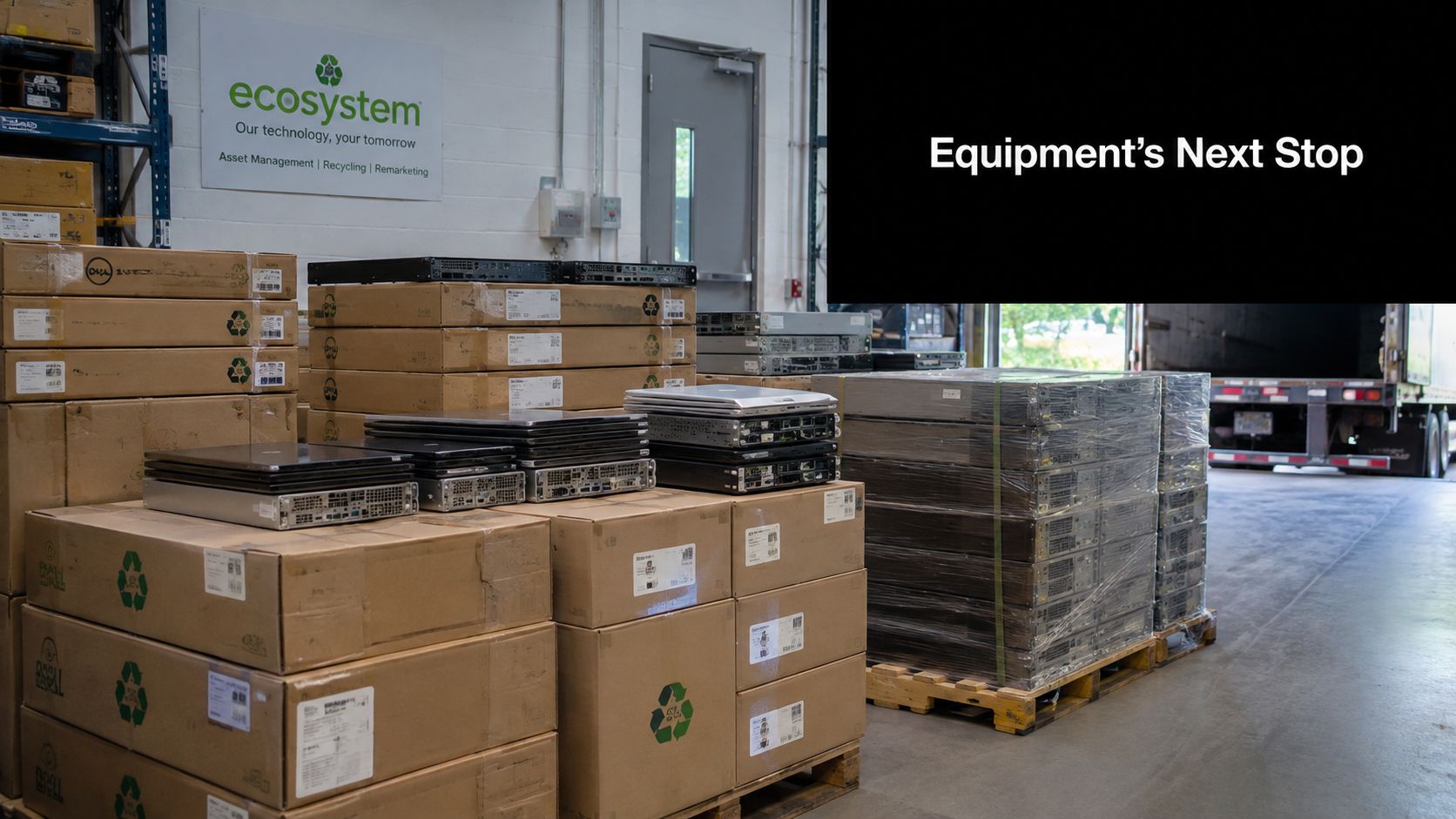
Your Old Equipment's Next Stop The Modern MRF
A company upgrades its fleet, IT clears out a server closet, and suddenly the back room fills with outdated hardware that can't just be tossed with office trash. The easiest mistake is to treat all recycling partners the same. A material recovery facility is the broader industrial answer to mixed recyclables, but the right one depends on what's inside the load and what the business needs protected on the way out.
The U.S. sector grew from 40 MRFs in 1991 to a peak of 556 in 2014, then slipped to fewer than 500 by 2018. By that same period, about two-thirds of facilities were handling single-stream material, and the average plant was moving about 200 tons per day in spaces of 30,000 to 70,000 square feet (Waste Recycling issue brief). That scale matters because it shows why MRFs became core infrastructure, not just local sorting sheds.
What that means for business equipment
For a business, the takeaway is simple. Municipal recycling infrastructure is built to process mixed material at volume, while electronics need controlled intake, careful handling, and downstream decisions that preserve security and value. A boxed-up server doesn't belong in the same mental category as a cardboard bale.
Practical rule: If the outgoing load includes batteries, drives, screens, circuit boards, or anything that stores data, treat it as a managed asset stream, not a general recycling pickup.
That distinction is why many companies start with a service like commingled recycling guidance and quickly realize they need a separate path for electronics. Reworx Recycling fits that narrower path because it focuses on electronics recycling, secure data destruction, and IT asset disposition rather than broad municipal sorting. In practice, that's what keeps a disposal event from turning into a data incident or a compliance misstep.
Inside a Municipal Material Recovery Facility
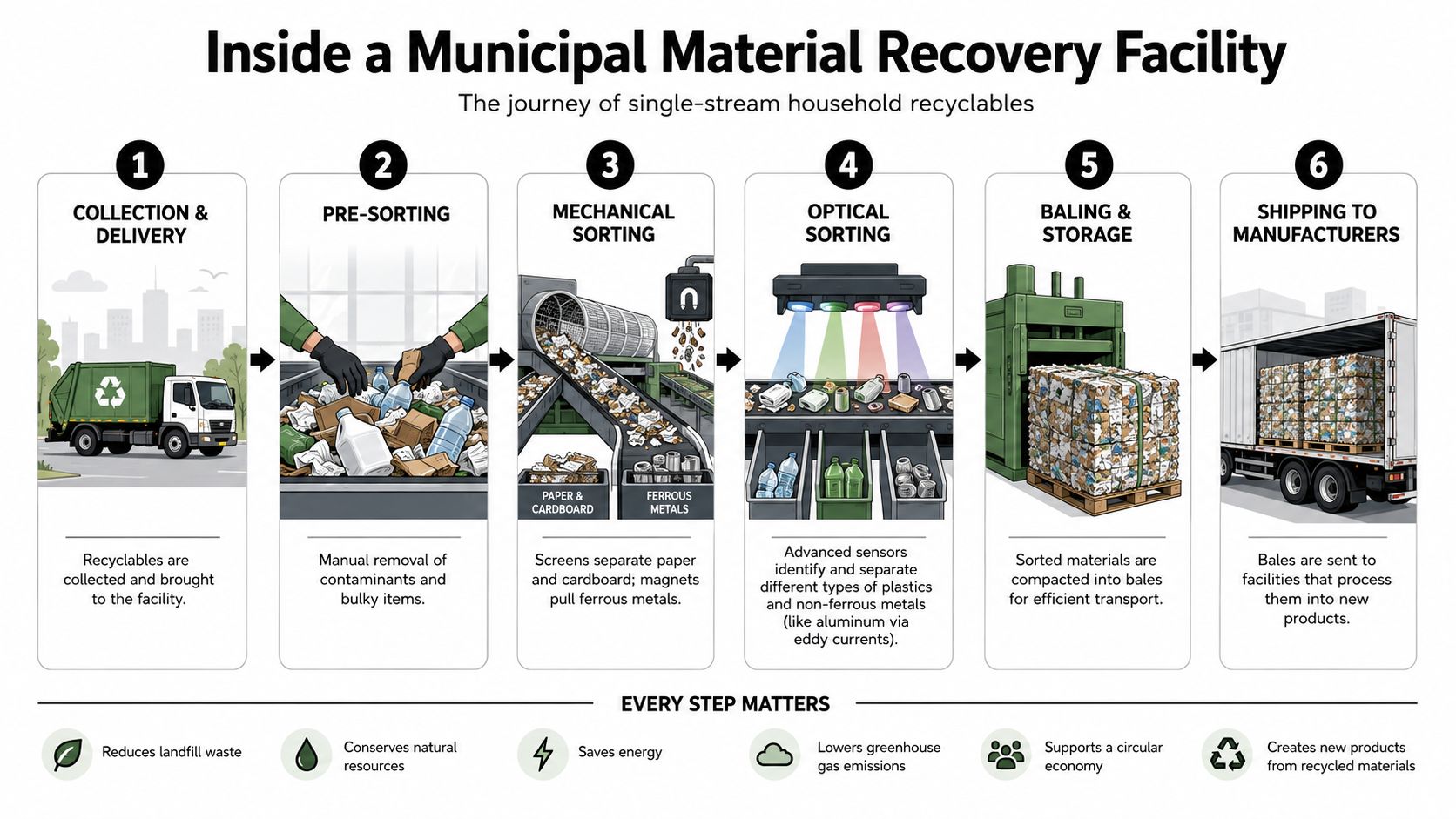
A municipal MRF works like a giant automated sorting kitchen. Trucks tip mixed recyclables onto the floor, operators remove obvious contaminants, and the material moves through a sequence of machines that divide it by size, weight, shape, and material type. The goal is not perfection, it's to turn a messy incoming stream into saleable commodities with enough purity to hold market value.
The EPA's design guidance is blunt about the basics. A well-designed MRF is an engineered system with dedicated receiving, sorting, storage, and loading zones, because contamination control starts before the material hits the line (EPA technical guidance). If the flow is poorly planned, bottlenecks rise, residue increases, and the commodity quality falls.
How the line actually works
- Collection and delivery bring the load in from curbside or transfer systems.
- Pre-sorting removes items that can jam the line or contaminate the output.
- Mechanical sorting uses screens and magnets to split paper, cardboard, and ferrous metal from the rest.
- Optical sorting uses sensors and air or other separation methods to isolate plastics and non-ferrous metals.
- Baling and storage compresses clean material into dense transport-ready units.
- Shipping sends those bales to manufacturers that turn them into new products.
That process works because each machine is tuned to a very specific material behavior. Screens separate by size, magnets pull steel, and optical equipment distinguishes material types that would otherwise look similar to the human eye. The facility is only as good as the cleanliness of the incoming stream and the discipline of the layout.
The technical details matter to business leaders because they explain why a municipal MRF is optimized for high-volume household recyclables, not for a mixed load of laptops, cords, printers, and hard drives. Electronics contain screws, plastics, metals, and sometimes batteries, but they also contain data-bearing components and hazardous constituents that don't belong in a general-purpose sorting line. Reworx's e-waste recycling process shows why electronics need a different intake and separation model.
Why Electronics Need a Specialized MRF Partner
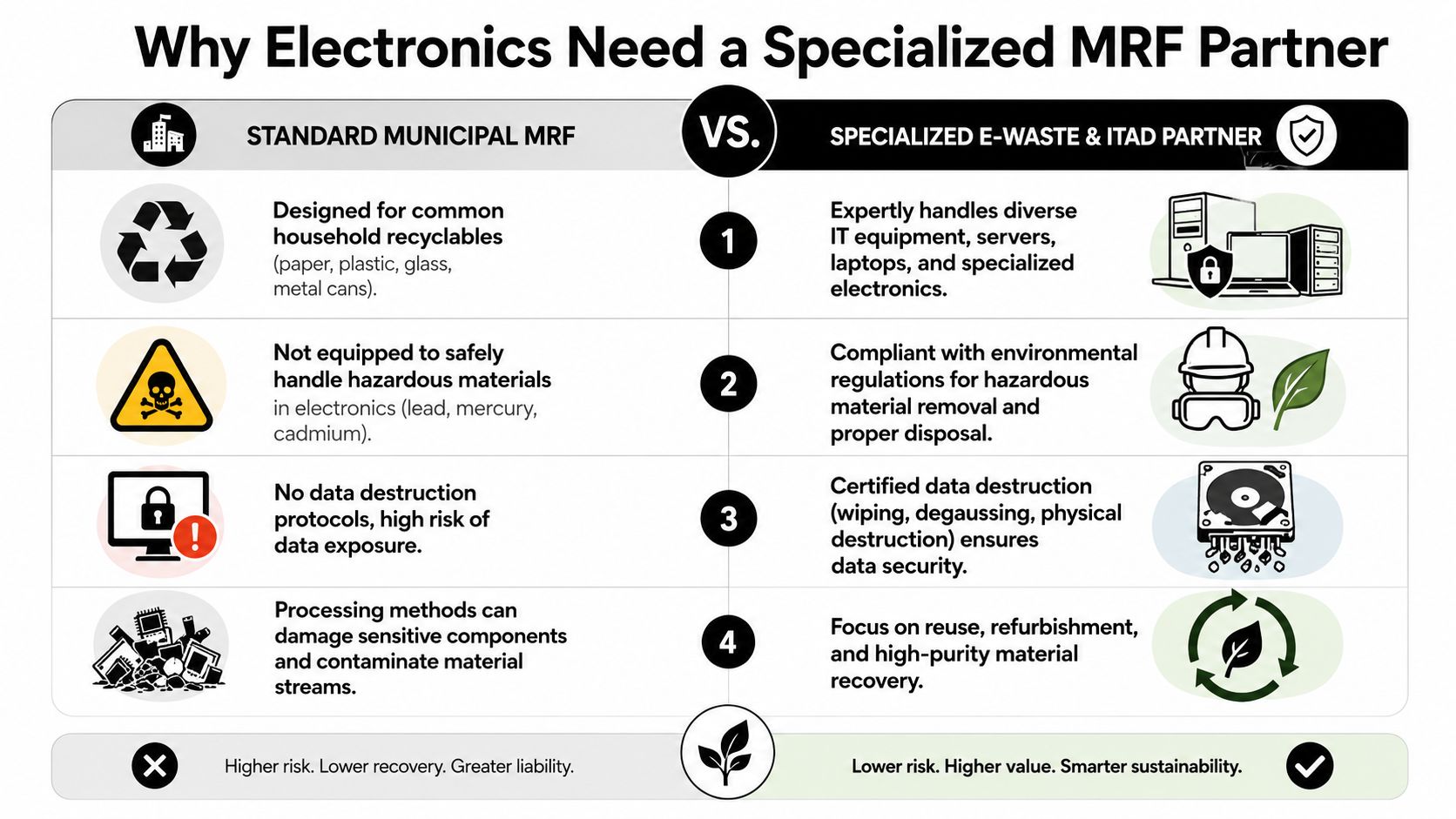
A municipal MRF can recover bottles, cans, cardboard, and some rigid plastics. It isn't designed to be the last stop for your IT closet. Once a device carries stored data, embedded batteries, or hazardous components, the operational logic changes from fast commodity sorting to secure, documented asset handling.
Municipal throughput versus electronics control
The municipal model is built for volume. It assumes incoming material can move quickly, with manual and mechanical separation tuned to a relatively narrow set of accepted recyclables. Electronics demand a slower front end, because a hard drive, a network switch, and a desktop monitor each follow different handling rules.
That's where specialized partners matter. Reworx Recycling handles computer recycling, laptop disposal, office cleanout, facility cleanout, data center decommissioning, and secure hard drive shredding as part of a controlled ITAD process. In that setting, the valuable pieces can be recovered, reusable items can be identified, and any sensitive data path stays documented instead of improvised.
The risk business leaders should care about
The biggest operational difference is custody. Municipal recycling depends on commodity purity. Electronics recycling depends on chain of custody, documented handoff, and destruction methods that match the sensitivity of the asset. If a device still has data, the question isn't whether it can be shredded eventually. The question is who controlled it before that point.
Practical rule: If your vendor can't explain how drives are isolated, logged, and destroyed, the process isn't ready for corporate use.
This is also where environmental compliance comes in. Electronics can include hazardous materials that require deliberate downstream processing, and that's why the wrong partner can create legal exposure even if the pickup itself looks efficient. A specialized donation-based recycling or social enterprise recycling provider can still recover value, but it does so within a framework built for reuse, refurbishment, and certified destruction rather than bulk commodity sorting.
For a business evaluating options, downstream processing matters as much as pickup logistics. The downstream question tells you whether your assets are entering a traceable process or disappearing into a mixed-material system that wasn't designed for corporate risk.
Measuring MRF Performance and Contamination Risks
A high-performing MRF does more than move material quickly. It keeps the right material moving, keeps contaminants out, and preserves enough value in the stream for the output to sell. For a business, that means lower operational waste, less risk at the dock, and tighter control over what leaves the facility.
What contamination really does
Contamination is any unwanted material that enters a recycling stream and interferes with sorting, resale, or safety. In a municipal facility, that can mean food residue, plastic film, or prohibited items. In an electronics stream, it can mean mixed device types, unremoved batteries, or assets that should have been separated for data destruction before they ever reach a shredder.
The EPA's guidance on MRF design makes the point clearly. Clean material improves marketability, while poor layout contributes to contamination, bottlenecks, and residue (EPA technical guidance). For a company, the operational lesson is straightforward. You do not want a vendor that treats every item as interchangeable.
Scale changes efficiency
A 2024 study in Resources, Conservation and Recycling found that large U.S. MRFs consume about 5 to 90 kWh per metric ton, compared with roughly 300 to 550 kWh per metric ton for smaller facilities, and that larger plants also have higher revenues and better access to plastic markets (study abstract). The important point for business leaders is not only the energy gap. Scale, technology, and market access materially affect performance.
That same logic applies to electronics, even though the streams are different. A provider that can show disciplined intake, good separation, and documented outcomes usually has stronger operational control than one that only talks about convenience. If you are comparing vendors, ask for recovery reporting, data destruction documentation, and the steps they use to keep contamination from creeping into the process. For a broader operational review, a waste stream analysis helps identify what is leaving the building, what needs secure destruction, and what could be reused or donated instead of discarded. The stronger the analysis, the easier it is to choose a partner that matches the actual risk profile of the equipment.
How to Choose the Right ITAD and E-Waste Partner
A retired laptop, a stack of monitors, and a box of old phones can look like routine disposal. In practice, they can expose data, trigger compliance questions, and create reputational risk if the chain of custody is weak. A good partner does more than collect electronics, it shows that pickup, transport, processing, and reporting can hold up under procurement review, security checks, and audit requests. That is the standard business leaders should apply when comparing IT asset management options and deciding who gets access to retired devices.

The questions that separate serious vendors from casual haulers
Start with documentation. Ask whether the vendor can provide certificates of recycling, serialized asset reporting, and secure data destruction records. Then ask how pickups are scheduled, what happens during office or facility cleanouts, and how the vendor handles assets that are better suited for reuse, refurbishment, or donation. Those answers reveal whether the provider has a controlled process or just a truck.
The compliance conversation should also cover certifications and internal controls. A vendor that cannot explain its security procedures clearly is a poor fit. A vendor that can explain them but cannot show evidence creates the same problem, because the burden still lands on your team if records are incomplete or inconsistent. For business leaders, that gap affects both compliance posture and how confidently the organization can defend its disposal decisions.
Where social enterprise adds value
A social enterprise model gives procurement teams a way to align disposal with community benefit. Reworx Recycling works in that lane by combining electronics recycling, corporate donation programs, and secure data destruction with a mission tied to environmental stewardship and community impact. That matters when one process needs to support sustainability, reuse, and responsible retirement at the same time.
For teams tightening their own controls, IT asset management guidance is a useful reference because it keeps attention on inventory discipline, lifecycle planning, and end-of-life accountability. Those same habits make e-waste contracts cleaner, reduce surprises during decommissioning, and help procurement teams ask better questions before a vendor is approved.
Practical rule: The right partner should make it easy to answer three questions, what left, who handled it, and how was it treated at the end.
A vendor-selection checklist should also cover logistics. Bulk pickups, secure transport, and the ability to manage mixed office hardware are basic expectations. If the vendor also handles product destruction, medical equipment disposal, or laboratory equipment disposal, the business still needs to verify that the process used for its own assets matches the risk profile of those items.
From Disposal Obligation to Strategic Partnership
A company that treats recycling as a back-office chore usually gets back-office results. A company that treats it as a strategic decision gets a better outcome across risk, reputation, and resource recovery. That's especially true with electronics, where the wrong path can expose data, weaken compliance, and waste material that still has value.
The national infrastructure picture reinforces that point. The EPA estimates that modernizing U.S. recycling infrastructure, including the 421 MRFs that process packaging, would require $36.5 billion to $43.4 billion by 2030 (EPA financial assessment). That's not just a public-sector number. It shows that responsible recycling depends on a large, connected system, and businesses are part of that system whether they think about it or not.
For leaders responsible for operations, compliance, and ESG reporting, the right takeaway is straightforward. A general MRF serves one need. A specialized electronics and ITAD partner serves a different one. When the assets include data, power supplies, batteries, and sensitive hardware, the partner choice becomes part of corporate governance.
Reworx Recycling is built for that narrower, higher-stakes lane. It handles business pickups, equipment decommissioning, secure hard drive shredding, and responsible electronics recovery in a way that supports both environmental goals and community-focused reuse.
If your company has retired laptops, servers, or mixed office electronics waiting for a decision, contact Reworx Recycling to arrange pickup or plan a secure disposition path. Visit Reworx Recycling to learn how its electronics recycling and ITAD services can help your team retire equipment responsibly while keeping data, compliance, and community impact in view.