Your team just replaced a floor of aging laptops. The IT manager wants the old devices gone fast. Finance wants a record of asset retirement. Legal wants proof that drives were wiped or destroyed. A customer questionnaire asks how you handle e-waste. Then someone in leadership says, “Can we include this in our sustainability report?”
That moment captures why so many companies start asking what sustainability reporting is. It sounds strategic and abstract until it lands in a real operational task like laptop disposal, office cleanouts, secure data destruction, or data center decommissioning.
In plain terms, sustainability reporting is a company's public disclosure of how it manages environmental, social, and governance issues. That includes what it measures, what risks it sees, what actions it takes, and how it tracks progress over time. For a B2B organization, that can touch everything from energy use and procurement to employee safety, vendor oversight, and responsible IT asset disposition.
Why Sustainability Reporting Is Now a Business Imperative
A lot of companies didn't start with a grand reporting strategy. They started because customers asked for ESG information in an RFP, lenders asked better questions, or procurement teams wanted evidence that vendors could manage environmental and compliance risk.
That pressure isn't isolated. Sustainability reporting has become common practice across large companies globally. In 2024, 96% of the world's 250 largest companies developed sustainability reports, and in the Asia-Pacific region, reporting rose from about 50% of firms to 92%, according to Statista's reporting rates overview.
What the term actually means
If you're trying to answer the question, what is sustainability reporting, start with this working definition: it's a structured way to show how your business affects people, resources, and long-term enterprise value.
It's broader than a recycling page on your website. It's also more disciplined than a list of good intentions. A real report connects policies, metrics, business risks, and operating decisions.
For many B2B companies, the practical trigger points look like this:
- Customer due diligence: Enterprise buyers want to know how you handle waste, data security, and supplier practices.
- Board and investor visibility: Leadership wants a clearer picture of non-financial risk.
- Operational control: Teams need one place to document what's happening across facilities, IT, HR, procurement, and logistics.
- Reputation protection: Public claims about sustainability need evidence behind them.
Sustainability reporting becomes useful when it helps a company make decisions, not just publish statements.
Why operations teams should care
The companies that do this well usually stop treating sustainability as a side project. They connect it to purchasing, facilities, fleet, warehousing, cybersecurity, and end-of-life asset handling.
That's why topics like electronics recycling and responsible e-waste processing belong in the conversation. If your company buys hundreds or thousands of devices, your environmental footprint doesn't end when the equipment stops working. Disposal choices affect waste handling, data security, documentation quality, and whether you can support stated sustainability goals with evidence. Reworx Recycling provides more detail on this connection in its guide to corporate sustainability goals.
For broader context on why efficient material use matters across business systems, this piece on resource efficiency for a sustainable world is a useful companion read.
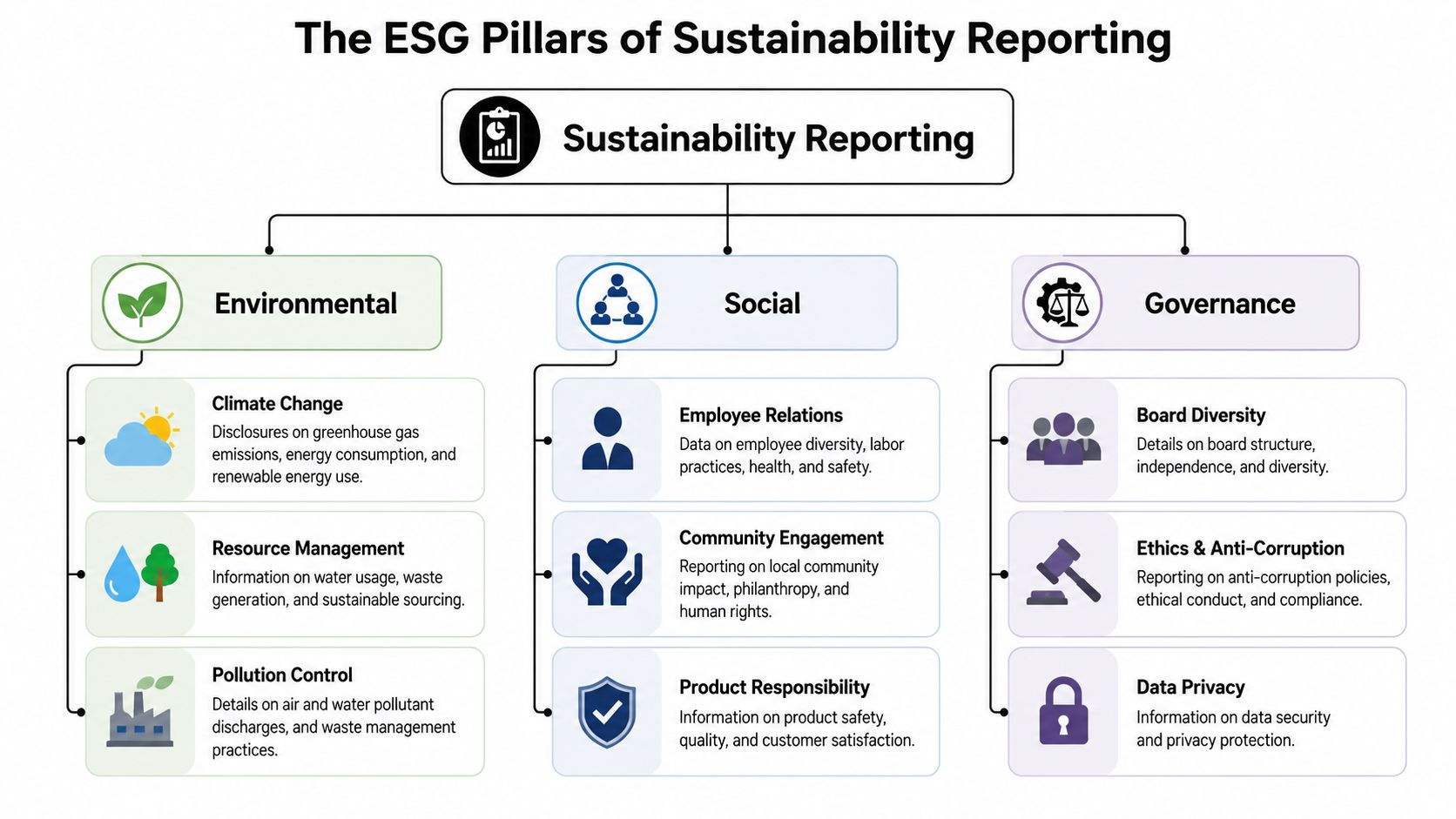
Understanding the ESG Pillars and Key Disclosures
Most reporting confusion starts here. Companies hear “ESG” and assume it refers only to carbon emissions. It doesn't. ESG is the basic structure used to organize what a company discloses.
Environmental
The Environmental pillar covers how business activity affects natural resources and pollution outcomes. For many organizations, that includes energy use, emissions, waste generation, water use, and materials management.
IT operations fit here more often than people expect. Examples include:
- Computer recycling: What happens to retired desktops, monitors, servers, and peripherals.
- Laptop disposal: Whether devices are reused, donated, remarketed, or recycled through documented channels.
- Data center decommissioning: How retired racks, drives, cables, and network hardware are removed and processed.
- Facility cleanout waste: Whether electronics are separated from general waste streams.
- Medical or laboratory equipment disposal: How specialized devices are retired responsibly.
A sustainability report doesn't need to describe every cable and keyboard. It does need a credible method for deciding what matters and how it's measured. That's where the environmental stewardship perspective from Reworx Recycling becomes operational. Stewardship is not just intent. It's process.
Social
The Social pillar focuses on people. That includes employees, customers, contractors, local communities, and others affected by your operations.
Many IT leaders realize sustainability reporting overlaps with security and community impact. A few examples:
- Secure data destruction: Retiring devices without exposing sensitive information.
- Worker handling practices: Safe collection, packaging, transport, and processing of retired electronics.
- Corporate donation programs: Redirecting usable technology to community benefit rather than sending it straight to scrap.
- Digital inclusion: Extending device life in ways that support schools, nonprofits, or workforce access to technology.
If your company donates retired but functional equipment, that can support a social narrative. But the claim becomes far stronger when it's documented as part of an actual disposition process.
Practical rule: If an activity creates environmental value but creates data privacy risk, it belongs in both Environmental and Social review.
Governance
The Governance pillar is the control system behind the report. It covers oversight, decision rights, policies, accountability, and risk management.
In plain language, governance answers questions like these:
- Who approves sustainability disclosures?
- Who owns each metric?
- How do you verify vendor claims?
- What process exists for handling exceptions?
- How are disposal, privacy, and compliance decisions documented?
A report can be no more reliable than the system behind it.
A useful way to think about structure is the three-layer architecture described by CarbonBetter: a framework sets the structure, standards define what to report, and protocols determine how to measure it, as explained in this overview of ESG reporting frameworks. That distinction prevents a common mistake. Teams often compare this year's waste or recycling figures to last year's without checking whether the measurement method changed.
Choosing Your Framework GRI vs SASB/ISSB vs TCFD
Framework names lose people fast. The acronyms pile up, and every option sounds official. The simplest way to choose is to ask one question first: who is the report for?
If you need broad transparency for customers, employees, partners, and communities, you'll lean one way. If you need investor-grade disclosure tied to financial risk, you'll lean another.
Sustainability Reporting Frameworks at a Glance
| Framework | Primary Focus | Main Audience | Materiality Focus |
|---|---|---|---|
| GRI | Broad sustainability impacts across ESG topics | Wide stakeholder audience | Impact on people, environment, and society |
| SASB / ISSB | Industry-relevant sustainability topics for capital markets | Investors and financial stakeholders | Financial materiality and enterprise value |
| TCFD | Climate-related governance, strategy, risk, and metrics | Investors, boards, and lenders | Climate-related financial risk |
GRI for broad stakeholder reporting
GRI is often the most intuitive starting point for companies early in the process. It helps organizations report on a broad set of impacts, not just issues that affect valuation or access to capital.
That makes it useful when your audience includes customers, employees, procurement teams, community partners, and the public. If your company wants to explain how it handles waste streams, labor practices, community engagement, and supply-chain effects, GRI-style thinking is a natural fit.
For example, a company documenting electronics recycling, office cleanouts, and donation-based recycling may find GRI easier to use because it supports a wider story about operational impact.
SASB and ISSB for investor relevance
SASB introduced industry-specific guidance around financially material sustainability issues. Today, many companies encounter that logic through the newer ISSB framework.
The key shift is focus. These standards ask what sustainability-related risks and opportunities could affect business performance, financing, and long-term value. That's a different lens from broad stakeholder impact.
According to the IFRS standard navigator, IFRS S1 requires entities to disclose sustainability-related risks and opportunities that could reasonably affect cash flows, access to finance, or cost of capital over the short, medium, or long term, which you can review in the IFRS S1 general requirements.
That requirement changes how teams work internally. Sustainability reporting starts to look more like financial reporting. You need clearer scope boundaries, stronger review processes, better data lineage, and repeatable methods. Reworx Recycling's discussion of carbon offset calculation is one example of the broader challenge. Once environmental claims connect to decision-making, the math and documentation matter.
If your CFO or board is asking how sustainability issues affect risk, financing, or resilience, you're no longer dealing with a narrative-only exercise.
TCFD for climate-specific disclosure
TCFD is narrower. It focuses on climate-related risk and opportunity through four themes: governance, strategy, risk management, and metrics and targets.
That makes it especially useful for organizations facing climate-related scrutiny from investors, lenders, insurers, or enterprise customers. It doesn't replace broader sustainability reporting. It sharpens one major part of it.
How to choose without overcomplicating it
If you're a small or mid-sized business, don't start by trying to satisfy every framework at once. Start by matching the framework to the pressure you face.
A practical way to decide:
- Use GRI-style logic if you need a broad, public-facing sustainability story.
- Use SASB or ISSB logic if investor relevance and financial risk are driving the conversation.
- Use TCFD if climate risk is the immediate requirement from stakeholders.
Many companies eventually blend approaches. That's normal. What matters is that the framework helps you answer real business questions with data you can support.
The Business Case for Sustainability Reporting
A lot of leaders still treat reporting as an output. It's more useful as a management tool.
When a company tracks waste, asset retirement, procurement patterns, and controls around disposal, it often finds problems that were previously buried in departmental handoffs. Old devices sit in storage rooms. Equipment gets scrapped without documentation. Pickup records and destruction records don't line up. Business units follow different rules.

Reporting improves management quality
The strongest business case for sustainability reporting is that it forces clarity. You can't manage what no one owns.
That matters because sustainability reporting is already mainstream in major U.S. capital markets. The CAQ found that 99% of S&P 500 companies disclosed some level of sustainability information for periods ending in 2023, and 73% of those that reported sustainability information obtained assurance over at least part of that information, as shown in the CAQ's review of S&P 500 ESG reporting.
Those figures tell B2B suppliers something important. Large customers increasingly expect documented, reviewable information. They also expect that information to hold up under scrutiny.
Where the value shows up in daily operations
The benefits usually appear in familiar business tasks:
- Procurement discipline: Teams ask better questions of disposal and recycling vendors.
- Risk reduction: Sensitive equipment is handled through defined secure data destruction processes.
- Operational efficiency: Facilities and IT stop duplicating effort during office cleanouts and refresh cycles.
- Customer readiness: Sales and compliance teams can answer sustainability questionnaires with evidence, not guesswork.
A company that tracks retired hardware well is usually better at more than e-waste. It tends to have better chain-of-custody habits, better cross-functional coordination, and clearer ownership of non-financial data.
Assurance changes the standard
External assurance matters because it raises the bar from “we believe this is right” to “we can support how this was assembled.” That same mindset applies inside operations whether or not you seek formal assurance immediately.
The practical takeaway is simple. If your sustainability claims depend on electronics recycling, IT asset disposition, product destruction, or equipment donation, your vendor records become part of your reporting system. That's one reason many teams look closely at the documented benefits of e-waste recycling when building an internal business case.
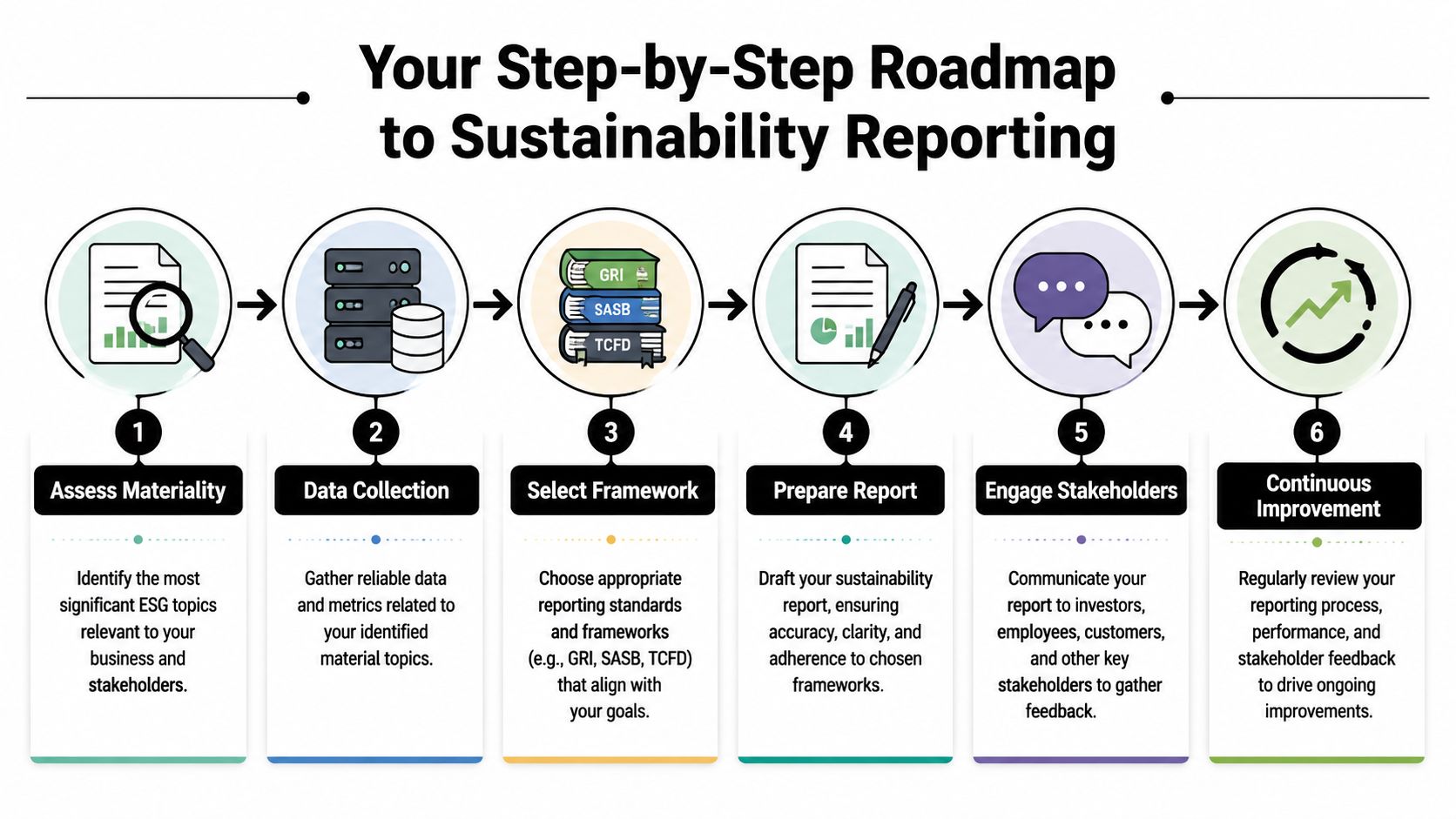
A Practical Roadmap to Begin Your Reporting Journey
Most organizations don't struggle with the idea of reporting. They struggle with the data. Finance has some of it. HR has some. Procurement has some. IT has disposal logs in one format, while facilities has pickup notes in another.
That's why reporting often stalls at the same point. The governance isn't there yet.
EcoVadis points to a common gap here. Reporting quality depends on “strong processes and controls from source to disclosure” and consistent methods across the value chain, as noted in its glossary entry on sustainability reporting. That point is especially relevant to e-waste, where many companies have activity but weak documentation.
Start with material topics
Your first report does not need to cover everything. It should cover what matters most to your business and stakeholders.
For many B2B firms, that short list includes:
- Energy and resource use: What major operating activities consume resources?
- Waste and end-of-life management: What leaves your facilities, and how is it handled?
- People and trust topics: Where do safety, privacy, labor, or community issues show up?
- Governance controls: Who approves, reviews, and verifies the data?
If your company buys and retires meaningful amounts of technology, IT asset disposition belongs on the list. It affects waste, security, procurement, and sometimes community impact through device donation.
Build a data map before a report draft
Don't begin by writing narrative text. Begin by mapping data sources.
Create a simple working sheet with these fields:
- Metric name: For example, retired laptops, recycled servers, donated desktops, shredded drives.
- Owner: IT, facilities, procurement, security, or finance.
- Source system: Asset inventory, pickup log, vendor certificate, invoice, service ticket.
- Method: How the metric is counted.
- Review step: Who checks it before publication.
This sounds basic, but it prevents a common failure. Teams often publish a number and later discover that one business unit counted collected assets while another counted processed assets. Those are not the same thing.
Field note: A sustainability metric is only as strong as the person who can explain where it came from.
Use IT asset disposition as an early win
ITAD is one of the easiest places to move from vague sustainability language to documented practice. Why? Because the process already produces records if it's managed well.
Think about the information an organization may already have access to:
- Pickup and chain-of-custody records
- Asset lists by type
- Certificates of data destruction
- Certificates of recycling or downstream processing
- Donation records for reusable equipment
- Internal approvals for decommissioning or product destruction
That documentation can support both environmental and governance disclosures. It can also help answer customer questions about computer recycling, secure data destruction, and responsible e-waste handling.
One practical option is to work with a processor that can supply those records as part of the service flow. For example, Reworx Recycling handles electronics recycling and IT equipment disposal with documentation that can support internal tracking for retired assets, data destruction, and downstream processing.
Keep your first reporting cycle narrow and repeatable
A credible first cycle is better than an ambitious but fragile one. Choose a manageable set of metrics. Define them clearly. Run them through a review process. Then improve the system next year.
A simple first-year operating model often looks like this:
- Quarterly collection: Gather source records on a schedule instead of waiting until year-end.
- Single owner per metric: Shared ownership usually means no ownership.
- Version control: Keep one approved source file for each disclosure.
- Vendor evidence retention: Save certificates, manifests, and confirmations in a central folder.
- Method notes: Write down how each figure was derived.
Watch for the common failure points
The same issues appear again and again:
- Storage room blind spots: Devices sit untracked for months, then disappear into a one-time cleanout.
- Mixed waste handling: Electronics get lumped into general facility disposal.
- No distinction between reuse and recycling: Teams claim “recycled” when some equipment was redeployed or donated.
- Security and sustainability teams working separately: Data destruction records never make it into ESG files.
- Vendor claims without evidence: Marketing language substitutes for process documentation.
The companies that avoid greenwashing risk usually do one thing well. They narrow the gap between what they say and what they can prove.
Turn Your Sustainability Goals into Community Impact
A good sustainability report doesn't live in a PDF. It shows up in routine business decisions. How you buy equipment. How long you use it. How you retire it. How you protect data. How you document where materials go next.
That's why the most practical answer to what sustainability reporting is isn't just “a disclosure process.” It's a way to connect business operations to accountability. Frameworks matter. Standards matter. Controls matter. But the report becomes credible when everyday activities can be traced back to clear evidence.
The strongest reports connect systems and outcomes
This is especially true in technology-heavy environments. A company may talk about environmental stewardship, but the visible proof often sits inside a facility cleanout, a laptop disposal workflow, a medical equipment disposal project, or a data center decommissioning plan.
When those activities are handled carefully, they support several goals at once:
- Environmental accountability: Equipment avoids unmanaged disposal.
- Social value: Reusable technology can support donation pathways and digital access.
- Governance quality: Data destruction and chain-of-custody records show control, not just intent.
For teams thinking beyond pure waste diversion, community-centered reporting can be instructive. Fillaree's waste recovery report is a useful example of how operational recovery efforts can be framed in terms of broader impact.
A practical partner matters
The hardest part of reporting is rarely picking the right language. It's getting dependable inputs from real operations.
That's where a specialized ITAD and electronics recycling partner can help. If your organization needs support with donation-based recycling, secure data destruction, product destruction, office cleanouts, or retired equipment pickup, the right partner can provide records that make internal reporting easier and more defensible.
The point isn't to turn recycling into marketing copy. The point is to turn a necessary operational task into documented evidence that supports environmental responsibility, risk management, and community impact.
If your business is ready to move from vague ESG intentions to documented action, explore Reworx Recycling. You can use the next hardware refresh, office cleanout, or IT equipment disposal project as a practical starting point. Donate old equipment, schedule a pickup, or build a repeatable process for electronics recycling, secure data destruction, and community-focused technology recovery.