You've got a cage in the parking structure, two pallets of laptops by the freight elevator, and a facilities director asking why the hardware from last quarter's refresh is still on site. That's electronics recycling in Los Angeles, CA for most businesses. It's not a lack of options. It's choosing a route that's legal for your jurisdiction, safe for your data, and realistic for your volume.
What Los Angeles E-Waste Actually Looks Like in 2026
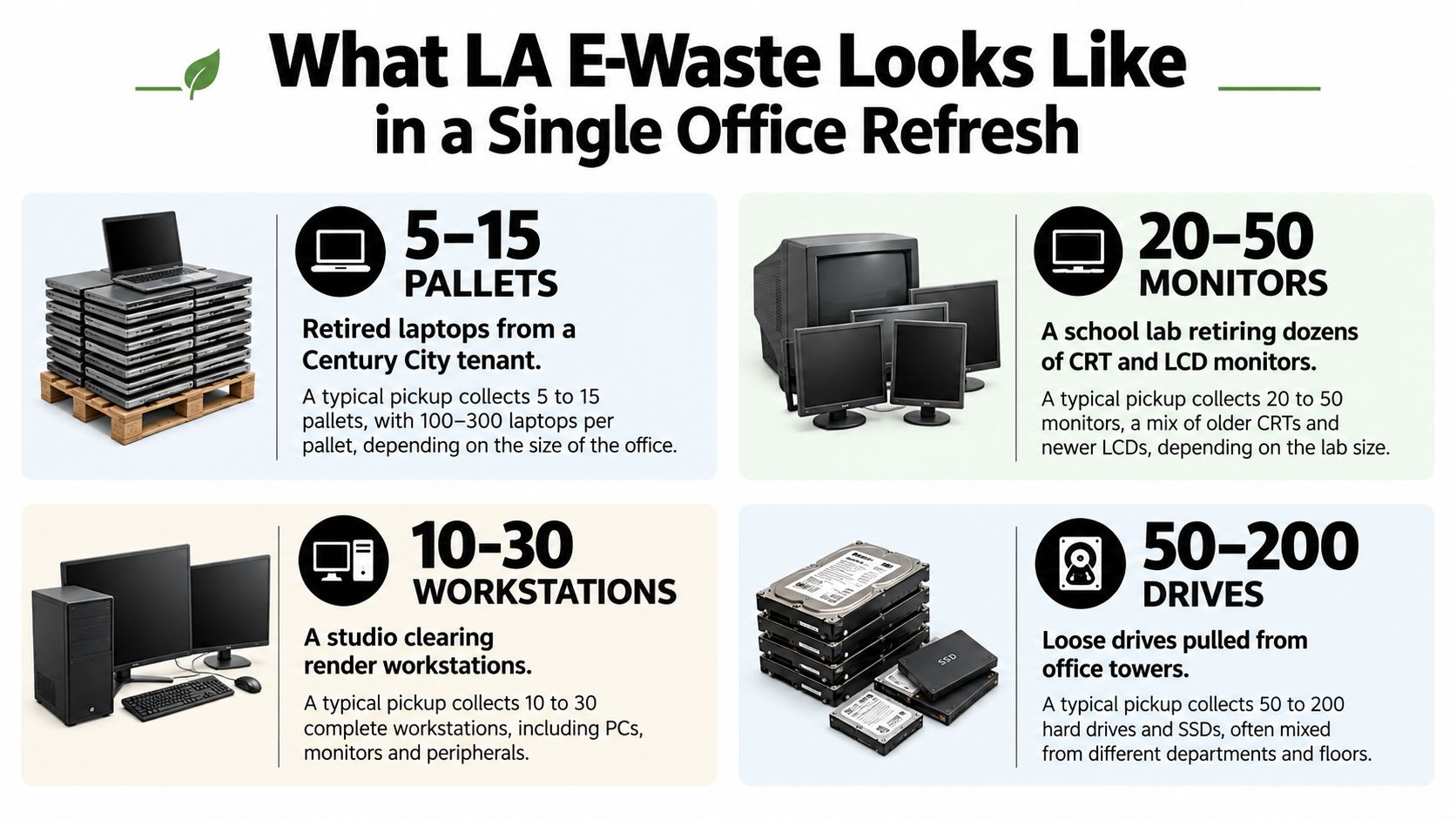
A Century City tenant moves floors and leaves pallets of retired laptops, docks, and monitors behind. A studio clears render workstations that are too heavy for one person to lift safely. A school retires a computer lab, and a healthcare practice decommissions imaging hardware that can't go in ordinary trash.
Those jobs look different, but they force the same three decisions. You need to decide where the equipment goes, what happens to the data, and who's accountable for compliance after it leaves your dock. If you answer those questions in the wrong order, you'll load a truck before you know whether reuse, donation, or destruction was even appropriate.
Los Angeles sits inside a statewide system
You're not inventing a disposal path from scratch. California's system was established through the Electronic Waste Recycling Act of 2003, also known as Senate Bill 20, which created funding for covered televisions and monitors containing hazardous materials, according to CalRecycle's program history and milestones. That same source notes the point-of-sale fee has been $4, $5, or $6 since January 1, 2020, depending on screen size.
The scale matters when you're choosing vendors. By December 2023, California had approximately 273 approved collectors and 21 approved recyclers, and since January 2005 the program had paid roughly $1.3 billion in recycling claims, per the CalRecycle source above. Between January 2015 and December 2023, approximately 18.8 million covered devices were transferred.
Don't start with a truck. Start with triage, because reuse value, battery risk, and data sensitivity determine which truck should show up.
My recommended order for every office cleanout or facility cleanout is simple. Prep the devices first, pick the route second, lock down secure data destruction third, then handle logistics and cost. That sequence prevents the most common LA mistake, which is treating a business-volume IT equipment disposal project like a household drop-off.
Entertainment, healthcare, education, legal, and technology tenants all generate the same core stream here. It's laptops, monitors, servers, printers, phones, loose drives, and batteries. The difference is how much risk is sitting inside them.
Preparing Devices, Batteries, and Paperwork Before Pickup
Do the prep work before you call anyone. A vendor can't give you a clean quote or a defensible certificate if your pallets are a mixed pile of laptops, loose batteries, and unlabeled drives.
Run this triage at the bench
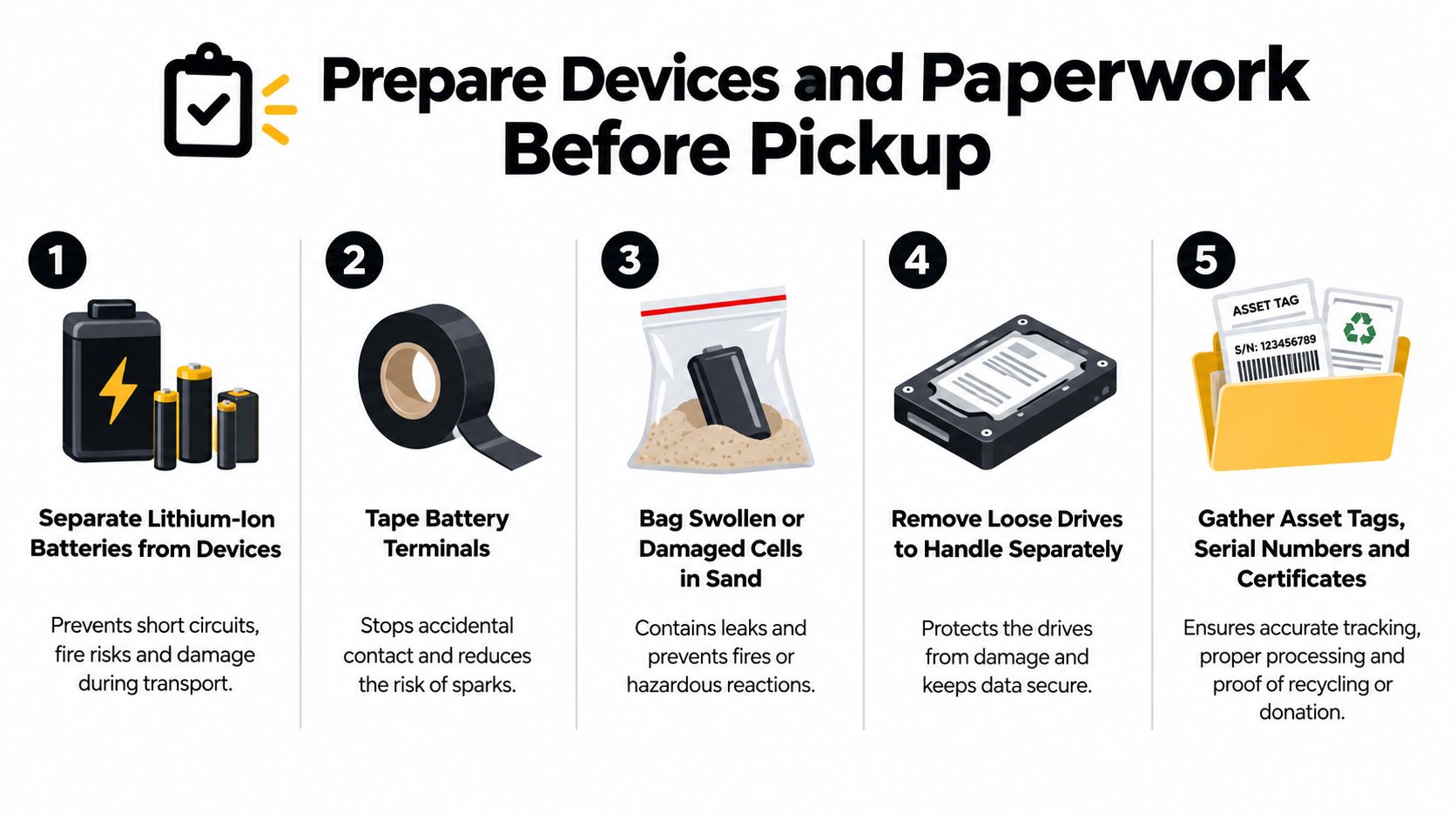
- Separate lithium-ion batteries: Pull removable batteries from devices and keep them out of mixed electronics gaylords.
- Tape every terminal: Cover exposed contacts so batteries don't short against each other in transit.
- Isolate damaged cells: Bag swollen or damaged batteries separately, ideally in sand, and flag them for the driver before pickup day.
- Pull loose drives: Remove drives that'll be wiped or destroyed separately and keep them in a locked, labeled container.
- Sort by outcome: Create clear stacks for reuse candidates, recycling only, and product destruction.
Los Angeles County guidance gives specific battery preparation instructions, including covering terminals and using lidded collection bins, as noted in City guidance on S.A.F.E. Centers and household hazardous waste. That guidance also warns that rechargeable batteries can spark when compacted and shouldn't go in ordinary trash. For a business, translate that warning into a staging rule and brief whoever is packing.
Build the inventory before anything moves
Your spreadsheet is your protection. Record make, model, serial number, asset tag, location, and data class for every data-bearing device. That list becomes the spine of your chain of custody and your certificate of destruction.
Without serial numbers, a certificate is just a vague receipt. With them, your auditor can match a retired laptop to a specific sanitization or destruction record. Use this practical guide to preparing company electronics for recycling to standardize the checklist across sites.
Verify your downstream partner at the same time. CalRecycle maintains a directory of participating collection and recycling organizations under the Covered Electronic Waste Recycling Program, described in CalRecycle's participant directory listing. Check it before a single box is loaded, not after.
Choosing the Right LA Disposal Path for Your Volume
Stop treating City of Los Angeles and Los Angeles County as the same jurisdiction. They aren't, and that confusion wastes more time than any fee dispute I've seen.
City guidance says residents can use S.A.F.E. Centers and mobile events at no charge, while bulky electronic items may qualify for free curbside pickup through MyLA311, according to LA Sanitation information on S.A.F.E. Centers. That's a solid lane for residents and very small offices with a handful of items. It's not a plan for a multi-floor computer recycling project.
County access works differently. Los Angeles County Public Works states that free household hazardous waste and electronic waste collection events occur almost every weekend, and the Antelope Valley Environmental Collection Center offers free service on the first and third Saturday of each month, per County Public Works answers on collection events. The county also states that collected materials are sorted, processed, and recycled through approved vendors.
Los Angeles E-Waste Routes at a Glance
| Route | Best For | Cost | Data Services | Documentation |
|---|---|---|---|---|
| City S.A.F.E. Centers and MyLA311 | City residents, tiny loads | Free for eligible residents | None you should rely on | Basic drop-off confirmation |
| County weekend events and centers | County households, smaller loads | Free for eligible residents | None you should rely on | Event-based handling |
| Private business recycler | Offices, schools, agencies, multi-site volume | Quoted by volume and service | Sanitization or destruction by contract | Serialized inventory and certificates |
The third lane is where most organizations belong. A private partner such as Reworx Recycling handles business-volume pickups, donation-based recycling, and documented IT asset disposition (ITAD) for data-bearing equipment. If you're comparing that route, review these IT asset disposal solutions for Los Angeles businesses against your volume and reporting needs.
Hard truth: Free disposal doesn't equal convenient disposal when you're bound by weekend hours, capacity limits, vehicle rules, and staff travel time.
Use public lanes for household-scale material. Use a contracted recycler when you have pallets, regulated data, medical equipment disposal, laboratory equipment disposal, or a lease deadline. Predictable logistics beat an event calendar every time you're paying staff to wait in line.
Secure Data Destruction That Holds Up to Audit
Deleting files isn't destruction. Neither is a factory reset you can't document. Treat secure data destruction as a procurement decision with a named method, a named performer, and a serialized record.
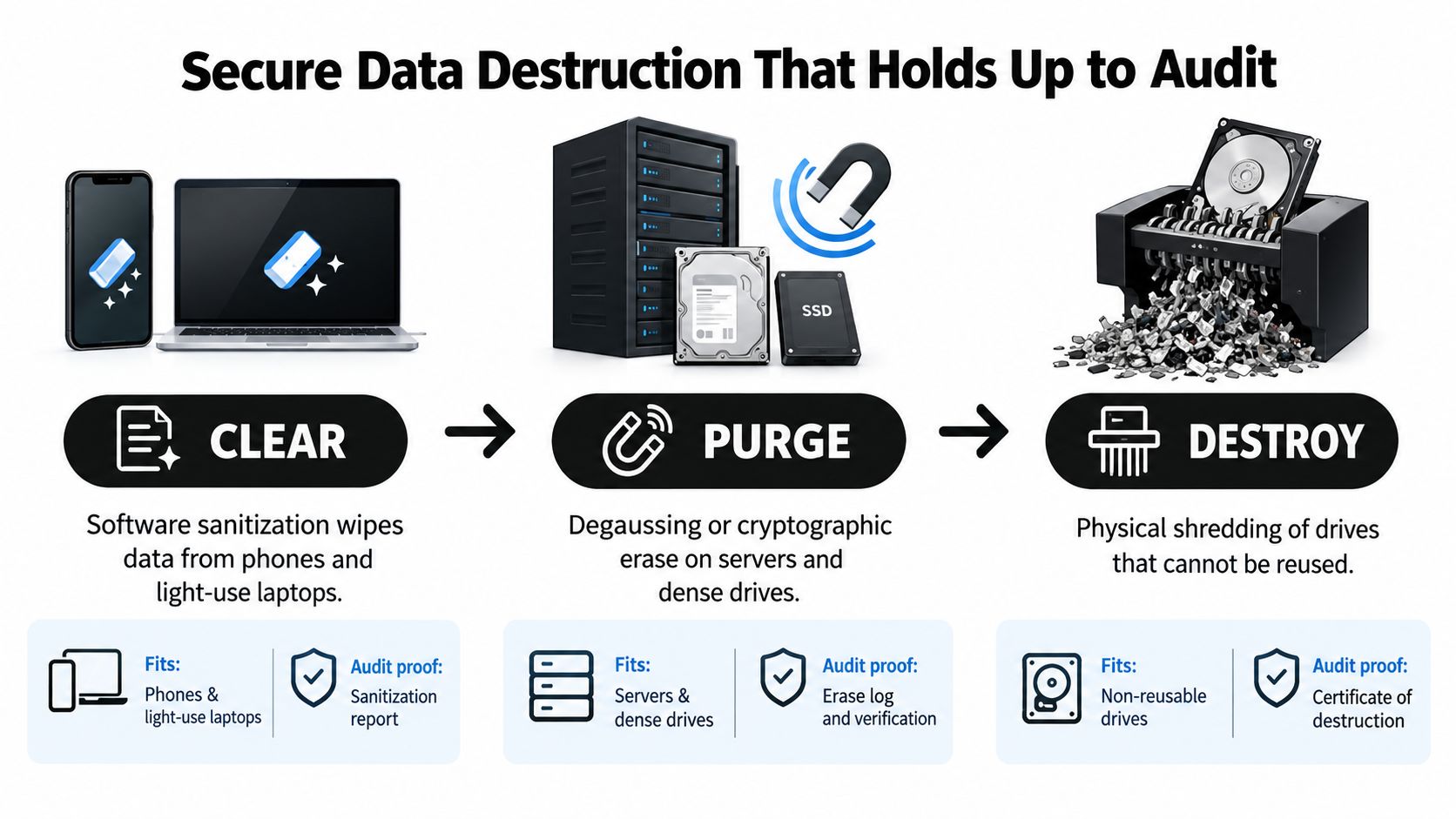
NIST distinguishes among Clear, Purge, and Destroy, with Destroy rendering recovery infeasible using state-of-the-art laboratory techniques and making media unusable for future storage, as defined in NIST Special Publication 800-88 Revision 1. NIST also identifies disintegration, pulverization, melting, and incineration as physical techniques generally handled through specialized licensed facilities.
Match the method to the device
- Clear for low-sensitivity reuse: Use logical sanitization only where the information categorization supports it and reuse is intended.
- Purge for higher-risk media: Apply stronger techniques such as cryptographic erase or degaussing where appropriate for the media type.
- Destroy when reuse is off the table: Physically destroy failed drives, high-sensitivity server media, and storage from a data center decommissioning project.
NIST states that sanitization decisions should be based on the categorization of information stored on the media and the effort required to make recovery infeasible, according to the NIST Computer Security Resource Center publication page. That means a loaner laptop and a finance server shouldn't get the same default treatment.
Before you sign, ask four questions. Which method applies to each media type, who performs it, what does the certificate show by serial number, and how is custody documented during transport? Compare answers against these secure data destruction services in Los Angeles and put the method in the contract, not in an email thread.
For laptop disposal tied to corporate donation programs, sanitize first and evaluate reuse second. That order protects customer records, employee information, and proprietary research while still allowing usable equipment to support sustainable recycling outcomes.
Scheduling a Pickup or Planning a Drop-Off in LA
Book the pickup with the information a dispatcher needs. Send the inventory, pallet count, dock hours, elevator restrictions, certificate requirements, and a site contact who can sign at handoff. Vague requests get vague arrival windows.

Stage the load so the driver isn't rebuilding it on your dock. Shrink-wrap pallets, keep batteries in their separate lidded containers, place loose drives in a sealed custody box, and label every stack by outcome. Keep a printed copy of the serial list at the dock and note any last-minute removals before the truck is sealed.
If you're using a public drop-off instead
Confirm jurisdiction, operating days, and whether e-waste is accepted that day before you send staff across town. Have a backup site or a return-to-storage plan if an event reaches capacity or is canceled. Don't send a box truck to a site designed for household vehicles and expect an exception.
For recurring volume, stop booking one-offs. Set a quarterly or annual cadence tied to refresh cycles, use one inventory template, and keep one certificate format. You can arrange the business route through electronics recycling pickup scheduling and build the cadence around your busiest sites first.
Every transfer needs a name, a time, and a signature. If custody breaks at the dock, your audit trail breaks with it.
That discipline matters most during multi-site cleanouts. One missing pallet label can turn a clean ITAD project into a week of reconciliation.
What LA E-Waste Fees Actually Cover and How to Read a Quote
Don't compare quotes by the headline per-device number. Compare the all-in total for transport, handling, data treatment, reporting, and exceptions. The cheapest headline often becomes the most expensive invoice.
Line items you should expect to see
- Handling by device or weight: Laptops, desktops, monitors, printers, and televisions may be priced differently.
- Battery-bearing equipment: Devices that need extra separation, packaging, or special handling can carry added cost.
- Data services: On-site shredding, off-site destruction, sanitization, and serialized certificates aren't interchangeable services.
- Logistics conditions: After-hours windows, difficult dock access, repacking, cancellations, and rescheduling can change the price.
Public collection changes the math only for eligible household material. City and County residential routes described earlier are free within their rules, so the fee conversation mainly applies to business volume, documented destruction, and jobs with deadlines. Don't budget a corporate office cleanout as if it were a Saturday household drop-off.
Ask every bidder for the same format. Require an all-in quote per device with transport, electronics recycling handling, data destruction, and certificate reporting shown as separate lines. Then ask what's excluded, especially damaged batteries, loose drives, and equipment that fails sanitization and must move to physical destruction.
Also ask how reuse or donation value is treated. In a social enterprise recycling model, equipment with remaining life may follow a donation path after data risk is addressed, while end-of-life gear goes to material recovery. Get that logic in writing so finance, IT, and sustainability leaders aren't working from different assumptions.
Turning a One-Off Cleanup into a Year-Round Program
Turn the project into a rhythm. Map a spring laptop refresh, a summer studio cleanup, a fall school lab retirement, and a year-end infrastructure project to one partner, one inventory format, and one reporting standard. You'll stop renegotiating the same decisions every quarter.
Build reuse into that rhythm instead of shredding by default. After sanitization, equipment with remaining life can support donation-based recycling, digital inclusion, and workforce development, while obsolete gear moves through responsible material recovery. That balance is the practical core of sustainable recycling for LA employers, schools, healthcare groups, and public agencies.
Start by tightening your internal playbook with these best practices for optimizing a company e-waste recycling strategy, then assign one owner for inventory, one for data decisions, and one for vendor oversight. A year-round program for Electronics Recycling in Los Angeles CA should feel boring in the best way. Predictable pickups, clean paperwork, and no mystery pallets.
If your LA team is sitting on retired laptops, monitors, servers, or lab and medical hardware, donate what's reusable, schedule a documented business pickup, and put secure destruction in writing before anything leaves the dock. Visit Reworx Recycling to plan a pickup or recurring ITAD partnership that keeps usable technology in the community and sensitive data out of circulation.