You've cleared the storage cage, the new laptops are deployed, and now there's a pallet of old desktops, monitors, phones, and loose drives blocking the loading dock. Facilities wants it gone this week. IT wants proof nothing sensitive left the building. Finance wants to know if any of it still has value. That pile is where most Tucson organizations discover that electronics recycling in Tucson isn't a dumpster problem. It's an asset, data, and documentation problem, and the channel you choose determines how much risk you carry after the truck leaves.
Why Electronics Needs Its Own Recycling Channel
An office cleanout rarely produces one kind of waste. One corner holds working laptops from a recent refresh. Another holds dead printers, cracked tablets, tangled cables, and monitors nobody wants to lift. Staff often treat that mix like general trash because it arrived through purchasing, sat on desks, and now looks like clutter.
A general waste bin is built for everyday material. Electronics behave more like specialty freight. They combine recoverable metals and plastics with batteries, circuit boards, screens, and other components that need controlled handling. They also carry a second payload that trash doesn't, stored data. Putting devices in ordinary garbage or curbside recycling ignores both issues.
What Tucson Built Instead Of Curbside Collection
Tucson's system reflects that distinction. The city routes household devices through hazardous waste infrastructure and scheduled collection, not curbside bins. Residents can bring many household electronics to the Los Reales Household Hazardous Waste site or community collection events, where approved recycling partners recover reusable materials and keep hazardous components out of landfills.
That model works well for its intended job. A resident with a television, an old laptop, and a box of peripherals gets a clear drop off path. Trained staff separate material and send it to approved downstream processors instead of a landfill. Structured computer recycling and sustainable recycling start with that separation.
Treat retired electronics as a separate asset stream from day one. Once devices mix with general waste, you lose control of data, materials, and records.
Your internal program should mirror that logic even when you don't use the public site. Create a distinct staging area. Keep storage media with host devices or log it separately. Segregate batteries and damaged equipment. Decide early whether each item is a candidate for reuse, resale, donation, material recycling, or destruction.
That discipline also preserves options. Functional equipment can support donation-based recycling and corporate donation programs that extend useful life. Nonworking equipment can still yield recoverable materials through proper processing. Devices with regulatory or branding concerns can move to documented product destruction instead of informal disposal.
The mistake isn't caring too late. It's assuming removal equals resolution. A separate channel gives you control over environmental handling, data exposure, and evidence. Without it, you've only moved the problem off your floor.
Where to Recycle Electronics Around Tucson
A household drop-off can handle a few devices. A school refresh, agency surplus, or office cleanout needs a different route, especially when equipment contains storage media or requires asset-level records. In Tucson, the right channel depends on volume, data sensitivity, staffing, and what documentation your organization needs.
Comparing The Main Channels
Tucson Electronics Recycling Channels
| Channel | Best suited for | Key limitation |
|---|---|---|
| Los Reales Household Hazardous Waste site | Small household loads of common electronics | Intended for residents, not documented bulk business disposition |
| Community collection events | Household drop-off and community drives | Set dates, eligibility requirements, and limited asset-level paperwork |
| Private ITAD vendor | Bulk business, school, and agency loads with storage media | Requires scheduling, inventory work, and vendor vetting |
Los Reales provides residents with a recurring option, while community events offer periodic collection across the area. Both can suit household electronics when eligibility is clear. Neither is set up to manage pallets of servers, networking switches, leased equipment returns, or drives requiring verified sanitization.
Community drives also show how quickly collection volumes can grow. A Reworx account of Tucson-area events describes more than 40,000 pounds collected at one January event and nearly 24,000 pounds at another the following month. The same source attributes a statewide total of more than 2.7 million pounds recycled through Arizona community efforts since 2009 to the Arizona Department of Environmental Quality. Event and Arizona community recycling figures
For a facility, those collections are a reminder to assess the load before assigning staff or vehicles. Count devices, estimate pallet space, and flag heavy or awkward items. A small team can quickly be stretched by a cleanout that has not been planned.
Matching Load To Channel
Use public drop-off for small, non-sensitive, household-type items only when the organization permits it and the site confirms eligibility. Do not distribute a commercial load among employees' cars to make it appear residential. That weakens the record of what left the site and leaves staff to resolve questions at the gate.
For an office cleanout, facility cleanout, data center decommissioning, or recurring IT equipment disposal involving storage media, use a private IT asset disposition (ITAD) partner. Compare Arizona electronics recycling pickup and drop-off options for business loads to assess how providers handle volume and logistics.
Reworx Recycling offers a private-channel option for donation-based electronics recycling and ITAD, with customer drop-off for smaller loads and business pickups for larger ones. Its social enterprise recycling model directs usable equipment toward community benefit, including digital inclusion and workforce development, while non-reusable material goes for recycling.
Make the channel decision based on the record your organization needs. For simple material diversion, a public option may fit eligible small loads. For bulk equipment or asset-level documentation, a scheduled ITAD process is the more suitable route.
Preparing Devices and Keeping Chain of Custody
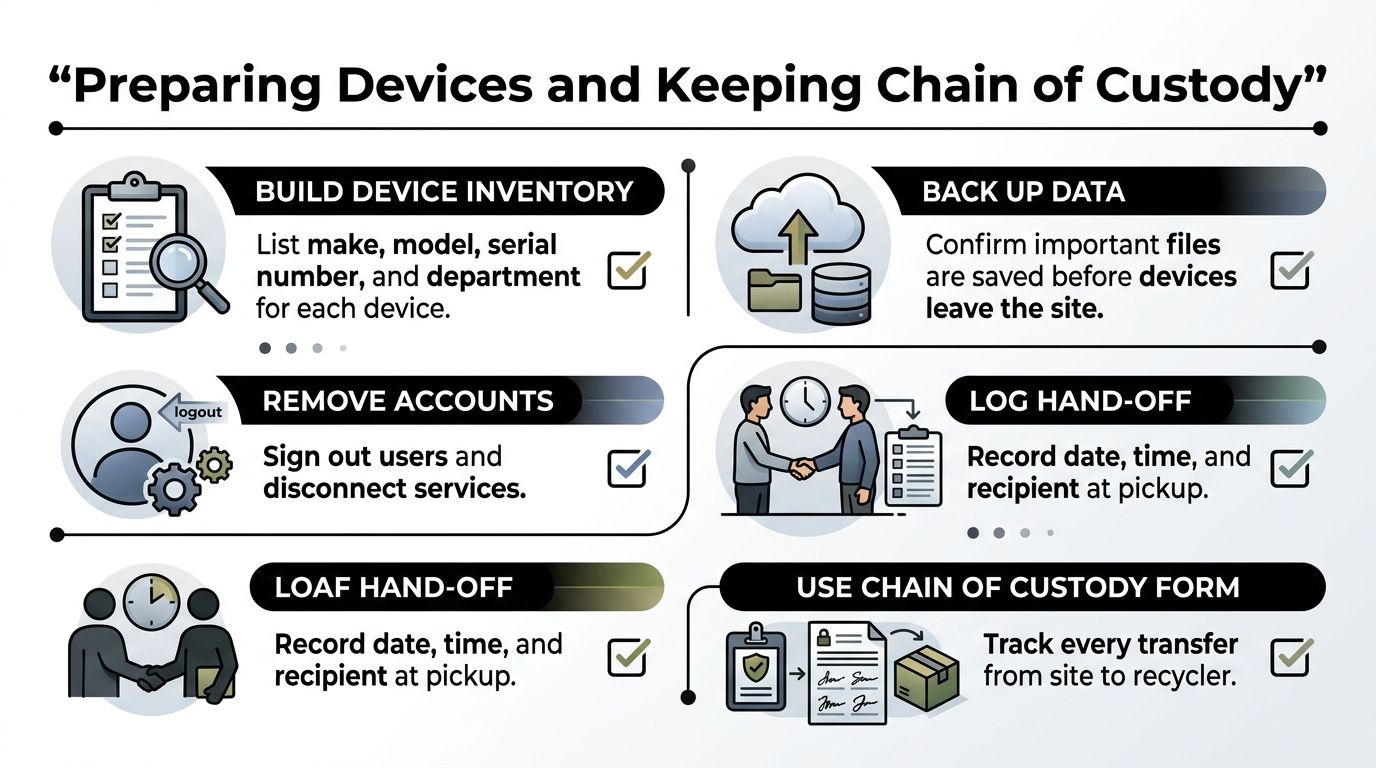
Good disposition doesn't start at pickup. It starts when a device is removed from service and someone records what it is, where it came from, and what should happen next. If you skip that work, even a qualified recycler can only document what arrived, not what you intended to send.
Build the inventory at the source. Capture make, model, serial number, asset tag, department, and storage media status. Photograph pallet labels and exception items. That list becomes the reference point for pickup counts, sanitization records, buyback decisions, and final disposition reports.
Sorting Before Anything Moves
Sort equipment into working and nonworking groups, but don't treat that label as final disposition. A working laptop may suit reuse after sanitization. A nonworking server may contain drives, batteries, or parts that need separate handling. Keep power adapters with devices when resale or donation is plausible, since missing accessories reduce reuse value.
- Back up and confirm retention: Verify required files and records are preserved under your retention schedule before release.
- Remove accounts and access: Sign out users, release management enrollment, and disconnect cloud services where your process requires it.
- Segregate problem items: Separate swollen batteries, damaged screens, loose drives, and unlabeled media for explicit handling instructions.
- Pack for identification: Group like items, protect screens, secure loose cables, and label every box or pallet to match the inventory.
Making The Handoff Defensible
Chain of custody means each transfer has a named sender, named receiver, date, time, count, and asset reference. Your staff member signs when the load leaves. The driver signs on receipt. The processor reconciles what arrived against the manifest and reports discrepancies promptly.
Those signatures sound basic until something goes missing. Without them, you can't tell whether a laptop never left the storeroom, disappeared in transit, or arrived but wasn't logged. A clear chain of custody documentation process for retired IT assets closes those gaps with records auditors can follow.
Keep the inventory ID consistent from staging through final certificate. Don't rename files or renumber pallets mid process. Consistency is what connects physical handling to the data trail and final disposition outcome.
Securing Data Before Devices Leave Your Site
Working and safe are different questions. A laptop can boot perfectly and hold student records, payroll exports, cached email, or browser sessions. A dead phone or failed drive can also retain recoverable information. Donation, resale, and recycling decisions must start with data classification, not device condition.
That distinction is easy to miss in public guidance. Most charities and agencies accept only working electronics, and public guidance rarely explains chain of custody, verified data erasure, or certificates of destruction for equipment that still holds sensitive information. Organizations need a more specific workflow than drop off instructions provide.
Choosing Sanitization Or Destruction
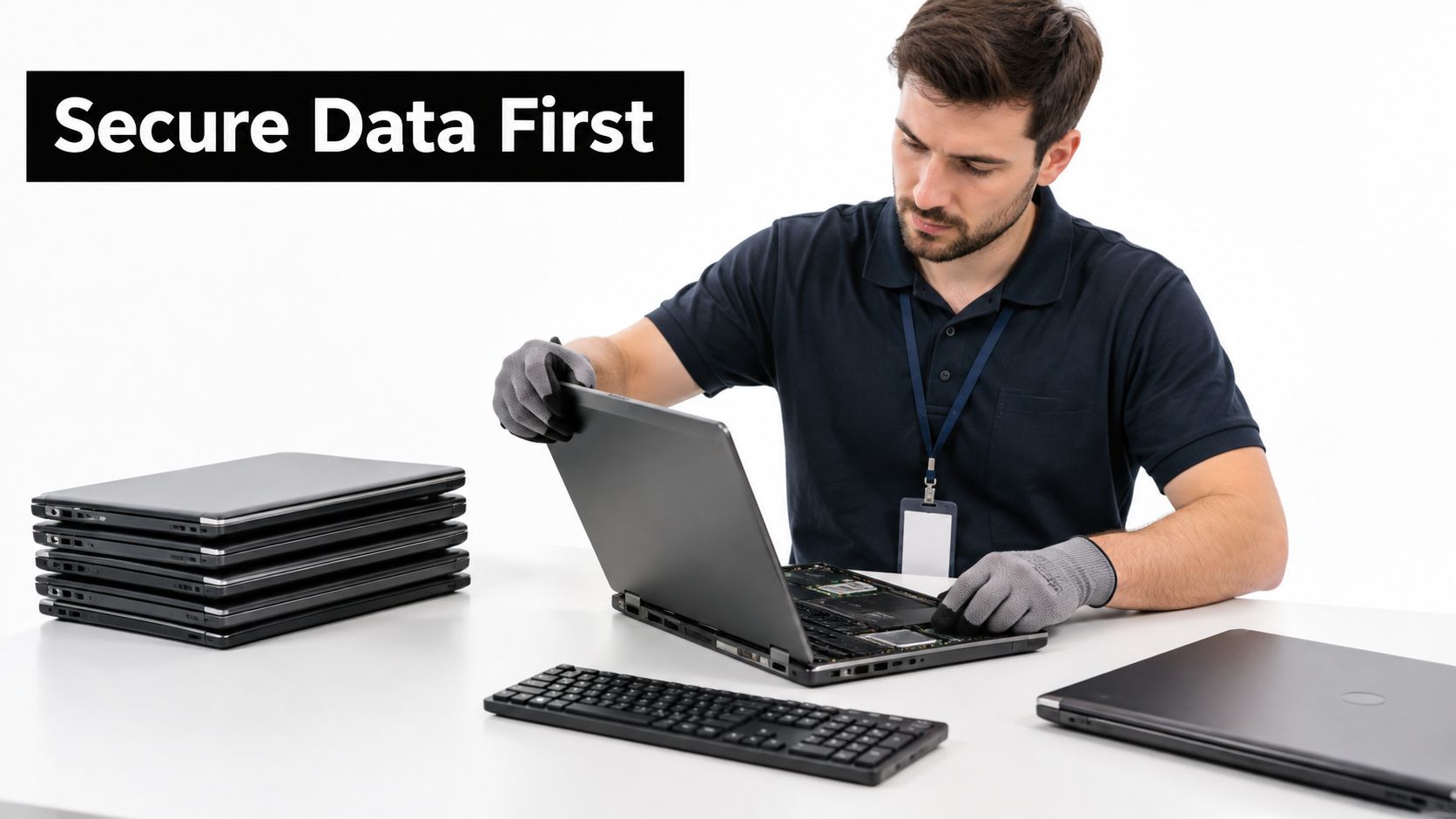
Software based erasure suits functional media when your policy permits reuse and the process includes verification. Record the method, tool result, device serial, drive serial, operator, and date. Failed verification shouldn't become a quiet retry loop. Escalate the drive to physical destruction.
Physical destruction is the more defensible route for failed, damaged, inaccessible, or high sensitivity media. Secure data destruction through shredding removes reuse value, but it gives you clear evidence that the storage component can't reenter circulation. Use it when the cost of exposure outweighs any resale value.
Review what data sanitization involves before selecting a method so your team distinguishes erasure, verification, and destruction in its records. For mobile fleets, guidance on protecting business phones and tablets can help you tighten account removal and device controls before retirement begins.
Handling Exceptions Without Improvising
Schools, healthcare adjacent organizations, and government offices face the highest consequences when exceptions are handled casually. Build escalation into the plan for drives that won't spin up, devices locked to former users, encrypted media with unknown keys, and equipment discovered after the main pickup.
Practical rule: If you can't verify sanitization for a specific drive, don't approve reuse for that drive.
Require certificates that identify assets at the level your policy demands. A generic statement that a load was processed may not satisfy an audit. Tie each certificate back to serial numbers, custody records, and disposition results. That's how laptop disposal and server retirement stay defensible long after equipment leaves Tucson.
Rules, Regulations, and What Cannot Go in the Bin
Free recycling sounds simple until you arrive with the wrong equipment, the wrong residency status, or a load the channel was never built to accept. Tucson's public guidance is useful, but it's household guidance. Organizations have to translate it into compliance checks before transport.
The clearest example is display technology. The City of Tucson lists electronic waste such as cameras, cell phones, game controllers, laptops, speakers, and televisions, but CRT computer monitors are not accepted through the listed household hazardous waste channel. One overlooked CRT can disrupt an otherwise clean load.
Audit For Exceptions First
Walk the inventory for CRT displays, integrated batteries, medical devices, laboratory instruments, and equipment containing storage media. Medical equipment disposal and laboratory equipment disposal may involve decontamination, calibration records, embedded batteries, or data bearing components. Don't assume a general electronics channel accepts them because they plug in.
- Confirm acceptance by category: Match every equipment type to the channel's published rules before packing.
- Flag nonstandard assets: Separate CRTs, damaged batteries, loose media, and regulated devices for specialist routing.
- Document the decision: Record why each category went to reuse, recycling, buyback, or destruction.
- Check site eligibility: Confirm who may use the channel, what identification applies, and whether business material belongs there.
Business laptops, servers, networking equipment, and drives should move through a qualified ITAD provider when you need documented data destruction, product destruction, and recycling outcomes. Public drop off doesn't replace that evidence chain. A broader Arizona electronics recycling compliance and service overview can help you frame state level planning without treating household rules as corporate policy.
Documentation Is Part Of Compliance
Keep acceptance confirmations, manifests, custody forms, sanitization records, and final disposition reports together. Sustainability teams need diversion outcomes. IT needs asset closure. Finance may need donation or buyback records. If each group keeps a separate partial file, nobody can reconstruct the full history.
Run the checks before vehicles are booked. It's cheaper to reroute a pallet on paper than to unload rejected equipment in a parking lot and improvise the next step.
Costs, Pickup Options, and Buyback Value
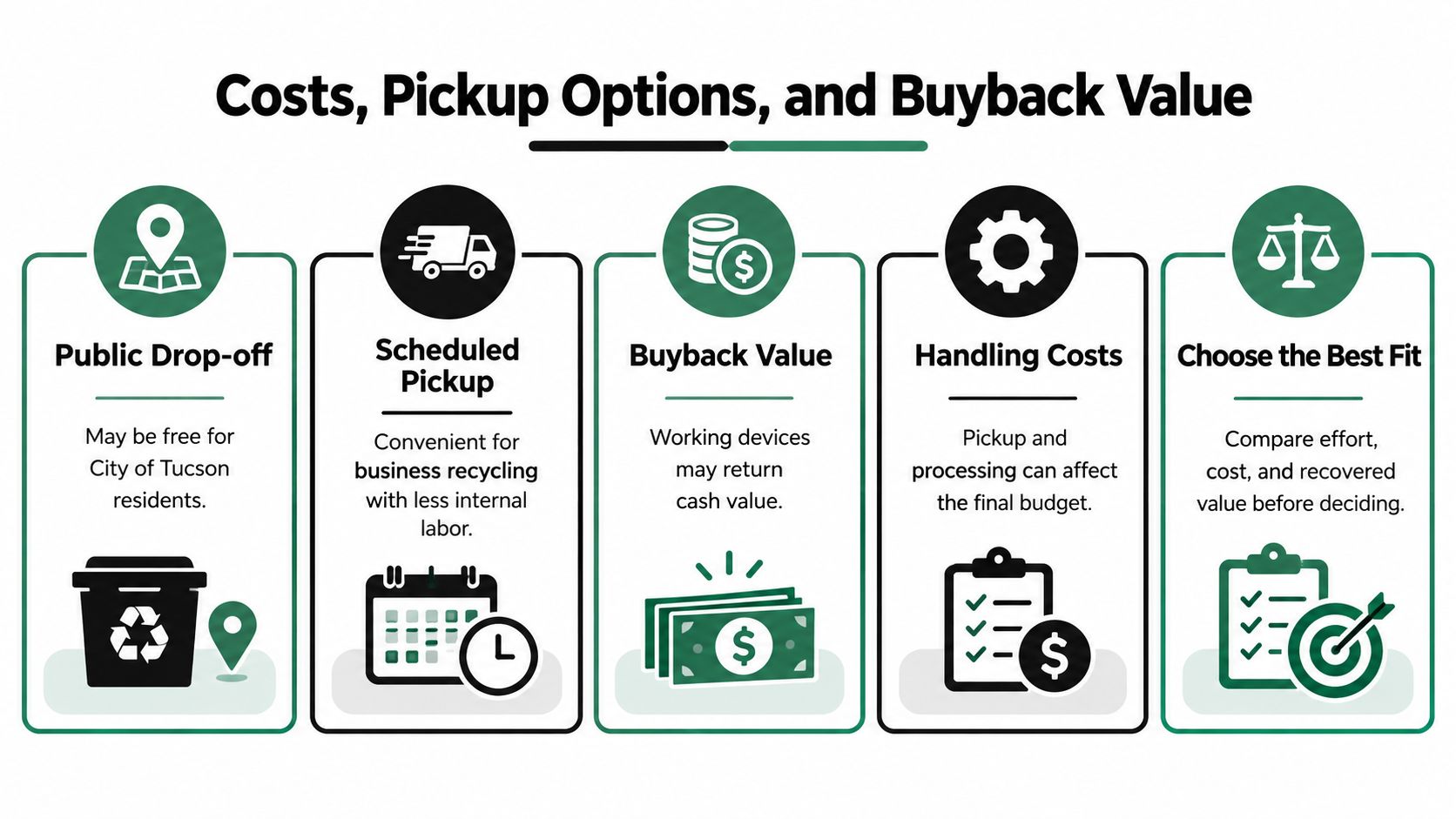
The cheapest channel on paper can become the most expensive once you count staff time, vehicle trips, rejected items, data handling, and lost reuse value. Compare total effort, not just the fee at the gate.
Residency changes the public price. Residents outside city limits may pay a $10 drop off fee at the Los Reales site, while recent community collection events charge residents of Marana, Oro Valley, Sahuarita, and unincorporated Pima County $15. For organizations with sites across jurisdictions, that's an early warning to verify eligibility instead of assuming one Tucson rule covers every address.
Weighing Drop Off Against Pickup
Self delivery can work for a small, accepted, non sensitive load. You control timing and avoid scheduling a vendor, but your team supplies labor, packing, transport, and waiting time. You'll also own the problem if an item is refused.
Scheduled business pickup shifts lifting and transport to the provider. That matters during multi room office cleanouts, school refreshes, and data center decommissioning, where equipment is heavy and staging space is limited. Pickup also supports pallet level custody records instead of scattered drop off receipts.
Reviewing cost recovery strategies for surplus IT equipment helps you compare service charges against labor saved and value recovered. Don't judge pickup only by invoice price if it prevents two days of internal handling.
Where Value Survives
Working surplus hardware may qualify for equipment buyback or donation. Newer laptops, functional networking gear, and complete systems with adapters retain more value than incomplete or damaged units. Sanitization cost, testing, grading, and logistics affect the final return, so ask how values are assessed and reported.
- Public drop off: Low direct cost for eligible small loads, highest internal effort.
- Scheduled pickup: Less staff labor, stronger documentation, service cost depends on scope.
- Buyback: Potential recovery from working assets, reduced by processing and condition.
- Donation: Community benefit when equipment is reusable and data is verified clean.
A donation based model can return community value even when cash recovery is modest. Usable equipment directed to schools and nonprofits supports digital inclusion, while nonworking assets still move into responsible material recovery.
Choosing a Partner and Taking the Next Step
A vendor checklist turns earlier decisions about channel, custody, data, and compliance into direct questions. Ask them before you sign, schedule, or hand over keys to a storeroom.
Start with evidence. Will the provider issue certificates tied to serial numbers? How are custody transfers recorded? What happens when counts don't reconcile? If answers stay vague, assume your audit trail will too.
Questions That Reveal Process Quality
- Data handling: Which sanitization methods are used, how are results verified, and when is shredding required?
- Exception streams: How are CRT displays, batteries, damaged drives, and nonstandard equipment routed?
- Disposition reporting: Will you receive device counts by category and reuse versus recycling outcomes?
- Logistics: Who packs, labels, lifts, transports, and signs at each transfer?
- Community impact: How does reusable equipment support technology donations, digital inclusion, or workforce development?
Ask about downstream processing in concrete terms. You don't need marketing language. You need to know which materials are refurbished, which are recycled, which require product destruction, and what documentation proves each outcome. That clarity supports sustainability reporting and protects your organization from unsupported diversion claims.
Choose the partner whose paperwork still makes sense six months later, when nobody remembers the pickup day.
Pilot the relationship with one defined load if you're changing providers. Use a clean inventory, set exception rules in writing, and review the final packet against your asset register. A small controlled run exposes reporting gaps before a campus wide refresh.
Plan recurring retirement instead of waiting for storage rooms to overflow. Quarterly pickups, school break refresh windows, and year end ITAD cycles keep equipment identifiable and reduce rushed decisions. That's when electronics recycling becomes an operating process, not an emergency cleanup.
Businesses, schools, and public agencies around Tucson can donate old equipment, schedule a pickup, or build a recurring partner program for office cleanouts, community e-waste drives, and year end disposition. Make the next load your documented baseline.
If you're planning an office cleanout, school refresh, or recurring IT equipment disposal program in Tucson, Reworx Recycling offers donation based electronics recycling, business pickup, secure data destruction, and documented ITAD support for organizations of all sizes. Turn surplus computers, laptops, servers, and networking equipment into responsible reuse, material recovery, and community benefit through technology donations and digital inclusion. Visit Reworx Recycling to explore services and take the next step toward a documented, sustainable pickup.