Your controller just approved a laptop refresh. Facilities wants the old equipment out of storage. Security wants proof that every drive was handled correctly. Then sustainability asks a simple question that turns complicated fast: what environmental impact should go into this year's report?
A lot of teams hit the same wall here. They have pickup records, maybe a recycling invoice, maybe a data destruction certificate for part of the lot. What they often don't have is a clean, auditable story that connects retired IT assets to broader environmental impact reporting.
That gap matters now because e-waste isn't a side issue anymore. For many organizations, IT asset disposition sits inside Scope 3 conversations, vendor reviews, compliance checks, client questionnaires, and board-level risk discussions. If your reporting on old servers, laptops, networking gear, and peripherals is vague, the rest of your environmental narrative starts to look vague too.
The New Mandate for Environmental Transparency
A familiar scenario plays out in many companies. An investor questionnaire arrives. A customer asks about electronics recycling practices during procurement. Leadership wants a sustainability update before the next board meeting. The IT manager opens the file folder for retired hardware and finds pieces of the story, but not the full record.
There might be shipping manifests. There might be an office cleanout summary. There might be a note that devices were sent for computer recycling. But when someone asks how much waste was generated, what happened to reusable assets, or how those decisions fit into ESG reporting, the answer often becomes manual guesswork.
Why the pressure keeps rising
This isn't limited to the largest public companies anymore, even if large enterprises set the pace. A projected 90% of S&P 500 companies publish dedicated sustainability reports by 2026, and 57% of businesses cite investor and client demand as the primary motivation for formal ESG strategies, according to these ESG reporting figures. That tells you something important. Environmental disclosure has moved from optional brand messaging to expected business practice.
For IT leaders, that expectation lands in operational terms:
- Asset retirement data becomes reportable data when leadership wants environmental impact reporting that stands up to review.
- Vendor claims need documentation because broad statements about sustainable recycling don't satisfy legal, procurement, or audit teams.
- Disposition choices affect risk since end-of-life handling now touches security, compliance, environmental stewardship, and reputation at once.
Practical rule: If your ITAD process can't produce evidence that finance, compliance, and sustainability can all use, it isn't finished.
What this means for day-to-day operations
Environmental transparency now reaches into routine work such as laptop disposal, data center decommissioning, medical equipment disposal, laboratory equipment disposal, product destruction, and secure data destruction. A recycling pickup used to close the task. Now it starts a chain of questions about where assets went, what was reused, what was recycled, and what can be disclosed externally.
That's why many teams are rethinking their process before the next refresh cycle begins. A useful starting point is understanding how sustainability reporting works in practice, especially when the data originates in IT operations rather than a centralized sustainability office.
What Environmental Impact Reporting Really Means
Environmental impact reporting is a business process for measuring what your organization affects, documenting it in a consistent way, and using that information to make better decisions. Think of it as the environmental version of financial reporting. Finance tracks revenue, costs, and liabilities. Environmental reporting tracks impacts such as emissions, waste, water use, and resource consumption.
For an IT manager, that means your retired equipment isn't just a disposal problem. It's a data source.
The four parts that matter
A workable reporting process usually includes four connected stages. The details differ by company, but the logic stays the same.
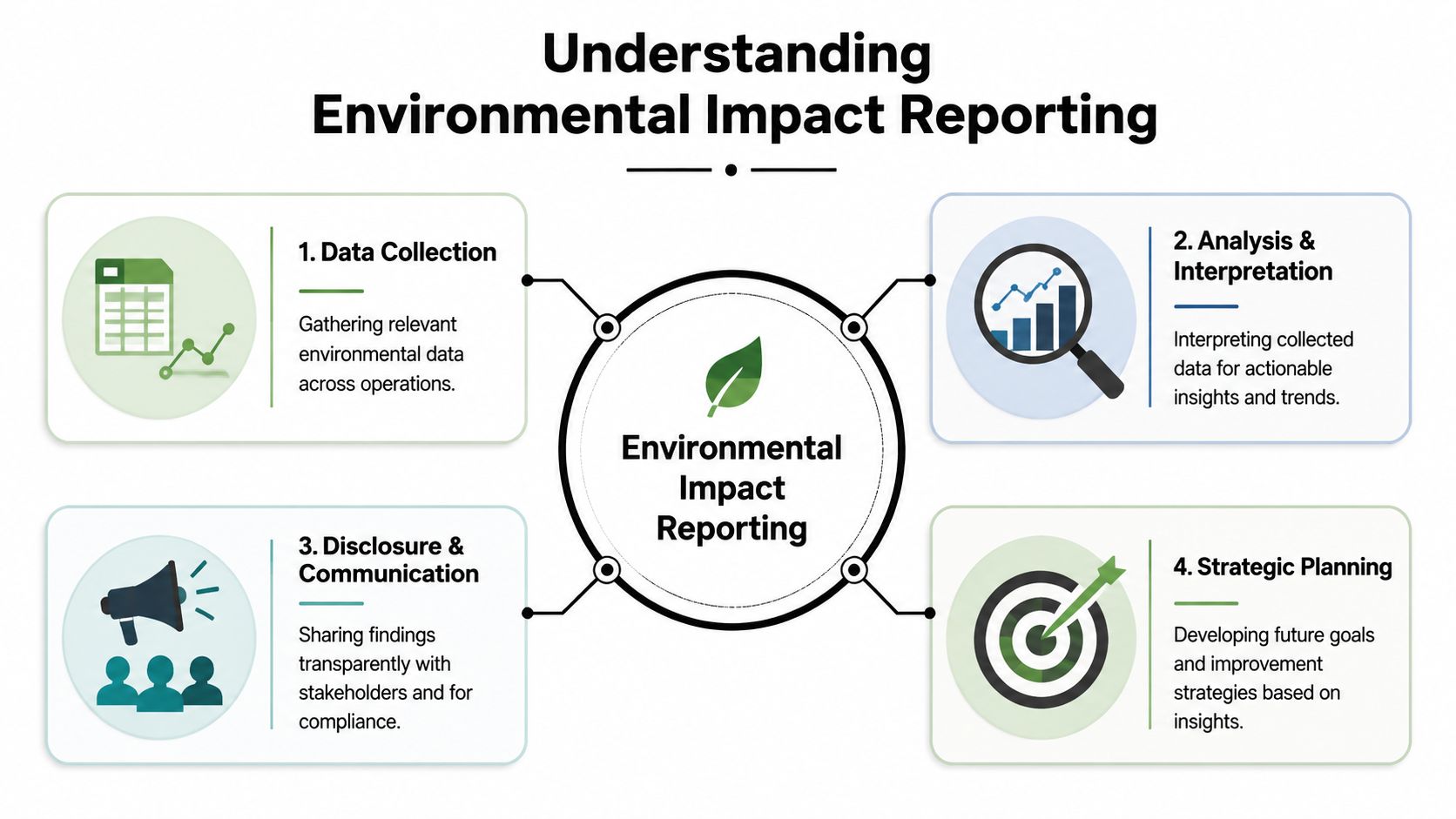
Data collection
You gather the underlying records. In an IT context, that can include asset inventories, serialized pickup lists, downstream processing records, and documentation tied to electronics recycling or IT equipment disposal.Analysis and interpretation
Raw records don't help much until someone organizes them. You may need to sort assets into reuse, refurbishment, resale, recycling, or destruction categories and estimate lifecycle implications where direct primary data isn't available.Disclosure and communication
This is the outward-facing part. Some organizations need formal sustainability reports. Others need customer-facing answers for procurement questionnaires, internal ESG summaries, or policy documentation for public-sector oversight.Strategic planning
Once the data is visible, patterns appear. Maybe your office cleanout process creates avoidable e-waste. Maybe your refresh policy retires devices too early. Maybe your vendor documentation is too thin for future reporting needs.
Why teams get confused
The confusion usually comes from mixing activity with impact. Sending equipment to a recycler is an activity. Reporting the environmental effect of that choice is impact reporting.
A simple way to separate the two is to ask three questions:
| Question | Operational meaning |
|---|---|
| What happened to the asset? | Reused, refurbished, recycled, destroyed, or disposed |
| What evidence supports that? | Inventory records, chain of custody, certificates, vendor reporting |
| What environmental outcome can be reported? | Waste handled, lifecycle implications, resource recovery context |
A recycling event is not the same thing as a reporting-ready record.
This same logic shows up outside IT too. Teams working on facilities, event operations, and logistics often use structured methods to document impacts. If you want a parallel example, Waymap's piece on sustainable practices for large venues is useful because it shows how operational decisions become measurable environmental inputs.
Navigating the Alphabet Soup of Reporting Standards
An initial encounter with environmental impact reporting often involves a wall of acronyms. GRI. SASB. CDP. TCFD. The reaction is usually the same: which one am I supposed to use?
The better question is what each framework is trying to help you do. These standards aren't identical, and they don't ask for the same style of information.
A quick way to separate them
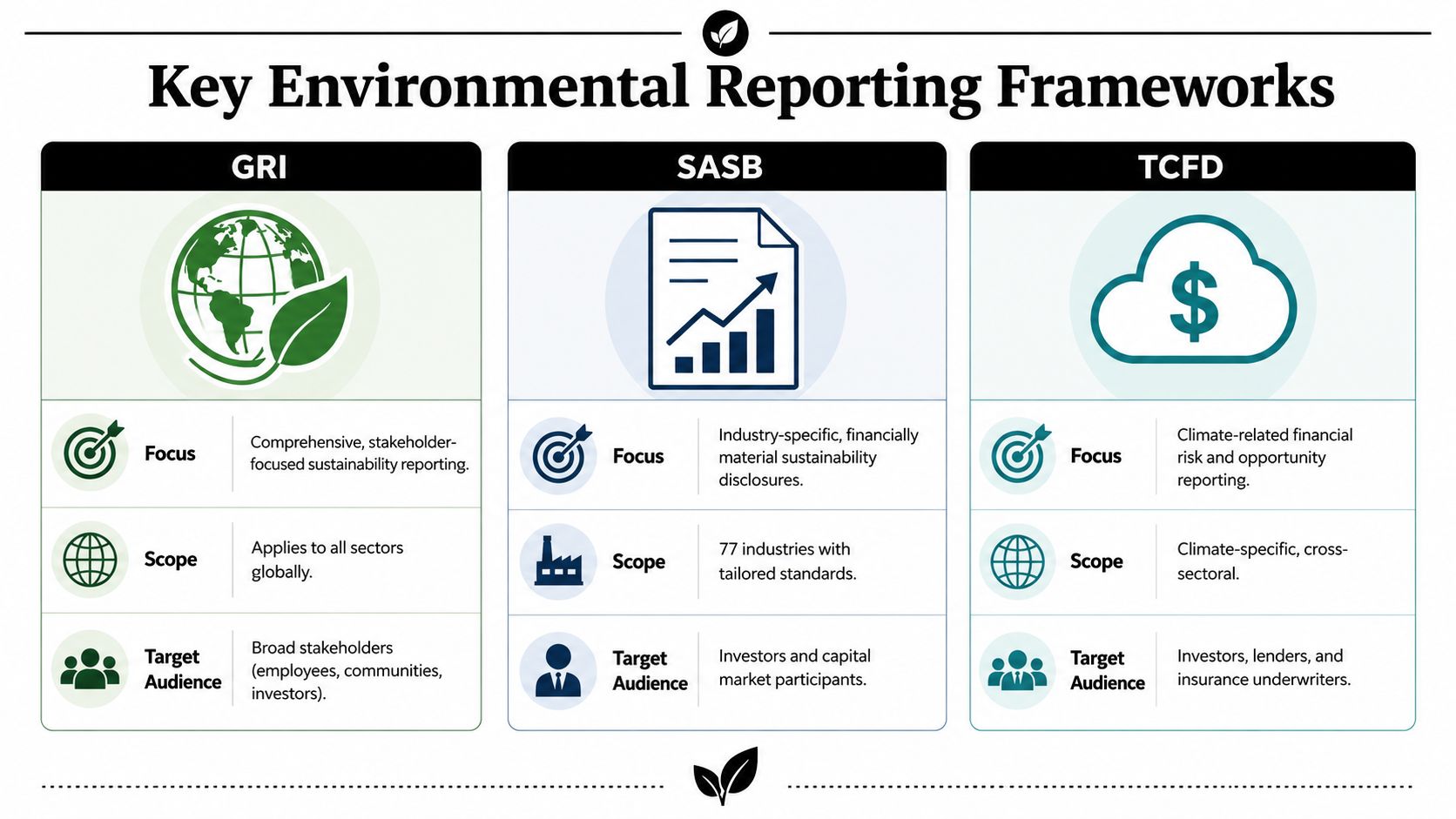
Here's the practical distinction many IT and sustainability teams use:
| Framework | Best use | Main audience |
|---|---|---|
| GRI | Broad sustainability communication across environmental and social topics | Employees, communities, customers, investors |
| SASB | Industry-specific issues that may affect financial performance | Investors and finance-oriented stakeholders |
| CDP | Structured disclosure on climate, water, and forests | Customers, investors, disclosure programs |
| TCFD | Climate-related risk and governance reporting | Investors, lenders, insurers |
GRI helps when your company wants a broad public-facing sustainability story. SASB is narrower and more financially material. CDP functions more like a disclosure channel for specific environmental themes. TCFD focuses on climate risk and how leadership manages it.
Why this matters for ITAD
If your team handles laptop disposal, facility cleanout projects, product destruction, or data center decommissioning, your records may feed more than one framework. A sustainability team could use your data in a GRI-aligned report. Finance may care about the same data under a SASB lens if retired assets expose supply chain or disposal risk. Climate teams may need it for value-chain emissions narratives.
That overlap is one reason reporting matured so quickly. The broader timeline matters here. The Global Reporting Initiative launched in 2001, and the Task Force on Climate-Related Financial Disclosures was established in 2015. By 2023, over 7,000 organizations were reporting through TCFD-aligned frameworks, according to this overview of major reporting milestones. The direction is clear. Reporting has become more standardized and more risk-focused.
Standards are different tools, not competing religions. Use the one that fits the job in front of you.
The common mistake to avoid
Teams often spend too much time arguing about the perfect framework and too little time building reliable source data. If your serialized records, disposition categories, and vendor documentation are weak, no framework will fix that.
That's why it helps to start with the operational layer. The certifications, downstream controls, and documentation standards behind electronics recycling and ITAD matter more than the acronym on the cover page. This overview of e-waste certification standards is a useful reference point when you're evaluating whether a vendor's outputs are strong enough for formal reporting.
Measuring What Matters in Electronics Recycling and ITAD
When companies first try to report IT-related environmental impact, they often choose the easiest numbers to find. Number of pallets shipped. Number of devices collected. Weight moved offsite. Those figures help internally, but they don't always tell a meaningful environmental story.
Useful reporting starts when you focus on metrics tied to actual impact.
Start with absolute metrics
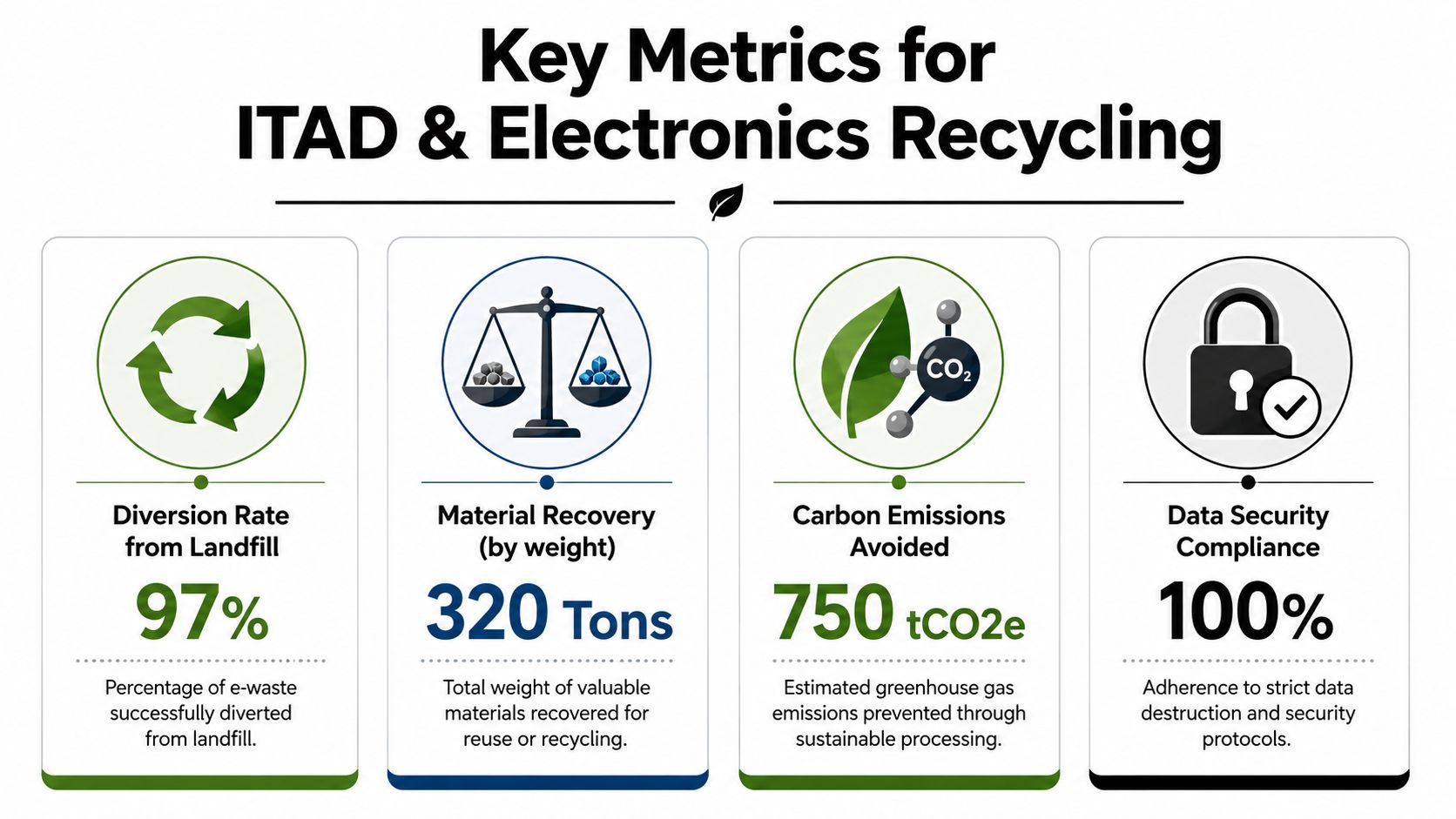
A strong principle from current guidance is to prioritize absolute metrics, not just intensity ratios. That means tracking total greenhouse gas emissions, total waste generation, total water withdrawal, or total material flows where possible. In the IT context, this matters because you're dealing with physical assets that move through a full lifecycle.
The same guidance is especially relevant to technology operations because Scope 3 emissions can represent 70 to 90% of a company's total carbon footprint, and effective reporting requires tracking absolute measures such as greenhouse gas emissions in tons of CO2-eq and waste generation in tonnes per year, as discussed in this analysis of environmental reporting variables.
What to ask your ITAD partner to provide
An IT manager usually needs a narrower, more practical list than a sustainability framework document provides. Ask for reporting inputs such as:
- Serialized asset counts so each device can be matched to a disposition path.
- Disposition category by asset including reuse, refurbishment, parts harvesting, recycling, or destruction.
- Weight-based material reporting where available, especially for mixed loads from office cleanouts or facility cleanouts.
- Data security records for secure data destruction, hard drive shredding, or logical sanitization.
- Environmental handling documentation that supports how equipment was processed downstream.
Some organizations also ask for reporting aligned to donation-based recycling and corporate donation programs. That creates a more complete picture because not every retired asset should go straight to commodity recycling. If a workable laptop can be refurbished for reuse, that changes both the environmental and social narrative.
A plain-language example
Take a standard laptop refresh. If your report says only that old devices were removed, readers learn almost nothing. If it says devices were collected under chain of custody, tracked by serial number, triaged for reuse or recycling, and documented through final processing, that becomes decision-grade information.
Field advice: For ITAD reporting, "how many devices left the building" is the starting point, not the finished metric.
The same logic applies to medical equipment disposal, laboratory equipment disposal, and data center decommissioning projects. These jobs often involve mixed asset classes, varied materials, and strict handling requirements. Broad sustainability language won't help much unless the underlying disposition data is specific enough to survive review.
If you need a supporting framework for translating retired equipment into carbon-related context, this guide to carbon offset calculation and reporting context can help teams understand how IT asset decisions connect to broader environmental accounting discussions.
Building an Auditable Trail for Your IT Assets
Good environmental impact reporting depends less on writing and more on recordkeeping. If the documentation is weak, the report will be weak no matter how polished the final PDF looks.
For IT operations, the auditable trail starts before pickup day. It begins when you identify which assets are leaving service, who approved the disposition, and whether those assets contain data-bearing components or regulated equipment.
What an audit-ready process looks like
A practical workflow usually includes these steps:
Create a disposition inventory
Record device type, serial number, location, owner department, and condition. This becomes your baseline.Assign a handling path
Some equipment is suitable for reuse. Some belongs in computer recycling. Some requires product destruction or secure data destruction before any other step happens.Maintain chain of custody
Every transfer should be documented, especially for laptops, servers, storage media, and network hardware.Collect final records
Ask for itemized reports, destruction certificates where applicable, and environmental handling documentation that maps to the original inventory.
Where estimated impact data fits
Many companies won't have primary lifecycle data for every single retired asset. That doesn't mean they have to abandon reporting. High-quality methodologies can use auditable, lifecycle-based estimates to translate asset counts or procurement activity into environmental impacts. Those methods rely on sector-specific intensity factors and are designed to support defensible ESG reporting, as explained in this lifecycle-based environmental data methodology.
That distinction matters. Estimated data can still be credible when the method is transparent and the source records are sound.
Documents worth insisting on
Not every vendor packet is equally useful. For reporting purposes, look for:
- Serialized reporting that ties each asset to a documented outcome
- Certificates of data destruction for drives and devices that held sensitive information
- Processing summaries that show whether assets were reused, recycled, or destroyed
- Pickup and transfer records that preserve the chain of custody
If a vendor can describe the process but can't produce the documents, your reporting team will inherit the risk.
Organizations that want tighter controls often standardize this process through internal policy and vendor requirements. A good starting point is a documented approach to chain of custody for retired electronics, because that's the point where environmental reporting and information security meet.
How Reworx Simplifies Your Environmental Reporting
A lot of reporting friction comes from fragmented handoffs. IT tracks devices one way. Facilities tracks removals another way. Sustainability wants environmental outputs. Legal wants proof. Procurement wants vendor consistency. Without a partner that understands all of those needs, the burden falls back on your internal team.
That's where a reporting-oriented ITAD workflow helps. Instead of treating electronics recycling as a one-step haul-away service, the process needs to produce records that support disclosure, audit review, and operational planning.

What useful support looks like
For companies managing office cleanouts, laptop disposal, secure data destruction, or broader IT asset disposition, practical support usually means:
- Asset-level visibility so internal teams can reconcile what left, what was processed, and what records were returned
- Disposition documentation that can feed environmental impact reporting instead of sitting in a disconnected compliance folder
- Social impact context for assets that are donated, refurbished, or otherwise directed into community-benefiting channels
- Operational flexibility for pickups, decommissioning projects, and recurring equipment retirement programs
One example in this space is Reworx Recycling, which works as a donation-based electronics recycling and social enterprise recycling partner for organizations handling IT equipment disposal, computer recycling, office cleanout projects, and related services such as secure data destruction.
Why the social layer matters too
Many environmental reports still stop at diversion, recycling, and emissions language. That leaves out a meaningful part of the story. EPA analyses show that underserved communities bear a disproportionate burden of pollution-related harms, which is why end-of-life electronics choices can also support a stronger social responsibility narrative when organizations work with social enterprise models, as discussed in the EPA's review of disproportionate climate impacts.
That matters for schools, universities, public agencies, and businesses that want their corporate donation programs to do more than clear storage rooms. Donation-based recycling can connect environmental handling with digital inclusion, workforce development, and community support. For reporting teams, that creates a fuller narrative without forcing environmental metrics to carry the whole ESG story alone.
Better reporting doesn't just show that assets were handled responsibly. It shows why the chosen handling path mattered.
Turn Reporting from a Burden into a Strategic Advantage
Environmental impact reporting feels heavy when teams treat it like an after-the-fact paperwork exercise. It becomes useful when they treat it as an operating system for better decisions.
For IT leaders, that shift is concrete. Cleaner asset inventories reduce confusion during refresh cycles. Better chain-of-custody records lower security and compliance risk. Clearer disposition data gives sustainability teams something they can use. Procurement teams can compare vendors more intelligently. Leadership gets a stronger answer when investors or clients ask hard questions.
The goal isn't to produce a glossy report full of vague claims. It's to build a process where electronics recycling, IT asset disposition, data center decommissioning, medical equipment disposal, and facility cleanout work all leave behind reporting-ready evidence. That's what turns routine disposal into measurable environmental management.
A lot of teams also benefit from streamlining the reporting mechanics themselves. If your organization is trying to reduce manual effort after the data has been collected, PlotStudio AI's guide for automated reports offers a useful overview of how reporting workflows can be standardized without losing clarity.
When you connect framework selection, absolute metrics, auditable documentation, and a credible downstream partner, reporting stops being a burden handed to IT at the last minute. It becomes a strategic asset that supports risk management, customer trust, and more responsible end-of-life decisions.
If your business needs a cleaner way to document electronics recycling, donation-based recycling, IT equipment disposal, computer recycling, secure data destruction, or broader IT asset disposition, explore Reworx Recycling. You can use the team's resources to plan an office cleanout, schedule a pickup, donate old equipment, or build a reporting-ready process for retired IT assets that supports both environmental responsibility and community impact.