A team is clearing a floor before a technology refresh. Laptops are boxed, servers are scheduled for removal, and a facilities manager is asking when the pickup will arrive. But nobody has reconciled the asset list, confirmed who owns each device, selected a data-sanitization method, or decided what can be reused. Once equipment moves, answering those questions gets harder.
A dependable business computer recycling program starts with evidence, not a collection date. A serial-level record can connect each device to its owner, custody transfers, data treatment, disposition route, and final report. That trail helps IT, facilities, procurement, security, and sustainability teams make decisions they can explain later.
Plan a Defensible Computer Recycling Program
Consider an office refresh where working laptops are boxed alongside retired desktops. The equipment looks ready to go, but some devices still belong to employees who haven't completed offboarding, several drives contain sensitive information, and nobody has confirmed whether the destination is reuse, resale, or material recycling. A pickup alone won't resolve those gaps.
Start by defining the program's scope and decision-makers. IT identifies devices and storage media; information security sets data-handling requirements; facilities manages access and staging; procurement checks purchasing and lease records; HR helps reconcile employee departures; and sustainability defines which outcomes need to be reported. Assign one project owner to resolve disagreements and approve exceptions before equipment leaves the site.

Set the scope before scheduling collection
The project may be a small office cleanout, laptop disposal across a distributed workforce, data center decommissioning, or a facility cleanout that includes laboratory equipment disposal or medical equipment disposal. Each scenario needs an asset boundary: which equipment is included, who can approve its release, which records must be preserved, and what qualifies as complete.
For a small refresh, plan enough time to inventory, label, approve, and stage devices before a pickup. For a distributed workforce, specify how remote employees return equipment and how a package is matched to its assigned asset. For a larger decommissioning, separate server racks, loose components, and storage media into controlled workstreams.
Assign ownership and approval
A workable approval path names the person who can authorize reuse, resale, donation, recycling, or destruction. It also says who can stop a shipment when an asset is missing from the manifest or its data status is unclear. Treat unresolved items as exceptions, not as a reason to send them along with the general load.
Reworx Recycling offers businesses equipment decommissioning, IT asset management, recycling consultations, pickups, donation options, and secure hard-drive shredding. Organizations can assess those services alongside their internal controls and project requirements. The useful test is whether a partner can support the records and disposition routes the organization has already defined.
Practical rule: Don't schedule collection until the project owner, asset boundary, release approvals, and evidence requirements are clear.
Build the Asset Inventory First
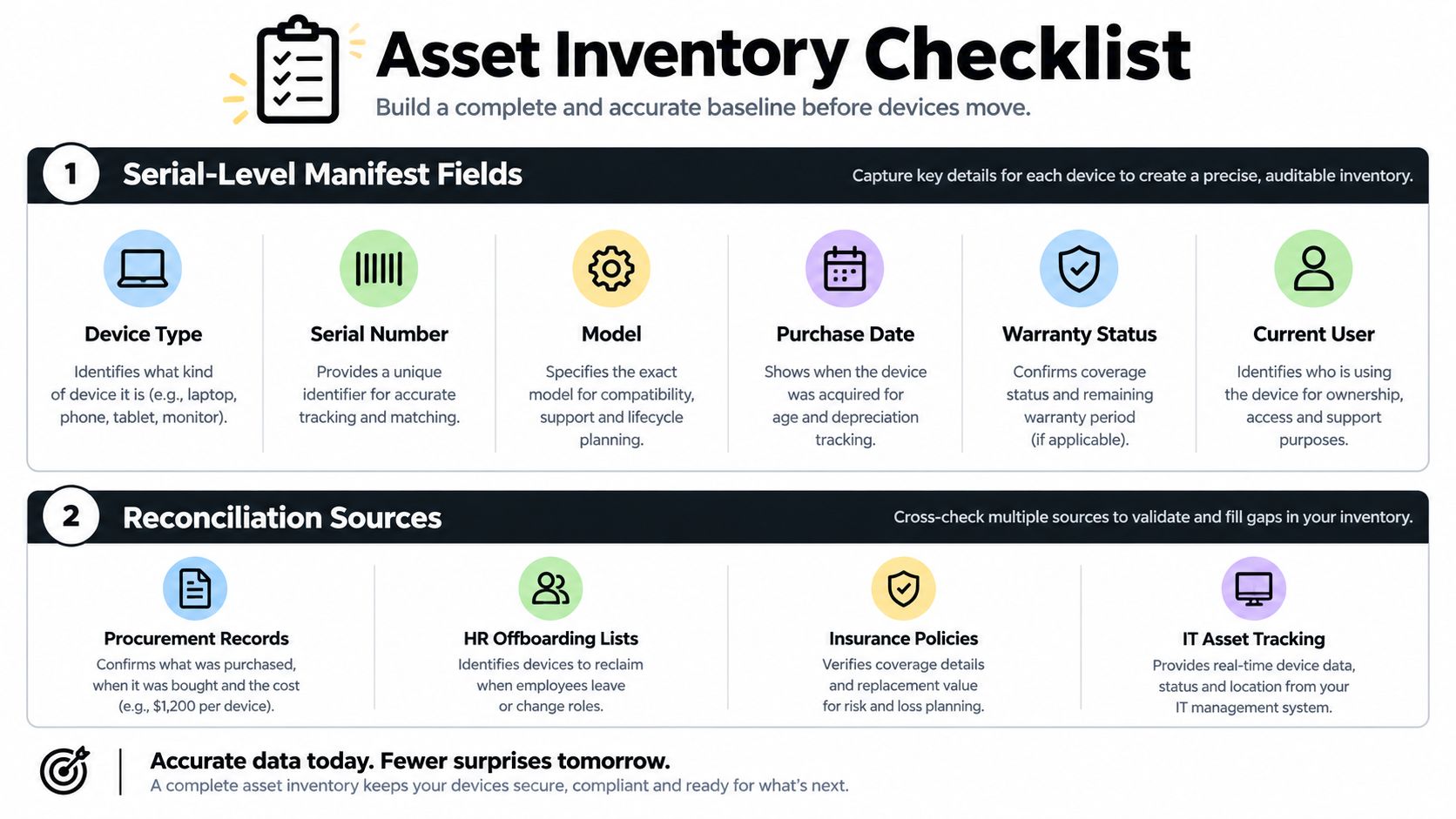
A defensible disposition begins with a baseline of what the organization has. Start with IT asset records, then reconcile them against procurement files, employee offboarding lists, insurance schedules, and physical equipment. A record that exists in one system but not another needs investigation before anyone makes a disposal decision.
Build a serial-level manifest
Give each device and storage medium a stable identifier. The manifest should capture the make, model, serial number, device type, media type, assigned owner, sensitivity, location, physical condition, and intended disposition. Record the chain-of-custody transfer as well, so the asset's movement can be linked to its identity.
Useful fields extend beyond the computer itself. Include purchase or lease status, approval status, whether the device powers on, and any known battery or hardware issue. If a storage medium has a separate serial number, record it independently and tie it to the host device. This helps prevent a certificate for one drive from being mistaken for proof about another.
Reconcile before triage
Compare the manifest with procurement and lease records to identify equipment the organization may not own outright. Use HR offboarding information to locate devices assigned to former employees, and check insurance and IT tracking records for discrepancies. An unmatched serial number, missing owner, or unclear lease status should receive an exception status with a named person responsible for resolving it.
For example, a 300-device laptop refresh becomes easier to manage when every laptop has a stable identifier, assigned user, location, media type, and approval status. The team can group items for collection without losing the ability to find a specific device or explain why it received a particular disposition.
Separate condition from destination
Once the baseline is reconciled, classify equipment as working, repairable, damaged, or untested. Assign a proposed route, but don't treat it as final until security and business owners approve it. A working laptop may be eligible for reuse or donation, while a damaged computer with an unverified drive may need a more restrictive path.
Organizations setting up this process can use asset inventory management guidance to inform how their records connect to technology retirement. Keep unidentified, high-risk, and disputed devices out of the general recycling stream until an authorized owner resolves the exception.
Choose the Right Data Destruction Method
The sanitization method should follow the media, data risk, and intended future use. A basic reset isn't a universal answer, and shredding every drive can waste equipment that could otherwise be reused. Decide at the asset level, then retain evidence that connects the chosen method to the device.
Match the outcome to risk
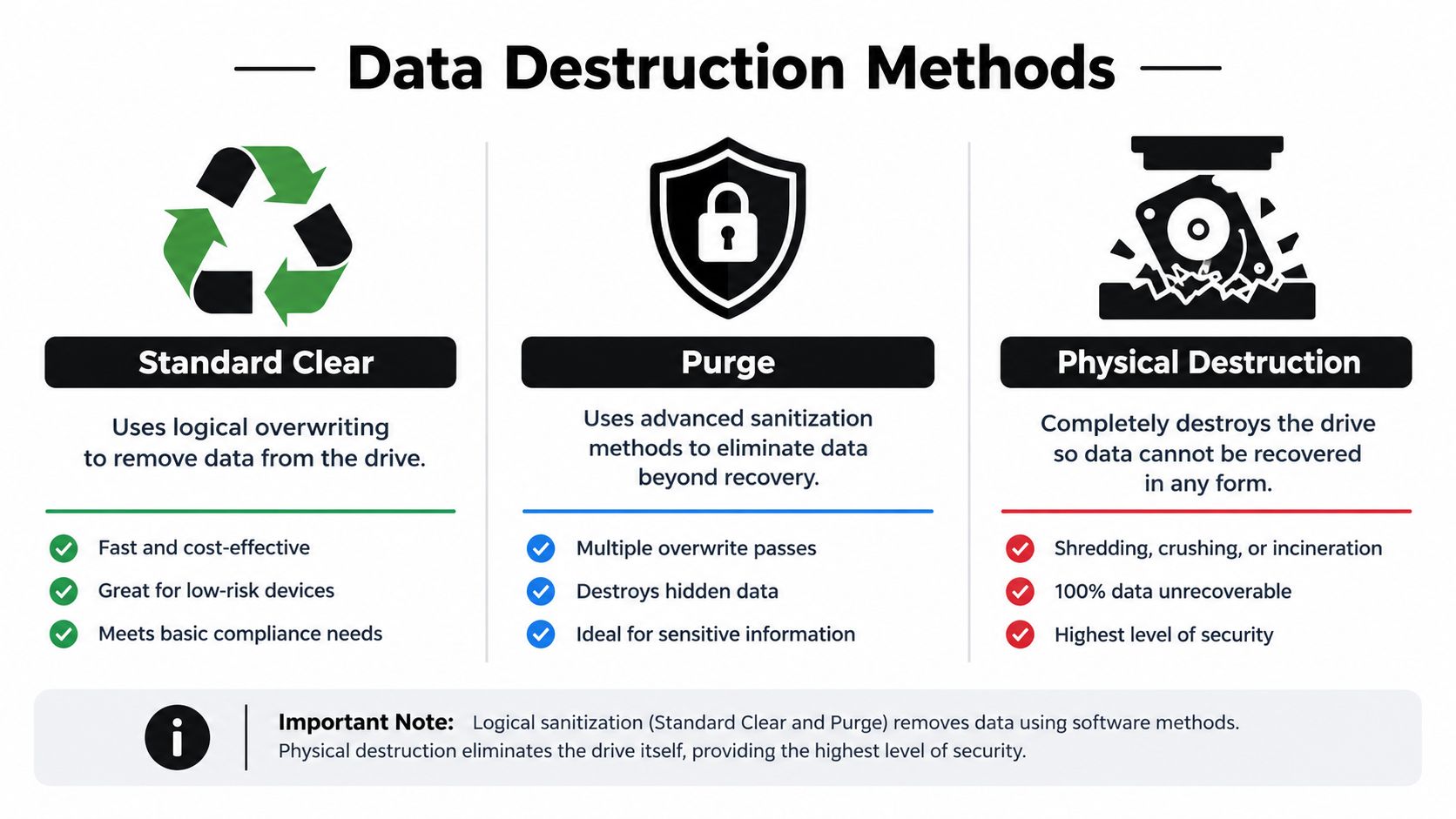
NIST defines clear as a logical technique protecting against simple, non-invasive recovery methods, purge as physical or logical techniques intended to make recovery infeasible with state-of-the-art laboratory methods, and destroy as making recovery infeasible while leaving the medium unusable for future storage. These outcomes aren't interchangeable. Select one based on the information involved, the media, the organization's risk tolerance, and whether the device is intended for reuse.
A laptop approved for internal reassignment may be a candidate for logical sanitization if its drive type and condition support a suitable, verifiable method. A server drive containing sensitive records may require purge or destruction under the organization's policy. If a drive has failed, can't be reliably sanitized, or must not return to service, physical destruction may be the appropriate decision.
Solid-state drives deserve particular care. Their controller-managed areas can make predictable overwriting difficult, so don't assume a method suitable for a magnetic hard drive will cover an SSD in the same way. Encrypted media also needs a risk-based decision. Encryption alone doesn't prove that the device has been sanitized to the standard the organization requires.
Make the record part of the operation
Capture the asset identifier, media identity, selected method, operator, timestamp, and result. Verify the outcome where practical and retain the evidence with the asset record. If a verification fails, keep the device on hold and escalate to a stronger sanitization method or destruction rather than marking the job complete.
Reworx Recycling's secure hard-drive shredding and data destruction service may suit equipment and media that meet an organization's destruction criteria. It shouldn't replace a decision about which devices need destruction in the first place. Teams developing a broader security program can also consult cyber resilience planning guidance as a resource for connecting operational controls with organizational resilience.
For a structured comparison of available approaches, data sanitization methods can support internal planning. Document exceptions clearly, especially when a device can't be matched to an approved method or the result can't be verified.
Control Pickups and Chain of Custody
An inventory is only useful if it stays connected to the equipment as it changes hands. Build the pickup record around named transfers, device-level reconciliation, and documented outcomes. A generic assurance from a processor doesn't tell an auditor which assets were collected, which were missing, or what happened to a particular drive.
Record each handoff
Before pickup, freeze the release manifest and identify the staff member authorized to hand over equipment. Label devices or containers so the identifier can be checked without relying on memory. Secure staged equipment, restrict access, and record the condition of seals or other transit controls used by the organization and its service partner.
At pickup, compare expected assets with the items physically handed over. Record the date, the releasing and receiving parties, and any missing, substituted, or damaged equipment. When the processor receives the shipment, reconcile its intake records against the release manifest. Differences should become named exceptions tied back to the original owner, not informal notes that disappear after collection.
Ask for linked evidence
The record sequence should cover preparation, pickup, transport, receiving, sanitization or destruction, and final disposition. For leased equipment, retain the evidence needed to show return or authorized release. For donated or resold devices, connect the asset to the recipient or sale record and the applicable data treatment. For destroyed equipment, link the destruction record to the device or media identifier.
| Control point | Required record | Business owner |
|---|---|---|
| Preparation | Approved manifest, asset labels, and exception list | IT asset manager |
| Pickup | Release manifest, transfer date, and names of releasing and receiving parties | Facilities lead |
| Transport | Shipment or custody record and any seal or container references | Logistics contact |
| Receiving | Intake reconciliation showing received, missing, or mismatched items | Processing partner, reviewed by IT |
| Data treatment | Device-level sanitization or destruction record with method and outcome | Information security |
| Final disposition | Reuse, resale, donation, recycling, or destruction report | Sustainability or procurement |
A certificate is useful only when the organization can reconcile it to its own asset records. A certificate that lists a batch but can't be matched to serial numbers may leave the central question unanswered: which equipment did the processor handle?
Use chain-of-custody documentation practices to shape evidence requests before the first collection. Agree on how the partner reports exceptions and final destinations, then retain the resulting records with the project file.
Verify Compliance and Vendor Controls
A vendor's contract may promise compliant handling, but operations teams need evidence that matches the equipment and its route. Start by identifying the rules, internal policies, customer commitments, and lease terms that apply to each asset and its data. Then ask prospective partners to show how their processes, downstream facilities, transport controls, and reporting support those requirements.
Check requirements by asset and data type
For computers that may contain electronic protected health information, healthcare organizations need a documented final-disposition process. The U.S. Department of Health and Human Services says covered entities must maintain policies and procedures for final disposition of electronic protected health information and its removal from electronic media before reuse. HHS identifies clearing, purging, and destruction as possible approaches. Select and document a suitable method for the equipment rather than assuming ordinary electronics recycling meets the requirement.
Public-sector organizations, schools, and businesses should map their own obligations before releasing equipment. A general vendor certificate may not cover every asset class, data type, destination, or subcontractor. Ask which steps the vendor performs directly, which it assigns to others, and what records support each handoff. A subcontractor's controls matter as much as the primary vendor's.
Scrutinize international routes
Cross-border movement can change the compliance picture, including for equipment with potential reuse or resale value. Amendments to the Basel Convention took effect on January 1, 2025, expanding international controls so transboundary movements of hazardous and non-hazardous e-waste are subject to its prior informed consent procedure. Exporters generally must notify and obtain written approval from importing countries and applicable transit countries before shipments begin. The Basel Convention's e-waste amendments cover whole equipment, components, and processing fractions.
Residual value does not by itself make an overseas route permissible. Ask who determines whether equipment is waste or a reusable product, which destination-country requirements apply, and who checks approvals before shipment. Refer legal questions to qualified counsel or compliance staff instead of relying on a processor's informal interpretation.
Qualify the evidence, not just the claim
Ask prospective partners specific questions:
- Who handles each stage? Identify subcontractors and downstream facilities, including the work each performs.
- How is sanitization documented? Request device-level records that match the manifest and show methods and outcomes.
- How are shipments tracked? Review transport and receiving records, including the process for resolving mismatches.
- Where does material go? Request documented final destinations and disposition reports.
- What happens when something fails? Confirm exception handling, escalation, and approval responsibilities.
An independently audited certification scheme or equivalent evidence can help assess downstream controls. Review electronic recycling certification to understand what to look for in an auditor-backed standard. Check that the certification's scope applies to the vendor's actual operations and relevant facilities; its name alone does not establish that a specific computer was handled as required. Tie the certification review to serial-level records, so the organization can connect its asset inventory and offboarding record to the partner's processing evidence and final report.
Choose Reuse, Resale, or Recycling
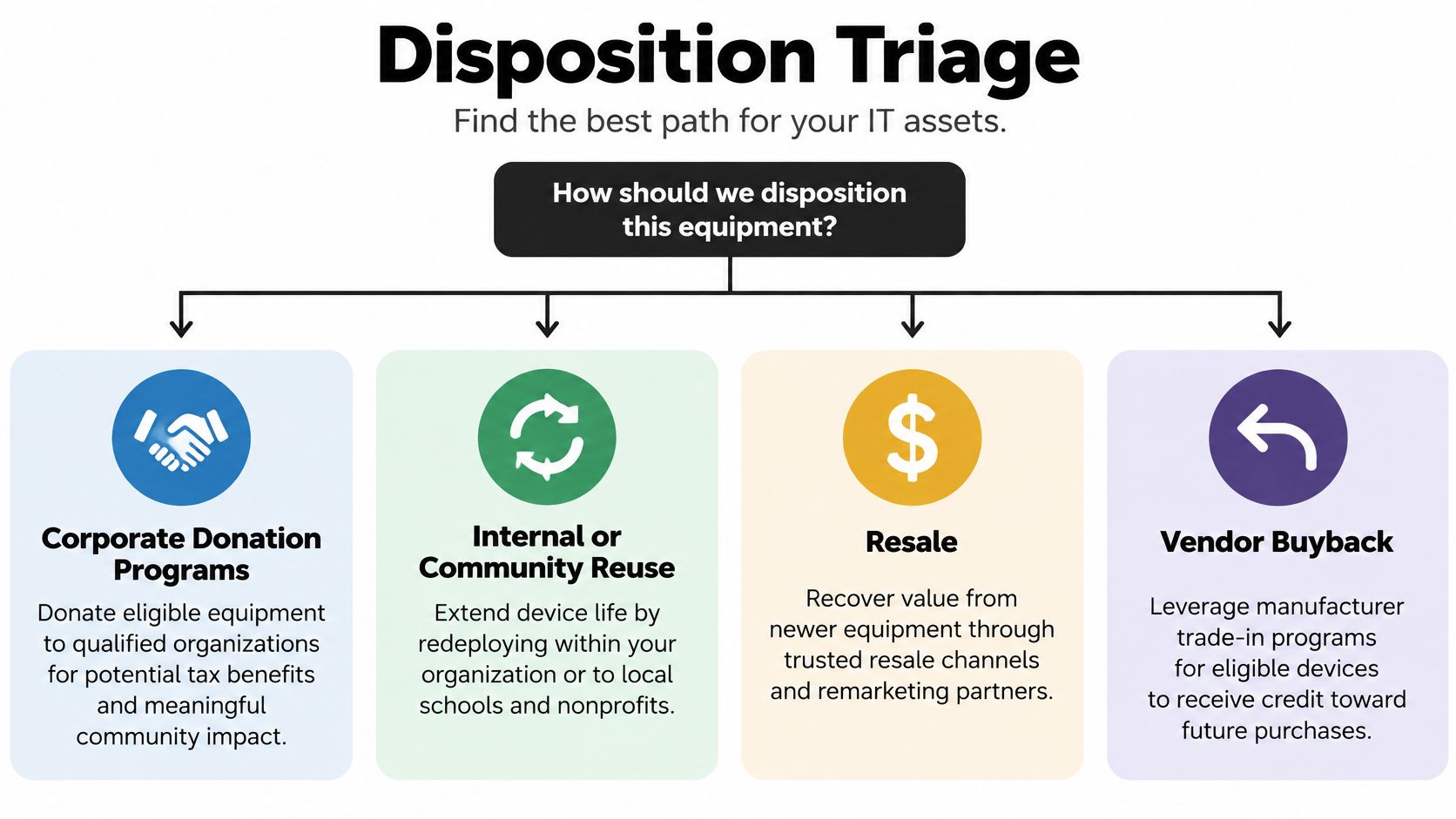
Retired computers aren't automatically waste. Disposition is a triage decision: a working machine might serve another employee or a community organization, while damaged equipment or a device with unresolved data risk may need a controlled recycling or destruction route. The highest resale offer isn't automatically the safest or most sustainable choice.
Compare routes against the same criteria
Assess device condition, remaining useful life, battery health, data sensitivity, software licensing, resale destination, transport distance, and downstream evidence. Internal reuse may avoid a new purchase but still requires an approved data process and a reliable record of reassignment. Donation can support digital inclusion, but the organization should confirm that the recipient can use the equipment and that all required data controls have been completed.
Resale or vendor buyback may recover value from newer equipment. That route needs a clear destination, an agreed process for data treatment, and records connecting the asset to its sale or trade-in. A long or unclear supply chain can create more uncertainty than a smaller return from a documented local or regional route.
For an office laptop refresh, first identify devices that remain suitable for employees or community recipients. Evaluate battery condition and repair needs, then confirm licensing and approved data treatment before allocating devices to a route. A server decommissioning has different constraints: drive security, component tracking, transport, and the handling of equipment that isn't practical to reuse may outweigh resale value.
Separate reuse from material recovery
Material recycling is appropriate for equipment that can't be responsibly reused, but “diverted” weight alone doesn't show what happened to a device. Record whether equipment was reused, refurbished, sold, donated, dismantled for material recovery, or destroyed. That distinction helps sustainability teams report outcomes without presenting every route as equivalent.
Reworx Recycling offers donation-based recycling, equipment buyback options, and IT asset disposition support. Its social enterprise mission connects responsible equipment retirement with technology donations, digital inclusion, and workforce development. Organizations comparing practical circular-economy choices may also find eco-conscious product options useful when considering how purchasing decisions fit into wider sustainability work.
A sound decision sequence is straightforward: hold devices with unresolved ownership or data questions; route usable equipment to approved internal reuse, donation, resale, or buyback; send non-repairable equipment through documented material recovery; and reserve product destruction for items that require it. Use asset recovery solutions to inform evaluation of recovery routes and their associated records.
Measure Results and Launch the Program
A pickup is complete only when the organization can account for each released device and its final outcome. Before launch, select a partner, publish instructions for staff, name who can release equipment, and set clear requirements for labeling and staging. Reconcile the manifest with the collection team before scheduling pickup, and agree on the records the partner will return.
Establish a scorecard
Track outcomes separately. A quarterly dashboard can show collection mass, reuse, resale, donation, refurbishment, recycling, destruction, documented destinations, and unresolved exceptions. Use a consistent calculation method, and label estimates or incomplete records clearly.
Historical EPA stewardship results offer a reference point, not a promise for every project. Participants sent 99.6% of collected used electronics to certified recyclers in 2013 and 99.7% in 2014. Another EPA stewardship initiative reported 99.9% in both years (EPA stewardship results for collected electronics). These figures apply to specific programs and periods. Use them to shape questions for suppliers, not to predict vendor performance.
Recycling also has resource benefits. A historical estimate cited by the EPA found that recycling 1 million laptops saves enough energy to power more than 3,500 U.S. homes for one year. Treat this as context for recovering materials, not as a substitute for assessing your project's environmental outcomes.
Review the evidence after every cycle
At project close, reconcile the received-asset list against the released manifest. Confirm that sanitization and destruction records identify the correct devices, and that every item has an approved final outcome. Assign owners to exceptions, investigate missing or mismatched assets, and retain shipment and acceptance records with the project file.
The Global E-waste Monitor reporting summarized by the United Nations Institute for Training and Research reports that the world generated 62 million tonnes of electronic waste in 2022, with 22.3% documented as properly collected and recycled. It estimates that approximately $62 billion in recoverable natural-resource value was unaccounted for. These are global figures, not measures of a business recycling program. Organizations need their own serial-level records to show what was collected, where it went, and how each asset was handled.
Use the scorecard to improve vendor selection and project controls. A traceable record should connect inventory and employee offboarding to collection, data destruction, reuse or resale, downstream processing, and final reporting. That chain of evidence makes gaps visible and gives operations teams a defensible account of each device.
Reworx Recycling supports business pickups, equipment decommissioning, IT asset management, donation options, recycling consultations, and secure hard-drive shredding with data destruction. For a refresh, office cleanout, or larger IT asset disposition project, review Reworx Recycling and contact the organization to discuss equipment donations, pickup scheduling, or a documented recycling partnership.