Yellowstone recorded 4,762,988 recreation visits in 2025, the park's second-highest visitation year on record, narrowly behind the 2021 record of 4,860,242 visits (National Park Service). That level of demand changes how a Wyoming trip works. Traffic, parking, animal movements, and the time you reach a geyser basin can determine whether the day feels calm or chaotic.
A successful Wyoming Yellowstone National Park travel guide and wildlife tips plan treats the park as a living ecosystem, not a collection of roadside attractions. You'll need a route that respects seasonal access, a schedule that avoids predictable congestion, and wildlife habits that keep both people and animals safe.
Why Wyoming Side Yellowstone Feels Different and How to Plan Around It
A roadside wildlife stop can become a traffic bottleneck within minutes. One visitor points toward a bison, another steps closer for a photograph, and vehicles stop behind them. The gathering may look like a successful viewing opportunity, yet it also increases risk for people, animals, and drivers.
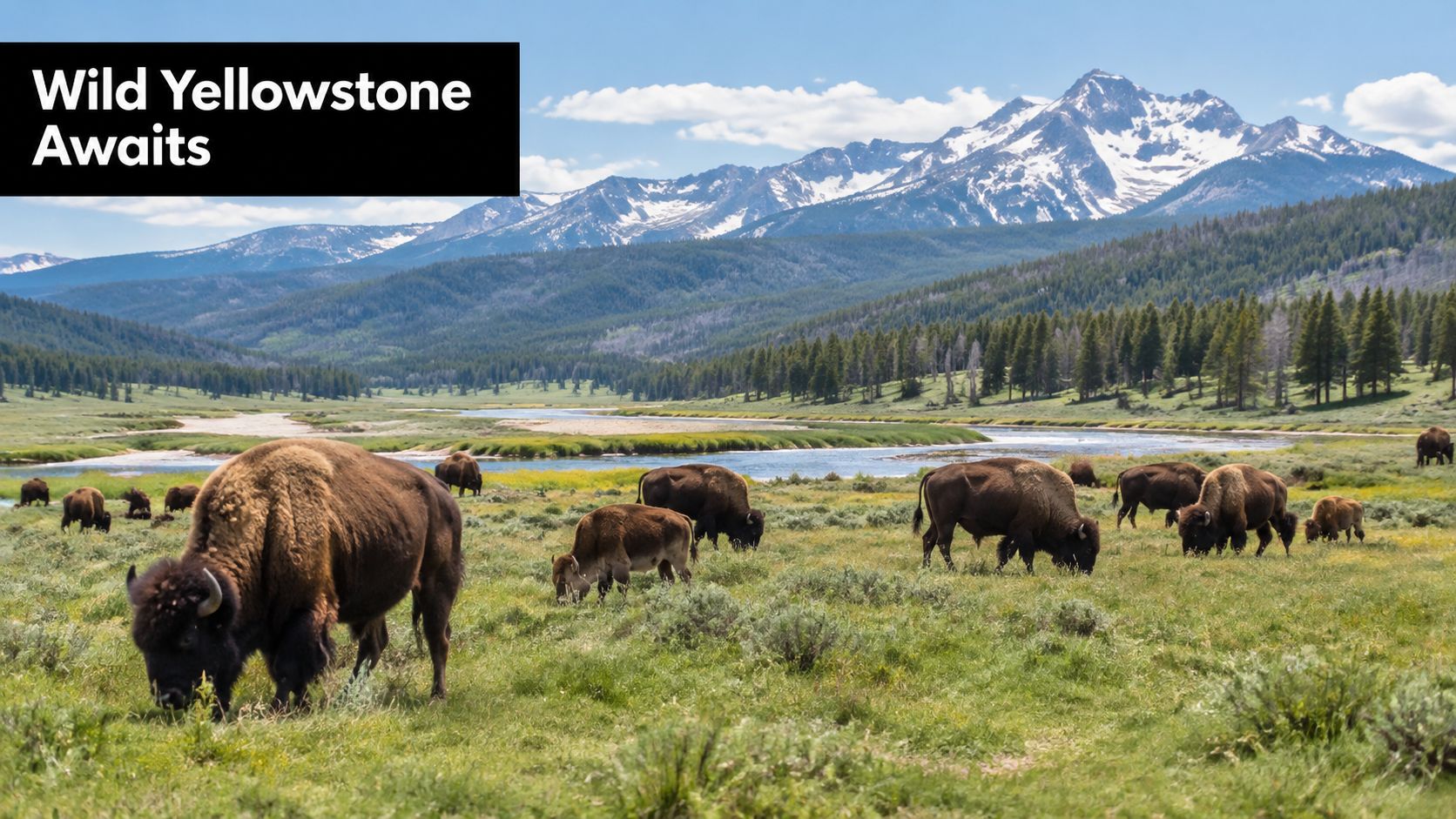
Yellowstone rewards a different mindset. Established in 1872 as the world's first national park, it protects about 2.2 million acres of habitat for grizzly bears, wolves, bison, elk, and many other species (National Park Service). The park works more like a living museum than a conventional attraction. The exhibits move, the roads pass through their habitat, and animals determine when a viewing opportunity begins and ends.
Think in systems rather than checklists
A checklist says, “See Old Faithful, Grand Canyon of the Yellowstone, and Lamar Valley.” A park-savvy plan asks four practical questions:
- Where will traffic concentrate? Major attractions, narrow corridors, and wildlife pullouts can fill quickly.
- When are animals most likely to be active? Dawn and dusk often offer better viewing conditions, although patience matters more than guarantees.
- Can the route absorb a delay? A bison crossing or crowded pullout can change the day's timing.
- What behavior protects the animal? Staying back and observing matters more than getting a close photograph.
The park's 2025 visitor total represented 86,891,452 visitor hours and 1,238,983 overnight stays (National Park Service). Those figures help explain why a short stop can become a long queue. A route that looks easy on a map may move slowly once traffic and wildlife share the same corridor.
Planning principle: Build your day around flexibility. Yellowstone's best moments often require waiting, rerouting, or letting an animal clear the road.
Wyoming-side access adds another planning layer. The East Entrance brings travelers from Cody toward Yellowstone Lake and the park's interior. The South Entrance connects naturally with Jackson and Grand Teton National Park. In both cases, treat the road as shared habitat, leave room for an unexpected crossing, and avoid stopping where vehicles cannot pass safely.
The same arrive-early, share-the-road logic applies in other crowded parks. Compare how it works on Going-to-the-Sun Road in the Montana Glacier National Park travel guide.
When to Go and How to Get There From Wyoming
A Yellowstone trip begins with road access, not a sightseeing list. The same entrance can feel efficient in one season and unusable by car in another, so choose the travel period before setting daily stops.
From Wyoming, three gateway patterns cover most plans:
- East Entrance: Cody suits travelers approaching Yellowstone Lake and the park's eastern interior.
- South Entrance: Jackson works naturally for combining Yellowstone with Grand Teton National Park.
- North Entrance: Gardiner leads to Mammoth Hot Springs and remains the only route generally open year-round to regular vehicles.
Most park roads close to regular wheeled vehicles from early November through late April. Oversnow access is generally limited to commercially guided snowmobiles and snowcoaches from mid-December through mid-March. The North Entrance route through Gardiner to Cooke City is generally open year-round (National Park Service).
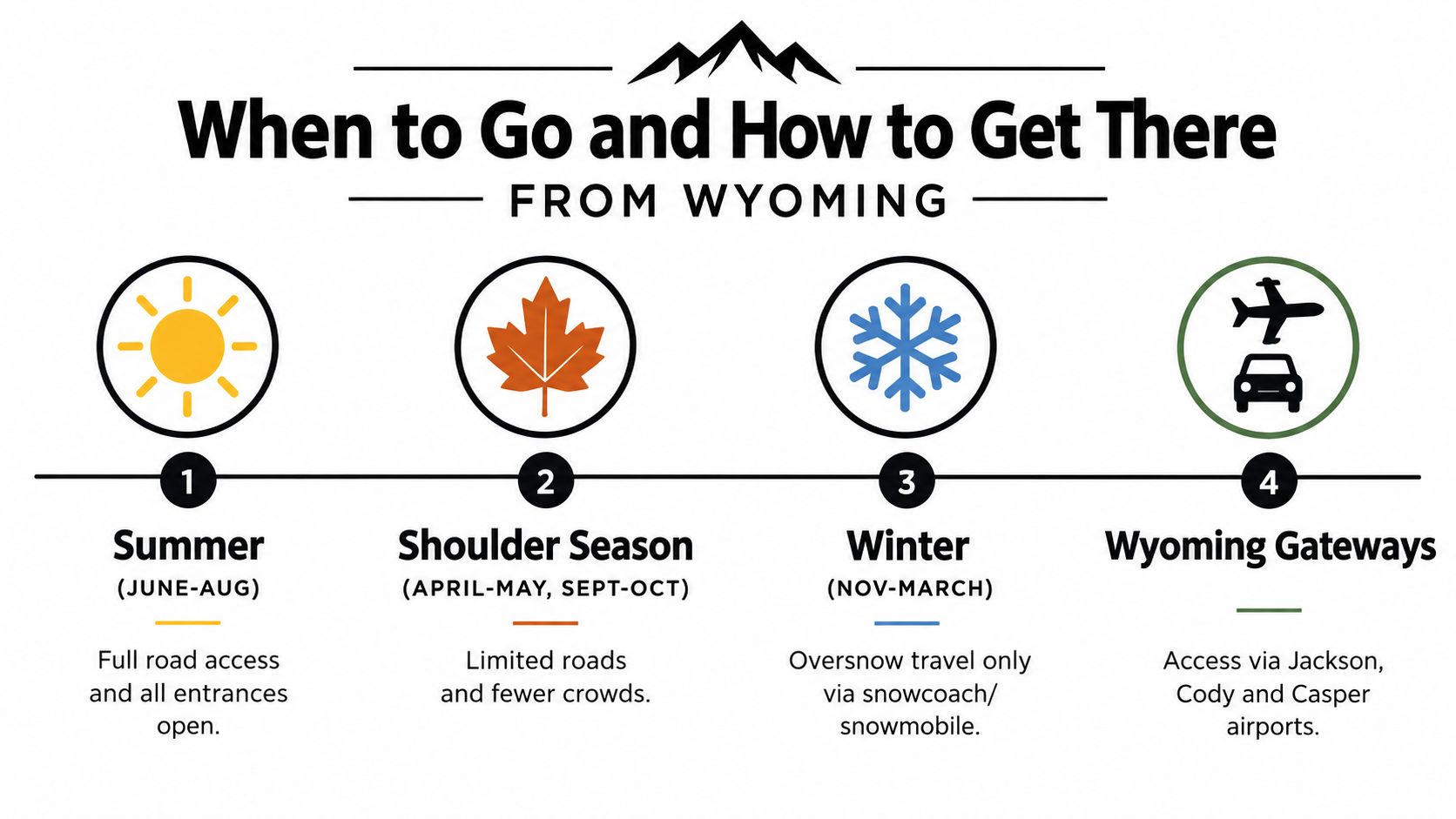
Match your travel style to road access
Summer offers the broadest regular-vehicle access, but it also brings the strongest demand. Shoulder seasons may feel quieter while bringing closures, changing weather, and reduced services. Winter requires a different transportation plan, with oversnow operations and snowbanks that can narrow open corridors for both vehicles and wildlife.
Arrival time shapes the entire day. Yellowstone planning guidance recommends arriving before 7 a.m. or after noon and avoiding major attractions between 10 a.m. and 4 p.m. during summer (National Park Service). Early entry can place you at a popular basin before parking fills. Later arrival may avoid the morning rush, but it still requires patience around pullouts, crossings, and animal-related slowdowns.
The park's 2026 visitation figures show why timing should be specific rather than based on a blanket assumption that every summer day has the same crowd level. Visitation was up 1% year-to-date through May 2026, then down 1% year-to-date through June and July (National Park Service). Those shifts do not remove peak-season congestion. They support comparing entrance, weekday, and viewing-window choices before committing to a route.
Gateway towns funnel visitors much like a single Strip corridor funnels Las Vegas traffic. The Las Vegas travel guide beyond the Strip illustrates how planning around crowd surges can reduce delays, although Yellowstone adds wildlife crossings and changing road access to the equation. A bottleneck is more than an inconvenience here: stopped cars can crowd animals and encourage unsafe roadside behavior. Arrive early, keep pullouts clear, and leave room for the corridor to function as both a travel route and animal habitat.
Wyoming Based Itineraries That Flow Without Backtracking
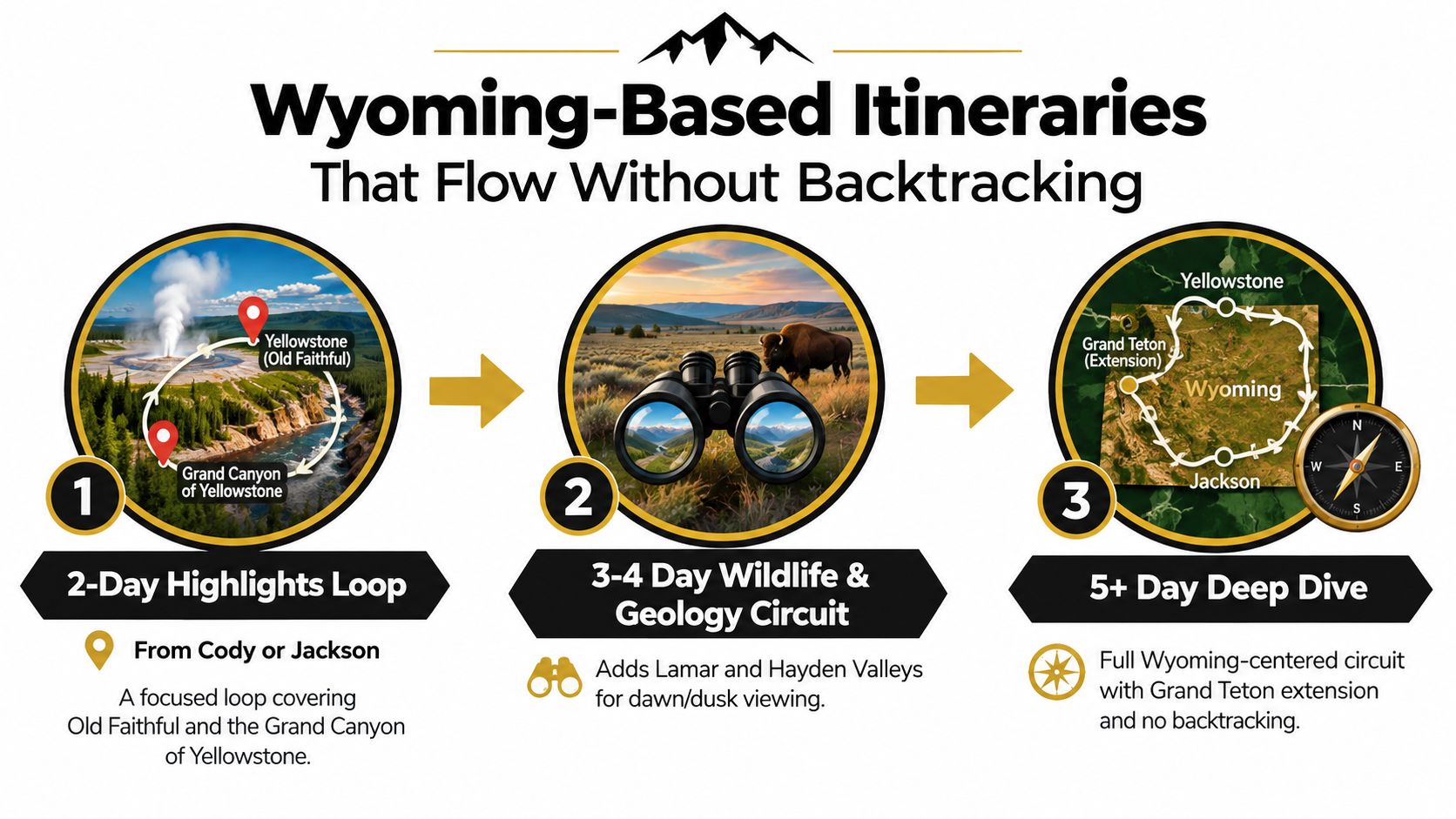
A good Yellowstone route behaves like a well-designed loop. You group nearby sights, protect the best wildlife hours, and avoid crossing the same busy corridor repeatedly. Starting from Cody or Jackson, the right itinerary depends less on seeing every landmark than on allowing enough time for road delays and unplanned animal sightings.
A focused two-day highlights loop
For a short visit, assign one day to the geyser country and one to the canyon and lake side of the park. Approach through the Wyoming entrance that best matches your lodging, then reach the popular geothermal areas early. Old Faithful and the surrounding Upper Geyser Basin deserve more than a quick photograph, but early arrival gives you a better chance of finding parking and walking the boardwalk at a manageable pace.
Use the second day for Grand Canyon of the Yellowstone, nearby viewpoints, and a wildlife-oriented drive through a valley if conditions allow. Don't force a distant detour to collect a name from the map. A delayed bison crossing or crowded canyon parking area can make a flexible two-day plan more enjoyable than an overloaded one.
A balanced three-day wildlife and geology circuit
Add a middle day for the transition between geothermal features and wildlife habitat. Spend the lower-loop portion of the trip exploring geyser basins and Yellowstone Lake, then use a separate window for Hayden Valley. This keeps you from treating wildlife as an accidental bonus between attractions.
A three-day schedule also gives you room to repeat a productive area at a better time of day. If midday traffic overwhelms a popular viewpoint, continue to a less congested pullout and return later. The objective is not speed. It's a sequence that places high-interest stops in calmer periods and leaves room for animals to control the pace.
A deeper four-day plan
Four days allow a more deliberate rhythm. Place Old Faithful and Grand Prismatic in an early or late window, use the middle of the day for boardwalks and overlooks, and reserve Lamar Valley or Hayden Valley for dawn or dusk. Lamar Valley is particularly valuable for patient, distant wildlife observation, while Hayden Valley can fit naturally into an interior route between the lake and canyon areas.
Keep one segment of every day adjustable. Construction, storms, parking shortages, or a roadside herd can make the planned order impractical. A route that flows without backtracking should still have an alternate stop ready.
Routing rule: Start early on the side nearest your first major attraction, cluster geothermal stops together, and protect low-light hours for valleys and wildlife.
A five-day or longer trip can add a Grand Teton extension from the South Entrance without making Yellowstone carry the entire schedule. The same principle applies to any gateway. If the route requires repeated long crossings, reduce the number of fixed stops and increase the time available at each habitat. You'll gain more from quiet observation than from racing between pins on a map. For another destination-focused route-planning example, see the Mount Rushmore travel guide and nearby attractions.
Must See Sights From Old Faithful to Lamar and Hayden Valleys
Yellowstone's signature sights represent different systems. Old Faithful demonstrates geothermal pressure, Grand Canyon of the Yellowstone reveals erosion and changing water flow, and the valleys show how open habitat supports large mammals. Treating them as interchangeable photo stops misses what makes the park distinctive.
Old Faithful and the Upper Geyser Basin
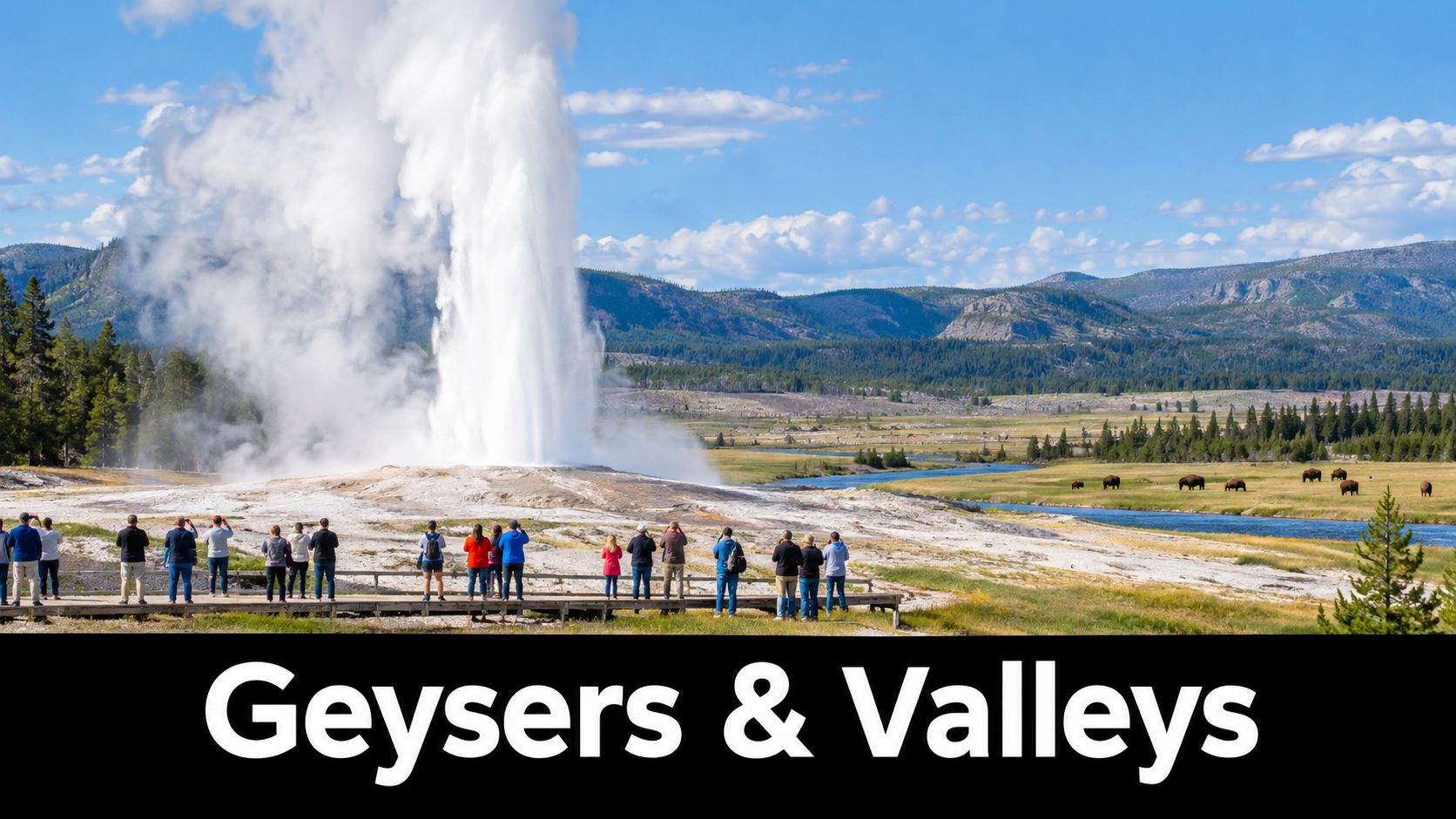
Old Faithful is the obvious anchor, but the Upper Geyser Basin rewards a slower visit. Stay on the boardwalk, use posted information to understand eruption timing, and continue beyond the main viewing area when the crowd thins. The boardwalk protects both visitors and delicate thermal ground, which can be unstable and dangerously hot.
Grand Prismatic belongs in the same geothermal portion of the day, but visibility changes with conditions. Steam can obscure colors during colder periods, so a flexible schedule helps. The best viewpoint isn't always the closest one, and the safest photograph is the one taken from the designated path.
Grand Canyon of the Yellowstone
The canyon shifts the lesson from underground heat to surface geology. Water, rock, changing light, and elevation create different experiences at the overlooks, so don't judge the area from a single stop. Give yourself time to move between designated viewpoints, watch conditions, and avoid turning a crowded pullout into a roadside photography lane.
Lamar and Hayden Valleys
These valleys are wildlife habitats first and scenic drives second. Bring binoculars or a telephoto lens, scan slowly, and expect animals to appear as small shapes rather than close subjects. Lamar Valley is well suited to patient observation along the park's northeastern wildlife corridor, while Hayden Valley fits naturally into routes connecting the lake and canyon areas.
The correct viewing distance matters more than the zoom setting. A quiet vehicle, a legal pullout, and a long lens let you observe without pressuring an animal to move. If an animal changes its behavior, stop feeding, or shifts toward people, treat that as information, not an invitation.
Where to Stay and How Roads Weather and Rules Shape Your Day
Your lodging base determines how much of the day goes to viewing places rather than driving between them. An in-park lodge or campground can support early starts and interior attractions. Cody and Jackson provide gateway-town services and more lodging choices, while West Yellowstone and Gardiner fit routes focused on western or northern areas.
Reservations and permits deserve early attention during popular lodging and camping periods. Camp only in designated areas, and store food and scented items according to park requirements. Campfires, parking, and overnight arrangements also follow park rules, so confirm current conditions instead of building a day around an old itinerary.
Choose the base that supports the route
A family with young children may prefer a shorter first drive and dependable access to rest facilities. A wildlife-focused traveler may choose a more remote base to reach a valley during a productive viewing period. Visitors planning around accessibility should confirm boardwalk surfaces, grades, parking, and restroom access for each attraction before committing to a long day.
The same road distance can feel very different in changing weather. Storms, snow, road work, and sudden temperature shifts can slow travel. Winter snowbanks may also narrow corridors where animals and vehicles pass, increasing the chance of congestion and hurried roadside decisions. Keep food, water, warm layers, and offline maps in the vehicle. A closed road is a firm boundary, not a problem to solve by improvising.
| Base Option | Best For | Trade Off to Consider |
|---|---|---|
| In-park lodge | Early starts and interior attractions | Less flexibility if plans change |
| In-park campground | Travelers who want an immersive, in-park experience | More preparation for weather and food storage |
| Cody | East Entrance access and a Wyoming gateway-town experience | Longer interior drives for western attractions |
| Jackson | South Entrance access and a Grand Teton combination | Route may be less efficient for northern Yellowstone |
| Gardiner | North Entrance access and year-round regular-vehicle travel | Less direct access to southern geothermal areas |
| West Yellowstone | Western geyser-basin itineraries | Popular periods can make local traffic demanding |
Before leaving your base, review the park's current road-status page, then select a primary route and a realistic fallback. This matters for wildlife viewing as well as arrival time. A traffic bottleneck near a pullout can turn a brief animal sighting into stopped vehicles and unsafe roadside movement, while a weather delay can consume the quiet hours when animals are easiest to observe. Leaving earlier, choosing a less congested route, and abandoning a blocked stop can protect both the schedule and the animals.
For a comparable approach to lodging and access planning, review this Utah Zion National Park travel guide. Lodging works best when it supports the route you will drive, not the place that looks closest on a map.
Responsible Wildlife Viewing and Safety Around Bears Bison and Wolves
Yellowstone recorded 2,635,384 recreation visits by July 2026, so a wildlife sighting can quickly become a traffic problem as well as a viewing opportunity. The danger often starts when vehicles stop in the travel lane, visitors gather at a pullout, and someone walks closer because an animal appears calm. A bottleneck leaves people, drivers, and wildlife with less room to react.
“Keep your distance” needs a clear field routine. Park guidance requires at least 100 yards from bears, wolves, and cougars, and at least 25 yards from bison, elk, deer, and all other wildlife (National Park Service). Your vehicle often works like a mobile viewing blind. Use binoculars or a telephoto lens to turn distance into detail.
Use a pullout-first routine
When an animal appears near a Wyoming-side road, follow this sequence:
- Find a legal pullout. Never stop in the travel lane, even when other vehicles have done so.
- Park fully clear of traffic. Leave room for passing vehicles and emergency access.
- Stay inside when the animal is close. A closed vehicle gives you a safer observation point than the road shoulder.
- Use optics instead of footsteps. Let lenses provide detail without shrinking the animal's space.
- Leave when the crowd becomes unsafe. A good sighting is not worth joining a human traffic hazard.
If an animal changes behavior or moves toward you, you are already too close, according to park guidance. That response matters more than guessing whether a bison looks relaxed. Large animals can cross ground quickly, and a crowded roadside limits their escape options.
Field rule: The best wildlife photograph is one that doesn't make the animal react.
Bison deserve particular caution. The National Park Service says bison have injured more visitors than any other animal in Yellowstone since 1980 (National Park Service). The park also reported at least two bison injuries in 2026. Together with the visitation total, these points show why traffic management belongs in wildlife safety. More vehicles at one sighting can mean blocked lanes, rushed decisions, and added pressure on an animal.
Bears and wolves require the greater distance, while the same conduct applies to every species. Do not approach, surround, feed, call toward, or chase an animal for a photograph. If a roadside stop becomes crowded, leave and choose a safer observation point later. A Wyoming-side wildlife viewing comparison with Theodore Roosevelt National Park reinforces the same principle: observers should adjust to wildlife, not demand close access.
Photography Gear Accessibility and Family Friendly Checklists That Work
Good preparation reduces rushed decisions. Pack for three purposes: seeing wildlife clearly, moving safely, and staying comfortable when the day changes.
A practical field kit
- Optics: Carry binoculars for valleys and a telephoto lens if photography matters. Your equipment should extend observation, not shorten distance.
- Layers: Use a warm layer, rain protection, sun protection, and sturdy footwear. Boardwalks and overlooks can feel exposed when wind or weather arrives.
- Safety items: Keep bear spray accessible on hikes, not buried under clothing or equipment, and learn how to use it before entering the backcountry.
- Navigation: Download maps before leaving service areas and carry a paper backup. Don't let a weak signal dictate a route.
- Food and water: Bring enough for delays caused by traffic, weather, or wildlife crossings.
Accessibility planning starts with the exact attraction, not the park name. Check boardwalk grades, seating, restrooms, parking distance, and shuttle or visitor-center arrangements before setting out. A family may enjoy more by choosing one accessible geothermal area, one canyon viewpoint, and a short wildlife stop than by attempting every major landmark in one day.
Children also need a pace they can sustain. Build in snack breaks, restroom stops, quiet time in the vehicle, and age-appropriate activities such as junior ranger materials. Teach one simple wildlife rule before arrival: animals get space, and the car is often the safest place to watch.
Before leaving your lodge, confirm four things: the first stop, the fallback route, the wildlife-viewing boundaries, and the departure time. Starting early or waiting until after the main midday rush can turn the same road into a calmer experience.
Reworx Recycling helps organizations retire outdated computers, laptops, servers, and other electronics through responsible electronics recycling, secure data destruction, IT equipment disposal, business pickups, and donation-focused programs. If your business is replacing equipment after a facility cleanout, office cleanout, or data center decommissioning, visit Reworx Recycling to donate old equipment, schedule a pickup, or explore a responsible IT asset disposition partnership that supports communities and reduces electronic waste.