You're probably doing what most OBX travelers do right now. You've opened five rental tabs, everyone in the group has a different opinion, and half the advice online acts like the Outer Banks is one interchangeable strip of beach. It isn't.
A smart North Carolina Outer Banks vacation rentals and travel guide starts with one decision: which submarket fits your group, your week, and your tolerance for driving or ferry logistics. Get that right, and the rest gets easier. Get it wrong, and you'll spend too much, drive too far, or book a “quiet beach” that turns out to be quiet because it's hard to reach.
Why the Outer Banks Works as a Set of Submarkets
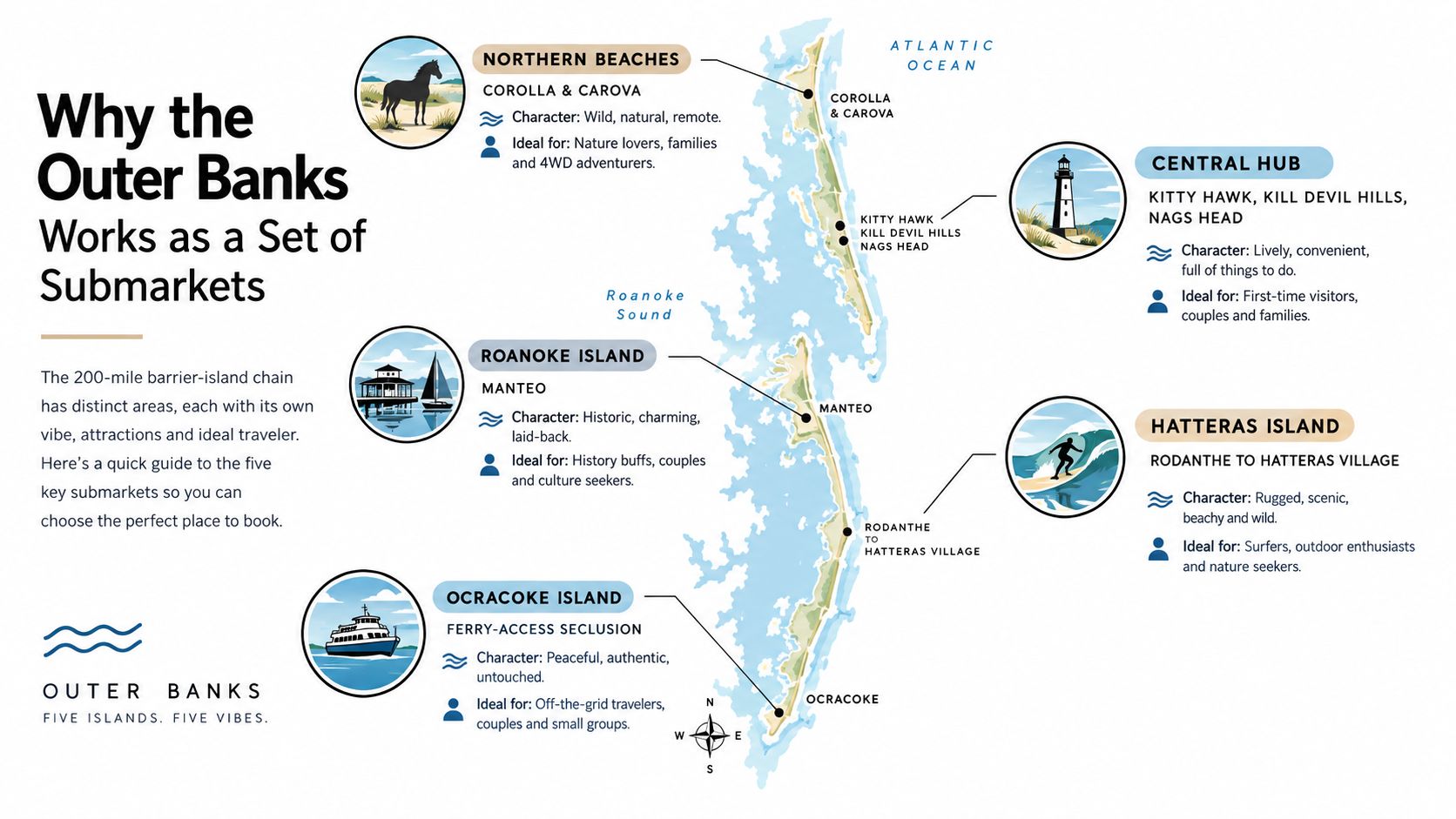
Most beach guides flatten the Outer Banks into one destination. That's lazy planning. The OBX works better as a chain of distinct rental markets with different access patterns, different house types, and different trip rhythms.
The economic scale alone tells you this is not some minor seasonal beach strip. In 2023, Dare County held its No. 4 ranking among North Carolina's 100 counties for total visitor spending, reached an all-time high of $2.15 billion, ran 8.8% above 2022, supported 12,564 leisure and hospitality jobs, equal to 45.5% of all local jobs, and visitors paid nearly $148 million in state and local taxes, according to the State of Dare County Tourism report. That level of demand creates real submarkets, not one uniform beach experience.
The three splits that matter
First, there's north of Oregon Inlet versus south of Oregon Inlet. North gives you the dense rental machine of Corolla, Duck, Kitty Hawk, Kill Devil Hills, and Nags Head. South gives you Hatteras Island and, beyond that, Ocracoke. Different pace. Different inventory. Different logistics.
Second, there's 4WD beach access versus paved access. Carova and parts of the far north are a different product from paved-access towns. If your group doesn't want to think about sand driving, recovery gear, or what happens when someone arrives after dark in a sedan, skip the romance and stay on pavement.
Third, there's road access versus ferry dependency. Ocracoke is worth the trouble for some travelers. It's the wrong pick for others.
Practical rule: Choosing an OBX town is really choosing a season length, price band, and access model.
If you want a useful comparison mindset, treat the OBX the way you'd compare any coastal destination with neighborhood-level differences, not as a single blob on a map. That's the same mistake travelers make in broader beach markets, and this Delaware beaches guide on best places to visit is a good example of how local variation changes the trip.
The decision tree I use
Ask these three questions in order:
- Do you want easy road access or are you willing to build the trip around a ferry?
- Is your group paying for convenience, space, or seclusion?
- Are you booking for peak summer, shoulder season, or a value week?
Answer those and your shortlist gets small fast.
Choosing the Right OBX Town for Your Trip
Town choice drives almost everything else. Not just vibe. Groceries, restaurant density, drive fatigue, beach access style, and rental pricing pressure all flow from the town.
Quick town matching
If you're booking a big family week and want the classic oversized beach-house setup, start with Corolla or Duck. If you're a first-timer and don't want to overthink the trip, Kitty Hawk and Kill Devil Hills are the easy answer. If your group cares about fishing piers, broad appeal, and a balanced budget, Nags Head usually wins. If you want fewer crowds and don't mind extra logistics, move south to Hatteras. If you want the most distinct trip and can tolerate ferry dependence, Ocracoke earns it.
Here's the clean side-by-side view.
OBX Town Comparison
| Town | Access | Nightly Rate Band | Best For | Watch Out For |
|---|---|---|---|---|
| Corolla | Long drive, paved until far north, some nearby 4WD areas | Higher | Family reunions, large houses, privacy | Longer supply runs, expensive prime inventory |
| Duck | Road-accessible, north of central towns | Higher | Couples, upscale family trips, walkable village feel | Fewer budget options |
| Kitty Hawk | Easy paved access | Moderate | First-timers, shorter trips, convenience | Less of a secluded feel |
| Kill Devil Hills | Easy paved access, central | Moderate to lower | Walkable dining, casual groups, long weekends | Busy main corridors |
| Nags Head | Easy paved access | Moderate | Mid-range family weeks, pier access, broad appeal | Summer demand for good ocean access stays strong |
| Hatteras | Long drive south | Lower to moderate | Surfers, anglers, uncrowded beaches | Distance, fewer services, weather sensitivity |
| Ocracoke | Ferry-dependent | Lower to moderate | Couples, offbeat stays, shorter escapes | Ferry timing controls the trip |
Who should book where
Corolla and Duck work best when the house is the product. Multi-family groups, reunion trips, and travelers willing to spend more for a better property mix do well here.
Kitty Hawk and Kill Devil Hills are the most forgiving choices. You can recover from weak planning in these towns because restaurants, groceries, and activities are easier to reach.
Nags Head is the strongest all-around compromise. If your group can't agree, Nags Head is often the least controversial answer.
Don't ask which town is “best.” Ask which town is best for your group size, driving tolerance, and spending ceiling.
Hatteras is for travelers who mean it when they say they want fewer crowds. It rewards people who value beach time over errands and nightlife.
Ocracoke is not a plug-and-play family week for most groups. It's better for couples, return visitors, and shorter stays built around the island itself.
For a broader relocation-style look at how North Carolina communities differ, this piece on the best places to live in North Carolina in 2026 is useful because it reinforces the same point: one state can contain very different local experiences.
Picking the Best Season and Week to Go
Book the wrong week and the rest of your planning gets harder fast. A great house in the right town will not save a trip if your week clashes with your group's priorities, the ferry schedule you need, or the level of weather risk you are willing to accept. The Outer Banks is not one seasonal market. Corolla, Nags Head, Hatteras, and Ocracoke do not perform the same way in the same week, and your timing should change accordingly.
Analysts at Staystra's Outer Banks STR market coverage found meaningful differences in occupancy and pricing across Corolla, Nags Head, Kitty Hawk, and Kill Devil Hills, with summer demand pushing especially high occupancy and larger luxury homes holding up better than smaller properties. That matters because week choice and rental type are tied together here. A prime July week in Corolla behaves differently from an early September week in Hatteras, and a ferry-dependent Ocracoke stay needs more buffer than a simple drive-in week in Kill Devil Hills.
The four seasons that actually matter for renters
Peak summer is for school-calendar families, first-time visitors, and large groups that need the deepest house inventory. If you need a seven-bedroom house, warm ocean water, and full business hours, book here and accept the price.
Shoulder weeks are the sharpest choice for adult groups, couples, and families with flexible calendars. Late May, early June, and early to mid-September usually give you a better mix of cost, comfort, and less crowded beaches.
Value weeks in spring and fall work best in the central beaches and Nags Head area, where you still have enough dining and activity options even when the beach is not the whole day. These weeks are weaker for travelers who expect textbook swim weather every afternoon.
Quiet season is best treated as a coastal house trip, not a classic beach vacation. It fits return visitors, writers, remote workers, and people who want long walks and low noise. It disappoints travelers expecting a full summer routine.
Match the week to the submarket
Corolla and Duck: Best in peak summer if your group is paying up for the house and plans to use it heavily. In cooler months, the higher rental cost makes less sense unless the home itself is the event.
Kitty Hawk, Kill Devil Hills, and Nags Head: These towns are the most forgiving across more of the calendar. Shoulder season works especially well here because access to groceries, restaurants, and rainy-day options stays easier.
Hatteras Island: Late spring and early fall are often the sweet spot. You get the lower-density feel people come for without paying absolute peak rates. The trade-off is greater weather sensitivity and longer drive times.
Ocracoke: Build this trip around the ferry first and the beach second. Summer works, but shorter shoulder-season stays often fit the island better because couples and repeat visitors tend to value the setting more than a full week of peak-beach scheduling.
Hurricane season changes the math
Atlantic hurricane season runs from June through November, and that matters more on the Outer Banks than in many inland vacation markets. August and September can be excellent beach weeks, but they demand better policy discipline. Read cancellation terms before you book, not after a storm forms. For a practical planning refresher, review this Outer Banks hurricane season guide and storm preparation tips.
If your group is ferry-dependent, weather risk matters even more. Ocracoke and some Hatteras-based plans have less margin for error than a standard drive-in week in Kill Devil Hills or Nags Head.
Here is the blunt version. If school schedules force summer, book earlier summer if you can and secure the house that fits your group size first. If you have flexibility, target shoulder weeks in the town that matches your trip style. That is where many OBX trips deliver the best value.
Matching the Rental to Your Group and Budget
Most renters waste time on decor and overlook the decisions that change the trip. Start with location type, then size, then amenities. In that order.
Start with the shoreline position
Oceanfront is convenience. That's the whole pitch. You're paying to avoid packing the car, crossing roads, and carrying chairs farther than necessary. For families with small kids or older adults, that convenience is worth real money.
Semi-oceanfront is the compromise pick that often makes the most financial sense. You still get practical beach access without paying the maximum premium.
Soundfront is a different vacation. Quieter, often prettier at sunset, and better for travelers who don't need to stand on the Atlantic every hour.
OBX Rental Types by Group and Trade-Off
| Rental Type | Peak Weekly Rate Range | Walk to Beach | Key Trade-Off | Best For |
|---|---|---|---|---|
| Oceanfront condo or small home | Higher | Immediate or very short | Smaller space for the money | Couples, small families |
| Semi-oceanfront home | Moderate to higher | Short | Some road crossing or limited view | Families who want value near the beach |
| Soundfront cottage | Moderate | Drive or longer walk | Less direct ocean access | Couples, quieter trips |
| Large oceanfront house | Highest | Immediate | Budget goes to location first | Multi-gen groups |
| Inland or soundside larger home with pool | Moderate to higher | Drive or longer walk | Less spontaneous beach use | Big groups chasing space value |
Size the house for your people, not for the listing photos
Couples don't need six bedrooms and a game room they'll never touch. Nuclear families should care more about beach access and kitchen layout than bonus bunk spaces. Multi-generational groups should focus on bedroom placement, second living areas, and stair burden.
Older housing stock often means limited elevator availability. If you have grandparents, toddlers, or anyone with mobility issues, stairs are not a minor detail.
Here's the amenity filter I use:
- Private pool: Great if your group will use it every day. Otherwise it's an expensive badge.
- Hot tub: Fine in cooler months. In summer, it often matters less than the listing implies.
- Pet-friendly status: Important if you're bringing a dog, but prime pet-friendly inventory tightens early.
- Linens and beach gear: These line items separate a manageable budget from an annoying one.
- Golf cart access: Nice in a few contexts, unnecessary in many.
For insurance and liability questions that come up when people compare deposits, liability exposure, and home rules, it helps to compare vacation home policies before you commit to a high-value rental.
Worth paying for: Easier beach access, better bedroom layout, and a location that reduces daily car trips.
Skip flashy extras before you lock those in.
Booking Mechanics, Policies, and Insurance
The Outer Banks rental system is simple once you stop treating it like hotel booking. It's a contract market, especially in the core summer season.
How reservations usually work
Summer inventory often turns over Saturday to Saturday. If your group wants prime oceanfront stock, especially larger homes, early booking matters because the best houses go first.
Published rental guidance also notes that vehicle ferries run year-round, while the Ocracoke Express passenger ferry operates only from mid-May to mid-September, is fee-based, accepts reservations, and lists 1-800-BY-FERRY as the ferry contact on the Outer Banks rental policies page. That matters if your booking plan assumes a car-free Ocracoke add-on.
The policies people skim and regret
One Outer Banks rental-policy page states that changing the date of stay for the same home, same rental rate, and same year is treated as a transfer and triggers a $75 plus tax transfer fee once submitted in writing and approved, according to Coastal Carolina OBX vacation rental policies.
Another policy page requires cancellation requests in writing and applies a $50 cancellation fee, according to Outer Banks Vacations rental policies.
A separate rental FAQ says smoking is prohibited inside or on the premises, including cigarettes, cigars, pipes, marijuana, and vaping, and violations incur a $500 fee to restore the property to a smoke-free condition, according to Outer Banks Blue FAQs.
Those details matter because renters often focus on headline rent and ignore fee exposure.
Insurance that actually matters
Don't confuse a damage waiver with broad trip protection. They're not the same thing. If you're booking during storm season, read the named-storm language, the refund terms, and whether rebooking depends on mandatory evacuation, property damage, or both.
If you want a plain-English starting point on policy types, this overview of insurance for short-term rentals is a useful comparison resource.
Read these clauses before signing:
- Date-change rules
- Written cancellation requirements
- Pet fees
- Pool heat charges
- Smoking restrictions
- Storm and evacuation language
That reading is not optional. It's how you avoid paying for assumptions.
Itineraries by Trip Length and Traveler Type
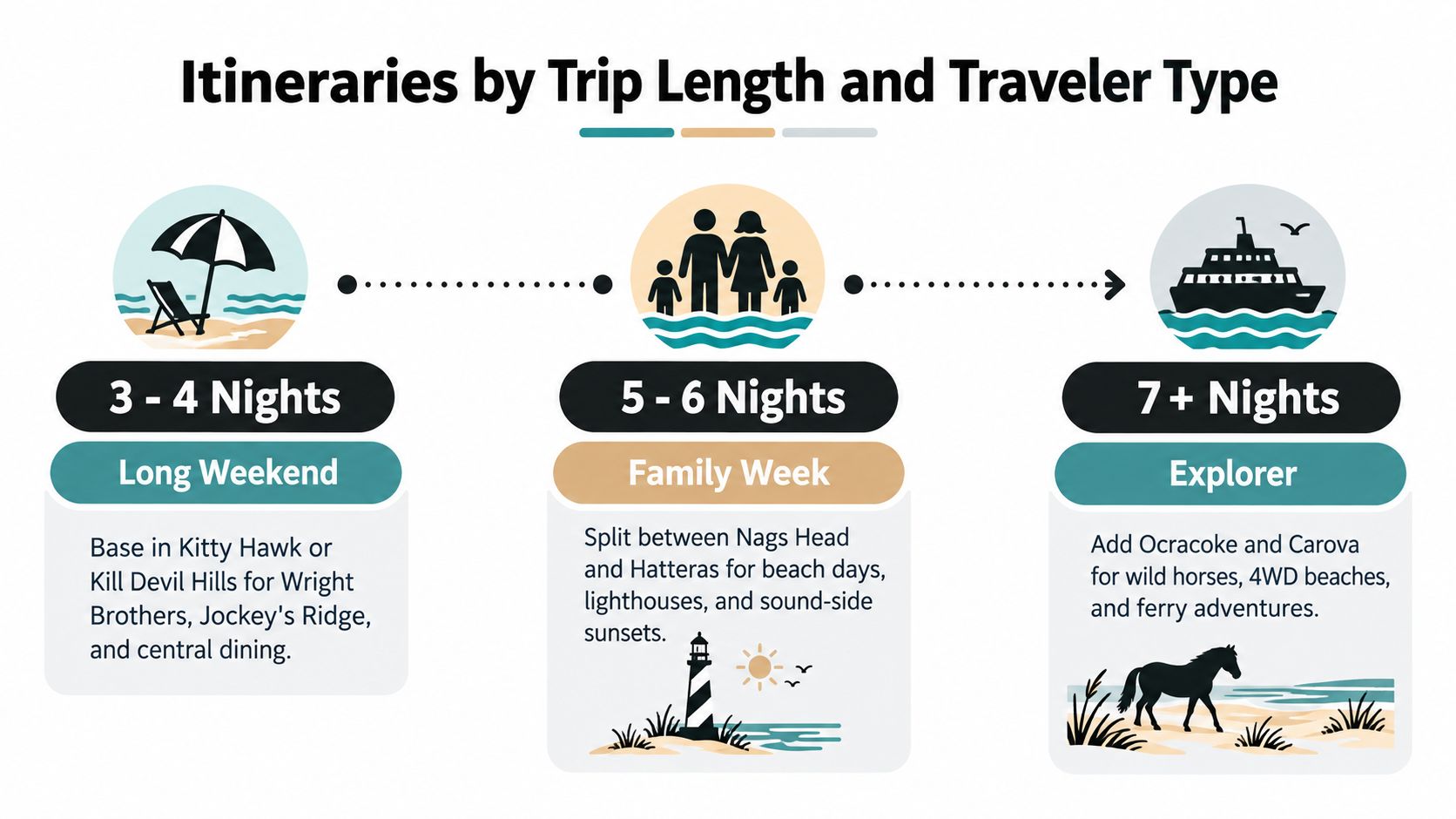
Trip length should decide your base town. Too many travelers try to force a seven-night geography onto a three-night stay.
Three to four nights
Stay in Kitty Hawk or Kill Devil Hills. That keeps first-timers close to core attractions and cuts down on dead time in the car.
- Best for: First visits, couples, short family breaks
- Must-book restaurant: Pick one early in the central beach corridor and lock it in
- Signature activity: Wright Brothers National Memorial
- Rest day: One low-effort beach block with an early dinner
Five to six nights
This is the sweet spot for many families. Nags Head works if you want broad convenience. Hatteras villages work if your family wants a slower rhythm and doesn't need constant restaurant variety.
A five- or six-night stay is long enough to settle in, but short enough that over-driving the islands starts to feel wasteful.
- Best for: Families who want one signature outing and plenty of beach time
- Must-book restaurant: One dependable local seafood dinner near your base
- Signature activity: Jockey's Ridge or a lighthouse-focused day
- Rest day: Full pool-and-beach rotation with no agenda
Seven nights or more
A full week gives Corolla and Hatteras room to make sense. These areas reward travelers who aren't trying to sprint through the destination.
- Best for: Multi-gen groups, reunion-style trips, repeat visitors
- Base towns: Corolla for big-house convenience, Waves or Nags Head for easier group movement, Ocracoke only if the ferry is part of the appeal
- Signature activity: Wild horses up north or a lighthouse-and-ferry combination farther south
- Rest day: Midweek house day, because large groups need one
If your group is also considering Mid-Atlantic beach alternatives, this Virginia Beach travel guide with things to do is a useful comparison point because it highlights how different an easier-access urban beach market feels from the OBX.
Getting There, Ferries, and On-Island Logistics
OBX logistics punish sloppy planning. Not maybe. Consistently.
Ferries are not a detail
The ferry network changes the shape of your trip. The Hatteras to Ocracoke ferry is free, first-come, first-served, and takes no reservations, while the longer mainland crossings from Ocracoke to Cedar Island and Swan Quarter are toll routes where reservations are strongly recommended. Typical vehicle capacity is around 30 to 50 vehicles, depending on vessel and vehicle mix, according to this Outer Banks ferry system overview.
That means RVs, trailers, and oversized setups need real planning. It also means “it's not far on the map” is useless if the ferry is your bottleneck.
OBX Ferry Routes and Vehicle Logistics at a Glance
| Route / Bottleneck | Vehicle Limit | Reservation or Wait Window | Best Use Case |
|---|---|---|---|
| Hatteras to Ocracoke | Capacity varies by vessel and vehicle mix | First-come, first-served | Day trip or island connection from Hatteras side |
| Ocracoke to Cedar Island | Capacity constrained by vessel mix | Reservations strongly recommended | Continuing south or west by vehicle |
| Ocracoke to Swan Quarter | Capacity constrained by vessel mix | Reservations strongly recommended | Longer mainland connection with a vehicle |
| Saturday bridge traffic into core northern towns | Not a vehicle limit issue, but a flow problem | Peak arrival windows can stack up | Standard weekly rentals north of Oregon Inlet |
Drive like a weekly renter, not a day-tripper
If you're checking into Corolla, Duck, Kitty Hawk, Kill Devil Hills, or Nags Head on a turnover day, do your grocery stop before you commit to the final island approach. Once you're in the main flow, simple errands cost time.
Parking also changes by town. Corolla and Ocracoke can feel tighter and more conditional than travelers expect. Central towns are easier, but they're also busier.
Beach Rules, Safety, Packing, and Local Resources
The last mistakes are usually the dumbest ones. People forget a ferry confirmation, bring the wrong shoes for dune walkovers, or assume every rental rule is common sense.
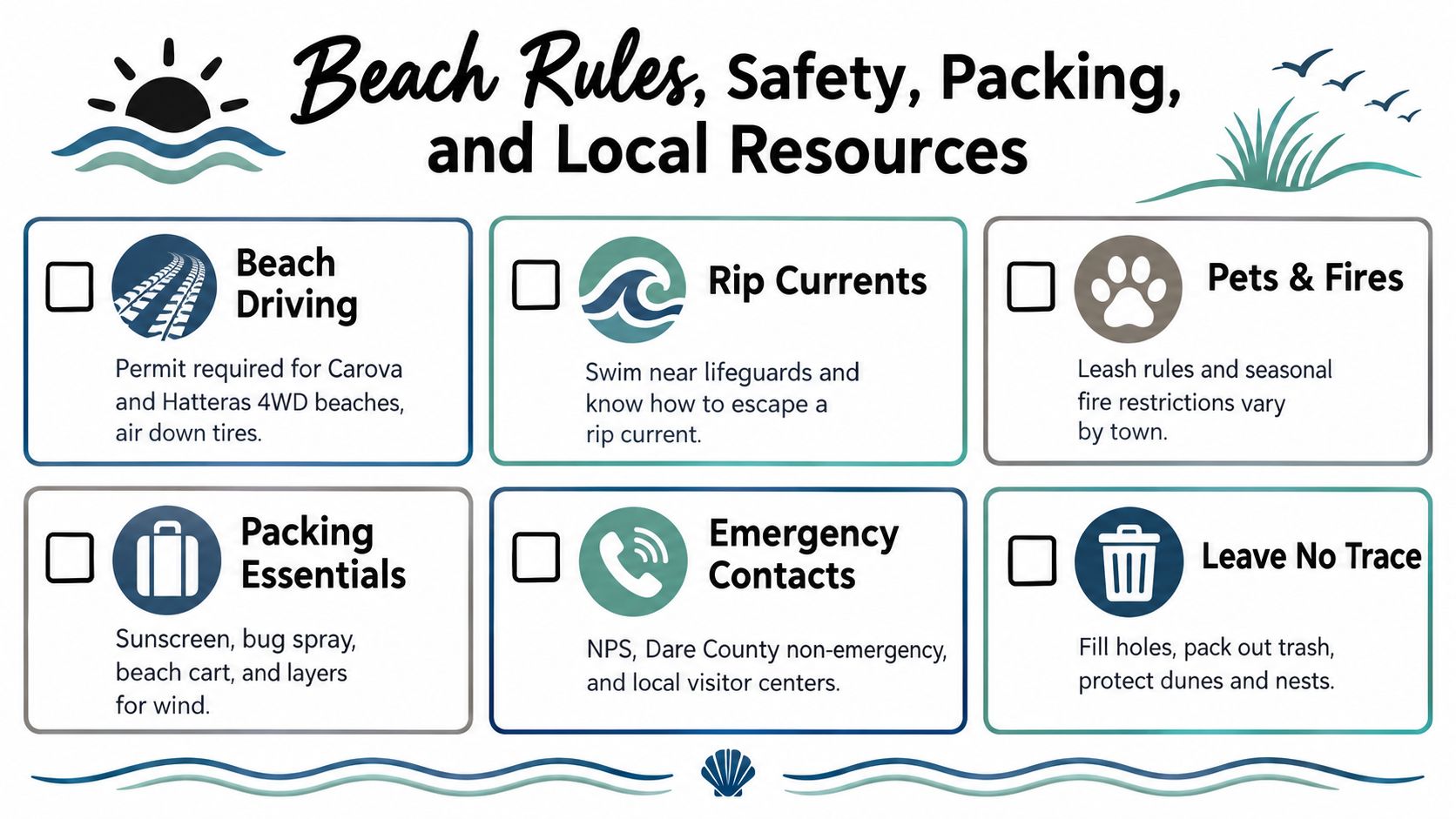
Use this short checklist before you leave:
- For 4WD beach areas: Know the local rules, air down tires, and don't improvise with a rental car that isn't suited for sand.
- For swimming days: Use lifeguarded beaches when possible and teach kids what to do in a rip current before they get in the water.
- For rental compliance: Confirm pet rules, fire rules, and any lighting expectations that protect dunes and nesting areas.
- For packing: Bring a beach cart, layers for windy evenings, sunscreen, bug spray, and printed travel confirmations if ferries are involved.
- For accessibility: Check boardwalk and crossover details before booking if anyone in your group has mobility needs.
If you compare beach destinations often, this Myrtle Beach vacation guide and travel tips is a good reminder that not every coastal trip asks the same things of renters. The Outer Banks rewards preparation more than convenience-first beach markets do.
If your office, school, or agency is planning a technology refresh before a coastal retreat or seasonal property turnover, Reworx Recycling can help you clear out aging devices responsibly and securely. They handle electronics recycling, secure data destruction, and IT equipment disposition with a practical, community-minded approach. Visit Reworx Recycling to donate old equipment, schedule a pickup, or explore smarter end-of-life options for business tech.