A facility manager walks into a storage room during an office cleanout and finds a box of unlabeled thermostats, a few old gauges, and a stack of devices that look harmless because they're small. That's exactly how mercury risks hide in plain sight. The hard part usually isn't a dramatic spill, it's the quiet assumption that older equipment is ordinary scrap, when some of it still falls under mercury containing equipment rules and needs a controlled path out of the building.
The Hidden Hazard in Your Facility

A renovation crew may be focused on cables, servers, and data-bearing drives, but the more stubborn risk often sits in the maintenance closet or above a ceiling tile. Older building systems, lab benches, and utility spaces can hold devices that contain elemental mercury, which means one rushed cleanout can turn into a compliance problem fast. Reworx Recycling's overview of the environmental impact of electronic waste is a useful reminder that end-of-life planning has to account for both data security and hazardous components, not just volume removal, and it's worth reviewing before a major decommissioning project starts: electronic waste and environmental impact guidance.
Where the surprise usually shows up
The devices that create the most trouble are rarely the ones people notice first. A thermostat on a wall, a pressure gauge on older equipment, or a relay buried inside a control panel can all be missed if the inventory process is built only around obvious electronics. In mixed facilities, that creates a bad habit, everything that looks like “old hardware” gets swept into one pile.
Practical rule: if your team can't explain what a device does and whether it contains mercury, it doesn't belong in general trash or an unvetted pallet.
The other problem is scale. During a facility cleanout or data center decommissioning, teams often move quickly, and speed hides detail. That's where a structured process matters, because mercury-containing items can sit beside modern replacements that look almost identical, especially in older mechanical spaces and laboratories.
For a business manager, the major risk isn't just environmental harm. It's the cost of rework, the disruption from a contaminated area, and the documentation gap if a regulator or auditor asks how the materials were identified, separated, and sent onward. The safest move is to treat unknown legacy devices as a discovery problem first, then a disposal problem.
What Is Mercury Containing Equipment
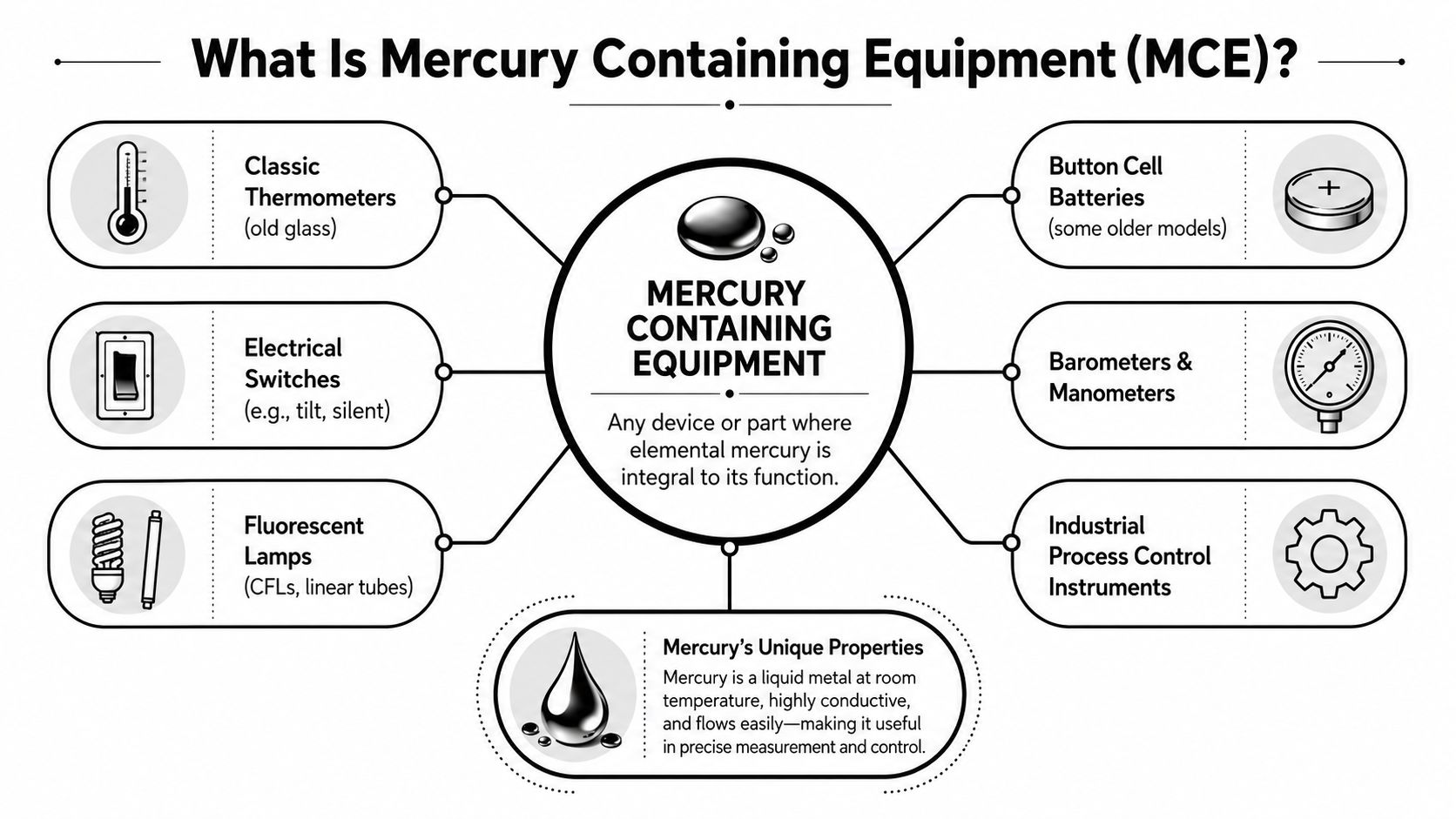
Under the U.S. EPA universal waste rule, mercury-containing equipment is a device or part of a device that contains elemental mercury integral to its function, which is the key regulatory test for whether the item falls under this category rather than general scrap or mixed waste (EPA universal waste rule definition). That definition matters because it focuses on function, not just appearance. If mercury is part of how the item works, it needs to be evaluated as universal waste.
Why mercury was used in so many devices
Mercury earned its place in older equipment because it behaved in ways many alternatives didn't. It moved predictably in response to temperature or pressure, and it could complete or interrupt electrical circuits in compact devices. That's why it appeared in thermostats, barometers, manometers, gauges, switches, relays, and some medical or laboratory tools.
The scope is broader than many facility teams expect. A school district, corporate campus, or light industrial site may have mercury in control devices, testing gear, and specialized instruments that were installed years apart by different vendors. If the inventory depends only on visible labels, some of those items will be missed.
Here's the simplest way to think about it.
- Elemental mercury inside the device: that's the core test.
- Mercury integral to the function: that's what triggers the category.
- Batteries and lamps: they're excluded from this specific definition, even though they can still be regulated under other rules.
Mercury-containing equipment isn't defined by age alone. A newer-looking device can still qualify if it uses elemental mercury as part of its operation.
That distinction helps when sorting mixed loads from office cleanouts or facility cleanouts. It also keeps teams from misclassifying items as ordinary scrap metal, which is a common error when maintenance crews are under pressure to clear space. If there's uncertainty, the right answer is to pause and verify the device type before packing it with the rest of the load.
Identifying Common MCE in Your Workplace
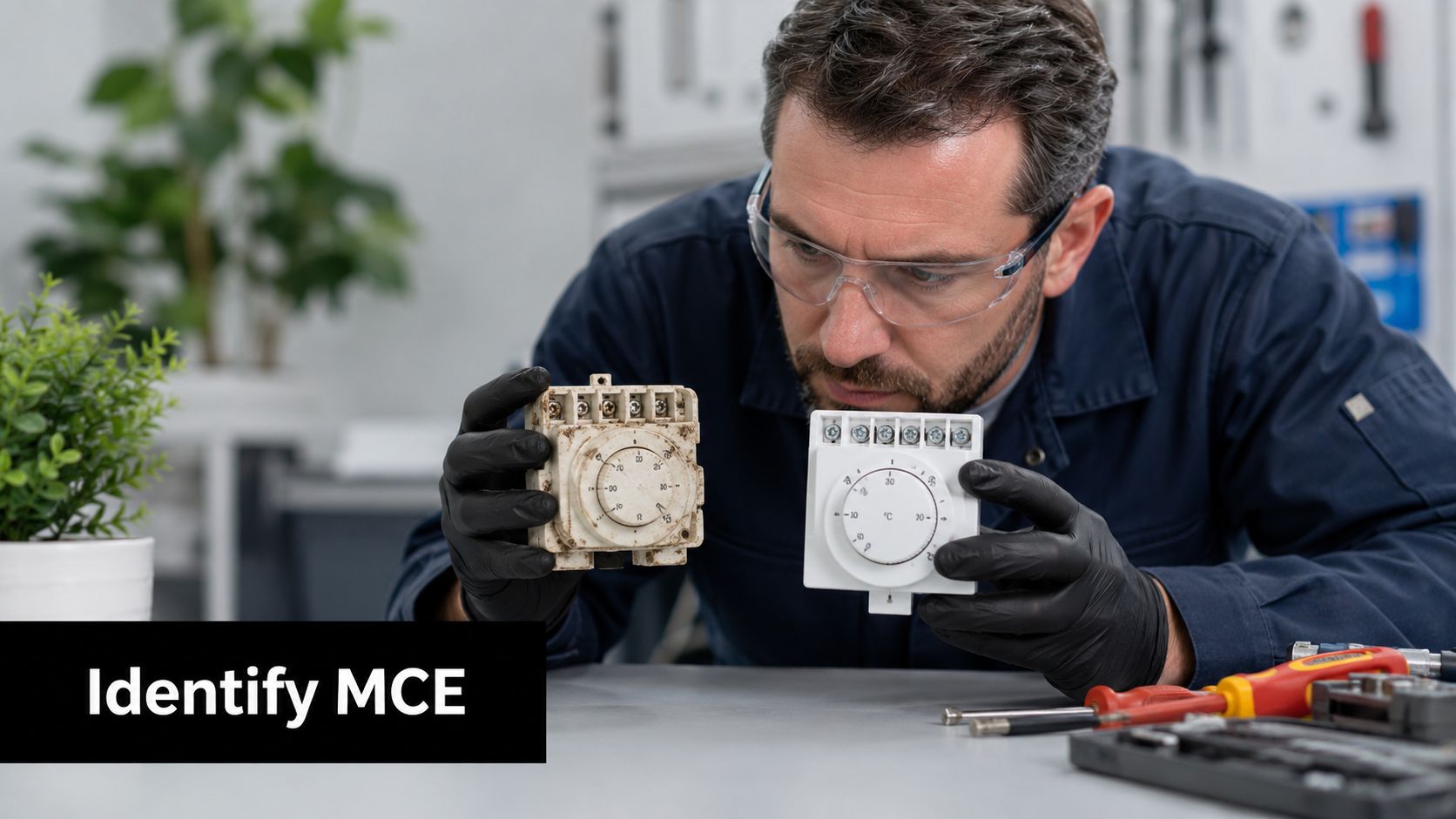
A thermostat on the wall can hide the problem in plain sight. Older models have often been a major source of mercury in buildings, and EPA market data shows thermostats were a significant source of mercury sold in products in the U.S. in 2004 (EPA market data). That does not mean every thermostat is mercury-containing equipment, but it does mean wall controls in older properties deserve a close look before demolition, tenant turnover, or HVAC work.
For a facility manager, the issue is not just spotting a single device. It is building an inventory process that works across mixed-asset sites, where one wing may be full of new equipment and another still holds older control devices installed under a different maintenance program. If your team relies only on labels, model sheets, or memory, some items will slip through.
Start with the spaces that age the slowest
Maintenance closets, boiler rooms, utility corridors, labs, and older office wings usually keep legacy gear the longest. These areas are replaced in stages, not all at once, so they often contain a mix of old controls and newer assets. A campus may have recent computers in one area and decades-old instrumentation in another.
Look for the devices that are easy to overlook during a cleanout:
- Old wall thermostats: a small glass bulb or ampoule with a silvery liquid inside may indicate a mercury tilt switch.
- Pressure and temperature gauges: older industrial units may contain mercury for stability and readability.
- Silent or mechanical switches: some older electrical systems used mercury switches and relays.
- Laboratory and medical instruments: specialized devices can still contain mercury even when they do not look obviously hazardous.
EPA historical market information also shows that thermostats, switches, thermometers, and gauges have been major sources of mercury-containing equipment, which is why older buildings so often turn up on inspection lists (EPA historical market data). If your crew is already sorting electronics, do not let the computer pile distract from the analog controls mounted nearby.
A field survey works better than a desk review. Have staff note the model number, manufacturer date, mounting style, and visible construction before anything goes into a mixed pallet. That makes later review far easier than trying to identify a device after it has been packed with unrelated material.
For teams standardizing replacements, pair the inventory with a broader office cleanout checklist. Reworx Recycling's guidance on older display and peripheral disposal can help crews keep the process organized when multiple device types are leaving the site at once: what to do with old computer monitors.
For agricultural operators, the same discipline applies when legacy equipment is spread across barns, shops, and storage areas. An essential guide for New York farmers can help frame the liability side of poor material control, especially where old instrumentation is mixed in with day-to-day operations.
Health Risks and Regulatory Compliance
A broken mercury device is not just a cleanup problem, it can turn into an exposure problem for staff, contractors, and anyone who uses the space afterward. Once mercury enters air, dust, soil, or drains, the issue can move beyond the facility boundary fast enough to create disposal, environmental, and liability concerns at the same time. For a facility manager, that means the compliance file and the safety file are tied together.
Why the rules are getting stricter
The pressure on mercury use is not coming from a single policy memo. A 2023 amendment to the Minamata Convention on Mercury prohibits the manufacture, import, or export of certain mercury-added products after 2025, which pushes businesses toward replacement planning instead of relying on indefinite storage (WHO mercury and health fact sheet). Procurement teams feel that pressure as much as waste handlers do. If one building still depends on mercury devices, the central question is how to phase them out without interrupting operations.
That shift changes how compliance work should be managed on site. A facility that keeps legacy inventory in place because replacement keeps getting delayed is carrying a risk that gets harder to control over time. Facilities staff, procurement, and sustainability teams should be working from the same list of affected assets, the same retirement timeline, and the same disposal path.
Replacement planning also gives you better control over budgeting and downtime. If you wait until a device fails, you may be forced into a rushed purchase, a rushed removal, and a rushed waste decision. A documented phase-out plan lets you sequence changes building by building, which is far easier than dealing with a mixed pile of unknown equipment after an incident.
For organizations that want a broader view of pollution liability and managed risk, Farm & Country Insurance's essential guide for New York farmers shows how environmental exposure can create business consequences well beyond the original worksite. The sector is different, but the lesson is the same. Poor material control creates long-tail liability that rarely stays isolated.
Mercury-containing equipment also falls under the EPA's universal waste framework, which is designed to make handling more workable without lowering the standard of care. Reworx Recycling's universal waste handling overview is a practical reference for teams building procedures around legacy devices and mixed loads. If your crew is managing an office move, a lab upgrade, or a multi-site asset retirement project, the priority is to separate mercury items, document what you found, and route them to a responsible downstream handler.
Best Practices for Handling and Storage
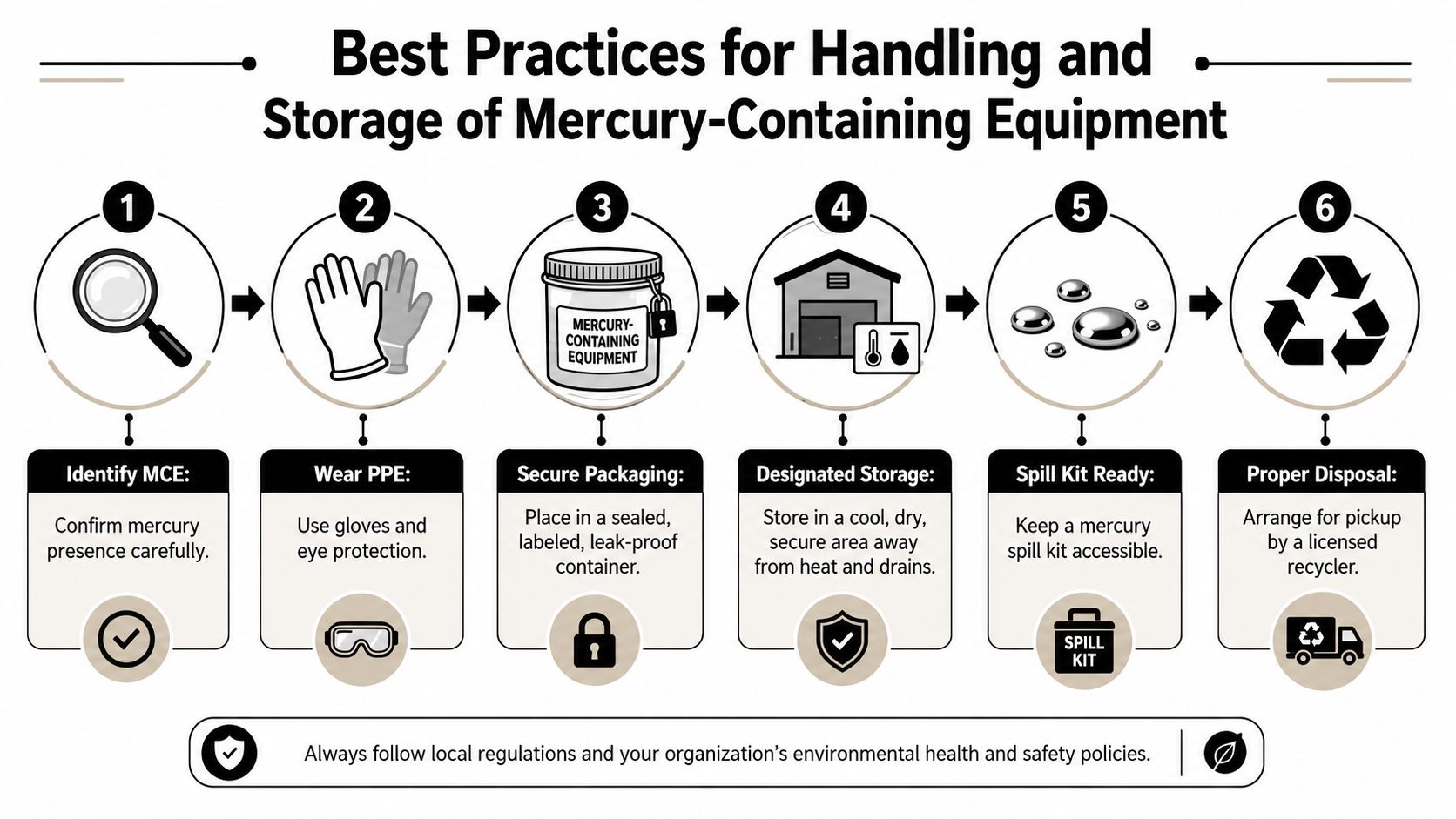
A facility that starts with a dumpster usually creates a problem for itself. The safer approach is to inventory suspect devices before anything is moved, then pull them out of general cleanout debris and unrelated IT equipment. In mixed-asset buildings, that early sorting step is what keeps mercury items from being missed during office moves, lab clearouts, and phased equipment retirements.
A workable on-site protocol
- Identify the device. Confirm whether it is mercury-containing equipment. Do not rely on age alone.
- Use PPE. Gloves and eye protection should be standard when staff handle suspicious devices.
- Contain intact equipment. Keep it in a closed, labeled, leak-proof container.
- Stabilize the storage area. Choose a secure, dry location away from heat sources and drains.
- Prepare for breakage. Keep a mercury spill kit accessible so a small incident does not turn into a wider release.
- Schedule removal. Move it into a compliant recycling stream as soon as the vendor is ready to receive it.
This protocol also fits within a broader universal waste system, which helps standardize handling across different material types. That matters on busy sites where mercury devices are only one piece of a larger disposal program.
California DTSC gives especially practical direction for broken or leaking units, advising that they be placed in a sealed plastic bag before being put into a closed, structurally sound container (California DTSC mercury device guidance). That detail matters because broken devices do not belong loose in a bin, even for a short time. If a container is leaking or unstable, the release risk grows during handling and transport.
For intact devices that still contain uncontained elemental mercury, the same conservative approach applies. Closed, compatible packaging lowers the chance of a release and makes the load easier to move through pickup, consolidation, and final recycling. The objective is not just to stash the item somewhere. It is to keep it identifiable, stable, and ready for lawful transfer.
A structured inventory also helps facilities that are decommissioning labs, schools, or older offices. Those sites often have a few obvious pieces and many hidden ones, and the hidden ones create the biggest delays when they are found late in the process.
Partnering for Lawful Disposal and Recycling
A good vendor does more than haul material away. It verifies what the site has, explains what can be accepted, documents the transfer, and keeps the organization from crossing the line between compliant accumulation and illegal storage. For mercury containing equipment, that matters because the chain of custody is part of the compliance record.
A qualified recycler should be able to explain how it handles universal waste, what happens to broken items, and what proof of recycling or downstream processing you'll receive. If a vendor cannot answer those questions clearly, it is a warning sign. For a practical checklist on that selection process, see how to choose a reliable e-waste recycling partner.
What to ask before you hand anything over
Start with documentation. A qualified recycler should be able to explain how it handles universal waste, what happens to broken items, and what proof of recycling or downstream processing you'll receive. Employee training matters too, because Wisconsin guidance says mercury-containing equipment must be removed for recycling within one year of the date marked on the container, and employees who handle this universal waste must receive documented training (Wisconsin universal waste guidance).
That one-year accumulation limit is a useful management benchmark even if your business operates in multiple states. If inventory sits too long, the site is no longer being managed as a short-term staging area. It becomes storage, and storage needs tighter controls, stronger records, and a clear pickup plan.
A strong partner can also keep mercury from getting mixed into broader IT disposal work. That matters in data center decommissioning, office cleanouts, and facility cleanouts, where one load may contain hard drives, monitors, control devices, and legacy building components. Reworx Recycling, for example, handles electronics recycling and IT equipment disposal with secure data destruction and pickup coordination, so teams can keep mercury-related items in the same compliance conversation as the rest of the retirement project.
The practical takeaway is simple. Don't wait until a room is full of unlabeled devices before deciding how to manage them. Build the inventory first, separate the mercury-bearing items, store them correctly, and send them to a recycler that can document the process end to end. That path protects staff, satisfies auditors, and keeps obsolete equipment from becoming a liability.
If your facility has old thermostats, control devices, lab instruments, or mixed legacy hardware waiting in storage, contact Reworx Recycling to schedule a pickup, review your inventory, and build a compliant plan for safe electronics recycling and mercury-containing equipment disposal.