Old laptops stack up fast. A few sit in a locked closet. More end up on shelves in the warehouse, under desks, or in a server room corner waiting for “later.”
For most business managers, that hardware feels like a nuisance. It takes space, may still hold sensitive data, and probably has some remaining value, but no one wants to guess wrong about disposal. That is where asset recovery solutions matter.
The confusing part is the term itself. A search for “asset recovery” often brings up debt collection and judgment enforcement, not old computers, servers, networking gear, and storage devices. For organizations dealing with end-of-life technology, the primary concern is IT Asset Disposition (ITAD), and the urgency is growing as global e-waste reached 62 million tonnes in 2022 and is projected to rise to 82 million tonnes by 2030, according to the UN Global E-waste Monitor 2024.
From Storage Closet Clutter to Strategic Asset
That pile of retired devices is not just clutter. It is a mix of security risk, environmental responsibility, and possible resale value.
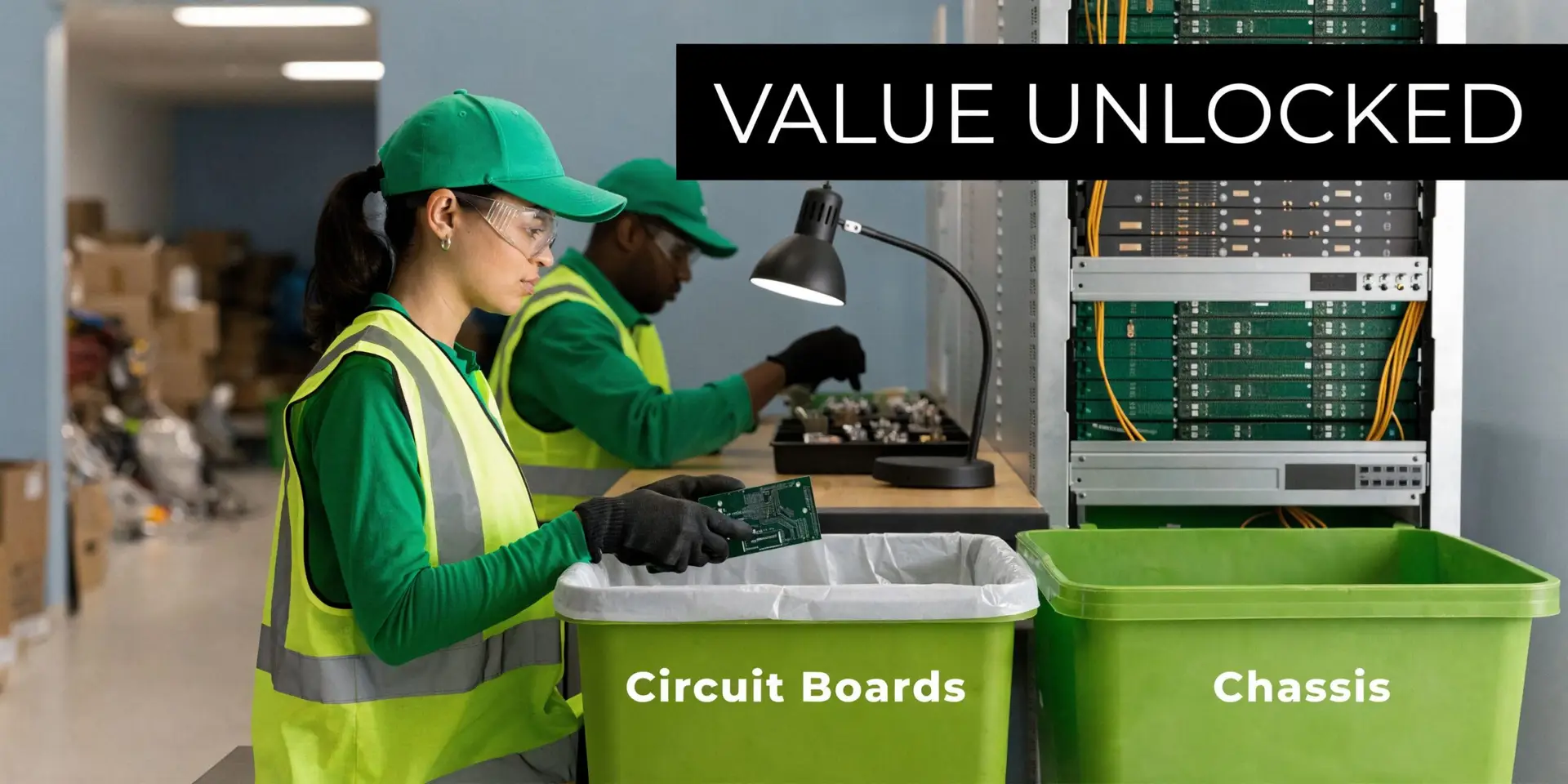
Why old equipment becomes a business problem
A laptop in storage may still contain employee records. A server pulled from production may still hold customer data. Even a broken desktop can create disposal issues if your team cannot document where it went and how it was handled.
Many organizations start with good intentions. They set old devices aside until the next office cleanout, laptop disposal event, or data center refresh. Then the backlog grows.
Common questions usually sound like this:
- Is there any value left: Can older equipment be refurbished, resold, or bought back?
- What about data: Is deleting files enough, or do drives need certified destruction?
- What counts as compliant: How do we document secure data destruction and sustainable recycling?
- Who owns the process: IT, facilities, procurement, compliance, or sustainability?
The shift from disposal to recovery
The useful mindset change is simple. Stop treating retired technology as trash. Treat it as an asset class that has reached the end of its internal use.
That changes the conversation from “How do we get rid of this?” to “How do we manage this safely and recover what we can?”
A disciplined ITAD program connects retirement decisions to inventory records, logistics, data handling, remarketing, recycling, and reporting. Teams that already follow IT asset management best practices usually find this easier because they already track equipment by user, location, and lifecycle stage.
Tip: The earlier you identify devices headed for retirement, the easier it is to preserve resale value and maintain a clean chain of custody.
This is why asset recovery solutions work best when they are planned, not improvised. The process is less about hauling things away and more about controlling risk while creating value.
The Five Stages of the IT Asset Recovery Lifecycle
Asset recovery is a sequence, not a pickup appointment. When buyers understand the lifecycle, they ask better questions and avoid providers that only handle the last step.
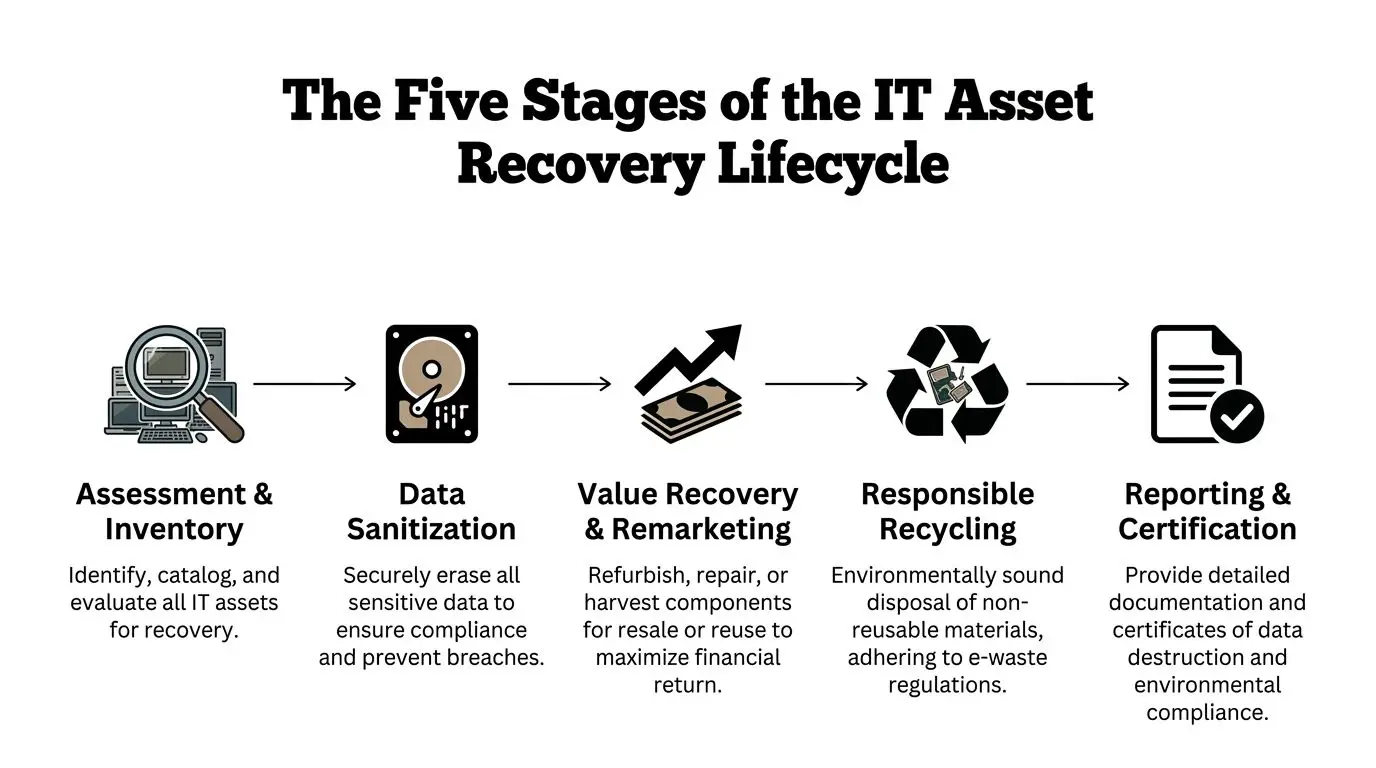
Assessment and inventory
Everything starts with knowing what you have. That sounds obvious, but many companies begin with rough estimates such as “about fifty laptops” or “a few racks of old servers.”
A proper intake process identifies device type, condition, age, serial numbers, asset tags, and whether the item stores data. This stage also separates reusable equipment from obvious scrap and flags anything that needs special handling, such as medical equipment disposal or laboratory equipment disposal.
If your team needs a baseline, this overview of IT asset disposition gives a practical starting point for how organizations move from internal use to final disposition.
Data sanitization
This is the stage no one can afford to treat casually. Formatting a drive or deleting files does not equal secure erasure.
Professional providers use recognized sanitization procedures for data-bearing devices. If sanitization is not feasible, physical destruction such as hard drive shredding may be the appropriate path. The key outcome is documented proof that the data is gone and that the device was handled under controlled custody.
Value recovery and remarketing
Not every retired device is worthless. Some can be refurbished and resold. Others can be harvested for components. Some may fit corporate donation programs if they are still serviceable and suitable for reuse.
This stage depends on realistic grading, testing, repair where appropriate, and a clear decision tree. A current-model laptop with cosmetic wear is very different from a damaged storage array with obsolete components. Good asset recovery solutions do not force every item into the same channel.
Responsible recycling
Equipment that cannot be reused still contains recoverable materials. Responsible electronics recycling keeps those materials in circulation and keeps hazardous components out of the wrong waste stream.
That matters for sustainability, but also for governance. Buyers increasingly want proof that downstream handling is controlled and that equipment is not exported or dumped without accountability.
Reporting and certification
The final stage turns operational work into evidence. This includes inventory reconciliation, data destruction certificates when applicable, chain-of-custody records, and recycling documentation.
A simple way to compare lifecycle stages is below.
| Stage | Main question | What good execution looks like |
|---|---|---|
| Assessment | What do we have? | Accurate inventory and device classification |
| Sanitization | Is the data removed? | Documented erasure or physical destruction |
| Recovery | Can value be reclaimed? | Testing, grading, refurbishment, resale decisions |
| Recycling | What cannot be reused? | Controlled material recovery and compliant handling |
| Reporting | Can we prove what happened? | Clear records for audit, compliance, and ESG reporting |
Key takeaway: If a vendor talks only about pickup and weight, you are hearing about hauling. If they can explain inventory, sanitization, remarketing, recycling, and reporting, you are hearing about asset recovery.
The Business Case for Professional Asset Recovery
The strongest case for asset recovery solutions is not environmental messaging alone. It is business logic.
The market itself shows how seriously organizations are taking this. The global asset recovery services market was valued at USD 12.5 billion in 2023 and is projected to reach USD 26.8 billion by 2032, reflecting an 8.8% CAGR, according to Dataintelo’s asset recovery services market analysis. That growth is tied to sustainability, compliance, and the push to recover value from rising e-waste volumes.
Where the return comes from
The first source of return is direct. Devices with remaining market demand can generate proceeds through refurbishment and resale. Equipment that no longer fits your environment may still fit someone else’s.
The second source is avoided cost. Organized office cleanout, product destruction, computer recycling, and secure data destruction reduce the time internal staff spend managing leftovers, ad hoc storage, and exception handling.
A third source is softer, but important. Companies that align IT equipment disposal with sustainable recycling and donation-based recycling can support internal ESG goals and community impact efforts at the same time.
One practical resource on this topic is maximizing value in IT asset disposition, which focuses on how planning, grading, and resale strategy affect outcomes.
Risk reduction is part of ROI
An unmanaged retirement process creates expensive problems. A misplaced laptop can become a security incident. Incomplete records can create audit headaches. Poor downstream recycling choices can undermine environmental commitments.
Professional asset recovery solutions reduce those risks by formalizing who touches equipment, when data is destroyed, how value is assessed, and what documentation is produced. That structure matters as much as resale revenue.
Reworx Recycling, for example, operates as a donation-based electronics recycling and ITAD provider that handles secure data destruction, equipment buyback, pickup logistics, and socially beneficial reuse pathways. For some organizations, that adds a community-impact layer to standard disposition work.
Why finance, IT, and sustainability all care
Different leaders care for different reasons:
- Finance teams look for recovered value and controlled disposal costs.
- IT teams want secure chain of custody and dependable device processing.
- Sustainability leaders want landfill diversion, reuse, and defensible reporting.
- Operations and facilities teams want space back and fewer one-off disposal projects.
When those priorities are combined, asset recovery stops being a cleanup task. It becomes a repeatable business process.
Navigating Compliance and Data Security Mandates
Retiring a device is one of the highest-risk moments in its lifecycle. The hardware leaves active service, but the data often remains unless someone deliberately removes it using a documented process.
Why simple deletion is not enough
A surprising number of organizations still assume a reset, reformat, or quick wipe solves the problem. It does not create the same assurance as a recognized sanitization method.
What matters is whether the provider can align its process to accepted standards, maintain chain-of-custody records, and issue documentation that your auditors or legal team can rely on. For data-bearing assets, the discussion should include whether sanitization or physical destruction is the right method for each device category.
Healthcare groups, schools, public agencies, financial institutions, and any business holding sensitive records all face the same core requirement. They need proof, not verbal assurances.
Certifications signal process discipline
Certifications matter because they show a provider has formal controls instead of informal habits.
The names buyers most often look for include:
- R2v3: Focused on responsible electronics reuse and recycling practices.
- e-Stewards: Another certification associated with responsible e-waste handling.
- NAID AAA: Focused on secure information destruction.
- ISO standards: Often part of broader quality, environmental, or security systems.
These credentials do not replace due diligence. They do, however, give buyers a credible screening tool. A provider offering secure data destruction services should be able to explain its sanitization methods, physical destruction options, recordkeeping, and certificate process in plain language.
Tip: Ask to see a sample Certificate of Data Destruction and a sample chain-of-custody report before signing anything.
Regulations are getting more specific
Recent rules make certified disposal harder to ignore. As of 2026, California’s SB 54 mandates certified ITAD for public agencies, while New York’s ECAL law requires enterprises to report e-waste emissions. The Reworx Recycling blog notes these 2026 disposal requirements, and they reinforce why a provider’s R2 or NAID AAA certification matters.
A short comparison helps clarify what to verify:
| Compliance concern | What to ask a provider |
|---|---|
| Data-bearing devices | How do you sanitize or destroy drives? |
| Chain of custody | Do you document custody from pickup through processing? |
| Environmental handling | What certifications govern recycling and downstream vendors? |
| Audit readiness | What reports and certificates do you provide after the job? |
| Public sector obligations | How do you support agency-specific documentation needs? |
The practical point is straightforward. Compliance is not a side benefit of IT asset recovery. It is one of the main reasons the process exists.
A Checklist for Choosing Your Asset Recovery Partner
Many vendors can remove old equipment. Far fewer can manage the full risk and value picture.
That is why buying decisions should go beyond price, pickup timing, or whether a company calls itself an electronics recycler. The better test is whether the provider can answer operational questions clearly and back the answers with documentation.
Questions worth asking in the first conversation
Use this checklist when evaluating asset recovery solutions:
- Certifications: Are you certified for electronics recycling and secure data destruction? Can you show current documentation?
- Chain of custody: How is equipment tracked from pickup through processing?
- Data process: Do you offer sanitization, hard drive shredding, or both?
- Valuation method: How do you determine whether equipment should be resold, donated, harvested for parts, or recycled?
- Reporting package: What records will we receive at the end?
- Downstream accountability: Who handles material after it leaves your facility, and how do you vet them?
- Service fit: Can you handle office equipment, server gear, networking hardware, and specialized streams such as medical or lab devices?
Ask about metrics, not just services
A capable provider should discuss performance in business terms. Key performance indicators include gross recovery value, net proceeds, and cost per unit, and INV Recovery notes that certified partners following best practices can achieve 10-30% higher returns by timing asset sales with market demand.
That does not mean every load will produce the same result. It means the provider should be able to explain how timing, device mix, condition, and channel strategy influence outcomes.
This buyer’s guide on factors for choosing an e-waste recycling partner is useful because it frames the decision around accountability, not just convenience.
Key takeaway: A low quote can hide weak documentation, unclear downstream handling, or poor value recovery. The cheapest pickup is not always the lowest-risk choice.
What separates a strategic partner from a basic recycler
A basic recycler removes equipment. A strategic partner helps you decide what to resell, what to destroy, what to donate, and what to recycle, then proves each action with records.
That difference matters most for SMBs and public agencies. They often do not have a dedicated ITAD manager, so the vendor’s process becomes the client’s process by default.
Your Roadmap to Implementing an Asset Recovery Strategy
Most organizations do not need a huge transformation to get started. They need a clean first pass.
Start with what you already know
Build a practical inventory. List laptops, desktops, servers, monitors, networking gear, and any data-bearing storage devices. Flag anything that may hold sensitive information.
Turn the backlog into a plan
Then talk with a certified provider about scope, security requirements, pickup logistics, and reporting needs. An implementation guide such as how to implement an IT asset disposition strategy can help structure decisions before equipment starts moving.
For managers trying to standardize operations as the company grows, broader service design thinking can help too. This article on how to scale a service business is useful because the same logic applies here. Repeatable workflows beat one-off cleanup projects.
Make it repeatable
The goal is not one successful office cleanout. The goal is a repeatable system for laptop disposal, computer recycling, secure data destruction, and sustainable recycling whenever hardware reaches end of life.
When asset recovery becomes part of normal operations, old tech stops piling up. Security improves. Reporting gets easier. Value recovery becomes more predictable.
If your organization is ready to retire old technology without guessing at security, compliance, or resale value, explore the resources from Reworx Recycling. You can use them to plan a pickup, evaluate donation-based recycling options, and build a more reliable IT equipment disposal process that supports both environmental responsibility and community impact.