A Certificate of Destruction (CoD) is more than just a receipt—it's your official, legally defensible proof that sensitive business assets and data have been permanently eliminated. For business owners and IT managers, using a solid destruction certificate template ensures every critical detail is captured, creating an auditable trail that protects your organization from compliance risks and data breaches.
Why a Destruction Certificate Is a Non-Negotiable Business Tool
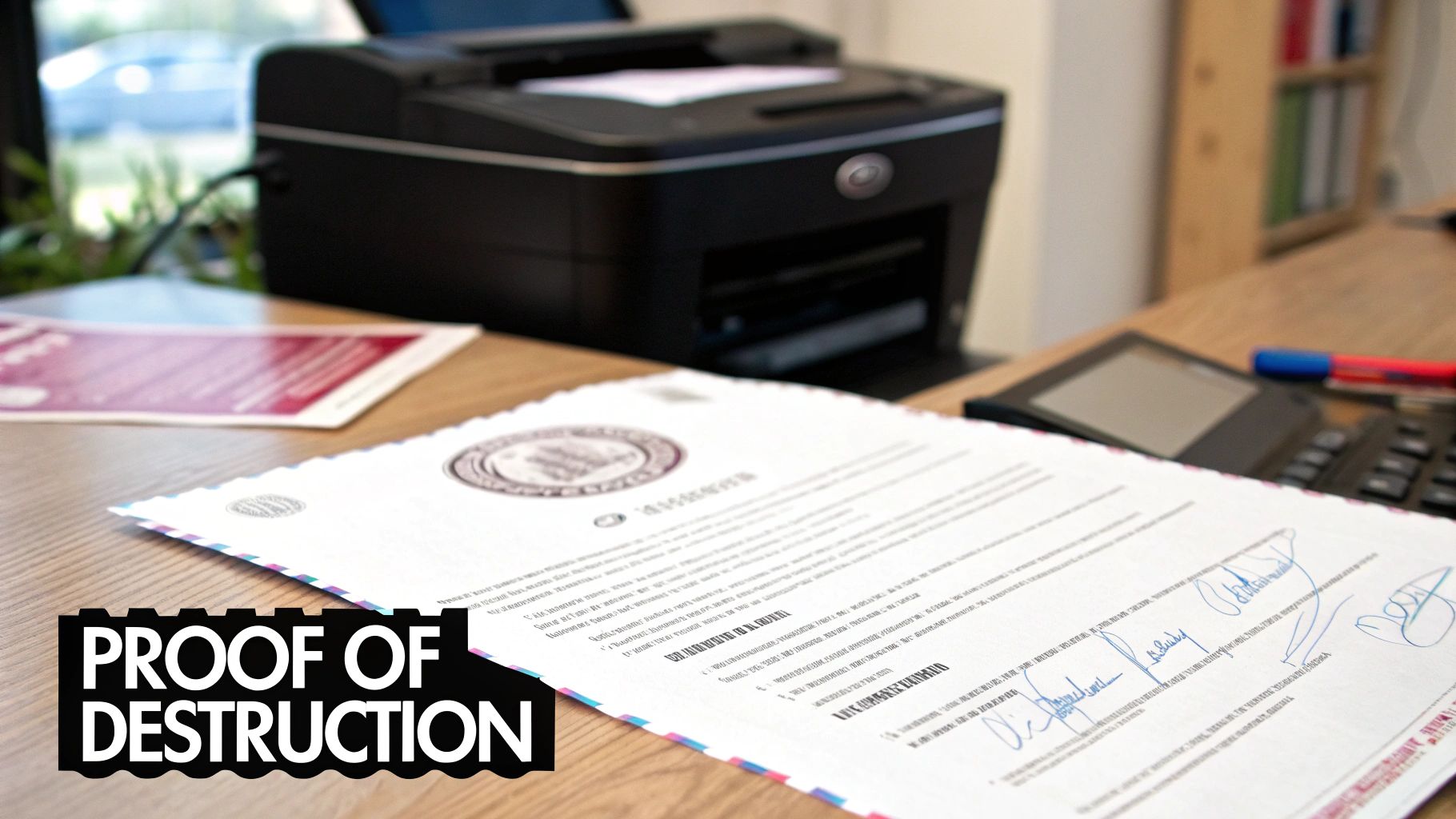
In any business, a Certificate of Destruction isn't just a piece of paper. It's your frontline defense against legal headaches, financial penalties, and a damaged reputation. Think of it as the final, critical checkpoint in your company's IT asset disposition (ITAD) process. Without it, you have no verifiable proof that sensitive information from a facility cleanout or data center decommissioning was handled correctly, leaving your organization wide open to risk.
And those risks are real. The consequences of improper IT equipment disposal range from crippling fines under regulations like GDPR and HIPAA to severe brand damage following a data breach. A single hard drive from an office cleanout that is disposed of improperly can become a goldmine for criminals, potentially costing millions.
The Rise of Standardized Documentation
The importance of this document is a globally recognized best practice. We've seen a huge spike in the use of standardized destruction certificate templates, especially in data-heavy fields like healthcare and finance.
In fact, a 2023 report showed that over 78% of organizations in North America and Western Europe now require formal destruction certificates for asset disposal. That's a massive jump from just 42% in 2015. This shift is a direct response to tougher data protection laws that demand documented proof of secure data destruction. The same report found that businesses using standardized templates cut their compliance-related incidents by a staggering 35% between 2018 and 2022.
The takeaway here is clear: a consistent, detailed template is your best bet for creating a reliable and audit-proof trail for all your computer recycling and laptop disposal activities.
Creating an Indisputable Record
A good template ensures every crucial piece of information gets captured every single time—from asset serial numbers to the exact method of destruction. That consistency is what builds an unbreakable chain of custody.
The destruction certificate is a key part of the bigger picture of information life cycle management, officially marking the end of an asset's journey with your organization.
A robust Certificate of Destruction process transforms a potential liability into a documented asset. It’s the definitive proof that you’ve met your legal and ethical obligations to protect sensitive data, closing the loop on your security protocols for everything from medical equipment disposal to product destruction.
When you work with a certified IT asset disposition (ITAD) provider like Reworx Recycling, this whole process becomes second nature. As a donation-based social enterprise, we don't just handle the physical destruction; we provide the certified paperwork that protects your business while ensuring your retired assets create community value. Our process guarantees that every step, from pickup to final destruction, is meticulously documented, giving you total peace of mind. To learn more, check out our guide on Reworx Recycling's secure data destruction services.
Ultimately, this document isn't an administrative chore—it's a core piece of your risk management strategy. It proves due diligence, makes audits a breeze, and helps build a culture of security from the ground up.
Getting Started with Your Destruction Certificate
First things first, let's get the paperwork sorted. We’ve put together a free, professionally designed certificate of destruction template right here at Reworx Recycling. It’s built to be a solid, reliable starting point for any business, covering all the essential fields you need for a compliant and auditable record.
No need to reinvent the wheel. You can grab our free template below:
[Download Your Free Destruction Certificate Template – Word Doc]
This is an editable Microsoft Word document, so it’s easy to work with and customize for your specific needs.
How to Set Up Your Master Template
Once you’ve downloaded the file, you can open it pretty much anywhere. It’s a standard .docx file, which means it plays nicely with most software:
- Microsoft Word: As the native format, editing is a breeze.
- Google Docs: Just upload the file to your Google Drive and open it with Docs. Perfect for cloud-based access and team collaboration.
- PDF Editors: If you prefer working with PDFs, programs like Adobe Acrobat can open, edit, and save the document without a hitch.
Before you do anything else, take a minute to create a master version for your company. This is a huge time-saver and ensures every certificate you issue is consistent. Just pop your company logo into the header and fill in your standard contact info—business name, address, and phone number.
Save this version as your official "master template," and you're good to go. This simple prep work cuts down on repetitive tasks and reduces the chance of errors down the road.
Why a Certified Partner Matters
Now, having a great template is one thing, but the certificate itself is only as trustworthy as the destruction process it documents. The paper records the action, but a certified IT Asset Disposition (ITAD) partner like Reworx Recycling is your guarantee that the job was done right and to the highest industry standards.
A template is a tool for consistency, but a certified partner is your guarantee of compliance. True peace of mind comes from knowing that a secure, verifiable process backs up every signature on that certificate.
When you partner with Reworx, you’re not just getting a service; you’re ensuring the entire process is handled securely and responsibly from the moment your equipment leaves your office. We provide the certified expertise that validates every piece of information on your certificate of destruction. This partnership turns a simple document into a powerful symbol of your commitment to data security and environmental responsibility. Through our corporate donation programs, your old equipment also supports our mission of digital inclusion and workforce development.
How to Accurately Fill Out Your Certificate
Moving from a blank template to a completed, legally sound Certificate of Destruction is all about precision. Every single field on that document plays a role in creating an unbroken, defensible chain of custody. Getting the details right isn't just good record-keeping—it’s how you build an indisputable log of your secure IT asset disposition.
Let’s walk through the process using some real-world situations businesses like yours face every day.
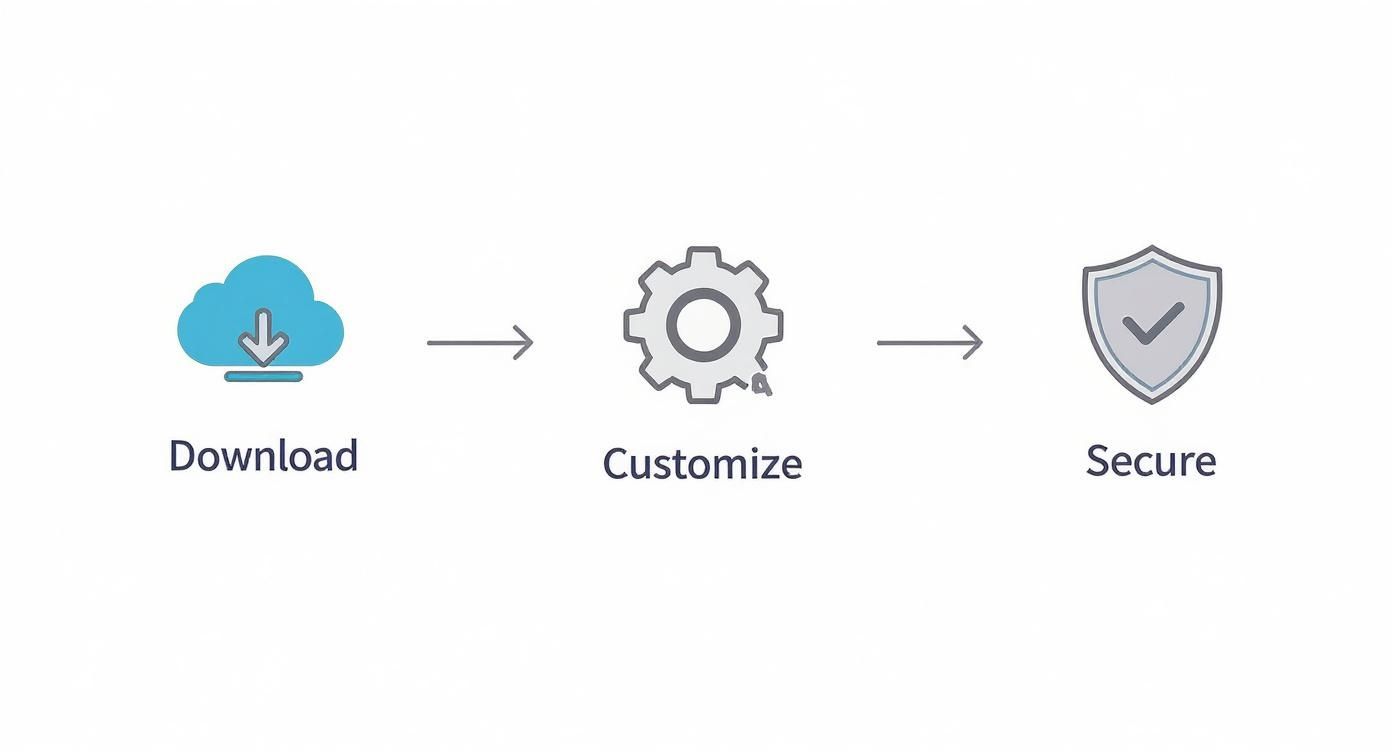
This simple three-step flow highlights the importance of a standardized process. It all starts with a reliable template, followed by customizing it for your specific needs, and finally, securing the completed certificate as a permanent part of your records.
Identifying the Assets with Unmistakable Clarity
The most common mistake on destruction certificates is vague asset identification. A line item that just says "50 Laptops" is a compliance nightmare waiting to happen. For your certificate to actually hold up under scrutiny, every single asset needs its own unique identifier.
Here’s the right way to do it:
- Asset Type: Be specific. Don't just say "laptop," say "Dell Latitude 7420 Laptop" or "HP ProLiant DL380 Server."
- Serial Number: This is your golden ticket. The manufacturer's serial number is the most critical piece of information for each item.
- Asset Tag (If Applicable): Does your company use internal asset tags for inventory? Add that number. It provides another layer of confirmation.
Real-World Scenario: An Office Cleanout
Imagine your company is completing an office cleanout and needs to destroy 150 hard drives from different workstations. Instead of one vague entry, your certificate needs a detailed asset list or table attached.
| Asset Type | Manufacturer | Model | Serial Number | Asset Tag |
|---|---|---|---|---|
| Hard Drive | Seagate | Barracuda | ZN1J7Y8P | IT-00451 |
| Hard Drive | Western Digital | WD Blue | WCAS84219P | IT-00452 |
| … | … | … | … | … |
This level of detail makes your record airtight. It proves exactly which assets were destroyed, leaving zero room for doubt during an audit.
Specifying the Method of Destruction
Describing how something was destroyed is just as important as identifying what was destroyed. Vague terms like "Destroyed" or "Recycled" just don't cut it. Your method needs to be specific enough to prove you met data security standards.
For example, stating "Hard Drive Shredded" is okay, but "Physically shredded to 2mm particle size in accordance with NAID AAA standards" is infinitely better. It shows you followed a recognized, verifiable process for your electronics recycling. For a deeper dive into compliant methods, check out our guide on the best practices for secure data destruction.
Here are a few precise descriptions you can use:
- For Hard Drives: "Degaussed using an NSA-approved degausser, followed by physical shredding."
- For Paper Documents: "Cross-cut shredded to Level P-4 security standards."
- For Proprietary Products: "Mechanically crushed and rendered unusable, then commingled for recycling."
Capturing the specific destruction method provides concrete evidence that you met your due diligence obligations. It answers the critical "how" question that auditors and legal teams will inevitably ask.
Documenting the Chain of Custody
The final pieces of the puzzle are all about establishing the timeline and who is accountable for the destruction. These fields validate the entire process, so they need to be filled out carefully.
Date and Time of Destruction
Be exact. Record the date and, if possible, the time the destruction was completed. This officially timestamps the event and closes the book on that asset's lifecycle within your company.
Location of Destruction
Note exactly where the destruction happened. This could be at your own facility ("On-site at 123 Corporate Dr, Anytown, USA") or at your vendor's secure plant ("At the Reworx Recycling facility"). This detail confirms the secure environment where the process took place.
Authorized Signatures
A certificate isn't complete without signatures. You need at least two:
- Your Company's Representative: An employee who either witnessed the destruction or was responsible for handing off the assets.
- Destruction Vendor's Representative: The professional from the ITAD partner (like us at Reworx) who performed or supervised the destruction.
Each signature must be accompanied by a printed name and title. This adds a layer of personal accountability that makes the document solid. For really high-stakes disposals—like destroying prototypes or servers with sensitive R&D data—you might even consider adding a third-party witness signature for even stronger verification.
Navigating Compliance and Legal Requirements
A completed certificate of destruction is so much more than an internal file. It's your documented, defensible proof of due diligence in a world governed by iron-clad data protection laws. Think of it as your final, tangible evidence that your organization handled its end-of-life data and assets responsibly.
When an auditor comes knocking, this certificate is your definitive answer.
This document directly links your disposal process to major regulations like Europe's General Data Protection Regulation (GDPR), the Health Insurance Portability and Accountability Act (HIPAA), and the Fair and Accurate Credit Transactions Act (FACTA). Every one of these mandates secure data disposal, and a meticulously completed certificate serves as your verifiable proof of following the rules.
In fact, the need for this kind of proof led to a huge spike in formal certification. After GDPR was implemented in May 2018, the use of destruction certificates skyrocketed across the EU. A 2021 survey showed that 92% of organizations handling EU personal data now use them, and 76% have adopted standardized templates to keep things consistent. That simple shift also cut documentation errors by a whopping 45%.
Upholding the Chain of Custody
You’ll often hear the term "chain of custody" in IT asset disposition (ITAD), and for good reason. It’s the chronological paper trail that documents every single touchpoint for your sensitive assets, from the moment they leave your control to the second they're destroyed. Every step has to be accounted for. No gaps.
Your destruction certificate is the final, authoritative link in that chain. It officially closes the loop, confirming that your assets were controlled, transported, and ultimately destroyed in a secure and documented way. A weak link anywhere can invalidate the whole process, but a properly executed certificate solidifies your defense against any claims of negligence.
Aligning with Major Data Protection Laws
Different regulations have their own specific demands, and your certificate needs to reflect them. Understanding these nuances is what makes your documentation stand up to real scrutiny.
- GDPR: This regulation is famous for the "right to erasure." Your certificate must prove you have permanently wiped personal data when requested or when it's no longer needed. A comprehensive GDPR compliance checklist can be a huge help here.
- HIPAA: In healthcare, the HIPAA Security Rule demands that covered entities have clear policies for the final disposition of electronic protected health information (ePHI). A certificate proves you’ve made that ePHI unreadable and irretrievable, which is critical for laboratory equipment disposal.
- FACTA: The Disposal Rule under FACTA is all about taking "reasonable measures" to protect consumer information. Your certificate is the document that outlines those very measures.
This is where partnering with a certified vendor can make your life so much easier. Reworx Recycling, for example, operates under strict standards like R2v3, which are specifically designed to meet or exceed the requirements of these major laws. Digging into e-waste certification standards can give you a much clearer picture of how certified processes align with legal mandates.
A Certificate of Destruction isn't just about logging an event; it's about building a legal firewall. It proves your intent, your process, and the final outcome, protecting your organization from the serious financial and reputational fallout of non-compliance.
Establishing Smart Record Retention Policies
So, you have the signed certificate. Now what? Your job isn't done—you have to store it according to a clear record retention policy. The big question is always, "How long do we need to keep this?"
While rules vary, a solid best practice is to retain destruction certificates for a minimum of three to five years. Be careful, though, as some industries require much longer periods. HIPAA-related records might need to be kept for six years, and certain financial or government contracts could demand a seven-year or even indefinite retention period. It's always smart to check with your legal team to define a policy that fits your specific needs.
The next decision is how to store them: physically or digitally?
- Physical Storage: Keeping hard copies in a secure, fireproof location is the old-school method. It’s reliable, but it can be a pain to manage and search through.
- Digital Storage: Scanning and storing certificates in a secure, encrypted, and backed-up digital archive is usually the way to go. It makes retrieval for audits a breeze and cuts down on physical clutter.
For most businesses today, a hybrid approach offers the best of both worlds. You can maintain a primary digital archive for quick access and a secure physical backup for total peace of mind. The key is to treat this process as a strategic part of your risk management, not just an administrative chore.
Common Mistakes That Weaken Your Destruction Documents
An incomplete or inaccurate destruction certificate can be just as risky as having no certificate at all. The real strength of this document is in its precision, and even a small oversight can create serious compliance gaps that leave your organization exposed.
Based on our years of hands-on experience in IT asset disposition, we've seen the same pitfalls trip businesses up time and time again. Avoiding these mistakes is all about building a foolproof internal system. It takes attention to detail and a clear grasp of what makes a certificate legally defensible.
Using Vague or Generic Asset Descriptions
One of the most frequent and dangerous errors we see is using ambiguous descriptions for the items being destroyed. An entry like "Lot of 20 Laptops" or "Box of Hard Drives" is practically useless if you're ever audited. It completely fails to create a specific, traceable record for each individual asset.
To be compliant, your certificate must list each item with a unique identifier. This is non-negotiable.
You absolutely need to capture details like:
- Manufacturer and Model: For instance, "HP EliteBook 840 G8."
- Serial Number: This is the most critical piece of data for unique identification.
- Internal Asset Tag: Including your company's own inventory tag adds another solid layer of verification.
Without this level of detail, you can't prove that a specific device containing sensitive data was properly destroyed. It just leaves a gaping hole in your chain of custody.
Failing to Get Authorized Signatures
A certificate without the right signatures is just a piece of paper. It lacks the formal authorization that makes it a valid legal document, and this mistake often happens when the process is rushed or when employees aren't sure who is responsible for signing off.
Your destruction certificate template should always have designated signature lines for at least two key parties:
- Your Company's Representative: This should be the person who witnessed the destruction or formally handed over the assets.
- The Vendor's Representative: This is the certified professional from your ITAD partner (like us at Reworx) who performed or supervised the destruction.
Each signature has to be accompanied by a printed name, title, and date. This creates clear accountability and validates the entire process.
Documenting an Incorrect or Incomplete Destruction Method
Simply writing "Destroyed" or "Recycled" in the method field isn't enough. Regulatory bodies and auditors need to know how the assets were destroyed to ensure the method met the required security standards. For example, some data types demand physical shredding, while others might allow for secure wiping.
You have to be explicit.
Instead of "Hard Drive Wiped," a much better description is "Data sanitized using a 3-pass DoD 5220.22-M wipe standard." For physical destruction, something like "Physically shredded to 2mm particle size per NAID AAA guidelines" is far superior. These specifics show you followed a recognized, secure protocol. Many of these points are crucial, as we’ve highlighted in our guide covering common mistakes to avoid when disposing of old hard drives.
A Certificate of Destruction is a story told in details. Vague descriptions, missing signatures, and unclear methods weaken the plot, leaving your organization vulnerable. Precision is your best defense.
Here's a pro tip: consider implementing a two-person verification process. Before any assets are handed over for disposal, have a second employee double-check the asset list against the physical devices. This simple cross-check can catch typos and omissions, ensuring the information on your final certificate is 100% accurate. It’s a small step that adds a powerful layer of integrity to your documentation process.
Why a Template Is Only Half the Solution
A good destruction certificate template is a fantastic starting point. It gives you a solid framework for creating a compliant, auditable record. But it’s critical to remember that the document itself is only as reliable as the process it represents. The integrity of your entire IT asset disposition program hangs on the actual, physical destruction—and that makes a certified partner the other essential half of the equation.
A template can capture serial numbers and signatures, sure. But it can't guarantee that the hard drive was shredded according to NAID AAA standards. It can't verify an unbroken chain of custody from your loading dock to the final processing plant. This is exactly where partnering with a certified ITAD vendor becomes indispensable.
The Partner as Your Proof
Working with a professional firm like Reworx Recycling transforms your certificate from a simple internal record into a verified testament to your due diligence. It’s one thing to fill out a form; it's another entirely to have it backed by a certified, secure, and transparent process. This partnership provides the real substance behind the paperwork, ensuring every single detail on that certificate is accurate and defensible.
This kind of assurance is becoming more critical as documentation practices evolve globally. Take the Asia-Pacific region, for instance, where new data protection laws have led to a surge in standardized templates. A 2022 study found that 65% of organizations there now use destruction certificates, with those using templates cutting down certificate issuance time by 40%. You can learn more about these findings on data destruction certification. This just goes to show how efficient templates are, but the underlying need for a trustworthy destruction process is universal.
More Than Just Destruction: The Reworx Advantage
Choosing a partner isn't just about ticking compliance boxes. When you work with a social enterprise like Reworx Recycling, your IT disposal process gains a whole new dimension of value. You don't just get a certificate; you get a story of positive community impact.
A destruction certificate template organizes the facts, but a certified social enterprise partner gives those facts purpose. Your end-of-life assets become a powerful tool for environmental stewardship and community empowerment.
Here's what that partnership looks like in practice:
- Certified Security: You receive NAID AAA certified data destruction, the gold standard for information security.
- Guaranteed Compliance: Your Certificate of Destruction is backed by a verifiable, audited process that stands up to scrutiny.
- Sustainable Impact: Your retired assets are handled responsibly, diverting e-waste from landfills and recovering valuable materials.
- Social Good: Usable equipment is refurbished and donated, supporting digital inclusion and workforce development programs in the community.
This approach provides a level of peace of mind that a template alone can never offer. You know that professionals are managing your sensitive equipment securely, sustainably, and with a real commitment to social responsibility. We offer comprehensive services to ensure every piece of equipment is handled correctly; discover more about our approach to professional equipment destruction.
Ultimately, a template is a critical tool for consistency and record-keeping. But pairing it with a certified partner like Reworx Recycling ensures the entire process—from pickup to final documentation—is secure, compliant, and socially conscious.
Ready to transform your IT disposal from a compliance task into a force for good? Partner with Reworx Recycling for secure, donation-based recycling that is certified, sustainable, and socially responsible. Donate your old equipment and empower your community while protecting your data.