You've just opened a storage room you haven't checked in months, and it's full. Old laptops sit on top of servers, phones are mixed with cables, and nobody can say which drives still hold data. That room isn't a housekeeping problem. It's a data risk, a budget question, and an environmental decision waiting for a system. Nationwide electronics recycling, done well, gives you that system.
Why Electronics Retirement Needs a System
Most organizations don't retire technology in a neat, planned stream. A school replaces classroom laptops over summer break. An office refreshes monitors floor by floor. A laboratory decommissions instruments when a grant ends, and a public agency clears a warehouse only after an audit forces the issue. By then, devices have accumulated faster than anyone tracked them.
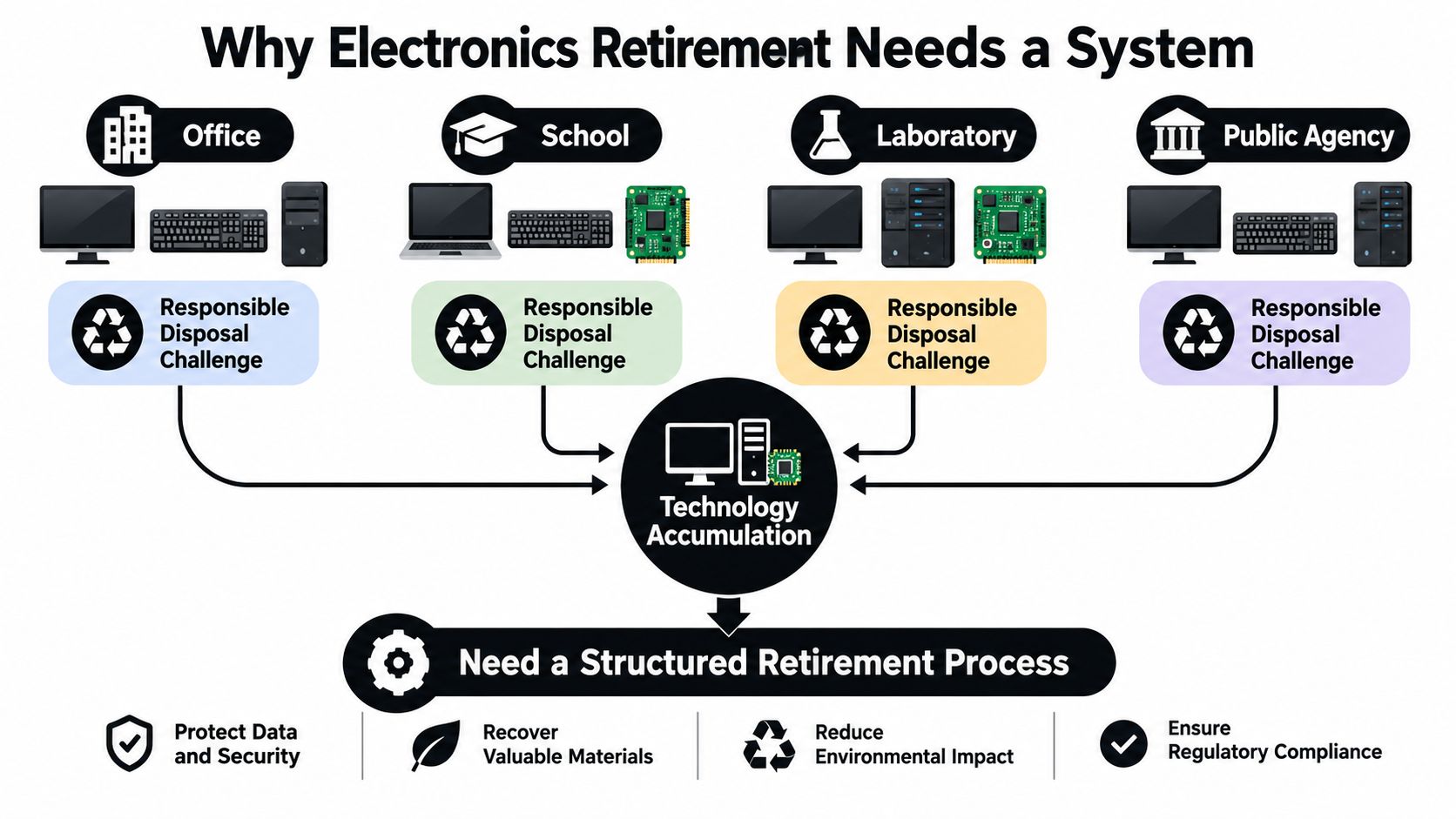
Treating that pile as generic scrap creates problems. A laptop, a server, a phone, and a loose storage drive don't carry the same risk. Batteries need isolation because they can create fire and contamination hazards. Networking equipment may hold configuration data. Displays, circuit boards, cables, and reusable whole units each need different downstream handling.
Four Questions Before Anything Leaves
A usable mental model starts with four questions, asked in order, for every batch.
- What is leaving: Do you have a serialized inventory, or only a rough count of pallets and boxes?
- What must be protected: Which devices store data, and how sensitive is that data if it's exposed?
- Should it be reused: Is the device working, repairable, or only valuable for parts and materials?
- What proves the outcome: Can you show custody records, weight tickets, and certificates that match your inventory?
Practical rule: If you can't answer those four questions for a batch, you don't have a recycling program yet. You have a pickup.
The scale behind those questions is not abstract. The 2024 Global E-waste Monitor reported approximately 62 million metric tonnes of discarded electrical and electronic equipment generated in 2022, with only 22.3% documented as formally collected and recycled, according to the UNITAR summary of the Global E-waste Monitor 2024. The same summary notes the volume would fill about 1.55 million 40-ton trucks, and that improperly managed e-waste left about US$62 billion in recoverable natural-resource value unaccounted for. Your storage room is a small part of that gap, and documentation is how you stay out of it.
What Nationwide Electronics Recycling Means
Think of asset retirement as a journey with three parts. Retirement is the departure gate, where you decide a device is leaving service and record what it is. Collection is the route, the pickup, drop-off, packing, and transport that move it safely. Documentation and certification are the receipt at the destination, confirming where it went and what happened to it.
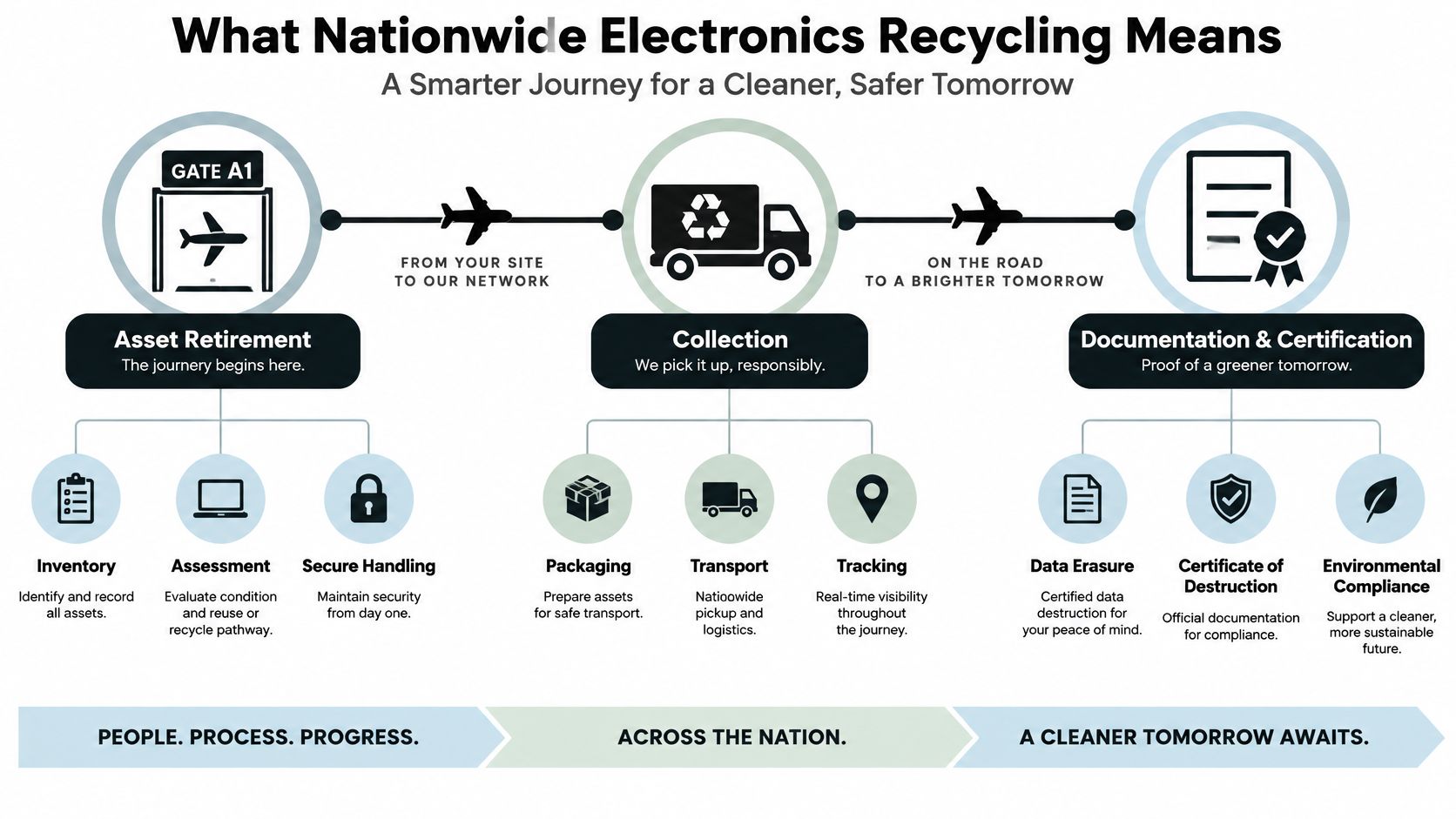
If any part is missing, the journey breaks. Equipment can leave your building without ever reaching a documented outcome, or it can arrive somewhere with no record tying it back to your inventory.
Nationwide describes coordination, not a slogan. It means an organization with offices, schools, or facilities in multiple states can apply one inventory standard, one data policy, and one reporting format across locations. You shouldn't infer that capability from national marketing language alone. Ask how pickups are coordinated in each state, who handles transport, and where processing occurs. Reworx Recycling describes that reach in its overview of coverage across all 50 states, which is the kind of specific claim you can test against your own site list.
Terms That Overlap but Aren't Interchangeable
Buyers often use several terms as if they mean the same thing. They don't.
- Computer recycling: Material recovery from end-of-life computers and related equipment.
- IT asset disposition (ITAD): The broader managed process covering inventory, data sanitization, reuse, resale, and recycling.
- Donation-based recycling: A model where usable equipment is redirected to community use instead of being scrapped.
- Product destruction: Verified destruction of branded, recalled, or sensitive items so they can't re-enter the market.
- Sustainable recycling: Material recovery designed to keep resources in manufacturing and out of disposal.
Reworx Recycling is a donation-based electronics recycling and IT equipment disposal social enterprise based in Smyrna, Georgia. Its model connects responsible device retirement with technology donations, digital inclusion, and community impact, which places it across several of those categories at once. The principle that holds any credible program together is simple. Each batch should link to inventory, custody, disposition, and outcome records, so you can trace a device from your dock to its final state.
Core Services That Complete the Lifecycle
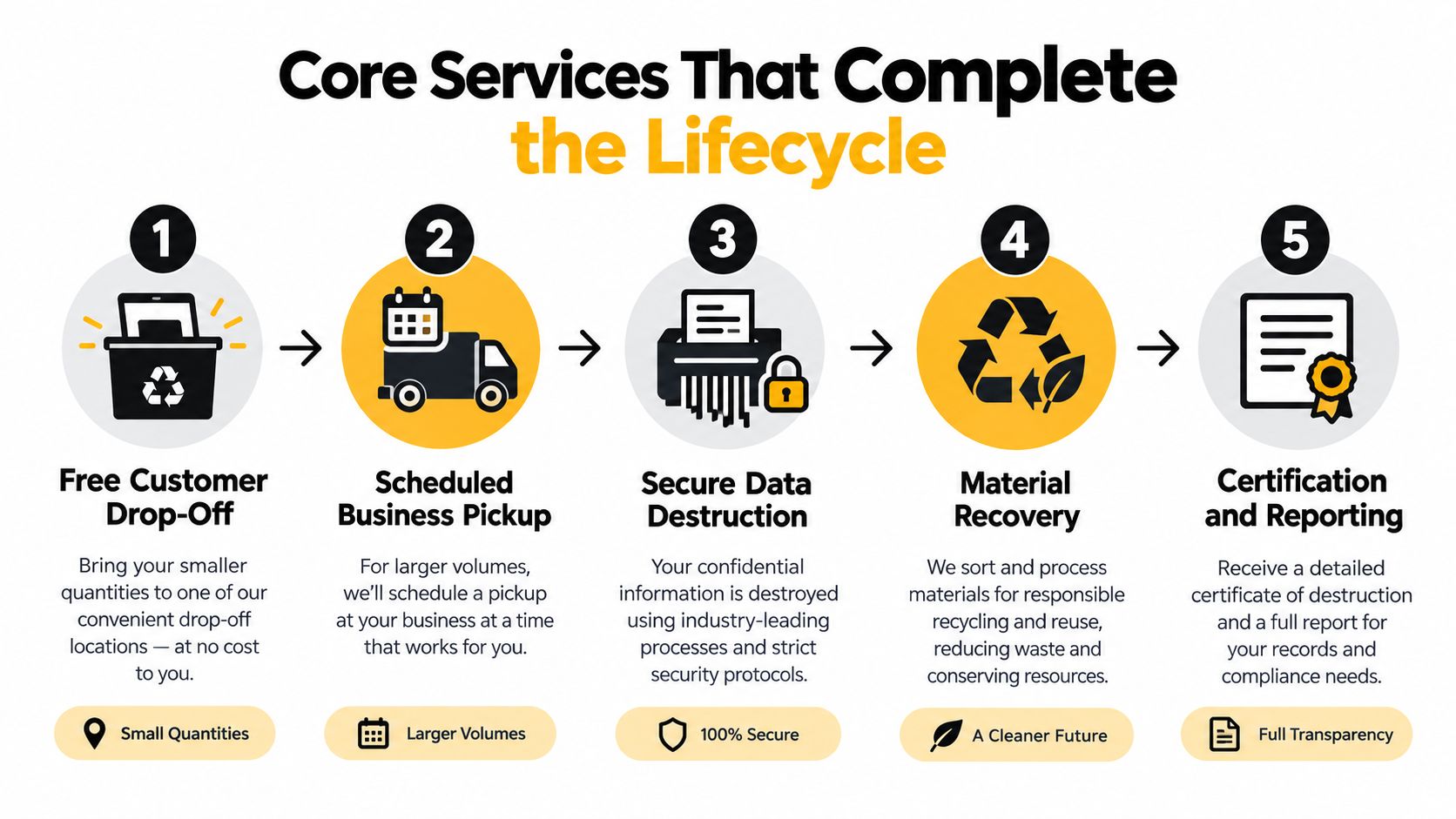
A complete program is a chain of services, and weak links usually hide between them. Buyers who compare only pickup price often discover later that inventory, data handling, or reporting wasn't included. Evaluate each stage on what you'll receive and verify.
Collection That Matches Volume
Free customer drop-off suits smaller quantities, a few laptops, phones, or peripherals that staff can deliver safely. Scheduled business pickups suit office cleanouts, school refreshes, and distributed teams where volume, loading access, and timing need coordination. The collection method should also define how devices are packed, how batteries are separated, and who signs for custody at handoff.
Logistics across multiple sites is where nationwide programs earn their keep. Coordinated reverse logistics services determine whether equipment from several locations consolidates under one report or arrives as disconnected shipments you have to reconcile yourself.
Decommissioning and Asset Management
Before transport, equipment needs to leave your systems cleanly. That work includes inventory reconciliation against your asset register, labeling, removal from active management tools, and sorting into reuse, repair, parts harvesting, and material recycling streams. Done well, it prevents the common failure where a device is recycled physically but still appears active in your records, or the reverse.
Data Destruction, Sorting, and Proof
Secure data destruction applies to storage-bearing devices, while sorting separates batteries, screens, cables, circuit boards, ferrous and nonferrous metals, plastics, and reusable units. Each stream has different downstream requirements, so a single undifferentiated scrap load is a warning sign.
Your evidence package may include chain-of-custody records, processor weight tickets, downstream certificates, and data-destruction records. Not every project needs identical evidence, but the scope should state in advance what you'll get.
Collecting equipment proves it left your building. Only matched inventory and downstream records prove what happened next.
Reworx Recycling combines pickups, decommissioning, recycling consultations, data destruction, and buyback guidance. Judge that combination as one operating model. Ask how a device moves between those services, who owns each handoff, and what record closes the loop, rather than pricing each service as if it stood alone.
Secure Data Destruction and Reuse Decisions
The most expensive mistake in electronics retirement is destroying equipment that could have been safely reused. The riskiest mistake is reusing equipment whose data wasn't properly sanitized. Good programs avoid both by making a risk-based disposition decision for each device class, not by shredding everything by default.
A 2025 analysis reported that up to half of processed devices were destroyed and as many as 47% of those devices were still operational, according to Resource Recycling reporting on data sanitization and premature device destruction. That finding matters because destruction permanently eliminates repair, refurbishment, resale, and donation value, even when secure sanitization was technically feasible.
Clear, Purge, and Destroy in Plain Language
NIST defines three sanitization outcomes that give you a shared vocabulary with any vendor, as set out in the NIST media sanitization guidelines in SP 800-88 Rev. 1.
| Outcome | What it does | Typical fit |
|---|---|---|
| Clear | Logical techniques such as rewriting data or a supported factory reset, resisting simple non-invasive recovery | Low-sensitivity devices staying in controlled use |
| Purge | Physical or logical methods that make recovery infeasible with state-of-the-art laboratory techniques, while potentially preserving the medium | Reusable laptops, phones, and drives leaving your control |
| Destroy | Makes recovery infeasible and leaves the media unable to store data afterward | Failed, unreliable, or highly sensitive media |
Your choice depends on four factors working together. Consider the sensitivity of the information, the physical condition of the device, your retention and regulatory obligations, and the intended destination. A working laptop headed for donation after verified purging is a different case from a failed server drive that can't complete a sanitization command. The first preserves value. The second justifies shredding.
Custody Checkpoints That Support the Decision
Sanitization only counts if you can prove the right device received it. Build checkpoints at removal from service, secure storage, transport, processing, and final disposition, with records tied to serial numbers or asset batches. That discipline is what secure data destruction services should document for you, including which method was applied and what happened to devices that failed verification.
Decision test: Destroy when sanitization can't achieve the required outcome or the media is physically unreliable. Otherwise, preserve the device and prove the data is gone.
That approach connects hard-drive shredding and product destruction to laptops, servers, phones, and storage media where needed, while keeping reusable equipment in circulation. You protect data without paying an environmental penalty for caution you didn't need.
Choose a Recycling Vendor With Evidence
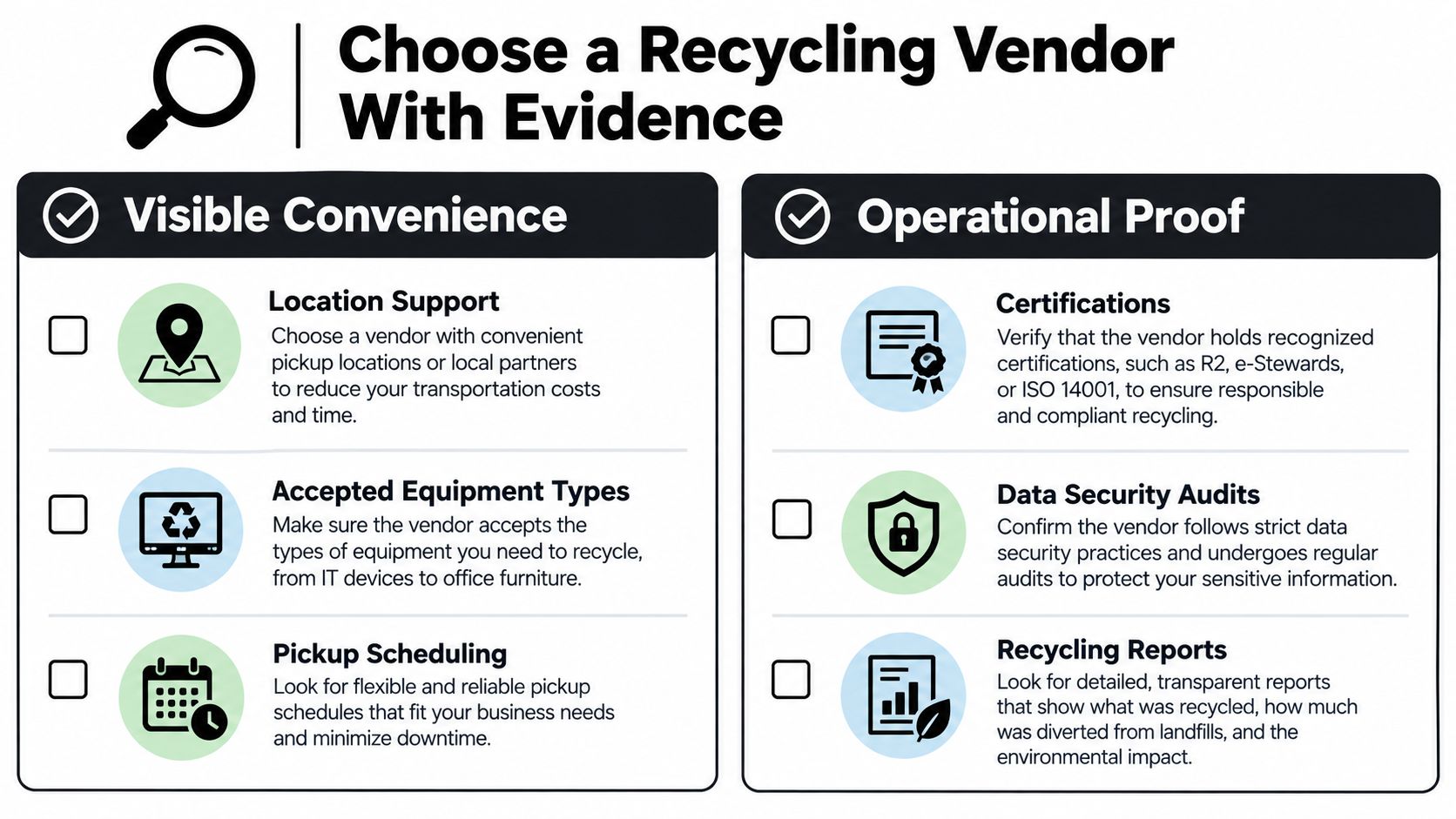
Convenience is visible on day one. Operational proof is what protects you during an audit two years later. A vendor can offer fast pickup scheduling and still leave you unable to show where your equipment went, so separate the two when you compare proposals.
Coverage and Capability Questions
Start with fit. Does the provider support every location in your program, not just your headquarters state? Does it accept your actual device mix, including batteries, displays, networking gear, laboratory equipment, and medical equipment where relevant? Can it offer both drop-off for small quantities and scheduled pickups for larger projects, and coordinate decommissioning and IT asset management rather than leaving preparation entirely to your staff?
Evidence and Certification Questions
Then move to proof, where vague answers should end the conversation.
- Certification scope: What does the certification cover, who issued it, and which facility performs the processing?
- Downstream visibility: Which processors receive each material stream, and what certificates come back to you?
- Chain of custody: How are assets tracked from pickup signature to final disposition?
- Reuse versus recycling claims: How does reporting distinguish donated, resold, refurbished, and materially recycled devices?
- Battery and hazard handling: How are batteries and hazardous components isolated during packing and transport?
- International movement: Does any equipment or shredded fraction cross borders, and under what approvals?
- Reporting fields: Will you receive serial numbers, quantities, weights, disposition categories, certificates, and a list of unresolved discrepancies?
Certification language deserves particular care. A credible explanation of electronics recycling certification should identify the standard, its scope, and the facility it applies to, not just display a logo. Ask for a sample report from a comparable project, with customer details removed, and check whether you could reconcile it against your own inventory.
Reworx Recycling positions itself as a partner for donation-based recycling, pickup scheduling, ITAD support, and community-oriented technology donations, alongside social enterprise recycling outcomes. Treat that as a starting point for validation, not a conclusion. Confirm the scope language in your engagement, the records you'll receive, and how community impact is reported. A vendor confident in its process will welcome those questions.
Compare Costs Buybacks and Disposition Value
A vendor quote is only part of what electronics recycling costs you. The full picture includes collection logistics, internal labor for gathering and preparing equipment, data destruction, asset tracking, processing, transportation, and certificates. It also includes a quieter cost that's easy to miss, the opportunity cost of usable equipment sitting idle in storage while its resale and donation value declines.
Five Pathways, Different Economics
Each disposition route fits a different asset condition.
- Donate: Working equipment supports corporate donation programs, digital inclusion, and community access.
- Sell or buy back: Surplus hardware with remaining market value can offset program costs after testing and sanitization.
- Repair or harvest parts: Repairable units and components keep value that whole-unit scrapping would lose.
- Recycle materials: Non-working equipment returns metals, plastics, and board fractions to manufacturing.
- Destroy: Sensitive, failed, or non-compliant items are physically destroyed with documentation.
The right route differs sharply by device. A usable laptop may suit donation or buyback, a broken monitor suits material recycling, a server may split into reusable components and recyclable chassis, a laboratory instrument needs specialized assessment, and a storage drive follows your data decision first. Material value is real at scale. EPA-cited USGS estimates indicate recycling one million mobile phones can recover approximately 35,000 pounds of copper, 772 pounds of silver, 75 pounds of gold, and 33 pounds of palladium, and recycling one million laptops can save energy equivalent to the annual electricity use of more than 3,500 US homes, per the EPA electronics basic information and research page. Those figures explain why commodity-oriented sorting matters, but they don't promise a price for your specific load.
For small quantities outside a business program, some owners also compare local resale options and find pawn shops near you that buy electronics, though that route won't provide chain-of-custody reporting or certified data handling for corporate assets. For organizational equipment, structured cost recovery strategies and Reworx Recycling equipment buyback options let you explore value recovery within a documented program.
Request a written scope that separates service charges from potential asset recovery. It should state who values and tests equipment, who carries data risk, and who is responsible for final downstream processing. Buyback is a possibility to evaluate, never a guaranteed return.
Sample Workflows for Common Business Assets
Frameworks become useful when you can picture them on your own loading dock. The workflows below are representative examples, not customer case studies, and each follows the same spine of inventory, custody, disposition, and documentation through a partner such as Reworx Recycling.
Office Cleanout
A facilities team clearing two floors starts with a room-by-room inventory of laptops, monitors, docks, and phones. Staff separate personal devices from company assets, tag storage-bearing equipment, and stage batteries apart from other hardware. A scheduled pickup collects everything under one custody record, and the final disposition report is reconciled against the original inventory so missing items surface immediately, not months later.
Data Center Decommissioning
A data center project begins earlier, with mapping asset ownership across racks before anything is unplugged. Equipment is removed from production in sequence, storage media are documented by serial number, and specialized handling protects both data and hardware value during transport. Because servers often mix reusable components with end-of-life material, sorting decisions happen per unit, and chain-of-custody evidence follows each batch through processing.
Laboratory and Medical Equipment Disposal
Laboratory equipment disposal and medical equipment disposal turn on inventory accuracy and routing. Each instrument is identified, checked against internal records, and routed according to its type and condition, with documentation confirming the applicable environmental and regulatory requirements for that equipment. The practical point for your team is confirmation before pickup, not assumptions. Ask which categories the provider accepts, what preparation your staff must complete, and what records close out each item.
Corporate Donation Program
A corporate donation program sorting a laptop fleet makes the reuse decision device by device. Working laptops that pass testing and verified sanitization move toward donation, units needing repair enter refurbishment, and failed devices go to parts recovery or material recycling. Drives that can't be sanitized reliably are destroyed and recorded. The result is a single report showing donated, refurbished, recycled, and destroyed quantities, which lets sustainability leaders report community impact without overstating it.
Small devices deserve special attention in every workflow. Collection and recycling reached only about 22% for small IT and telecommunications equipment such as phones, compared with about 34% for large equipment, according to Statista data on recycled e-waste by category. Phones and tablets hide in drawers and get retained over data concerns, so clear collection points and plain data-security instructions raise participation more than another reminder email.
Common Questions and the Next Step
Several misconceptions undermine otherwise good programs. Correcting them costs nothing and improves every decision that follows.
Isn't collection the same as recycling? No. Collection proves equipment was picked up. Documented recycling proves it reached a processor and what material or reuse outcome resulted. European experience shows why the distinction matters, since the EU-wide WEEE collection rate was 40.6% in 2022, below the 65% target under the EU framework, even as separately collected equipment grew from 3.0 million tonnes in 2012 to 5.2 million tonnes in 2023, according to Eurostat data on waste electrical and electronic equipment. Infrastructure alone doesn't deliver outcomes. Convenient collection, accurate inventories, and reverse logistics do the rest.
Does a certification claim settle everything? Only if it names the standard, scope, facility, and downstream outcome. Otherwise it's marketing, and you should ask for the underlying records.
Can we use drop-off instead of pickups? Yes, for smaller quantities your staff can transport safely. Scheduled pickups make sense when volume, multiple sites, loading logistics, or custody documentation exceed what a drop-off trip can handle.
What records should we keep? Retain inventories, custody sign-offs, sanitization or destruction records, weight tickets, and downstream certificates, matched by batch. If equipment or processed fractions cross borders, review them carefully, because Basel Convention amendments effective January 1, 2025 subject transboundary e-waste movements to the prior informed consent procedure, as explained in the Basel Convention e-waste amendments FAQ. Those amendments were adopted in June 2022, and the Basel Convention status page for the e-waste amendments tracks their entry into force, so confirm consent steps before any international shipment.
Are donation and destruction just two names for disposal? They're opposite choices. Donation preserves a working device for community use after sanitization, while destruction ends its useful life permanently. Your program should decide deliberately, device class by device class.
Your next step is concrete. Inventory what's sitting in storage, classify it by data risk and condition, and talk with Reworx Recycling about donating old equipment, scheduling a pickup, or partnering on an ITAD, sustainable recycling, or community donation program that your records can support.
Reworx Recycling offers donation-based electronics recycling, IT equipment disposal, secure data destruction, and coordinated nationwide pickups that turn retired business technology into documented recycling outcomes and community technology access. If you're planning an office cleanout, data center decommissioning, or a multi-site laptop refresh, visit Reworx Recycling to donate equipment, schedule a pickup, or start a partnership built around responsible recycling and digital inclusion.