Your offices have replaced their laptops, but the old equipment hasn't left the building. Facilities wants the storage space back, finance wants to know whether anything has resale value, and IT can't confirm which drives were sanitized. Meanwhile, another location is arranging its own pickup.
Nationwide ITAD services should bring those decisions under a shared program, not just send a truck. The starting point is deciding who controls each asset, what must happen before it leaves your organization, and what evidence you'll retain afterward.
A Growing E-Waste Problem Across Distributed Organizations
Consider a regional operations director comparing equipment lists from different offices. One site has neatly labeled laptops. Another has mixed boxes of cables, drives, and monitors. A third reports that someone already removed the equipment, but nobody can find the paperwork.
That's an illustrative situation, not a case study. It shows why business owners, IT managers, sustainability leaders, government agencies, and universities need more than occasional electronics recycling. Without a common retirement process, each location makes its own decisions about security, reuse, and disposal.
The gap between retirement and responsible recovery
The Global E-waste Monitor 2024 reported 62 billion kilograms of e-waste generated in 2022, with only 22.3% documented as formally collected and recycled in an environmentally sound manner. The same report found that e-waste generation was growing almost five times faster than formal recycling capacity.
For an organization, the practical issue isn't how much equipment it retires. It remains whether employees can distinguish devices suitable for reuse from equipment requiring controlled recycling, while keeping sensitive information protected.
An overview of the environmental impact of electronic waste can help facilities and sustainability teams connect their local cleanout decisions with broader resource-management responsibilities.
Practical rule: An asset isn't fully retired when it leaves the office. It's retired when its approved destination and supporting records are confirmed.
A structured program gives each department a defined responsibility. IT approves the treatment of data-bearing devices. Facilities coordinates physical access and staging. Procurement establishes vendor obligations, while sustainability staff review the evidence behind environmental claims.
This changes IT equipment disposal from an overflow-storage problem into a governance program. The objective is to protect information, preserve useful equipment, and account for what happens to the remaining materials. Pickup is necessary, but it's only the visible part of that work.
What Nationwide ITAD Services Actually Mean
Think of IT asset disposition like maintaining a vehicle fleet. You wouldn't manage every company vehicle through unrelated arrangements with no shared service history. You'd establish common rules, assign responsibilities, and require records that remain useful wherever the vehicle operates.
IT asset disposition (ITAD) applies that discipline to technology retirement. It covers the decisions and activities between taking equipment out of service and confirming its final destination.

Follow the asset, not just the truck
A practical workflow begins before collection. Staff identify equipment, establish ownership, and decide whether devices need assessment for redeployment, donation, resale, or recycling.
The physical work then follows those decisions:
- Collection and transport: Move approved equipment from the site through a documented handling process.
- Data treatment: Apply the authorized sanitization method before equipment becomes available for another user.
- Evaluation and routing: Test devices for refurbishment or remarketing, and separate non-reusable equipment for controlled processing.
- Closeout: Reconcile what was collected with what was processed and report unresolved exceptions.
Informal scrap removal might solve the immediate space problem. An ITAD program should also answer who accepted the equipment, whether anything was missing, and whether the agreed treatment occurred.
What makes the service nationwide
National coverage isn't just a map of pickup locations. It means the organization can apply consistent requirements across offices, campuses, warehouses, and remote facilities without expecting every site to design its own process.
For example, a business headquartered in Smyrna, Georgia, might coordinate an Atlanta office cleanout alongside retirements elsewhere. Those projects can have different access arrangements and transport needs while using the same approval rules and reporting fields.
Ask whether the provider delivers work directly, uses regional partners, or combines both approaches. None of those arrangements automatically determines quality, but you need to understand who remains accountable.
A useful working definition is this: Nationwide ITAD services coordinate technology retirement across multiple locations under shared security, environmental, financial, and documentation controls. The service includes logistics, but its value depends on the decisions and evidence surrounding those movements.
Core Service Pillars of a Nationwide ITAD Program
A hospital intake process offers a useful analogy. Staff identify the patient, assess the condition, choose an appropriate treatment, and document the outcome. They don't apply the same treatment to everyone who arrives.
Technology retirement needs a similar separation of tasks. A working laptop, a failed server drive, and a mixed container from a facility cleanout shouldn't automatically follow the same route.
Match each service to an output
Core ITAD Service Pillars and Their Typical Deliverables
| Service pillar | Primary audience | Core deliverable |
|---|---|---|
| Scheduled pickups and reverse logistics | Facilities teams and distributed organizations | Collection records, custody transfers, and receipt reconciliation |
| Secure data destruction | IT, security, and public-sector teams | Device-linked sanitization results and certificates |
| Testing and refurbishment | Schools, businesses, and donation programs | Condition grades, test results, and reuse decisions |
| Certified recycling | Sustainability and environmental managers | Processing records and downstream disposition evidence |
| Buyback or value recovery | Finance, procurement, and asset managers | Valuation terms, deductions, and settlement statements |
Pickup and recycling aren't interchangeable. Pickup documents a transfer of possession. Recycling documentation should explain what happened after that transfer, including how non-reusable material was handled.
Testing deserves similar clarity. A device that powers on hasn't necessarily passed an agreed refurbishment assessment. Specify which functions must be checked, how defects are recorded, and who authorizes the final reuse decision.
Define boundaries before work begins
A small business may need a manageable equipment list, a clear collection arrangement, and understandable closeout records. Enterprise and government clients may need asset-management exports, exception approvals, and separate reporting by department or funding source.
Specialized projects need their own intake questions. Data center decommissioning can involve servers, storage systems, racks, and networking equipment with different ownership and removal requirements. Medical equipment disposal and laboratory equipment disposal should begin with an acceptance review, including any safety or special-handling concerns.
- Office cleanout: Separate ordinary electronics from records, furniture, and unrelated waste before quoting.
- Product destruction: Define which products must become unusable and what evidence will demonstrate completion.
- Value recovery: Agree on ownership, testing deductions, selling costs, and settlement timing before assets enter resale channels.
NIST's earlier guidance on physical media destruction emphasizes trained, authorized personnel and identifying safety, hazardous-material, and special-disposition requirements before destruction begins. Buyers should carry that planning discipline into their scope of work while using current sanitization guidance.
The strongest contract describes deliverables and exceptions, not just a list of services.
Secure Data Destruction Built on a Risk-Based Framework
Deleting a file is like removing an entry from a filing cabinet's index. It doesn't establish that nobody can retrieve the underlying information. Secure data destruction begins by deciding what level of protection the information requires and which treatment can reliably achieve it.
NIST's September 2025 announcement of SP 800-88 Revision 2 emphasizes a media-sanitization program built around governance, validation, and trust in service providers. That's a stronger foundation than purchasing shredding without first classifying the assets.
Choose a method for the actual risk
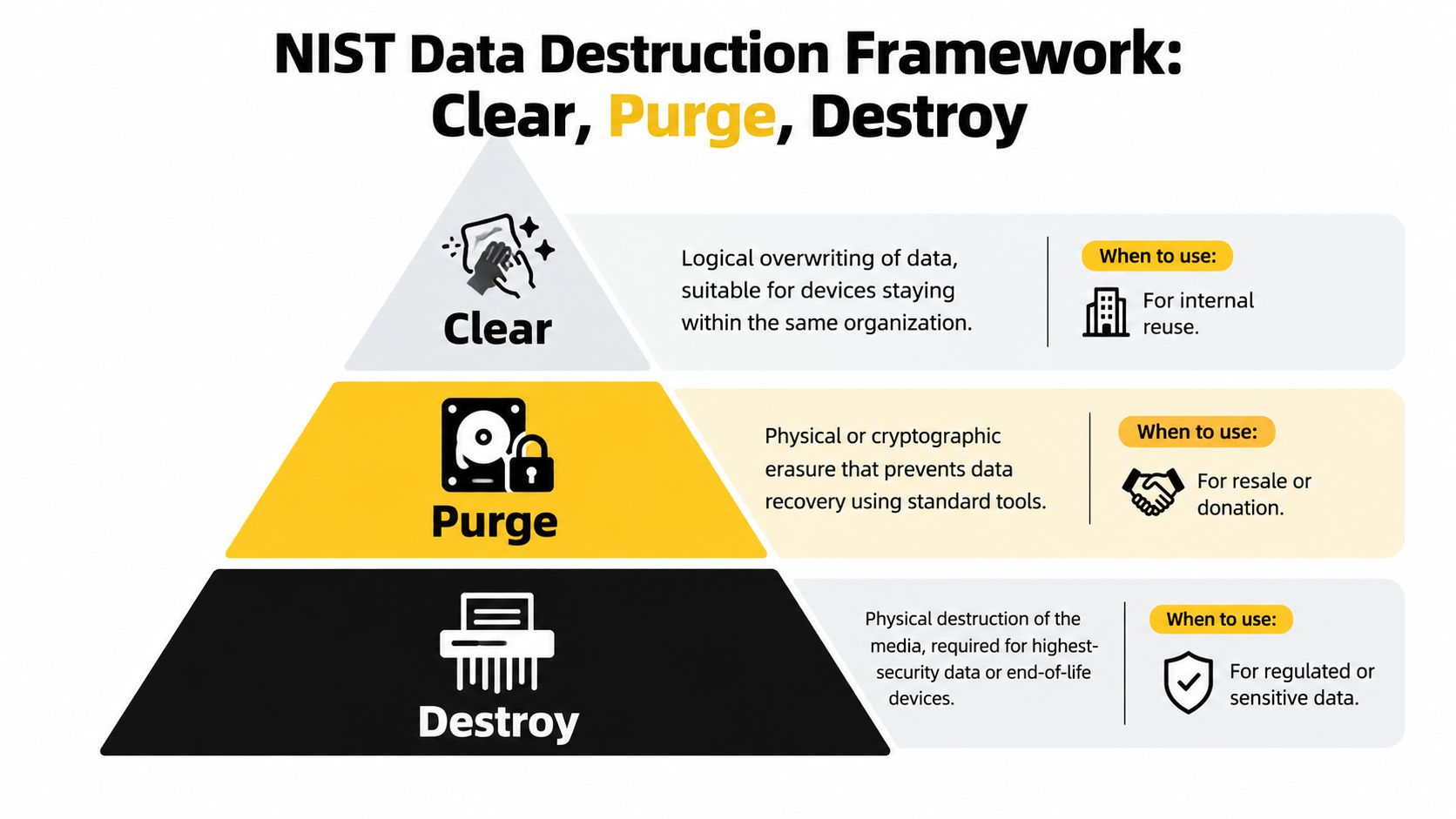
The current NIST media-sanitization publication distinguishes Clear, Purge, and Destroy. Method selection depends on information sensitivity, the device's destination, and the effort an attacker might use to recover information.
- Clear: Consider for approved lower-risk internal reuse, subject to the organization's policy and the device's capabilities.
- Purge: Evaluate when stronger protection is needed while preserving the possibility of reuse, resale, or donation.
- Destroy: Select when the risk decision requires making the storage media unusable, or when an acceptable reusable outcome can't be established.
These aren't automatic labels for particular industries. An SMB handling confidential customer records may need stricter treatment than a large organization retiring a device that never stored sensitive information. Schools should classify student and research data separately, while public agencies should apply their records, security, and disposition requirements.
Encrypted SSDs require particular care. Cryptographic erase depends on verified encryption coverage and appropriate key handling, not merely a vendor's statement that encryption was enabled. Legacy hard drives, removable storage, and optical media also need media-specific procedures.
Require evidence of the outcome
NIST's published optical-media guidance specifies nominal residue dimensions of 5 millimeters and a surface area of 25 square millimeters for shredded or disintegrated optical media. Those specifications illustrate why buyers shouldn't assume one destruction process fits every medium or treat older technical instructions as a substitute for current policy review.
A certificate is useful only when you can connect it to the device, the authorized method, and the recorded result.
The NIST Revision 2 sanitization FAQ identifies documentation, responsibilities, training, and tool controls as program elements. Start a data risk assessment before selecting a destruction service, and require a documented route for failures and exceptions.
Operational Challenges of Delivering Coverage Across Many Sites
A collection plan can look straightforward until the truck reaches a locked loading dock, the inventory includes devices still under a retention hold, or a regional subcontractor uses different asset labels. These are planning problems with security consequences.
Nationwide delivery is a reverse-logistics problem: equipment moves from dispersed users toward assessment and processing locations. Unlike new equipment distribution, retired assets can arrive with uncertain condition, incomplete records, and inconsistent packaging.
Centralize the rules, localize execution
Regional differences in formal e-waste handling show why collection alone isn't sufficient evidence of responsible processing. UNITAR's Global E-waste Monitor summary reports a 42.8% documented collection and recycling rate in Europe, compared with less than 1% in African countries.
Those global figures aren't a scorecard for American vendors. They demonstrate that handling infrastructure and documentation differ by destination, so buyers should examine the actual route rather than assume consistent outcomes.
For a domestic program, central teams should define required records, approved destinations, escalation rules, and who may authorize changes. Local staff should confirm access, staging conditions, contact details, and collection readiness.
| Operational problem | Control to establish |
|---|---|
| Inventory changes before pickup | Approve a final release list and record additions separately |
| Multiple transport or processing partners | Identify each handoff and the accountable organization |
| Different site schedules | Confirm local access windows and escalation contacts |
| Missing or unreadable identifiers | Use an exception process rather than silently omitting assets |
| Cross-jurisdiction movement | Review applicable requirements before approving the route |
Plan for the handoffs
Pay particular attention to temporary storage. Ask where equipment will wait, who can access it, and what happens if the intended processing location can't accept the shipment.
State and local requirements should be checked for each planned route rather than reduced to a blanket claim of nationwide compliance. The contract should also establish whether a provider may change downstream partners without notice.
A review of reverse logistics services should therefore cover more than transportation availability. Discuss packaging responsibilities, receipt discrepancies, incident notification, and how the final records return to your asset-management team.
The practical balance is centralized authority with local execution. Headquarters shouldn't need to schedule every loading-dock appointment, but a branch office shouldn't independently waive the organization's security requirements.
Choosing the Right ITAD Vendor for Your Organization
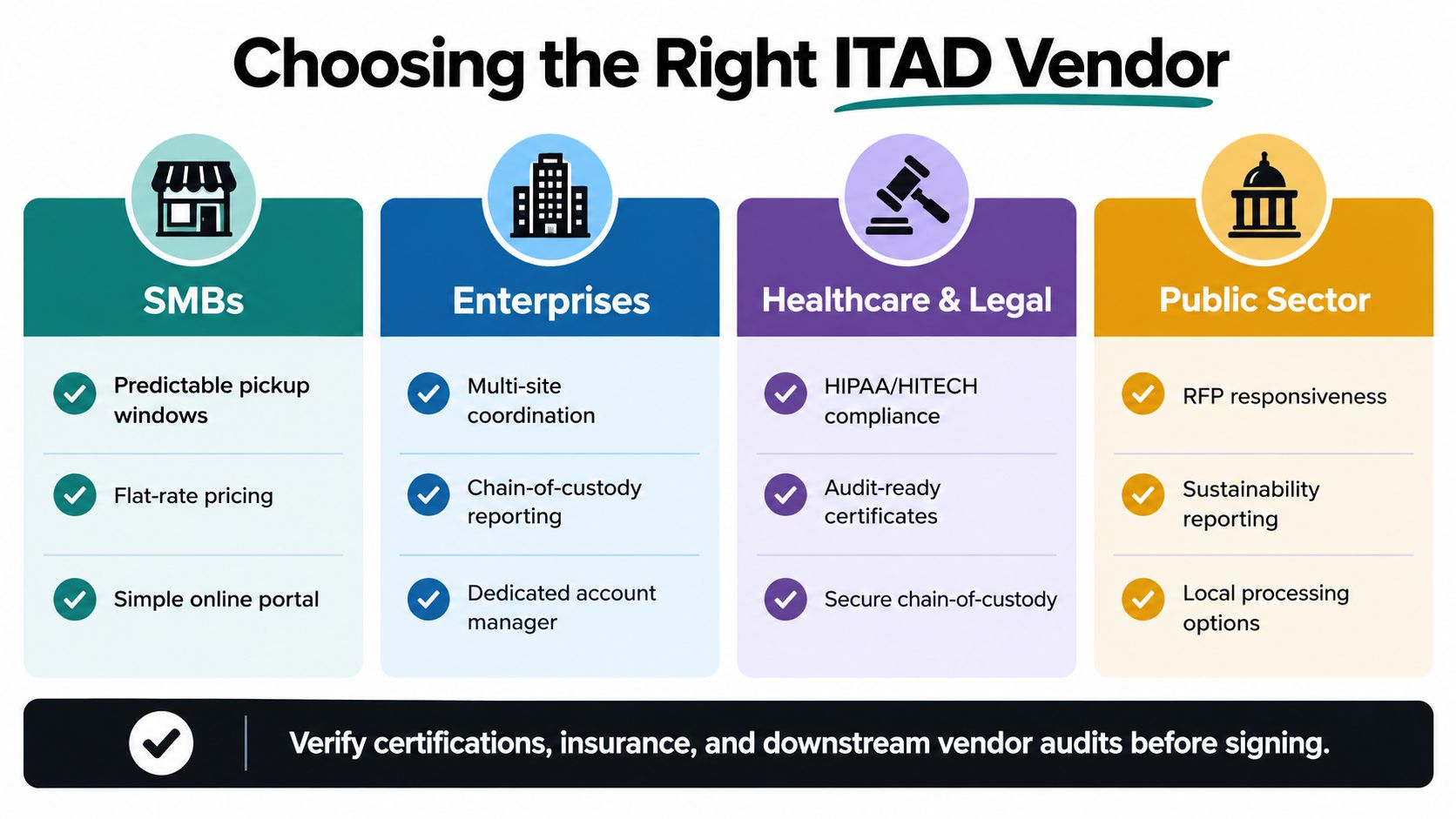
Choose a vendor against your operating needs, not the length of its service list. A provider might handle routine computer recycling effectively yet need different resources for a campus retirement project or a tightly controlled infrastructure removal.
Begin with a sample report, a proposed workflow, and a discussion of exceptions. Those materials reveal more than a promise of convenient service.
Evaluate through your organization's lens
| Buyer profile | Prioritize | Ask before signing |
|---|---|---|
| Small and mid-sized businesses | Clear acceptance rules, manageable paperwork, predictable charges | What could change the quote, and who resolves a discrepancy? |
| Enterprises | System compatibility, consolidated reporting, partner oversight | Can your output reconcile against our existing asset records? |
| Government and public agencies | Procurement requirements, approval authority, records retention | Can you meet our contract terms and demonstrate each authorized disposition? |
| Schools and universities | Academic schedules, ownership restrictions, sensitive information | How will you separate institutional, research, and donation-eligible assets? |
For healthcare and legal organizations, include the appropriate privacy, security, and contractual stakeholders in evaluation. A certificate template alone doesn't establish that a vendor's workflow meets your obligations.
Inspect the evidence behind credentials
Ask for current certification documentation and check its scope, covered facility, and relevance to the work you're purchasing. Don't assume a logo applies to every subcontractor or processing location.
Then examine the operating details:
- Insurance: Have your procurement or risk team review coverage against the proposed activities.
- Downstream transparency: Request an explanation of how processors are selected, monitored, and replaced.
- Audit access: Establish what records you can inspect and how unresolved findings are handled.
- Exception management: Ask for a realistic example of how missing assets or failed sanitization would be reported.
Buyer's test: If a vendor can't explain what happens when something goes wrong, its normal-process presentation isn't enough.
Broader technology projects may require professional services outside equipment retirement. For that separate scope, you can browse service offerings from Purple, while evaluating ITAD custody, sanitization, and recycling controls independently.
Use documented vendor selection criteria to compare proposals consistently. Red flags include unclear processing destinations, unsupported security claims, reluctance to share sample records, and pricing that leaves important handling costs undefined.
Donation-based recycling and commercial remarketing are both routes worth evaluating. The right choice depends on asset eligibility, organizational priorities, and the evidence available for the promised outcome.
Implementation Checklist, ROI Metrics, and Sustainable Impact
Start with a pilot that includes ordinary equipment and a realistic exception, such as a missing serial label or a failed drive. A carefully chosen pilot lets your team test approvals, communication, and reporting before expanding the program.
Assign a program owner with authority to bring IT, procurement, facilities, finance, and sustainability staff together. Otherwise, each department may complete its task without anyone confirming that the overall retirement is finished.
Put the program into operation
- Inventory and classify: Identify ownership, location, media type, data sensitivity, and any retention restrictions.
- Update policy: Define approved disposition routes, authorization requirements, and evidence retention.
- Select and contract: Match vendor deliverables to your controls, including downstream oversight and incident reporting.
- Run the pilot: Compare collected assets with received assets and investigate differences before closeout.
- Expand deliberately: Add sites only after resolving reporting and handling problems.
- Review results: Use a recurring review to examine costs, exceptions, reuse outcomes, and vendor performance.
SMBs can keep this process lightweight with a shared inventory and a named approver. Enterprises should connect it to asset-management and procurement workflows. Public agencies should incorporate required disposal approvals, while schools should check grant ownership and donation eligibility before releasing equipment.
Measure outcomes rather than collection volume
Build financial reporting around actual proceeds and actual costs. Include collection, processing, storage, administrative effort, and any agreed deductions when reviewing cost recovery strategies. Don't treat an estimated resale value as realized income.
Environmental reporting needs the same discipline. The Global E-waste Monitor executive summary identifies approximately US$62 billion in recoverable natural-resource value left unaccounted for in 2022. That global context supports careful recovery planning, but it doesn't establish the value or environmental benefit of your particular inventory.
Track reuse rate, material recovery yield, documented final destinations, unresolved assets, and completion of required sanitization records. Claim landfill diversion only when supporting disposition evidence exists, rather than equating everything collected with everything responsibly recycled.
Repair decisions also belong upstream of disposal. Procurement and sustainability teams can find repair rights info through RepairSeeker when considering repairability and service options, then assess whether repair makes operational sense for the actual equipment.
Social enterprise recycling adds a community objective to this framework. Corporate donation programs can support technology access, digital inclusion, and workforce development, but their reports should distinguish equipment offered for donation from equipment prepared and transferred for use.
Sustainable recycling is most credible when security, financial, environmental, and community outcomes remain separately measurable. That lets leaders support responsible retirement without overstating what the program achieved.
Reworx Recycling offers donation-based electronics recycling, business pickups, equipment buyback options, and secure hard-drive shredding to help organizations plan responsible IT asset disposal while supporting community-focused technology reuse. Visit Reworx Recycling to discuss donating eligible equipment, scheduling a pickup, or building a nationwide ITAD program with documented security and recovery requirements.