Your team is probably facing a familiar problem. Laptops are piling up after a refresh. A server room cleanup is overdue. Someone in legal is asking about chain of custody, someone in sustainability wants landfill diversion, and someone in finance wants to know whether any value can be recovered.
That's where the phrase downstream processing becomes useful.
Most business leaders don't hear that term until they're deep in a vendor review or reading technical recycling language. It sounds abstract, but the idea is simple. It describes what happens after equipment leaves active service and enters the controlled part of the retirement process. In electronics recycling and IT asset disposition, that final mile determines whether your devices are handled securely, whether usable equipment is donated or remarketed, whether hazardous parts are managed properly, and whether raw materials are recovered instead of wasted.
What Is Downstream Processing in Electronics Recycling
Outside recycling, the term often shows up in biotechnology. That's helpful because biotech uses the phrase very precisely. The global downstream processing market was valued at USD 41.81 billion in 2024 according to Grand View Research's downstream processing market analysis. That scale shows how important it is to isolate something valuable from a messy, mixed stream.
Electronics recycling works on the same principle.
A retired laptop isn't one material. It's a compact bundle of steel, aluminum, plastics, boards, batteries, glass, chips, storage media, and data risk. A pallet of old IT gear is even more complex. Downstream processing is the disciplined work of separating that mix into secure, compliant, useful outputs.
What the term means in ITAD
In the ITAD world, downstream processing starts once assets are collected, logged, and routed for their next outcome. That outcome might be reuse, refurbishment, donation, parts harvesting, secure destruction, or commodity recycling. The key point is that this isn't “throwing electronics away.”
It's controlled de-manufacturing.
That distinction matters because business outcomes are tied to the quality of that process:
- Risk mitigation means drives and storage media are identified, sanitized, or destroyed under documented controls.
- Value recovery means reusable equipment and recoverable components aren't lost in a bulk shred stream.
- Corporate responsibility means hazardous and recyclable materials are handled through a documented downstream chain rather than informal disposal.
Practical rule: If a vendor can't clearly explain what happens to each device class after pickup, they're not really explaining their downstream processing.
Why business leaders should care
A lot of confusion comes from the word “processing.” It sounds like a back-end plant operation that only engineers need to worry about. In reality, it affects procurement, infosec, ESG reporting, facilities planning, and audit readiness.
Consider two different outcomes for the same office cleanout. In one, everything gets mixed, shredded, and sold as scrap. In the other, technicians triage equipment, isolate data-bearing devices, remove batteries, route repairable assets for reuse, and separate the rest into recoverable material streams. The second approach usually creates better documentation, lower risk, and stronger circular-economy outcomes.
If you want a plain-language primer on the broader category, Reworx's overview of electronic waste recycling is a useful starting point.
The Core Stages of ITAD Downstream Processing
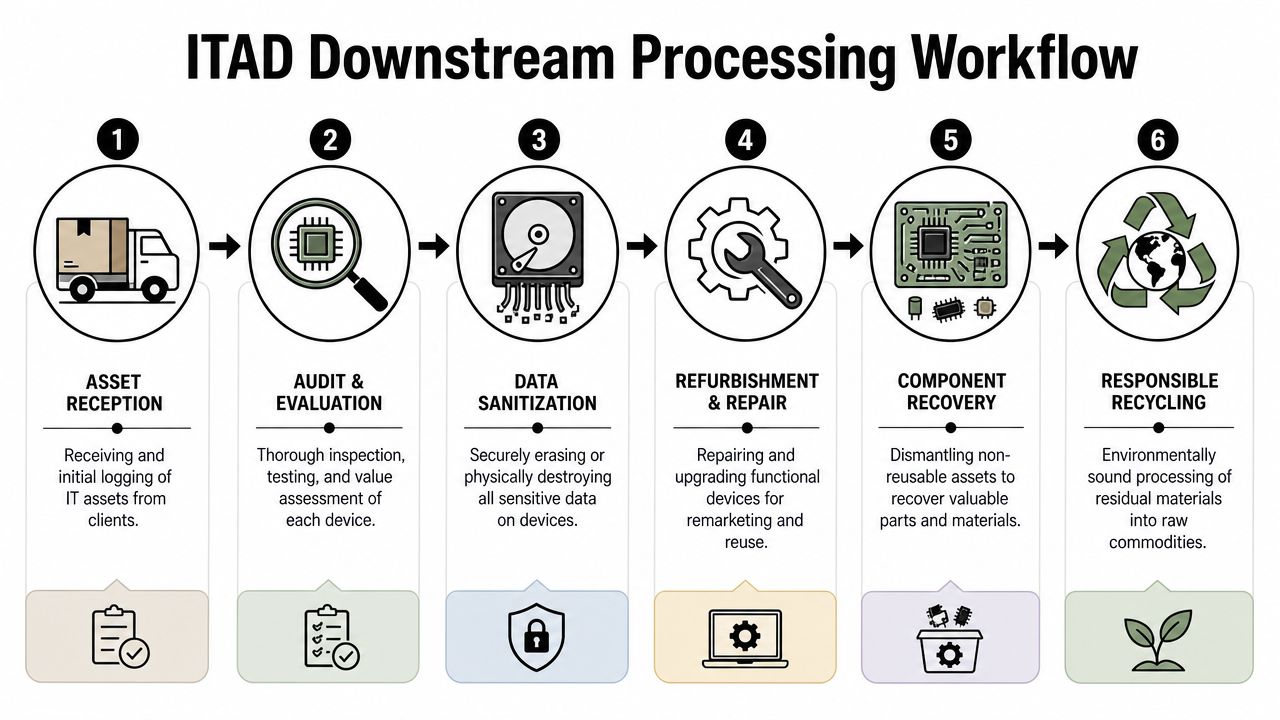
Once equipment arrives at a processing facility, the work becomes sequential. Each stage affects the next one. If sorting is sloppy, data security suffers. If data devices are missed, compliance suffers. If disassembly is rushed, reusable parts and recyclable materials are lost.
Stage one through three
The first part of the workflow is about control.
Asset reception
Equipment is received, counted, and associated with the client shipment. Labels, serials, and container integrity matter here. Chain of custody starts to become real rather than contractual at this stage.Audit and evaluation
Teams identify what each item is, whether it powers on, whether it has resale or donation potential, and whether it contains data-bearing media. A desktop, a switch, a medical device, and a rackmount server don't move through the same path.Data sanitization
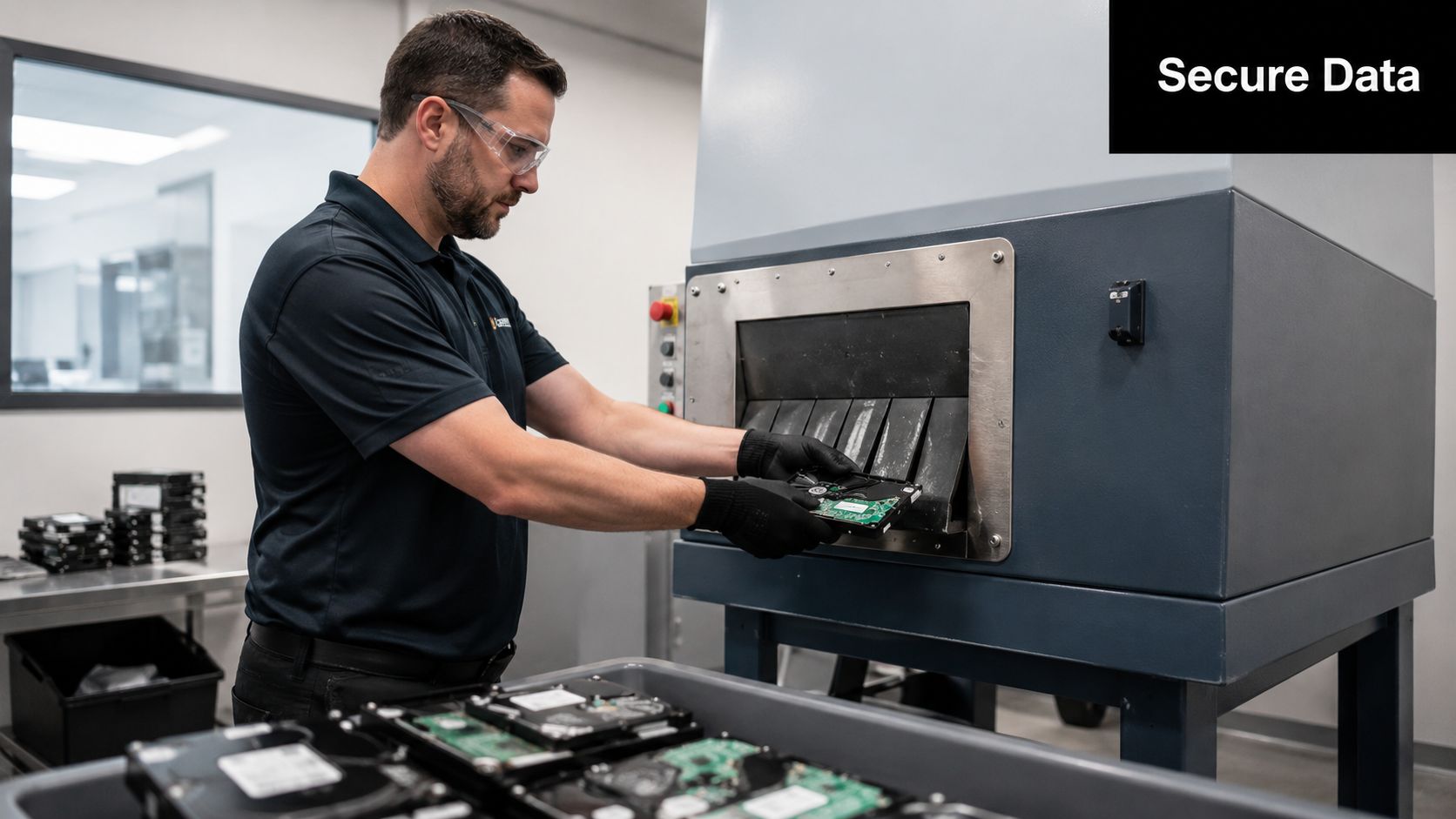
Devices that store data must be routed into secure workflows. Depending on the media and client requirements, that can mean logical wiping, degaussing, or physical shredding. This step has to happen before equipment is released into broader material recovery streams.
A good way to think about this is filtration. In biopharma, ultrafiltration and diafiltration are used to concentrate and separate substances in a controlled way, as described by Mettler Toledo's overview of downstream processing in biotechnology. In electronics recycling, the “filters” are operational rather than membrane-based. Staff decisions, equipment settings, sensor systems, and process checkpoints all separate one risk or material class from another.
Stage four through six
The second part of the workflow is about extracting the right outcome from each asset.
| Stage | What happens | Why it matters |
|---|---|---|
| Refurbishment and repair | Functional devices may be cleaned, tested, repaired, or upgraded | Extends useful life and supports reuse or donation |
| Component recovery | Non-reusable devices are dismantled for boards, metals, plastics, drives, batteries, and parts | Protects value and isolates regulated or hazardous components |
| Responsible recycling | Residual materials move into specialized recycling streams | Converts mixed electronics into commodity-grade outputs |
Not every item goes through every lane. A lightly used business laptop may be tested and reused. A damaged UPS battery cabinet may go straight into a specialized materials workflow. A failed hard drive may skip refurbishment entirely and head to certified destruction.
The important question isn't whether a vendor recycles. It's whether they know when not to shred, when to isolate, and how to document every handoff.
If you want to compare this general framework with a practical electronics workflow, Reworx outlines its e-waste recycling process in more operational detail.
Unlocking Hidden Value from Retired IT Assets
The word “waste” causes bad decisions.
When companies treat old equipment as junk, they often miss the fact that retired IT assets still contain multiple layers of value. Some devices still have functional value. Others have recoverable parts value. Even when reuse is off the table, the materials inside the equipment can still matter.
Where value actually sits
A business leader usually sees equipment by category. Laptops. Servers. Docking stations. Networking gear. A processor sees it by recoverable output.
That output can include:
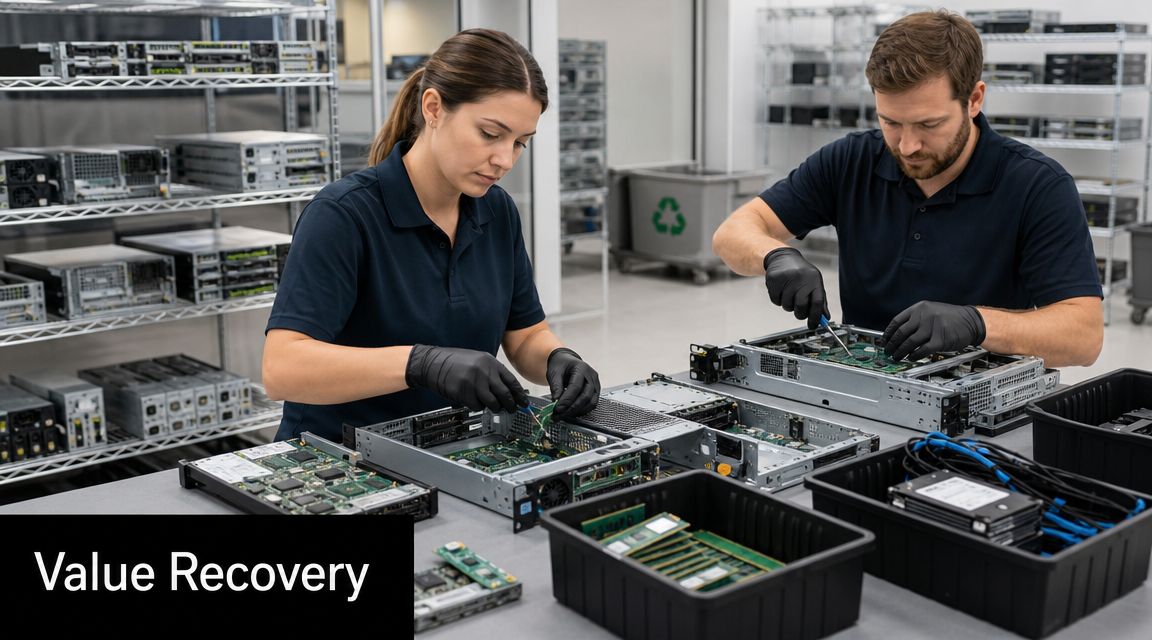
- Reusable systems with remaining service life
- Harvestable components such as memory, power supplies, and working boards
- Base materials such as copper, aluminum, steel, and sorted plastics
- Precious-metal-bearing fractions embedded in circuit boards and connectors
The challenge is that value is trapped inside mixed assemblies. It has to be identified, separated, tested, and routed correctly. That takes labor, equipment, documentation, and experience.
Why recovery is expensive and still worth doing
In advanced industrial settings, the separation phase is often the hardest part. A 2024 white paper notes that downstream processing can account for up to 70% of total industrial bioprocess costs, which is why Arxada's biotechnology downstream processes paper is useful as an analogy here. The lesson isn't about medicine. It's about economics. Separating value from complexity is costly.
That same principle applies in electronics recycling. If a processor wants to recover maximum value from a mixed stream of retired hardware, they can't rely on crude bulk handling. They need triage, testing, disassembly, targeted shredding, and clean output streams.
For finance and sustainability teams, that has two practical implications:
- Higher-quality downstream processing can offset retirement costs because useful devices and recoverable materials are preserved.
- Poor downstream processing destroys optionality because once mixed assets are indiscriminately shredded, reuse and parts recovery are gone.
A retired asset doesn't have one value. It has several possible values, and the downstream process decides which one survives.
For organizations evaluating return pathways, Reworx provides an asset recovery overview that helps frame how reuse, resale, and recycling fit together.
Data Security and Regulatory Compliance in the Workflow
Many companies start vendor conversations by asking, “Do you recycle electronics?” A better first question is, “How do you control failure points?”
That's because the greatest business risk in downstream processing usually isn't metal recovery. It's a broken handoff. A missed hard drive. An undocumented pallet split. A battery left inside a device that enters the wrong stream. A subcontractor nobody disclosed.
Bottlenecks create risk
A review of bioprocess surveys reported that 78.6% of U.S. respondents in 2012 cited downstream processing bottlenecks, according to Celignis' discussion of downstream processing challenges. In manufacturing, that signals congestion and quality risk. In ITAD, the same logic applies. Any multi-step workflow has vulnerable points where mistakes compound.
That's why a serious downstream program needs more than a promise of secure handling. It needs operational discipline.
Key controls usually include:
- Documented intake procedures that connect received assets to customer records
- Segregated data destruction lanes so storage media doesn't drift into general recycling
- Chain-of-custody records that show who handled what, when, and under what method
- Downstream vendor oversight for any material that leaves the primary facility
- Environmental controls for batteries, CRTs, lamps, and other regulated streams
What compliance looks like in practice
A secure and compliant workflow should answer specific questions without hesitation:
- Where are the hard drives right now?
- Which devices were wiped, and which were shredded?
- Which items were designated for donation, resale, or commodity recycling?
- Which downstream partners received residual material?
- What documentation can support an audit?
These aren't small details. They're the operating record of your risk posture.
Compliance test: If your vendor's documentation stops at pickup, your exposure hasn't stopped at pickup.
For companies that need audit-ready records, chain of custody documentation is one of the clearest indicators of whether the downstream process is under control.
Reworx Recycling's Commitment to Responsible Processing
A business in metro Atlanta closes a satellite office. The IT manager needs laptop disposal, monitor pickup, and secure data destruction. The facilities lead wants the space cleared on schedule. The sustainability lead wants to keep equipment in productive use when possible. Those goals can conflict if the downstream process is crude.
They don't have to conflict if the workflow is designed around routing decisions.
A practical example from office cleanout work
In a well-run office cleanout, the first decision isn't shredding. It's triage.
A batch of recent laptops may be tested for reuse. Devices that still have practical life can be routed into donation-based recycling or remarketing paths. Broken systems with salvageable components may be dismantled. Data-bearing media move into secure destruction procedures. Peripheral scrap with no reuse path moves into material separation.
That sequence matters because it preserves three outcomes at once:
- Security, because storage media is identified early
- Resource recovery, because parts and materials aren't destroyed unnecessarily
- Community benefit, because suitable equipment can support digital inclusion rather than becoming immediate scrap
Why transparency matters more than slogans
The industry is moving toward more continuous, data-driven downstream systems. Reviews of continuous downstream processing in other sectors note the need for reliable, production-grade monitoring and control, as discussed in VWR's overview of strategies for optimizing downstream processing. The ITAD parallel is straightforward. Buyers need partners who can show how assets move, how exceptions are handled, and how records are maintained.
That's the practical standard organizations should apply to donation-based recycling, office cleanouts, facility cleanouts, computer recycling, data center decommissioning, and medical equipment disposal. A responsible process doesn't hide behind broad claims like “zero landfill” or “fully secure.” It explains routing logic and documentation.
One example is Reworx Recycling, which handles electronics recycling, secure data destruction, pickups, and donation-oriented reuse programs for organizations retiring IT equipment. The relevant point for a buyer isn't branding. It's whether the provider can connect social enterprise recycling goals with auditable downstream controls.
Equipment retirement is a business process with social and environmental consequences. The processor's workflow determines whether those consequences are positive, negative, or simply undocumented.
Choose a Partner Who Masters the Final Mile of Recycling
Downstream processing sounds technical because it is technical. But the business decision around it is simple. The quality of the final mile determines whether your retired equipment creates liability or value.
When a provider handles downstream processing well, your organization gets several things at once. Data-bearing devices stay under control. Reusable assets have a chance to support donation or recovery pathways. Commodity materials are separated responsibly. Documentation exists when auditors, customers, or internal stakeholders ask questions.
When a provider handles it poorly, the same asset stream can create preventable problems. Security controls weaken. Reuse opportunities disappear. Reporting gets vague. Environmental responsibility becomes hard to prove.
That's why vendor review shouldn't stop at pickup logistics or a certificate template. It should include a hard look at the processor's downstream methods, decision points, documentation, and subcontracting model. Reworx offers a helpful framework for vendor selection criteria that businesses can use when comparing ITAD and electronics recycling partners.
The term is worth reclaiming in the electronics world because it names the part of the process that matters most after collection. It's where secure data destruction, value recovery, sustainable recycling, and corporate responsibility either become real or fall apart.
If your business is planning an office cleanout, laptop disposal project, data center decommissioning, or broader IT asset disposition program, consider starting with Reworx Recycling. You can use their educational resources to evaluate downstream practices, explore donation-based recycling options, and plan a pickup or partnership that aligns data security, environmental responsibility, and community impact.