A lot of teams reach the same point the same way. An IT manager is planning a laptop refresh, a sustainability lead is trying to tighten electronics recycling practices, and procurement suddenly asks for proof. Not a promise. Proof of secure data destruction, chain of custody, downstream accountability, and repeatable handling of retired equipment.
That's when quality management systems stop sounding theoretical. They become operational. If your company handles IT asset disposition, secure data destruction, electronics recycling, product destruction, or facility cleanout, a QMS gives you a way to run those services with fewer surprises and stronger evidence. It turns scattered know-how into a controlled process that a customer, auditor, or regulator can follow.
For organizations working in electronics recycling, donation-based recycling, computer recycling, laptop disposal, medical equipment disposal, laboratory equipment disposal, and data center decommissioning, that shift matters. The work already carries environmental, legal, and reputational risk. A QMS helps you manage those risks before they show up as a missed pickup, an incomplete asset log, or a client asking hard questions after the fact.
Beyond Compliance The Strategic Role of a QMS
The usual mistake is treating a QMS as an audit binder. That mindset creates paperwork, not control.
In practice, the best quality management systems sit closer to risk management than to administration. They define how equipment gets received, who verifies serial numbers, how hard drives move to shredding or sanitization, where exceptions get logged, and what happens when something doesn't match the manifest. For an ITAD or recycling operation, those details are the business.
What buyers are really asking for
When enterprise clients review a recycler or ITAD partner, they're rarely interested in abstract statements about quality. They want to know whether your operation can produce consistent records and defend them under scrutiny. They want evidence that secure data destruction and sustainable recycling aren't ad hoc tasks left to individual judgment.
That pressure isn't going away. The global QMS market is projected to reach USD 29.53 billion by 2033, with a CAGR of 9.14% between 2026 and 2033, which points to a broader institutional shift toward formal quality and compliance systems across industries, according to Quality Management System market projections.
For IT teams evaluating an external recycler, this changes the vendor conversation. A provider offering corporate e-waste solutions shouldn't just describe services like office cleanout, pickup scheduling, or IT equipment disposal. They should be able to show how those services are controlled from intake through final disposition.
Practical rule: If a process matters to a client, it has to exist in more than someone's memory.
Why this matters beyond the audit
A QMS gives management a common operating discipline. It reduces the number of decisions that depend on tribal knowledge. It makes onboarding easier because staff don't have to guess how to process a server lot, a batch of medical devices, or mixed loads from an office cleanout. It also creates a cleaner handoff between compliance, warehouse, logistics, and customer service.
That's why mature organizations don't view quality management systems as overhead. They use them to support growth, sharper client communication, and stronger control over electronics recycling and IT asset disposition work that already carries high consequences.
What Exactly Is a Quality Management System
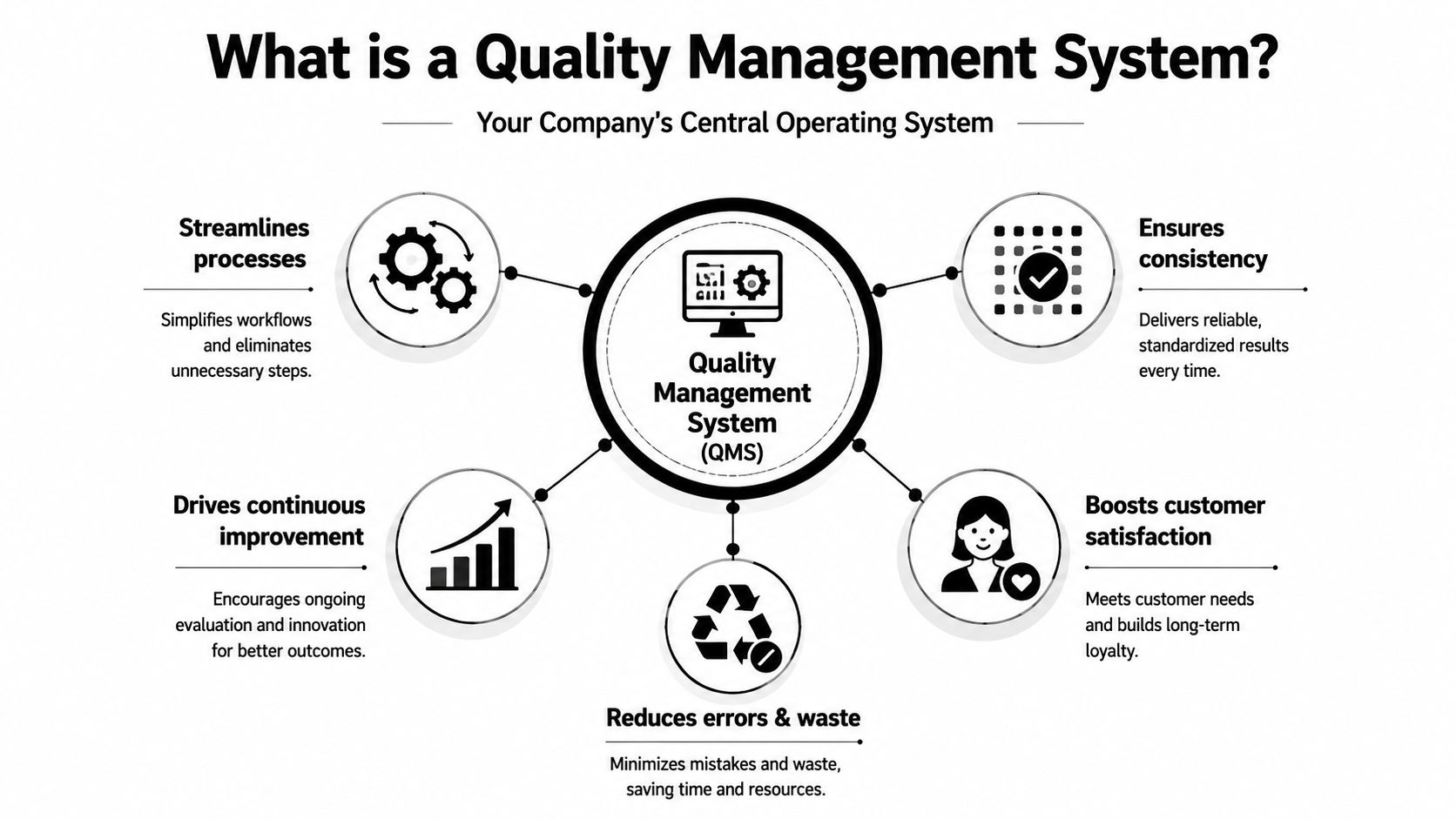
A quality management system is a company's operating system for repeatable work. It doesn't replace people or expertise. It gives both structure.
If your business handles computer recycling, secure data destruction, facility cleanout, laboratory equipment disposal, or corporate donation programs, a QMS tells people what “done correctly” looks like. It defines the policy, the approved process, the records that must exist, and the way performance gets reviewed.
Think of it as process control, not document storage
Many first-time teams think a QMS is a pile of SOPs in a shared folder. That's too narrow.
A working QMS connects four things:
- Policy and intent. What the organization is committed to doing.
- Process definition. How tasks are performed, approved, and checked.
- Evidence. The records that prove the process happened.
- Review and correction. The mechanism for spotting failures and improving them.
That's why digital systems often help. If your team is juggling intake logs, destruction records, downstream vendor checks, training acknowledgments, and customer requests, fragmented files quickly become their own risk. Tools that support structured workflows can reduce confusion. For teams reviewing options, Streamlining compliance with Odoo ERP offers a useful example of how compliance documentation can be organized in a more operational way.
What ISO expects in plain language
ISO 9001:2015 is built around a process-oriented framework using the Plan-Do-Check-Act cycle and risk-based thinking. The standard requires documented information including the scope of the QMS, process support information, a quality policy, and quality objectives. ISO specifically requires maintaining documented information for the quality policy under clause 5.2 and quality objectives under clause 6.2, as outlined in the ISO 9001:2015 standard overview.
That sounds formal, but the practical meaning is simple. You need a defined scope, clear operating rules, and records that show your team followed them.
A company with credible environmental certifications should already be thinking this way. Quality management systems support that same discipline by making process control visible, teachable, and auditable.
A useful test is this. If two trained employees complete the same task on different days, the output should be materially the same.
What a QMS changes day to day
Without a QMS, teams solve recurring problems one incident at a time. With a QMS, they prevent repeat failures by adjusting the process itself.
That shift is what makes quality management systems valuable in operations like IT equipment disposal, donation-based recycling, social enterprise recycling, and product destruction. The goal isn't to create more documents. It's to create fewer uncontrolled outcomes.
Why QMS Is Critical for Electronics Recycling and ITAD
In many industries, quality means product consistency. In electronics recycling and IT asset disposition, quality means something broader. It means chain of custody, data security, environmental handling, record integrity, and client confidence that every retired asset followed the right path.
That's why a QMS matters so much here. It converts trust from a marketing claim into a documented process.
In this field, quality and security are linked
A truckload of retired laptops isn't just scrap. It may contain regulated data, licensed software, asset tags tied to finance systems, and devices destined for reuse, donation, destruction, or parts harvesting. If your process isn't clear, one handling error can create several problems at once.
Recent audits found that 43% of enterprise clients now demand QMS-certified evidence of hard drive shredding and data sanitization as part of vendor risk assessments, according to this reference on QMS-certified evidence in vendor risk assessments. That's a practical signal. Buyers increasingly want proof that your controls for secure data destruction are auditable.
A strong QMS supports that proof through defined intake, asset logging, disposition decision points, witnessable destruction practices, exception handling, and retained records.
Where weak systems usually break
The failure points are usually ordinary.
| Operational area | What goes wrong without control | What a QMS should define |
|---|---|---|
| Asset intake | Mixed counts, unclear ownership, incomplete manifests | Verification steps, intake forms, escalation rules |
| Data-bearing devices | Drives move without clear status | Sanitization or shredding workflow, approvals, records |
| Pickup logistics | Loose chain of custody during transport | Handoffs, seals, driver documentation, receipt confirmation |
| Reuse and donation | Inconsistent evaluation of equipment condition | Testing criteria, grading rules, release approvals |
| Downstream processing | Limited visibility after transfer | Vendor qualification, record retention, disposition evidence |
For businesses involved in ITAD, office cleanout, computer recycling, data center decommissioning, and medical equipment disposal, these aren't edge cases. They're daily operating risks.
Field observation: Clients rarely ask for every document you have. They ask for the one record that proves a critical step happened when it was supposed to happen.
Why this changes how clients view your organization
A recycler without a credible QMS looks like a haul-away vendor. A recycler with one starts to look like a risk-management partner.
That distinction matters when your customer is under pressure from legal, procurement, cybersecurity, ESG, or internal audit teams. If you can produce consistent chain of custody documentation and tie it to an approved process, your service becomes easier to defend inside the client's organization.
That's also why quality management systems align so well with high-accountability recycling models. In this sector, “quality” isn't cosmetic. It's the framework that holds together electronics recycling, secure data destruction, sustainable recycling, and client trust.
The Core Pillars of an Effective QMS
A QMS becomes usable when teams can point to a few core building blocks and explain how they work together. If one of those blocks is weak, the rest of the system starts compensating for it.
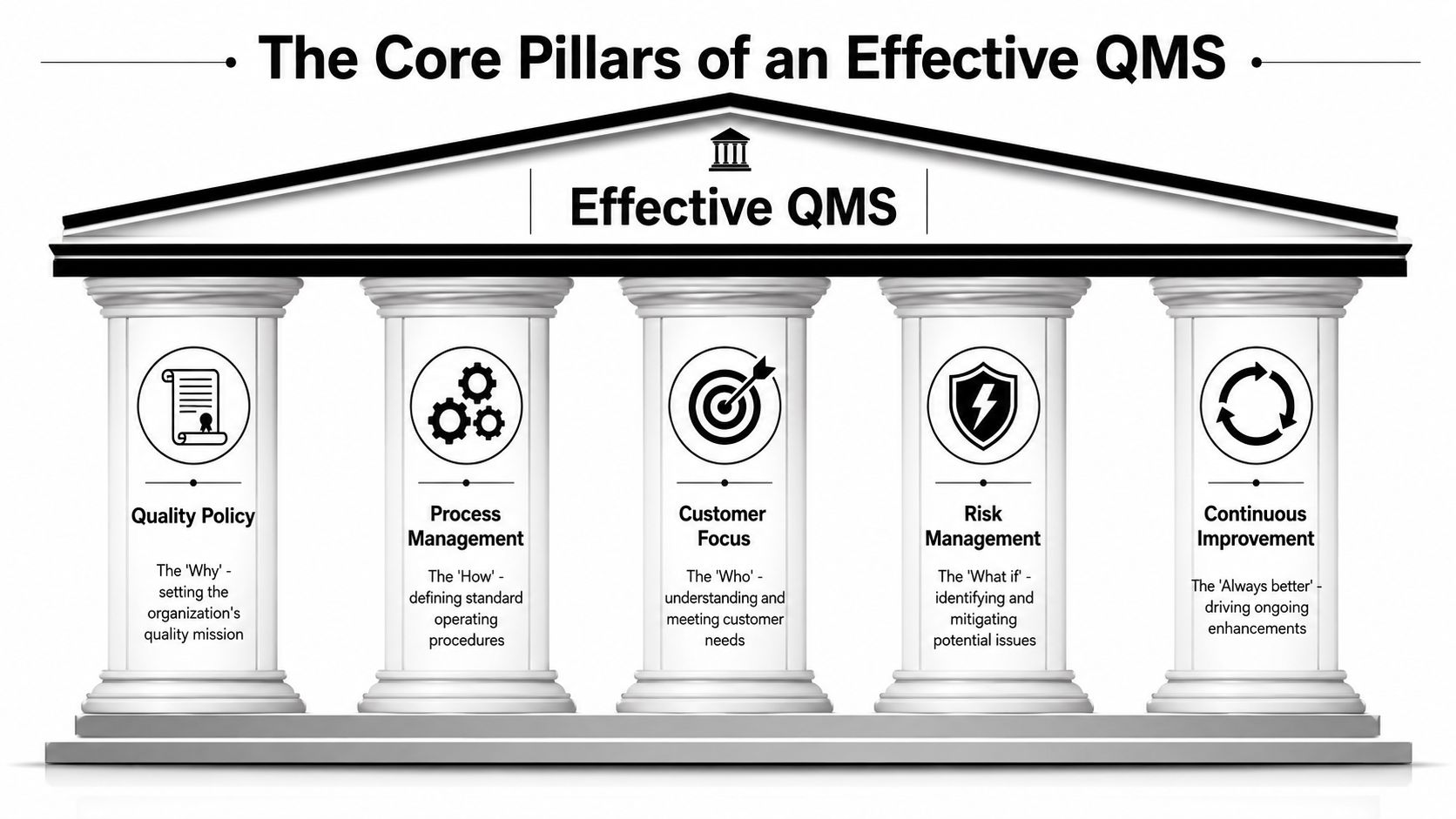
Policy and objectives
The policy is the organization's quality position in writing. It's short, but it matters because it sets the standard for decisions. Quality objectives turn that commitment into something operational.
ISO 9001:2015 requires organizations to maintain documented information including a quality policy under clause 5.2 and quality objectives under clause 6.2, embedding defect prevention and waste reduction into operations, as described in the ISO 9001:2015 requirements summary.
For an ITAD or recycling business, the policy shouldn't be vague. It should speak directly to secure handling, environmental responsibility, record accuracy, and customer requirements.
Process management and SOPs
Most daily control happens here. Your SOPs should define the tasks that create the most risk or the most confusion.
Examples include:
- Asset intake SOP for receiving, counting, labeling, and reconciling equipment.
- Data destruction SOP for segregation of data-bearing devices, approved sanitization methods, and evidence retention.
- Pickup and transport SOP for custody handoffs during business pickups and multi-site collections.
- Reuse release SOP for testing, grading, and approval before donation or resale.
These don't need to read like legal documents. They need to be clear enough that a new employee can follow them and a supervisor can verify them.
Records, training, and verification
A process you can't prove is a process you can't defend. Records convert work into evidence.
That includes intake logs, destruction certificates, training acknowledgments, nonconformance reports, and internal audit findings. Some teams are exploring tools such as blockchain-powered document verification when tamper resistance or document authenticity is a concern, especially where multiple parties need to trust a record trail. The technology isn't a substitute for a QMS, but it can reinforce document integrity in the right environment.
Strong records don't make a weak process good. They do make a good process defensible.
Training closes the loop. If staff don't understand the approved method, the written system won't survive normal operational pressure.
Customer focus and improvement
An effective QMS also listens. Complaints, missed pickups, rejected manifests, or recurring intake discrepancies are not just service issues. They're process signals.
Use a simple review rhythm:
- Look for repeat friction in customer feedback and internal exceptions.
- Trace the root cause to a process, training gap, or unclear ownership.
- Update the procedure and communicate the change.
- Check whether the fix held in the next audit cycle.
That's how quality management systems become practical. Not by collecting binders, but by giving teams a stable way to run IT equipment disposal, laptop disposal, sustainable recycling, and corporate donation programs with fewer avoidable failures.
A Practical Framework for QMS Implementation
The fastest way to fail is to build an oversized system for a small team. That happens constantly in SMBs. Someone copies an enterprise template, loads it with approvals, version controls, forms, and meeting cadences, and the system collapses under its own weight.
That problem is common enough to quantify. 68% of SMBs abandon QMS initiatives because of perceived complexity, while 82% of regulated industries, including ITAD, now require certified partners, according to USDM's discussion of building a scaled QMS. The lesson is clear. Small teams need a QMS that fits their actual operation.
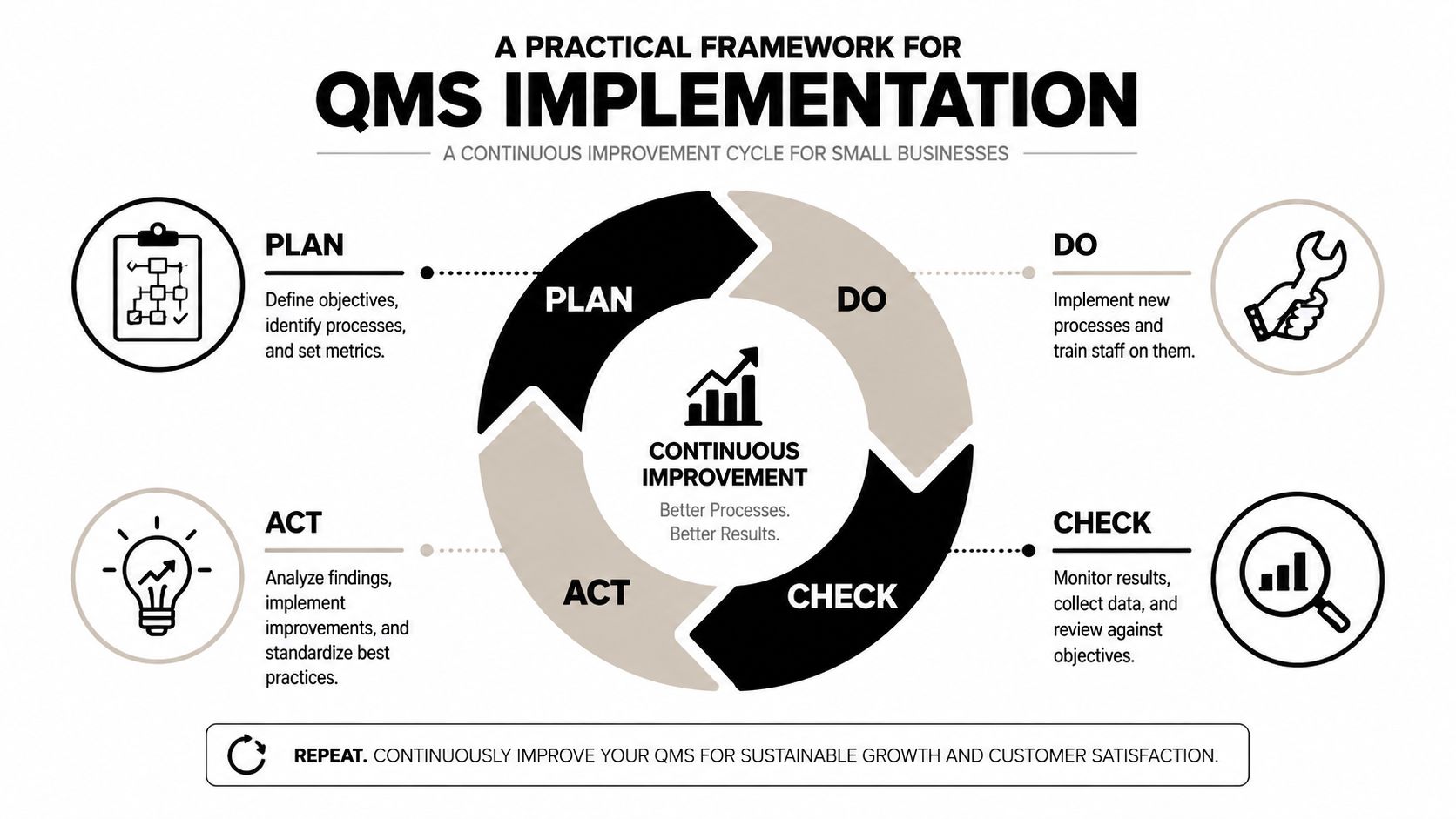
Plan with a narrow scope first
Start with the highest-risk workflow, not the whole company.
For most organizations in electronics recycling, ITAD, secure data destruction, or office cleanout, that means beginning with data-bearing assets and custody records. Define your scope in one sentence. Example: “The QMS applies to intake, storage, transport, destruction, and disposition records for customer-owned electronic equipment.”
Then map only the core process path:
- What comes in
- Who verifies it
- Where it goes next
- What record is created
- Who reviews exceptions
A realistic implementation schedule helps prevent drift and overbuild. Teams planning a staged rollout often benefit from seeing example implementation timelines before they decide what to document in phase one versus phase two.
Do by documenting the few procedures that matter most
You do not need to document everything at once. You do need to document the work that creates the most exposure.
A lean first release usually includes:
| Priority document | Why it belongs in phase one |
|---|---|
| Quality policy | Gives the system a clear management position |
| Scope statement | Prevents the system from expanding too fast |
| Asset intake SOP | Controls the first custody point |
| Data destruction SOP | Covers the most sensitive risk area |
| Nonconformance log | Captures mistakes before they disappear |
| Training record | Shows who was trained on what and when |
Write procedures in plain language. If a step requires interpretation, the document is probably too vague.
Check with short audits and visible metrics
Early audits should be small and frequent. Don't wait for a formal annual review to discover the system isn't being followed.
A practical internal check sounds like this:
- Pull one recent pickup file.
- Match the manifest to intake records.
- Confirm any data-bearing devices reached the approved destruction or sanitization path.
- Verify the related evidence was retained.
- Note where the process depended on memory instead of documentation.
Implementation advice: Audit the handoffs first. Most failures happen between teams, not inside a single task.
For metrics, keep it simple. Focus on indicators that reveal process discipline, such as missing records, unresolved exceptions, or delayed disposition documentation.
Act by simplifying, not by adding bureaucracy
Many teams err by reacting to one mistake with layered extra signatures, forms, and approvals. Over time, the process becomes too heavy for daily use.
Instead, ask three questions:
- Was the process unclear?
- Was training weak?
- Was ownership ambiguous?
Fix the smallest thing that removes the repeat risk. Sometimes the right answer is a better intake checklist. Sometimes it's a single field on a form. Sometimes it's assigning one person responsibility for release approval.
For small and mid-sized businesses, that's the durable model. Build a QMS that protects computer recycling, facility cleanout, data center decommissioning, and donation-based recycling work without turning the operation into a paperwork exercise.
Essential Templates and Checklists to Start Today
A QMS starter kit should be usable on the day you create it. If the template is too long, people won't fill it out. If the checklist is too abstract, supervisors won't use it on the floor.
The goal is to create a few documents that shape behavior immediately.
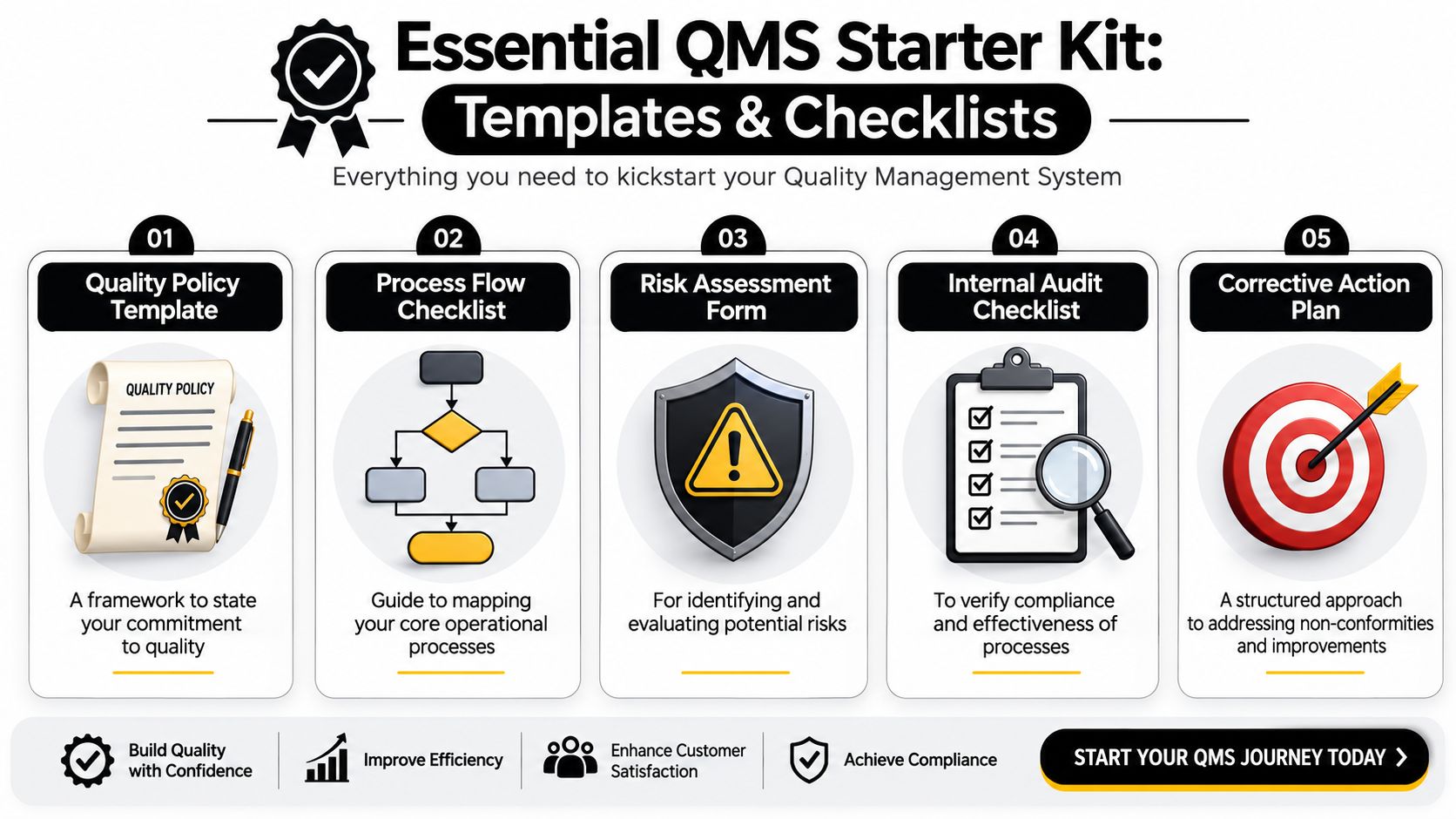
Three documents worth building first
One-page quality policy
State the company's commitment to secure handling, compliant processing, accurate records, and continuous improvement. Keep it readable. If frontline staff can't explain it back to you, it's too polished and not practical enough.Asset intake SOP outline
Include receipt of equipment, manifest verification, serial number capture where required, identification of data-bearing devices, segregation rules, and exception escalation. This is the backbone for IT equipment disposal, laptop disposal, medical equipment disposal, and computer recycling work.Internal audit checklist for data security controls
Use short yes-or-no checks. Was the asset count reconciled? Were drives identified correctly? Was the destruction path documented? Were any custody gaps noted? Did the file retain final evidence?
Keep templates aligned with operating goals
Some teams struggle because their compliance documents sit far away from their management goals. A lighter way to fix that is to connect quality documents to short operating objectives and review cycles. If your team already uses goal frameworks, resources like Toolkit for your OKR quarter can help structure accountability without making the QMS itself more complicated.
A practical starter pack can live in a shared system as long as version control is clear and ownership is assigned. If you need a baseline document set, a compliance checklist template can help teams start with a structure they can adapt instead of building from scratch.
Keep every template tied to one decision, one handoff, or one proof point. If a form exists only because “auditors might want it,” it usually won't survive daily use.
A simple test for every template
Ask two questions before approving any QMS document:
- Does this help someone perform or verify a real task?
- Would we notice if this record were missing during a client review?
If the answer to both is no, leave it out for now. Good quality management systems grow from operational need, not from document volume.
Transforming Your Operations with Reworx Recycling
The companies that benefit most from a QMS stop seeing it as an isolated compliance project. They use it to tighten operations, improve how teams hand work off to one another, and give clients better evidence in critical situations.
That's where the business case becomes visible. Companies with effective quality management systems maintain customer retention that is 25% higher than competitors, along with a 9% increase in sales and a 40% reduction in customer complaints, according to quality management performance data. Those outcomes don't come from paperwork alone. They come from more consistent execution.
For organizations managing electronics recycling, secure data destruction, IT asset disposition, office cleanout, product destruction, and corporate donation programs, the practical payoff is straightforward. Your team knows what to do. Your customers know what to expect. Your records support the story your sales team and sustainability team are already telling.
That's also why the strongest recycling partners stand out. They don't just remove old equipment. They operate with process discipline that supports environmental responsibility, digital inclusion, community benefit, and defensible handling of retired technology.
A company like Reworx Recycling fits that model well because the mission goes beyond hauling material away. The work connects donation-based recycling, social enterprise recycling, IT equipment disposal, and community impact in a way that depends on consistent execution. When quality management systems are built correctly, they don't slow that mission down. They make it repeatable.
If your organization needs a more reliable approach to electronics recycling, secure data destruction, IT asset disposition, data center decommissioning, or donation-based recycling, Reworx Recycling can help you retire equipment responsibly while supporting technology donations, digital inclusion, and workforce development. Businesses can donate old equipment, schedule a pickup, or explore a longer-term recycling partnership built around secure handling and sustainable outcomes.