A familiar scene plays out after an office refresh in Cranford. The new laptops are deployed, a few old monitors are leaning against a wall, retired desktops are stacked in a back room, and someone asks the question nobody wants to answer twice: where should all of this go?
For a small business, medical office, school, lab, or municipal department, old electronics create three separate problems at once. They take up space. They may still contain sensitive data. They also can't be treated like ordinary trash. That's why many local decision-makers start by looking at the Cranford NJ Conservation Center. It's a real community asset, especially for residents trying to recycle responsibly close to home.
The challenge is that municipal convenience and business-ready disposal are not the same thing. A resident dropping off a few household items has very different needs from an IT manager handling laptop disposal, an office cleanout, or a facility cleanout tied to compliance and chain of custody. That distinction matters more than most organizations assume.
Introduction What to Do with Old Office Electronics in Cranford
If your team just completed an upgrade, you probably have a mixed pile of equipment. Some assets may still have reuse value. Others are obsolete, damaged, or missing drives. A few may be easy to move. Servers, networking gear, printers, and specialized devices usually aren't.
The local starting point many people search for is the Cranford Conservation Center, which is permanently located at 210 Birchwood Avenue in Cranford, New Jersey, between Orange Avenue and Cranford Avenue, and it operates as the township's primary drop-off facility for recycling and reuse materials without requiring resident permits according to the official Cranford Conservation Center page. If you're trying to understand the local recycling system, that's useful baseline information.
For businesses, though, the better question isn't just where to drop equipment. It's this:
- Data risk: Do any devices still hold employee, customer, patient, student, or financial information?
- Handling risk: Can your staff safely sort, transport, and document the material?
- Disposition risk: Do you know whether each item should be reused, remarketed, donated, or recycled?
- Logistics: Can your team move bulk hardware without disrupting operations?
Practical rule: If the device ever touched business data, treat disposal as a managed process, not a cleanup task.
Many Cranford-area organizations start with local municipal options, then realize they need a business-grade electronics recycling and IT equipment disposal workflow instead. That's especially true when projects involve secure data destruction, computer recycling, medical equipment disposal, laboratory equipment disposal, or broader IT asset disposition (ITAD) planning. For companies evaluating New Jersey options, this broader view of business electronics recycling in New Jersey helps frame the issue correctly.
Understanding the Cranford Conservation Center Services
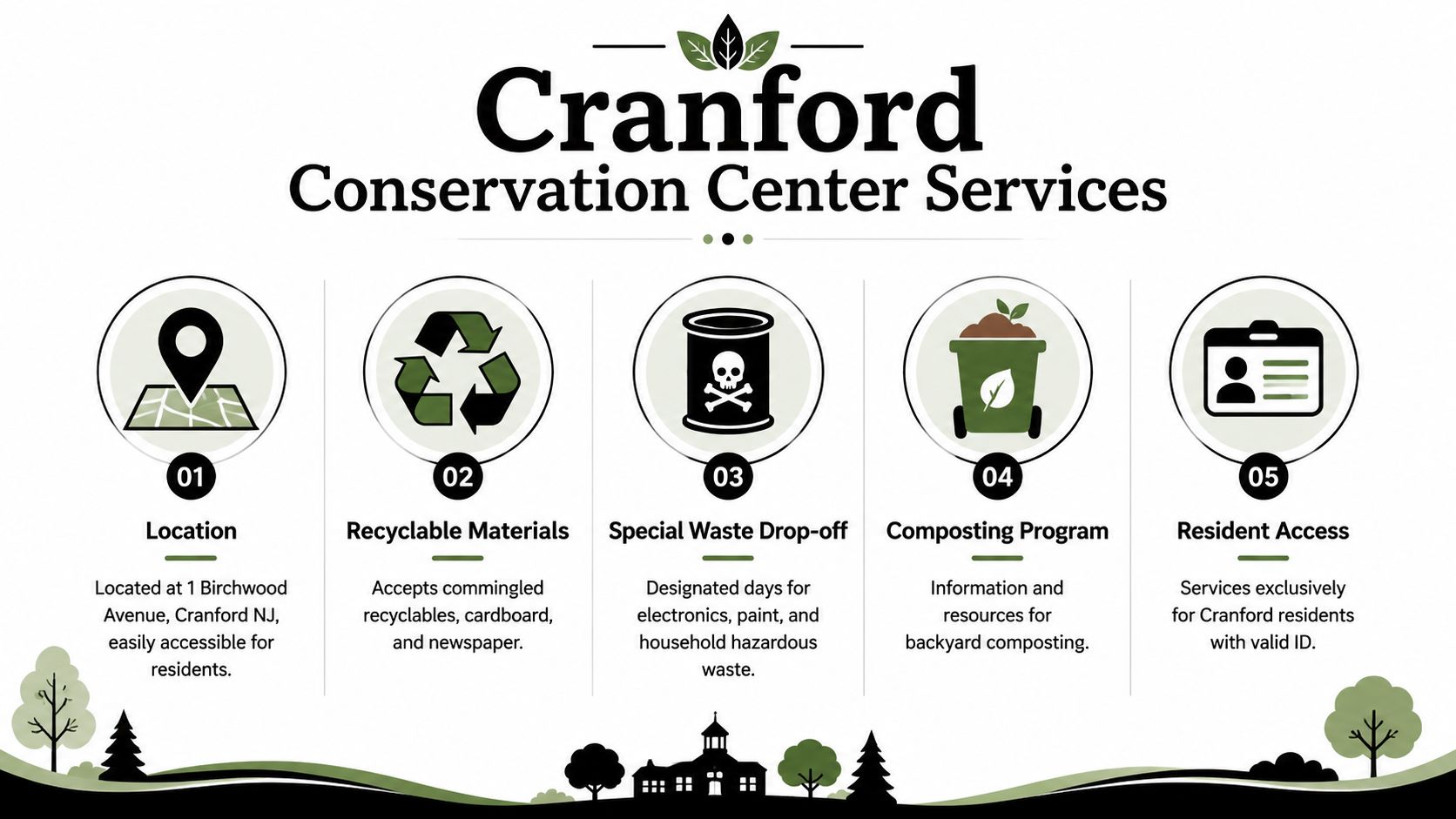
The Cranford Conservation Center gives residents a local place to handle recycling and reuse tasks that don't fit curbside pickup. That matters. Municipal infrastructure like this keeps reusable and recyclable materials in circulation and gives the community a practical outlet for responsible disposal.
The key operating details are straightforward. The center is located at 210 Birchwood Avenue and operates on Wednesdays from 9:20 a.m. to 3:20 p.m. and on Saturdays and Sundays from 9:20 a.m. to 3:50 p.m., with an important seasonal exception: it closes on Sundays during January and February, as listed on the township's Conservation Center information page.
What the center does well
For local households, the center fills an important gap between curbside collection and regional waste facilities. It functions as a municipal hub for reuse, reduce, and recycle activity, and it also hosts a Helpsy drop-off location for unwanted household items, which expands its role beyond standard recycling into community reuse. Residents can also contact the Department of Public Works directly by phone at 908-709-7217, extension 2, or by email at dpw@cranfordnj.org, as noted in the Union County public information notice about the Cranford facility.
That local accessibility is a real advantage. If someone in Cranford wants a nearby option for assorted residential materials, the conservation center is often more convenient than traveling to the Recycling Center at 72 Fadem Road in Springfield, NJ, which serves a broader regional role.
Where the business questions begin
A municipal center can still be the wrong tool for a commercial disposal project. The center supports community recycling, but businesses need certainty around process, documentation, and category-specific handling. That becomes harder when the list of accepted items is broad in concept but not always specific enough for business equipment decisions.
A practical comparison helps:
| Need | Municipal center | Business ITAD workflow |
|---|---|---|
| Small resident drop-off | Good fit | Usually unnecessary |
| Bulk office cleanout | Unclear | Better fit |
| Hard drive handling | Not clearly defined | Should be documented |
| Chain of custody | Limited | Expected |
| Asset reporting | Limited | Often required |
Local recycling access is valuable. It just doesn't answer every commercial question that a business has to answer before equipment leaves the building.
Key Limitations for Commercial and Business Recycling
Businesses usually run into problems at the point where convenience meets accountability. A few retired household devices are one thing. A stack of workstations, old servers, failed backup drives, VOIP phones, tablets, or lab-adjacent equipment is something else entirely.
The biggest issue is ambiguity. While the Cranford Conservation Center partners with Helpsy for general unwanted items, there is no clear, official guidance on its website or related materials specifying the acceptance of business electronics like computers, servers, or lab equipment, creating a serious gray area for corporate disposal needs, as reflected in the Cranford Conservation Center YouTube explainer and the gap it leaves around accepted electronic devices.
Why ambiguity is a problem for companies
A business can't rely on “probably accepted” when equipment contains data or when auditors may later ask how assets were handled. If your organization manages customer files, HR records, internal financials, protected health information, research files, or login credentials, uncertainty isn't a minor inconvenience. It's a process failure.
Three operational gaps show up repeatedly in commercial projects:
- Secure data destruction: A municipal drop-off model isn't built around hard drive shredding records, serial-level tracking, or device-by-device verification.
- Documentation: Businesses often need internal records that show what left the site, how it was processed, and when.
- Project logistics: Office cleanouts and facility cleanouts usually involve coordinated pickup, packing, staging, and labor planning.
What works and what doesn't
What works is using municipal services for the kind of local resident recycling they were designed to support. What doesn't work is pushing a commercial IT equipment disposal project into a public drop-off workflow and hoping the details sort themselves out.
That mismatch gets expensive in non-financial ways. IT teams lose time. Facilities staff improvise. Sensitive assets sit too long in unsecured rooms. Sustainability leaders end up without a clean reporting trail. The legal and operational consequences of getting that wrong are covered well in this discussion of the environmental and legal impacts of improper commercial e-waste disposal.
Operational advice: The moment a disposal project involves storage rooms, server closets, multiple departments, or regulated data, treat it as an asset disposition project instead of a recycling errand.
There's another trade-off. Municipal centers are built for access. Businesses need control. Access helps residents. Control protects organizations.
Reworx Recycling The Professional Solution for Corporate E-Waste
When a Cranford-area business needs more than a drop-off location, the right model is a managed disposition process. That means identifying what you have, separating reusable assets from scrap, controlling how data-bearing equipment is handled, and planning transportation before anything leaves the site.
That's where a specialized electronics recycling and ITAD partner fits. The value isn't just hauling equipment away. The value is turning an unstructured pile of obsolete hardware into a documented, lower-risk workflow that supports sustainability goals, secure data destruction, and practical operations.
A better framework for business equipment disposal
For most organizations, the cleanest process follows four stages:
Inventory the asset mix
Separate laptops, desktops, monitors, servers, networking gear, mobile devices, printers, and any specialized equipment. A mixed pallet always moves more smoothly when the categories are known in advance.Flag data-bearing items first
Desktops, laptops, servers, external drives, and certain multifunction devices should never be treated like ordinary recycling. These items belong in a secure data destruction workflow before anyone talks about donation-based recycling or downstream processing.Match the disposition path to the asset
Some equipment may be suitable for reuse or corporate donation programs. Some belongs in product destruction. Some may fit standard computer recycling or sustainable recycling streams. A qualified partner helps sort those paths instead of forcing every item into the same outcome.Plan removal around business operations
The timing matters. Pickup windows, loading access, internal signoff, and department coordination make the difference between a smooth project and a week of disruption.
Why the social enterprise model matters
A capable recycling partner should do more than reduce clutter. It should help an organization retire equipment responsibly while supporting community outcomes where reusable technology can do real good. That's where donation-based recycling and social enterprise recycling stand apart from disposal-only vendors.
Businesses also benefit from using a partner that understands project variety. The same organization may need laptop disposal this quarter, data center decommissioning next quarter, and later a combination of medical equipment disposal, laboratory equipment disposal, or a broader office relocation cleanup. A partner built for those transitions helps standardize internal process across departments.
For organizations comparing providers, this overview of electronics recycling and repurposing solutions for business is useful because it frames recycling, reuse, and asset management as one connected decision rather than separate tasks.
A good ITAD process protects data, clears space, and advances sustainability at the same time. If it only solves one of those, it's incomplete.
Streamlining Your Next Office or Facility Cleanout
Most cleanouts go sideways for simple reasons. Nobody finalizes the inventory, departments mix personal and company devices, and pickup gets scheduled before the material is staged. The result is confusion in the loading area and leftover equipment that somehow stays behind.
A smoother process starts earlier and uses fewer assumptions.
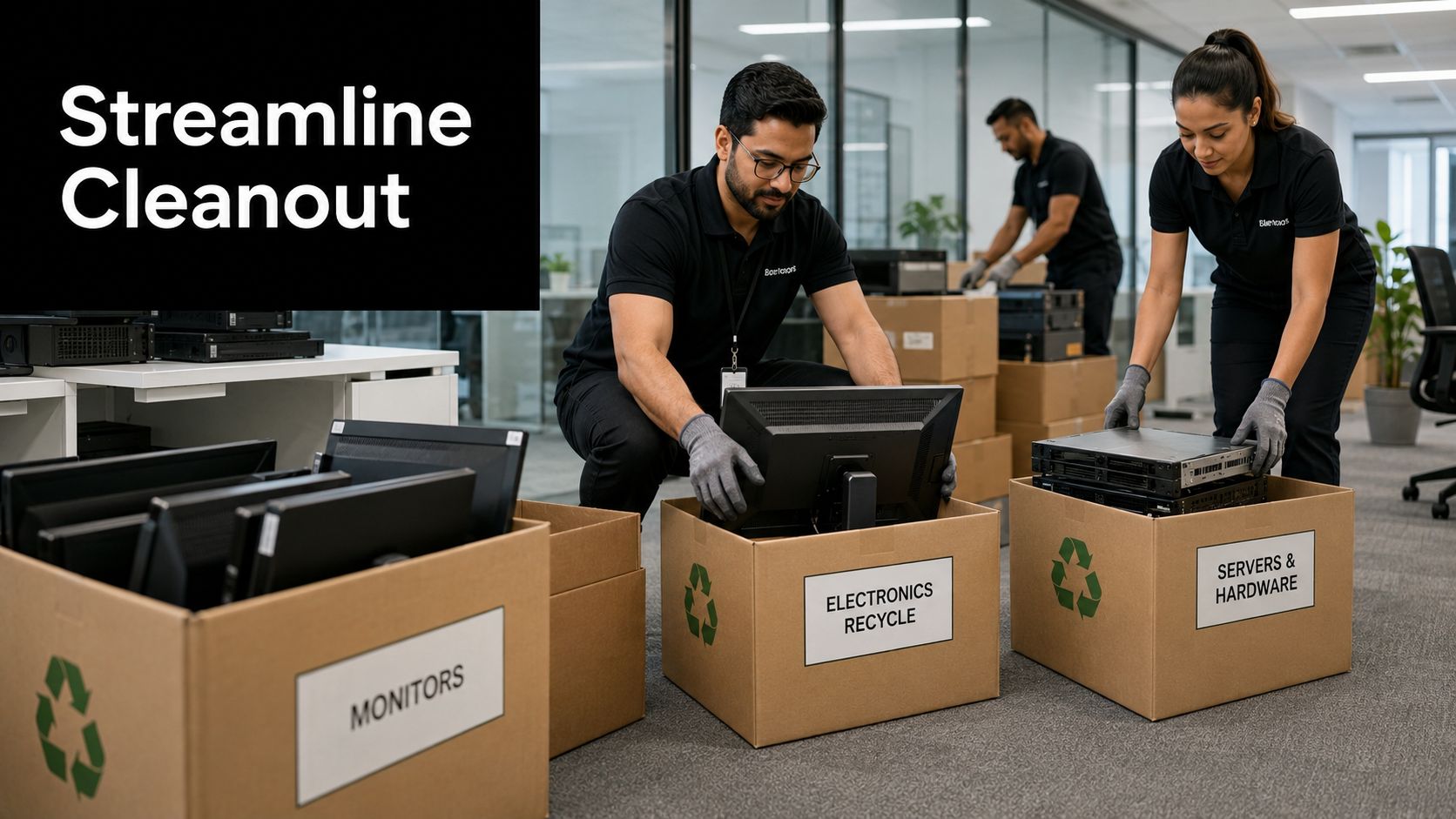
A practical cleanout sequence
Use this sequence for anything from a small office refresh to a larger facility cleanout:
Start with a room-by-room list
Don't aim for perfection. A working inventory of laptops, docks, displays, servers, phones, and miscellaneous peripherals is enough to plan labor and transport.Separate by handling needs
Put data-bearing devices in one stream. Put simple peripherals in another. Keep damaged or broken items identified so nobody assumes they're donation-ready.Assign one internal owner
Someone needs authority to approve what's leaving, answer questions from IT and facilities, and coordinate access on pickup day.Decide what needs special handling
Product destruction, secure data destruction, medical equipment disposal, and laboratory equipment disposal shouldn't be improvised in the moment.
Why this saves time later
Organizations often focus on recycling as the final step. In practice, the biggest efficiency gains happen before the truck arrives. Better sorting reduces pickup friction. Better staging shortens on-site time. Better communication prevents repeat trips and internal confusion.
This is especially true during office consolidations, lease exits, mergers, and storage room purges. In those settings, IT equipment disposal overlaps with facilities planning, records management, and employee communications. Teams that treat disposal as an isolated errand usually create more work for themselves.
For a more practical view of project planning, this guide to efficiently decommissioning office equipment aligns well with what businesses need during office cleanouts and larger decommissioning projects.
The easiest pickup is the one that was staged correctly the day before.
Choosing the Right Recycling Partner in Cranford
The Cranford Conservation Center is a useful public resource. For residents handling local recycling and reuse, it plays an important role in the township's environmental infrastructure.
Businesses operate under a different standard. They need a partner that can support secure data destruction, business-scale logistics, documented IT asset disposition, and clear downstream handling for electronics recycling, computer recycling, and sustainable recycling programs. They may also need support for donation-based recycling, product destruction, and pickup coordination across multiple departments or locations.
The right partner should be easy to evaluate. Look for process clarity, responsive communication, pickup capability, and a model that fits your organization's compliance and sustainability goals. This checklist for vendor selection criteria in electronics recycling and ITAD is a good way to pressure-test your options before your next refresh or facility cleanout.
If your organization in Cranford or the wider Union County area is planning an office move, retiring obsolete hardware, or building a more defensible e-waste process, use the municipal center for what it does well. Use a specialized commercial workflow for everything that requires security, documentation, and scale.
If your business needs a smarter path for electronics recycling, secure data destruction, office cleanouts, or donation-based IT equipment disposal, Reworx Recycling is worth a closer look. Their team helps organizations donate old equipment, schedule pickups, and build responsible end-of-life programs that support both environmental goals and community impact.