A pallet of recalled laptops is already on the dock, the power banks are still in a cardboard box, and facilities wants that stack on tomorrow's office cleanout truck. It should not go. How to dispose of recalled electronics is one chain of custody, not three separate chores. Battery condition, the manufacturer's remedy, and any business or patient data have to stay tied to the same serial number. Miss one handoff and you can lose a refund, fail an audit, or put a fire risk on a truck that was never cleared to take it.
I would not let a unit leave the building until the route, the data decision, and the receipt plan sit on the same sheet.
Choose the Right Route and Certified Recycler
A recalled device is not ordinary e-waste. Its route depends on the device, the battery, and whether it still holds data. Household trash and the curbside bin are the wrong answers. The EPA overview of electronics waste explains that some electronics qualify as hazardous waste under the Resource Conservation and Recovery Act (RCRA) while others do not, and that states may add requirements. That EPA material reported that 25 U.S. states had e-waste recycling laws as of 2013, with 15 including landfill-disposal bans. It also estimated that end-of-life electronics increased 122% between 1999 and 2009, and that in 2009 about 2.37 million short tons were ready for end-of-life management while only 25% were sent for recycling.
The EPA page on electronic waste states that electronics generally cannot be recycled through curbside collection programs. Use a designated collection site, a manufacturer or retailer take-back, or a local household-hazardous-waste facility, and choose a recycler certified to R2 or e-Stewards.
Pull the model, the serial range, and the remedy from the notice before anyone tapes a box.
Match the unit to a route
| Situation | Rule | Route |
|---|---|---|
| Intact laptop or phone in the recall serial range | The maker may accept only units it can verify | Hold for serial check, then the manufacturer return |
| Swollen lithium-ion battery | Fire risk, not ordinary recycling | Household-hazardous-waste after you confirm acceptance |
| Recalled power bank removed from its device | Treat the pack on its own | Isolated hazardous channel, not a retail battery box |
| CRT monitor or television | Funnel glass contains lead and can be regulated hazardous waste; export needs notice and consent | Separate inventory and a qualified recycler |
| Device holding business or patient data | Sanitization has to be recorded against the serial | Secure data destruction, then the authorized channel |
| Recalled appliance with no battery | Still not household trash | Take-back or electronics recycling once the remedy allows |
Compare the channels
| Channel | Best use | Limit |
|---|---|---|
| Manufacturer or retailer take-back | Units the recall notice routes to the maker or seller | Follow the remedy; serial verification may be required |
| Household-hazardous-waste drop-off | Swollen, leaking or damaged lithium-ion batteries | Confirm acceptance before transport |
| Certified recycler drop-off | Devices already cleared for destruction or recycling | Needs written authorization for recalled units |
| Business pickup | Bulk recalled equipment from an office cleanout | Needs a per-serial manifest and signed receipt |
| Mail-back | Only where the recall allows it | No mail-back for batteries without approval |
Take-back protects a refund, and it is slow. A household-hazardous-waste site is the right place for a hot or swollen cell, and it may refuse a commercial load. A certified drop-off fits computer recycling and product destruction only after the maker releases the unit. A business pickup fits a facility cleanout, and it fails if the manifest skips a serial. Mail-back is convenient only when the notice says so.
Practical rule: If the notice names a remedy, that instruction outranks a standing recycling contract.
Before you sign, ask where parts go, whether the vendor exports, whether it accepts lithium batteries and CRTs, whether it issues a destruction certificate per serial, and whether it gives chain-of-custody records. Our recycling processes follow EPA rules for e-waste disposal. The working sequence is four steps: schedule a drop-off or pickup, prepare the electronics, securely wipe or shred data-bearing devices, and recycle the electronics responsibly. Reworx Recycling's certification page is the place to start that map, whether you have one laptop or a bulk load from a lab or a clinic. Donation-based recycling and IT asset disposition (ITAD) still wait until the recall owner authorizes the disposition.
Step by Step Handoff for Recalled Devices and Batteries
The Consumer Product Safety Commission recalls page draws a hard line: damaged, defective, or recalled lithium batteries should not enter household trash, curbside recycling, or standard retail battery-collection boxes, because they present a higher fire risk. Build the handoff so every transfer is written down.
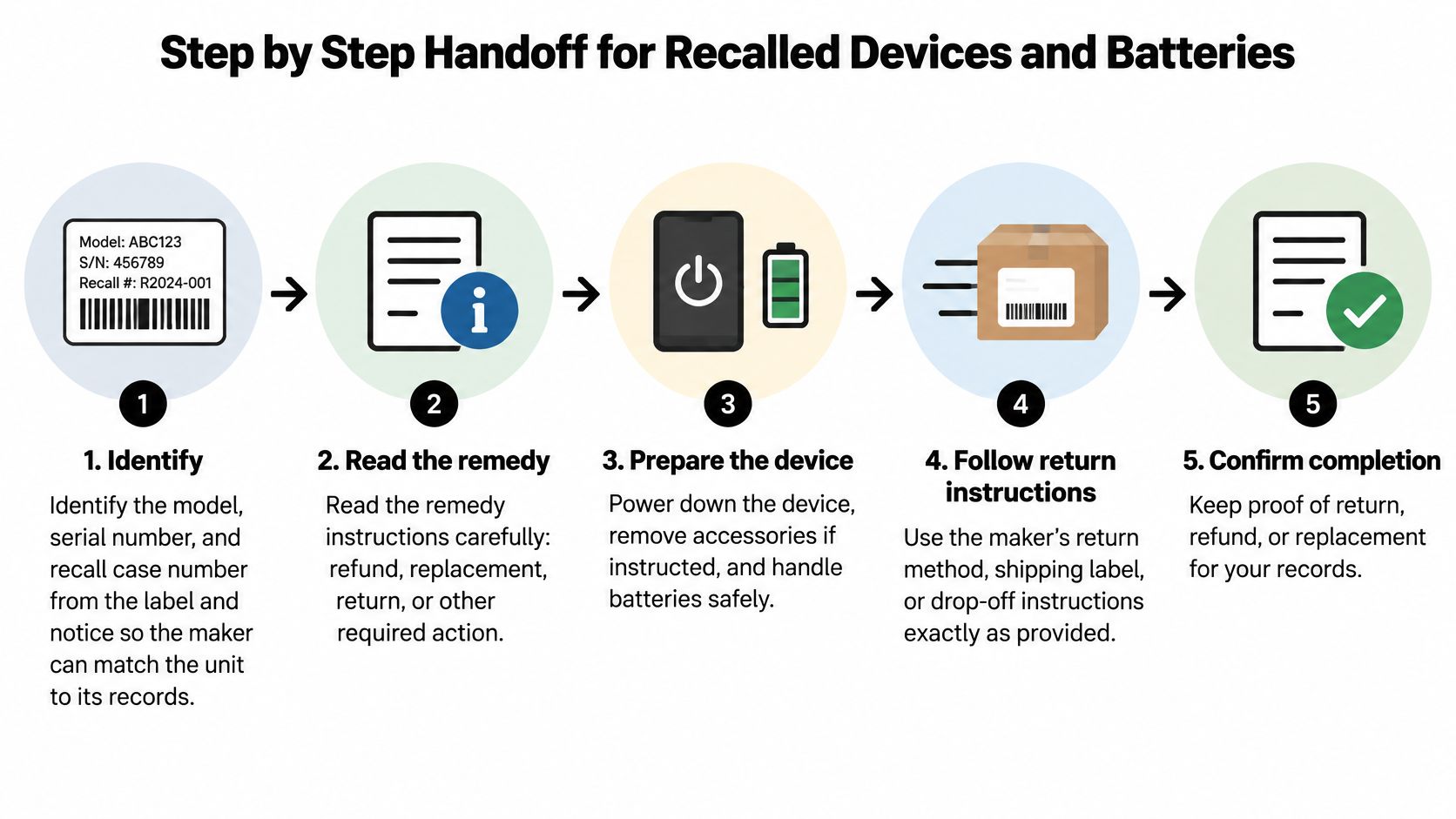
- Identify the unit. Copy the model, serial number, and recall case from the label and the notice, because the maker may accept only units that match its records. Open an intake line with asset ID, condition, battery status, and each later custody change.
- Read the remedy before you touch storage. Refund, replacement, return, and destruction are not interchangeable. Some notices require serial verification first. Wiping a drive, or mailing the unit, before that check can kill the claim.
- Isolate it and stop charging it. Put the unit in a labeled quarantine, away from paper, solvents, and other combustibles. Ban resale, donation, and parts harvesting until the manufacturer or regulator authorizes it. A swollen case, heat, leaking fluid, a burnt smell, or a puncture changes the plan: stop handling, move it only if you can do so safely into an open area or a fire-safe container, and do not open the housing or pull the battery unless the notice allows it.
- Confirm a receiver before you drive. Call the municipal household-hazardous-waste facility and ask whether it accepts recalled batteries. If it refuses, ask for the municipality's designated alternative, a manufacturer collection kit, or a specialist hazardous-waste hauler, and log the name, date, and answer. Lithium battery recycling belongs in that call, not in a mixed gaylord with ordinary e-waste.
- Sanitize data-bearing parts only when the remedy allows it. Use your approved method and keep the serial on the certificate. If the maker still needs the intact unit, do not shred it to "get ahead."
- Pack only as the notice requires. Use the original box when you still have it, tape terminals, and never put loose batteries in the same container. Keep CRT monitors and televisions out of the mixed electronics pallet and send them on their own qualified shipment.
- Close the serial. Take a signed receipt, mark the asset out of inventory, and file the recall reference with that receipt.
Slips that reopen the risk
Mailing a battery without approval: Carriers and the recall notice both have to allow it. A prepaid label for the laptop does not cover the cell.
Assuming a general recycler takes defective cells: Many sustainable recycling contracts exclude damaged lithium. Get the exclusion in writing against your model list.
Mixing a recalled pack into a data center decommissioning pallet: The server load can be routine. The pack is not. Split them before the truck arrives.
Wiping or Destroying Data Before Any Handoff
A shredder pass is not sanitization. NIST SP 800-88 defines sanitization as rendering access to stored data infeasible for the applicable level of effort, and it warns that destructive techniques can fail on medium- and high-security media because modern storage is dense and a coarse shred can leave recoverable fragments behind.
Match the method to the data and the drive.
- Cryptographic erase fits properly encrypted modern drives. It is the path NIST recognizes for that media, and it finishes faster than overwriting a large array.
- Full-drive overwrite fits older machines with spinning disks. The FTC guidance on disposing of old computers states that ordinary delete commands are not enough because files may remain recoverable, and that secure-erasure software should overwrite the entire drive.
- Physical destruction fits high-sensitivity media when the technique is thorough and the vendor's plan specifies particle size instead of assuming a light pass through a shredder covers it.
Work in this order.
- Classify the asset by sensitivity: employee files, student records, patient data, or citizen data.
- Check the remedy. If the manufacturer needs the unit intact, do not destroy it. Photograph the label and serial plate first, because some remedies need that plate readable.
- Apply the approved method, then verify it. A log file from the erase tool or a destruction certificate with a witness signature closes the step. A technician's verbal assurance does not.
- Keep the certificate with method, operator, date, and serial number, and get the downstream processor's written acceptance that data-bearing parts were sanitized or destroyed, not merely recycled.
Gather the unwanted electronics and note every device that holds sensitive data before an electronics pickup is scheduled. For phones and tablets, the wipe may have to wait until the recall return is accepted. Isolate a battery before treatment only when the notice and a trained procedure allow it. Otherwise the intact unit goes through the hazardous channel. Data sanitization methods should be named on that certificate, so an auditor can match the serial without opening another system.
When the Manufacturer or Local Program Refuses
The usual dead end is simple. The maker has stopped taking returns, the remedy window has closed, or the local program will not take a recalled battery. Informal disposal is still not the fallback.
- Check the state environmental agency site for e-waste rules that sit on top of federal guidance. A landfill ban or a business-generator rule can close the bin you were counting on.
- Ask the manufacturer in writing whether an alternative remedy, a collection kit, or an extended deadline exists. Keep the reply with the recall case number.
- Use the municipality's named alternative if staff give you one. Record the facility name, the date, and the acceptance, including any limit on commercial quantities.
- Do not donate, resell, or harvest parts until the manufacturer or a regulator authorizes it. A working-looking laptop from a school cart is still a recalled asset.
- Quarantine what has no approved channel. Keep it in a labeled, fire-safe area, log every refusal, and escalate to a certified recycler that will accept the hazardous items under a written plan. That file is the disposition until a legal outlet exists.
Reworx Recycling can compare those options and log each attempt, including units held back from corporate donation programs. A social enterprise goal does not override a closed remedy.
Keep Records That Prove Compliant Disposal
Records serve three readers: the manufacturer paying a claim, the regulator or auditor checking handling, and your own data governance. Recent CPSC notices on recalled Anker power banks show recalls that require serial-number checks and manufacturer return or disposal instructions, and notices that require photographs proving destruction before a refund can proceed. Destroying a recalled laptop or power station can cut fire risk and can also erase the evidence a refund, an insurance claim, or a warranty recovery needs.
Photograph labels. Secure and sanitize drives. Those are different files.
| Record | What to capture | Why it matters |
|---|---|---|
| Asset identifier | Internal ID, model, serial number | Links every other record to one physical unit |
| Recall reference | Recall case number and remedy chosen | Shows which remedy the disposal followed |
| Condition and battery status | Intact, swollen, leaking or damaged; photos of label and battery | Supports the hazard decision and the transport route |
| Custody transfers | Name of each handler, date and location | Proves who held the device at each stage |
| Disposition authorization | Manufacturer or regulator approval where required | Protects recall eligibility and avoids unauthorized disposal |
| Facility or transporter receipt | Signed receipt from the collection or recycling site | Confirms the device reached an approved channel |
| Data destruction certificate | Method, operator, date and serial number | Shows that data was sanitized or destroyed as documented |
Back up anything you still need before a wipe. A practical guide to business backups is a useful check so sanitization does not become the only copy of a finance or clinical file. Keep the packet with the asset record for as long as the recall, insurance, or audit window requires, and tie each serial to its receipt. Chain-of-custody documentation should let someone who was not in the room reconstruct what happened to that device from the file alone.
Schedule a Compliant Pickup for Your Recalled Equipment
Match the device to its route, isolate it, sanitize data, hand it off with a receipt, and file the records. That is the whole job.
For the next booking, gather the recalled units, mark which ones hold sensitive data and which have damaged batteries, and send that list so the pickup or drop-off matches the hazard. Customers can donate old electronics that are not under recall. Free e-waste pickups are available nationwide, and a single laptop and a bulk load both get a documented handoff, including loads that started as laboratory equipment disposal or an IT equipment disposal project.
Schedule an electronics recycling pickup once the list is ready, donate cleared equipment, or set a recurring office cleanout. Working hardware that passes recall clearance can support technology donations, digital inclusion, and workforce development. Recalled units stay on the controlled path.
Reworx Recycling helps businesses retire recalled electronics with documented pickup or drop-off, serial tracking, and responsible recycling after the recall owner authorizes the method. If you are holding quarantined laptops, power banks, or mixed IT gear, bring the asset list and the recall notice to the same conversation. Visit Reworx Recycling to donate cleared equipment, plan a pickup, or start a disposal partnership.