That pile of old IT equipment in the corner isn't just a clutter problem. It's a minefield of potential data security, environmental, and legal risks. An electronics recycling certification is your proof—a guarantee from an independent, third-party auditor that your recycling partner follows strict, documented standards for handling e-waste. It's your single best defense against these serious threats.
Why Certification Is Your Best Defense in E-Waste Disposal
In a world where data privacy and corporate responsibility are under a microscope, just finding any recycler for your old IT assets won't cut it anymore. Who you choose has direct consequences for your company's security, legal standing, and public reputation. This is where certification becomes a non-negotiable part of the process. It shifts you from hoping your assets are handled correctly to knowing they are.
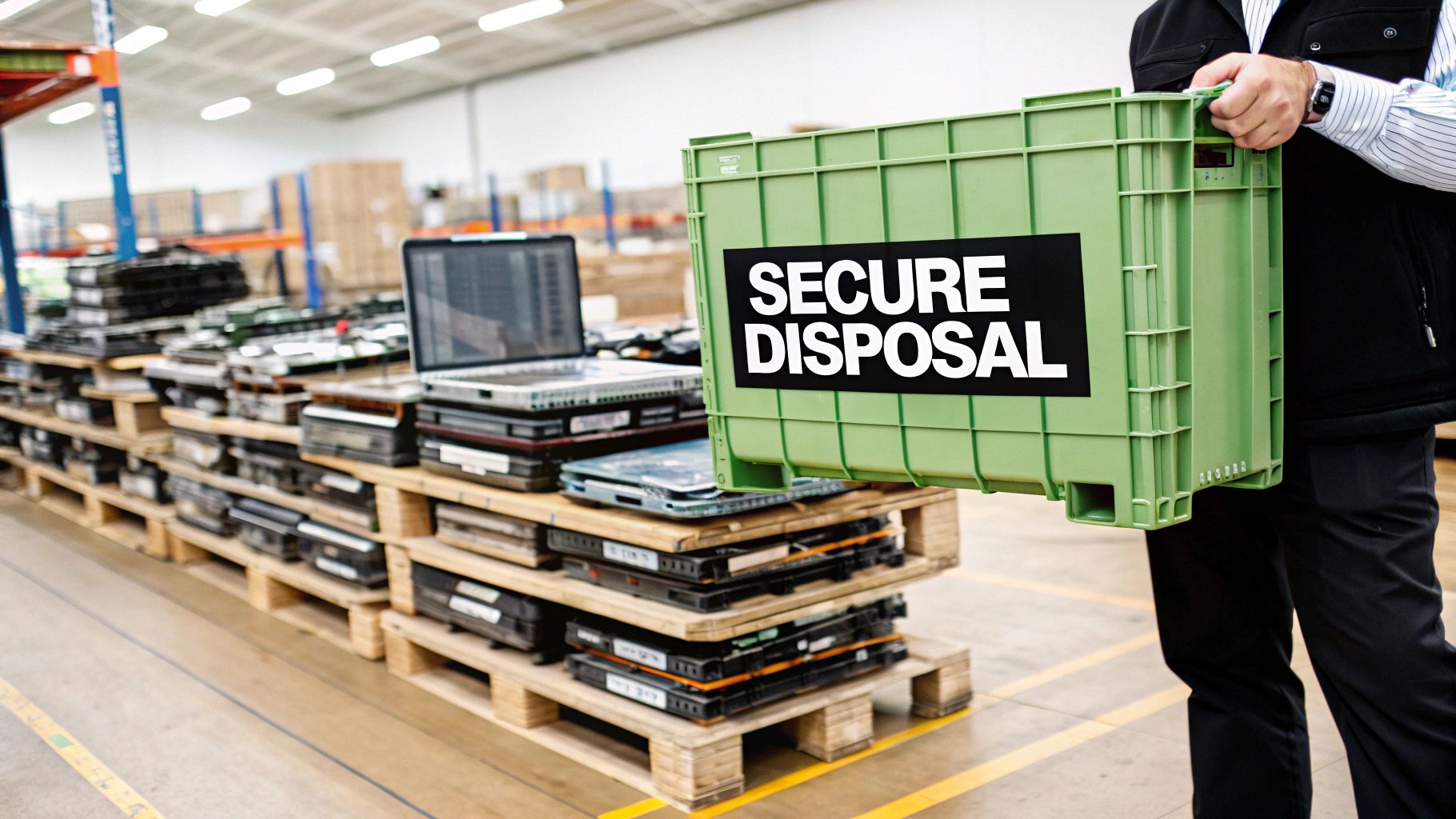
Think of it this way: you wouldn't hand over your company's investments to a financial advisor without credentials. The same logic applies to your data-bearing assets. Certification is the essential credential for the IT equipment disposal industry.
The Core Pillars of Protection
A legitimate electronics recycling certification is a promise, backed by proof, that your partner meets strict protocols in several key areas. It's a framework designed to protect your business from every angle.
- Secure Data Destruction: Certified recyclers must prove their methods for data sanitization and destruction are airtight. This is what protects you from data breaches that can trigger millions in fines under laws like HIPAA or GLBA.
- Environmental Compliance: Certification guarantees that all materials, especially hazardous ones like lead and mercury, are managed responsibly according to regulations from the Environmental Protection Agency (EPA). No illegal dumping, no environmental harm.
- Worker Safety and Health: Top-tier certifications require safe working conditions for employees handling potentially hazardous electronic components. It shows a real commitment to ethical operations.
- Downstream Accountability: A certified recycler is required to track all materials to their final destination. This ensures none of your e-waste is illegally exported or dumped by a vendor down the line.
Beyond Compliance: A Strategic Business Decision
Working with a certified recycler is more than just a defensive play; it’s a smart, strategic decision that strengthens your brand. For IT managers and corporate sustainability leaders, it turns a routine office cleanout or data center decommissioning into a powerful story for your ESG (Environmental, Social, and Governance) reports.
Choosing a certified partner demonstrates a proactive commitment to risk management and corporate social responsibility. It provides tangible proof to investors, customers, and employees that your organization operates ethically and sustainably.
When you partner with a certified social enterprise like Reworx Recycling, this benefit is amplified. Our donation-based recycling model doesn't just meet the highest standards for data security and environmental responsibility—it also funnels reusable technology back into the community. This simple choice aligns a necessary operational task with a profound community impact, turning your retired assets into tools for digital inclusion and workforce development. You protect your business while actively helping build a stronger, more equitable society.
Diving Into the Most Important E-Waste Certifications
When you're trying to figure out e-waste recycling, the jumble of acronyms—R2, e-Stewards, ISO 14001—can feel like alphabet soup. But for any business owner, IT manager, or sustainability leader, knowing what these mean is the key to making a truly responsible choice for getting rid of old IT equipment.
Think of these certifications as a kind of trust hierarchy. At the bottom, you have the basic blueprint for environmental management. Then, more specialized, e-waste-specific standards build on top of that, creating a solid framework for security and ethical recycling.
The Foundational Standard: ISO 14001
ISO 14001 is the international standard for an Environmental Management System (EMS). It proves a recycling facility has a solid system in place to measure and continuously improve its environmental impact. While it’s not exclusive to e-waste, this certification shows a real commitment to responsible operations. It tells you a partner like Reworx Recycling has established processes to manage its environmental duties, meet compliance rules, and hit its own sustainability goals. It's often the first big step a recycler takes before going after the more specialized credentials.
R2v3 (Responsible Recycling): The Industry Benchmark
Building on that foundation is the R2 (Responsible Recycling) standard, now in its third version (R2v3). It's the most widely adopted electronics recycling certification in the world, setting tough requirements for every single step of the recycling journey.
The R2 standard digs into several critical areas:
- Data Security: It demands strict, documented processes for wiping and destroying data, which is your best defense against a breach.
- Downstream Vendor Management: Recyclers have to vet and track all materials to their final destination. This ensures none of your assets end up in an uncertified, non-compliant facility.
- Worker Health and Safety: It enforces clear protocols to protect employees from the hazards that come with handling electronic components.
- Legal Compliance: It requires total adherence to all applicable environmental, health, and safety laws.
Choosing an R2-certified partner gives you a high level of confidence that your old computers, servers, and other office gear are being managed securely and ethically from the moment they leave your hands.
E-Stewards: The Gold Standard for Environmental Purity
At the very top of the hierarchy sits the e-Stewards certification. It’s widely seen as the most stringent standard in the industry, making it the benchmark for companies with a deep commitment to environmental and social governance (ESG).
The e-Stewards certification is a big deal for organizations that put corporate social responsibility first. It guarantees that e-waste isn't just shipped off to developing countries and that recycling practices meet the highest environmental and human rights standards.
The biggest thing that sets e-Stewards apart is its absolute ban on exporting hazardous electronic waste to developing nations. It also has a strict no-landfill and no-incineration policy for toxic materials. For businesses whose brand is built on a deep commitment to sustainability, an e-Stewards certified partner offers the ultimate peace of mind.
To help you see how these stack up, here’s a quick comparison.
Comparing Major E-Waste Recycling Certifications
This table gives you a side-by-side look at the top electronics recycling certifications, helping you understand their core focus and what they demand from a recycler.
| Certification | Primary Focus | Key Requirement | Best For Businesses That Prioritize… |
|---|---|---|---|
| ISO 14001 | Environmental Management | Establishes a formal Environmental Management System (EMS). | A foundational commitment to environmental processes. |
| R2v3 | Comprehensive E-Waste Management | Data security, downstream tracking, and worker safety. | A balance of data security, compliance, and responsible recycling. |
| e-Stewards | Environmental and Social Responsibility | Absolute ban on exporting hazardous e-waste to developing nations. | The highest level of environmental purity and ethical treatment. |
Understanding these key differences empowers your business to confidently vet potential partners. Of course, many leading certifications also require strict control over hazardous materials. A solid grasp of regulations, like the relevant topics within the REACH Directive SVHC List, is crucial for any certified recycler to stay compliant. This knowledge will help you pick a recycler whose credentials align perfectly with your company’s risk tolerance, compliance needs, and corporate values.
The Real Business Value of a Certified Recycling Partner
When you move past the theory behind the standards, what does partnering with a certified recycler actually do for your business? The return on this decision is surprisingly powerful, touching everything from your data security and legal standing to your brand’s reputation. An electronics recycling certification is much more than a logo; it’s a guarantee that protects your bottom line.
This choice turns a routine task—getting rid of old IT gear—into a strategic move. The real value isn't just in what you dispose of, but in the peace of mind and brand equity you build along the way.
Ironclad Data Security and Risk Mitigation
First and foremost, the real value is in ironclad data security. A data breach is one of the most devastating events a modern business can face, with the average cost soaring into the millions. Certified recyclers are required to undergo rigorous, ongoing audits to prove their data destruction processes are not just effective, but completely foolproof.
This isn't a vague promise; it's a documented and audited commitment.
- Audited Processes: Their methods for wiping or shredding hard drives are tested by third-party experts to meet or exceed tough government and industry standards.
- Chain of Custody: From the second your equipment leaves your office, a certified partner maintains a secure and unbroken chain of custody, tracked right up until a final Certificate of Data Destruction is issued.
- Reduced Liability: This verifiable process gives you legal proof of due diligence, shielding your company from the severe financial and reputational fallout of a data breach that comes from improperly discarded assets.
Guaranteed Environmental and Legal Compliance
Next, a certified partner guarantees you’re meeting your environmental obligations. The regulatory landscape for e-waste is a complex and constantly shifting maze. Federal laws like the Resource Conservation and Recovery Act (RCRA) impose strict rules on handling the hazardous materials found in most electronics.
A certified recycler takes on this responsibility for you, making sure every component from your old computers, lab equipment, or servers is managed in full compliance with the law. This completely removes the risk of steep fines and legal headaches that come with environmental negligence.
This diagram shows the hierarchy of trust in e-waste certifications, from the foundational ISO 14001 to the specialized R2 and e-Stewards standards.
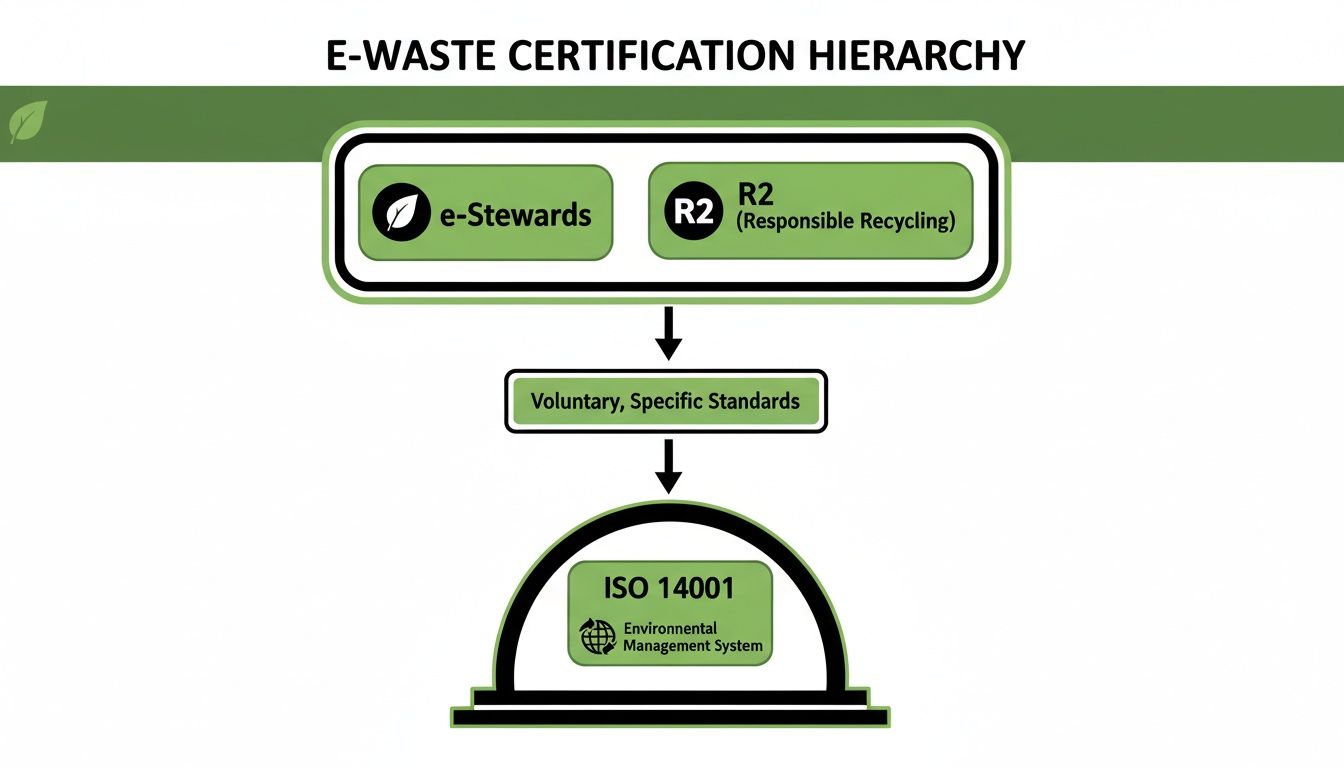
As you can see, specialized certifications like R2 don't exist in a vacuum. They build on the core principles of a solid environmental management system, adding critical layers of security and accountability that give you true peace of mind.
A Powerful Story for Your Brand and ESG Goals
Finally, choosing the right partner is a powerful statement about your brand’s commitment to sustainability and corporate responsibility. In an era where customers, investors, and employees are all scrutinizing a company's ethical footprint, your choice of vendors says a lot. Partnering with a certified social enterprise like Reworx Recycling provides a compelling, authentic story for your ESG reports.
By selecting a certified recycler, you convert a cost center into a brand asset. It’s tangible proof of your commitment to ethical operations, providing a powerful narrative for stakeholders, investors, and customers who increasingly demand corporate accountability.
This approach transforms a necessary task into a public demonstration of your company's values. Your retired assets don't just disappear; they are securely and responsibly handled, with reusable technology often funneled back into the community to support digital inclusion.
Of course, the benefits don't stop at just compliance. Understanding how responsible e-waste management fits into your broader sustainability strategy is key. For example, topics like Why Carbon Accounting Matters for Your Business Now show how these decisions contribute to a healthier environmental footprint. To learn more about what to look for, check out our guide on the key factors for choosing an e-waste recycling partner. This isn't just about getting rid of old equipment; it's about building a more resilient, respected, and responsible brand.
How to Spot Greenwashing and Verify a Recycler's Credentials
In the world of IT equipment disposal, it’s easy to get fooled by flashy claims of being "green" or "eco-friendly." This is the classic problem of greenwashing: when a company spends more time and money looking environmentally friendly than actually being environmentally friendly. For any business owner or IT manager, cutting through the fluff is a critical part of due diligence.
The good news? A legitimate electronics recycling certification is your best defense. These aren't just fancy logos for a website; they are hard-earned credentials backed by rigorous, independent audits. This guide will show you how to look past the marketing and ensure your partner for that next office cleanout or data center decommissioning is the real deal.
Go Straight to the Source for Verification
You should never just take a recycler’s word for it. The most foolproof way to verify a company’s status is to check the official databases managed by the certifying organizations themselves. This simple step cuts right through the marketing noise and gives you undeniable, real-time proof.
- For R2 (Responsible Recycling): Head over to the official directory maintained by SERI (Sustainable Electronics Recycling International). You can search their database to confirm a facility's R2 certification is current and valid.
- For e-Stewards: The Basel Action Network (BAN) is the gatekeeper for this standard. They manage the official list of e-Stewards certified recyclers, and a quick search will tell you if a provider truly meets this high bar.
If a company claims a certification but doesn't show up in the official directory, that’s a massive red flag. Transparent partners like Reworx Recycling will always be upfront with their certification details and encourage you to verify them independently.
Critical Red Flags to Watch For
Beyond checking the databases, there are several other warning signs that a recycler might not be as reputable as they seem. Keeping an eye out for these red flags during your vetting process can save you from major legal headaches and reputational damage down the road.
Vague, unsupported claims like "eco-friendly disposal" or "green recycling" without any specific, verifiable certifications are the hallmark of greenwashing. True responsibility is demonstrated through audited, third-party standards, not just buzzwords.
Be cautious of any potential partner who does the following:
- Won’t Provide a Certificate: A legitimate recycler will always issue a Certificate of Destruction or Certificate of Recycling. If they hesitate or refuse, it’s a good sign their processes aren’t documented or defensible.
- Lacks Transparency: Ask them about their downstream partners—where do the materials go after leaving their facility? If they get cagey, that’s a huge concern. Certified recyclers are required to maintain a transparent and fully accountable downstream chain.
- Offers Unusually Low Prices: While everyone wants a good deal, rock-bottom prices often mean a recycler is cutting corners. This could involve anything from illegally exporting e-waste to skipping crucial data security measures.
- Doesn't Emphasize Data Security: Any reputable recycler knows that data security is paramount. If their website and sales materials don’t prominently feature their secure data destruction services, they likely don’t have the expertise to handle your assets safely. To understand this better, you can learn more about the importance of standards like NAID AAA certification for data security.
By arming yourself with these verification tools and red flags, you can confidently perform your due diligence on any potential recycling partner. This ensures your ITAD strategy is built not on empty promises, but on a foundation of verifiable trust and a genuine commitment to doing things the right way.
Why Market Growth Is Driving Demand for Certified Recyclers
The sharp rise in demand for certified electronics recycling isn't happening in a bubble. It's a direct response to two powerful global forces: an absolute explosion in electronic waste and a tidal wave of government regulations trying to get it under control.
For businesses, this new reality is shifting the conversation. Choosing a certified recycling partner is no longer just a "best practice"—it's quickly becoming a core operational necessity.
The E-Waste Explosion and Regulatory Response
The global electronics recycling market is growing at a breakneck pace, fueled by the sheer volume of retired devices. A recent industry report valued the market at USD 43.2 billion in 2025 and projected it to skyrocket to USD 147.9 billion by 2035.
What’s driving this? Mostly, it's a flood of new e-waste regulations. In 2022 alone, the world generated a staggering 62 million tonnes of e-waste, but a shockingly low 22 percent was properly collected and recycled.
Governments are responding. By 2023, 81 countries had enacted e-waste legislation, creating a complex web of rules that hold manufacturers and businesses accountable. The days of informal or unverified IT equipment disposal are officially over.
Choosing a certified recycler is the most direct way to future-proof your business against evolving e-waste regulations. It provides a verifiable, third-party guarantee that your disposal practices meet the highest legal and ethical standards, protecting you from fines and legal action.
This proactive stance doesn't just keep you compliant; it positions your company as a leader in responsible, sustainable operations.
Market Demand for Trust and Transparency
It isn't just about government mandates, either. The market itself is pushing businesses toward certified partners. Customers, investors, and even your own employees are looking closely at corporate environmental, social, and governance (ESG) policies.
A company's choice of vendors—especially for sensitive tasks like laptop disposal or product destruction—is now seen as a direct reflection of its values.
This demand for transparency comes from a few key places:
- Brand Reputation: A single incident of improper e-waste dumping can cause immense and lasting damage to a company's public image.
- Investor Scrutiny: ESG-focused investors actively seek out companies that can prove a real commitment to sustainability through verifiable actions.
- Supply Chain Integrity: Businesses need assurance that their recycling partners aren't contributing to illegal e-waste exports or unethical labor practices downstream.
Partnering with a certified social enterprise like Reworx Recycling directly answers these market demands. Our donation-based recycling model offers the highest level of certified security and environmental compliance while giving you a powerful, positive story to share with your stakeholders.
You can learn more about what the future holds for e-waste and the innovations driving change by reading our article on trends and innovations in recycling. This approach ensures your IT asset disposition (ITAD) strategy isn't just compliant but is also a valuable asset to your brand.
Building a Certified ITAD Program That Works
Knowing what electronics recycling certifications are is one thing. Actually turning that knowledge into a solid, internal IT Asset Disposition (ITAD) program is what really protects your company. This is where you put theory into practice, creating a clear, repeatable process that makes responsible recycling a part of your company’s DNA. A well-designed program means every single piece of retired tech gets handled the right way, every time.
This isn't just about checking a compliance box—it's about building an efficient, secure, and smart system for your end-of-life assets. And when you work with a partner like Reworx Recycling, the whole thing becomes simple, secure, and perfectly aligned with your company's bigger goals.
Mandating Certification in Your Procurement Policy
The single most effective way to ensure you're working with qualified recyclers is to make certification a formal requirement. Your company’s procurement or vendor management policy is the perfect place to put this in writing. By updating this policy, you establish a non-negotiable standard for anyone involved in getting rid of old IT gear.
Make sure your updated policy clearly states:
- All ITAD partners must hold a current R2v3 or e-Stewards certification.
- They must provide proof of that certification before any contract is signed or work begins.
- Their certification status must be checked and confirmed every year.
This simple change takes all the guesswork out of the equation. It guarantees that only pre-vetted, top-tier recyclers ever touch your assets.
Standardizing Your Process from Start to Finish
With certification mandated, the next move is to standardize your operational workflow. This gives you consistency, whether you’re retiring a few old laptops or decommissioning an entire data center. A standard process closes the door on mistakes and gives you a clear audit trail from beginning to end.
Your process should always include these key steps:
- Mandatory Asset Inventory: Before anything leaves your facility, create a detailed list of every device being retired. Make sure to flag any that hold data.
- Secure Chain of Custody: Your partner must provide documentation that tracks your assets from the moment they leave your control until they arrive at their facility.
- Required Certificates of Destruction: A Certificate of Data Destruction for every batch of assets is non-negotiable. This is your official, legal proof that the data was properly handled.
Following these steps creates a transparent and defensible system for your IT asset disposition needs.
Educating Your Internal Teams
A policy is only as good as the people who follow it. You have to get your IT, facilities, and procurement teams on board by explaining why these rules are so important. Let them know that a certified partner is what stands between the company and a potential data breach, environmental fine, or serious brand damage.
When your team understands the risks involved, they become your best defense in maintaining a secure ITAD program.
Partnering with Reworx Recycling makes this entire process feel effortless. Our certified, donation-based model delivers the security you demand and the positive social impact your company wants to create. Your next step is to schedule a pickup and build an ITAD program that truly works.
Common Questions About Electronics Recycling Certifications
When you're dealing with old tech, questions about certifications are bound to come up. For any business, getting clear answers is the key to protecting yourself from liability and making a smart choice. Let's tackle some of the most common questions from IT managers, business owners, and sustainability leaders.
Is an ISO 14001 Certification Good Enough for Electronics?
While ISO 14001 is a great starting point—it shows a recycler has a solid environmental management system in place—it just doesn't go far enough for the unique risks that come with e-waste. Old electronics contain both sensitive data and potentially hazardous materials, both of which need specialized handling.
This is where certifications like R2v3 and e-Stewards come in. They build on the foundation of ISO 14001 but add layers of critical, industry-specific rules. These include strict protocols for destroying data securely, tracking materials to downstream partners, and keeping workers safe. For total peace of mind, you should always look for a recycler with R2 or e-Stewards certification in addition to ISO 14001.
What’s the Difference Between "Registered" and "Certified"?
This is a really important distinction, and one that trips a lot of people up. Getting it right helps you avoid partners who are only doing the bare minimum.
Registered: This usually just means the facility is on a list with a state or local environmental agency. The process might be as simple as filling out a form and paying a fee. There's often little to no real oversight of their day-to-day operations.
Certified: This is a whole different ballgame. It means the facility voluntarily went through tough, independent audits to prove they meet the high standards of a program like R2 or e-Stewards.
Certification is an active commitment to doing things the right way, backed by verifiable proof from a third party. Registration, on the other hand, is often just a passive legal checkbox. Always, always choose certified partners.
How Does Using a Certified Recycler Help My Company’s ESG Goals?
Partnering with a certified recycler is a powerful and direct way to support all three pillars of your ESG (Environmental, Social, and Governance) strategy. It turns a routine task like equipment disposal into a tangible win for your corporate responsibility goals.
On the Environmental front, it’s a guarantee that your old electronics are managed responsibly. This prevents pollution, promotes the circular economy, and gives you solid, verifiable data for your sustainability reports.
For the Social piece, choosing a certified social enterprise like Reworx Recycling takes your impact even further. Your retired assets can be refurbished to support community programs that bridge the digital divide and create workforce development opportunities.
Finally, from a Governance perspective, it’s a clear signal of strong corporate oversight and proactive risk management. It shows stakeholders—from your customers to your board—that you’re committed to transparent, ethical, and compliant business practices.
Ready to turn your retired technology into a force for good? Partner with Reworx Recycling for secure, certified, and impactful ITAD solutions that align with your business values. Schedule a pickup today to donate your old equipment and see how our social enterprise can benefit your community and your bottom line. You can explore more topics on our recycling blog.