Your facilities lead is planning an office cleanout. Your IT team is refreshing laptops. Finance wants clearer sustainability reporting before budget season. At the same time, customers, boards, and procurement teams are asking harder questions about emissions claims.
That's where carbon offset calculation stops being a marketing exercise and starts becoming operational work.
For most businesses, the challenge isn't understanding the broad idea of offsets. It's figuring out how to calculate emissions in a way that stands up to scrutiny, especially when a big part of the footprint sits inside the technology lifecycle. Servers, monitors, networking gear, storage devices, leased equipment, shipping, decommissioning, and downstream recycling all create accounting questions that simple consumer calculators don't answer well.
A credible carbon strategy usually combines direct reductions, better procurement, cleaner energy choices, and carefully selected offsets for remaining emissions. If you're also evaluating energy choices, it helps to explore solar energy's environmental impact alongside your broader footprint decisions so you're not treating offsets as your only lever.
Why Carbon Offset Calculation Matters for Your Business
Businesses don't get much credit anymore for vague sustainability language. Buyers want detail. Internal stakeholders want traceability. Auditors and reporting teams want a clear method they can defend.
That's why carbon offset calculation matters. If the calculation behind an offset claim is weak, the claim itself is weak.
Trust depends on the math
An offset only has meaning if the underlying emissions estimate is credible. If your business can't explain what activities were counted, what time period was used, and where the emissions factors came from, then “carbon neutral” starts to sound like branding instead of accounting.
That risk is especially high in tech-heavy organizations. Many companies can estimate electricity use from utility bills. Fewer can explain the footprint tied to laptop refresh cycles, data center migrations, device transport, secure data destruction, or end-of-life handling.
Practical rule: If a sustainability claim can't survive a procurement questionnaire or board review, it's not ready for publication.
The business case is practical
Accurate carbon accounting helps with more than public messaging. It improves vendor conversations, sharpens capital planning, and gives operations teams a clearer view of where reduction work should happen first.
For example, an IT manager deciding between extending hardware life, buying refurbished equipment, or accelerating replacement needs more than a disposal invoice. They need emissions visibility across the lifecycle. That's one reason many companies pair offset planning with broader corporate sustainability goal setting. The offset is only one decision. The management system around it matters just as much.
What works and what doesn't
A few approaches tend to hold up in practice:
- What works: using a defined reporting period, documented assumptions, and operational boundaries your finance and operations teams both understand.
- What works: separating reduction efforts from offset purchases so nobody confuses compensation with actual operational decarbonization.
- What doesn't: buying credits first and trying to reverse-engineer the emissions math later.
- What doesn't: treating IT disposal as a black box after equipment leaves the building.
Carbon offset calculation is useful when it's boring in the best possible way. Measured inputs. Clear formulas. Verifiable records. Honest claims.
The Building Blocks of a Credible Offset Calculation
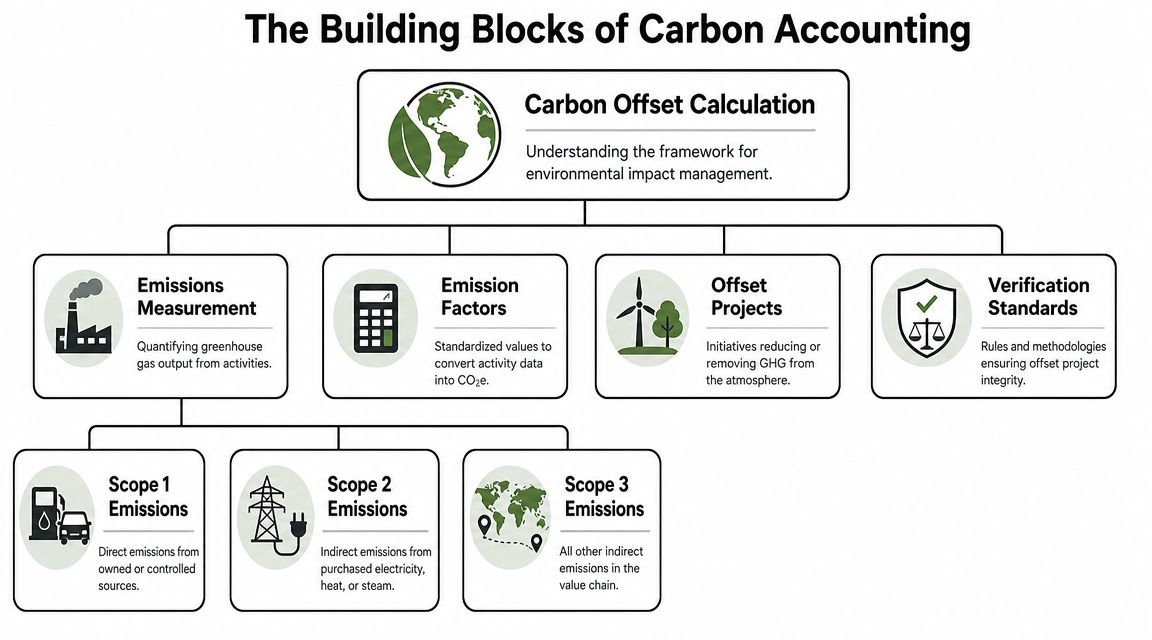
Before you can buy a single credit, you need a common language inside the business. Most confusion starts when teams use the same words to mean different things.
Start with scopes
Most business footprints are organized into Scope 1, Scope 2, and Scope 3 emissions.
| Scope | What it usually includes | Common business example |
|---|---|---|
| Scope 1 | Direct emissions from sources you own or control | Company vehicles, onsite fuel combustion |
| Scope 2 | Indirect emissions from purchased energy | Office electricity, purchased heating or cooling |
| Scope 3 | Other indirect emissions across the value chain | Purchased laptops, cloud services, freight, disposal activities |
For a tech-enabled business, Scope 3 is often where the mess begins. Hardware procurement, warehousing, third-party logistics, leased equipment, and end-of-life processing don't fit neatly into a simple utility-bill model.
Understand CO2e and emission factors
You won't calculate every greenhouse gas one by one in daily business operations. Instead, teams typically convert emissions into CO2e, or carbon dioxide equivalent, so different gases can be reported in one comparable unit.
The working formula is straightforward. A robust calculation starts by quantifying activity data, applying an emission factor, and converting gases into CO2e. In practical terms, “activity data × emission factor = GHG emission,” and reporting should generally cover a 12-month period as noted in guidance on calculating carbon credits.
That means your spreadsheet needs two things before it needs anything else:
- Activity data: kilowatt-hours, gallons of fuel, miles shipped, number of devices purchased, weight of materials handled.
- Emission factors: the conversion values that translate those activities into greenhouse-gas emissions.
Know what a carbon credit actually represents
Once the footprint is calculated, offsets come into view. A foundational rule is that 1 credit = 1 metric tonne of greenhouse-gas reduction or removal, provided that reduction is additional, permanent, and otherwise uncounted, with project reductions compared against a baseline and typically subject to independent third-party verification according to the Carbon Offset Guide.
That standard matters because it keeps offsets tied to measurable accounting, not charitable intent.
A credit is only as credible as the baseline, verification, and claim discipline behind it.
Why IT teams should care
If you manage device fleets or infrastructure, this isn't abstract policy language. Scope definitions influence how you classify retired assets, leased servers, equipment transfers, and residual value recovery. Good asset recovery planning often improves both documentation quality and lifecycle visibility, which makes later offset decisions easier to defend.
Gathering Your IT and Operational Activity Data
Most carbon projects don't fail because the formula is hard. They fail because the data is scattered across AP systems, facilities records, procurement files, and vendor portals.
That problem gets worse in IT environments. Hardware moves fast, ownership changes, and disposal events often happen under deadline pressure.

Where to pull the first-pass data
Start with records your teams already have. Don't wait for perfect granularity on day one.
- Facilities records: utility bills, backup generator fuel logs, maintenance logs for HVAC or onsite equipment.
- Fleet and transport records: fuel purchases, mileage logs, courier and freight invoices.
- Procurement data: purchase orders for laptops, monitors, servers, docking stations, networking gear, batteries, and peripherals.
- IT inventory systems: asset tags, model numbers, deployment dates, retirement dates, serial-level device counts.
- Waste and recycling documentation: bills of lading, decommissioning records, chain-of-custody files, certificates tied to recycling or destruction.
The U.S. EPA guidance cited in the verified data also advises relying on utility bills, fuel data, and yearly usage when using calculators for better accuracy. That sounds basic, but in practice it prevents a lot of avoidable guesswork.
Scope 3 is where IT lifecycle accounting gets real
One of the biggest gaps in carbon offset calculation is mixed and indirect emissions. Guidance often focuses on flights or household-style estimates, while business value chains are more fragmented. That gap is specifically noted by the UNFCCC carbon offset platform, and it matters for procurement, IT refresh cycles, and third-party logistics.
In practical terms, that means a business should ask questions like these:
- Purchased equipment: What devices entered service during the reporting year?
- Refresh cycles: Were systems upgraded early, on schedule, or life-extended?
- Disposition activities: Were retired devices reused, resold, dismantled, or recycled?
- Third-party handling: Can your ITAD or recycling vendor provide auditable downstream records?
If your hardware leaves the building but disappears from your data trail, your Scope 3 story is incomplete.
Build a collection process your team can repeat
A strong process is less about sophistication and more about repeatability. One useful reference for tightening fragmented records is Querio on improving data reliability, especially if your finance, facilities, and IT systems don't use the same naming logic.
For internal operations, a simple collection model works well:
- Assign ownership to facilities, IT, procurement, and finance.
- Set one reporting window that aligns with your operating year.
- Create one source register listing every file, vendor report, and system export used.
- Flag assumptions so they can be reviewed later instead of hidden in formulas.
For IT departments, this is also where device retirement reporting becomes useful. If you're trying to connect e-waste handling to emissions decisions, practical guidance on minimizing the carbon footprint of IT departments helps frame disposal as part of lifecycle accounting, not just end-of-life cleanup.
How to Calculate Your CO2e Footprint
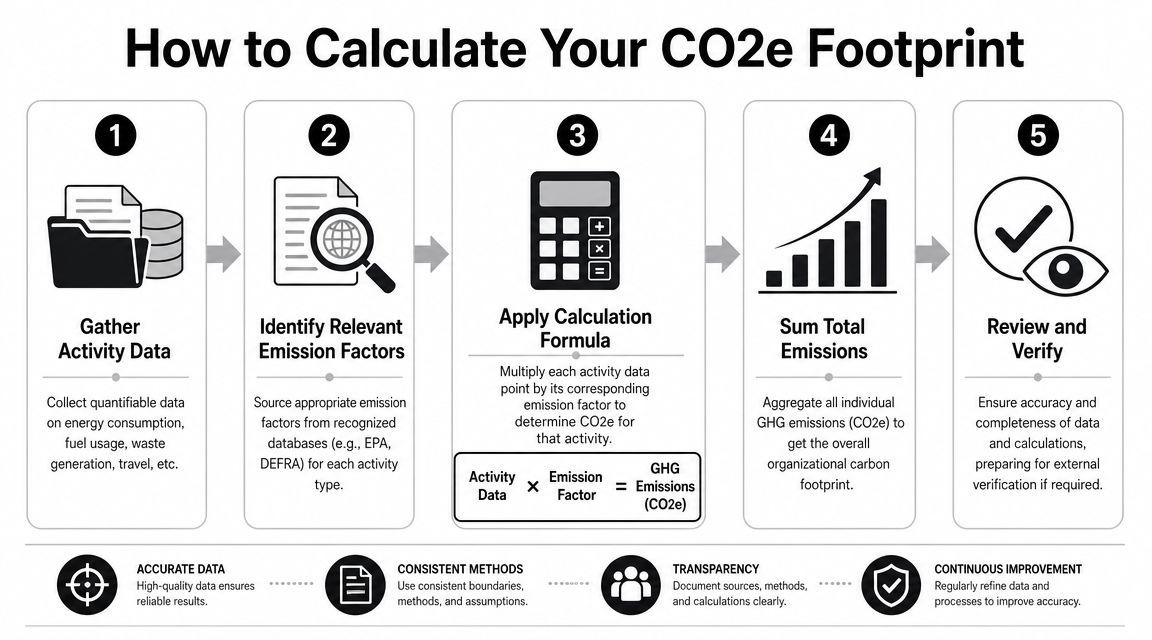
Once your activity data is collected, the calculation itself is more mechanical than is often thought. The hard part is usually choosing the right boundary and documenting assumptions well enough that someone else can follow the logic.
Use a consistent formula
The core formula is simple:
Activity data × emission factor = GHG emissions
That framework comes directly from the verified guidance already noted. The discipline is in doing it consistently across categories and keeping the reporting period to a defined 12-month window.
A practical IT example
Take a common scenario. Your company is doing an office cleanout and retiring laptops, monitors, and servers through an ITAD process. You want to estimate the emissions tied to that activity inside your broader annual inventory.
Here's how the workflow should look:
Define the activity boundary
Decide what you're counting. Transport to the processing site? Packaging materials? Decommissioning labor? Recycling or refurbishment pathway? Don't let the boundary drift halfway through the exercise.Gather the raw activity data
Pull device counts from your asset management system. Pull shipment data from the logistics record. Pull weight if the vendor reports by weight rather than by unit.Map each activity to an emission factor
Many teams use recognized public databases such as EPA factor resources for transport and energy-related activities, plus supplier or lifecycle data where available for equipment-related categories.Convert each line item to CO2e
Multiply each activity quantity by its relevant factor. Keep every assumption visible in the workbook.Aggregate the results
Sum those emissions into the category where they belong in your annual inventory.
What the spreadsheet might contain
A working sheet for that office cleanout could include rows like these:
| Activity line | Data source | Calculation approach |
|---|---|---|
| Retired laptop count | IT asset register | Device count paired with chosen lifecycle or disposal factor |
| Monitor shipment | Freight invoice | Distance or shipment record paired with transport factor |
| Server decommissioning energy | Facility or vendor record | Energy use paired with electricity factor |
| Recycling or recovery pathway | ITAD documentation | Treatment pathway paired with the selected methodology |
Notice what's missing. There's no invented shortcut and no generic “offset everything” line. Every entry needs a source and a method.
Working advice: If you can't show where a line item came from, don't let it drive a public claim.
Turning footprint into offset demand
After you total the emissions for the year, you can estimate offset demand in credits. If your footprint is measured in metric tonnes of CO2e, the credit quantity is generally matched on the same tonne basis when you purchase and retire credits for compensation.
That does not mean the exercise is over. The conversion from footprint to credit quantity is the easy part. You still need to decide whether the credits are appropriate for the claim you plan to make, and whether the underlying emissions estimate is complete enough to justify the purchase.
A practical example from the technology disposal side is working with a vendor that can supply environmental reporting on retired assets. Reworx Recycling provides reporting tied to processed e-waste and IT asset disposition activity, which can help businesses document downstream handling as one input into lifecycle and Scope 3 analysis.
Common mistakes in calculation workbooks
A few patterns cause trouble over and over:
- Mixed reporting periods: procurement data from one year paired with disposal data from another.
- Hidden assumptions: a workbook uses estimated shipment distances or generic device categories with no note explaining why.
- Double counting: the same event appears in facilities, IT, and vendor records and gets counted more than once.
- Premature precision: the sheet shows decimal confidence that the underlying records don't support.
Good carbon offset calculation is not about making the workbook look complex. It's about making each row explainable.
Choosing and Verifying Your Carbon Credits
Once you have a footprint, the next decision is whether the credits you buy support a defensible claim. Many otherwise careful teams encounter difficulties concerning this decision.
The market often presents offsets as interchangeable. They aren't.
Start with quality, not price
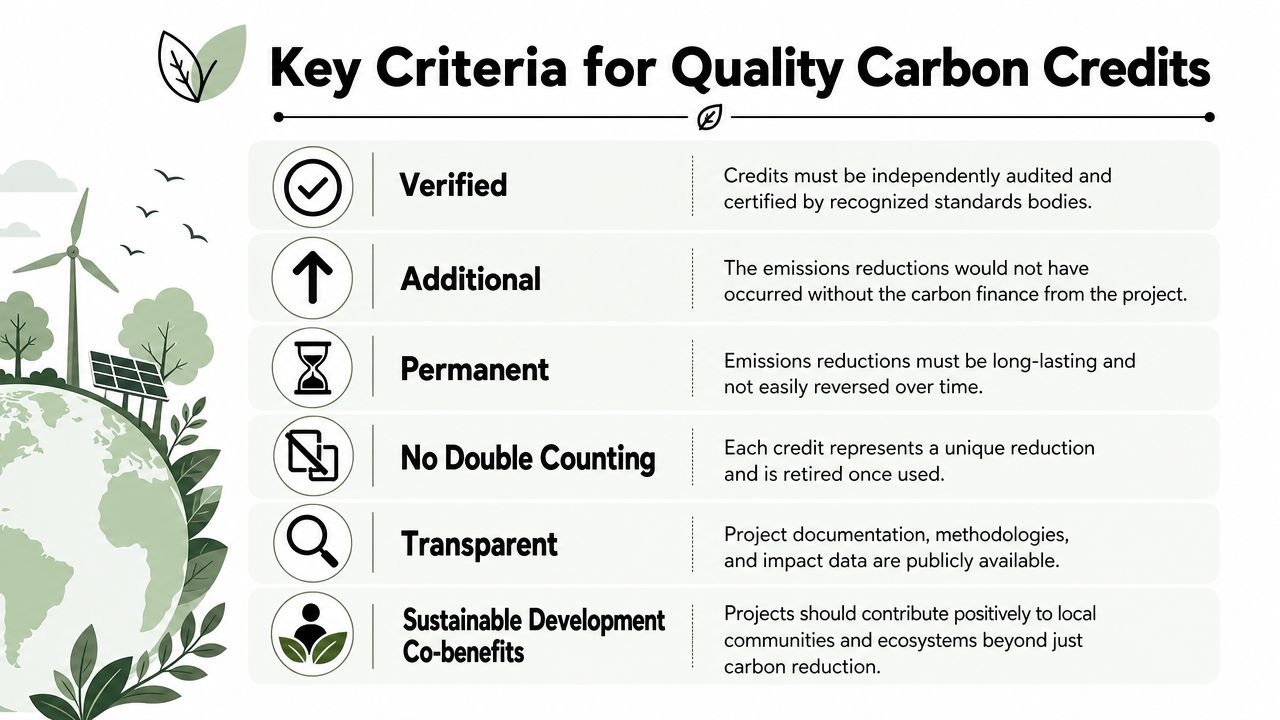
Foundational guidance defines a credit as one metric ton of CO2e, but it also stresses that a quality credit must be additional, permanent, and otherwise unclaimed. The harder part now is not arithmetic. It's deciding how much confidence to place in the calculated tonnage once those integrity questions are considered, as discussed in the offset market guidance document.
That's the key trade-off. Cheap credits can lower purchasing cost while increasing reputational risk.
Questions worth asking before you buy
Use these as screening questions in procurement or vendor review:
- Additionality: Would this project likely have happened without carbon finance?
- Permanence: If the project stores or avoids carbon today, how durable is that outcome?
- Claim clarity: Will your organization describe the purchase as compensation, neutralization, or a broader climate contribution?
- Retirement evidence: Can you confirm the credit will be retired and not claimed elsewhere?
- Project type: Are you buying an avoidance credit or a removal credit, and does that match your internal policy?
A lot of teams skip the last question. They shouldn't. Avoidance and removal projects can play different roles in climate claims, especially for businesses trying to be more precise about residual emissions.
Documentation matters as much as the purchase
Good offset procurement produces paperwork, not just a receipt.
| What to review | Why it matters |
|---|---|
| Project documentation | Shows methodology, baseline logic, and monitoring approach |
| Verification records | Confirms independent review took place |
| Registry retirement evidence | Supports exclusivity of claim |
| Chain of custody files for related IT events | Helps connect the operational event to the compensation decision |
For businesses linking offsets to equipment retirement or facility cleanouts, thorough chain of custody documentation helps close the gap between the physical asset event and the sustainability narrative built around it.
Buying a credit is easy. Defending the claim attached to it is the real work.
Keep an eye on market infrastructure
Some buyers are also evaluating newer market systems, including digital registries and a carbon credit tokenization platform, to understand how traceability and ownership records may evolve. That can be useful background, but tokenization doesn't solve core quality questions by itself. A weak project doesn't become strong because its recordkeeping is newer.
One more practical note on pricing. Verified data shows the voluntary market price cited by the French public platform referenced in Decarbo'Solution rose from €4.1 per tCO2 in 2021 to €6.1 per tCO2 in 2022, while certified French Bas-Carbone projects averaged €33 per tCO2, as summarized in this pricing overview. That spread is a useful reminder that project type and certification can materially change cost.
Best Practices for Reporting and Sustainable ITAD
A lot of offset problems are really reporting problems. Teams calculate something plausible, buy credits, then communicate the result too aggressively.
That's where accounting mismatch becomes important. Offsets may be priced and claimed per metric tonne of CO2e, but companies still need to report their underlying Scope 1, 2, and 3 emissions, and offsets don't erase that inventory. They support separate compensation or neutralization claims, as explained in Persefoni's discussion of carbon offsets.
Report the inventory and the compensation separately
Keep these lines distinct in your sustainability reporting:
- Gross emissions inventory: what your business emitted across the reporting period.
- Reduction actions: what you changed operationally, such as energy efficiency, hardware life extension, procurement controls, or logistics improvements.
- Offset use: what emissions you chose to compensate for, using which type of credits and under what claim language.
That separation protects credibility. It also gives operations teams a better roadmap for reduction work next year.
Treat ITAD as part of the strategy, not the cleanup
Sustainable ITAD is often treated as a disposal function. It should be treated as a lifecycle management function.
When IT, facilities, procurement, and sustainability teams work from the same asset data, they can make better decisions about redeployment, resale, refurbishment, data destruction, and recycling. They can also document those outcomes in a way that supports annual reporting and future offset decisions.
That's why some organizations build formal processes around sustainable IT asset disposition services rather than handling end-of-life events as one-off projects. The business value is cleaner records, lower risk, and more defensible environmental claims.
What strong reporting sounds like
Clear reporting tends to sound modest and specific:
We measured our annual emissions across defined operational boundaries, reduced where feasible, and used retired credits to compensate for a stated portion of remaining emissions.
Weak reporting usually overreaches. It implies the business has erased its footprint altogether, even though the emissions inventory still exists and still needs to be disclosed.
The most credible companies do three things consistently. They measure carefully, reduce where they can, and use offsets with discipline. That approach is less flashy than broad neutrality slogans, but it holds up better under scrutiny.
If your organization is upgrading devices, planning an office cleanout, managing data center decommissioning, or trying to document the environmental side of IT asset disposition, Reworx Recycling can be part of that process. Businesses can donate old equipment, schedule a pickup, or explore a partnership that supports responsible electronics recycling, secure handling, and community-focused reuse.