A Midtown clinic replaces 200 laptops after an EMR update. A logistics company near Hartsfield-Jackson clears out a warehouse office. A Buckhead finance firm closes a floor and boxes up old desktops for pickup. In each case, the risk is not limited to firewalls and phishing filters. It also sits in retired devices, rushed vendor handoffs, incomplete records, and disposal decisions made without clear accountability.
That is the Atlanta version of IT risk. The city's growth in healthcare, fintech, logistics, and distributed operations has increased the number of systems, vendors, endpoints, and compliance obligations each business has to control. At the same time, many companies are under pressure to cut waste, document sustainability efforts, and recover value from aging equipment instead of treating every refresh as a write-off.
A practical risk program has to connect those realities. Security, legal exposure, environmental compliance, reverse logistics, and asset recovery affect the same hardware lifecycle. If one part breaks, the rest usually follow. I see this most often when a company has solid controls for active devices but weak procedures for storage rooms, office cleanouts, remote employee returns, and third-party pickups.
That gap creates avoidable exposure. It also creates missed value.
The trends below focus on how Atlanta businesses can handle IT risk in the local market, with specific attention to regulated industries, fast hardware turnover, and the city's push toward more responsible reuse and recycling. Each trend ties back to decisions companies make every week about devices, data, vendors, and documentation, including whether to use secure data destruction services in Atlanta and how to vet partners that touch sensitive equipment. Even smaller hardware workflows matter. A simple repair event can expose customer data if controls are weak, which is why topics like phone repair data security belong in the same conversation as enterprise risk.
For Atlanta companies, the goal is not more policy for its own sake. The goal is fewer surprises, cleaner audits, lower disposal risk, and better recovery from the assets you already own.
1. Data Security and Secure Device Decommissioning
A lot of companies still protect live systems better than retired ones. That's a mistake.
The highest-risk device in many offices isn't the laptop in use. It's the one sitting in a closet after an upgrade, the failed SSD waiting for pickup, or the stack of workstations from an office cleanout that no one formally decommissioned. In Atlanta, that risk hits especially hard in healthcare, finance, legal, and any business handling customer records.
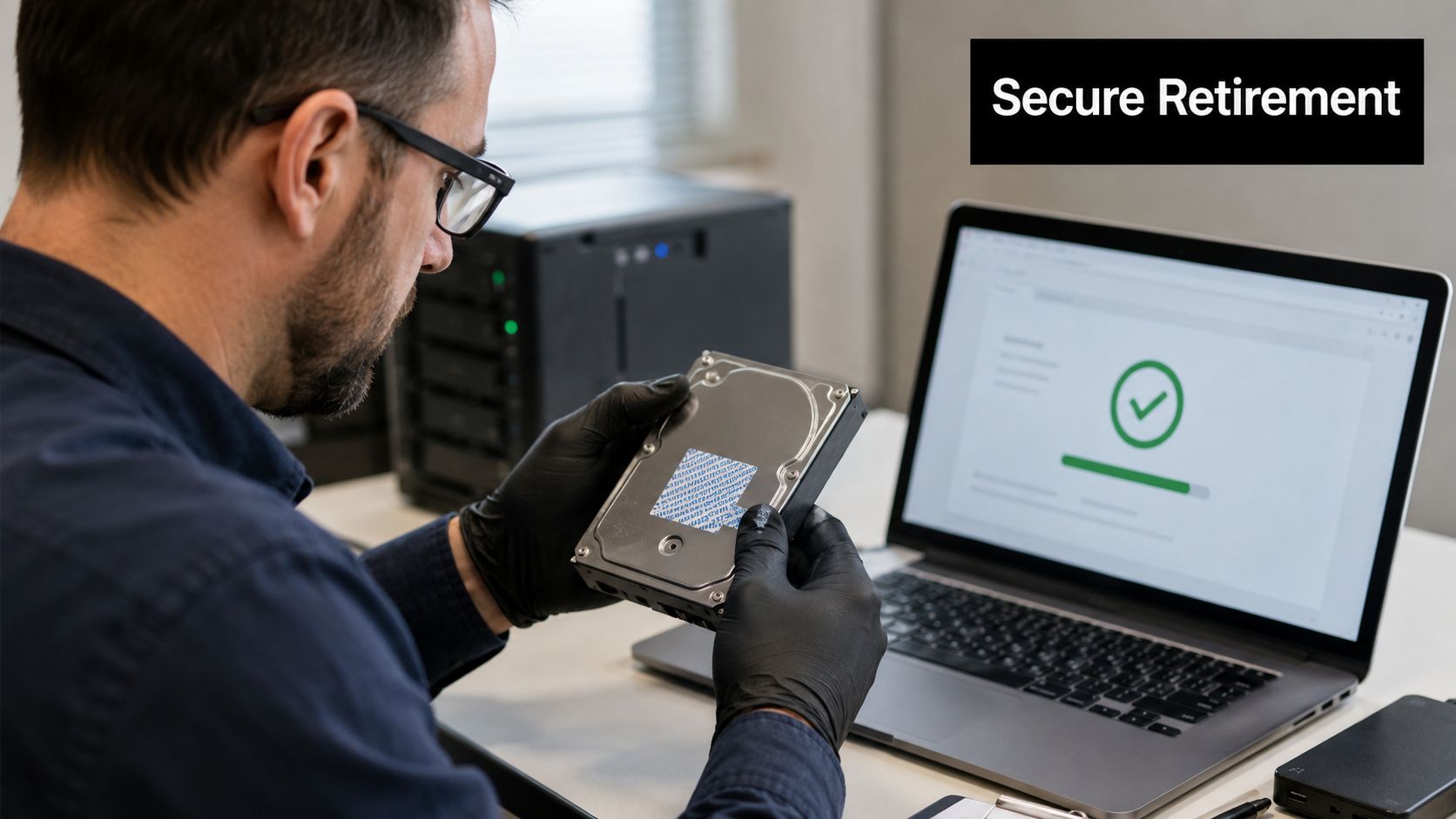
What secure decommissioning looks like
Secure decommissioning starts before equipment leaves the building. IT teams need an asset list, user ownership, data classification, chain-of-custody steps, and a clear decision on sanitization versus physical destruction. If that process only begins when a recycler shows up, the business has already lost control of the risk.
For Atlanta healthcare practices, this often means treating retired endpoints and storage media as regulated assets until destruction is verified. The same logic applies to accounting firms, payment environments, and businesses with remote employees returning equipment from home.
Practical rule: If you can't prove what happened to the data-bearing device, assume the risk is still open.
A good operating standard includes:
- Asset tracking first: Record serial numbers, assigned users, and whether the device held protected, financial, or client data.
- Policy before pickup: Define when you require wiping, shredding, or both.
- Proof after service: Ask for documented destruction records, not verbal confirmation.
If you need a benchmark for process maturity, review how providers structure secure data destruction services. Businesses comparing disposal options should also think through practical privacy issues similar to those discussed in this piece on phone repair data security, because temporary device handling creates many of the same exposure points.
Reworx Recycling fits naturally into this trend because donation-based recycling and secure data destruction shouldn't be treated as separate conversations. If a device can be reused, great. If it can't, the data still has to be handled as carefully as the hardware.
2. IT Asset Disposition and Reverse Logistics
Many Atlanta businesses don't have an electronics disposal problem. They have a logistics problem disguised as disposal.
A company might manage one headquarters well, then lose visibility when devices are spread across branch offices, remote staff, storage rooms, and project sites. That's where IT asset disposition, or ITAD, becomes more than e-waste removal. It becomes an operational discipline.
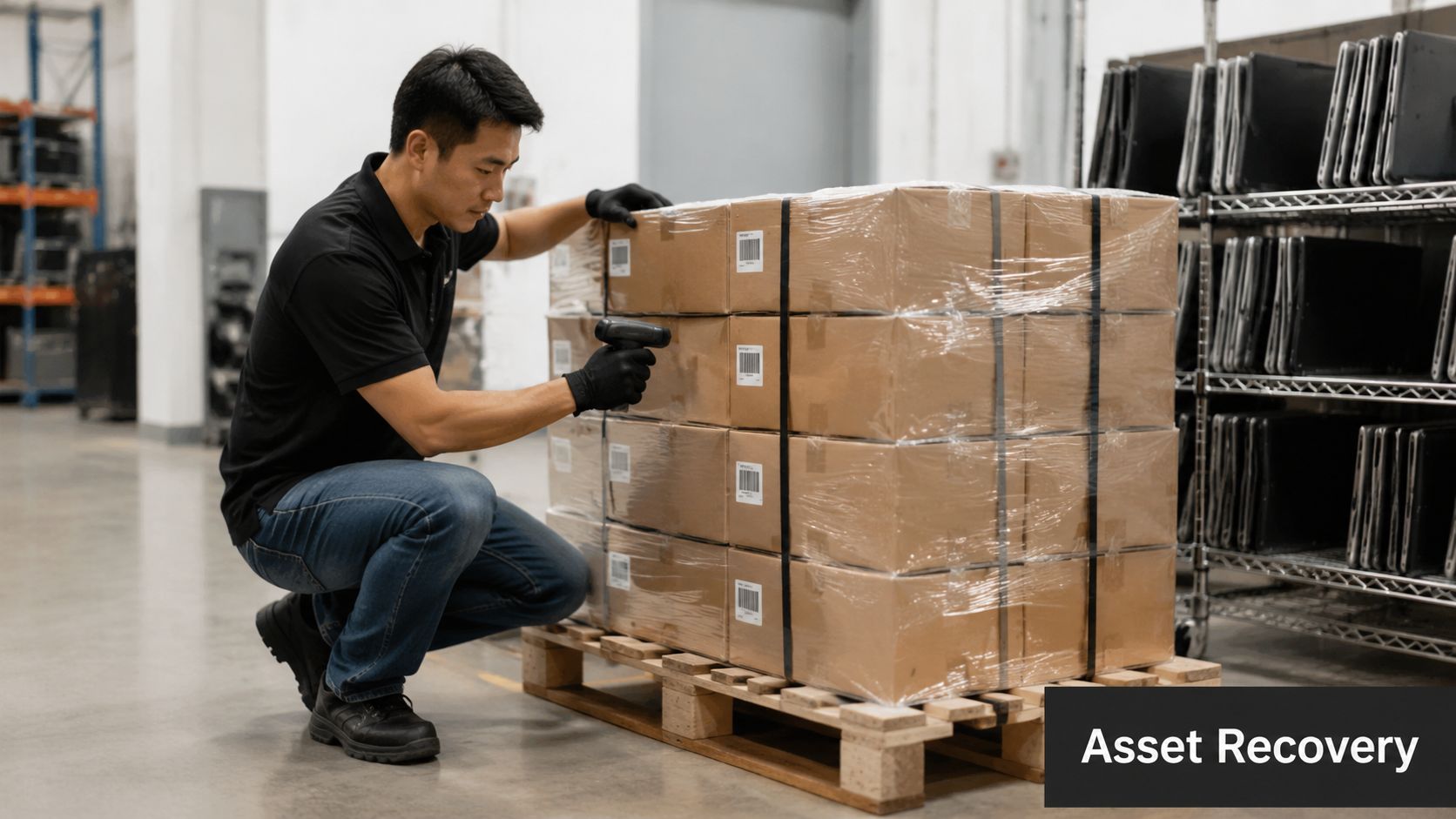
Why reverse logistics matters in Atlanta
Atlanta companies often operate across offices, clinics, warehouses, campuses, and hybrid environments. That creates friction when it's time to collect laptops, docking stations, servers, networking gear, and surplus accessories. Without a reverse logistics plan, old equipment piles up, disposition gets delayed, and inventory accuracy breaks down.
That delay creates three business problems at once. Security teams lose control of dormant assets. Finance teams lose visibility into recoverable value. Facilities teams inherit clutter and liability.
The more practical approach is to treat ITAD like a managed workflow:
- Centralize intake: Create one process for collecting equipment from offices, remote workers, and satellite locations.
- Grade devices consistently: Separate reusable hardware from scrap early.
- Coordinate pickup windows: Don't let retired assets sit for months waiting for a convenient cleanout.
For teams refining that process, this overview of what is IT asset disposition is useful because it frames ITAD as a chain of custody, value recovery, and compliance function rather than just computer recycling.
I've seen Atlanta organizations get better results when they stop using different vendors for pickup, storage, wiping, recycling, and reporting. Fewer handoffs usually means fewer surprises. That's especially true during mergers, office moves, data center decommissioning projects, and large laptop refreshes.
Reworx Recycling's local relevance here is straightforward. A donation-based recycling partner can help businesses handle pickup, IT equipment disposal, and reuse pathways in one program, which reduces management overhead for teams already stretched thin.
3. Environmental Compliance and Circular Economy Integration
Environmental risk now sits closer to IT than many executives expected. Once a business starts replacing laptops, monitors, servers, phones, batteries, and medical or lab-adjacent electronics at scale, disposal decisions become part of risk management.
For Atlanta companies with sustainability commitments, this is no longer only about keeping e-waste out of landfills. It's about proving that retired equipment was managed responsibly, especially when procurement teams, ESG reporting teams, and customers all want cleaner documentation.
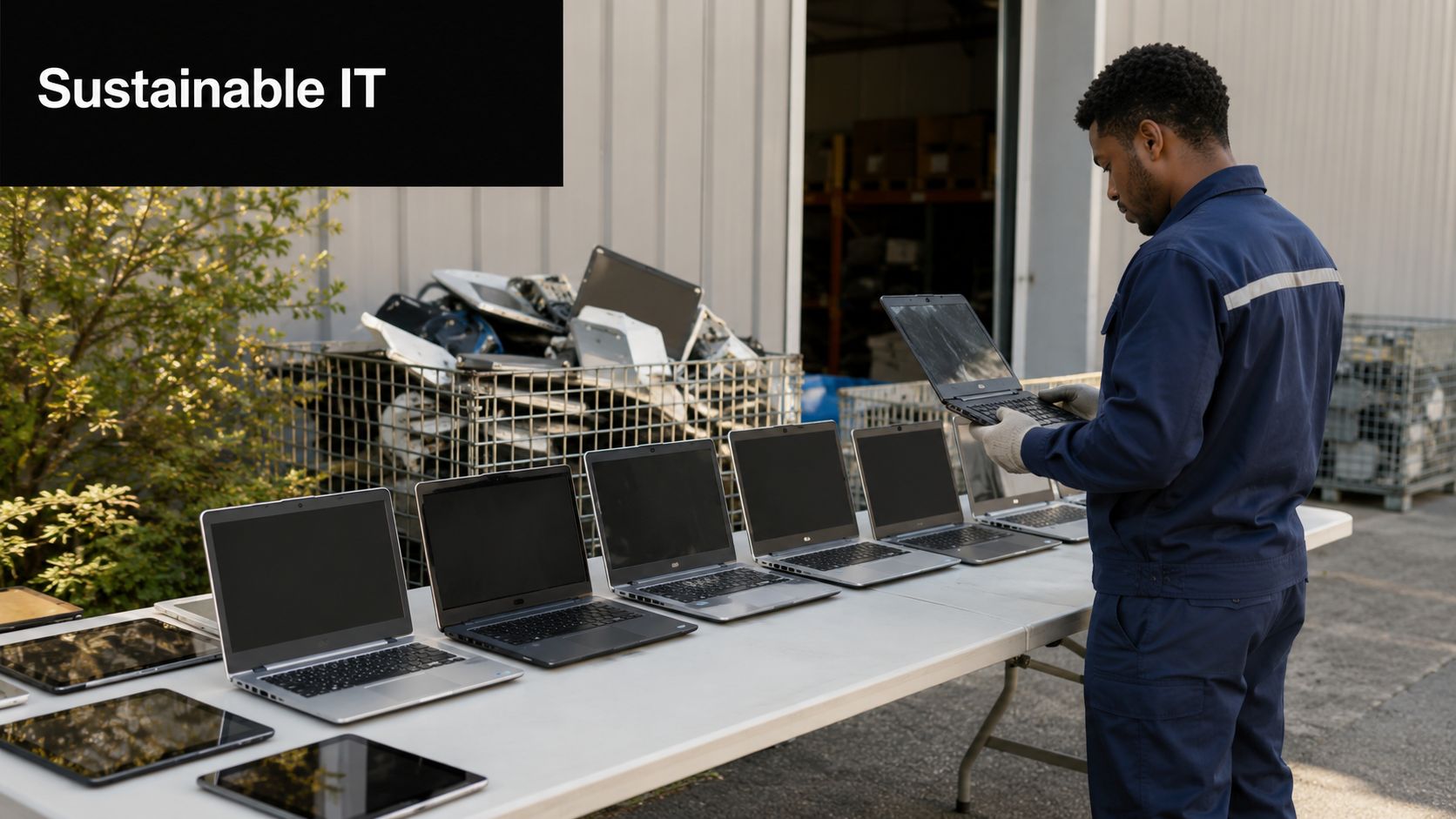
Circular thinking reduces more than waste
The old model was linear. Buy equipment, use it, scrap it, move on. The newer model asks different questions. Can the device be redeployed internally, donated, refurbished, harvested for parts, or recycled through a documented downstream process?
That matters in a city like Atlanta where many organizations want both operational discipline and visible community impact. A social enterprise recycling partner can help bridge those goals, especially when the business wants sustainable recycling and technology donation outcomes without losing accountability.
Responsible electronics recycling should produce records, not just good intentions.
A few practices consistently work better than generic green messaging:
- Extend useful life first: Redeployment is often cleaner and cheaper than early replacement.
- Separate by outcome: Reuse, remarketing, parts recovery, and scrap recycling should follow distinct paths.
- Document downstream handling: Ask where equipment goes after pickup, not just who collects it.
If your team is building a more mature program, look at how e-waste circular economy and sustainable recycling supports both environmental compliance and operational planning. For broader environmental context, the EPA's guidance on electronics donation and recycling is also worth reviewing.
Reworx Recycling stands out in this discussion because donation-based recycling gives Atlanta businesses a practical way to connect office cleanouts and IT refreshes with community benefit. That's useful when sustainability leaders want more than a disposal receipt.
4. Vendor Risk Management and Third-Party Accountability
Most IT risk programs still spend more time evaluating software vendors than disposal vendors. That gap doesn't make sense anymore.
If a third party touches your retired laptops, hard drives, network appliances, or servers, that vendor can create security, compliance, operational, and reputational risk. The danger isn't only malicious behavior. It's sloppy intake, weak documentation, missed pickups, subcontracted transport, poor downstream controls, or vague reporting that doesn't hold up in an audit.
The vendor questions that actually matter
Atlanta businesses should vet recyclers, ITAD firms, shredding providers, and logistics partners with the same seriousness they use for cloud providers or managed service firms. Ask who handles pickup. Ask whether subcontractors are used. Ask how custody is documented from dock to final disposition. Ask how exceptions are reported.
A healthcare group, for example, may need stronger data handling assurances than a general office refresh project. A manufacturer disposing of specialized equipment may need different chain-of-custody controls than a school district clearing out old laptops.
Use a practical review checklist:
- Scope clarity: Make sure the statement of work matches what you need, including pickup, sorting, reporting, and destruction.
- Evidence of process: Request sample inventories, destruction records, and audit documentation.
- Escalation path: Know who responds if assets are missing, delayed, or misclassified.
A vendor isn't low risk because they're friendly, local, or inexpensive. They're low risk when they can show consistent process control.
For Atlanta teams comparing providers, this guide to vendor selection criteria is a useful starting point. It helps frame vendor review around accountability instead of marketing language.
Reworx Recycling belongs in this conversation because local service can be an advantage when it improves pickup coordination and responsiveness. It only matters, though, if the process is documented well enough for IT, compliance, and facilities teams to rely on it.
5. Regulatory Compliance and Legal Liability Management
Compliance failures around retired equipment often happen in ordinary moments. A storage room gets cleared. A clinic replaces devices. A finance team swaps workstations. Someone assumes disposal is routine, and no one checks whether records, drives, or embedded storage were handled under the right standard.
That creates legal exposure fast, especially for Atlanta organizations in healthcare, finance, education, public sector work, or any business with contractual data-handling obligations.
Documentation is the control that gets skipped
A lot of companies focus on the physical act of destruction and neglect the paperwork. That's backwards. In a dispute, the question usually isn't whether your policy sounded reasonable. The question is whether you can prove what happened, when it happened, and who handled the assets.
Georgia also remains an active cyber risk environment. One Atlanta-focused industry source noted that Georgia ranked 11th in the nation for cybercrime complaints in 2024, while estimating the state's cybersecurity sector at about $5 billion annually centered in Atlanta. For local businesses, that combination reinforces a simple point. Regulators, insurers, customers, and legal counsel all expect more mature controls now than they did a few years ago.
A defensible compliance program around IT equipment disposal usually includes:
- Written retention and destruction rules: Different data types shouldn't be retired under ad hoc decisions.
- Recorded approvals: Someone should authorize disposition based on policy, not convenience.
- Retained proof: Certificates, inventories, and custody records need retention rules too.
If your team is screening service providers for documented destruction standards, review NAID AAA certification considerations. That kind of benchmark helps businesses separate real controls from generic claims.
Reworx Recycling can support a broader compliance effort. Secure data destruction, electronics recycling, and IT asset disposition are operational services, but they also shape legal defensibility. That's why legal, IT, compliance, and facilities teams should all care about the same workflow.
6. Cybersecurity Integration in Hardware Lifecycle Management
A Midtown firm finishes a laptop refresh on Friday. By Monday, the old devices are stacked in a storage room waiting for pickup, still joined to the domain, still carrying browser sessions, saved credentials, and local files. That gap between "out of service" and "secured" is where hardware lifecycle management becomes a cybersecurity issue.
Atlanta companies feel this more sharply than generic best-practice lists suggest. Healthcare groups, fintech teams, logistics operators, and fast-growing SaaS firms often retire devices in bursts during office moves, mergers, clinic expansions, or data center changes. In those moments, risk does not come only from the device itself. It comes from rushed handoffs, unclear ownership, inconsistent sanitization, and staging areas that were never designed for sensitive equipment.
Security leadership should set the rules before any asset leaves a user, rack, or office. That means defining approved sanitization methods, deciding when physical destruction is required, documenting chain of custody, and setting escalation steps for devices with failed drives, encrypted volumes, or signs of prior compromise. Facilities and procurement still have roles, but they should not be left to make security decisions on the fly.
The practical trade-off is speed versus control. Teams want refresh projects completed fast so users can get back to work and storage rooms do not fill up. But speed without a security workflow creates avoidable exposure. A better model is to build retirement tasks into the same project plan as deployment, offboarding, and access cleanup.
A workable lifecycle process usually includes:
- Risk-based pre-retirement review: Flag devices tied to regulated data, privileged users, security incidents, or unusual storage configurations.
- Sanitization by device type: Use methods that fit laptops, mobile devices, servers, removable media, and failed hardware differently.
- Identity and access cleanup: Remove devices from management tools, revoke certificates, disable admin accounts, and close any cloud sync tied to the asset.
- Documented final disposition: Match every serial number to a recorded outcome so nothing sits in limbo.
Physical controls matter too, especially during server room upgrades and decommissioning work. Companies reviewing cage design, staging controls, and restricted access models can use Data center security solutions as a reference point for the facility side of the problem.
One mistake shows up often. IT tracks the asset, security owns the policy, facilities controls the room, and the recycler handles pickup, but no one is accountable for the full chain from last login to final disposition. That is where local coordination matters. Reworx Recycling fits into this process as an operational partner for secure data destruction, electronics recycling, and documented custody, which helps Atlanta businesses run one controlled workflow instead of piecing together separate handoffs.
7. Cost Optimization Through Asset Recovery and Circular Business Models
A lot of businesses still budget for disposal as if every retired device is pure waste. That leaves money on the table.
Not every laptop, desktop, monitor, or server has resale value. But enough equipment does that asset recovery should be part of financial planning, especially during fleet refreshes, relocations, or office consolidations. The key is to recover value without weakening security or compliance.
Recovery works when timing and grading are disciplined
The most common mistake is waiting too long. Equipment sits in storage until the market window closes, cosmetic condition declines, chargers disappear, and model information goes stale. At that point, even decent hardware becomes low-value scrap.
Atlanta businesses get better outcomes when they build value recovery into the refresh plan from day one. Finance, procurement, and IT should agree on which assets are candidates for buyback, donation-based recycling, redeployment, or commodity recycling before replacement orders go out.
Three habits make a difference:
- Condition grading: Honest grading prevents disputes and speeds quoting.
- Accessory control: Missing power supplies, drives, or components reduce usable value.
- Volume coordination: Consolidated pickups often simplify handling and improve program efficiency.
The goal isn't to squeeze every dollar from old hardware. It's to recover what you can without creating new risk.
This trend also aligns with circular business goals. Some devices should move into corporate donation programs. Others belong in refurbishment channels. Others need secure destruction and material recovery. A good ITAD program doesn't force one outcome on every asset.
That balance is where Reworx Recycling can be useful to Atlanta organizations. A social enterprise recycling model gives businesses another option between landfill thinking and resale-only thinking. For firms trying to balance sustainable recycling, community impact, and budget discipline, that flexibility matters.
8. Data Analytics and Risk-Based ITAD Decision Making
The most mature programs don't rely on memory, email threads, or a spreadsheet one admin updates when there's time. They run on data.
If you're managing hundreds or thousands of devices across Atlanta offices, remote workers, labs, clinics, field teams, or shared workspaces, intuition won't tell you which assets are overdue for retirement, which locations generate the most exceptions, or which vendors create reporting friction. Analytics will.
What to measure before problems grow
Start with the basic metrics you can maintain. Track asset age, location, assigned user, pickup dates, final disposition, data-bearing status, and exception history. Then connect that information to replacement planning, compliance review, and sustainability reporting.
This isn't about building a flashy dashboard for its own sake. It's about seeing risk earlier. If one office repeatedly returns incomplete equipment, if one business unit delays offboarding hardware, or if one vendor takes too long to close custody records, the pattern should show up before it becomes a larger failure.
Useful reporting questions include:
- Where are dormant assets accumulating?
- Which device classes create the most secure destruction needs?
- How long does it take to move assets from retirement approval to final disposition?
Atlanta companies that make better ITAD decisions usually share the same habit. They review trends across departments instead of treating each disposal event as a one-off task. That supports better budgeting, fewer compliance surprises, cleaner office cleanouts, and stronger board-level reporting on both risk and sustainability.
For leaders trying to improve that decision process, this guide to data-driven choices offers a useful mindset. The underlying point is simple. Good asset disposition decisions come from visible patterns, not assumptions.
Reworx Recycling fits here as a practical operational partner because reporting quality matters as much as pickup quality. If a provider helps you close the loop on inventory, secure data destruction, and final disposition records, they support better decision-making long after the truck leaves.
Atlanta IT Risk Management Trends, 8-Item Comparison
| Trend / Item | Implementation Complexity 🔄 | Resource Requirements ⚡ | Expected Outcomes ⭐📊 | Ideal Use Cases | Key Advantages 💡 |
|---|---|---|---|---|---|
| Data Security and Secure Device Decommissioning | High, certified methods, chain-of-custody, audit processes | Moderate–High, certified vendors, time for certification and verification | Strong reduction in data-breach risk; demonstrable regulatory compliance | Healthcare, finance, government, any sensitive-data environments | Eliminates insider risk; provides legal evidence and preserves reputation |
| IT Asset Disposition (ITAD) and Reverse Logistics | Moderate, systems integration, grading workflows, coordinated pickups | Moderate, tracking systems, transport/logistics, refurbishment capacity | Residual value recovery; streamlined logistics and compliance reporting | Multi-site corporations, education, manufacturing, large-scale retirements | Recovers value; reduces operational burden; buyback options |
| Environmental Compliance and Circular Economy Integration | Moderate, certification (R2/e-Stewards), lifecycle programs | Moderate–High, certified recyclers, reporting tools, refurbishment programs | Improved ESG metrics; reduced landfill and environmental liability | Companies with sustainability targets, public sector, large retailers | Enhances brand/ESG; reduces regulatory risk; may yield incentives |
| Vendor Risk Management and Third-Party Accountability | High, due diligence, SLA creation, ongoing audits | High, legal, audit teams, monitoring tools, insurance checks | Greater vendor transparency; lower third-party security/compliance risk | Organizations outsourcing ITAD; regulated industries | Mitigates vendor failure; documents due diligence and performance |
| Regulatory Compliance and Legal Liability Management | High, multi-jurisdictional compliance, documentation regimes | High, compliance staff, legal counsel, recordkeeping systems | Minimized fines and legal exposure; auditable evidence for regulators | Healthcare, finance, government, institutions with strict regulation | Protects against penalties; supports litigation and regulatory audits |
| Cybersecurity Integration in Hardware Lifecycle Management | High, secure erasure, vulnerability assessments, tracking integration | High, cybersecurity expertise, cryptographic tools, device tracking | Prevents compromised hardware reuse; strengthens overall security posture | Tech firms, defense, critical infrastructure, enterprises with APT risk | Addresses advanced threats; aligns disposal with zero-trust practices |
| Cost Optimization Through Asset Recovery and Circular Business Models | Moderate, grading/pricing models, refurbishment and remarketing ops | Moderate, refurbishment capacity, storage, market channels | Capital recovery; reduced net acquisition costs; improved IT budgets | Organizations seeking cost offsets (corporate, education, government) | Generates revenue from assets; offsets refresh costs and preserves value |
| Data Analytics and Risk-Based ITAD Decision Making | Moderate–High, analytics platform integration and governance | Moderate–High, BI tools, data quality processes, analyst resources | Data-driven ITAD decisions; measurable ROI; proactive risk identification | Enterprises with scale, CIO/IT asset managers, compliance teams | Enables predictive optimization; provides executive visibility and ROI metrics |
Your Strategic Partner for IT Risk Management in Atlanta
Atlanta businesses don't need more vague advice about being proactive. They need practical systems that reduce exposure during the moments when risk usually slips through. Device refreshes, office moves, remote employee offboarding, medical equipment disposal, laboratory equipment disposal, facility cleanout work, and data center decommissioning all create those moments.
The strongest response is to stop treating cybersecurity, compliance, sustainability, and electronics recycling as separate workstreams. In practice, they're connected. A retired laptop can trigger a data security issue, an audit problem, a storage headache, and a sustainability reporting gap at the same time. That's why the best IT risk management trends for Atlanta businesses all point in the same direction. Better process control, better documentation, better vendor oversight, and better visibility across the hardware lifecycle.
Reworx Recycling is one relevant option for organizations that want a local partner for donation-based recycling, secure data destruction, IT asset disposition, office cleanout support, and responsible IT equipment disposal. The company is based in Smyrna and works in the same regional business environment Atlanta teams operate in every day. For many organizations, that local alignment helps when timing, pickup coordination, and chain-of-custody discipline matter.
This also isn't only about avoiding downside. A well-run program can support corporate donation programs, reduce unnecessary storage, improve sustainable recycling outcomes, and create cleaner handoffs between IT, facilities, procurement, compliance, and sustainability teams. When businesses build those workflows well, they spend less time chasing old equipment and more time making sound decisions about replacement, reuse, product destruction, and secure data destruction.
If you're reviewing your current process, start with a few blunt questions. Do you know where retired devices are sitting right now? Can you prove how data-bearing assets are destroyed? Are your vendors easy to audit? Can you separate reusable equipment from scrap quickly? Does your reporting support legal, operational, and environmental review? If any answer is shaky, the fix usually isn't a single tool. It's a tighter end-to-end program.
Atlanta's business environment rewards companies that can move fast without losing control. In IT risk management, that means building a repeatable process for equipment retirement, not improvising one during the next upgrade cycle. A capable partner can help make that process more secure, more compliant, and more useful to the broader business.
If your organization is planning an upgrade, office cleanout, laptop disposal project, or broader IT asset disposition program, Reworx Recycling can help you build a more secure and responsible path for electronics recycling. Reach out to discuss business pickup options, corporate donation programs, secure data destruction, or a long-term partnership that supports both risk reduction and community impact.