A logistics manager leaves Midtown before sunrise, expecting the usual crawl. Instead, one corridor moves differently. Signals adapt, transit information updates in real time, and the route feels less like a fixed street grid and more like a responsive system.
That shift captures why Atlanta transportation tech and smart mobility matter to corporate sustainability directors. The issue isn't novelty. It's whether connected infrastructure, fleet technology, data systems, and retired hardware are being managed as one operational lifecycle.
The Future of the Atlanta Commute
A few years ago, an Atlanta commute often felt like a private problem. Every driver, rider, dispatcher, and facilities team was left to absorb delay as a cost of doing business. The newer model treats congestion, routing, and modal choice as shared system questions.
For a corporate campus, that changes more than employee travel time. It affects shift scheduling, last-mile access, fleet routing, parking demand, and the reliability of service calls. In practice, a smart commute isn't just faster. It's more coordinated across signals, transit, curb space, and trip-planning tools.
From fixed routes to responsive movement
Atlanta's mobility direction points toward trips that combine several systems without making the traveler manage every handoff manually. A worker might drive to a transit node, use real-time service information, and arrive through a corridor where signals and roadside technology support smoother flow. That sounds simple. Operationally, it requires connected infrastructure, data sharing, and institutions that can manage both.
Business leaders should read this as a shift from transportation capacity to transportation orchestration. The companies that benefit most won't only be the ones that move people or goods. They'll be the ones that align office location strategy, fleet policy, and employee commuting programs with a city that's becoming more digital at street level.
A useful companion read is this in-depth look at electric transport trends, especially for teams connecting mobility planning to electrification, charging strategy, and broader sustainability goals.
The practical question for employers isn't whether Atlanta is becoming more connected. It's whether your own travel, fleet, and site operations are ready to plug into that environment.
What this means for sustainability directors
For sustainability teams, the commute used to sit partly outside the organization's control. That's changing. Once a city begins building connected corridors and integrated mobility tools, employers gain new levers. They can redesign commuter incentives, rethink site access, and support lower-friction alternatives to single-occupancy driving.
They also inherit a quieter responsibility. Smart mobility depends on physical technology that ages out. Roadside devices, networking gear, telematics hardware, kiosks, and upgraded office-side systems all create end-of-life obligations.
That's why Atlanta transportation tech and smart mobility should be read alongside asset retirement planning. Even adjacent sectors like aviation and logistics are pushing more technology into daily operations, a pattern reflected in this local context around Atlanta and Hartsfield-Jackson in 2026. The smarter the city becomes, the more discipline companies need around hardware refresh cycles, secure decommissioning, and responsible reuse.
Atlanta's Smart Mobility Blueprint
Atlanta didn't arrive at smart mobility by accident. Its modern strategy was shaped by the city's 2015 U.S. Department of Transportation Smart City Challenge submission, which proposed a citywide network of Connected Transportation Centers, a Smart City Command Center, and an upgraded technology backbone to coordinate people and freight movement. That proposal mattered nationally because Atlanta was one of six finalist cities selected from 78 applicants in the federal competition.
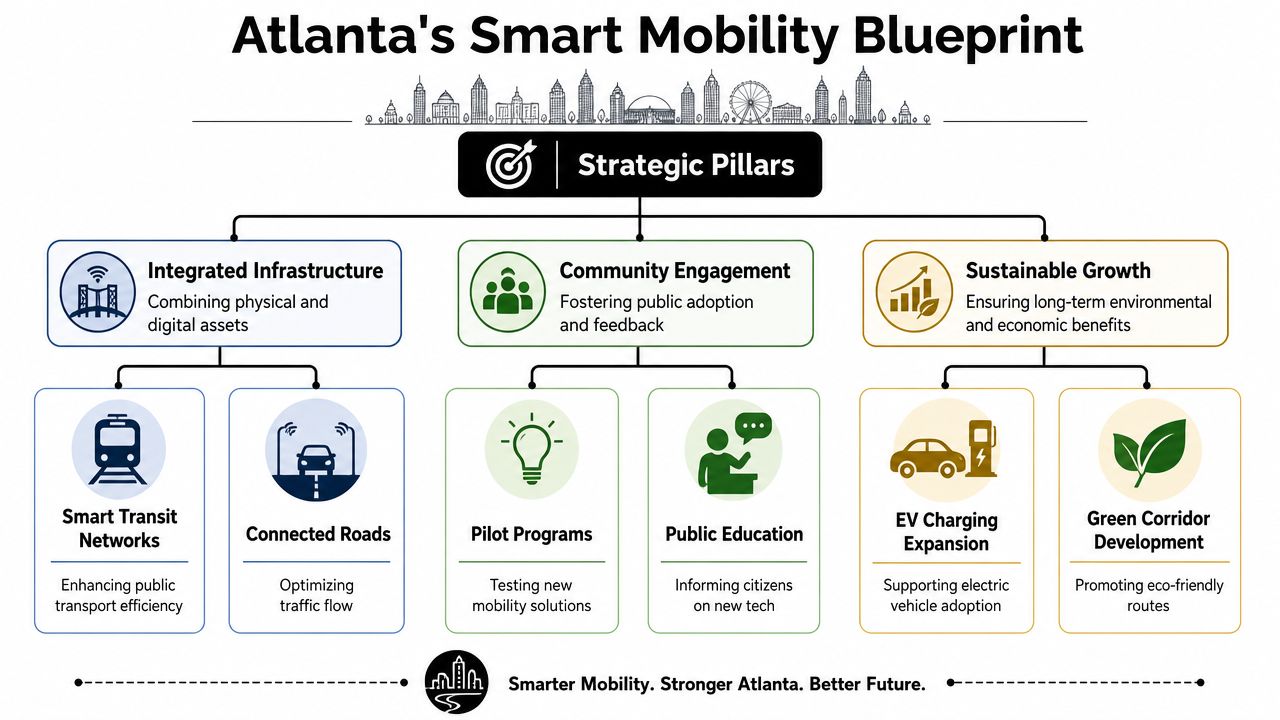
The original architecture still matters
Many city tech initiatives fade once pilot funding ends. Atlanta's blueprint is different because the original proposal tied transportation innovation to regional scale, public transit hubs, and the use of data and analytics to improve network efficiency. That's a durable operating model, not a gadget list.
Three ideas from that blueprint still shape how businesses should interpret the market:
- Connected nodes matter more than isolated assets. A smart corridor, station, or logistics touchpoint has the most value when it feeds a larger operating system.
- Central coordination is the point. The command-center concept signals that city mobility is becoming a data management function as much as a pavement function.
- Freight is part of the story. Atlanta's approach wasn't limited to passenger convenience. It recognized goods movement as a core use case.
A business reading of the blueprint
For a corporate sustainability director, this history leads to a concrete conclusion. Atlanta is an early major-market testbed for a model now seen globally, one where connected infrastructure, centralized data operations, and multimodal coordination are treated as core transportation functions. That means your organization shouldn't evaluate local mobility changes as scattered public-sector experiments.
Use a simple lens when assessing partnership, procurement, or location decisions:
| Strategic question | Why it matters in Atlanta |
|---|---|
| Does this site connect to major transit or corridor infrastructure? | Atlanta's model is built around integration, not stand-alone access points. |
| Can our fleet and facilities systems exchange data with external mobility platforms? | The city's direction favors coordinated operations. |
| Are we budgeting for hardware refresh, support, and retirement? | The original vision assumed a persistent technology backbone, not one-time installation. |
Practical rule: Treat smart mobility infrastructure the way you treat enterprise IT. If you wouldn't deploy it without governance, maintenance, and retirement planning, don't assume the transportation layer can run on pilot logic forever.
This is the significance of Atlanta's early Smart City Challenge role. It gave the region a strategy that links streets, transit, freight, and data into one operating framework. Companies that understand that framework can make better decisions about office placement, delivery windows, employee access, and technology procurement.
Key Technologies and Players Shaping Atlanta
Atlanta's smart mobility environment is easiest to understand as an ecosystem with three visible layers. First, there's the street-level technology people can see, such as signal systems, connected intersections, and automated vehicle demonstrations. Second, there are service models that combine modes, operators, and user demand. Third, there's the institutional layer that decides whether these tools remain pilots or become durable public services.

Corridors, vehicles, and on-demand systems
Current reporting highlights the North Avenue Smart Corridor as a testing ground for smart signals, connected vehicles, and IoT. The same coverage points to the 2026 Glydways automated transit demonstration and a Georgia Tech-led on-demand multimodal transit project aimed at underserved communities. That mix is important because it shows Atlanta is not betting on one mode.
Instead, the region is layering technologies that solve different problems:
- Connected corridor tools improve how intersections and signals respond to real traffic conditions.
- Automated transit pilots test whether controlled-route autonomy can fill service gaps.
- On-demand multimodal models explore how technology might help residents who don't have reliable access to fixed-route service.
For business readers, the takeaway isn't that every pilot will scale. It's that Atlanta is building practical experience in several mobility categories at once.
The institutions behind deployment
Public agencies and regional partners matter as much as the hardware. Projects become operational only when transportation planners, local governments, transit institutions, universities, and private vendors can share risk and align procurement. In Atlanta, that coordination challenge is often more consequential than the technology itself.
That's especially true for employers with campuses, delivery fleets, healthcare operations, or distributed worksites. They need to know who owns the curb interface, who maintains roadside devices, who controls traffic data, and who can make interoperability decisions. The market rewards firms that map those relationships early.
A related dynamic is playing out in adjacent digital infrastructure. Companies trying to understand why local mobility systems increasingly depend on low-latency processing should look at broader edge computing trends in Atlanta businesses. The same logic applies at the curb and intersection level. Faster local processing can support safer, more responsive transportation systems.
The harder question is scale
The most underexamined issue in Atlanta transportation tech and smart mobility isn't whether pilots exist. It's whether they can move beyond showcase environments into daily service for people who need reliable access most.
That creates a useful decision framework for corporate and institutional stakeholders:
Coverage
Does a technology improve mobility only in high-visibility corridors, or does it support broader access?Affordability
Can users adopt the service consistently, or is it operationally elegant but economically narrow?Operating model
Who funds maintenance, software updates, fleet support, and eventual replacement when grant attention fades?
If you're evaluating partnerships in Atlanta, ask less about demo performance and more about continuity. The strongest smart mobility program is the one that can survive procurement cycles, maintenance demands, and neighborhood-level expectations.
That's where many city narratives stop too early. They celebrate pilots, but businesses need to plan for contracts, uptime, service equity, and lifecycle cost. Those questions determine whether smart mobility becomes a citywide service layer or remains a collection of impressive proofs of concept.
The Data Infrastructure Powering Smart Transit
The visible part of smart mobility is easy to recognize. The harder part sits in cabinets, servers, software platforms, and device-management systems. Smart transit depends on a data infrastructure that collects, routes, stores, secures, and interprets information from many moving parts.
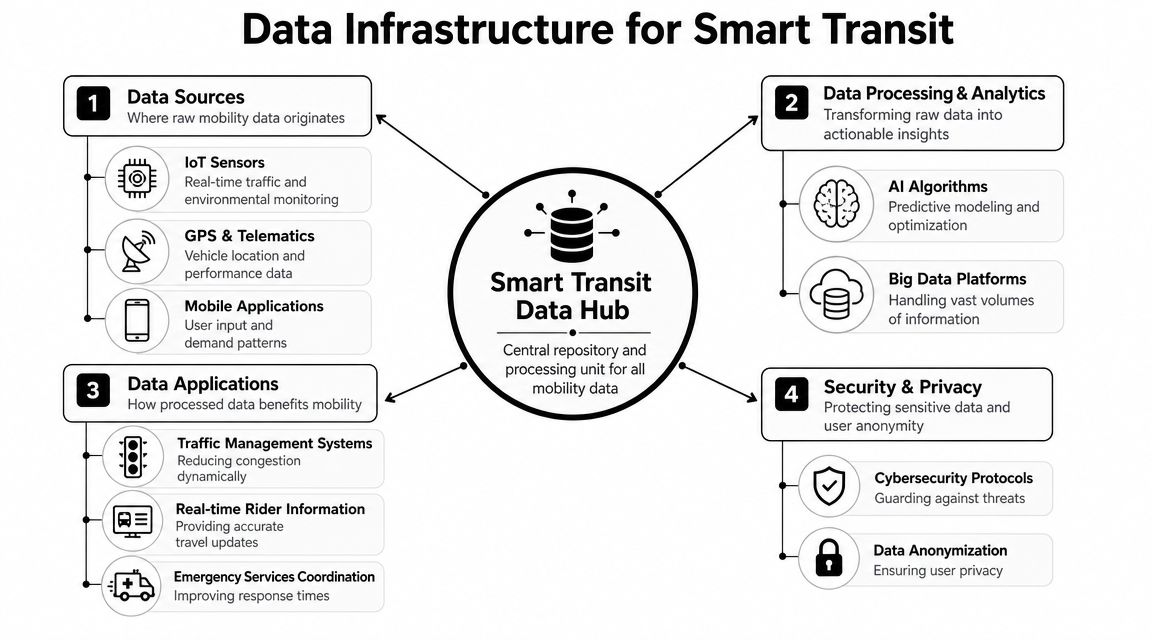
What the backbone actually includes
In operational terms, Atlanta's smart transit stack likely involves a mix of roadside sensors, signal controllers, communications equipment, telematics feeds, cloud or hybrid platforms, analytics tools, and user-facing applications. None of those categories are unusual on their own. The complexity comes from stitching them together across agencies, vendors, and public expectations.
This is why IT managers should care about transportation projects even when they don't own the roads. Many of the design questions are familiar:
- Interoperability between different hardware and software environments
- Cybersecurity for connected devices in exposed physical settings
- Data governance covering retention, access, and ownership
- Maintenance planning for sensors and communications equipment that degrade over time
Where current public discussion is thin
Public coverage of Atlanta's corridor work often highlights capabilities and near-term safety outcomes. Arcadis notes reported 20% to 35% accident reductions on sections of the North Avenue Smart Corridor. What that same discussion leaves less developed are the operational burdens behind scale, including cybersecurity, cross-vendor interoperability, sensor maintenance, data ownership, and the budget impact of keeping systems current.
That gap matters because technology pilots can look successful long before their maintenance model is proven. A sustainability director may see cleaner traffic flow and stronger mobility reporting. A CIO or facilities lead sees something else as well: firmware updates, device replacements, network hardening, spare parts, support contracts, and end-of-life data risk.
Why lifecycle discipline belongs in transit planning
A mature smart transit program needs the same discipline as enterprise infrastructure. Devices fail. Vendors sunset products. Security standards evolve. Storage systems fill up. Teams merge datasets that were never designed to interoperate.
A useful way to frame internal oversight is this short checklist:
Asset inventory
Keep a current map of every data-bearing device involved in mobility operations, whether on site, in fleet vehicles, or at edge locations.Retention policy
Decide what mobility-related data must be kept, what can be anonymized, and what should be deleted on schedule.Retirement protocol
Require secure decommissioning for drives, controllers, gateway devices, and retired networking hardware.
For organizations operating warehouses, hospitals, campuses, or regional offices, mobility data won't stay separate from enterprise data for long. That's one reason demand for local processing and retention capacity keeps rising, as seen in broader discussions around Atlanta's growing demand for data storage solutions. The smart transit question is no longer just how to collect data. It's how to govern and retire the systems that collect it.
Policy Funding and Sustainability Goals
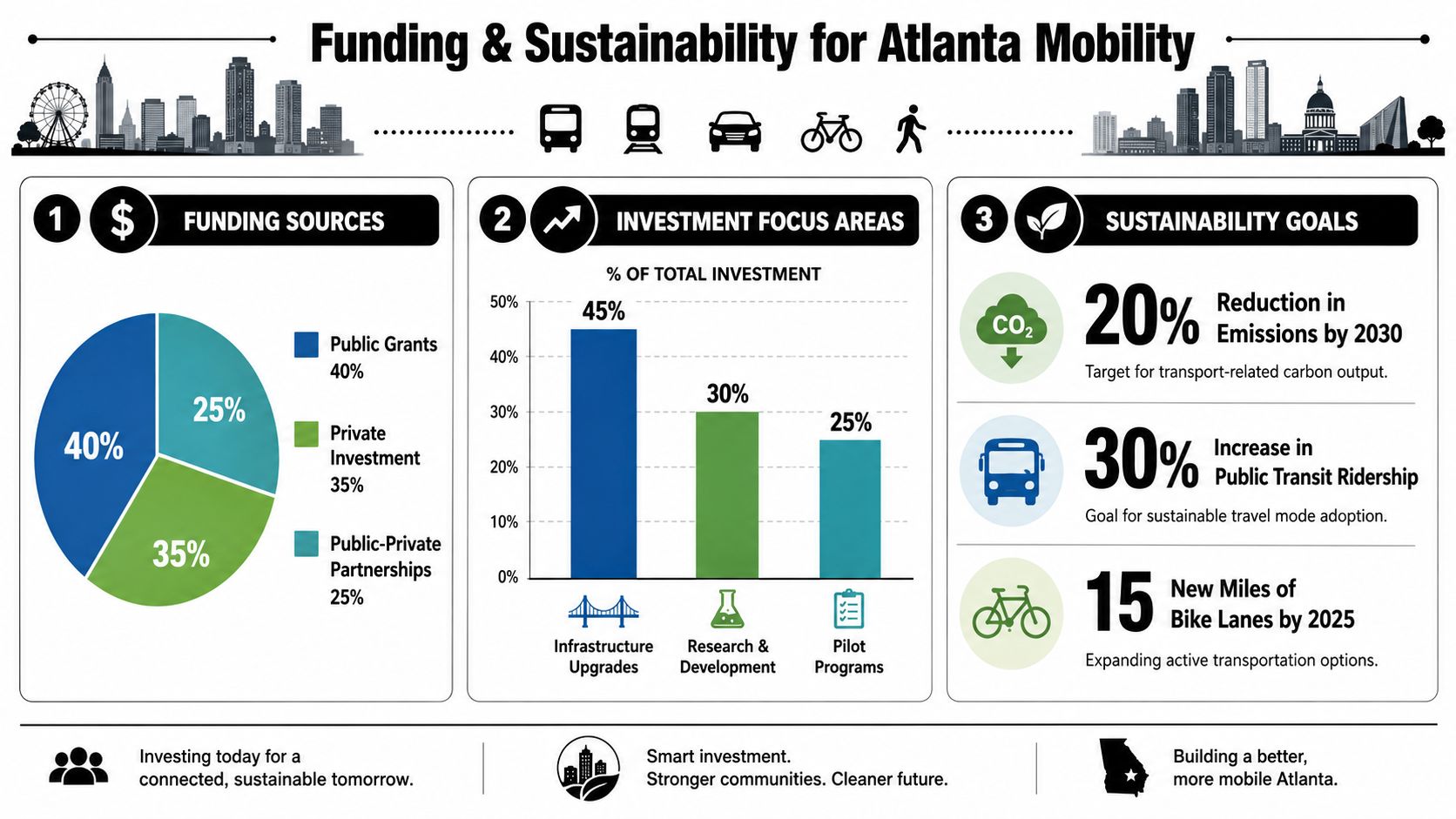
Smart mobility becomes durable only when policy, capital, and operating responsibility line up. In Atlanta, that means business leaders should track not just innovation headlines but the funding pathways and procurement structures behind them. A corridor can be technologically promising and still be fragile if the long-term ownership model is unclear.
Atlanta sits inside a large market shift
Atlanta's direction is part of a larger economic movement, not a local exception. One industry estimate says the global smart mobility market is projected to reach USD 419 billion by 2034 from USD 45.7 billion in 2024, and that North America held more than 38.2% of the market in 2024, with revenues of USD 17.4 billion according to this market analysis from GM Insights. For corporate planners, that matters because it confirms local mobility investments sit in a fast-growing North American sector.
This changes how companies should classify mobility-related spending. What once looked like optional local engagement increasingly looks like market participation. Firms involved in fleets, logistics, property operations, electrification, or digital infrastructure are already exposed.
Funding questions become corporate questions
A corporate sustainability director usually encounters transportation policy through emissions goals, employee commuting, or fleet planning. But smart mobility policy also shows up in procurement, partnerships, and site operations.
Three funding-linked questions deserve board-level attention:
| Decision area | What to ask |
|---|---|
| Vendor selection | Can this provider support compliance, maintenance, and upgrade cycles if public funding changes? |
| Partnership design | Are responsibilities for software support, data access, and replacement clearly assigned? |
| ESG alignment | Will this mobility investment strengthen reporting on operational efficiency, access, and responsible technology use? |
A practical source for teams monitoring state and public opportunities is this guide to SamSearch for GA bids, especially if your organization is evaluating Georgia procurement pathways or partnership opportunities tied to infrastructure programs.
Board-level lens: Smart mobility funding isn't only a public finance matter. It determines which technologies become standard operating conditions for employers, landlords, fleet operators, and service providers.
Sustainability claims need an end-of-life component
Many organizations are comfortable linking smart mobility to climate and efficiency goals. Fewer connect it to electronics stewardship, which is where sustainability reporting often gets thin. If a company benefits from smart fleets, connected buildings, charging equipment, telematics, or digital wayfinding, it also needs a retirement plan for those assets.
That's why local sustainability planning should include a responsible electronics pathway, not just energy and mobility metrics. For Atlanta organizations building that foundation, this overview of responsible electronics recycling for Atlanta businesses is useful context. It helps connect mobility modernization with the less visible obligations around equipment turnover, secure data handling, and material recovery.
The strategic mistake is to treat funding and sustainability as separate conversations. In practice, they meet at the same place: who owns the asset, who maintains it, and who is accountable when it reaches end of life.
Managing the E-Waste of Smart Transportation Tech
The cleanest rendering of a smart city often leaves out the messiest part. Hardware retires. Devices break. Platforms get replaced. Batteries degrade. Storage media still hold data after the pilot ribbon-cutting photos are gone.
That's the blind spot in many discussions of Atlanta transportation tech and smart mobility. Cities, agencies, property operators, fleet managers, and contractors focus on deployment. They spend less time on the eventual flow of discarded electronics generated by connected transportation systems.
What equipment actually enters the waste stream
Smart transportation creates e-waste in layers. Some of it is obvious, such as onboard computers in vehicles, tablets used by field teams, digital signage, and networking equipment. Some of it is more specialized, including roadside sensors, communications gateways, controller hardware, telematics units, charging equipment, and supporting server infrastructure.
For corporate operators, the list widens further during upgrades and site changes:
- Fleet technology such as telematics devices, vehicle computers, handhelds, and access hardware
- Facility-side systems including kiosks, screens, access controls, cameras, edge devices, and network gear
- Back-end equipment such as storage arrays, decommissioned servers, and retired user devices tied to mobility workflows
Why disposal is a governance issue
Improper disposal isn't just an environmental lapse. It can also be a data and compliance problem. Devices involved in mobility operations may store route histories, service logs, credentials, configuration files, employee data, or other operational records.
That's why IT asset disposition (ITAD) belongs in mobility planning. A mature ITAD program covers chain of custody, secure data destruction, material recovery, and documentation. It also recognizes that not every retired asset should be shredded immediately. Some equipment can be refurbished, redeployed, or handled through donation-based recycling if risk is properly managed.
Retired mobility hardware should be classified before it leaves the site. Teams need to know which assets require destruction, which can be remarketed, and which can support reuse or donation programs.
The stronger sustainability model is circular
A city can't call mobility infrastructure smart if it ignores what happens after replacement cycles begin. The more connected the street, fleet, and facility become, the more value there is in a circular approach that prioritizes reuse where appropriate and secure recycling where necessary.
For sustainability leaders, this creates a better internal narrative than simple disposal. It supports several goals at once:
- Environmental stewardship through responsible material recovery
- Risk reduction through secure handling of data-bearing assets
- Community benefit when eligible equipment can support reuse and digital inclusion
- Operational discipline through planned refresh and cleanout cycles
Organizations looking at this issue through a smart-city lens can build a stronger framework by reviewing practices for responsibly managing e-waste in smart cities. The core point is straightforward. End-of-life management isn't a side task after mobility modernization. It's part of whether the modernization was responsible in the first place.
Your Action Plan for a Smarter Atlanta
Most organizations don't need a grand smart-city strategy. They need a workable operating plan that connects transportation change to facilities, IT, procurement, and sustainability. In Atlanta, that starts with acknowledging that mobility infrastructure is becoming more digital, more connected, and more dependent on disciplined lifecycle management.
Five moves to make now
Start with a focused internal review.
Map your mobility exposure
Identify where your organization touches Atlanta's evolving transportation environment. That may include employee commuting, service fleets, loading operations, campus access, parking systems, or charging equipment.Align facilities and IT teams
Don't let mobility hardware sit in an ownership gap. Someone needs responsibility for asset inventory, update schedules, network dependencies, and retirement procedures.Write lifecycle terms into procurement
New mobility-related purchases should include service expectations, support windows, replacement planning, and end-of-life handling requirements.
After that, move into execution.
Questions that improve decisions
Use these prompts before approving the next technology deployment:
- Can this system integrate cleanly with existing operations?
- Who owns the data, and how long should we retain it?
- What happens when the vendor sunsets the product?
- Does the retirement pathway include secure data destruction and responsible recycling?
These questions sound tactical. They're strategic because they determine whether the asset remains useful, secure, and supportable.
What strong organizations do differently
The strongest teams treat mobility technology the same way they treat any other critical system. They create joint ownership across sustainability, IT, facilities, legal, and operations. They also plan office cleanouts, facility cleanouts, laptop disposal, secure data destruction, and broader electronics recycling before refresh cycles create urgency.
That matters in Atlanta because the city's transportation future will produce more connected devices at the edge of business operations, not fewer. Companies that prepare now will be better positioned to support employee access, cleaner logistics, credible ESG reporting, and lower-risk technology transitions.
Smart mobility planning is only complete when the retirement plan is written before the hardware arrives.
If your organization is upgrading fleet tech, clearing a facility, retiring servers, or building a more responsible IT asset disposition process, Reworx Recycling can help you turn that work into a practical sustainability program. Businesses can donate old equipment, arrange secure handling for data-bearing devices, schedule a pickup, or explore a longer-term partnership for electronics recycling, computer recycling, office cleanout support, data center decommissioning, medical equipment disposal, product destruction, and donation-based recycling that supports community impact.