Your storage room probably has a shelf of retired laptops, a stack of network switches, a few old servers nobody wants to touch, and a box of phones from the last mobile refresh. Most companies treat that pile as a disposal project. A better way to view it is as a mix of risk, recoverable value, and reporting responsibility.
That shift matters for sustainability managers and IT leaders. When end of life equipment enters an IT asset disposition workflow, the question isn't only how to remove it securely. The better question is whether the organization has a plan to capture material value, document compliance, and avoid wasting assets that still contain economically recoverable metals.
The Hidden Gold in Your IT Storage Closet
An IT manager finishes a hardware refresh and runs out of space. The old equipment doesn't look valuable anymore. The monitors are dusty, the desktops are outdated, and the server rails are piled in a corner. Finance sees write-offs. Facilities sees clutter. Security sees unmanaged devices. A sustainability manager should see one more thing. Embedded resources.
That old equipment contains more than steel, plastic, and glass. It also contains small but meaningful amounts of gold, silver, palladium, and other metals that industrial recyclers target through specialized recovery processes. That is why many people now use the term urban mining. Instead of extracting value from ore in the ground, recovery operators extract it from devices already circulating through offices, schools, hospitals, and data centers.
This isn't a fringe activity. The precious metals e-waste recovery market was estimated at US$5.92 billion in 2023 and is projected to reach US$8.75 billion by 2030, with a 5.0% CAGR, according to Grand View Research's precious metals e-waste recovery market report. The same source notes that global e-waste generation reached 62 million metric tonnes in 2022, while only 22.3% was formally collected and recycled.
Why business leaders should care
Those figures tell you two practical things.
- There is still a large unmanaged waste stream. A lot of material with recoverable value never reaches formal recovery channels.
- Recovery is already an industrial market. If your organization still thinks of electronics recycling as a charitable cleanout or a hauling service, you're missing the financial and operational side of the decision.
Practical rule: If equipment has circuit boards, connectors, chips, or plated contacts, it shouldn't go into a generic scrap stream without evaluation.
For a business, the hidden value doesn't always show up as a check from recovered metals alone. It can also show up through avoided storage costs, cleaner audit trails, stronger ESG reporting, and better end of life planning. That is why smart ITAD programs start with asset visibility, not just pickup scheduling.
If you want a business-focused view of how recovery fits after disposition, Reworx has a useful explainer on unlocking value after electronics recycling.
Identifying Which Electronics Contain Recoverable Value
Not all e-waste has the same recovery profile. A pallet of mixed peripherals won't be evaluated the same way as retired blade servers, telecom gear, or laboratory electronics. If you're trying to build a business case for precious metals recovery, the first task is simple. Sort by material quality, not by device count.
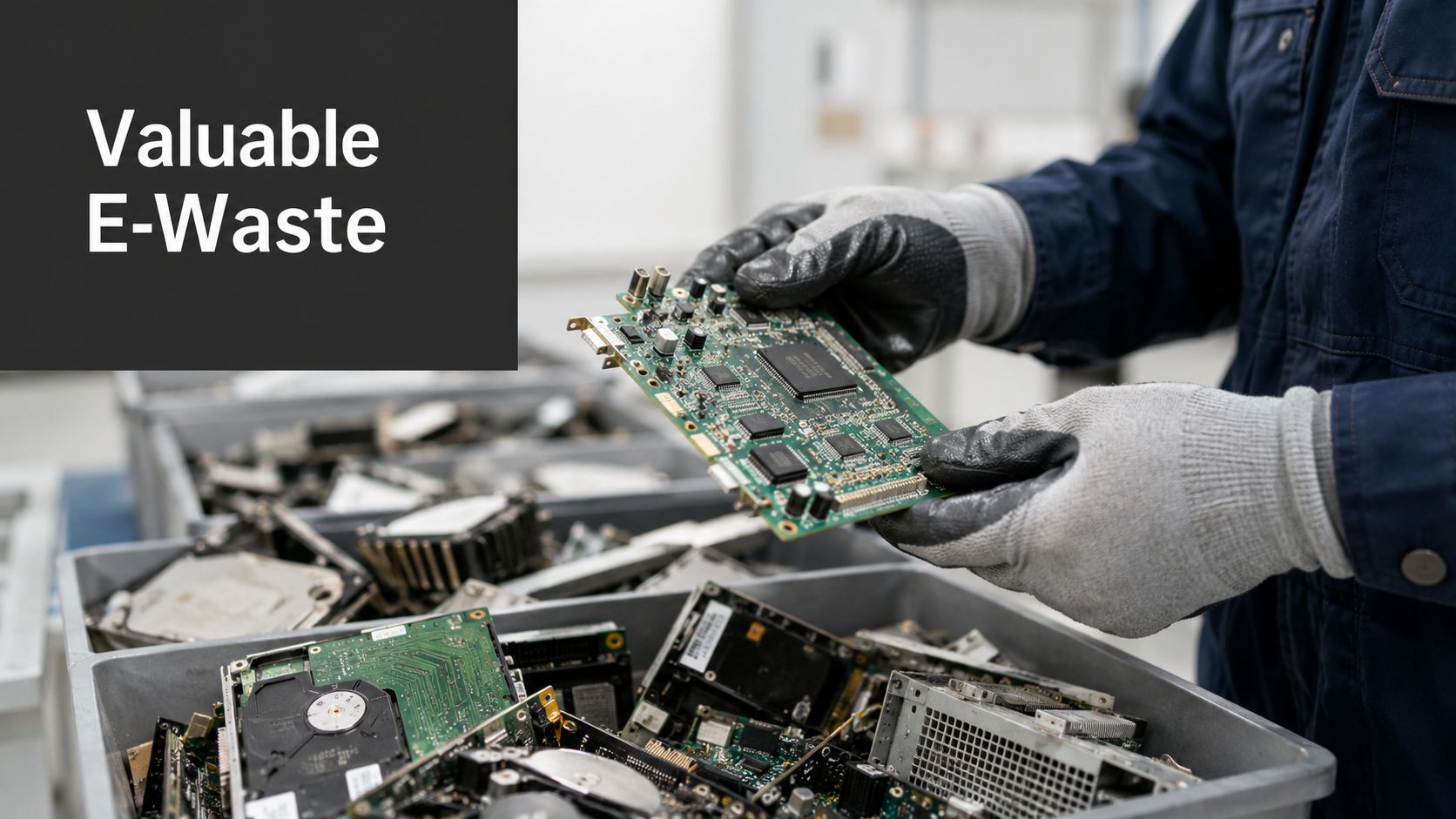
Start with board-rich equipment
The most obvious candidates are the devices with dense internal electronics:
- Servers and network equipment often contain higher-grade boards, connectors, processors, and memory.
- Desktop towers and business laptops can still hold value, especially when collected in volume and sorted correctly.
- Enterprise storage gear usually includes controller boards, backplanes, and power systems worth separating from low-value bulk scrap.
In practical terms, boards matter more than housings. A heavy metal chassis may look substantial, but the more important question is what sits inside it.
Don't miss the less obvious feedstocks
Businesses also overlook materials outside the classic IT closet. According to the DLA Precious Metals Recovery Program overview, viable recovery streams go beyond standard hardware and include x-ray film, silver batteries, and precious-metal plated materials. The same source notes that silver demand exceeded supply by 184.3 million ounces in 2024, the fourth consecutive year of deficit, which helps explain why overlooked silver-bearing streams deserve closer attention in current recovery planning. You can review that broader list in the DLA PMR Program Overview.
That matters to organizations with mixed operations, especially if you're responsible for:
- Medical equipment disposal in clinics, imaging departments, or health systems
- Laboratory equipment disposal at universities or industrial facilities
- Facility cleanouts where plated parts, test instruments, or specialty batteries may be mixed into general surplus
A recovery program usually gets stronger when procurement, facilities, IT, and environmental health teams compare notes before a shipment leaves the site.
A broad inventory also helps with donation-based recycling decisions. Some assets belong in refurbishment or redeployment. Others are too old, too damaged, or too specialized and make more sense in a recovery stream. If your team needs a wider checklist of what qualifies, this guide to electronics people often don't realize they can recycle is a good starting point.
How Precious Metals Are Recovered From E-Waste
A sustainability manager signs off on a data center cleanout and sees two very different outcomes. In one, the load is shredded with little sorting, settlement is thin, and documentation leaves gaps. In the other, the same material is separated carefully, hazardous parts are removed correctly, and the metal-bearing fractions are sent into a controlled recovery chain that produces a clearer return and a cleaner compliance record.
That difference starts with process discipline.
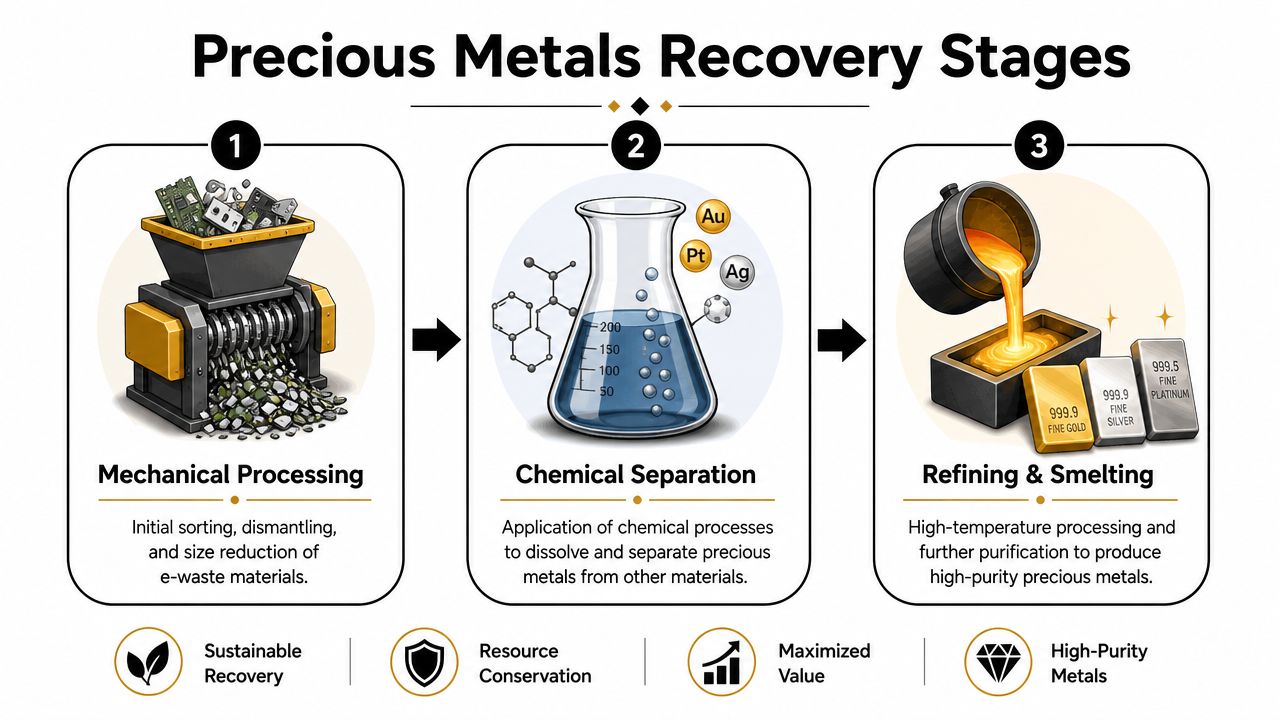
Mechanical processing
Recovery begins long before any refining. First, equipment is collected, sorted, dismantled, and reduced into smaller pieces. Batteries are removed. Hard drives may be pulled for secure destruction. Boards, wire, ferrous metals, non-ferrous metals, and plastics are separated into more uniform streams.
This stage works like triage in a hospital. The first job is to sort by urgency and type so the right treatment happens next. In ITAD, that sorting decides whether an item belongs in reuse, secure destruction, hazardous handling, or metals recovery.
A processor is usually trying to answer a practical business question early: what portion of this load contains recoverable value, and what portion will add cost if it stays mixed?
| Material type | Why it matters |
|---|---|
| Board-rich devices | Higher concentration of target metals |
| Mixed low-grade scrap | Often needs more sorting before recovery |
| Batteries and hazardous components | Must be handled separately for safety and compliance |
| Reusable assets | May be better candidates for resale, redeployment, or donation |
That sorting step affects more than yield. It also affects auditability, worker safety, freight efficiency, and whether your downstream vendor can produce a settlement you can explain internally.
Chemical separation and refining
After preprocessing, the higher-value fractions move into metallurgical recovery. Depending on the material, refiners may use thermal treatment, chemical leaching, electrochemical methods, or a combination of those approaches to separate precious metals from copper, plastics, ceramics, and residue.
For a business buyer, the key point is simple. Refining is where metal content becomes marketable output. If the incoming stream is poorly sorted or contaminated, the refiner has more work, lower efficiency, and more residual loss. That usually shows up somewhere in the chain as lower recovery, higher fees, or both.
Purity matters here for the same reason grade matters in any commodity sale. A mixed bucket of scrap has potential value. A refined metal product has realizable value. That is also why some organizations compare downstream options with the same care they would use when they sell platinum for the best price. The underlying question is similar. How much of the material's theoretical value can the buyer or processor return once testing, processing, and market terms are applied?
Why process control affects ROI
A device can contain gold and still be a poor recovery candidate if it enters the wrong stream. Recovery economics depend on concentration, throughput, contamination, handling costs, and the vendor's ability to document what happened to each material fraction.
PatSnap's summary of technical research on closed-loop recycling reports that professional e-waste operations typically achieve high recovery rates for gold and silver, and that strong gold recovery is closely tied to profitability in industrial settings. See the PatSnap report on closed-loop recycling efficiency metrics.
That is the business case in plain terms. Process quality protects margin.
For sustainability managers, this is also a responsibility issue. Chain of custody protects data. Controlled dismantling protects staff and downstream handlers. Documented material flows support environmental reporting and reduce the chance that recoverable value disappears into a low-visibility scrap stream. Reworx explains the front-end stages in this overview of the e-waste recycling process for business electronics.
Estimating the Yield and Value of Your IT Assets
A sustainability manager gets the inventory list from IT. Finance wants a number. Procurement wants options. Legal wants documented disposition. The challenge is that an asset list rarely tells you what the recovery stream will return.
A server, switch, laptop, and phone may all count as "one unit," but they do not contribute value in the same way. Precious metals recovery works more like evaluating ore than counting boxes. What matters is the concentration of recoverable material, the cost to separate it, and whether the equipment still has reuse or parts value before it ever reaches a smelter.
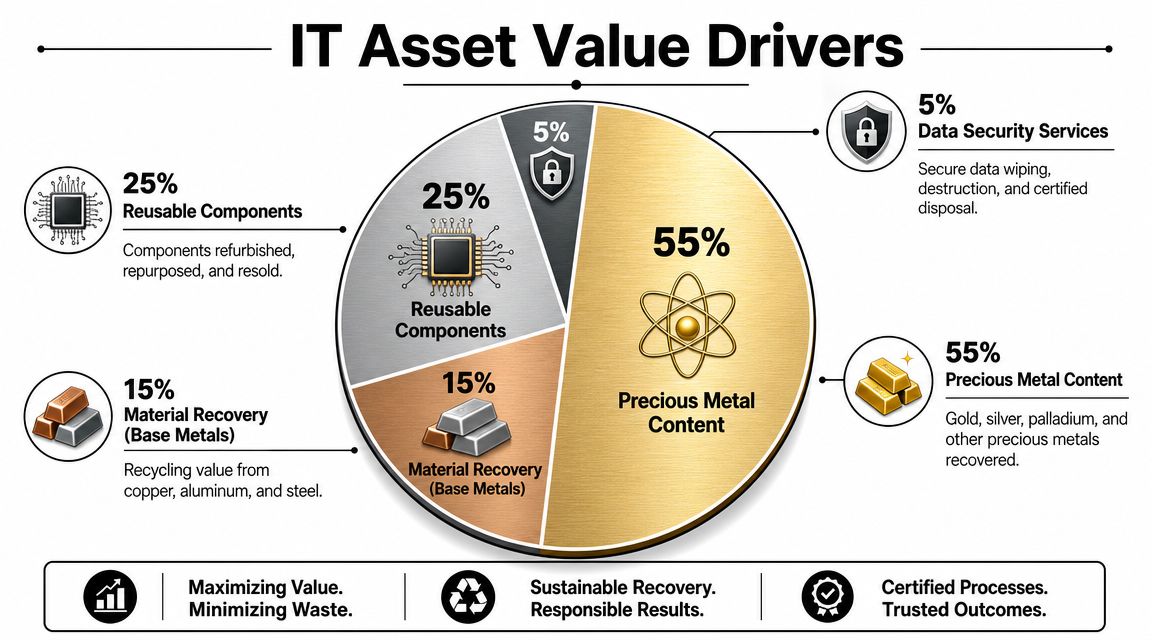
Where the value usually sits
In many enterprise electronics streams, the strongest recovery value sits in printed circuit boards and other dense non-ferrous fractions. As noted earlier, industry sources consistently show that a small group of metals, especially gold, palladium, silver, and copper, drives most of the value in board-rich material.
That changes the valuation conversation. A useful question is not just how many devices are in storage. A better question is how much high-grade board content is in the lot, what condition it is in, and which portion should be reused, harvested for parts, or sent to refining.
This distinction matters for ROI. If reusable assets are scrapped too early, your organization loses resale value. If low-grade material is handled as if it were high-grade concentrate, processing costs can eat into returns. Good estimates come from sorting the stream before pricing it.
Market prices shape timing
Recovery value also moves with commodity markets. CIBJO reports strong recent demand and rising recycled supply for precious metals, along with sharp gold price gains in 2025. You can review that context in the CIBJO Precious Metals Special Report 2025.
For business planning, the takeaway is straightforward. The same pallet can produce different financial results depending on when it is sold, how it is graded, and which downstream outlet receives it. A stale internal scrap assumption can understate value, especially if older equipment contains richer boards than current commodity assumptions reflect.
A practical framework for estimating value
Use a four-part screen before you ask an ITAD vendor for pricing:
- Start with asset mix. Separate servers, storage, network gear, laptops, mobile devices, peripherals, batteries, and anything with specialized components.
- Estimate board richness. Enterprise equipment with dense boards usually deserves a different recovery path than low-complexity accessories or housings.
- Check condition and hierarchy of value. Reuse usually comes first, then parts harvesting, then commodity recovery.
- Match timing to the market. Ask when the quote was generated, what metal assumptions sit behind it, and how long the pricing is valid.
This framework helps prevent a common mistake. Companies often ask for one blended number across a mixed load, then compare vendors on payout alone. That is like pricing a warehouse by weight without separating copper cable from office furniture. The estimate may be quick, but it is not very useful for decision-making.
If your organization handles platinum-bearing components or mixed specialty scrap outside a standard IT stream, it can help to see how other secondary markets price material quality, testing, and timing. This guide on where to sell platinum for the best price offers a helpful comparison.
For internal budgeting, it also helps to compare resale, buyback, and recovery side by side instead of treating everything as scrap. Reworx outlines that decision in this guide to getting money for old electronics.
Navigating Environmental and Regulatory Compliance
Many organizations make expensive mistakes. They focus on material value and overlook the fact that precious-metal-bearing waste can create a compliance problem if it's mishandled, mislabeled, or shipped under the wrong assumptions.
Under EPA rules, generators of precious-metal-bearing waste must meet specific conditions to qualify for a recycling exclusion, including notification, manifests, and recordkeeping to demonstrate legitimate recovery. If those conditions aren't met, the material can be regulated as hazardous waste, as described in Lion's explanation of EPA precious metals recycling rules.
What usually confuses companies
The confusion usually comes from one bad assumption. If a material is going to a recycler, people assume compliance is automatic. It isn't. The key issue is whether the handling and documentation support a legitimate recovery claim under the rules that apply to the waste stream.
That means the practical questions are often administrative and operational:
- Was the shipment characterized correctly
- Did the generator maintain the required records
- Was manifesting handled properly
- Can the downstream vendor show that the material was sent for recovery
Why this belongs in risk management
A failed recovery claim can become more than an environmental issue. It can affect audits, contract obligations, public reporting, and reputation. For schools, healthcare systems, manufacturers, and government agencies, that risk gets larger when multiple departments touch the same surplus equipment.
Compliance isn't separate from sustainability. If a company can't document how precious-metal-bearing material moved through recovery, the sustainability story won't hold up under scrutiny.
This is also why international frameworks and environmental management systems still matter, even when you're operating under U.S. waste rules. If your team works across regions or compares vendor practices globally, this resource on ISO 14001 compliance in Australia is a useful reference point for how structured environmental systems support consistent handling and documentation.
Choosing the Right Partner for Recovery and Disposition
A business has three basic choices with end of life electronics. It can store them too long, move them through a generic scrap path, or choose a qualified ITAD and recycling partner that can manage data, logistics, compliance, and recovery together. Only one of those choices supports both value recovery and governance.
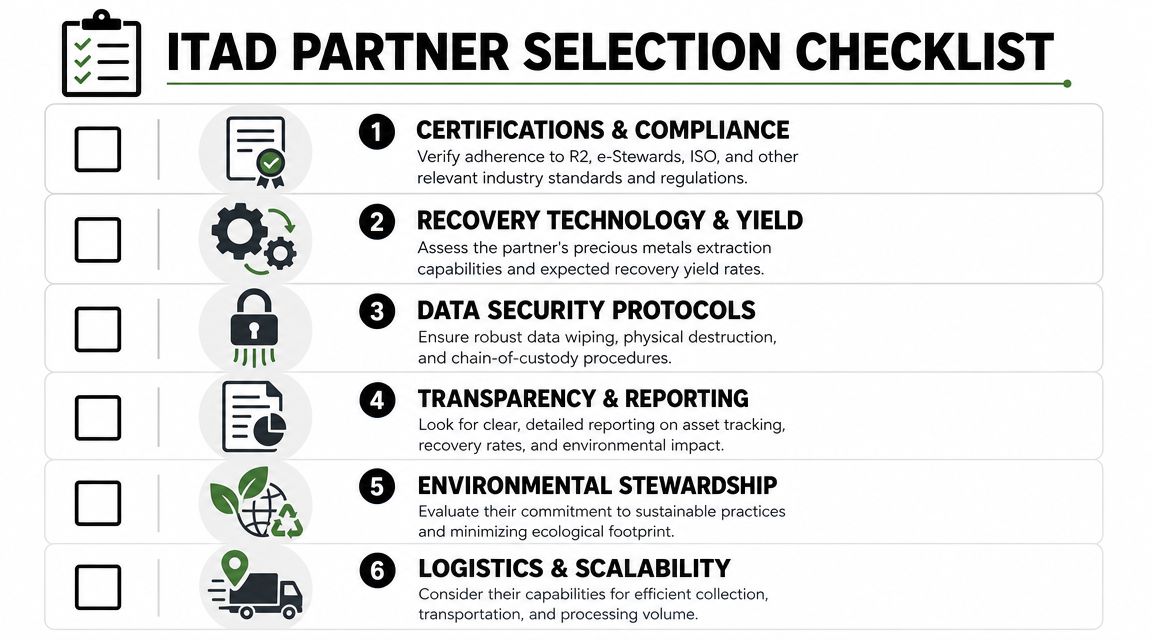
What to compare when evaluating vendors
Use a checklist that goes beyond price.
- Certifications and policy fit matter because your vendor should align with your internal controls for electronics recycling, secure data destruction, and sustainable recycling.
- Chain of custody matters because drives, servers, laptops, and mobile devices can hold regulated or confidential information long after they've lost business use.
- Downstream transparency matters because material often passes through several hands before final recovery or refining.
- Reporting quality matters because sustainability teams need documentation they can use in governance and ESG workflows.
- Logistics capability matters because office cleanouts and data center decommissioning don't behave like small consumer drop-offs.
DIY versus managed disposition
A do-it-yourself approach looks cheaper at first. It rarely stays simple.
| Approach | Main risk | Main benefit |
|---|---|---|
| Internal accumulation | Storage creep, unclear ownership, delayed disposition | None beyond short-term convenience |
| Generic scrap vendor | Weak documentation, uncertain downstream handling | Fast removal |
| Qualified ITAD partner | Requires vendor diligence upfront | Better control over security, compliance, and recovery outcomes |
You can see a non-electronics example of how physical storage problems grow inside public-sector operations in this West Palm Beach storage challenge case study. The lesson carries over. When materials pile up without a structured system, access, accountability, and efficiency all suffer.
For companies building a vendor review process, Reworx has a practical framework on ITAD vendor selection criteria. It covers the sort of questions procurement, IT, facilities, and sustainability teams should be asking before they approve a partner.
Partner with Reworx for Responsible Asset Recovery
Precious metals recovery becomes a strategic decision when you connect four things. Material value. Data security. Regulatory control. Community impact. If one of those pieces is missing, the program is incomplete.
For organizations that need electronics recycling, IT equipment disposal, computer recycling, laptop disposal, medical equipment disposal, product destruction, or secure data destruction, a structured ITAD program gives you a cleaner answer than ad hoc hauling or indefinite storage. It helps your team decide what should be reused, what should enter donation-based recycling, and what belongs in a recovery stream.
Reworx Recycling is one available option for organizations that want a single workflow for pickup coordination, asset handling, data destruction, and responsible downstream processing. That can be especially useful during office moves, facility cleanouts, hardware refresh cycles, and corporate donation programs where multiple goals need to be managed at once.
The point isn't to chase scrap revenue in isolation. It's to retire assets in a way that protects the organization and supports environmental responsibility.
If your business is planning an office cleanout, hardware refresh, data center decommissioning, or broader IT asset disposition effort, Reworx Recycling can help you turn retired equipment into a more organized, secure, and responsible recovery program. Donate old equipment, schedule a pickup, or explore a partnership that supports electronics recycling, digital inclusion, and community impact.