Every IT team has a version of the same room. It might be a locked closet near the server rack, a shelf in facilities, or a back office with retired laptops stacked beside old monitors and docking stations. Some devices still power on. Some have asset tags from three refresh cycles ago. A few probably contain data nobody has formally cleared.
That pile looks like junk until someone asks the obvious question: should we sell it, recycle it, donate it, or just get it out of the building?
For a business, that isn't a housekeeping decision. It's an asset disposition decision with financial, legal, security, and environmental consequences. A generic second hand electronics shop might seem like the fastest answer, especially when space is tight and a move, upgrade, or office cleanout is already underway. But speed often hides risk. The right path depends on what the equipment is, what data it held, whether it still has resale life, and what proof your organization needs after it leaves your custody.
The Hidden Costs in Your IT Storage Closet
The storage closet fills up slowly. First it's a few laptops from a hardware refresh. Then a batch of monitors from a floor renovation. Then old switches, access points, VoIP phones, and a retired NAS that nobody wants to touch because nobody is fully sure what's on it.
On paper, those assets are already retired. In practice, they keep creating work. Facilities wants the room back. Finance wants obsolete equipment cleared off records. Security wants to know whether any drives still contain customer, employee, or regulated data. Sustainability wants to avoid a landfill outcome. Nobody wants a rushed mistake.
A second hand electronics shop solves only one part of that problem. It may buy selected items with obvious resale appeal, but it usually won't manage the entire chain of custody, document data destruction, reconcile serial numbers against inventory, or separate viable assets from scrap in a way that satisfies audit, compliance, and reporting needs.
What businesses usually miss
The hidden cost isn't only the equipment itself. It's the unmanaged process around it.
- Untracked assets: Devices often leave service before records are updated, which creates gaps in inventory and makes audits harder.
- Informal handling: A well-meaning staff member might drop equipment at a local buyer without documenting who transferred what.
- Dormant risk: Old desktops and external drives can hold credentials, local files, cached email, or licensed software long after users move on.
A disciplined review before disposition prevents most of that confusion. A practical starting point is an IT inventory audit before recycling, especially if your organization has gear spread across departments, storage rooms, and remote sites.
Practical rule: If your team can't name the device owner, confirm the storage media inside it, and match it to a disposition decision, it isn't ready to leave the building.
The closet problem isn't clutter. It's unmanaged end of life.
Resale vs Recycling Defining Your Disposition Path
A second hand electronics shop and an electronics recycler serve different purposes. Businesses often blur the two, then wonder why the outcome feels incomplete.
A shop focused on resale looks for devices it can test, clean up, and move quickly. Think newer laptops, recent smartphones, tablets, or business-grade desktops with clear demand. The shop's objective is straightforward: buy at one price, resell at another, and avoid handling gear that takes too much labor or carries too much uncertainty.
Recycling has a different objective. It deals with equipment that has little resale value, failed devices, broken displays, obsolete peripherals, damaged boards, cables, batteries, and mixed e-waste that still needs proper handling. That path emphasizes material recovery, downstream management, and environmental compliance.
The easiest way to frame the choice
A good comparison is vehicle disposition.
| Path | Main objective | Best for | Main concern |
|---|---|---|---|
| Resale | Recover value from usable equipment | Recent, functional devices | Data security and grading accuracy |
| Recycling | Responsibly process end of life equipment | Broken, obsolete, incomplete gear | Environmental handling and documentation |
| ITAD program | Combine both under one controlled process | Mixed corporate asset loads | Security, compliance, value recovery, reporting |
The mistake is treating a mixed corporate load like a simple consumer trade-in. Businesses rarely retire only one category of device. They retire fleets. That means some units should be remarketed, some donated, some dismantled for parts, and some physically destroyed because the risk profile is too high.
What works and what doesn't
What works is a disposition plan built around device condition, data sensitivity, and chain of custody.
What doesn't work is letting convenience drive the decision. A local buyer may be useful for a handful of low-risk items, but not as a policy for enterprise laptops, healthcare workstations, school district refreshes, or data center gear.
If your organization is trying to reduce the frequency of emergency refreshes, it also helps to plan upstream. Models such as flexible IT equipment leasing can make replacement cycles more predictable, which in turn makes end-of-life disposition easier to schedule and document.
For a business audience, the more accurate term is IT asset disposition, not just resale or recycling. A solid overview of that framework is covered in this explanation of IT asset disposition.
The Business Case for Value Recovery and Resale
The second hand electronics shop market is much larger than many corporate teams assume. The global second-hand electronic products market was estimated at US$104.5 billion in 2024 and is projected to reach US$233.0 billion by 2030, while the U.S. market alone was estimated at US$28.5 billion in 2024, according to this second-hand electronic products market outlook. That matters because it confirms resale isn't a fringe activity. It's a major channel with enough scale to support disciplined value recovery programs.
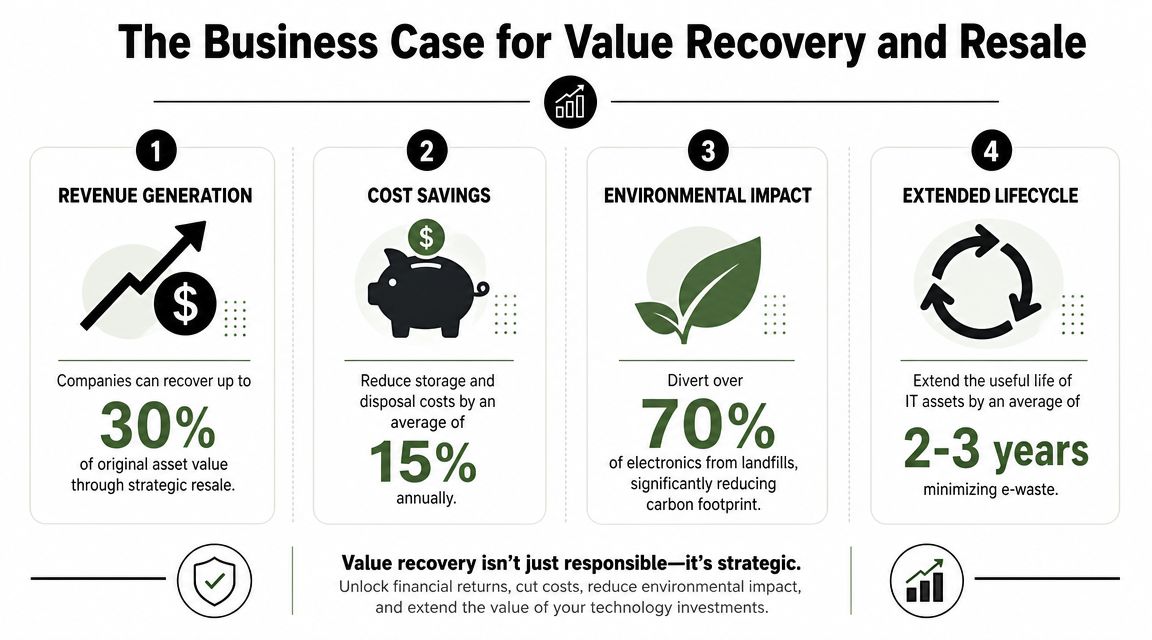
For IT leaders, that scale changes the conversation with finance. Retired equipment doesn't need to be viewed only as disposal cost. In many environments, some portion of the fleet still has resale life if devices are collected on time, tested consistently, and graded before condition deteriorates in storage.
Where value recovery usually succeeds
Resale works best when businesses act before equipment becomes stale.
- Business laptops with current demand: Devices from standard enterprise fleets often move better than odd one-off models because parts, chargers, and buyer expectations are clearer.
- Uniform batches: A matched set of identical laptops or phones is easier to process than a random stack of mixed-age gear.
- Equipment with complete accessories: Power adapters, docks, and matching components improve remarketing efficiency.
The operational payoff matters as much as the direct recovery. Clearing surplus equipment reduces storage pressure, simplifies inventory, and makes refresh planning less reactive.
Circularity has budget value too
Extending the useful life of equipment through remarketing supports circular economy goals in a way business stakeholders can understand. Sustainability teams want landfill avoidance and resource recovery. Finance wants less waste tied up in idle assets. Operations wants space back. Resale can support all three when the process is controlled.
Equipment loses value while it sits. The longer assets stay in a closet, the more likely they shift from remarketing candidates to recycling candidates.
That is why timing matters. A device that's worth reselling this quarter may become low-value scrap after another year of neglect, battery degradation, or cosmetic damage. Businesses that want stronger recovery need policy, not occasional cleanup. That means scheduled collection, internal handoff procedures, and a disposition partner that can separate resale from recycling without guesswork.
If you're building that process, this guide on maximizing value in IT asset disposition is a practical place to start.
Data Security and Compliance The Hidden Risks of Resale
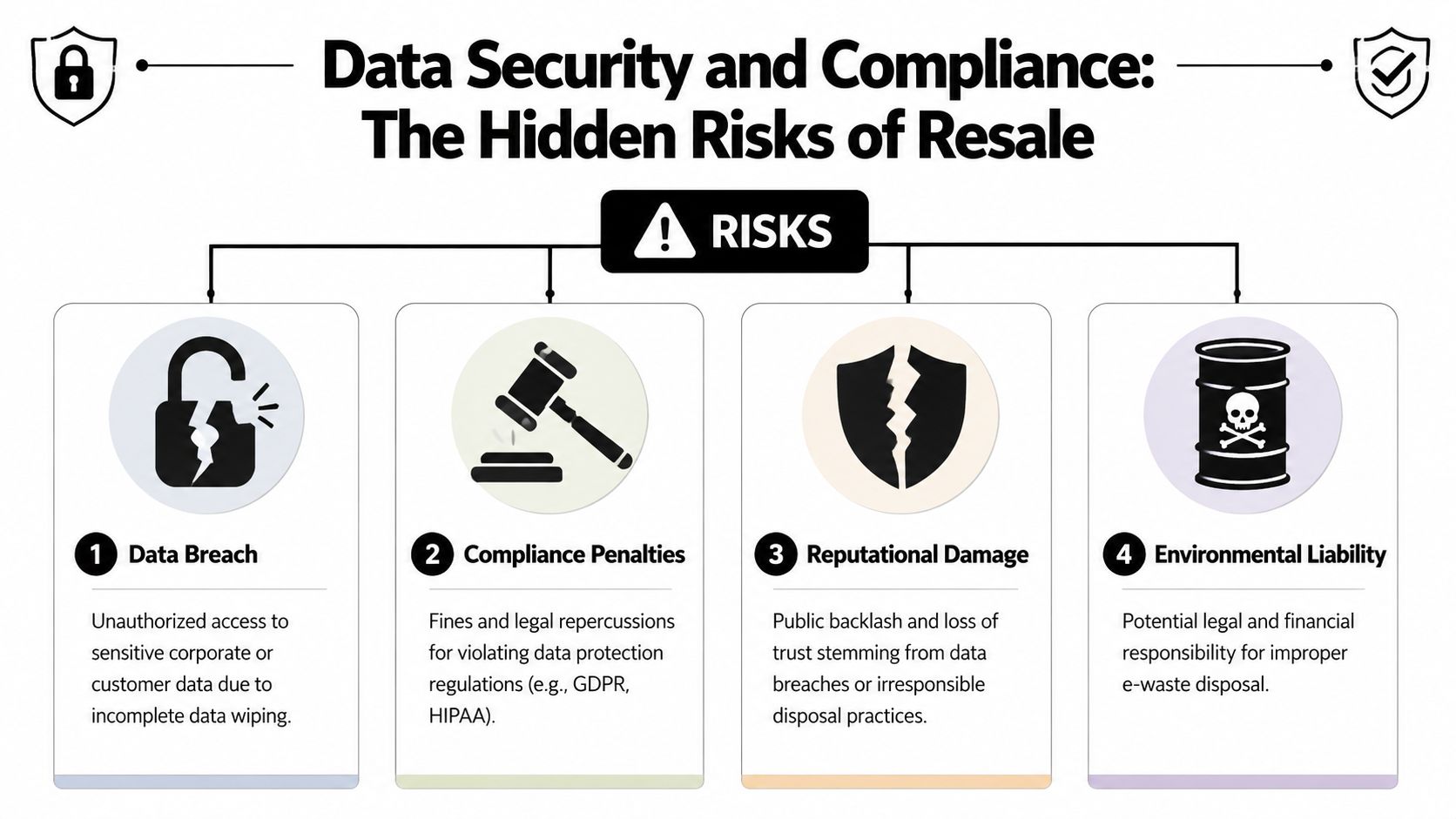
The financial upside of resale is real. So is the downside when a company treats used equipment like ordinary surplus property.
A factory reset is not the same thing as a defensible data destruction process. On a corporate device, the issue isn't only visible files. It's cached credentials, synced folders, browser data, email remnants, virtual machine images, local archives, application tokens, and data that can remain recoverable without proper sanitization. Once that device leaves your control, you may not get a second chance.
Resale risk isn't just an IT problem
Security teams often understand the issue immediately. Other stakeholders may not. The risk surface spreads across multiple departments:
- Legal and compliance: If a device held regulated information, the burden isn't reduced just because the hardware is old.
- HR: Retired laptops may contain employee records, payroll exports, or local documents from offboarding gaps.
- Sales and customer success: Field devices can hold account lists, contracts, and client communications.
- Engineering and product teams: Test devices sometimes retain source files, credentials, internal builds, or configuration data.
In regulated sectors, this gets even sharper. A healthcare organization, for example, can't treat workstation disposal as a basic resale transaction. Security validation has to align with the broader control environment. Teams reviewing healthcare cyber controls often look at related practices such as HIPAA Pentesting, because technical assurance and equipment disposition are part of the same risk story.
The weakest point is usually process
Most failures don't come from complex attacks. They come from informal habits.
| Weak practice | Why it creates risk |
|---|---|
| Ad hoc staff drop-offs | Chain of custody breaks immediately |
| No serial-level records | You can't prove which assets were wiped, sold, or destroyed |
| Reset without verification | Data may remain recoverable |
| Mixed loads with no triage | High-risk devices get treated like low-risk surplus |
A local buyer may know how to evaluate resale condition. That doesn't mean they know how to support your compliance obligations.
Brand damage is part of this too. If company-branded equipment appears in the wrong place, still labeled and still recoverable, the problem becomes public-facing fast. Environmental mishandling creates another exposure. If downstream handling is opaque, your company may carry reputational fallout even when the equipment is no longer onsite.
For organizations that need a tighter standard, data security best practices in IT asset disposition lays out what a more defensible process should include.
Introducing Strategic IT Asset Disposition (ITAD)
Once you combine value recovery with security, compliance, and environmental handling, the right framework is IT asset disposition, usually shortened to ITAD. That term matters because it shifts the job from "find someone to take old electronics" to "manage end of life assets under controlled business rules."
A strategic ITAD program handles the full lifecycle of retirement. It identifies what you have, tracks movement, applies the right data destruction method, routes viable equipment to remarketing or donation, and sends non-viable material to responsible recycling. Just as important, it produces records that an IT manager, auditor, compliance lead, or sustainability officer can use.
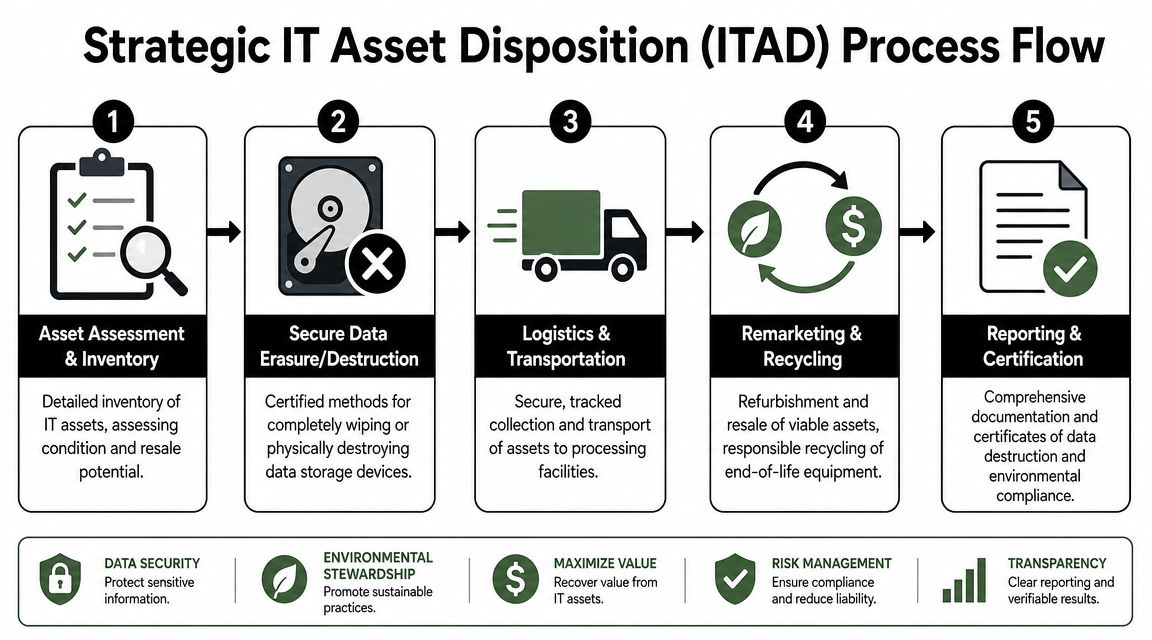
What a real ITAD workflow looks like
The core workflow is usually more structured than many organizations expect.
Asset assessment and inventory
Devices are logged, identified, and associated with the right disposition path. During this process, hidden drives, missing accessories, and inconsistent records usually surface.Data sanitization or destruction
Storage media is wiped using defined procedures or destroyed physically when policy, risk, or device condition requires it.Secure logistics
Equipment moves under documented custody rather than informal handoffs.Testing and grading
Usable assets are evaluated for remarketing, redeployment, or donation.Recycling and reporting
Remaining material is processed responsibly, and the client receives documentation.
Why this beats a generic second hand electronics shop
A general resale outlet is optimized for transactions. ITAD is optimized for governance.
That distinction matters most when a load includes mixed asset classes: laptops from remote staff, failed SSDs, networking gear from a branch closure, monitors from a facility cleanout, and tablets from a field team. A transactional buyer will usually cherry-pick resale items and leave the rest. An ITAD process treats the entire lot as one managed project.
The strongest ITAD partners aren't just buyers of used gear. They're risk managers with remarketing capability.
Another overlooked point is supply-side complexity. The used electronics market isn't shaped only by bargain-hunting. Research discussed by Dartmouth notes that remanufacturers have to manage both the quantity and quality of returned items, and inventory availability depends on the condition and flow of returned equipment in ways that affect sourcing and consistency in secondary markets, as explained in this analysis of used electronics market constraints. That helps explain why some models are easy to remarket and others are unpredictable, even when demand seems obvious from the outside.
For corporate programs, that reality reinforces the value of early triage and disciplined collection. Better inputs produce better resale outcomes.
Your Checklist for Vetting a Disposition Partner
When businesses evaluate a second hand electronics shop, recycler, or ITAD vendor, they often ask the wrong first question: "What will you pay for the gear?" That's understandable, but it should come later.
The first question is whether the provider can protect your organization if something goes wrong.
Non-negotiables to verify
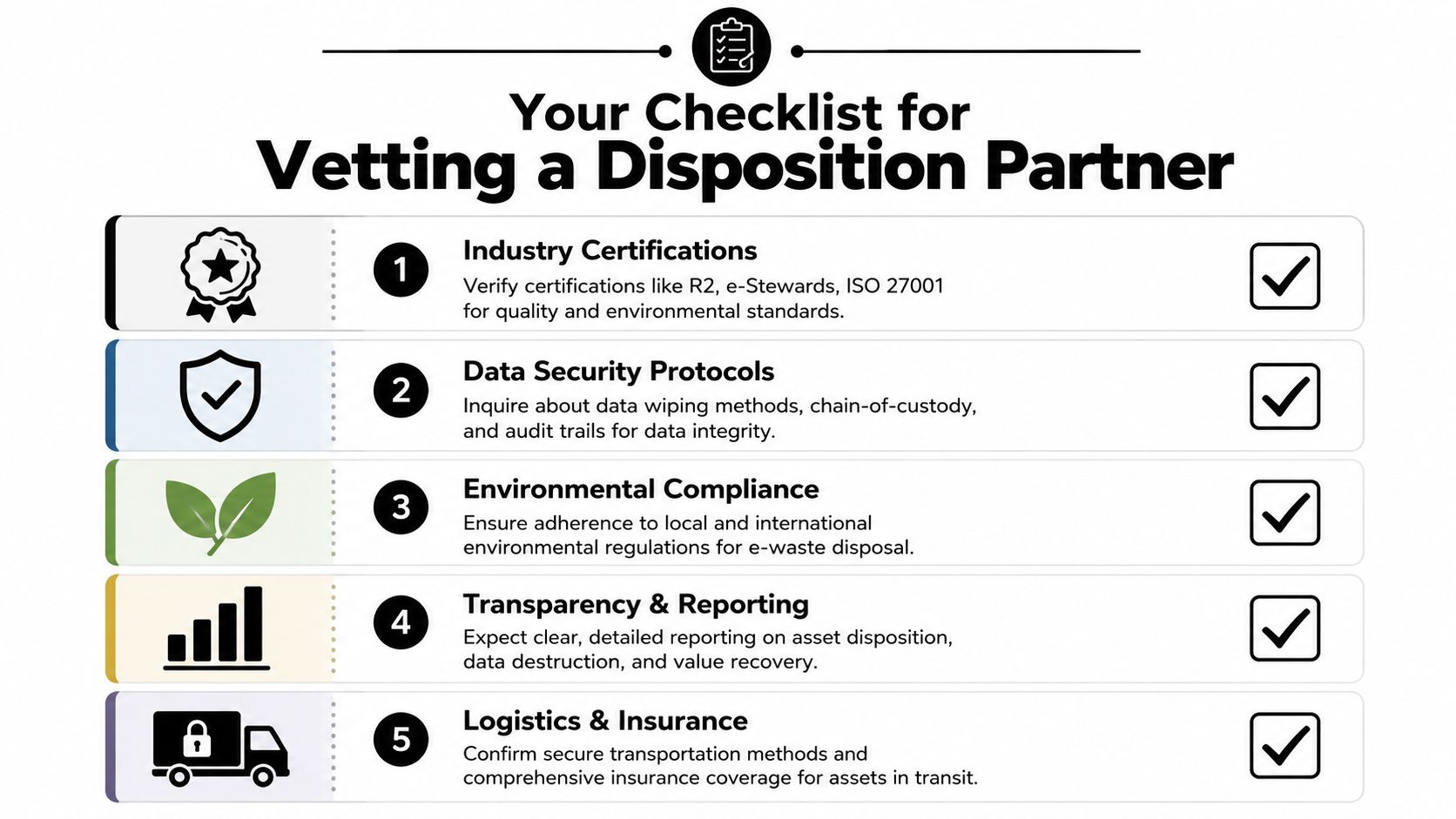
Use this list when reviewing any disposition partner.
Documented chain of custody
Ask how assets are tracked from pickup through final disposition. If they can't explain custody clearly, stop there.Defined data destruction methods
You need more than "we wipe drives." Ask when they use logical sanitization, when they use shredding, and what documentation you receive afterward.Serial-level reporting
Bulk summaries aren't enough for many organizations. You should know what happened to each relevant asset or media item.Environmental downstream transparency
Ask where non-remarketable material goes. Responsible vendors should be able to explain downstream handling without evasion.Insurance and logistics controls
Transport risk is still your risk while assets are moving. Confirm how pickups are secured and what coverage exists.
Questions that reveal maturity fast
Some questions cut through marketing quickly.
| Ask this | Strong answer sounds like | Weak answer sounds like |
|---|---|---|
| How do you handle mixed loads? | "We triage for reuse, donation, recycling, and destruction." | "We mainly buy what has resale value." |
| What proof do we receive? | "Inventory records, destruction documentation, disposition reporting." | "We can send a receipt." |
| How do you support audits? | "We maintain records tied to the project and asset flow." | "That usually hasn't been an issue." |
A mature partner should also understand your sector. School systems, healthcare groups, manufacturers, labs, and public agencies don't retire equipment the same way. The workflow should reflect that.
Don't ignore mission alignment
This part is often skipped, but it matters. If your company has sustainability targets, community investment goals, or corporate donation programs, ask how the vendor supports them. Some organizations want maximum resale return. Others want a blend of secure recycling, responsible donation, and documented social impact. Neither approach is wrong, but you should choose intentionally.
A more detailed framework for comparing providers is available in these vendor selection criteria for ITAD and electronics recycling.
If a provider can't explain their process in plain language, they probably won't explain a problem clearly either.
The best vetting exercise is simple: request the exact documents, sample reports, and operational explanations you'd need if legal, audit, or leadership asked for them tomorrow.
Partner with Reworx for Responsible ITAD
A second hand electronics shop can be useful in narrow cases. It can move a few clean, low-risk devices into the secondary market. But most businesses don't have a narrow case. They have mixed assets, security obligations, sustainability commitments, and limited time to manage the handoff well.
That's where a structured ITAD partner makes sense.
Reworx Recycling approaches end-of-life electronics as a business process, not a quick resale transaction. For organizations handling office cleanouts, laptop disposal, secure data destruction, data center decommissioning, medical equipment disposal, or broader electronics recycling, the value is in combining control with flexibility. Equipment that still has life can be evaluated for reuse and value recovery. Equipment that doesn't can move into responsible recycling. Sensitive media can be destroyed under a defensible process. The result is cleaner documentation, lower operational friction, and less guesswork for internal teams.
The other distinction is mission. Reworx Recycling operates as a donation-based recycling and social enterprise recycling partner, which matters for companies that want their IT equipment disposal strategy to support more than compliance. Responsible disposition can also support technology access, community impact, digital inclusion, and workforce development. For many sustainability leaders, that's a stronger outcome than simple liquidation.
If your organization is planning a refresh, consolidating offices, clearing a storage room full of retired equipment, or formalizing an IT asset disposition program, don't default to the nearest second hand electronics shop. Start with a partner that can protect data, document outcomes, and support your environmental goals at the same time.
If you're ready to retire old equipment without losing control of the process, connect with Reworx Recycling to discuss electronics recycling, secure data destruction, pickup scheduling, donation-based recycling, or a broader IT asset disposition plan for your business.