Atlanta's energy story doesn't start with power plants. It starts with software, servers, advanced manufacturing lines, and buildings that now depend on continuous digital uptime. Georgia's tech industry has an estimated annual economic impact of $113 billion, and technology accounts for 12% of the Atlanta metro's total GRP, according to Atlanta technology industry statistics summarized here. That scale changes how business leaders should think about energy. In Atlanta, energy is no longer just a utility expense. It's a strategic input into growth, resilience, and asset planning.
That's why Atlanta energy sector tech innovations matter beyond utilities and venture-backed startups. When energy systems become more digital, businesses inherit a second operational question: what happens to the hardware when it's upgraded, replaced, or retired? Smart building controllers, edge devices, battery controls, networked meters, and data center gear all create an end-of-life obligation that many organizations still treat as an afterthought.
Atlanta's Tech Boom and The New Energy Imperative

PwC expects U.S. power demand to climb by 2030 as data centers and electrification add load across the economy. In Atlanta, that national trend lands on a metro business base built around digital operations, logistics, enterprise systems, healthcare, and advanced industrial activity. The result is practical, not theoretical. Energy performance now affects uptime, site selection, capital planning, and the useful life of the equipment companies deploy to manage power more precisely.
That shift changes who owns the issue. Until recently, energy strategy was often delegated to facilities management. Now the finance team sees margin exposure from higher consumption and peak demand. IT leaders see a reliability problem tied to servers, network closets, controls, and edge devices. Procurement and compliance teams see a growing inventory of electronics that will eventually need secure retirement.
Three business implications stand out:
- Expansion planning now carries an energy systems component. New offices, labs, warehouses, and compute-heavy environments increase both electricity needs and the volume of connected hardware on site.
- Efficiency has become an operating discipline. Companies that install better controls, monitor loads more closely, and reduce waste can limit cost volatility and improve resilience during periods of grid stress.
- Energy upgrades create downstream ITAD work. Smart meters, building controls, battery interfaces, sensors, and supporting network gear all enter a lifecycle that ends with data security, chain-of-custody requirements, and compliant recycling.
A simple rule helps frame the issue. If an organization adds digital infrastructure to improve energy performance, it is also adding future decommissioning work.
Atlanta executives can see the pattern in corporate real estate decisions. Teams evaluating daylighting, building envelope performance, and lower-load design can still borrow relevant ideas from Vivid Skylights' energy plan advice, even if the project type differs. The broader lesson is that energy performance is rooted in early design and procurement choices, then reinforced through operations and maintenance.
Corporate transition activity sharpens the point. Mergers, relocations, retrofit programs, and site consolidations often trigger simultaneous changes in power systems, networking, and device inventories. Companies following local tech merger and acquisition shifts should also account for the retired hardware left behind after systems are integrated, standardized, or replaced. That is where secure, documented IT asset disposition becomes part of energy modernization rather than a separate cleanup task. For Atlanta organizations managing that turnover, providers such as Reworx Recycling fit into the operating model by handling equipment retirement in a way that supports data security, compliance, and responsible e-waste processing.
Atlanta's energy-tech boom is best understood as operational modernization with hardware consequences. Companies that recognize both sides of that equation tend to budget more accurately, reduce transition risk, and avoid treating retired electronics as an afterthought.
Decoding Atlanta's Key Energy Tech Innovations
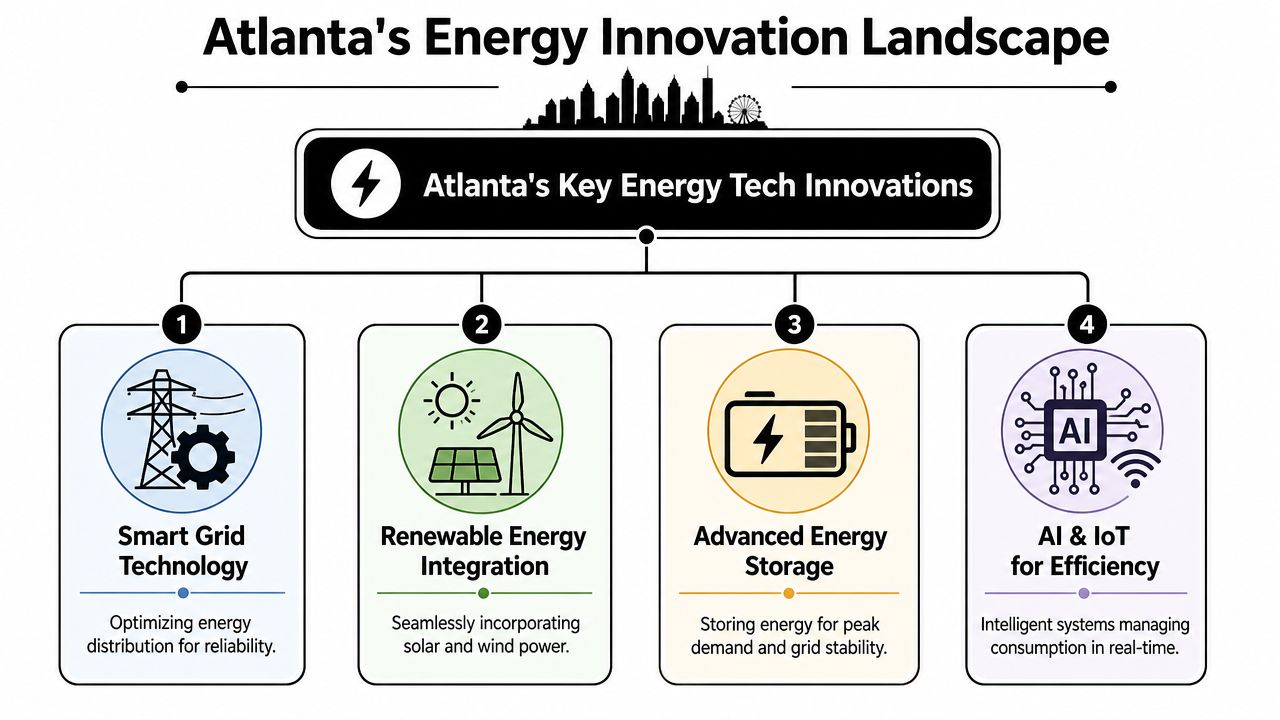
Most Atlanta energy sector tech innovations fall into a handful of practical categories. Business leaders don't need to become engineers to understand them. They only need to know what each technology does, why it matters, and what equipment it introduces into the workplace.
Smart grid technology
Think of a smart grid as an internet layer for electricity. Traditional grids push power one way and provide limited visibility. Smarter grid systems add sensors, communications tools, and software that help utilities and facilities react faster to changes in load, outages, and equipment conditions.
For a business, the benefit is straightforward: improved reliability and better visibility into how and when power is used.
Renewable energy integration
This category includes the systems that help buildings and campuses work with solar and other variable generation sources. The innovation isn't only the panel or generation source itself. It's the control architecture around it, including inverters, monitoring devices, and energy management software that make intermittent power usable.
The business implication is less exposure to volatile operating conditions and more control over long-term sustainability planning.
A useful way to evaluate these systems is to compare not just installation options, but lifecycle support and equipment complexity. Even a consumer-facing reference like comparing London solar panel quotes highlights a discipline many B2B teams skip: reviewing the full installed system, not just the headline technology.
Advanced energy storage
Storage acts like a shock absorber for the power system. Batteries can store electricity for later use, support peak demand management, and help facilities maintain continuity during grid stress or shifting load patterns.
For a large site, storage can change procurement strategy, backup planning, and facility design. It also introduces highly specialized components that eventually require careful handling at end of life.
AI and IoT for efficiency
Energy innovation becomes visible inside the building. Sensors, gateways, controllers, and software platforms track occupancy, temperature, equipment runtime, and electrical use. AI models can then adjust HVAC, lighting, and other systems in near real time.
That matters because waste usually hides in routine operations. Buildings run empty conference rooms, overcool lightly occupied floors, and keep older equipment online long after it should've been retired.
Atlanta's Energy Tech at a Glance
| Technology | Primary Business Benefit | Associated Equipment |
|---|---|---|
| Smart grid technology | Better reliability and load visibility | Sensors, meters, communications hardware, control systems |
| Renewable energy integration | More control over energy sourcing and facility sustainability | Inverters, monitoring platforms, switchgear, connected generation assets |
| Advanced energy storage | Peak demand management and resilience support | Battery systems, battery management electronics, controllers |
| AI and IoT for efficiency | Lower waste through real-time optimization | Sensors, gateways, building controllers, edge devices |
What non-technical leaders should ask vendors
Rather than chasing novelty, ask practical questions:
- What hardware is required on site? Software-only promises often hide a sizable device footprint.
- Who manages replacement cycles? Sensors, controllers, and batteries don't last forever.
- How is retired equipment handled? If a vendor can't answer this clearly, the disposal burden may fall back on your team.
That final question is where many energy projects stop being innovation stories and become operations stories.
The Role of AI and IoT in Energy Management
A typical Atlanta office building illustrates the shift well. The property team starts with a familiar complaint: utility costs feel unpredictable, comfort complaints come in clusters, and no one trusts the old schedule-based HVAC setup. The building isn't broken. It's just blind.
The first upgrade is modest. Occupancy sensors go into conference rooms and common areas. Environmental sensors track temperature and humidity more closely. Gateways collect the data, and a building platform starts showing what's happening floor by floor.
From static schedules to responsive buildings
Before the upgrade, the office cooled and lit spaces based on assumptions. After the upgrade, it responds to usage. A lightly occupied floor no longer gets treated like a full one. Meeting rooms don't receive the same conditioning all day. Maintenance staff can see unusual equipment behavior earlier and address it before the issue becomes disruptive.
The primary shift occurs when AI starts interpreting the incoming data. Instead of showing a dashboard that someone has to watch constantly, the software can recommend or automate changes. It can trim unnecessary runtime, reduce avoidable overlap between systems, and flag anomalies that suggest aging equipment.
Buildings don't waste energy because managers don't care. They waste energy because old systems can't see enough, fast enough.
The hidden hardware footprint
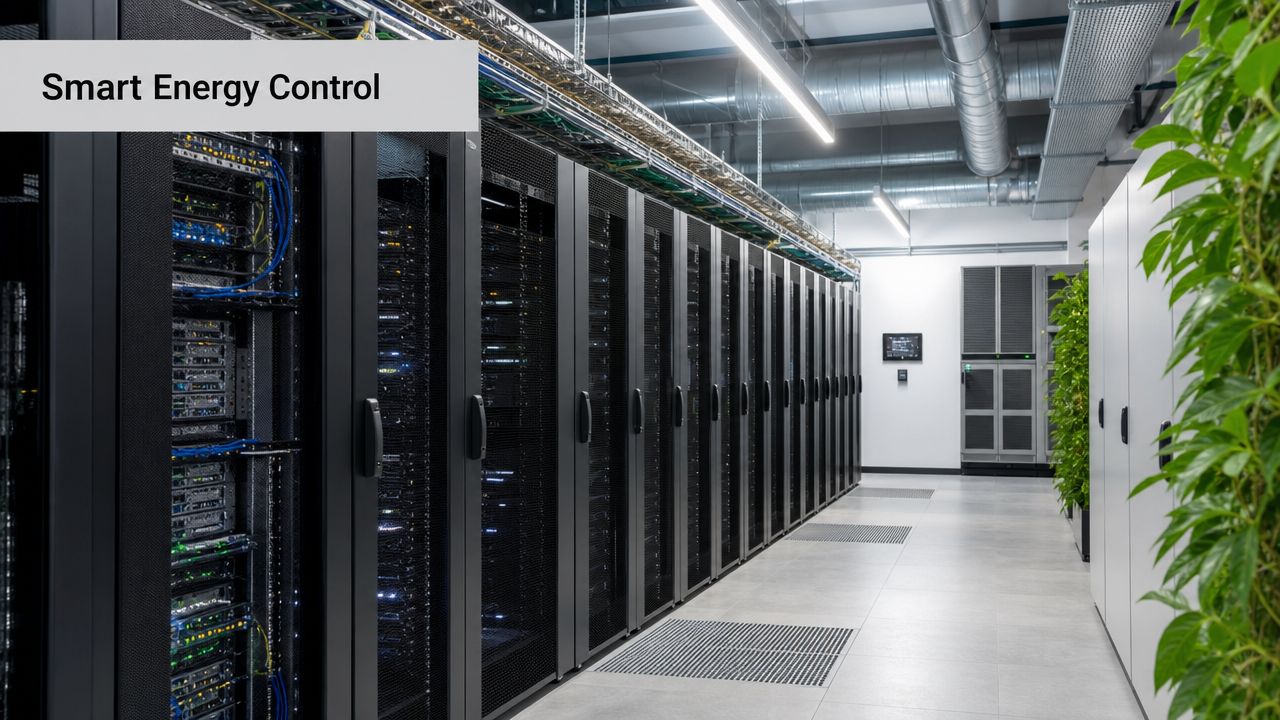
Every one of those gains depends on physical equipment. Sensors are hardware. Controllers are hardware. Network appliances at the edge are hardware. The platform may feel virtual, but the deployment leaves a trail of devices in ceilings, closets, server rooms, and electrical spaces.
That matters for IT and facilities teams because these upgrades blend operational technology with traditional IT asset management. A business that's already studying edge computing trends in Atlanta operations should recognize the overlap immediately. Once devices become distributed, connected, and security-sensitive, retirement planning can't be improvised.
What should happen before rollout
A sensible AI and IoT deployment plan includes more than procurement and installation.
- Map device ownership. Decide whether IT, facilities, or a vendor tracks each asset class.
- Classify data risk. Some devices store logs, credentials, network settings, or other operationally sensitive information.
- Define retirement procedures early. If hardware fails, gets replaced, or reaches end of support, your team needs a secure path for removal and disposition.
That's the operational side of Atlanta energy sector tech innovations that often gets missed. Smart systems reduce waste while they're in service. They also multiply the number of assets that need disciplined handling later.
Local Pioneers and Projects Shaping the Future
Nearly $30 billion in private-sector clean-energy investment announced in Georgia since 2021 has shifted the conversation from experimentation to industrial buildout, with roughly 29,000 associated jobs expected across EV, battery, and solar manufacturing, according to Georgia's energy industry overview. The same state profile also points to a broader foundation of solar generation, new nuclear capacity at Plant Vogtle, and ongoing work in battery, hydrogen, and solar technologies. For Atlanta organizations, that combination matters because it ties innovation to production capacity, labor demand, and long-term infrastructure planning.
The most important local signal is coordination across capital, infrastructure, and workforce development. Once those three move together, energy technology stops being a niche category and starts affecting how companies buy equipment, staff technical roles, and schedule facility upgrades.
Why this matters inside Atlanta
Atlanta businesses do not need to build utility assets to feel the operational effects. Regional investment changes supplier depth, raises expectations for energy performance, and pushes more projects toward software-connected equipment that sits between traditional facilities systems and core IT.
That shift has direct consequences for day-to-day operations.
- Procurement becomes cross-functional. Energy upgrades now involve controls, communications hardware, software subscriptions, and cybersecurity review alongside electrical and mechanical scope.
- Technical ownership gets less clear. Facilities, OT, IT, and sustainability teams increasingly share responsibility for the same systems.
- Asset retirement becomes more frequent. More electrified and instrumented environments produce more controllers, drives, meters, gateways, and storage devices that eventually need secure disposition.
The last point gets less attention than it should. Organizations expanding intelligent buildings, grid-interactive systems, or energy analytics often add storage and processing capacity at the same time. That pattern is already visible in Atlanta's growing demand for data storage solutions, where more digital infrastructure supports performance goals but also increases the volume of hardware that will later leave service.
The ecosystem is deeper than startup coverage
Local coverage often emphasizes incubators, grants, and early-stage ventures. Those developments matter, but executives should pay equal attention to installed base growth. Every successful deployment creates a future replacement cycle, a new chain of custody question, and a larger pool of devices that may hold configuration data, operational logs, or network credentials.
That is where the business case becomes more concrete. A region with rising energy-tech adoption will also see faster turnover in specialized electronics. Companies that plan for secure removal, documented data destruction, and compliant recycling early will be in a stronger position than those that treat end-of-life handling as an afterthought. For Atlanta firms managing that hardware churn, ITAD partners such as Reworx Recycling can support the compliance and security side of decommissioning without separating it from broader operational planning.
The business takeaway
For Atlanta-based leaders, regional clean-energy investment is more than a policy story. It is a direct signal for operational planning. The market around them is becoming more electrified, more software-defined, and more dependent on equipment with shorter and more complex refresh cycles. Companies that align procurement, asset tracking, and end-of-life processes with that reality are more likely to avoid security gaps, compliance problems, and unnecessary disposal costs.
Navigating Regulatory Incentives and Business Impacts
Federal funding is changing the energy adoption equation. The U.S. energy-innovation pipeline is being driven by an $8 billion regional clean-hydrogen hub program plus over $20 billion more for large-scale demonstrations, including $6.3 billion for industrial decarbonization, according to the State and Regional Energy Innovation Index. That scale matters because it pushes energy technology closer to commercial use, supplier readiness, and corporate adoption.
For Atlanta businesses, the strategic question isn't whether every program applies directly to their facility. It's whether these investments will lower barriers, expand vendor ecosystems, and normalize technologies that once felt experimental. In many cases, they will.
The business case is broader than utility savings
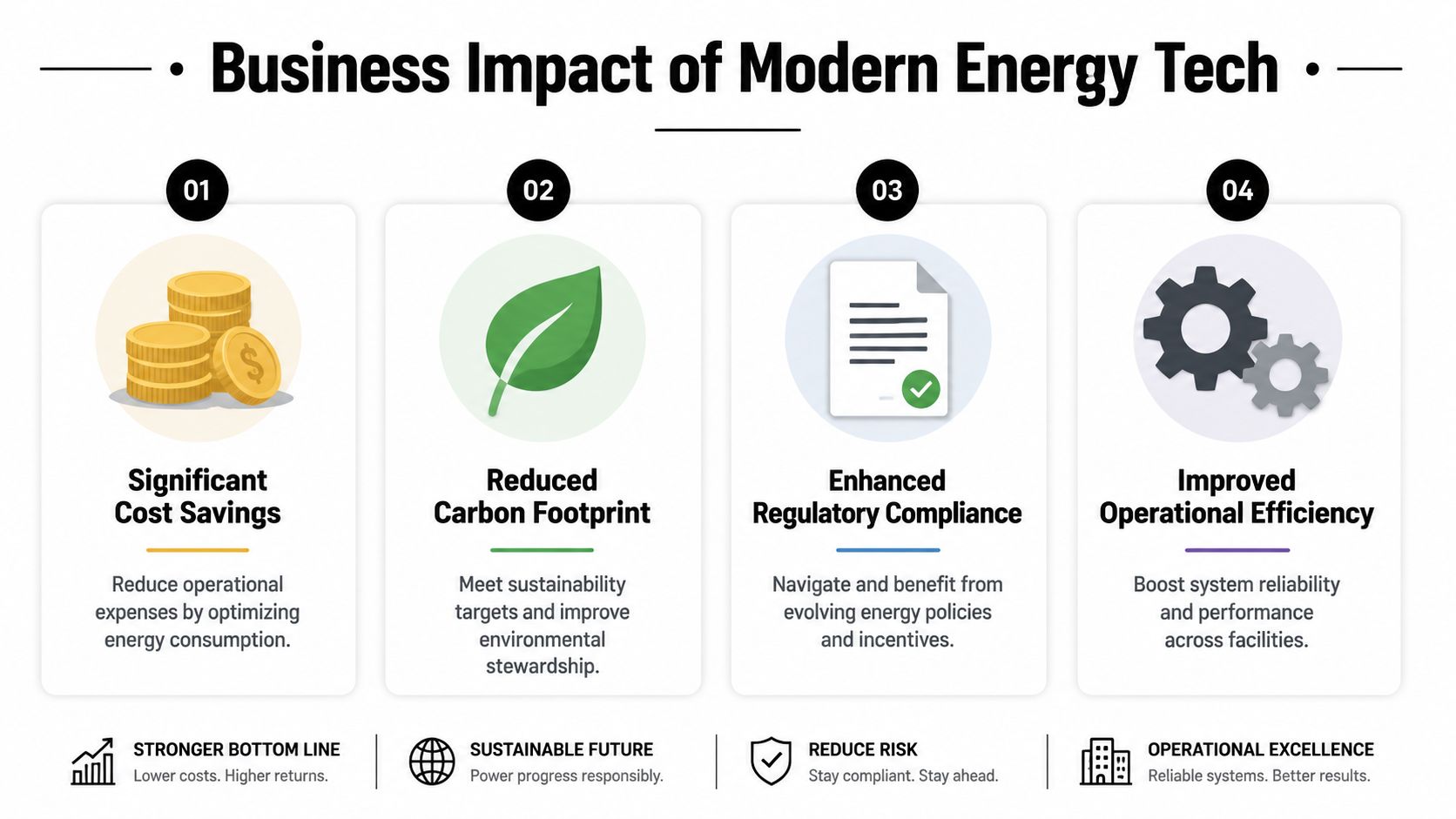
Energy innovation creates four kinds of business value, and only one of them is direct efficiency.
- Resilience: Smarter systems can reduce operational disruption by improving visibility and flexibility.
- Compliance readiness: Businesses face growing pressure to document how they manage equipment, waste streams, and environmental risk.
- Capital planning discipline: Firms that understand technology lifecycles can budget upgrades and retirements more cleanly.
- Brand credibility: Customers, employees, and partners increasingly notice whether sustainability claims are matched by operational practice.
Compliance includes what leaves the building
Many energy upgrade discussions remain incomplete. Leaders often focus on incentives for installation but spend less time on disposal obligations after replacement. That creates risk. Buildings, labs, offices, and mixed-use facilities often remove old devices in bulk during modernization. If those assets contain data or regulated components, poor handling can undercut the value of the original investment.
A practical starting point is understanding local e-waste compliance expectations in Fulton County. Even where rules vary by asset type and disposal channel, the business principle is simple: retirement planning should happen before equipment is removed, not after it's stacked in a storage room.
Decision lens: Don't evaluate an energy project on installation economics alone. Evaluate the full asset lifecycle, including removal, data security, and recycling responsibility.
What mature organizations do differently
The most prepared organizations don't frame energy modernization as a one-time retrofit. They treat it as a governance issue. Procurement, legal, IT, facilities, and sustainability teams all have a stake in how new systems are adopted and how old systems are retired.
That approach improves outcomes because it connects incentives to execution. The technology may begin as an energy decision, but its long-term business impact depends on how well the organization manages the equipment around it.
The Hidden Lifecycle E-Waste from Energy Tech Upgrades
Every energy upgrade creates a future disposal event. That's true for smart meters, connected thermostats, EV charging electronics, battery controls, monitoring gateways, server-connected building systems, and older infrastructure removed during retrofits. The more Atlanta invests in digital energy systems, the more it creates a parallel stream of specialized electronic waste.
This is the operational blind spot in many innovation discussions. Coverage often celebrates deployment and workforce activity, but one of the key unresolved issues is how that innovation translates into practical operational needs. As noted in reporting on Atlanta's cleantech workforce and innovation gap, rapid growth in energy tech creates significant end-of-life equipment turnover and requires specialized ITAD, decommissioning, and secure asset retirement services that most innovation coverage ignores.
Why energy-tech waste is different
Retired energy-tech equipment often carries a more complex risk profile than standard office electronics.
- Data exposure: Controllers, gateways, drives, and management appliances may contain network settings, logs, credentials, or facility operating information.
- Mixed material streams: Some assets combine electronics, industrial components, and battery elements in ways that complicate disposal.
- Chain-of-custody problems: During renovations and upgrades, devices can move through multiple contractors before anyone documents what happened to them.
That's why an ordinary cleanout process often isn't enough. Organizations need a documented disposition path that matches the sensitivity of the assets involved.
The ITAD connection many teams miss
An energy retrofit can look like a facilities project on paper and still generate an IT asset disposition problem in practice. Once equipment stores data or connects to enterprise systems, retirement becomes a security and compliance issue, not just a hauling issue.
A structured lifecycle approach helps. Teams that formalize how IT equipment moves from acquisition through recycling are usually better prepared for smart-building and energy-control hardware as well. The principle transfers cleanly: inventory first, remove securely, document disposition, and route assets into appropriate recycling or destruction channels.
Where specialized support fits
For Atlanta businesses that need electronics recycling, secure data destruction, computer recycling, product destruction, or data center decommissioning support tied to facility modernization, Reworx Recycling provides services related to IT equipment disposal, hard drive shredding, pickups, decommissioning, and recycling consultations through its Atlanta-area operation. In this context, that matters because energy-tech upgrades increasingly produce mixed loads of conventional IT assets and less familiar operational devices.
If your upgrade creates connected hardware, your disposal plan should look more like an ITAD program than a janitorial task list.
A broader sustainability point
Responsible retirement isn't separate from sustainability. It's part of whether the upgrade was managed well in the first place. A company can't credibly talk about cleaner infrastructure if obsolete devices, storage media, and control equipment end up unmanaged in closets, dumpsters, or informal secondary channels.
That's the overlooked operational consequence of Atlanta energy sector tech innovations. The smarter the city's infrastructure becomes, the more disciplined businesses need to be about what happens when that hardware leaves service.
Actionable Steps for Atlanta Businesses and Agencies
Most organizations don't need a sweeping transformation plan. They need a tighter process. The businesses handling Atlanta's energy transition well usually do three things early, before equipment starts piling up or contractors start removing gear.
Run a combined energy and asset audit
Start with one inventory, not two separate initiatives. Review building controls, edge devices, networking hardware tied to facility systems, backup equipment, older laptops, servers, and any electronics likely to be displaced by modernization.
Focus on practical questions:
- Which systems are aging out?
- Which devices store data or credentials?
- Which upgrades will trigger an office cleanout, facility cleanout, or partial decommissioning event?
That gives IT, facilities, and sustainability leaders a shared operating picture.
Build the retirement plan before the upgrade
Too many companies approve installation budgets without deciding how the outgoing equipment will be handled. Reverse that order. Before new gear arrives, define pickup logistics, chain of custody, data destruction standards, internal signoff, and where reusable equipment might fit into corporate donation programs.
This step is especially useful for organizations managing multiple asset types at once, such as laptop disposal, laboratory equipment disposal, medical equipment disposal, or secure destruction of obsolete storage media. The categories differ, but the discipline is the same.
Choose an execution partner with documented processes
Don't evaluate disposal support on convenience alone. Ask for specifics on inventory handling, transport, decommissioning, secure data destruction, and downstream recycling practices. If your site includes server rooms, distributed smart-building hardware, or mixed electronic loads, the provider should be comfortable with both traditional ITAD and more complex sustainable recycling workflows.
The strongest plans also account for donation-based recycling where appropriate. That's particularly relevant for businesses that want to align electronics recycling with social impact, digital inclusion, and internal ESG goals rather than treating every retired asset as scrap.
A good final check is whether your team can answer this question without hesitation: when the next upgrade happens, who owns the last mile of asset retirement?
Atlanta businesses that are modernizing facilities, replacing connected equipment, or planning secure IT equipment disposal can explore practical guidance through Reworx Recycling. If your team needs help with electronics recycling, donation-based recycling, secure data destruction, computer recycling, a pickup schedule, or a broader ITAD plan tied to an office cleanout, facility cleanout, or decommissioning project, now's the time to set that process before the next round of upgrades begins.