Boston talks about zero waste in big, civic terms. Business leaders need to translate that into an operating decision. The reason is simple: Boston generates roughly 1.2 million tons of materials annually across all sectors, and 75% is still disposed of in incinerators or landfills, while current waste operations cost an estimated $37 million annually according to reporting on the city’s zero waste planning process.
For a company replacing laptops, retiring servers, closing a lab, or clearing out a satellite office, that local backdrop changes the conversation. Electronics recycling is no longer just a housekeeping task. It’s a risk decision, a compliance decision, and a sustainability decision. Zero Landfill Electronics Recycling in Boston matters because the city’s goals are moving in one direction while practical infrastructure still lags behind.
Why Boston Businesses Must Rethink Electronics Recycling

Boston’s business community sits at the center of a difficult contradiction. The city has ambitious waste goals, but the current system still sends a large share of material to disposal. For companies in technology, biotech, higher education, healthcare, and financial services, that gap creates pressure from several directions at once.
The old model was simple. Equipment aged out, facilities called a hauler, and the organization moved on. That approach no longer works when retired devices contain sensitive data, reusable components, and hazardous materials.
Why the status quo creates business risk
A laptop isn’t just scrap metal. A server rack isn’t just bulky waste. End of life electronics carry three separate responsibilities:
- Data protection: Drives, backup devices, and embedded storage can expose customer, employee, research, or financial information if they’re not handled correctly.
- Environmental handling: Equipment may contain materials that require specialized processing rather than standard trash or mixed recycling.
- Brand accountability: Stakeholders increasingly expect companies to show where equipment goes, not just that it left the building.
That’s why zero landfill has become the higher standard. It asks a tougher question than “Was this item picked up?” It asks whether the asset was directed into the highest and most responsible use available.
Zero landfill is an operating standard, not a slogan
For Boston businesses, zero landfill electronics recycling is best understood as disciplined end of life management. That includes reuse when equipment still has function, refurbishment when it can be restored, parts harvesting when systems can support other devices, and downstream material recovery when the product can’t remain in service.
Practical rule: If your company can’t explain what happened to retired equipment after pickup, you don’t yet have a zero landfill program.
A thoughtful electronics recycling strategy also creates a cleaner internal process. IT, facilities, legal, procurement, and sustainability teams stop improvising. They work from the same playbook.
Companies looking for that kind of structure often start by reviewing a dedicated Massachusetts electronics recycling program so they can compare standard hauling with asset-focused disposition.
Understanding Zero Landfill IT Asset Disposition
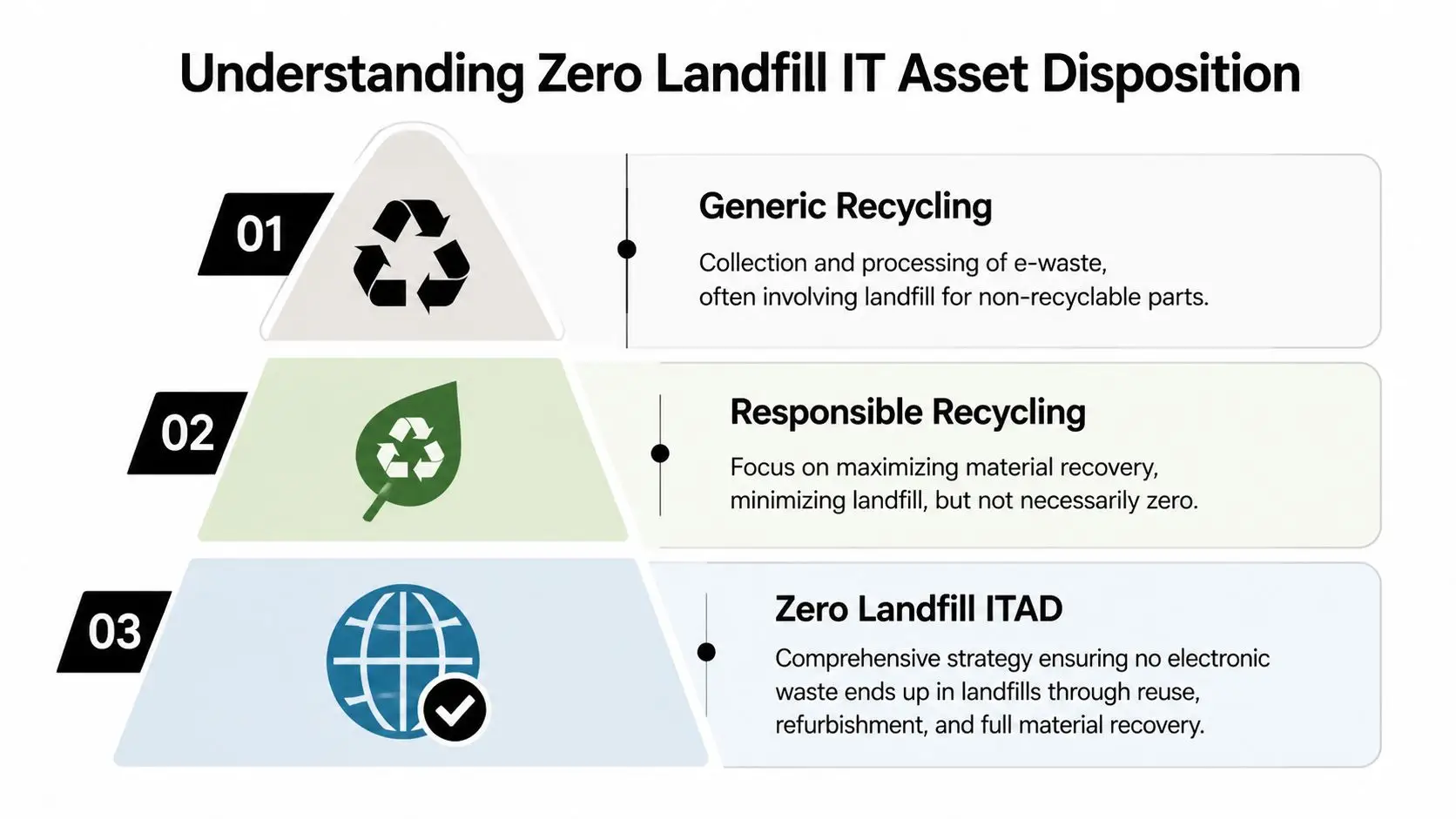
Many executives hear “electronics recycling” and assume the job is done. That’s where confusion starts. Recycling is a broad word. Zero landfill IT asset disposition is a narrower and more disciplined process.
Think of it as a circular supply chain for technology. In a linear model, a company buys equipment, uses it, then gets rid of it. In a circular model, the company asks a better question at the end of use: what is the highest-value, lowest-waste path for this asset?
The hierarchy that matters
A practical zero landfill ITAD model usually follows this order:
Reuse
If a device still works and still fits a business need, redeployment is often the best outcome. A marketing team’s retired laptop may still serve a warehouse station or training room.Refurbishment
Some devices need testing, wiping, repairs, or minor upgrades before they can re-enter service. Here, equipment stops being “waste” and starts being an asset again.Component harvesting
A whole device may no longer make sense to redeploy, but useful parts may remain. Memory, power supplies, drives, or specialty components can support other machines.Material recovery
If the device can’t be reused, processors recover commodities and specialized materials through proper dismantling and downstream handling.Responsible disposal of the residual fraction
Zero landfill programs aim to avoid landfill, but the operational discipline comes from managing every remaining material stream carefully and transparently.
Why this is different from a cleanout vendor
A furniture liquidator clears space. An ITAD partner manages chain of custody, data-bearing assets, reuse potential, and environmental handling. That distinction matters during office moves, mergers, and facility closures.
If you’ve ever reviewed the estate liquidation process explained, the useful parallel is this: both processes involve sorting items by value, condition, and best next use. Electronics just add far stricter data and compliance requirements.
Generic recycling asks, “How do we remove this?”
Zero landfill ITAD asks, “How do we recover value, protect data, and avoid disposal?”
What business leaders should ask internally
Before approving any disposition plan, ask:
| Question | Why it matters |
|---|---|
| Can this equipment be reused internally? | Reduces replacement purchases and extends asset life |
| Can it be refurbished or donated? | Supports circular use instead of immediate destruction |
| Which items contain data? | Determines wiping, shredding, and chain-of-custody controls |
| Which assets have resale or parts value? | Turns disposal into value recovery when appropriate |
| What can’t go through standard recycling? | Flags specialized handling needs early |
A strong starting point is understanding the scope of IT asset disposition services and how they differ from basic recycling pickup. Once that distinction is clear, the rest of the strategy gets much easier.
Navigating Boston's E-Waste Regulations and Gaps

Boston’s zero-waste goals set a clear direction. The city’s public electronics collection system, however, was not built to function as a business IT disposition program.
That gap matters more than many executives expect. A city can promote diversion and still offer limited access points, event-based collection, or resident-focused programs that do not match the volume, documentation, and security standards a business needs. The City of Boston’s recycling and waste resources show the public framework, including special collection options. For a company retiring dozens or hundreds of devices, that framework is a starting reference, not an operating model.
A simple analogy helps here. Municipal e-waste collection works like a neighborhood drop-off day. Corporate zero-landfill ITAD works like a controlled supply chain, with inventory control, data handling, documented transfers, and verified downstream processing.
The access gap is real
Boston’s infrastructure also reflects uneven access across the city. More than 5,600 Boston residents lack access to recycling services, and 33% of surveyed apartment buildings offer no recycling services, according to research on Boston recycling access disparities.
Business leaders should pay attention to that finding for a practical reason. If the public system does not serve every resident evenly, it should not be treated as a reliable outlet for complex commercial electronics streams. It also points to a broader opening for employers to lead, especially when they can use private partners to handle materials responsibly and keep reusable equipment in circulation.
Where public programs fall short for business users
Public collection can help with small household volumes. Commercial users usually need a different setup.
Here is where the mismatch shows up:
- Data security: City collection programs are not designed around corporate audit trails, device-level tracking, or destruction records.
- Asset mix: Offices often need processing for servers, networking gear, storage hardware, phones, and specialized equipment, not just common consumer devices.
- Pickup and timing: Scheduled onsite removal matters during office moves, tech refreshes, and decommissions.
- Reporting: Sustainability, procurement, and compliance teams often need clear documentation of reuse, recycling, and final disposition.
These are operating requirements, not preferences. If your team cannot show where devices went, how data was handled, and how much material avoided disposal, your recycling program is harder to defend internally.
Boston’s policy direction creates an opening for business leadership
Boston’s zero-waste ambition is real. The infrastructure to support every commercial electronics stream is still uneven. That creates a practical leadership opportunity for businesses that want to move faster than the public system can.
The strongest approach is to treat electronics recycling as a managed vendor relationship, similar to secure document destruction or regulated facilities services. The city sets the destination. Certified ITAD providers help companies build the route.
For Boston organizations comparing options, secure electronics recycling services in Boston can clarify how a business-grade process differs from a public drop-off model. That distinction helps leaders choose a partner that can support zero-landfill goals with the controls, records, and logistics municipal programs typically do not provide.
Implementing Your Corporate Zero Landfill Program
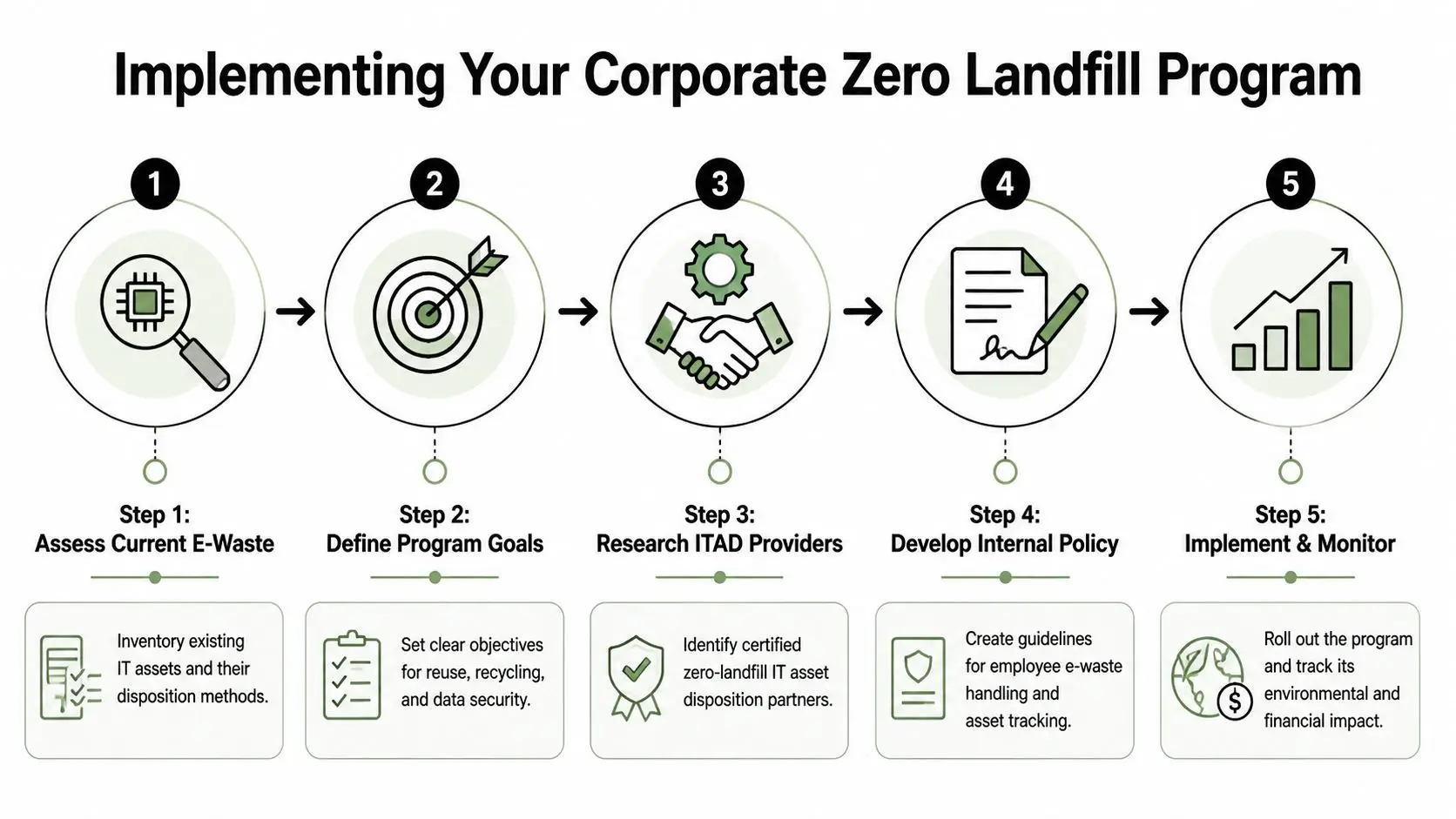
A zero landfill program doesn’t start with a truck. It starts with an internal decision about control. Companies that struggle with electronics recycling usually treat each disposal event as an exception. Companies that handle it well build a standing process that people can follow without reinventing it every quarter.
That shift matters because Boston’s documented recycling rate has stagnated around 10% for a decade, even while the EPA recognizes the “inherent value” in e-waste, as noted in Brookline’s draft zero waste framework discussing regional e-waste dynamics. In plain terms, too much equipment still gets treated like trash instead of a recoverable asset.
Start with an asset map
Most organizations already own more retired equipment than they realize. It’s in closets, under desks, in branch offices, in server rooms, and with remote staff.
Build an inventory around categories, not perfection. Start with:
- User devices: laptops, desktops, tablets, phones
- Infrastructure: servers, switches, firewalls, storage arrays
- Peripherals: monitors, docking stations, printers, cables
- Specialized gear: lab tech, medical devices, point-of-sale hardware, test equipment
A useful first pass includes model, serial number, location, data status, condition, and likely disposition path.
Set rules before the next refresh cycle
The biggest operational mistake is waiting until replacement day to decide what happens to retired assets. Policy should come first.
Create written rules for:
| Policy area | Decision to make |
|---|---|
| Data handling | Which assets require wiping, shredding, or both |
| Approval authority | Who signs off on retirement and release |
| Storage | Where retired devices wait before pickup |
| Tracking | How serials and quantities are recorded |
| Value recovery | Which assets should be evaluated for refurbishment or buyback |
| Exceptions | How damaged, obsolete, or specialty devices are handled |
Field advice: If your policy doesn’t cover remote employees, office closures, and emergency replacements, it isn’t finished yet.
Build around the common event types
Not every disposal project looks the same. A practical program usually covers several recurring scenarios.
Routine laptop disposal needs a fast, repeatable workflow. Devices come back from staff, IT confirms status, data-bearing media is routed correctly, and the assets move into reuse, donation-based recycling, or processing.
Office cleanout and facility cleanout work need coordination with facilities teams. Electronics shouldn’t get mixed into general junk removal. Tagging, staging, and pickup windows matter.
Data center decommissioning is its own discipline. Servers, rails, networking gear, UPS components, and storage media require chain-of-custody controls and careful removal planning.
Laboratory equipment disposal and medical equipment disposal often call for added review because mixed-material equipment may include specialty components, embedded drives, or regulated handling requirements.
Choose metrics that management can actually use
Avoid vanity reporting. The point isn’t to build a glossy dashboard nobody trusts. The point is to create proof that assets were handled according to policy.
Track items such as:
- Disposition path: reused, refurbished, harvested for parts, recycled
- Data security documentation: certificates, serial reconciliation, destruction records
- Program coverage: departments, sites, and event types included
- Operational friction: storage backlog, pickup frequency, internal handoff issues
A finance leader, a sustainability manager, and an IT director should all be able to read the same report and understand what happened.
Make employee behavior part of the program
Even strong policies fail when staff don’t know what to do with old electronics. Give employees a short operating guide:
- Identify whether the item stores data.
- Use the approved intake point, not general trash or mixed recycling.
- Record the handoff.
- Wait for authorized release or pickup.
That sounds simple because it should be. A zero landfill program works when the front-end behavior is easy and the back-end controls are rigorous.
One option businesses may evaluate for this workflow is Reworx Recycling, which offers electronics recycling, secure data destruction, pickups, decommissioning support, and donation-based recycling services for organizations managing end-of-life equipment.
Choosing a Certified ITAD Partner in the Boston Area
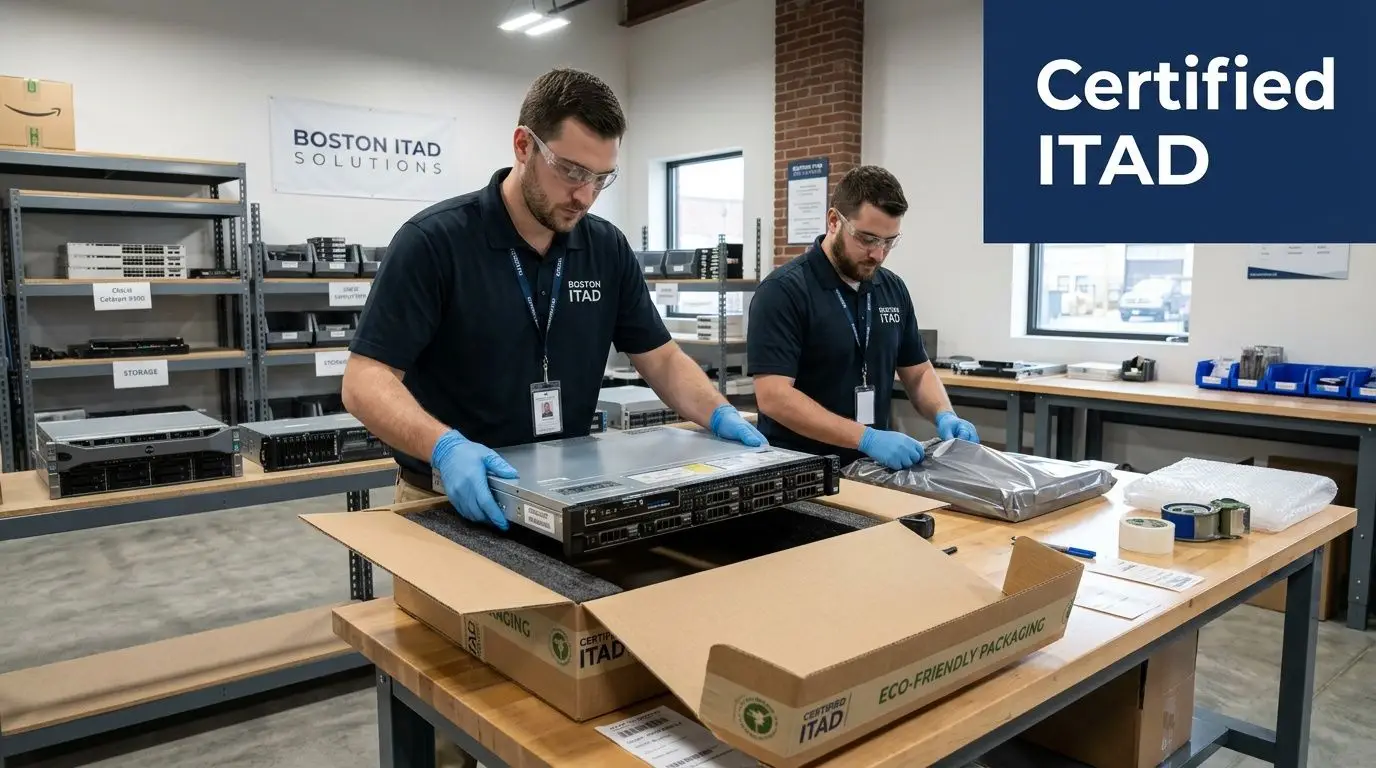
A certified ITAD partner closes a gap that Boston’s municipal system does not fully cover. City collection programs can help with basic diversion, but they are not designed to manage enterprise data destruction, asset tracking, audit documentation, and downstream vendor oversight at the level a business needs.
That gap creates a leadership decision for Boston companies. You can treat retired electronics as a facilities nuisance, or you can manage them like any other controlled business asset. The second approach protects data, supports zero-landfill goals, and gives procurement, compliance, and sustainability teams something they can verify.
The simplest way to evaluate a provider is to picture the chain of custody as a relay race. If one handoff is unclear, the whole result becomes harder to trust. A qualified ITAD partner should be able to explain what happens at pickup, during transport, during data destruction, during testing for reuse, and at final recycling, without vague language or missing steps.
The shortlist checklist
Ask direct questions and expect specific answers:
- Certification scope: Which recognized recycling or ITAD certifications does the provider hold, and which facilities and services are covered?
- Data destruction methods: How are laptops, servers, mobile devices, SSDs, and embedded storage handled? Are sanitization and destruction methods aligned with recognized standards such as NIST guidance?
- Chain of custody: How are assets labeled, transported, reconciled, and documented from pickup through final disposition?
- Downstream accountability: Can the provider identify downstream processors and explain how materials are managed after initial sorting?
- Documentation: What do you receive after service, such as serialized inventories, certificates of data destruction, recycling records, and audit support?
- Project capability: Can the provider handle office closures, decommissioning projects, product destruction, and mixed loads of reusable and obsolete equipment?
Those questions matter because electronics recycling for a business is not a single service. It is a controlled process with security, environmental, and financial consequences.
Warning signs to take seriously
Some vendors sound capable until you ask for process detail. That is usually where the risk shows up.
| Warning sign | Why it matters |
|---|---|
| Vague answers about where material goes after pickup | Weak downstream visibility makes landfill claims harder to verify |
| A hauling-focused pitch with little discussion of reuse, wiping, or audit trails | Suggests a disposal mindset instead of asset management |
| No clear explanation for handling data-bearing devices | Increases security and compliance exposure |
| Limited reporting or generic certificates | Makes internal review and policy enforcement harder |
| One process for every device type | Ignores the difference between a monitor, a printer, and a laptop with stored data |
A useful test is to ask, "What happens to a retired laptop, a failed server, and a broken printer?" A mature provider will give three different answers, because those items carry different data, parts value, and processing requirements.
Social mission should still be part of the decision
Certification and security controls come first. For many Boston organizations, though, partner selection also reflects how the company responds to the city’s broader zero-waste ambitions and the limits of current public infrastructure. A provider that can sort equipment into reuse, donation, parts recovery, and recycling gives your business more than a disposal outlet. It gives you a way to lead where the municipal system is still catching up.
That added value only counts if the provider can document it. Usable equipment should move into legitimate next use under policy. Data-bearing equipment that cannot be reused should be sanitized or destroyed with the same level of discipline.
Teams building a vendor review file often compare requirements against published e-waste certification standards so procurement, IT, legal, and sustainability are using the same decision criteria.
Partnering for Impact The Reworx Social Enterprise Model
A zero landfill strategy gets stronger when the end point isn’t just “processed,” but “put to better use.” That’s where a donation-based model changes the conversation. Instead of treating every retired device as a liability, a business can sort assets into secure destruction, recycling, refurbishment, and community-benefit channels.
Consider a hypothetical Boston biotech firm preparing for a facility cleanout after a lab and office consolidation. The company has shelves of older laptops, monitors, small networking equipment, keyboards, and surplus peripherals. Some assets are obsolete. Some contain sensitive information and must be destroyed under policy. Some are still usable after testing and wiping.
What the practical decision looks like
The firm’s leadership team has to balance several concerns at once:
- IT wants secure data destruction for anything that stored research or employee data.
- Facilities wants a clean pickup schedule that doesn’t interfere with the move.
- Sustainability wants landfill avoidance and credible reporting.
- Corporate affairs wants the project to reflect the company’s community commitments.
A donation-based recycling model helps because it doesn’t force one answer onto every item. It allows the organization to separate what must be destroyed from what can still create value through refurbishment or responsible reuse.
Why the social enterprise angle matters
For many businesses, community impact feels separate from IT equipment disposal. It doesn’t have to be. A social enterprise model connects those two decisions.
A retired laptop that can’t stay in your environment may still support digital access elsewhere after proper processing. A batch of reusable peripherals may still serve a nonprofit or training setting. Equipment that has no reuse path can still move into sustainable recycling rather than landfill disposal.
The strongest end-of-life programs don’t ask only, “How do we get rid of this safely?” They also ask, “What good can still come from this equipment after we’ve met security requirements?”
That combination is especially relevant in a city where public infrastructure doesn’t reach every resident equally. A business-led program can reduce waste and support access at the same time.
Organizations exploring that model can review how Reworx approaches partnership and community impact through its social enterprise framework. For a Boston employer, the appeal is practical as much as ethical. One program can support secure IT equipment disposal, sustainable recycling, and a more credible corporate donation story.
Take the First Step Toward Zero Waste Today
Zero Landfill Electronics Recycling in Boston isn’t a niche sustainability project. It’s a practical operating standard for organizations that want tighter control over data, clearer compliance processes, and better outcomes for retired technology.
The local context makes this urgent. Boston’s policy direction is pushing toward higher diversion and better materials management, while the city’s infrastructure still leaves real gaps in access, processing specialization, and business-ready data security workflows. That means companies can’t rely on casual disposal habits or occasional municipal options if they want a defensible program.
What a strong first move looks like
If your organization wants to act, start with three steps:
Audit what you already have
Identify stored laptops, desktops, servers, monitors, networking gear, and specialty equipment. Most companies discover more idle equipment than expected.Separate data risk from material value
Some devices need immediate secure data destruction. Others may be candidates for refurbishment, donation-based recycling, or resale-oriented IT asset disposition.Choose a provider that can document outcomes
A credible partner should support secure handling, sustainable recycling, and reporting your internal teams will use.
The business case is broader than waste diversion
A mature electronics recycling program helps companies:
- Reduce security exposure by managing drives and data-bearing devices correctly
- Improve internal control through chain of custody and standardized workflows
- Support sustainability goals with a zero-landfill framework rather than ad hoc disposal
- Create social value when reusable equipment can support community outcomes
- Handle complex transitions such as office cleanouts, data center decommissioning, and equipment refresh cycles
Boston businesses don’t need to wait for perfect municipal infrastructure. They can build a better end-of-life system now.
If you’re leading IT, facilities, procurement, or sustainability, the next decision doesn’t need to be complicated. Start with your current backlog, your next refresh cycle, or your next move project. Then build a repeatable process around secure data destruction, value recovery, and zero landfill outcomes.
If your company is ready to donate old equipment, schedule a pickup, or build a more structured electronics recycling program, explore the resources available through Reworx Recycling.