
A lot of Seattle organizations are sitting on the same problem right now. There’s a locked storage room with retired laptops, a few carts of monitors from the last office refresh, networking gear nobody wants to touch, and maybe a shelf of drives from a partial server migration that never made it into a formal disposition plan.
That pile looks like clutter, but it’s a risk register in physical form. Some of it still has recoverable value. Some of it contains regulated data. All of it needs a documented path out of the building.
For facilities teams, sustainability managers, and IT leaders, Sustainable IT Asset Disposition in Seattle works best when it’s treated as an operational program, not a one-time cleanup. In a city shaped by technology, biotech, research, healthcare, and distributed office footprints, the strongest ITAD programs balance three goals at once: secure data handling, environmental performance, and community impact through responsible reuse and donation-based recycling.
Navigating Seattle's E-Waste Challenge
A Seattle facilities manager gets the remodel date. IT still has devices awaiting sign-off. Security wants proof that every drive is accounted for. Sustainability needs diversion data for year-end reporting. The equipment may be sitting in one room, but the risk is spread across several teams.
Disposal decisions get harder in Seattle because the asset mix is rarely simple. A biotech lab may have specialized workstations and peripherals with limited resale value. A cloud or software company may be rotating large laptop fleets on a tight refresh cycle. A healthcare-adjacent office may be retiring ordinary-looking endpoints that still carry strict data handling requirements. Treating all of that as generic e-waste usually leads to one of two bad outcomes: reusable equipment gets shredded too early, or risky equipment sits in storage because no one wants to approve the release.
Washington’s E-Cycle program matters, and it gives organizations a responsible baseline for covered electronics. But public e-waste collection is not the same as enterprise IT asset disposition. Most Seattle businesses need asset-level tracking, data destruction controls, and records that stand up to internal audit, customer questionnaires, and sustainability reporting.
The bottleneck is usually ownership. Facilities can clear space. IT can identify device classes. Security can define destruction requirements. Sustainability can track diversion and reuse. If no one owns the full path from retirement to final disposition, retired equipment stays put.
A practical rule applies here. If assets have been sitting for months because teams are waiting on approvals, the problem is not storage capacity. The problem is process design.
Seattle organizations also have an advantage that many generic ITAD guides miss. The local economy creates strong reuse and recovery opportunities when assets are sorted correctly. Business-grade laptops, monitors, networking gear, and accessories can often follow different paths based on condition, data risk, and remaining market value. For teams working through large endpoint refreshes, a documented computer recycling service in Seattle can help separate what should be remarketed, donated, or recycled instead of pushing everything into one stream.
That sorting decision affects more than environmental metrics. Reuse can support community access programs. Resale can offset part of your refresh cost. Recycling remains the right end point for obsolete or damaged hardware, but it should usually be the last option after your team has screened for data risk, redeployment potential, and residual value.
In Seattle, the strongest ITAD programs reflect that reality. They treat e-waste as an operations issue with local regulatory context, a security chain of custody, and a clear social impact opportunity.
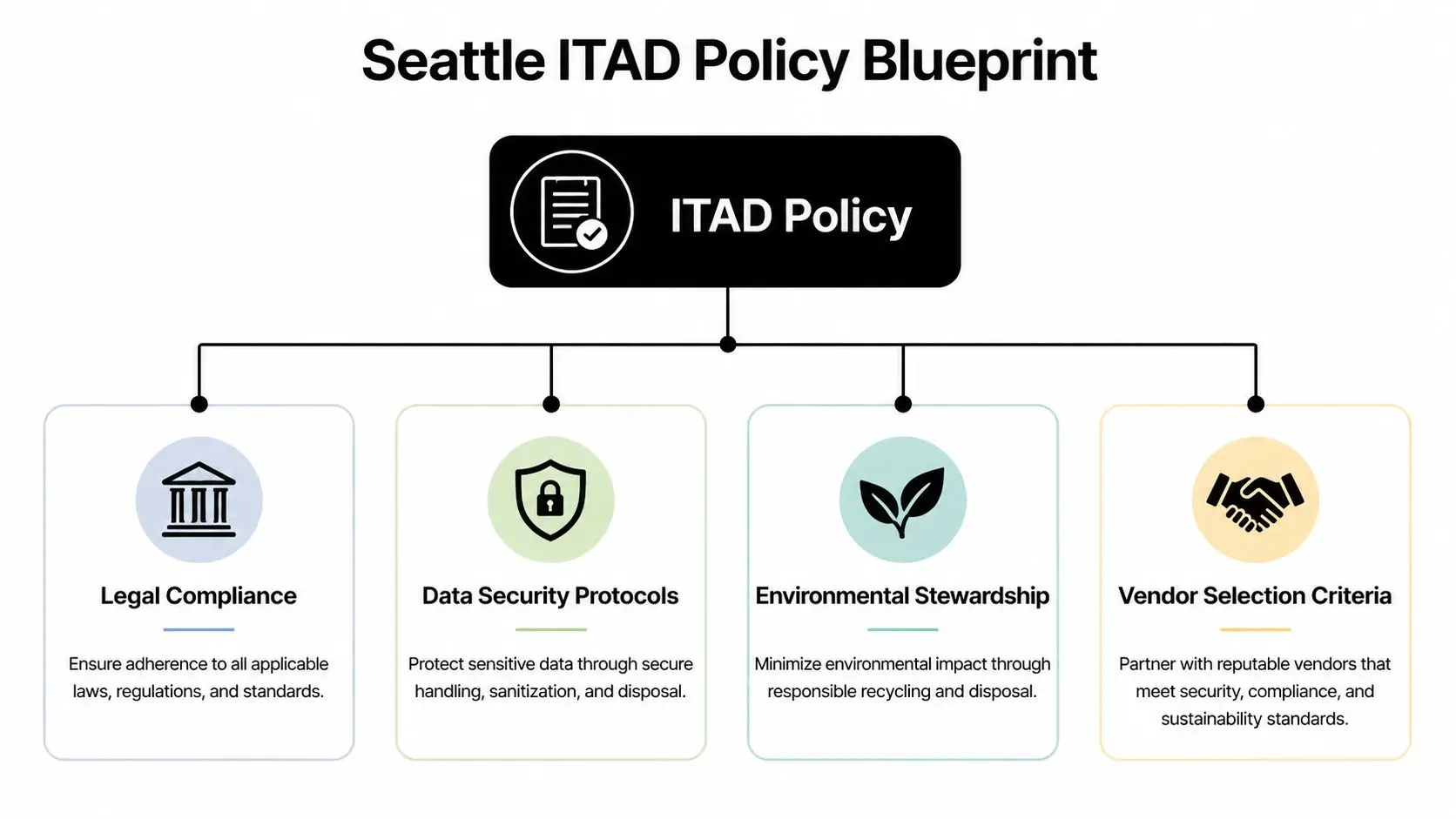
Building Your Seattle ITAD Policy and Legal Framework
A good ITAD outcome usually starts months before the first pallet leaves the site. If your organization only starts thinking about disposition when a closet is full, you’ll make rushed decisions. In practice, the companies that avoid confusion are the ones with a written policy that tells IT, facilities, procurement, security, and sustainability exactly how assets move from active use to final disposition.
The business case for formalizing that policy is getting stronger. The global ITAD market was valued at USD 25.31 billion in 2024 and is projected to reach USD 54.54 billion by 2030, with North America holding nearly 16.0% of global market share in 2024, according to Grand View Research’s IT asset disposition market analysis. That growth reflects what Seattle teams already feel on the ground. Regulations, data security expectations, and sustainability commitments are pushing ITAD out of the “miscellaneous recycling” bucket and into formal governance.
Put asset lifecycle rules in writing
Start with scope. Your policy should define what counts as an IT asset in your environment. Many businesses write policies that cover laptops and desktops but ignore phones, AV hardware, network switches, badge readers, printers, lab-adjacent electronics, and devices embedded in facilities systems.
A strong policy names the lifecycle stages clearly:
| Lifecycle stage | What it should define | Why it matters |
|---|---|---|
| Procurement | How assets enter inventory | Prevents orphaned devices later |
| Active use | Ownership and location tracking | Supports audits and recovery |
| Retirement trigger | What makes an asset eligible for ITAD | Reduces storage drift |
| Data handling | Sanitization or destruction requirements | Protects regulated information |
| Final disposition | Reuse, donation, resale, recycling, destruction | Creates consistency |
If the policy doesn’t define retirement triggers, teams delay. Devices linger because no one knows whether they’re spare, surplus, or pending approval.
Align data security with actual risk
Most Seattle organizations already have an information security policy. The problem is that asset disposition often sits outside daily security operations. Your ITAD policy should close that gap by spelling out who approves release, what sanitization standard applies, when physical destruction is required, and what documentation must come back from the vendor.
That language should be practical, not ceremonial. For example, some assets can be wiped and redeployed internally. Others need physical destruction because the device type, tenant environment, or data class makes sanitization riskier than destruction.
If your security team can classify data but can’t classify end-of-life handling, your policy is incomplete.
Build environmental standards into the policy
Many organizations often fall short on specificity. “Recycle responsibly” isn’t a standard. A better policy requires certified downstream handling, documented material paths, and preference for reuse or refurbishment when equipment condition allows.
This isn’t only about environmental messaging. It changes how assets are prepared, packed, and evaluated. Equipment that’s handled carefully during deinstallation has a better chance of reuse than equipment tossed into mixed gaylords with broken screens and missing accessories.
Use your policy to require:
- Hierarchy of outcomes with reuse and refurbishment considered before commodity recycling
- Segregation rules for batteries, drives, peripherals, and specialty equipment
- Reporting expectations for diversion, transfer, and final processing
- Vendor transparency so your team can verify where equipment goes
Organizations that want a clearer baseline for evaluating downstream practices often use guidance from certified recyclers and ITAD providers. This overview of electronics recycling certifications is useful for translating broad sustainability goals into concrete vendor requirements.
Assign roles before a project starts
The practical failure point isn’t usually legal language. It’s decision ownership. A workable Seattle ITAD policy names who does what.
Here’s the split I recommend most often:
- IT owns asset identification, data classification, and release approval.
- Facilities owns site access, loading logistics, and space coordination.
- Procurement or finance owns vendor onboarding and value recovery terms.
- Security or compliance owns audit expectations and exception handling.
- Sustainability owns reporting alignment for ESG or CSR disclosure.
When those roles are blurred, pickups get delayed and audit trails get patchy. When they’re clear, disposition moves like any other controlled business process.
Executing a Secure and Compliant Disposition Process
The strongest ITAD projects don’t look dramatic. They look controlled. Every asset is accounted for, every movement is documented, and every exception gets resolved before the truck leaves. That’s true whether you’re clearing one floor of office equipment or planning a full data center decommissioning.
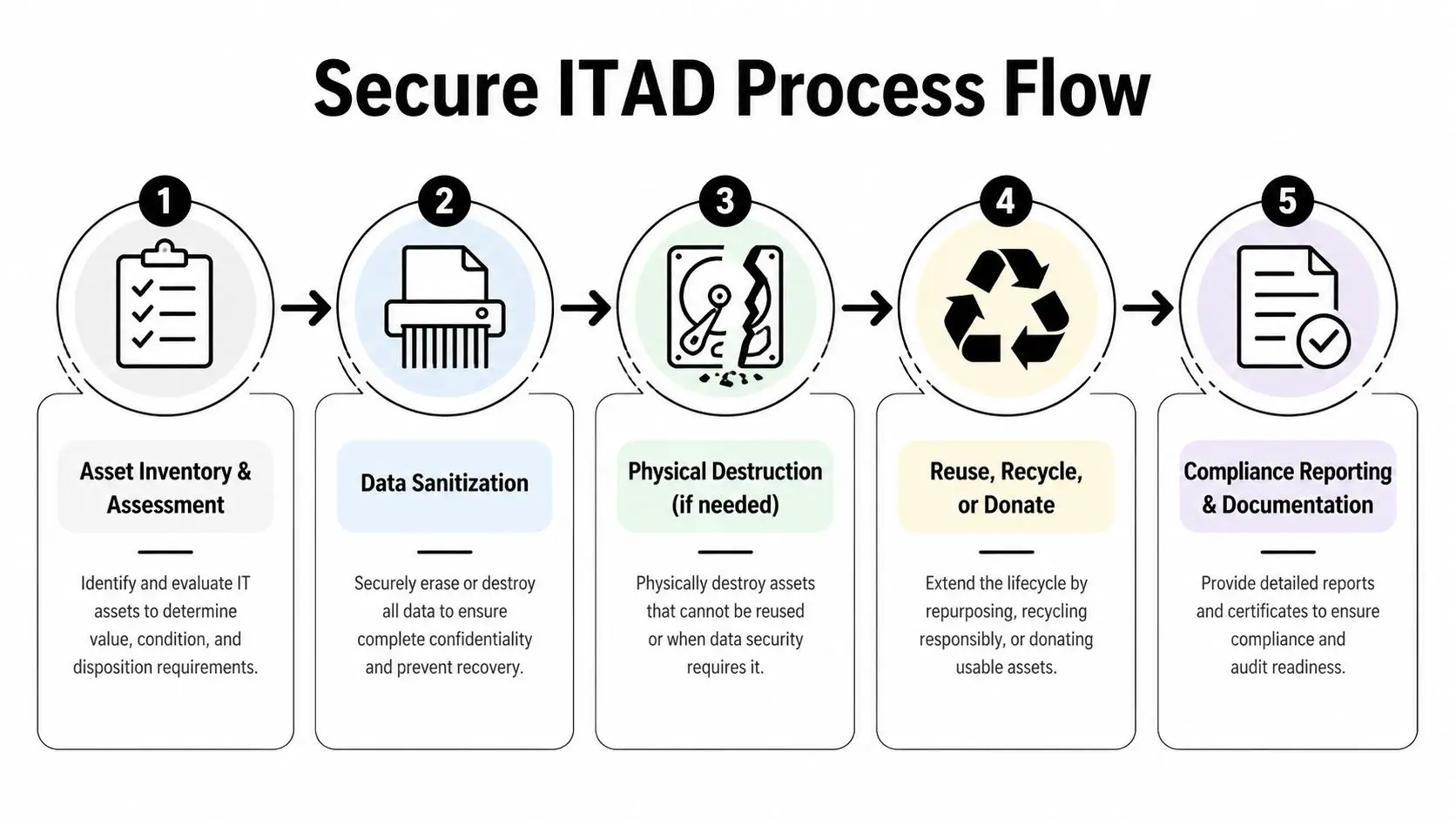
A rigorous methodology starts with a thorough asset audit and certified data erasure such as NIST 800-88-compliant wiping. According to Zones’ practical ITAD use case, that process can achieve up to 90% landfill diversion and matters because breach risks are reported in 1 of every 5 improper disposals. Those two facts belong together. Environmental performance without data discipline isn’t a sustainable program.
Start with asset audits that reflect reality
Most inventories are messier than teams expect. The CMDB says one thing, local spreadsheets say another, and what’s physically in the room says something else. Before disposition starts, reconcile them.
For office cleanouts, that means walking the site and matching physical assets to records. For lab and medical-adjacent spaces, it also means confirming whether anything contains embedded storage or requires special handling before release. For server rooms, validate rails, PDUs, drives, and loose components separately from major chassis.
The goal isn’t a perfect spreadsheet. The goal is a release-ready inventory that can support pickup, data decisions, and final reporting.
Useful fields include:
- Asset identifier such as serial number or internal tag
- Device type including laptop, server, switch, monitor, or specialty equipment
- Condition note for reuse, resale, parts harvest, or recycling
- Data-bearing status so wiping and destruction workflows stay separate
- Physical location down to room, rack, or floor
Separate data sanitization from material handling
Data destruction decisions should happen before equipment is mixed into a load. That sounds obvious, but it’s where projects get compromised. Teams often palletize everything first and figure out sanitization later. By then, they’ve made chain of custody harder to defend.
For assets approved for erasure, use documented wiping standards and require certificates tied to the asset record. For assets that require destruction, make the method explicit. That may mean drive shredding or physical destruction of storage media before the rest of the hardware enters reuse or recycling channels.
The safest time to decide whether a drive will be wiped or shredded is before anyone disconnects the equipment.
This matters outside conventional IT too. Printers, copiers, clinical workstations, security appliances, and even some phones can carry data. When teams overlook those categories, they create hidden exposure. If your internal staff finds a device after pickup and needs to understand recovery risk on mobile hardware, resources like Perth data recovery for phones help illustrate why “factory reset” and actual recoverability aren’t always the same thing.
Keep chain of custody tight during pickup and transport
The physical handoff is where good plans become auditable operations. Your pickup process should show who released the assets, when they were transferred, how they were packed, and how the load was tracked. If there’s a custody gap between dock departure and processing intake, your documentation won’t hold up well under scrutiny.
For Seattle sites, logistics planning also matters because building access can be a major bottleneck. Freight elevators, loading dock reservations, downtown traffic windows, campus restrictions, and multi-tenant security protocols all affect how equipment moves. Build those into the project plan early.
A defensible chain of custody usually includes:
| Control point | What good looks like |
|---|---|
| Release authorization | Named approver signs off on asset transfer |
| Pickup documentation | Inventory or lot list tied to shipment |
| Packaging method | Assets protected and segregated by handling path |
| Transport visibility | Tracked movement and documented receipt |
| Intake confirmation | Processed count reconciled to released count |
For organizations planning larger projects, especially rack equipment and infrastructure removals, a specialized Seattle data center equipment disposal service is often the difference between a controlled decommissioning and a messy haul-out.
Preserve reuse value before recycling
A lot of money gets lost before assets ever reach a processor. It happens during deinstallation, storage, and handling. Monitors lose stands, laptops lose adapters, servers get stacked carelessly, and mixed loads make testing harder. Once that happens, reuse options narrow.
Teams that want stronger outcomes usually pre-sort assets into three buckets:
- Likely reuse or resale such as newer laptops, enterprise desktops, and maintainable server gear
- Donation candidates where business value is lower but functional life remains
- Recycling-only material including damaged, obsolete, or incomplete hardware
That triage doesn’t need to be elaborate. It just needs to happen before everything is treated as scrap.
Make final reporting usable
The last mile of ITAD is paperwork, but not the kind people ignore. Reporting should answer the questions your finance, security, and sustainability teams will ask later.
At a minimum, keep records for asset transfer, data destruction, and downstream disposition. If your organization reports sustainability outcomes, make sure those reports can connect back to the original inventory rather than floating as a detached summary.
A certificate is useful. A certificate tied to serialized assets, custody records, and disposition outcomes is what survives an audit.
When that reporting is built into the operating flow, the process feels lighter, not heavier. Teams stop chasing answers after the fact because the evidence is already attached to the project.
Choosing Your Seattle ITAD Partner
Not every recycler is an ITAD partner, and that distinction matters. If your organization only needs to remove low-risk commodity electronics with no data, a basic recycler may be enough. But most Seattle businesses aren’t dealing with such a simple stream. They have laptops with user data, phones from hybrid work programs, networking gear from office consolidations, and servers coming out of production environments.
That mix calls for a partner that can manage risk, not just move material.
What separates a true ITAD partner from a hauler
A scrap-focused vendor usually talks first about pickup volume. A real ITAD partner talks first about inventory, data controls, audit trails, and downstream handling. That difference shows up quickly in the questions they ask.
If the vendor doesn’t ask how you classify data-bearing devices, whether you need on-site destruction options, or how you want serialized reporting structured, they’re probably not set up for a full ITAD program.
The other difference is transparency. You should be able to understand where equipment goes after pickup, how it’s tested, when it’s refurbished, when it’s recycled, and what documentation comes back.
Cheap removal becomes expensive the moment your team has to explain a custody gap, an undocumented drive, or an unclear downstream path.
Mission fit matters in Seattle
Seattle buyers often evaluate vendors on more than minimum compliance. They care about climate commitments, circularity, and community benefit. That’s especially true for public institutions, healthcare-adjacent organizations, universities, and companies with visible ESG goals.
A donation-based recycling and social enterprise model can add something a conventional processor can’t. It creates a clearer story around reuse, digital inclusion, and community impact. For sustainability leaders, that matters because it turns end-of-life hardware from a waste problem into a tangible social contribution.
That doesn’t replace the basics. The partner still needs secure data destruction, reliable logistics, and defensible reporting. But when two vendors can both process equipment, mission alignment can be the deciding factor.
Seattle ITAD Partner Evaluation Checklist
| Evaluation Criteria | What to Look For | Why It Matters |
|---|---|---|
| Data security process | Documented sanitization and destruction options, plus certificates | Reduces breach exposure and supports audits |
| Chain of custody | Clear transfer records, intake confirmation, and shipment visibility | Protects accountability from pickup to processing |
| Environmental handling | Priority for reuse and responsible recycling when reuse isn’t viable | Improves diversion and supports sustainability goals |
| Reporting quality | Serialized asset reporting and outcome documentation | Gives IT, compliance, and sustainability teams usable records |
| Project capability | Experience with office cleanouts, server removals, and mixed asset streams | Prevents improvised handling during larger projects |
| Social impact model | Donation-based recycling or community technology support | Adds measurable mission value beyond disposal |
| Vendor transparency | Clear explanation of downstream handling and certifications | Helps validate claims before onboarding |
A practical comparison point is whether the vendor can explain its own controls without resorting to general promises. If the answers are fuzzy, the process will be too. For a useful starting point, this guide on factors for choosing an e-waste recycling partner mirrors many of the questions procurement and facilities teams should already be asking.
The best Seattle ITAD partner is usually the one that makes your internal governance easier. They simplify approvals, reduce storage delays, and hand back documentation your teams can use.
Maximizing ROI and Reporting Your Sustainability Impact
ITAD gets approved faster when the organization stops treating it like pure disposal expense. In many environments, retired hardware still holds value through refurbishment, resale, parts recovery, or donation pathways that support sustainability reporting. The key is to measure both the financial return and the environmental outcome without blending them into vague “good citizenship” language.

The biggest lever is usually reuse. According to Sustainable ITAD, refurbishing IT assets can extend device life by 2 to 3 years, cutting the manufacturing footprint, which accounts for 80% of a device’s lifetime emissions, by 60% compared with recycling alone. The same source notes that recent supply chain disruptions have driven Pacific Northwest data center asset resale values up by as much as 40%. That changes the conversation from “How do we get rid of this?” to “What should we preserve for maximum recovery?”
Where ROI actually comes from
The strongest returns usually come from equipment that was retired on time, stored briefly, and kept intact. Laptops with chargers, maintainable desktops, and enterprise servers with traceable specifications are easier to test and remarket than mixed, damaged loads.
That means ROI starts before disposition. It starts when your team avoids careless storage, removes assets cleanly, and segregates viable equipment from true end-of-life scrap.
Three practical sources of return show up most often:
- Resale recovery from marketable devices and enterprise hardware
- Avoided disposal cost when reusable equipment doesn’t enter lower-value waste streams
- Reporting value when documented outcomes strengthen CSR and ESG narratives
For organizations that want a more structured recovery path, asset recovery services are often where IT, finance, and sustainability priorities finally line up.
What to track for sustainability reporting
Most sustainability teams don’t need more anecdotes. They need clean outputs they can put into internal reports, board summaries, customer questionnaires, and ESG disclosures.
Use a compact reporting set that reflects the disposition hierarchy:
| Metric category | What to track | Why it belongs in reports |
|---|---|---|
| Material outcome | What was reused, donated, resold, or recycled | Shows hierarchy, not just total volume |
| Diversion result | What avoided landfill through managed processing | Supports environmental performance claims |
| Data security proof | Certificates and destruction records | Demonstrates governance, not just sustainability |
| Community impact | Donated equipment and program outcomes | Connects ITAD to social value |
Teams often underreport in this context. They record pounds moved but not the quality of the outcome. Reuse and donation tell a stronger story than raw tonnage alone because they show circularity and community benefit, not just removal.
Reporting insight: If your ITAD summary only says how much material left the building, finance sees cost. If it shows value recovery, reuse, and documented diversion, leadership sees a managed program.
Refurbishment versus recycling
Recycling is necessary. It just shouldn’t be the automatic first option for everything. For many Seattle organizations, especially those with regular fleet refreshes, the best sustainability result often comes from preserving devices for second life before sending non-viable material into commodity recycling streams.
That trade-off is operational, not philosophical. Refurbishment takes better sorting, testing, and documentation. Recycling is simpler. But simpler isn’t always better if it destroys recoverable value and a stronger environmental outcome at the same time.
When teams report those differences clearly, Sustainable IT Asset Disposition in Seattle starts to look less like a back-end facilities task and more like a measurable business practice.
Frequently Asked Questions About ITAD in Seattle
A Seattle office closes a floor on Friday and wants everything gone by Monday. On paper, it looks like a simple pickup. In practice, the load often includes laptops with customer data, monitors with little resale value, access control hardware mounted to walls, and a few lab or medical-adjacent devices that need separate handling. That is usually when the real questions start.
Seattle organizations also tend to have mixed asset streams. A biotech firm in South Lake Union will not retire equipment the same way a software company in Bellevue does. The best ITAD plans account for that difference early, especially if the goal is secure disposition, compliance, reuse where practical, and a reporting trail leadership can use.

Can one program handle office IT, medical devices, and lab equipment
Yes, if the program is designed for mixed inventories.
The mistake I see most often is putting every asset into the same workflow. Standard office devices usually fit a familiar chain of custody. Lab systems, diagnostic peripherals, industrial tablets, and other specialty equipment often need a separate review for embedded storage, batteries, accessories, deinstallation requirements, and internal release approval.
In Seattle, that matters because many organizations operate across more than one environment. A university lab, clinic, and admin office may all feed into the same disposition event. Sort by asset type before pickup. Do not wait until equipment is on the truck.
What should I expect during a large office cleanout or facility cleanout
Expect logistics to drive the outcome.
Downtown loading docks, elevator reservations, restricted access floors, and phased move schedules create more risk than the recycling decision itself. If the site is in a busy commercial building, the property manager’s rules can shape the project as much as your IT team does.
For a cleanout to run smoothly, prepare four things in advance:
- A site access plan with dock instructions, elevator windows, parking details, and contacts
- Department release approvals so disputed assets do not stall the job
- Staging areas for assets headed to resale, donation, destruction, or recycling
- Staff instructions so employees know what is in scope and what stays in service
Treat the event like a move or decommissioning project. That approach reduces surprises and keeps custody cleaner.
What documentation should a reputable ITAD partner provide
Start with itemized transfer records and data destruction documentation tied back to the assets you released.
A serious ITAD partner should also be able to show where equipment went next. That does not mean every commodity downstream detail has to sit in your monthly summary. It means you should receive enough reporting to defend the process to IT, legal, procurement, sustainability, and any auditor who asks reasonable questions.
Useful records usually include:
| Document type | What it should confirm |
|---|---|
| Asset transfer record | What left your control and when |
| Data destruction certificate | How data-bearing assets were sanitized or destroyed |
| Disposition report | Whether assets were reused, donated, or recycled |
| Exception log | Missing tags, damaged items, or unresolved variances |
| Settlement or value recovery summary | What generated return and what did not |
If a vendor only hands over a pickup receipt, the program is too thin for most Seattle organizations with compliance and ESG obligations.
Is sustainable ITAD realistic for smaller Seattle businesses
Yes.
A 40-person architecture firm still has data risk. A small life sciences startup still has specialty equipment and battery handling issues. A local nonprofit still needs a documented path for retired devices if it wants to avoid informal disposal and inconsistent data handling.
The scope is smaller, but the discipline should stay the same. Keep an inventory, separate data-bearing assets, confirm how equipment will be reused or recycled, and get documentation that matches the size of the job.
Washington’s E-Cycle program can help with certain covered electronic products, but it does not replace business-grade ITAD. Many companies still need serialized tracking, secure data destruction, pickup coordination, and a reuse or donation strategy that aligns with internal policy.
How do I know whether to donate, resell, or recycle equipment
Use a simple decision order.
Start with data risk and functional condition. Then look at market value, testing effort, cosmetic quality, age, and whether your organization is willing to approve donation. Equipment with a good second-life profile should be evaluated for resale or reuse first. Devices with modest value but practical usefulness may be better suited for donation, especially if community benefit is part of your sustainability goals. Equipment that is obsolete, damaged, incomplete, or unsafe should go to recycling.
The trade-off is straightforward. Resale can return more value, but it usually requires better inventory discipline and clearer ownership approvals. Donation can produce stronger social impact, which matters to many Seattle organizations, but it still requires data handling and documentation. Recycling is often the right endpoint for low-value or nonfunctional material, just not the default for everything.
A partner like Reworx Recycling can be useful when social impact is part of the brief, not just pounds removed from a building. That is a practical distinction for companies here that want disposition outcomes to support both environmental targets and local community commitments.
What should Seattle companies ask an ITAD vendor before signing
Ask questions that expose process, not just marketing language.
Start with these:
- How do you separate assets for reuse, donation, and recycling?
- What is your process for data-bearing devices that arrive without tags?
- Can you handle office IT and specialty equipment in the same project?
- What documentation do you provide after pickup?
- How do you coordinate building access, dock scheduling, and phased cleanouts in Seattle properties?
- If donation is part of the program, how is that tracked and reported?
Good answers are specific. Vague answers usually lead to confusion once the project starts.