Universities in Austin are retiring laptops, lab devices, classroom AV gear, monitors, printers, and research equipment constantly. The hard part usually isn’t deciding that old equipment has to go. It’s figuring out who owns the process, how to protect data, where material can legally and practically move, and how to avoid turning a sustainability initiative into a storage-room problem.
That’s where Electronics Recycling for Universities in Austin stops being a generic recycling topic and becomes an operations issue. Facilities teams need clean logistics. IT needs chain of custody and defensible data destruction. Sustainability staff need measurable diversion and reporting. Procurement and legal teams need policies that hold up under review. If any one of those pieces is weak, the whole program slips.
Austin has strong local infrastructure and a university environment that cares about waste reduction. But local institutions also face a more complicated disposal mix than a typical office. Campuses have residence halls, research labs, athletics, libraries, clinics, office suites, and decentralized departments that all retire equipment differently. A workable playbook has to reflect that reality.
The E-Waste Challenge on Austin Campuses
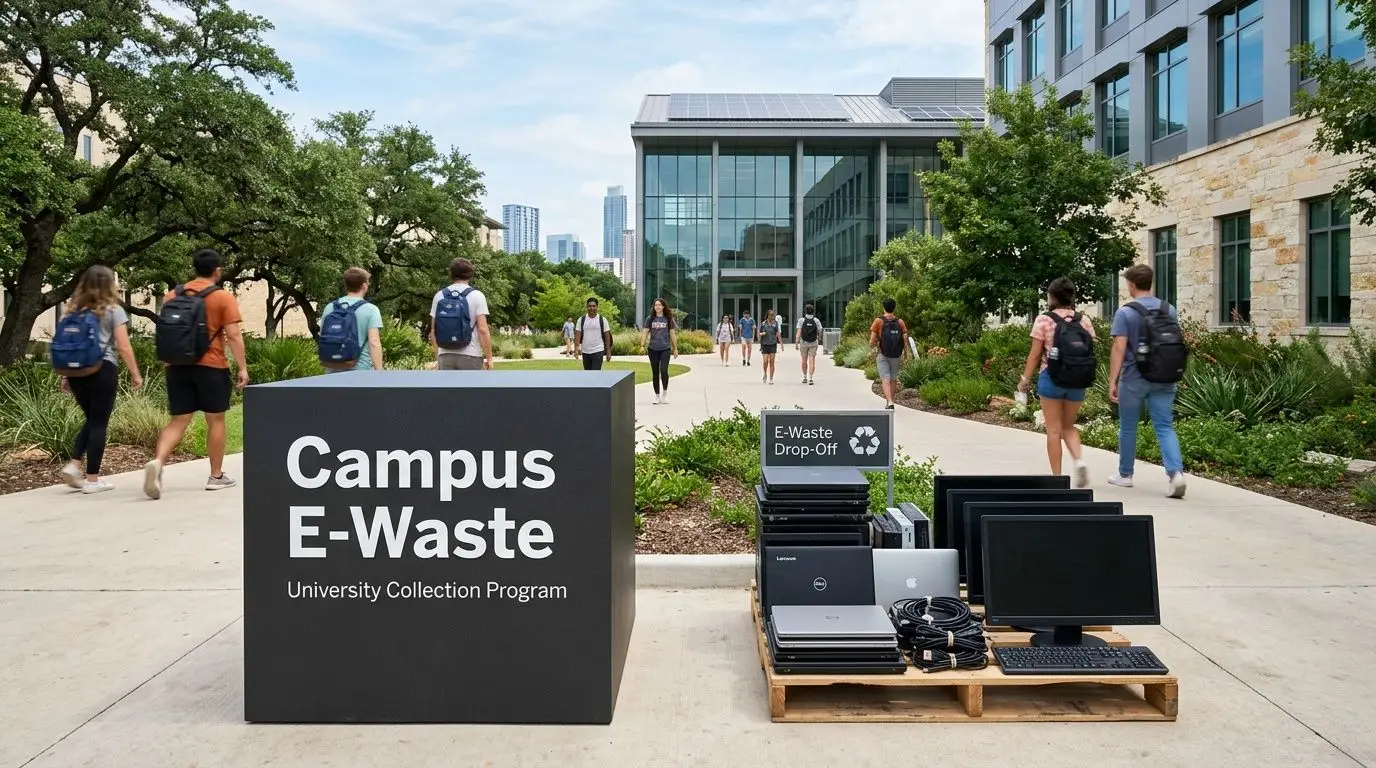
Austin campuses generate a wide range of electronics waste, but the operational challenge is less about one dramatic pile of devices and more about fragmentation. Equipment sits in faculty offices, storage closets, departmental labs, and shared spaces. Some assets belong to central IT. Others were bought on grants, departmental cards, or through auxiliary units. That creates a disposal problem before a recycler ever sees the first pallet.
UT Austin offers a useful local reality check. The university set a zero waste goal that aimed for 90% diversion by 2020, yet the campus diversion rate for 2022-23 was 31%, and that rate had decreased by 12% over five years despite relatively stagnant waste production, according to The Daily Texan’s review of the university’s waste diversion progress. For universities in Austin, that gap matters because it shows that ambitious sustainability language doesn’t solve the day-to-day realities of collection, sorting, accountability, and departmental behavior.
Why campuses struggle more than standard office sites
A university isn’t one building with one IT closet. It’s a network of competing priorities.
- Decentralized ownership: Departments often keep equipment longer than they should because no one wants to fund replacement and disposal in the same budget cycle.
- Mixed risk levels: A classroom projector doesn’t carry the same exposure as a faculty laptop, lab workstation, or device tied to student or research data.
- Irregular disposal timing: Semester-end cleanouts, grant closeouts, lab moves, and renovation cycles create waves of equipment instead of a steady stream.
- Contamination risk: Staff often place cords, peripherals, and small devices into the wrong bins, which breaks otherwise good recycling plans.
Sustainability pressure is real, but so is operational drag
Most campuses already have public sustainability commitments. What they often lack is a campus-wide IT asset disposition routine that people consistently use. Without that routine, departments improvise. Improvisation leads to unsecured storage, informal handoffs, bad records, and missed reuse opportunities.
Operational truth: Electronics recycling on a campus fails long before final processing if the university never establishes a clear intake, approval, and storage process.
Facilities teams usually see the symptom first. Hallways fill with surplus carts. Loading docks become temporary holding areas. Storage rooms turn into unofficial graveyards for monitors and CPUs. IT sees the next symptom. Nobody can confirm whether drives were wiped, which devices were redeployed, or which assets disappeared into a vendor pickup with incomplete records.
That’s why universities need a localized playbook rather than a broad sustainability statement. A strong program should help the institution reduce landfill pressure, protect data, simplify office cleanout and facility cleanout work, and support responsible computer recycling without adding friction to daily operations. For teams that are still building internal urgency, it can also help to review the broader impact of e-waste on the environment and connect that issue directly to campus asset turnover.
Where a campus can create value instead of just removing waste
The best university programs don’t treat every retired device as scrap. They separate material into different paths:
| Campus asset condition | Best disposition path | Why it works |
|---|---|---|
| Functional and supportable | Internal redeployment or approved donation | Extends useful life |
| Functional but surplus | IT asset disposition with remarketing review | Can offset program cost qualitatively |
| Nonfunctional but data-bearing | Secure data destruction, then downstream recycling | Reduces breach risk |
| Nonfunctional and low-value | Responsible electronics recycling | Keeps improper material out of landfill |
That’s also where a donation-based recycling model can make sense. When a qualified partner can sort for reuse, secure destruction, and responsible downstream recycling, a university can turn end-of-life equipment into both an environmental program and a community-impact program. Reworx Recycling operates in that broader social enterprise recycling model, which is especially relevant for higher education institutions trying to connect waste reduction with digital inclusion.
Building Your University ITAD Program Framework
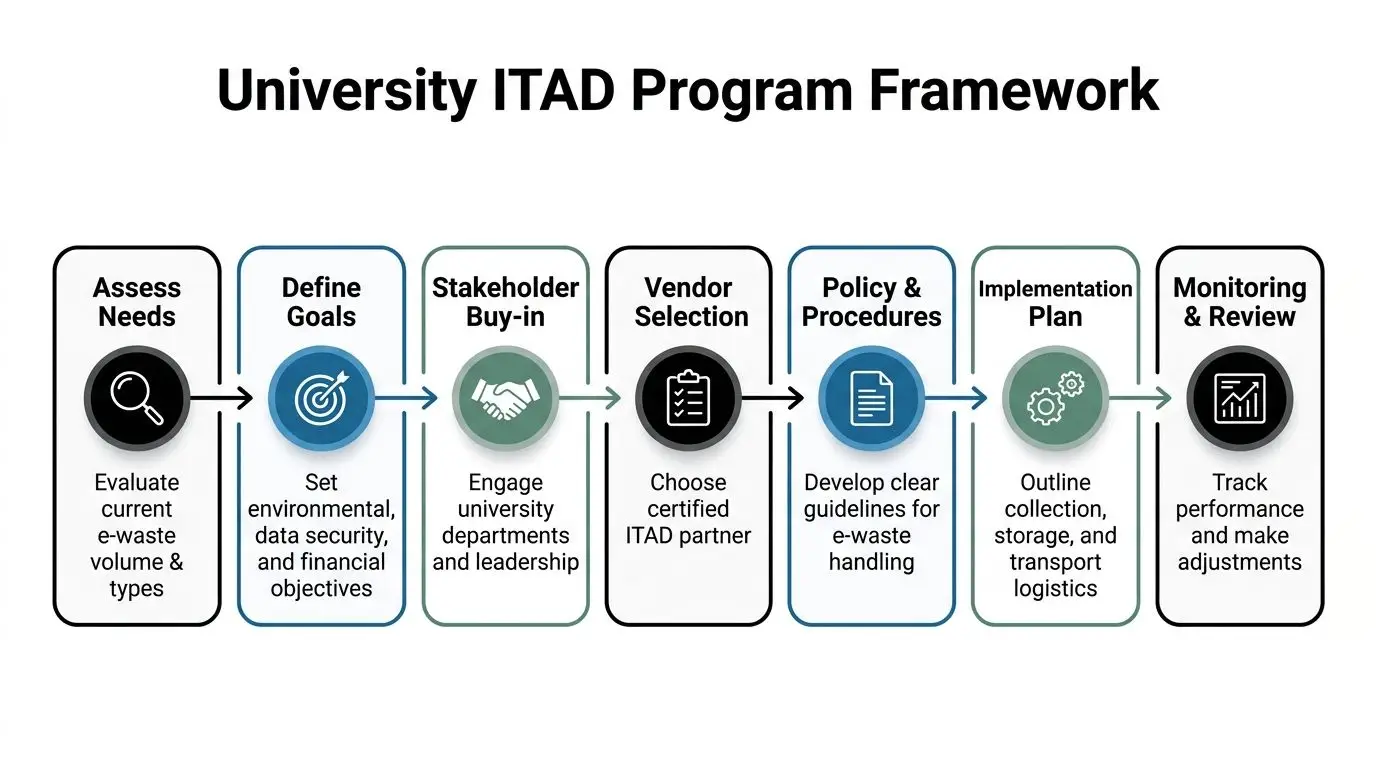
A functioning university electronics recycling program starts with governance, not gaylords and pickup dates. If the institution can’t answer who approves disposition, who signs off on data destruction, who tracks assets, and who reports outcomes, the program will stall as soon as the first complicated batch appears.
The practical starting point is a formal IT asset disposition (ITAD) framework. That framework should be written down, approved, and usable by people outside central IT. On many campuses, the failure point is simple: the process lives in someone’s head instead of a policy.
Start with the right committee
Universities often assign e-waste to one office and hope the rest of campus cooperates. That rarely holds. The framework needs cross-functional ownership.
Include these stakeholders early:
- IT leadership: They define asset classes, approved wipe standards, and chain-of-custody requirements.
- Facilities or surplus operations: They manage staging areas, pickups, storage constraints, and movement across buildings.
- Sustainability staff: They connect the program to diversion goals and public reporting.
- Procurement: They align purchasing language, vendor requirements, and end-of-life obligations.
- Legal or compliance staff: They review policy language for data, records, and environmental handling.
- Research administration or lab operations: They surface specialized equipment streams that standard office IT doesn’t cover.
A smaller campus can combine some of these roles. A larger university shouldn’t.
Build the framework around seven decisions
Most institutions don’t need a complex manual at first. They need clarity on a short list of decisions that governs everything else.
What counts as in-scope equipment
Define whether the program covers only computers and monitors or also peripherals, printers, networking hardware, AV, data center gear, batteries, and laboratory electronics.Who owns approval
Decide whether departments can initiate disposal directly or whether central IT, surplus, or property management must authorize every release.How assets are identified
Require asset tags, serials, departmental ownership, and device condition to be recorded before removal.What happens to data-bearing devices
Set the approved sanitization standard and identify when erasure is acceptable versus when shredding is required.Where equipment goes first
Assign secure intake points. Without this step, devices end up in hallways and unsecured rooms.How reuse decisions are made
Some devices should be redeployed internally, some donated, and some recycled. Spell out the criteria.What documentation is mandatory
Require inventory logs, transfer records, and destruction confirmation.
A policy that only says “recycle electronics responsibly” is not a policy. Staff need decision rules they can use under time pressure.
Use the inventory process to expose the real problem
Before pickup schedules and vendor quotes, conduct an asset review. Universities usually discover three separate streams:
- Routine retirements from desktop refresh cycles, laptop disposal, and office moves
- Project retirements from data center decommissioning, lab upgrades, or construction
- Orphaned equipment sitting in closets with no clear owner
That review should map where devices accumulate, who controls each stream, and what security level applies. It should also identify where the process already breaks. On some campuses, the issue is poor tagging. On others, it’s the absence of a secure staging room. On research-heavy campuses, laboratory equipment disposal may be the hidden problem because those assets don’t fit neatly into the standard surplus workflow.
Put goals in writing, but make them operational
A university goal should do more than sound good in an annual report. The useful goals are practical:
- Reduce time that retired devices sit unsecured
- Standardize secure data destruction requirements
- Improve recovery of reusable equipment
- Keep electronics out of single-stream recycling
- Produce audit-ready reporting for leadership
Those goals should align with the institution’s sustainability plan, but they also need to match what facilities and IT can execute. That’s why many campuses benefit from a documented primer on what IT asset disposition means in practice before they finalize policy language.
Write one policy for the campus people actually have
A strong university ITAD policy should answer common scenarios plainly. What happens when a department wants to clear a storage room fast? Who handles medical equipment disposal for affiliated health programs? Can student organizations drop off devices? What if a research lab has mixed electronics and specialized components? How are product destruction requests handled for branded or recalled devices?
The more decentralized the campus, the more important it is to remove ambiguity. People comply with clear workflows. They bypass vague ones.
Austin's E-Waste Regulations and Logistics
Austin universities don’t operate in a vacuum. They can use state programs and city infrastructure, but those systems work best when administrators understand where public resources fit and where institutional needs go beyond them.
Texas has already built significant electronics collection capacity. State programs have collected over 488 million pounds of electronics, and 17.4 million pounds were collected in 2025. Locally, Austin’s Recycle & Reuse Drop-off Center processed 420 tons of electronics in 2024, according to the Texas Commission on Environmental Quality electronics recycling data. That tells university administrators two things at once. The infrastructure is real, and large institutions still need a more controlled process than a public household-facing system can usually provide.
What the state infrastructure does well
Texas programs create a baseline recycling network for covered electronics. They help normalize proper disposal and keep material out of landfills. For universities, that matters because state-level systems support the broader market for compliant computer recycling and television recycling.
The public value is clear. Recycling also recovers useful material. The same TCEQ document notes that recycling one million cell phones recovers valuable materials like copper, silver, and gold, and recycling one million laptops saves enough energy to power 3,500 U.S. homes annually. For campus sustainability officers, that provides a practical resource-conservation lens, not just a waste-hauling lens.
Where public options run into campus limits
Universities are different from households and small drop-off users. They often need:
- Serialized chain of custody for institutional assets
- Secure data destruction before devices leave control
- Department-level reporting for audits and inventory reconciliation
- Scheduled pickups for bulk quantities
- Managed handling for office cleanout, facility cleanout, and research moves
Those needs don’t invalidate city and state resources. They just change how those resources should be used.
Public recycling access is useful for convenience. Institutional ITAD requires accountability.
A personal printer dropped off by a staff member is one thing. A pallet of faculty laptops, networking gear, and hard drives from an academic department is another. The university needs a documented handoff process, approved data handling, and records that survive scrutiny later.
How to use Austin’s local logistics intelligently
Austin gives campuses a few practical pathways, especially for overflow and non-sensitive streams. Administrators should think in terms of matching the channel to the risk.
| Disposal scenario | Good fit | Caution |
|---|---|---|
| Personal electronics from staff, faculty, or students | Campus acceptance points or local public options | Keep separate from university-owned assets |
| Small, non-sensitive departmental surplus | Controlled internal collection, then approved recycling channel | Still needs documented release |
| Bulk institutional pickups | Managed ITAD workflow with scheduled logistics | Requires chain of custody |
| Data-bearing equipment | Sanitization first, then controlled transport | Never place in general recycling flow |
For universities, the safest operating model is usually hybrid. Use on-campus collection and sorting first. Route assets based on ownership, data sensitivity, and condition. Then decide whether material goes to a public-facing local option, a contracted ITAD stream, or an internal reuse program.
Compliance should include universal waste thinking
Electronics disposal often intersects with broader waste-handling obligations. That’s especially true when campuses are managing batteries, lamps, peripherals, or mixed streams generated during renovations and lab moves. Facilities teams should make sure electronics procedures align with their wider universal waste management approach, rather than treating every item as a standalone disposal event.
A practical rule for administrators
Don’t build your campus process around what’s easiest for one department on one afternoon. Build it around what remains secure and defensible at scale.
That means asking a few blunt questions before any equipment leaves campus:
- Does the item contain data?
- Is it university-owned or personal?
- Was it logged by serial or asset tag?
- Does the department need proof of destruction or transfer?
- Is this a one-off drop, or part of a recurring stream that needs scheduled logistics?
If a university can answer those questions consistently, Austin’s local infrastructure becomes a strength. If it can’t, even a well-intentioned recycling effort can create avoidable risk.
A Step-by-Step Guide to Campus E-Waste Execution
Once the framework is approved, execution has to be simple enough that a department chair, lab manager, or facilities supervisor can follow it without guesswork. The best campus workflows are repetitive, documented, and easy to audit. They don’t depend on heroic effort from one sustainability coordinator.
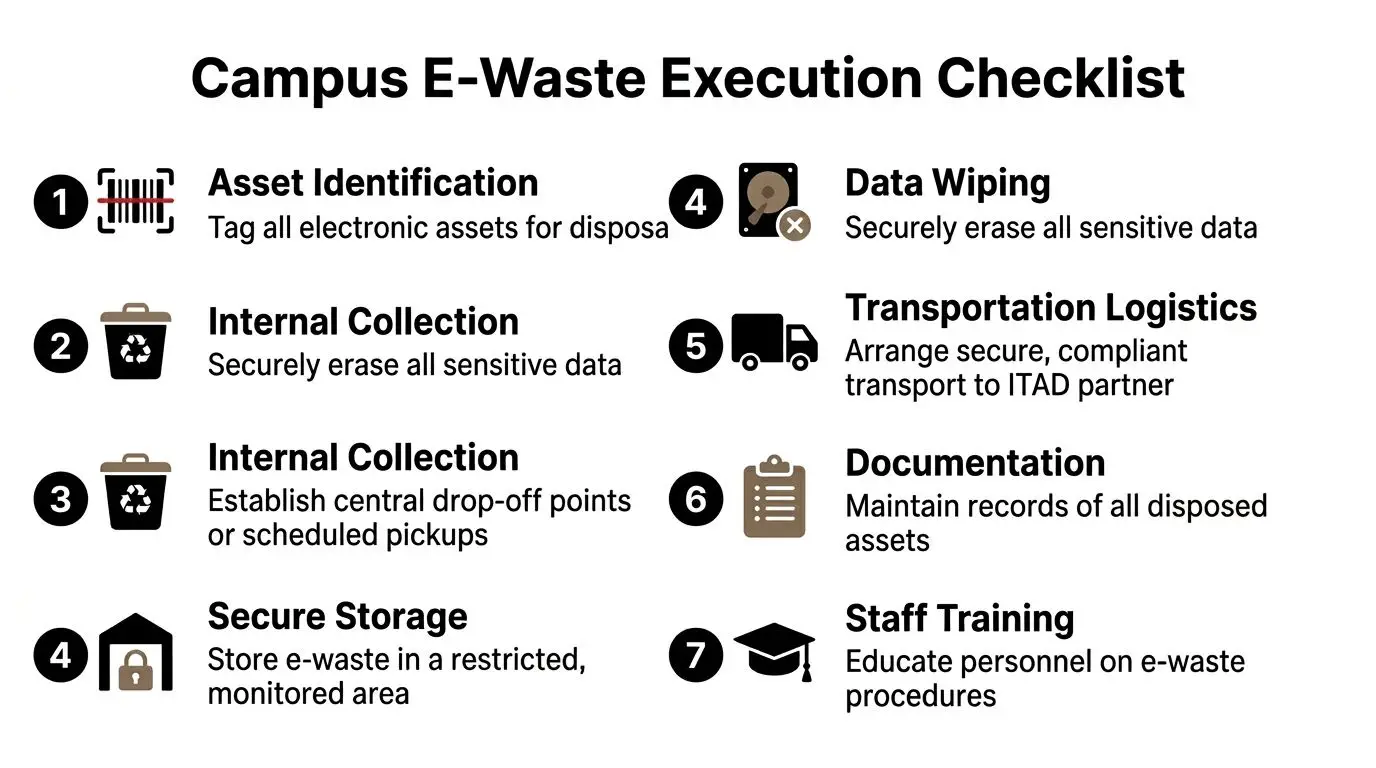
A local best-practice model for Austin universities includes serialized inventory tracking, on-campus collection at secure points such as UT’s Campus Computer Store, and mandatory data sanitization via DoD 5220.22-M certified methods or physical shredding before any equipment leaves campus, reflecting the methodology described by UT Austin Facilities Services. That operational sequence is what turns electronics recycling into a controlled process instead of an end-of-semester scramble.
Step one: identify assets before anyone touches them
Start with intake discipline. Every device marked for retirement should be logged with its serial number, asset tag if available, owning department, physical condition, and whether it is data-bearing.
This sounds obvious, but it’s where many campuses lose control. Departments often want to “clear the room” and sort later. That approach produces missing serials, uncertain ownership, and weak records.
Use a simple intake form or barcode workflow. Keep it consistent across desktops, laptop disposal, monitors, networking hardware, peripherals, and specialized equipment.
Step two: separate data-bearing devices from everything else
Not every electronic item creates the same risk. A monitor and a hard drive shouldn’t move through the same controls. Devices with storage media need their own stream immediately.
Create visibly different handling paths:
- Data-bearing assets go to locked staging under IT or authorized surplus control.
- Non-data-bearing assets can move to standard electronics holding areas.
- Specialized or mixed equipment such as laboratory equipment disposal items should be reviewed before release.
Security rule: If staff can’t quickly tell whether a device stores data, treat it as if it does until IT verifies otherwise.
Universities often make expensive mistakes. Old copiers, multifunction devices, lab instruments, and AV systems may contain storage components even when users assume they don’t.
Step three: choose between permanent collection and event-based collection
Campuses usually need both.
Permanent collection points work well for routine retirement. They’re useful for smaller weekly volumes and make compliance easier because staff know where approved handoff happens.
Event-based drives are better for:
- Semester-end office cleanout activity
- Building renovations
- Department relocations
- Faculty refresh cycles
- Surplus reduction campaigns
A useful campus model is to maintain one or more secure year-round collection points while scheduling periodic drives for backlog reduction. If your team is planning one of those larger pushes, practical guidance on running a successful e-waste drive can help avoid the usual bottlenecks around signage, intake, and staffing.
Step four: sanitize data before off-campus movement
This is not optional. The institution should define what sanitization method applies to each asset class.
Use data erasure when devices are suitable for reuse or remarketing and the approved standard permits that path. Use physical shredding when devices are damaged, non-redeployable, or subject to stricter destruction requirements.
A workable campus policy usually covers:
| Asset type | Typical treatment |
|---|---|
| Reusable laptop or desktop | Approved data erasure, then reuse or downstream processing |
| Failed hard drive | Physical shredding |
| Servers from restricted environments | Sanitization standard set by IT and compliance |
| Unknown storage media | Hold and review before release |
Never allow a department to drop retired computers into a general recycling stream and assume the vendor will sort out the data issue later.
Step five: secure storage and transport
After logging and sanitization decisions, store material in a restricted area with limited access. That area should be monitored, organized by disposition category, and designed so equipment doesn’t get mixed after intake.
Transport planning matters more than many campuses expect. The handoff should document pickup date, quantity, responsible staff, and receiving party. For larger projects such as data center decommissioning or facility cleanout work, assign one campus coordinator to reconcile the outbound list against the vendor receipt.
Step six: document final disposition
The final record should show what happened to each category of equipment. Universities don’t need beautiful dashboards at this stage. They need records they can trust.
At minimum, maintain:
- Intake log
- Department release confirmation
- Data destruction record where applicable
- Outbound shipment or pickup record
- Final disposition summary
For campuses that want one partner to handle secure pickup, hard drive shredding, donation-based recycling, and reporting under a social enterprise recycling model, Reworx Recycling is one available ITAD option for multi-site and institutional workflows.
Step seven: train the people who actually generate the stream
The process won’t hold if it only lives with central IT. Train department admins, lab managers, facilities supervisors, and anyone likely to coordinate an office move or surplus request. Keep the training short and scenario-based.
The message should be practical:
- Don’t place electronics in standard recycling bins
- Don’t leave retired devices in open hallways
- Don’t move data-bearing devices without logging them
- Don’t assume every recycler handles secure data destruction
That level of clarity is what keeps campus execution consistent.
Selecting Your University's ITAD Partner
Universities shouldn’t choose an ITAD vendor the same way they choose a commodity hauler. The wrong choice can create long-tail problems that don’t show up on the pickup day. Data can be mishandled. Downstream processing can become opaque. Equipment that looked “recycled” on paper can turn into an accountability problem later.
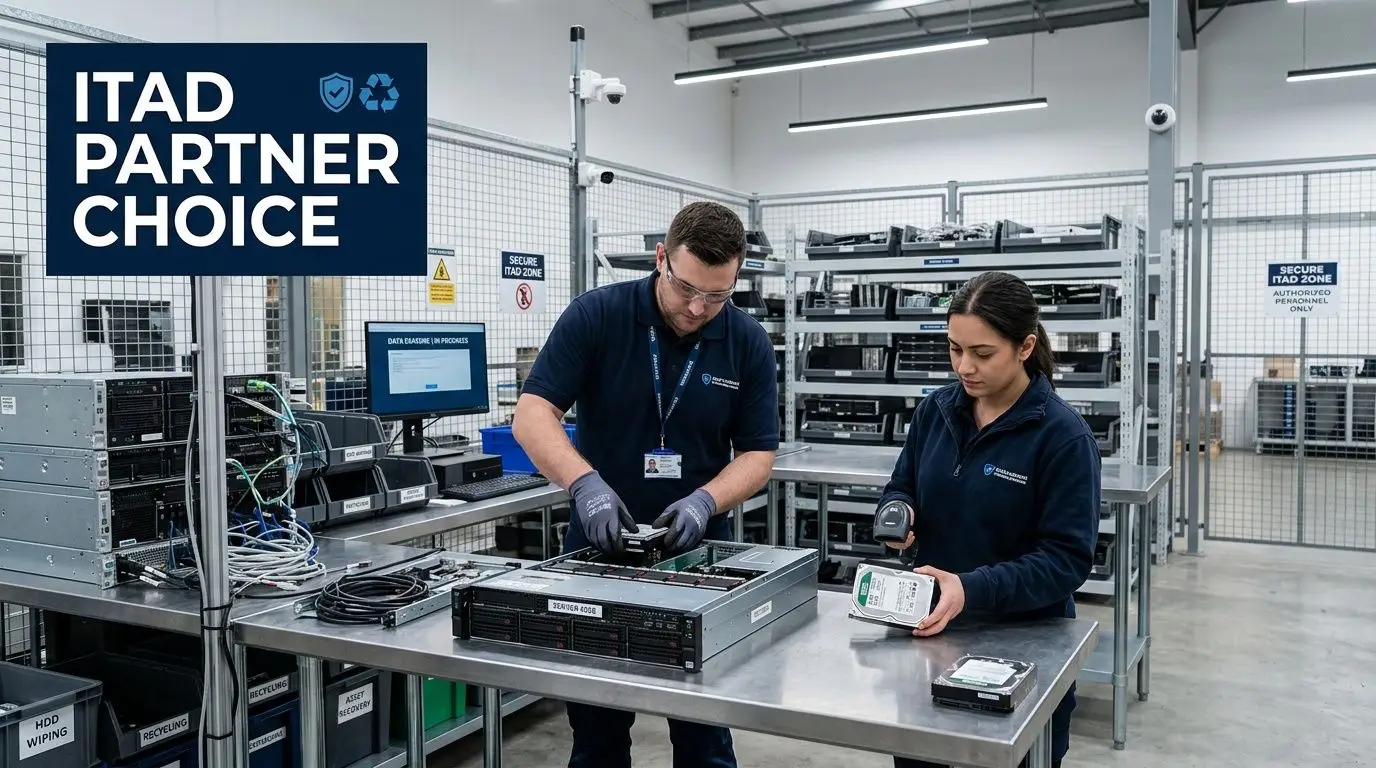
Vendor selection should start with standards and evidence. According to guidance on school and university electronics recycling practices, top-tier vendors with R2 or e-Stewards certification provide downstream accountability and secure data handling aligned with standards such as NIST SP 800-88r1. The same source notes that up to 15% of discarded school drives are not properly sanitized, and that certified vendors can recover 85-95% of material value versus 10-20% in informal sectors. For a university, those figures aren’t abstract. They translate directly into risk management and stewardship quality.
What to verify before you sign anything
A university should ask for documentation, not assurances. At minimum, confirm the vendor can show:
- Recognized certification: R2 or e-Stewards for responsible electronics recycling controls
- Data destruction standards: Documented handling aligned with institutional requirements
- Downstream transparency: Clear explanation of where material goes after first processing
- Serialized reporting capability: Essential for university-owned assets
- Certificates of destruction: Especially for hard drives and other storage media
- Insurance and chain-of-custody procedures: Relevant for pickups, storage, and transport
If the vendor can’t answer these questions cleanly, the institution should keep looking.
Don’t let price become the only filter
Low-cost hauling can look attractive when departments are trying to clear space quickly. But universities don’t just need removal. They need removal with proof, consistency, and controls that hold across multiple departments.
A better selection approach is to compare vendors on three dimensions:
| Selection factor | What good looks like | Red flag |
|---|---|---|
| Data handling | Defined sanitization process and documentation | Vague promise to “wipe everything” |
| Environmental controls | Verifiable downstream accountability | No detail on final processors |
| Institutional fit | Pickup, reporting, and campus coordination | Residential-style drop-off model only |
Why social mission can matter in higher education
Universities often want more from the end-of-life process than simple disposal. They may prefer a partner that can support corporate donation programs, responsible reuse, and digital inclusion alongside secure recycling. That doesn’t replace the need for certification and chain of custody. It complements it.
A donation-based recycling model can be a good fit when a campus wants retired equipment evaluated for reuse before recycling. It can also align with institutional values around access, community impact, and responsible procurement.
The strongest ITAD partnerships create two outputs at once. Controlled risk for the university and usable value from equipment that still has life left.
Questions that separate serious vendors from convenient ones
Ask these in the RFP or review call:
- How do you document each pickup for institutional assets?
- When do you erase data, and when do you shred?
- Can you provide serialized reports for mixed campus collections?
- How do you handle nonstandard equipment such as lab devices or product destruction requests?
- What happens to equipment that is reusable?
- How do you support recurring pickups for universities rather than one-off loads?
For Austin-area teams evaluating local and national options, it also helps to compare the vendor’s approach against a defined corporate computer recycling service model in Austin. That gives procurement and IT a practical checklist for service scope, secure data destruction, and reporting expectations.
Measuring Impact and Optimizing Your Program
A university electronics recycling program becomes credible when it produces reporting that leadership can use. If the only output is that “a lot of stuff got picked up,” the program will struggle to secure budget, campus buy-in, or policy support. Facilities, IT, procurement, and sustainability need a shared view of what happened and what should change next.
The most useful reports connect operational activity to institutional priorities. That means tracking not only what left campus, but how the program reduced storage pressure, improved secure handling, increased reuse opportunities, and supported sustainability commitments.

Build a reporting set that leadership will actually read
Good campus reporting usually includes a concise dashboard and a supporting operational appendix. The dashboard should stay focused on decisions.
Track categories such as:
- Assets processed by type: laptops, desktops, servers, monitors, peripherals, and specialized equipment
- Disposition path: reuse, recycling, destruction, or pending review
- Department participation: which units are using the process and which are still bypassing it
- Security controls completed: erasure and physical destruction records
- Program friction points: storage bottlenecks, untagged assets, recurring contamination, or unclear ownership
This kind of reporting is closer to program management than marketing. Universities that want a stronger structure for evaluating environmental programs can borrow ideas from broader public-sector methods for understanding M&E for global policy, then adapt them into campus-scale metrics, review cycles, and corrective actions.
Use the report to improve behavior, not just record history
The best reports lead to changes in process. If one building consistently sends untagged devices, train that department. If data-bearing equipment keeps showing up in the wrong stream, tighten intake controls. If one lab category keeps getting stalled because no one knows whether it qualifies for standard recycling, create a separate review path.
A reporting system is useful only if it changes the next pickup, the next refresh cycle, and the next policy revision.
A practical review cadence should include short operational check-ins and a broader annual review tied to campus sustainability and capital planning. That annual review is where leadership can decide whether to expand permanent collection points, add more formal office cleanout support, or revise procurement language so end-of-life handling is clearer from the moment equipment is purchased.
Future-proof the program for new waste streams
A growing challenge for universities is that tomorrow’s electronics waste won’t look exactly like today’s. A documented planning gap is the rise of AI hardware and other advanced research technology in university waste streams. At the same time, UT Austin researchers have developed mineral extraction techniques for e-waste, but there’s still little data on campus-level implementation, as discussed in this coverage of emerging e-waste innovation and planning gaps.
That creates a practical problem for sustainability directors. They’re being asked to plan for devices and components that may not fit existing office ITAD assumptions. Research hardware, specialized accelerators, and advanced lab electronics can require a more customized review of reuse potential, parts recovery, data sensitivity, and downstream processing.
What optimization looks like in practice
Instead of waiting for those new streams to become a crisis, universities should build a standing review process around them.
Consider these actions:
- Create a special handling category for advanced research and nonstandard electronics
- Include research stakeholders in annual ITAD policy reviews
- Flag unknown devices early instead of forcing them into the standard office equipment stream
- Ask vendors how they handle emerging device types before the campus generates volume
That’s how a program matures. It moves from disposal to lifecycle management. It also gives universities a stronger story to tell when they report on sustainable recycling, secure data destruction, community donation pathways, and the operational discipline behind their electronics recycling program.
Universities in Austin don’t need another vague recycling policy. They need a repeatable ITAD process that protects data, supports sustainability goals, and handles everything from routine computer recycling to complex cleanouts and specialized equipment. If your team is evaluating donation-based recycling, secure data destruction, or a structured pickup program, Reworx Recycling is one place to start. Explore the company’s resources, compare service models, and use that information to build a campus program that’s practical, defensible, and easier to run.