
A lot of Los Angeles businesses are sitting on a quiet liability right now. It’s in the IT closet, under desks after a laptop refresh, in the server room after a virtualization project, or stacked on pallets after an office move. Old monitors, retired drives, broken tablets, surplus networking gear, and demo equipment don’t look urgent until someone asks where they went, how the data was destroyed, and whether the company can prove compliant disposal.
That’s why Responsible E-Waste Recycling in Los Angeles matters well beyond sustainability messaging. For an IT manager, facilities lead, or ESG stakeholder, e-waste is a chain-of-custody issue, a data security issue, and a brand governance issue. In a city with dense commercial activity, frequent technology turnover, and high public visibility, the wrong disposal choice can create avoidable legal exposure and unnecessary operational drag.
The High Stakes of E-Waste for Los Angeles Businesses
Los Angeles companies replace electronics constantly. Production teams cycle through displays and peripherals. Healthcare and lab environments retire specialized devices. Offices upgrade laptops in batches. Warehouses and field teams turn over handheld equipment, printers, and mobile hardware. The volume adds up fast, but volume isn’t the main risk.
A key issue is that retired electronics still contain value, sensitive information, and regulated materials. A decommissioned server can still hold customer data. A box of old employee laptops can still expose logins, browser data, or locally stored files. A stack of monitors can trigger hazardous waste handling obligations if someone treats them like ordinary trash.

What makes the risk different in business settings
Residential guidance often focuses on convenience. Business disposal needs something else: documentation, secure handling, and repeatable process. That’s where many companies get exposed.
Improper e-waste disposal can trigger fines up to $70,000 per violation per day under hazardous waste regulations, and businesses also retain cradle-to-grave liability under RCRA because e-waste can contain toxics such as lead and mercury, as explained in this overview of Los Angeles electronics recycling requirements. If your recycler cuts corners downstream, the risk doesn’t disappear just because the equipment left your building.
A strong sustainability program should account for those environmental consequences too. This primer on the environmental impact of electronic waste is useful if you need to align internal stakeholders around why these controls matter.
Practical rule: If your company needs to prove where equipment went, what happened to the data, and how the materials were handled, “we dropped it off somewhere” isn’t a defensible process.
Where companies usually get this wrong
The most common failure isn’t malicious disposal. It’s informal disposal. Someone in operations calls a hauler. A facilities team mixes electronics into a broader cleanout. A branch office asks staff to “take old equipment to recycling.” Those shortcuts feel efficient, but they break chain of custody and make audit trails thin or nonexistent.
Watch for these weak points:
- Untracked storage areas: Closets and back rooms often become long-term holding zones for devices that were never formally retired.
- Mixed cleanouts: Office furniture removal, junk hauling, and electronics handling require different controls.
- No sign-off from IT or compliance: Equipment leaves the site before anyone verifies data-bearing assets.
- No downstream visibility: The company receives a pickup, but not meaningful proof of sanitization or final processing.
Reputational damage can be just as costly as the direct compliance risk. LA businesses operate in a market where employees, customers, and procurement teams increasingly expect responsible handling of end-of-life equipment. If a discarded drive resurfaces or materials are mishandled, the story quickly shifts from “waste management” to “poor governance.”
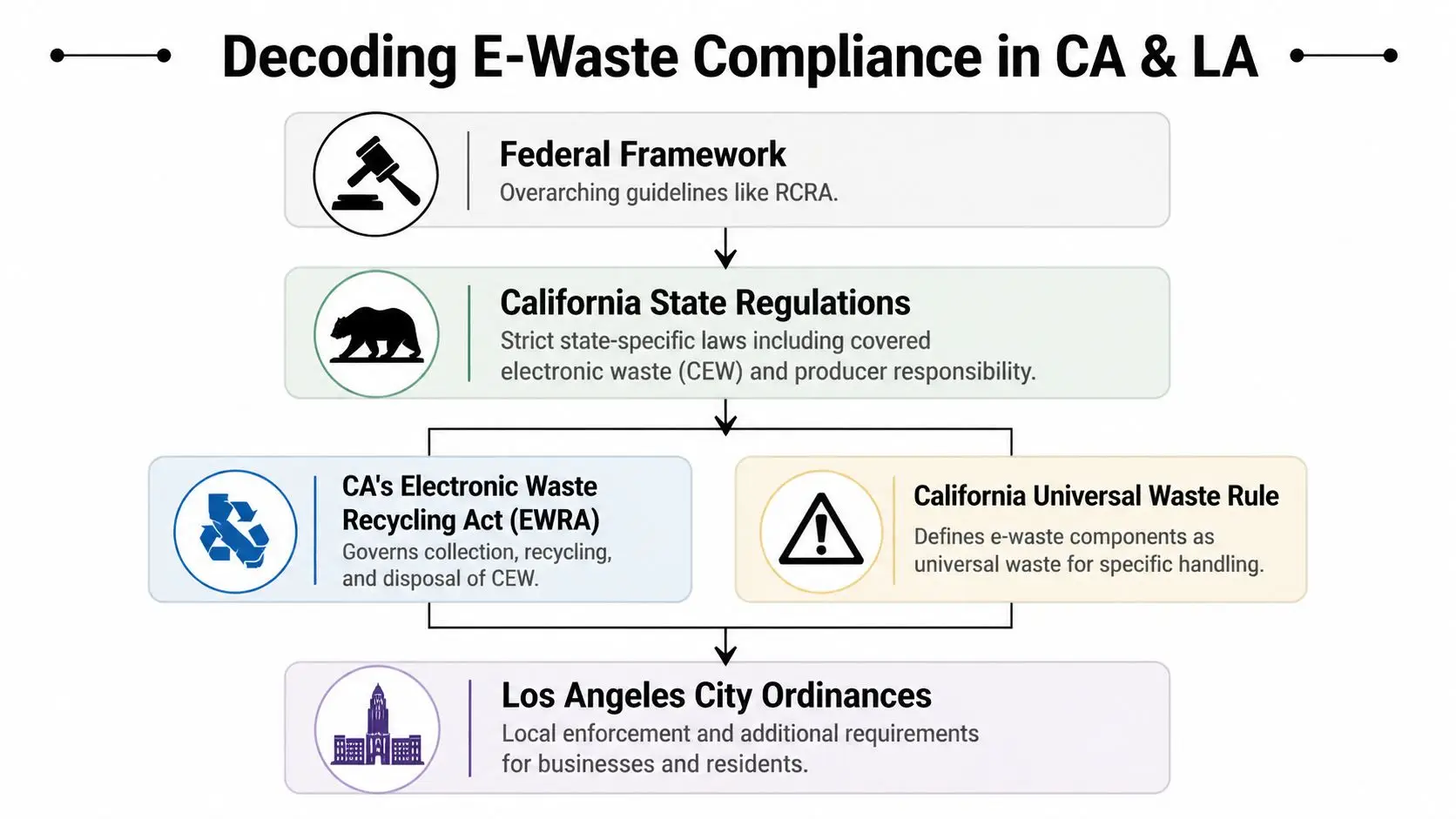
Decoding E-Waste Compliance in California and Los Angeles
A Los Angeles IT manager approves an office refresh on Friday. By Monday, old monitors are stacked in a storage room, a facilities vendor is asking for pickup access, and no one has confirmed which units still hold data or which disposal path meets California rules. That is how compliance problems start. Usually with speed, mixed responsibilities, and thin documentation.
What the state framework means for businesses
California does not treat many electronics as ordinary trash. The state’s Electronic Waste Recycling Act created a formal recovery system for covered devices, funded through an Advanced Recycling Fee collected at the point of sale. A practical overview of the state program appears in this California electronics recycling overview.
For a business, the takeaway is straightforward. Display devices and other covered electronics need to move through approved recycling channels, with records that show your company handled them responsibly. If equipment includes storage media, compliance and data security become part of the same decision.
That distinction matters in corporate settings. Public consumer programs exist to increase access. They are not designed to give an employer the chain of custody, serialized reporting, or data-destruction evidence an auditor, client, or insurer may expect.
What Los Angeles managers need to control
In day-to-day operations, Los Angeles companies should assume that video display devices and similar electronic equipment require separate handling from general office waste. They should also assume that local convenience options do not automatically meet corporate governance needs.
Focus on these controls:
- Identify covered devices before a move or cleanout. Monitors, TVs, and other screen-based equipment should be tagged early so they do not get mixed into general surplus.
- Separate data-bearing assets from non-data equipment. Laptops, desktops, servers, phones, and network gear need a stricter retirement process than a broken keyboard or cable bin.
- Document internal custody before pickup. Record what was removed from service, where it was stored, and who approved release.
- Use a recycler or ITAD provider that can prove downstream handling. A pickup receipt alone is not enough for most business risk profiles.
A lot of companies miss the second and third steps.
Documentation is where business compliance is won or lost
California disposal rules matter, but for LA businesses, documentation usually decides whether a process holds up under scrutiny. If a device leaves your site and you cannot show what it was, whether data was sanitized, and where it went next, the program is weak even if the equipment reached a legitimate recycler.
A defensible process usually includes:
- Asset identification
- Segregation of data-bearing devices
- Secure storage before transfer
- Documented handoff
- Proof of sanitization or destruction
- Recycling, resale, or final disposition records
This is the main trade-off between public drop-off options and business-grade ITAD service. Public programs may be appropriate for residents or very small volumes of low-risk equipment. Corporate programs need control, accountability, and evidence.
Los Angeles does offer public collection pathways, including S.A.F.E. Centers, household hazardous waste and electronics collection options, and mail-back services discussed in earlier compliance summaries. Those programs can be useful reference points, much like a municipal guide to same day junk removal helps clarify what general haulers do and do not cover. But they are not a substitute for a managed corporate disposition process when your company is handling fleets of devices, regulated data, or client-sensitive equipment.
For LA businesses, the primary compliance question is not where electronics can be dropped off. It is which path gives your company documented custody, secure data handling, and a record you can stand behind.
E-Waste Logistics Options for LA Companies
The right logistics model depends on volume, security needs, and how much internal labor you want to spend. Most Los Angeles companies don’t need every option. They need the one that matches the equipment type and the level of risk.
Public drop-off for small, simple loads
Public drop-off works best when the load is small, non-urgent, and low complexity. It can be useful for a tiny office with a few non-sensitive peripherals or a one-time disposal of basic display devices where the company has already managed data controls separately.
It’s a weak fit for most business environments. Staff time disappears into sorting, loading, transport, waiting, and paperwork. Chain of custody becomes harder to defend the moment equipment leaves your controlled facility in a personal or pooled vehicle.
Business pickup for routine programs and larger projects
Pickup service is the stronger option for office refreshes, relocations, warehouse cleanouts, and recurring IT retirements. It reduces handling touches and gives your team a cleaner transfer point. For data center decommissioning, laptop disposal, medical equipment disposal, laboratory equipment disposal, or product destruction, pickup also makes internal coordination easier because the provider works from your site conditions rather than forcing your team into a consumer-style drop-off process.
A good reverse logistics setup should support scheduling, staged collection, and documented transfer. This article on reverse logistics solutions for efficiency and sustainability is useful if you're building a broader internal process around office cleanout or facility cleanout work.
Mail-back for distributed teams and low-volume assets
Mail-back can work when a company has remote staff, branch offices, or a handful of small devices spread across locations. It’s practical for isolated assets, especially when shipping and handling are simpler than coordinating a site visit.
It’s less effective for mixed loads, fragile screens, or projects that require tight data destruction controls. Once a program grows beyond occasional low-volume returns, mail-back can become administratively messy.
A logistics option is only “convenient” if it preserves custody, keeps labor low, and produces the records your business will actually need later.
Corporate collection events and internal drives
Some organizations create internal e-waste drives during refresh cycles or relocation periods. That can work well if the event is managed like an operations project instead of a volunteer cleanup. You need intake rules, internal communications, an approved list of accepted devices, and a defined handoff.
If you’re bundling electronics disposal with broader space clearing, it helps to understand where standard junk removal ends and controlled electronics handling begins. Even a non-electronics resource like this guide to same day junk removal is a helpful reminder that speed and convenience don’t automatically equal compliance, especially when regulated or data-bearing items are in the mix.
A simple way to choose
Use this decision filter before booking anything:
- Choose drop-off if the quantity is very small and the assets don’t require business-grade documentation.
- Choose pickup if you have pallets, mixed equipment, secure assets, or limited internal labor.
- Choose mail-back if the equipment is distributed and the load is light.
- Choose a managed event if multiple departments need to retire assets at once and someone can enforce intake controls.
What doesn’t work is treating every e-waste stream the same. A few keyboards, a rack of storage arrays, and a room of decommissioned monitors are three different jobs.
How to Select a Certified ITAD Partner in Los Angeles
Choosing a recycler for business equipment isn’t a disposal decision. It’s a risk transfer decision, and you should vet it with the same seriousness you’d apply to a cloud vendor or document destruction provider.
That matters because a lot of California business e-waste still misses the mark. A CalRecycle report noted that only 15-20% of California business e-waste goes through certified channels, despite 80% containing sensitive data, creating a compliance gap because public drop-off sites aren’t built for business-grade data destruction or liability documentation, as summarized by the LA County household hazardous waste collection resource.
What to verify before you hand over equipment
Start with certifications and process controls. You’re looking for evidence that the provider follows structured handling, data security, downstream management, and environmental practices.
Ask direct questions such as:
- Which certifications do you hold: Look for recognized standards such as R2v3 or e-Stewards for electronics processing, and NAID AAA where secure data destruction is part of the service model.
- How is chain of custody documented: You want a clear intake-to-final-processing trail.
- What happens to reusable equipment: Reuse, remarketing, donation, and parts harvesting all require controls.
- How do you manage downstream vendors: If materials leave the first processor, who audits the next handoff?
- What reporting do you provide: Certificates, asset lists, serial-level reporting, destruction records, and weight summaries all matter in different situations.
A useful screening framework is this guide on selecting a reliable e-waste recycling partner. It aligns well with how procurement and compliance teams typically evaluate service providers.
Public drop-off versus certified ITAD
The biggest source of confusion for SMBs is the apparent price advantage of public options. “Free” is attractive until you account for labor, transportation, custody gaps, and missing documentation.
| Feature | Public S.A.F.E. Centers | Certified ITAD Partner (e.g., Reworx) |
|---|---|---|
| Primary design | Household-focused collection | Business-focused asset disposition |
| Data destruction | Not designed for business-grade secure data destruction | Structured sanitization and destruction workflows |
| Chain of custody | Limited for corporate audit needs | Documented transfer and tracking |
| Reporting | Basic or limited | Audit-ready records, certificates, asset reporting |
| Pickup service | Not the core model | Typically available for offices and facilities |
| Remarketing and value recovery | Usually not a business service focus | Often part of ITAD strategy |
| Support for office cleanouts | Difficult at scale | Built for staged or bulk projects |
| Compliance positioning | Better for residents and simple disposal | Better for regulated, data-bearing, and repeat business streams |
Public collection has a place. It’s just usually not the right place for corporate laptops, servers, storage devices, or any load that could trigger audit, privacy, or contractual questions later.
The checklist that separates strong partners from risky ones
Use this short diligence list during vendor review:
- Request a written description of the data destruction method.
- Ask what proof you’ll receive after processing.
- Confirm whether pickups are handled by trained staff or subcontractors.
- Review how the provider handles reuse versus scrap.
- Ask how exceptions are managed, such as damaged drives or unlabeled assets.
- Confirm whether they support specialty streams like medical equipment disposal, laboratory equipment disposal, or product destruction.
A provider doesn’t need the flashiest pitch. They need clean process discipline. If answers are vague, if documentation is treated like an afterthought, or if downstream handling is hard to explain, move on.
The Social Enterprise Advantage for Sustainable Recycling
Compliance keeps you out of trouble. A social enterprise model can do more than that. It can turn an ordinary end-of-life equipment program into a meaningful part of your ESG story.
For companies in Los Angeles, that matters because sustainability expectations are now broader than landfill diversion alone. Stakeholders want to know whether your vendor choices support responsible material recovery, community benefit, and practical reuse where appropriate.
Why the model is gaining attention
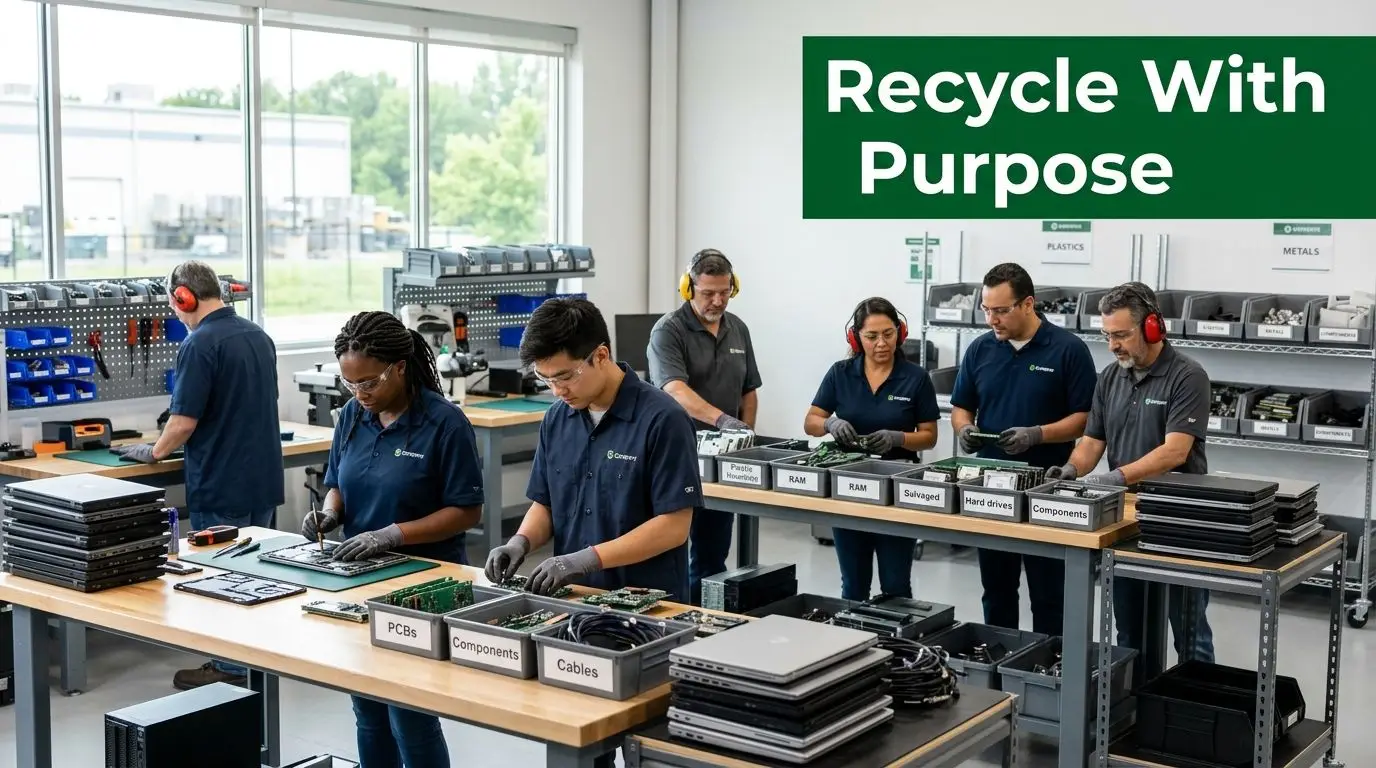
Certified social enterprise recyclers can achieve material diversion rates of up to 95%, compared with a 60% average for standard programs, and California social enterprises saw a 25% rise in e-waste processing in 2025, according to this overview of social enterprise recycling impact. For a business, that means vendor selection can materially influence how much of your retired equipment is reused, remarketed, or responsibly processed.
That has real reporting value. Sustainability leaders are under pressure to connect operational decisions to measurable outcomes. Social enterprise recycling gives them a stronger narrative than “we disposed of obsolete equipment.”
What this changes for an LA business
A social enterprise partner can support several objectives at once:
- Environmental performance: More effective diversion and stronger reuse pathways.
- Community impact: Workforce development, digital inclusion, and mission-driven employment.
- Corporate donation programs: Working equipment can support social value instead of becoming immediate scrap.
- Procurement alignment: Vendor choices reinforce broader ESG commitments already being made elsewhere in the organization.
For certain devices, donation-based recycling becomes especially useful. Some devices should be securely destroyed. Others still have life left in them and can support refurbishment, redeployment, or structured donation. That distinction matters because sustainability improves when companies stop treating every retired asset as waste.
Strong IT asset disposition separates assets into what must be destroyed, what can be remarketed, and what can still serve a social purpose.
How repair and reuse fit the bigger picture
The social enterprise model also aligns with the larger movement toward keeping electronics in use longer. Even outside the U.S., policy conversations increasingly focus on repairability and extended product life. For context, these Australian Right to Repair laws show how the market is moving toward reuse and repair principles that support better end-of-life outcomes.
For Los Angeles businesses, the lesson is practical. Don’t build an e-waste program that starts and ends with shredding everything. Build one that classifies equipment intelligently. Sensitive data-bearing assets may need secure data destruction. Surplus working equipment may be better handled through donation-based recycling or controlled reuse. Broken equipment may need component recovery through sustainable recycling channels.
A mission-aligned provider relationship can help your company communicate that distinction internally and externally. This perspective on partnering for impact through responsible electronics programs is useful if your sustainability and IT teams are trying to align operational disposal with broader social goals.
Your Corporate E-Waste Program Action Checklist
A workable program doesn’t need to be complicated. It needs to be repeatable. The companies that handle e-waste well usually have one thing in common: they remove guesswork before the next refresh, move, or decommissioning project starts.
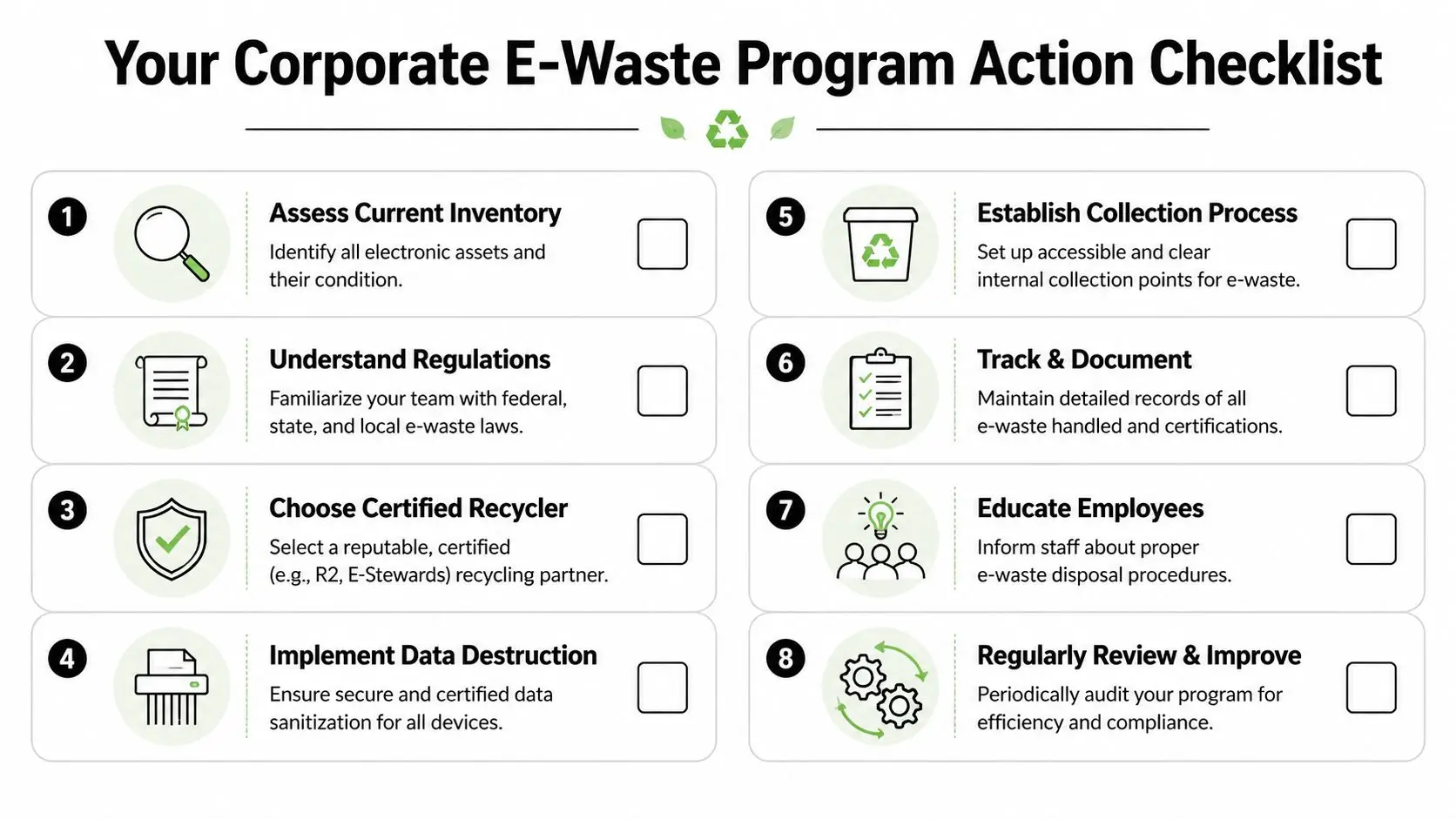
Build the program in five phases
Inventory what you have
Start with storage rooms, branch locations, staging areas, server racks, and employee return streams. Separate data-bearing devices from peripherals and display equipment. If your organization struggles with surplus tracking, even process ideas from adjacent fields can help. This article on optimizing inventory for estate sales is a useful reminder that clean categorization drives better disposition decisions in any asset-heavy workflow.Set a security rule before collection begins
Decide who approves release of laptops, desktops, servers, mobile devices, and removable media. Define whether equipment is sanitized, shredded, or held for review. This step should involve IT, compliance, and whoever signs off on disposition.Create approved equipment categories
Make three buckets: reuse candidates, remarketing candidates, and destruction-only assets. Don’t leave this to ad hoc judgment on pickup day.
Lock down execution
Choose one approved partner process
Your team shouldn’t have to reinvent decisions every quarter. Standardize the intake form, handoff method, and required documentation.Establish internal collection points
Set designated areas in offices or facilities for retired electronics. Label them clearly. Restrict access to anything that can store data.Prepare for special projects separately
Office cleanouts, facility cleanouts, and data center decommissioning should run as managed projects, not as an extension of routine recycling. The handling needs, staffing, and timing are different.
The best e-waste program is the one employees can follow without improvising.
Measure and improve
Keep records that someone else can understand
Maintain pickup logs, asset lists, certificates, and internal approvals in one place. If a customer, auditor, or regulator asks questions later, your records should answer them without detective work.Train employees on what not to do
They shouldn’t take company devices to public household events, leave retired laptops in unsecured rooms, or mix electronics with general trash or furniture disposal.Review the program after each major event
Look for bottlenecks. Did assets sit too long before pickup? Did your team struggle to identify what was reusable? Did the reporting match what finance, security, and sustainability teams needed?
A mature program is less about volume than discipline. Once those steps are in place, computer recycling, laptop disposal, secure data destruction, and IT equipment disposal stop being recurring fire drills and become standard operations.
Frequently Asked Questions about Business E-Waste in LA
Can a business use public e-waste drop-off sites in Los Angeles
Sometimes, but that doesn’t make them the best fit. Public programs are generally geared toward residents and simple disposal. A business should think first about custody, data destruction, reporting, and whether the load includes sensitive or specialized equipment.
What documentation should a company keep
Keep enough documentation to show what left your site, when it left, who received it, and what happened next. In practice, that usually means internal approvals, asset records where available, pickup or transfer records, and certificates for data destruction or recycling when the provider offers them.
How are business recycling costs usually determined
Costs typically depend on volume, equipment type, pickup complexity, labor requirements, and whether the project includes secure data destruction, deinstallation, sorting, or specialty handling. In some cases, equipment buyback or remarketing can offset part of the cost. The main point is to compare total program value, not just the line item for hauling.
What should a small business do with only a few devices
A very small quantity may be manageable through a simple approved channel, but the decision should still reflect whether the devices hold sensitive data. Even a small batch of laptops or drives deserves a controlled process.
Can specialized equipment be handled through the same program
Often yes, but only if the provider is equipped for it. Medical equipment disposal, laboratory equipment disposal, and product destruction may require additional review, especially if the items contain data, regulated components, or brand-sensitive materials.
If your team needs a practical partner for donation-based recycling, secure data destruction, IT asset disposition, office cleanouts, or corporate donation programs, explore Reworx Recycling. Businesses can use their resources to plan responsible electronics recycling, schedule a pickup, and build a process that protects data, supports sustainable recycling, and puts retired equipment to better community use where possible.