A Boston CIO usually sees the problem after the refresh is already done. New laptops are deployed, old servers are out of warranty, a lab moved floors, or a finance team consolidated offices. Then the core issue appears in a locked room or loading area. Stacks of retired devices with regulated data on them, uncertain chain of custody, and no one eager to sign off on disposal.
In Boston, that pileup isn’t just an operations problem. It touches data security, Massachusetts disposal rules, internal audit readiness, and ESG reporting. Biotech, healthcare, finance, higher education, and public sector teams all face the same question. How do you move equipment out quickly without creating a breach, a compliance gap, or an ugly sustainability story later?
Navigating Boston's E-Waste Challenge
A common Boston scenario goes like this. A biotech firm in Cambridge finishes an instrument upgrade. A financial services office in the Seaport replaces trader workstations. A university department clears out storage ahead of a renovation. In each case, the assets look like surplus equipment. In practice, they’re regulated data containers and environmental liabilities.
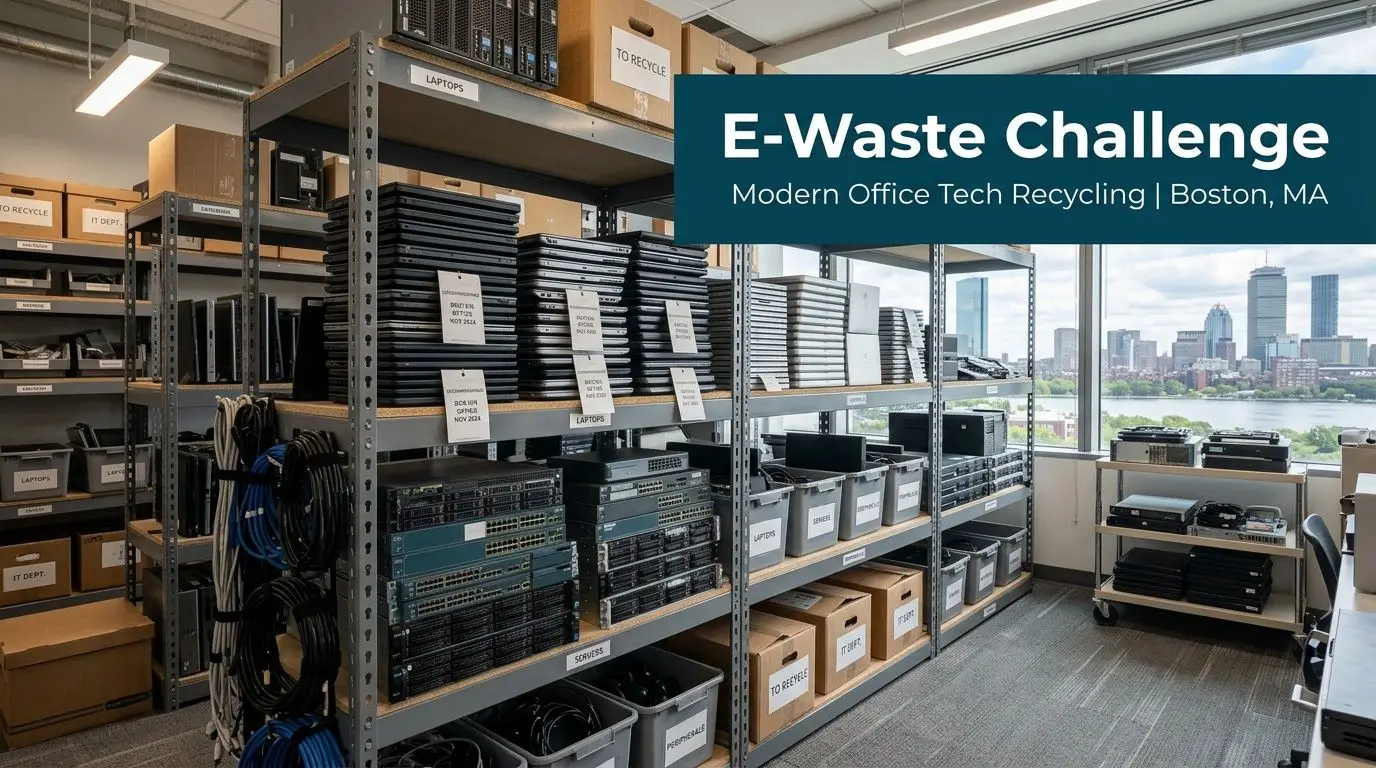
Boston’s market is mature enough that secure recycling shouldn’t be treated as an afterthought. Businesses can work with providers that handle computers, monitors, printers, and peripherals, issue Certificates of Destruction, and operate under established state and federal e-waste expectations. If you’re evaluating options across the region, a localized Massachusetts electronics recycling service is a useful starting point for understanding what a compliant program should include.
Where Boston teams get stuck
The friction usually isn’t deciding that recycling matters. It’s deciding who owns the process and what standard the company will accept.
- IT owns the assets but may not control building access, loading dock timing, or facilities labor.
- Compliance owns the risk but often sees the devices only after pickup has already been scheduled.
- Sustainability owns the story but needs documentation that many generic haulers don’t provide.
That’s why secure electronics recycling services in Boston need to work as an ITAD workflow, not a junk removal appointment.
Practical rule: If a vendor can’t explain chain of custody, downstream processing, and destruction documentation before pickup day, they’re not solving your risk problem.
What good looks like on the ground
The process that works is boring in the best sense. Assets are inventoried. Pickup instructions are clear. Data-bearing devices are segregated. Building management knows when the truck is arriving. Certificates and disposition records show up when promised. Viable devices go through legitimate value recovery or donation channels, and non-resalable material stays out of landfill streams.
For Boston organizations under pressure to upgrade fast, that discipline matters more than marketing language. Secure recycling is what closes the loop between technology change, legal defensibility, and corporate responsibility.
What Secure Electronics Recycling Really Means
For a business, “secure recycling” has very little to do with tossing devices into a responsible bin. It’s a risk management function with three jobs. Protect data, satisfy disposal rules, and leave an audit trail that stands up under scrutiny.
If any one of those fails, the project isn’t secure.
The three pillars that matter
First is data security. Every retired laptop, server, phone, external drive, copier drive, or medical workstation may contain customer records, employee data, research files, login credentials, or regulated health information. Once those assets leave your control, assumptions stop counting. You need documented handling.
Second is environmental compliance. Electronics contain materials that can’t be treated like ordinary office waste. A recycler should be able to explain how assets are processed, what gets resold, what gets dismantled, and how non-resalable material is routed through responsible downstream channels.
Third is chain of custody. Weak vendors often fail on this point. A receipt alone isn’t enough for most B2B programs. You want asset tracking, destruction records for data-bearing media, and paperwork your legal, audit, and ESG teams can use.
For organizations reviewing secure data handling options, secure data destruction services should be evaluated as part of the recycling scope, not as an optional add-on.
What doesn’t work
Several approaches sound convenient but create avoidable risk:
- Using a general junk hauler because the office needs space cleared quickly.
- Assuming internal wiping is sufficient without confirming the condition of each drive and documenting the outcome.
- Treating pickup as the finish line instead of the start of a documented disposition process.
A fast office cleanout can still become a slow compliance problem if no one can prove what happened to the drives.
Why leadership should care
CIOs usually don’t need persuasion that a breach is expensive. They do need a process that removes ambiguity. If legal asks for proof of destruction, if procurement asks whether a vendor met recognized standards, or if sustainability asks how the equipment was handled, the answer should come from records, not recollection.
That’s also where corporate social responsibility enters the decision. Responsible IT equipment disposal is not just the absence of landfill dumping. It’s also whether viable equipment can be reused or directed into programs that support community access to technology rather than being prematurely scrapped. That’s the difference between disposal and a defensible end-of-life strategy.
Decoding Certifications and Boston Compliance
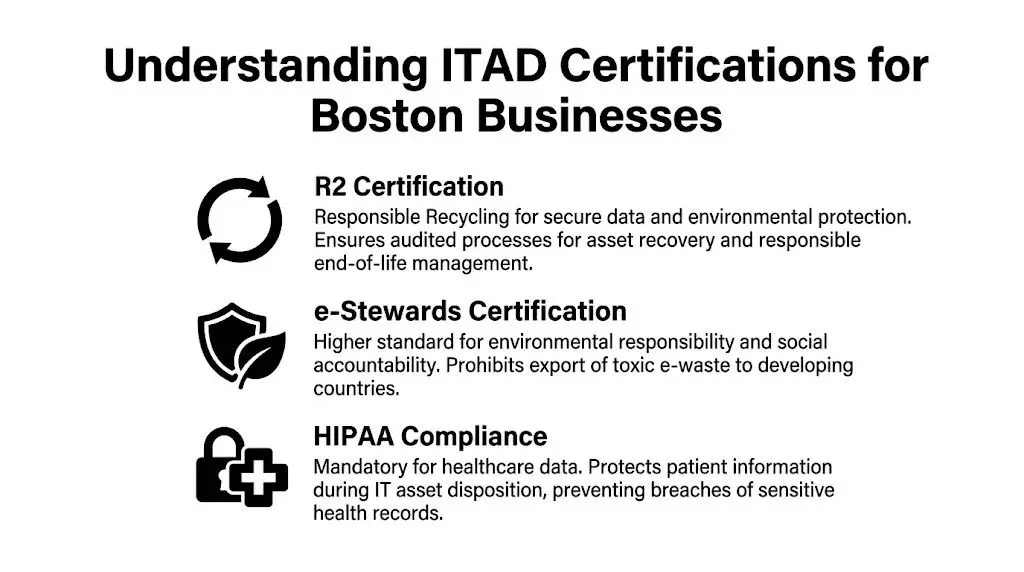
Boston buyers hear a lot of certification language. R2v3, e-Stewards, HIPAA handling, NIST, DoD-grade destruction. The practical question is simpler. Which of these tells you a vendor can be trusted with regulated assets from a hospital, bank, university, lab, or city agency?
What the labels mean in practice
R2v3 matters because it points to audited processes around reuse, recycling, data security, and downstream accountability. For a CIO, that translates into fewer blind spots. You’re not relying on verbal assurances about where equipment goes next.
e-Stewards is useful when your organization wants tighter environmental and social guardrails around export and downstream handling. It’s often relevant when procurement or sustainability teams want higher confidence that toxic e-waste won’t be pushed into weak processing channels elsewhere.
HIPAA-aligned handling matters whenever devices may contain protected health information. That includes hospitals, outpatient networks, research environments, and any employer managing health data through occupational clinics or benefits systems.
A good baseline for reviewing vendors is a clear electronics recycling certification framework that ties certifications to operational controls rather than marketing claims.
What Boston’s market maturity changes
Boston’s secure electronics recycling sector has been established for over 30 years, with some providers operating since the mid-1990s. That maturity shows up in standardized handling for computers, monitors, and peripherals, along with compliance processes built around Certificates of Destruction and state and federal e-waste requirements. Some local providers have also responsibly recycled more than 5 million pounds of electronics with zero landfill diversion, according to Boston electronics recycling provider information.
That longevity matters because it raises the floor. In a mature market, a serious ITAD partner should already know how to document pickups, separate reusable equipment from scrap, and support audit needs.
How to map compliance to your industry
Boston organizations shouldn’t evaluate certifications in the abstract. They should map them to the kind of data and equipment they retire.
- Biotech and healthcare: Focus on HIPAA-aligned handling, documented destruction, and defensible treatment of specialized devices.
- Finance and legal: Prioritize strict chain of custody and media destruction protocols.
- Higher education: Expect controls that support institutional privacy obligations and decentralized asset collection across departments.
- Government and public sector: Look for disciplined tracking, formal certificates, and clear downstream reporting.
Certifications don’t replace vendor diligence. They narrow the field to providers whose processes are more likely to survive audit and procurement review.
The Anatomy of Irreversible Data Destruction
There’s a reason experienced ITAD teams separate “recycling” from “destruction” in their internal planning. One addresses material handling. The other addresses evidentiary risk. If your business is retiring devices with sensitive data, irreversible destruction is the control that matters most.
Why wiping alone isn’t enough
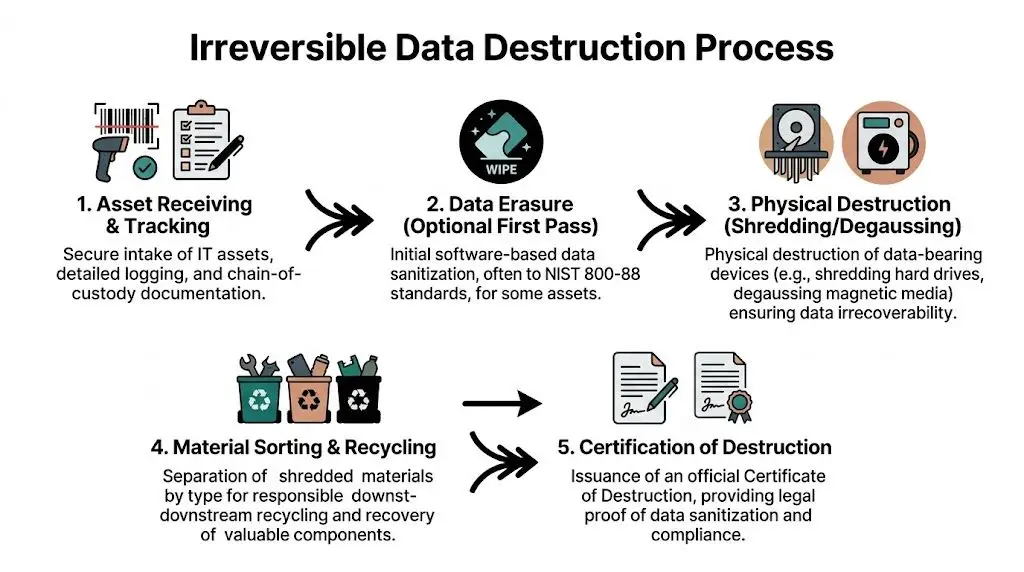
According to NIST SP 800-88 guidance summarized by Surplus Technology Solutions on electronics recycling and media destruction, physical destruction through shredding renders data unrecoverable. Certified recyclers use industrial shredders that reduce hard drive platters into particles of 2mm or less, a size that even electron microscopy cannot reassemble. The same source notes that 20-30% of enterprise drives are damaged in ways that make software wiping unreliable, and that the average cost of a data breach is $4.45 million.
That's the trade-off. Software sanitization can be appropriate in controlled cases, but it depends on drive health, proper execution, and good records. Physical destruction removes those dependencies.
If you want to understand the flip side of that risk, it helps to look at what specialists in hard drive data recovery do. Their work is built on recovering information from media that ordinary users assume is inaccessible. That’s exactly why damaged or partially erased drives shouldn’t be treated casually in a disposal program.
The methods that hold up
For Boston organizations handling sensitive records, these are the methods worth discussing with a vendor:
- Shredding: Best when you need finality. Once media is physically reduced, recovery isn’t a realistic path.
- Degaussing: Effective for magnetic hard drives in the right use cases, but not a universal answer for newer media types.
- Documented destruction events: On-site or off-site, the process needs tracking and a certificate tied to the job.
A dedicated hard drive destruction service should explain which media types it destroys physically, when wiping is used as an interim step, and how the final proof is delivered.
What a defensible workflow looks like
The best programs don’t just destroy media. They preserve evidence that destruction occurred under control.
- Receiving and logging assets with serialized or batch tracking.
- Segregating data-bearing devices from non-data peripherals.
- Applying the chosen destruction method based on media type.
- Recycling the resulting material through approved downstream channels.
- Issuing a Certificate of Destruction that can be stored for audit, legal, and policy purposes.
When the device condition is unknown, default to the method that leaves no forensic debate.
For biotech, finance, healthcare, and legal environments in Boston, that’s usually the decision that keeps everyone aligned.
Choosing the Right Service Model for Your Business
The best service model depends less on the recycler and more on your operating environment. A single-floor office cleanout has different needs than a hospital network, a university department spread across buildings, or a data center decommissioning project.
Business pickup
For most Boston companies, pickup is the default model because it reduces internal labor. Qualified business programs often include free pickup, official certificates, and documented tracking while meeting or exceeding Department of Defense and NIST standards, as described by STS Electronic Recycling’s Boston service overview.
Pickup works well when you have volume, limited staff time, or difficult logistics such as loading dock scheduling, elevator reservations, or multi-room collections.
Best fit: office cleanouts, hardware refreshes, multi-department collections, facility moves.
Main caution: if the vendor’s intake process is vague, convenience can hide weak chain of custody.
Scheduled drop-off
Drop-off can work for small organizations with limited quantities and staff that can transport devices safely. It’s often efficient for non-urgent loads when the business wants to control timing closely.
The downside is internal handling. Your team takes on packaging, transport, and interim custody. For regulated environments, that can create extra policy questions that aren’t worth the savings.
On-site destruction
On-site shredding is the strongest option when leadership wants to witness the event or when the sensitivity of the data makes off-site transport politically or operationally harder to approve.
It’s common in healthcare, finance, and some public sector settings because it narrows the custody window. If your team is comparing models and vendors, a practical guide to choosing an e-waste recycling partner should include questions about on-site availability, documentation, and post-event reporting.
How to choose
Use the service model that matches your risk profile, not just your budget.
- Choose pickup when the main challenge is labor, volume, or building logistics.
- Choose drop-off only when device quantities are small and internal controls are strong.
- Choose on-site destruction when custody sensitivity is high or executive oversight is required.
The wrong choice usually shows up later, when someone asks for documentation that the service model was never built to produce.
A Practical Checklist for Selecting Your Recycling Partner
Most vendor reviews focus too heavily on convenience and not enough on evidence. That’s backwards. In Boston, where biotech, education, finance, and healthcare all generate sensitive e-waste, the right partner is the one who can prove what happened to each class of asset and support the business case behind the program.
A useful market signal comes from a 2026 Boston Chamber study, which found that 60% of enterprises prioritize transparent value recovery and ESG reporting when selecting an ITAD partner. The same finding notes that businesses now look beyond free pickup toward measurable recovery and reporting needs, as outlined in Reworx Recycling’s Boston market page.
The questions worth asking
Start with controls, then move to economics, then to mission fit.
| Evaluation Criterion | What to Look For | Why It Matters |
|---|---|---|
| Data destruction method | Clear explanation of when media is wiped, shredded, or otherwise destroyed, plus destruction certificates | This determines whether your program is merely convenient or actually defensible |
| Chain of custody | Pickup receipts, tracking records, and documented handoffs | Audit teams need evidence, not assumptions |
| Environmental handling | Zero-landfill policy language, downstream accountability, and responsible material processing | This protects your sustainability claims and procurement standards |
| Asset value recovery | Transparent process for identifying reusable hardware and returning value where appropriate | Surplus equipment may offset part of the refresh cost |
| Reporting quality | Useful documentation for compliance teams and ESG stakeholders | Good records save time during audits and board-level reporting |
| Service model fit | Pickup, on-site destruction, or drop-off aligned to your facilities and data risk | The right operating model prevents avoidable exceptions |
| Specialized equipment capability | Comfort with laptops, servers, medical devices, lab gear, and network hardware | Specialized assets often require more careful handling |
| Social impact option | Donation-based recycling, reuse pathways, or community technology support | This strengthens CSR outcomes beyond basic disposal |
What sophisticated buyers do differently
They don’t ask only, “What’s your pickup fee?” They ask:
- How do you document destruction?
- What happens to viable equipment?
- What records will my audit and ESG teams receive?
- Can you support office, facility, and data center decommissioning workflows?
This is also the section where social enterprise recycling belongs in the decision. One option in the market is Reworx Recycling, which provides electronics recycling, secure data destruction, IT equipment disposal, pickups, and donation-based pathways that connect retired equipment management with community benefit. For companies with corporate donation programs or digital inclusion goals, that changes the outcome from simple disposal to measurable social impact.
Procurement should treat social impact as a selection factor only after security and compliance controls are validated.
That order matters.
Common Questions About E-Waste in Boston
Boston businesses usually don’t struggle with whether to recycle. They struggle with how to document the process well enough to satisfy compliance, facilities, and leadership at the same time.
A key warning sign comes from a 2025 MassDEP report summarized by eWaste Solutions, which found that 40% of audited small and mid-sized businesses in New England faced fines averaging $5,000 due to incomplete audit trails for e-waste disposal. That’s a paperwork problem as much as a recycling problem.
Frequently Asked Questions
| Question | Answer |
|---|---|
| How do we stay compliant with Massachusetts e-waste expectations? | Use a recycler that provides documented chain of custody, Certificates of Destruction for data-bearing devices, and clear downstream handling. The main failure point is incomplete records. |
| Is a certificate enough on its own? | Not always. A certificate is important, but many organizations also need pickup records, internal asset lists, and retention of disposition documents for audit readiness. |
| What should hospitals, clinics, and labs do differently? | Separate specialized equipment early, identify data-bearing components before pickup, and confirm that the recycler can support HIPAA-aligned handling and documented destruction. |
| Can old laptops and desktops be donated instead of scrapped? | Sometimes, yes. Devices with remaining useful life may fit donation-based recycling or reuse programs if your data destruction and asset release procedures are solid. |
| What about office cleanouts during relocations or hybrid work changes? | Plan them like mini-ITAD projects. Assign ownership, inventory what’s leaving, coordinate facilities access, and don’t let mixed storage rooms become untracked disposal events. |
| Should ESG teams be involved before pickup? | Yes. If the company intends to report on waste diversion, reuse, or social impact, ESG stakeholders should define documentation requirements before the recycler arrives. |
The local lesson
Boston’s combination of regulated industries and dense facilities makes ad hoc recycling a weak strategy. The safest approach is structured from the start. Inventory first. Confirm destruction scope. Align facilities access. Preserve records.
That’s how secure electronics recycling services in Boston move from a one-time cleanup task to a repeatable governance process.
If your organization is planning an office cleanout, laptop disposal project, medical equipment disposal effort, or a broader IT asset disposition program, consider working with Reworx Recycling to build a documented, donation-aware recycling process that protects data, supports sustainability goals, and puts retired technology to better use where possible.