
Your storage room probably tells the story already. Retired laptops from the last refresh sit on one shelf, a few failed switches are still tagged for “later,” and a stack of drives from an office cleanout keeps getting deferred because nobody wants to make the wrong call on data, compliance, or resale value.
That’s where Corporate IT Recycling and Sustainability in Chicago stops being a side task and becomes an operating discipline. In this market, businesses aren’t just disposing of hardware. They’re managing legal risk, internal audit expectations, ESG reporting pressure, and the practical reality that old technology still has material value if it’s handled correctly.
Chicago also brings a local trust issue to the table. Many businesses have learned not to assume that putting something into a recycling stream means it was recycled. That history matters when you’re retiring servers, medical devices, lab equipment, laptops, or networking gear that carry both environmental burden and sensitive information.
Beyond the Blue Bag A New Era for Corporate E-Waste in Chicago
At 4:30 on a Friday, the office move is on schedule until someone opens the IT storage room. There are retired laptops with asset tags, a few phones from terminated employees, failed network gear, and a box of loose drives nobody wants to touch without sign-off. For a Chicago IT manager, that pile is not a recycling problem. It is a cost, compliance, and chain-of-custody problem.
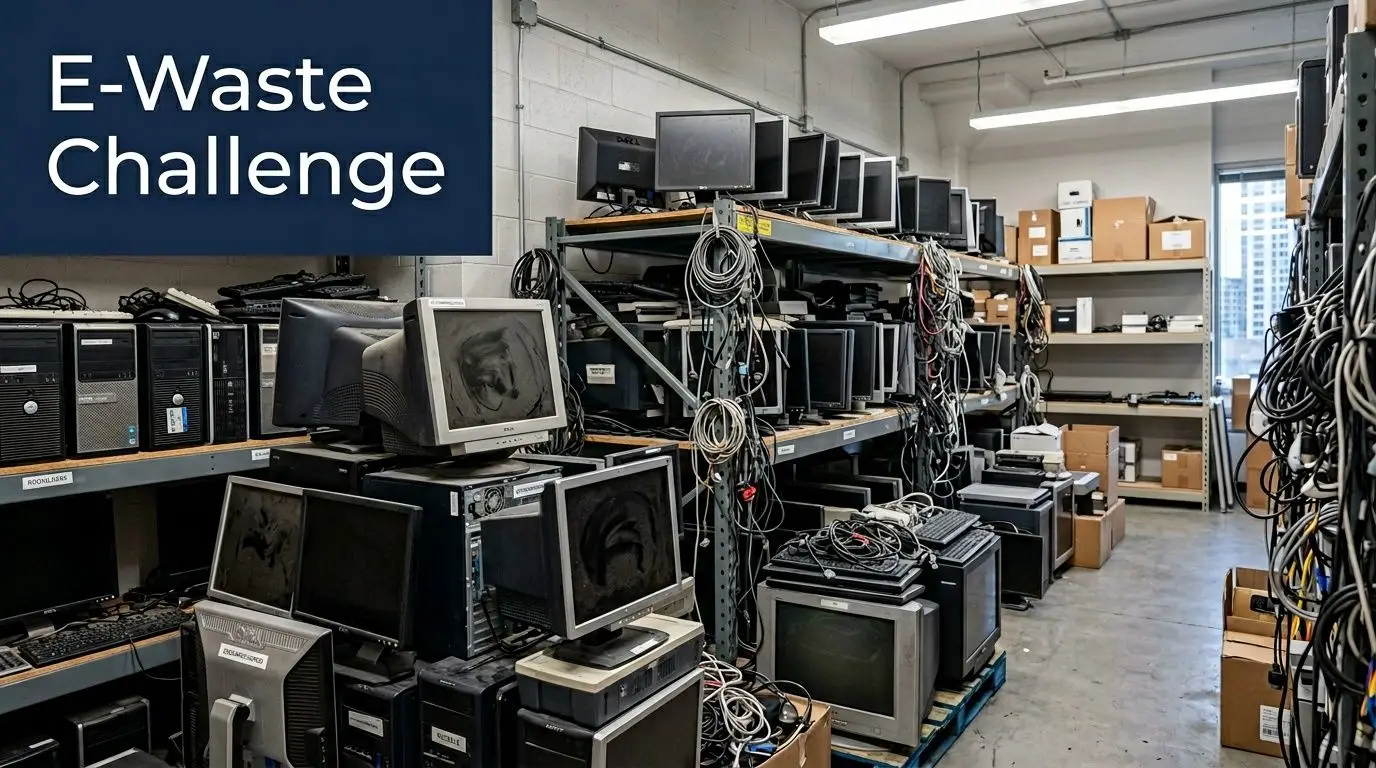
Chicago businesses have good reason to ask harder questions before handing electronics to a generic recycler. Local recycling history left plenty of companies skeptical about where material ends up. In corporate IT, that skepticism is healthy. If a vendor cannot show where assets went, how data-bearing devices were handled, and what was reused versus dismantled, the process will not hold up under audit or ESG review.
The standard for business equipment is higher because the risks are different. A pallet of old desktops may contain regulated data, lease-return obligations, and resale value at the same time. SMBs feel that pressure more sharply than large enterprises do. They often have tighter budgets, less storage space, and no dedicated ITAD team, but they still need documentation that satisfies legal, finance, and security stakeholders.
A workable program answers a few basic questions clearly:
- Which devices can be remarketed and what condition are they in
- Which items need certified destruction or material recycling
- Who maintains custody from pickup through final disposition
- What reporting supports internal controls, insurance, and sustainability claims
That is the shift beyond the blue bag. Corporate e-waste is handled as an asset disposition workflow, not a cleanup task.
In practice, the best Chicago programs separate devices by risk and value before anything leaves the site. Newer laptops and phones may justify resale or employee purchase options. Obsolete or damaged gear may go straight to recycling. Data-bearing equipment needs tighter handling, and equipment with community use value should be evaluated for donation through qualified channels rather than scrapped by default.
For teams sorting through employee phones, a practical consumer-side reference like CTF's phone selling guide can help frame the value-recovery question. Corporate programs need more controls, but the logic is the same. Identify the device, wipe or destroy data correctly, document the transfer, then decide whether the right outcome is resale, donation, or recycling.
That last option matters more than many managers expect. Social enterprise partners can turn an IT cleanout into both a compliance win and a local impact story, especially for SMBs that want measurable results without building a large internal program. Chicago companies looking for that model often start with corporate sustainability with e-waste solutions that tie reuse, responsible recycling, and workforce development to the same end-of-life process.
Navigating Chicago's E-Waste Regulatory Landscape
A Chicago office move is where weak disposal policies get exposed. Facilities wants the floor cleared by Friday. IT is tagging old monitors, laptops, docking stations, and a few dead printers. Procurement assumes the junk hauler can take the overflow. That is how covered electronics end up in the wrong waste stream, and how a routine cleanout turns into a compliance problem.
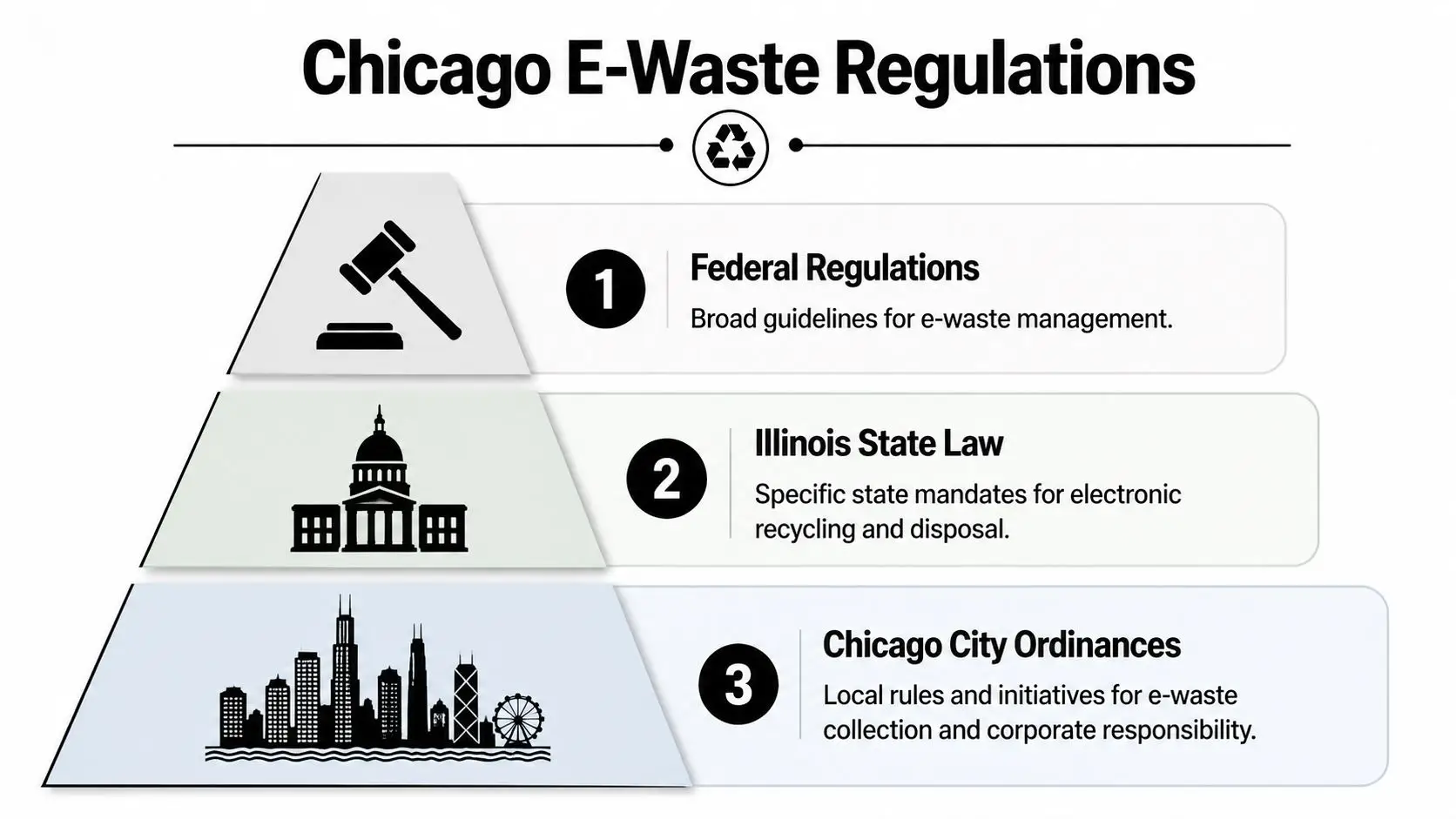
The Illinois rule set that should drive your process
Start with the rule that changes day-to-day handling. In Illinois, many electronics cannot go to landfill, and businesses should treat retired IT equipment as a regulated material stream, not as ordinary office waste. For a Chicago IT manager, that means desktops, laptops, monitors, and similar devices need a documented path into a compliant recycling or reuse program.
That sounds simple. In practice, SMBs usually run into two trade-offs.
The first is speed versus control. A fast office clear-out saves labor and storage space, but it also increases the chance that devices get mixed into general waste or leave the site without proper records. The second is cost versus value recovery. Certified handling, serialized tracking, and separate processing for reusable assets can cost more up front, but those controls often reduce legal risk and improve resale or donation outcomes.
Chicago companies that need a practical baseline can start with Illinois electronics recycling guidance for businesses. It is a useful reference for building internal SOPs that match state requirements.
What compliance looks like in daily operations
Good compliance programs reduce ad hoc decisions. They do not rely on the last person in the room knowing which pile is safe for scrap and which one needs chain-of-custody controls.
Use these operating rules when equipment is coming out of service:
Flag covered electronics before the project starts
Build device categories into move, refresh, and decommission checklists so teams are not sorting under deadline pressure.Separate data-bearing assets from everything else
A monitor and a laptop may leave on the same truck, but they should not be managed under the same control standard.Keep electronics out of general cleanout bins
Label staging areas and train facilities staff so old IT gear does not get swept into mixed waste during a renovation or office closure.Require records that can survive audit review
Collection logs, asset lists, and final disposition documentation should be available to procurement, legal, and compliance teams.Define the exception path
Servers with drives, damaged batteries, and specialty equipment need a named owner and a written handling rule before pickup day.
A policy that works only when the IT director is standing in the room is not a real policy.
Where Chicago policy changes matter, and where they do not
City waste reforms matter because they shape public expectations, vendor practices, and local infrastructure. They do not remove the company’s duty to control electronics disposal. A corporate tenant still needs to know who took the equipment, whether downstream handling met state requirements, and whether internal records match what left the building.
That matters even more when compliance and data protection overlap. Cross-border and chain-of-custody issues are discussed in Blowfish Technology's data guide. The legal framework differs from Illinois e-waste rules, but the operating lesson is the same. Know where assets go, who handles them, and what documentation proves it.
What to require from a vendor
A qualified ITAD or recycling partner should remove guesswork. At minimum, the relationship should include clear acceptance rules for covered devices, pickup procedures that fit Chicago offices and multi-site operations, asset tracking from collection through final disposition, and reporting that your finance, legal, and ESG teams can use.
For SMBs, this is also where community impact can become part of the program instead of a side note. A social enterprise partner can help a business stay compliant, recover value where appropriate, and direct usable equipment or recycling revenue into local workforce and community benefit programs. That model works well in Chicago because many smaller firms need one vendor that can balance cost, compliance, and measurable local impact.
Secure Data Destruction The Cornerstone of Corporate ITAD
Most Chicago businesses can recover from a delayed pickup. They can absorb a little warehouse congestion. They can even tolerate a slow resale process. What they can’t absorb easily is a preventable data exposure tied to retired equipment.
That’s why secure data destruction sits at the center of IT asset disposition. Sustainability matters. Value recovery matters. Community impact matters. But if the data process is weak, the rest of the program doesn’t hold.
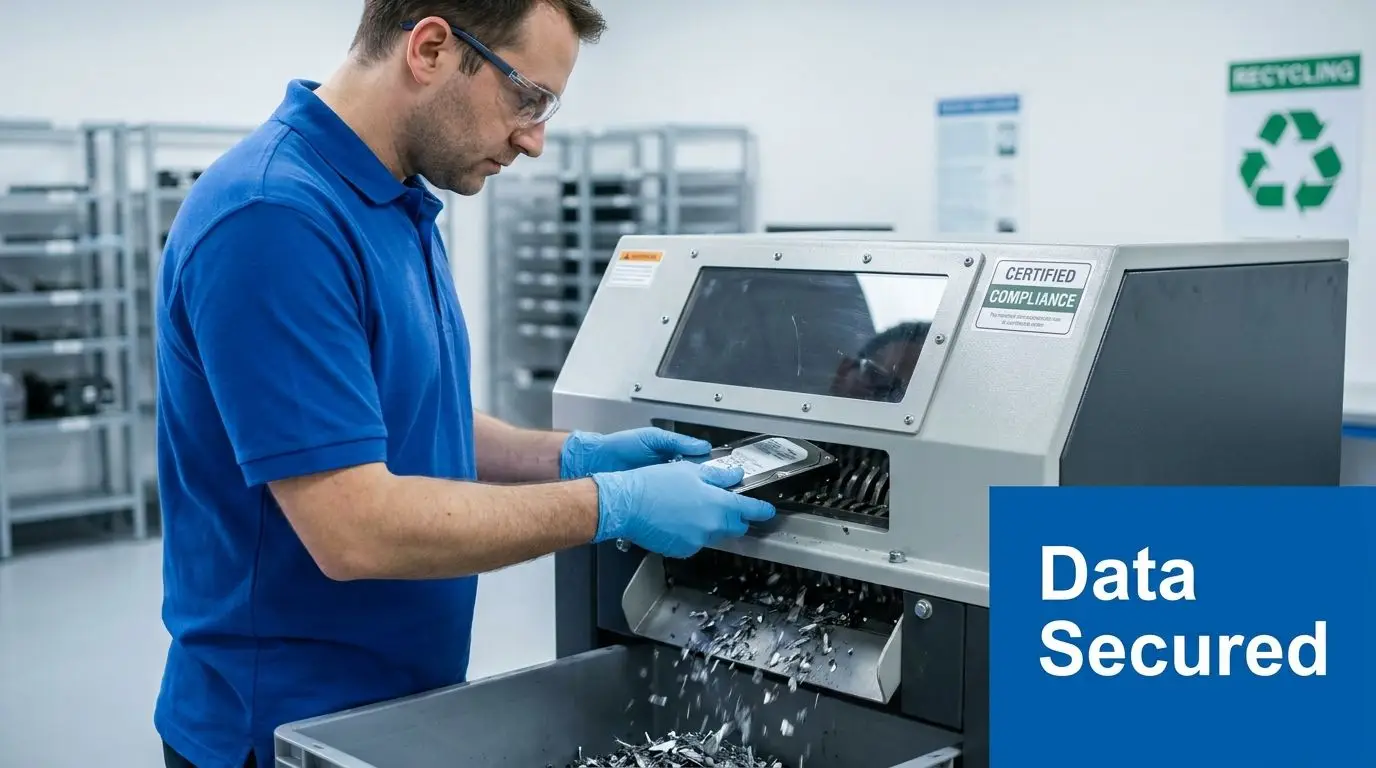
Not every destruction method serves the same goal
A mature ITAD program usually uses more than one method because the asset mix is never uniform.
Software wiping
Software-based erasure is often the right choice when the business wants to preserve remarketing value. It’s best suited to devices that can still be reused and that meet the technical and policy requirements for certified erasure.
Degaussing
Degaussing can be useful in environments with specific magnetic media handling requirements. It’s less common as a universal answer because it affects asset recovery options and depends heavily on media type.
Physical shredding
Physical destruction is the cleanest answer when the risk tolerance is low, the media is damaged, or policy demands irreversible destruction. It’s often the preferred route for failed drives, highly sensitive storage, and equipment tied to strict internal security rules.
Operational advice: Choose the destruction method based on data risk and reuse potential, not habit. Overusing shredding can destroy recoverable value. Underusing it can create compliance risk.
The Chicago SMB problem nobody explains well
Local guidance is thin where small and mid-sized businesses need it most. There’s a real decision conflict between finance, compliance, and sustainability. The known gap is this: Chicago SMBs often don’t have a workable framework for comparing data destruction requirements with equipment buyback value, as noted in this coverage of the decision gap facing Midwest business e-scrap programs.
That tension shows up every time a company retires a fleet. Finance asks whether the laptops can be remarketed. Compliance asks whether every drive should be shredded. Operations asks how quickly the room can be cleared. If nobody owns the decision framework, the project stalls or defaults to the most expensive option.
A better model asks four questions first:
- Does the device still have recoverable market value
- Is certified erasure acceptable under internal policy
- Does the business handle regulated data that narrows options
- What evidence will auditors or customers expect later
For healthcare, legal, finance, and public sector environments, that last question often drives the rest.
Documentation is part of the control
A destruction event that isn’t documented properly may as well not have happened from an audit perspective. Your provider should issue a Certificate of Destruction or equivalent record that ties the service back to specific assets or media lots. Chain-of-custody records matter just as much as the destruction method itself.
That’s one reason many IT managers look for secure data destruction services that package pickup, custody controls, and formal reporting into the same workflow. It reduces handoff risk and keeps the audit trail intact.
For organizations that operate across regions, broader policy discussions can also sharpen internal standards. A useful example is Blowfish Technology's data guide, which, while written from a different jurisdictional lens, helps frame why data governance and physical asset disposition can’t be treated as separate topics.
What works in practice
The strongest programs don’t argue ideology. They classify assets.
A current-generation laptop in good condition may justify certified erasure and resale. A failed server drive from a healthcare environment may require shredding. A batch of office desktops used for standard productivity work might split between redeployment, donation preparation, and recycling based on age and condition.
That’s how you balance security with economics. Not by picking one destruction philosophy for every device, but by applying controls with enough precision that legal, finance, and sustainability teams can all sign off.
Choosing Your Chicago ITAD Partner A Vendor Selection Framework
Selecting an ITAD vendor isn’t procurement theater. It’s risk transfer. You’re handing off assets that may contain sensitive data, regulated materials, recoverable value, and reporting obligations. If the vendor is weak, those problems come back to your organization.
The fastest way to sort the field is to evaluate three things together: certifications, process discipline, and service model.
Start with certifications, then verify operations
Certifications matter because they establish a baseline. They don’t replace diligence, but they do narrow the field.
| Certification | Primary Focus | What It Guarantees Your Business |
|---|---|---|
| R2 | Responsible electronics reuse and recycling operations | A structured process for handling electronics with environmental and downstream accountability controls |
| e-Stewards | High-standard electronics recycling practices | Stronger assurance around responsible processing and prohibited disposal practices |
| NAID AAA | Secure data destruction practices | A recognized framework for documented destruction controls and information security handling |
A vendor that talks a lot about sustainability but avoids specifics on certifications usually isn’t the right fit for corporate work.
Questions that reveal whether a provider is operationally sound
Ask these in the first serious call, not after legal review starts.
How do you maintain chain of custody from pickup through processing
If the answer is vague, stop there.What happens to equipment that still has reuse value
You want a clear explanation of testing, triage, and remarketing logic.How are failed or damaged data-bearing assets handled
A provider should distinguish between wiping, physical destruction, and non-data equipment recycling.What reports do clients receive after completion
Look for certificates, serialized records where appropriate, and environmental disposition summaries.Can they support office cleanouts, data center decommissioning, and mixed equipment streams
Many vendors are fine at one service line and weak at the others.
A strong ITAD partner can describe the bad scenarios as clearly as the happy path. That’s usually the sign they’ve actually managed them.
Social enterprise model versus commodity hauling
Not every electronics recycling relationship needs the same service model. Some businesses only need compliant removal. Others want a broader outcome that includes donation-based recycling, corporate donation programs, and community-facing reporting.
That’s where social enterprise recycling stands apart from commodity hauling. If reusable devices can support digital inclusion or workforce development, the disposition decision carries social value in addition to environmental value. For many companies, especially those with active CSR or ESG commitments, that’s not a side benefit. It’s part of the business case.
One option businesses evaluate in that category is guidance on selecting a reliable e-waste recycling partner, which outlines what to look for across security, environmental handling, and service reliability. Reworx Recycling fits that discussion as a donation-based, social enterprise recycling provider for organizations that want secure IT equipment disposal with a community impact component.
Red flags worth treating seriously
Vendor risk often shows up in small signals before it becomes a real problem.
Watch for:
- Generic promises instead of process detail
- No clear downstream explanation for non-reusable material
- Weak paperwork after jobs are completed
- Inflexible service design for mixed loads such as laptops, monitors, servers, accessories, and specialty gear
- No meaningful conversation about data-bearing assets
The right partner should be able to support computer recycling, secure data destruction, product destruction, office cleanout projects, and facility cleanout logistics without making your team invent the process for them.
Logistics and Sustainability Metrics for Chicago Businesses
A sustainability plan fails most often in the loading dock, not the boardroom. The strategy can be solid, the vendor can be approved, and the policy can be written well. But if assets aren’t inventoried, separated, packed, moved, and reported properly, the outcome gets messy fast.
Chicago businesses usually face this during office consolidations, branch closures, lab upgrades, laptop refresh cycles, or data center decommissioning. The operational challenge isn’t just moving material out. It’s moving the right assets through the right channel without losing control of value, data, or reporting.
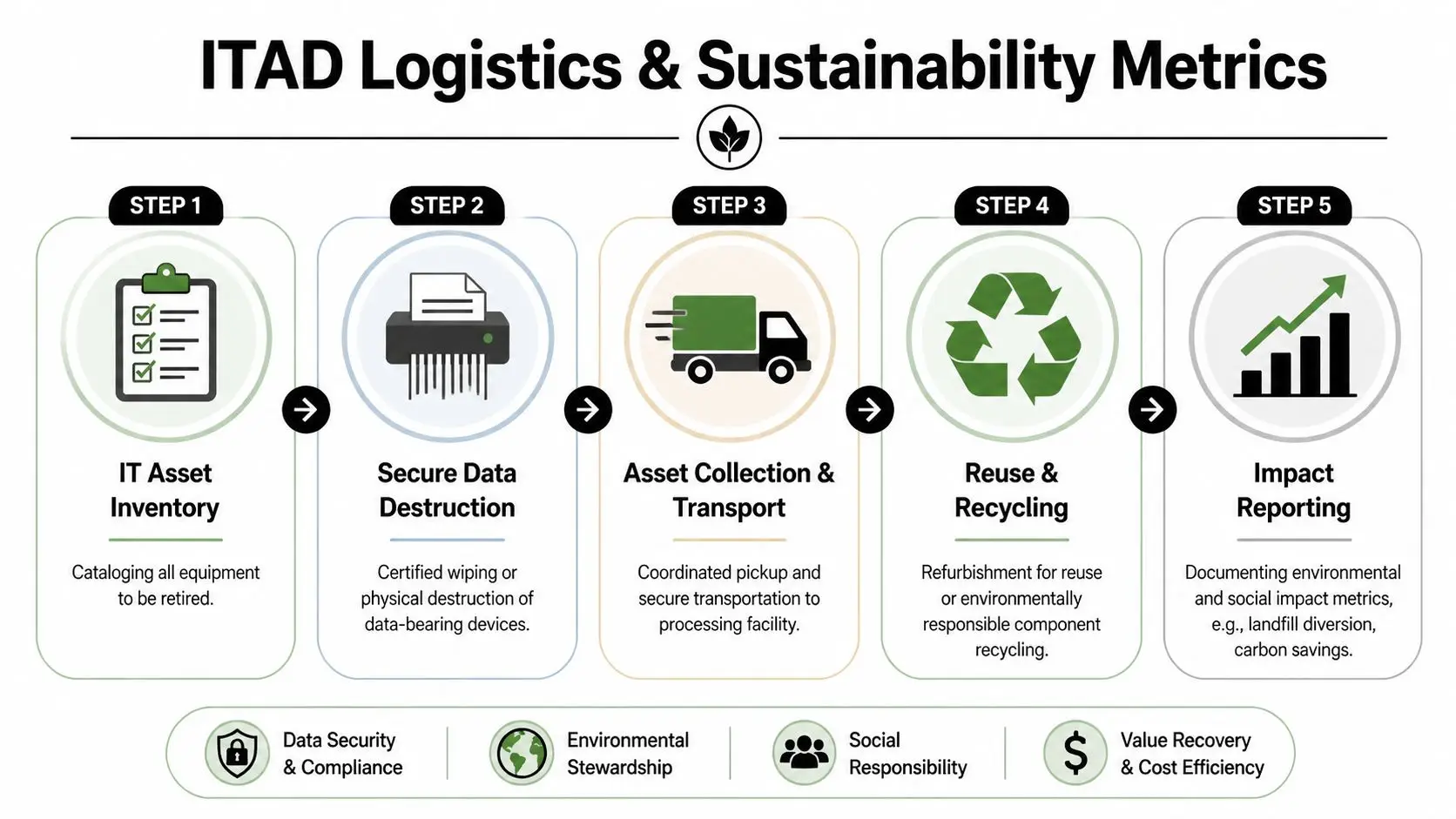
Build the program around reverse logistics
The most effective ITAD programs treat retired equipment like inventory in reverse, not as junk waiting for pickup.
That means establishing a repeatable flow:
- Inventory first so nobody discovers surprise assets on pickup day
- Stage by category with data-bearing items separated from accessories and scrap
- Coordinate transport windows around security and facilities access
- Decide reuse versus recycling before material leaves the site whenever possible
- Close the loop with reporting that procurement, sustainability, and compliance teams can all use
For businesses running multi-floor office cleanouts or facility transitions, that structure keeps projects from drifting into ad hoc disposal.
Metrics that actually say something useful
A lot of internal reporting still defaults to one metric: total weight recycled. That’s better than nothing, but it doesn’t tell leadership much about environmental quality, asset recovery, or true program performance.
A stronger reporting set usually includes:
Disposition by category
What was reused, refurbished, donated, remarketed, or recycled.Data-bearing asset handling
Which devices were wiped, which were physically destroyed, and what evidence exists.Material recovery narrative
Not just pounds moved, but what components or materials were recovered where reporting allows.Social impact summary
If assets are donated through a corporate donation program, document that path.
If your sustainability report only says “electronics recycled,” leadership still doesn’t know whether the program created environmental value, reduced risk, or supported community outcomes.
Why component-level thinking matters
Many Chicago sustainability programs still undershoot. According to University of Chicago reporting on electronics sustainability, more than 70% of the carbon footprint of electronic devices comes from their circuit boards in this component-level analysis of electronics impact. That changes how an IT manager should think about retirement decisions.
If circuit boards carry that much environmental weight, then a simplistic “count the boxes removed” approach misses the full story. A sustainability program becomes more credible when it can explain not only that equipment avoided landfill disposal, but also that the business captured value through reuse, refurbishment, and material recovery with attention to the components that matter most.
Practical applications for different Chicago asset streams
Different environments create different logistics demands.
Office environments
Laptop disposal, monitor swaps, dock removals, and printer retirements usually benefit from scheduled pickups and boxed, labeled staging areas.
Data centers
Data center decommissioning requires tighter sequencing. Racks, servers, networking gear, and storage often need serialized control, secure drive handling, and coordinated removal windows.
Labs and healthcare spaces
Laboratory equipment disposal and medical equipment disposal add another layer. Teams need item-level review because devices may involve specialty handling, embedded storage, or operational restrictions tied to the environment they came from.
For organizations trying to connect execution with ESG reporting, reverse logistics and sustainability planning is where the process starts to mature. Good logistics don’t just prevent chaos. They create the data needed to prove the program worked.
Real-World Impact Chicago Case Studies in Sustainable IT Recycling
A Chicago IT manager usually sees the problem all at once. Forty laptops from a refresh. Old monitors stacked near facilities. A few network switches nobody wants to touch until someone confirms whether they still hold configuration data. The test of an ITAD program is whether it can turn that clutter into a documented, defensible outcome.
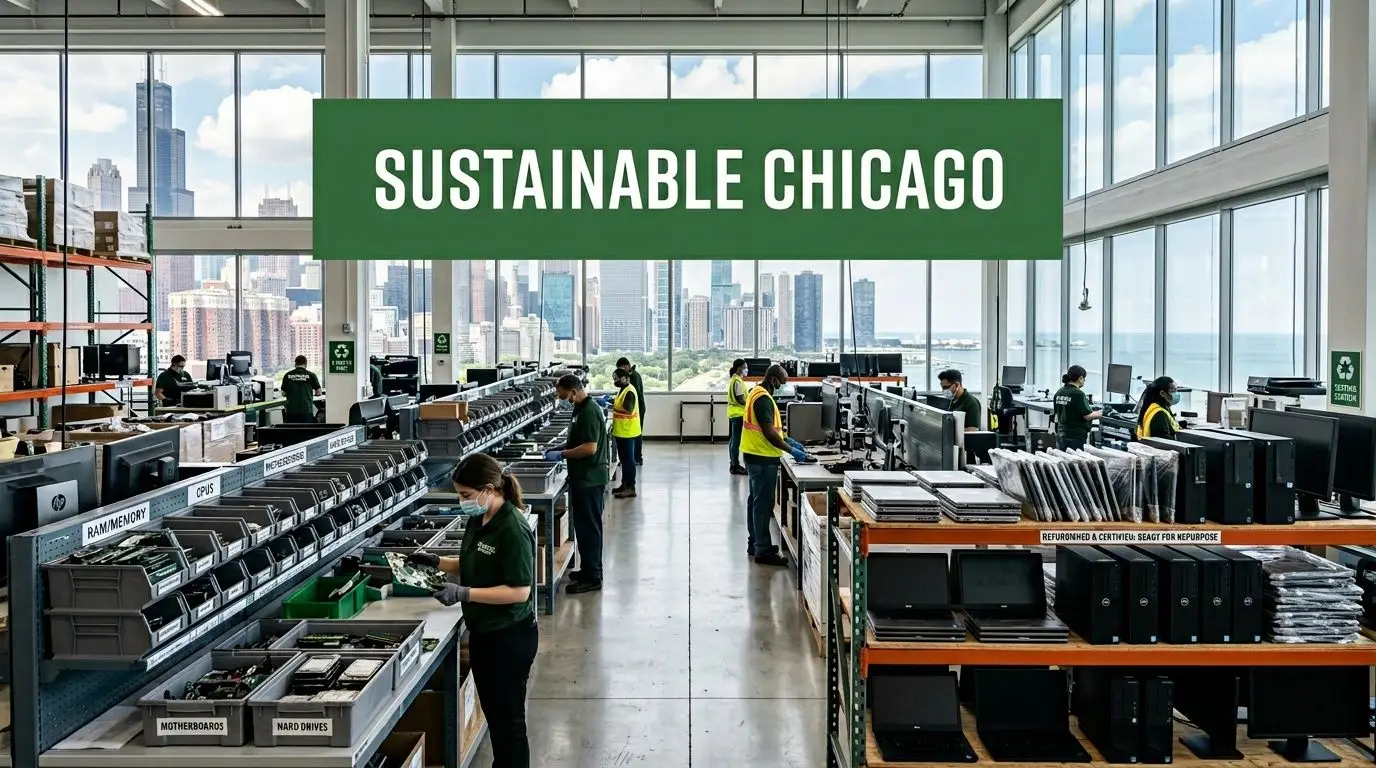
What the University of Chicago gets right
The University of Chicago offers a useful local example because its program is built around clear operating rules, not vague sustainability language. Staff know what belongs in the e-waste stream, how pickup works, and which channels keep electronics out of standard trash handling. That kind of clarity matters more than aspirational policy statements.
For Chicago SMBs, the lesson is practical. A good program reduces internal guesswork. It gives IT, facilities, legal, and finance a shared process for collection, disposition, and recordkeeping. That is what makes a recycling effort repeatable instead of reactive.
A realistic Chicago business scenario
Consider a mid-sized financial services firm in the Loop after a hybrid work redesign. It has retired laptops, conference room equipment, decommissioned switches, and several storage devices left over from a server migration. Finance wants value recovery where the market supports it. Legal wants proof that data-bearing assets were handled correctly. Sustainability wants outcomes the company can report without overstating the result.
One disposition path will not fit that mix.
Usable laptops may justify refurbishment or resale after approved sanitization. Failed drives and high-risk media should go straight to destruction. Low-value peripherals often belong in commodity recycling. Equipment with remaining life may also support donation or community reuse, but only after security and chain-of-custody requirements are met.
That trade-off is where strong providers separate themselves. They do not force every asset into shredding, and they do not push reuse where the compliance risk is too high.
Credible sustainability results start with controlled operations, documented handling, and decisions that match the asset type.
Why the social outcome matters to businesses
Community impact has become a legitimate part of the decision, especially for Chicago companies that want local results from local spend. Social enterprise partners add a layer many standard recyclers do not. They process retired equipment, create workforce opportunities, and help direct reusable technology toward schools, training programs, and nonprofit use when the equipment qualifies.
That model is particularly relevant for SMBs. Budget pressure is real, and so is the need to show that responsible disposal does more than remove risk from the balance sheet. A provider with a social enterprise structure can help a company control costs, meet reporting expectations, and create visible community benefit from the same project.
Chicago teams looking for that combination often start with electronics recycling solutions in Chicago, Illinois that can support secure processing, practical value recovery, and local impact without losing sight of compliance.
Your Next Steps Toward Responsible ITAD in Chicago
If you’re responsible for retired technology in Chicago, the job is bigger than getting old equipment out of the building. You’re managing compliance, secure data destruction, sustainability reporting, and internal accountability at the same time.
The practical path is straightforward. First, identify the assets that are already waiting for action. Second, separate data-bearing devices from everything else. Third, choose a disposition model that doesn’t force you to sacrifice security for value recovery or sustainability for speed. Then make sure every pickup, destruction event, and recycling outcome is documented in a way your business can defend later.
For Chicago SMBs, that discipline matters even more because internal teams are usually small and responsibilities overlap. The IT manager may also be the facilities coordinator, security contact, and project lead for an office cleanout. A clear partner process reduces that burden and keeps decisions from slipping into guesswork.
If you’re formalizing a program now, start with a pickup and reporting workflow that can scale from a one-time laptop disposal project to a larger facility cleanout or data center decommissioning effort. A scheduled, documented process like business electronics pickup planning is often the cleanest first move because it turns a backlog into a controlled project.
If your team is ready to retire outdated devices without losing control of data, compliance, or community impact, talk with Reworx Recycling. Chicago businesses can use Reworx to schedule a pickup, plan a secure IT asset disposition workflow, or build a corporate donation program that supports responsible electronics recycling and local digital inclusion.