A Miami retail chain usually discovers its e-waste problem on upgrade day, not before it. New POS terminals arrive. Old barcode scanners pile up in the back room. Store managers start asking whether displays, tablets, receipt printers, and retired laptops can sit near receiving for a week. Then IT asks for serial-number tracking, legal asks about data, facilities asks about pickups, and finance asks what this will cost.
That’s when Corporate Electronics Recycling for Retail Chains in Miami stops being a sustainability talking point and becomes an operational issue. For multi-location retailers, the hard part isn’t deciding to recycle. It’s building a process that works across stores, protects data, satisfies internal controls, and doesn’t disrupt sales operations during a busy season.
Navigating Miami's E-Waste Challenge for Retail Chains
A chain-wide refresh creates a very specific kind of pressure. One store might generate a manageable stack of retired hardware. Fifty stores create a moving target of mixed assets, uneven timing, limited storage, and inconsistent store-level handling. In Miami, that gets harder because retail activity is fast, space is tight, and technology turnover tends to cluster around openings, remodels, and end-of-year resets.

The broader context matters. Annually, 53.6 million tons of e-waste is generated globally, yet only 17.4 percent is recycled properly, according to this overview of the global e-waste crisis. That same source notes that, within the United States, electronics recyclers earn most of their revenue from direct or indirect government subsidization. For a retail chain, the takeaway is practical. E-waste isn’t a side issue. It’s part of a regulated recovery system that depends on disciplined handling and qualified downstream partners.
What retail chains actually struggle with
Retail e-waste is messy because it rarely leaves the business in neat categories. A single Miami district might be dealing with:
- Front-of-house hardware like cash registers, payment devices, scanners, customer kiosks, and digital displays.
- Back-office equipment such as laptops, desktops, networking gear, phones, and small peripherals.
- Fixtures with embedded electronics that fall into gray areas during remodels and store closures.
- Rush-driven turnover when upgrades happen right before peak sales periods and no one wants obsolete equipment taking up floor or stockroom space.
When teams don’t plan this in advance, stores improvise. That’s where errors happen. Devices get mixed together, asset records go incomplete, and a local manager may treat retired electronics like ordinary surplus rather than controlled end-of-life assets.
Field observation: The first breakdown usually isn’t at the recycler. It happens at the store when no one has clear instructions for what gets tagged, boxed, locked, or held for pickup.
Miami adds a scale problem
Miami retail operations often span urban storefronts, suburban centers, and tourist-heavy corridors. That creates uneven logistics. One location may have room for pallets and staging. Another may only have a narrow back hallway and a shared dock window. A corporate plan that looks efficient on paper can fail fast when each store has a different physical setup and staffing pattern.
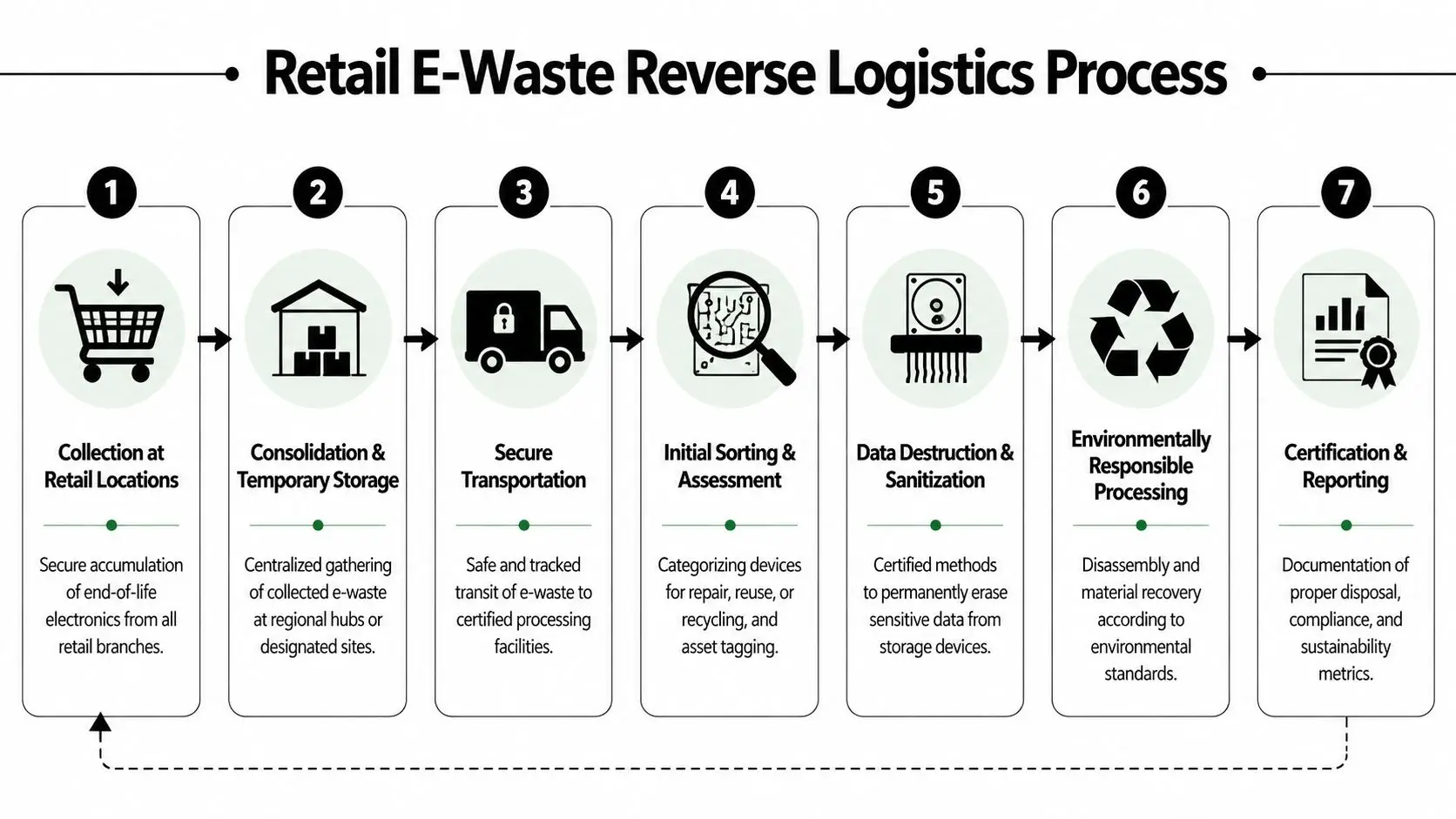
That’s why good programs treat electronics recycling as part of reverse logistics, not janitorial cleanup. The discipline is closer to inventory control than waste hauling. Assets need identification, chain of custody, secure storage, and a reliable release process.
For retail teams trying to benchmark local options, a useful starting point is this guide to electronics recycling near Miami and beyond, especially when you’re mapping out what services should be available for business-grade pickups and IT equipment retirement.
The opportunity inside the problem
Handled well, a large refresh does more than remove old hardware. It cleans up inventory records, reduces storage headaches, and gives leadership proof that sustainability and operations can work together. It also gives retail chains a cleaner story to tell internally. This isn’t just about keeping devices out of a landfill. It’s about managing assets with the same discipline used to deploy them.
Understanding Your Compliance and Regulatory Obligations
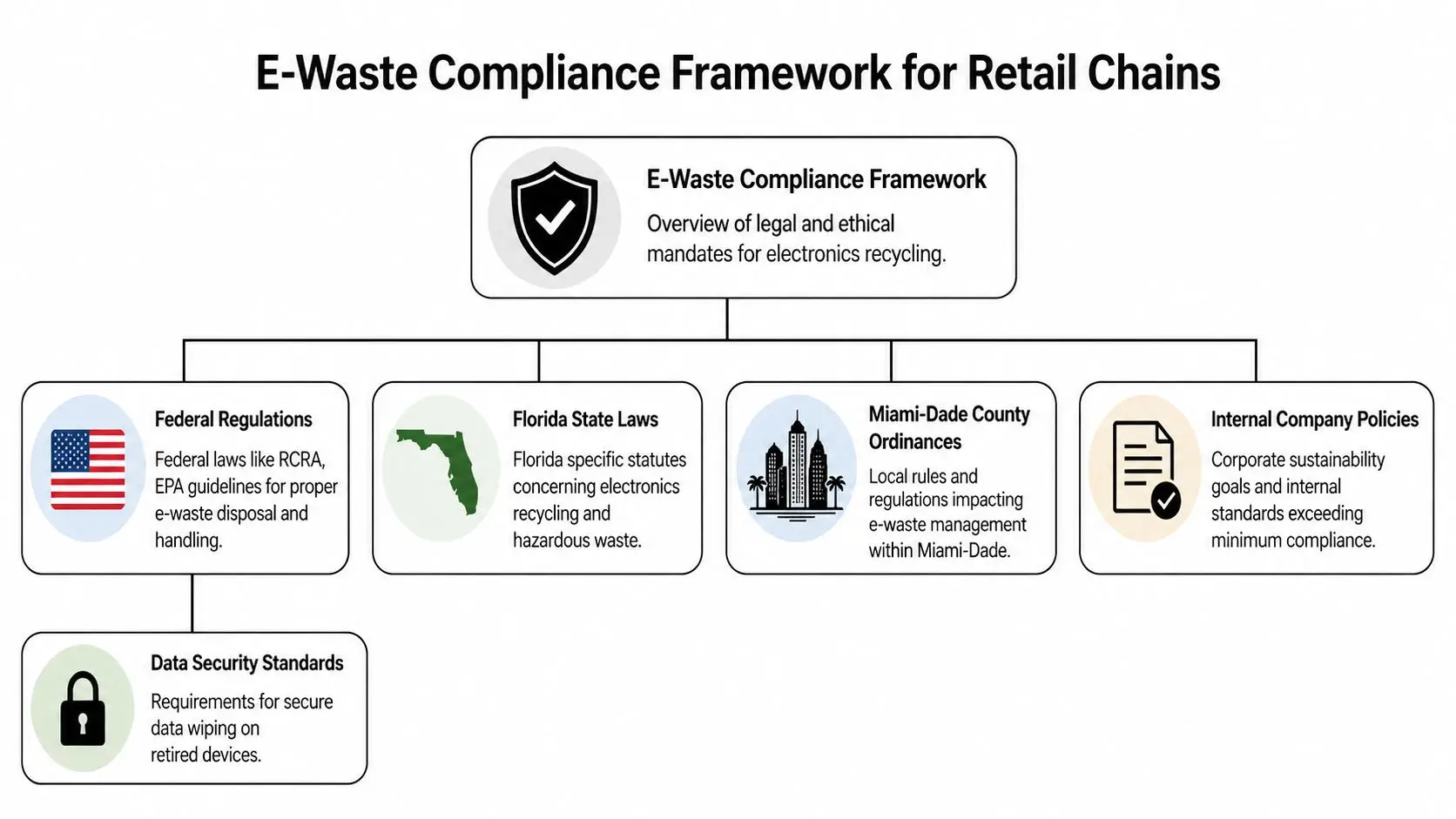
Retail chains get into trouble when they treat electronics recycling as a vendor task instead of a company obligation. The recycler matters, but the legal exposure starts with the business that owns the devices. If your stores hold equipment, move it, release it, or dispose of it without proper controls, the risk sits with your organization first.
A major local pressure point is scale. A South Miami electronics recycling service page identifies a market gap in multi-site logistics for retail chains generating bulk e-waste from 50+ stores, and notes the associated risk around Miami-Dade's 2026 zero-landfill mandates for commercial e-waste as a future compliance concern. For management teams, that means planning now for a standard that may become much harder to satisfy if stores continue using ad hoc disposal practices.
Federal rules and why they matter to retailers
At the federal level, the most important practical issue is that electronics can contain components that must be handled under environmental rules tied to hazardous materials management. Retailers don’t need every store manager to become a regulatory specialist, but they do need a process that recognizes retired electronics as controlled material.
The biggest federal concerns usually fall into three buckets:
- Hazardous component handling under rules connected to waste management and material containment.
- Data security obligations for any device that may store customer, employee, payment, or business information.
- Documentation and chain of custody showing what left each store, where it went, and how it was processed.
If any of those three are weak, compliance becomes hard to defend in an audit, a customer inquiry, or an incident review.
Florida and Miami-Dade obligations in practice
Local execution is where policy becomes real. Miami-area retailers often assume a recycler’s pickup receipt is enough. It usually isn’t. Management needs records that connect each shipment to a site, a date, an asset list, and a final disposition. That’s especially important when the same chain operates mall stores, freestanding locations, and larger-format sites with different operational rhythms.
A practical compliance file for each project should include:
- Store-level release records showing who approved pickup and what was released.
- Asset identification details for tracked devices such as POS systems, laptops, and networking gear.
- Data handling confirmation that devices with storage were wiped or physically destroyed under approved methods.
- Final certificates for destruction, recycling, or reuse, depending on the disposition path.
A pickup without a defensible paper trail solves a floor-space problem, not a compliance problem.
Internal policy often matters more than external minimums
Strong retail chains usually discover that their own standards need to be stricter than baseline legal requirements. Legal wants defensibility. IT wants control over data-bearing devices. Sustainability wants landfill diversion. Operations wants simplicity. Those priorities only align when the company writes one policy that stores can follow.
That internal policy should answer basic questions clearly:
| Policy area | What management should define | Why stores need it |
|---|---|---|
| Asset scope | Which electronics are controlled under the program | Staff can identify what belongs in the process |
| Storage rules | Where retired devices may be held before pickup | Reduces loss, tampering, and unsafe accumulation |
| Approval authority | Who can release assets to a vendor | Prevents informal handoffs |
| Data handling | Which devices require wiping or shredding | Keeps IT and compliance aligned |
| Record retention | What documents must be kept and by whom | Supports audits and incident response |
A chain with multiple South Florida locations should also maintain one approved vendor workflow for all sites. Store-by-store improvisation creates uneven handling, uneven paperwork, and uneven risk.
For companies reviewing local service requirements and broader business obligations, this overview of Florida electronics recycling options for organizations can help frame what a compliant statewide or regional program should include.
A Checklist for Evaluating Electronics Recycling Vendors
Most vendor evaluations fail because the retailer asks broad questions and accepts broad answers. “Are you certified?” “Do you handle data destruction?” “Can you do pickups in Miami?” None of those questions are wrong, but none of them is enough. A retail chain needs to know exactly how the vendor operates when a project involves many stores, mixed equipment, and time pressure.
The strongest screen is a process screen. A compliant IT asset disposition (ITAD) methodology includes Inventory and Auditing with 99.9% accuracy per NIST 800-88, Data Sanitization using DoD 5220.22-M or shredding for 100% data irretrievability, Physical Deconstruction that contains hazardous materials per RCRA, and Certificates of Destruction that support 98%+ diversion from landfills, according to this Miami ITAD methodology overview. The same source states that inadequate vendor vetting leads to a 30% non-compliance risk. That’s why procurement, IT, facilities, and sustainability should all have input before approval.
Start with process, not promises
Ask the vendor to walk through a real retail scenario. For example: thirty stores, mixed POS equipment, some drives still in devices, limited stockroom space, staggered pickups, and a final reporting deadline. If the answer stays at the marketing level, keep digging.
Look for specificity in these areas:
- Inventory control: Can the vendor track assets from collection through final disposition?
- Data handling: Do they separate reusable devices from devices that require shredding or destruction?
- Operational flexibility: Can they support store-by-store pickups, consolidation, or both?
- Reporting: Will they issue usable documentation for internal audit and leadership review?
Vendor test: If a recycler can’t explain chain of custody in plain language, they probably can’t defend it under pressure.
ITAD vendor evaluation checklist for retail chains
| Evaluation Criteria | What to Look For | Why It Matters for Retail |
|---|---|---|
| Certifications and standards | Clear alignment with recognized ITAD, environmental, and quality systems | Retail chains need a vendor that can support legal, IT, and ESG review |
| Asset tracking | Barcode or other itemized inventory controls | Prevents devices from disappearing between stores and processing |
| Data destruction methods | Documented wiping and physical destruction options for data-bearing devices | POS terminals, back-office PCs, and laptops may hold sensitive data |
| Chain-of-custody controls | Signed releases, transport records, secure staging procedures | Multi-store programs fail when custody is informal |
| Downstream transparency | Willingness to explain where materials and non-working equipment go | Protects brand reputation and sustainability claims |
| Reporting quality | Certificates plus management-friendly summaries | Leadership needs more than a pickup receipt |
| Logistics capability | Experience with regional, multi-site retail pickups | Miami chains need execution, not just facility capacity |
| Fee structure | Clear pickup, processing, packaging, and special handling terms | Hidden transport or bulk-load charges disrupt budgeting |
| Reuse and donation pathways | Credible programs for refurbishment or donation when equipment qualifies | Supports corporate donation programs and social impact goals |
| Account management | One point of contact with escalation support | Store-level confusion drops when coordination is centralized |
Questions worth asking in the interview
Some of the best diligence questions are operational, not legalistic.
Ask things like:
- What happens if a store releases unlisted devices at pickup?
- How do you handle mixed loads with data-bearing and non-data-bearing equipment?
- What documentation arrives after each pickup, and what arrives after final processing?
- How do you handle a rollout where some stores are ready early and others slip by a week?
- Can you support donation-based recycling, remarketing, and secure destruction under one program?
The answers will tell you whether the vendor has worked with retailers or mainly with one-site offices.
What works and what doesn’t
What works is a vendor that behaves like an operations partner. They ask for asset categories, store count, timing constraints, and site conditions. They care about receiving access, pallet counts, and data-bearing devices. They explain how exceptions are handled.
What doesn’t work is a vendor chosen only because they advertise free pickup. Free can still be expensive if the program creates rework, weak records, surprise fees, or inconsistent site handling.
A helpful framework for procurement teams is this guide on selecting a reliable e-waste recycling partner. It’s a good reference point when building a formal vendor scorecard for electronics recycling, secure data destruction, and broader IT equipment disposal.
Implementing Chain-Wide Reverse Logistics for E-Waste
Once the vendor is selected, execution comes down to reverse logistics design. Retail chains usually land on one of two models. They either bring equipment from stores into a central consolidation point, or they arrange direct pickups from each site. Both can work. Both can also create avoidable friction if chosen for the wrong reasons.
Model one with centralized consolidation
In this setup, stores send retired electronics to a regional hub, distribution center, or designated warehouse. The recycler then handles a larger, scheduled recovery from that single point.
This model often works well when the chain already runs disciplined internal freight and has a facility that can stage material safely. It can simplify vendor coordination because the recycler deals with one primary collection point instead of many store addresses.
The upside is control. Corporate teams can inspect material before release, reconcile inventory in one place, and manage pickups around warehouse schedules.
The downside is internal burden. Someone in your organization has to receive, sort, stage, and secure the material. If the warehouse isn’t prepared for mixed electronics, the DC turns into a temporary junk room with compliance responsibilities attached.
Model two with direct multi-site pickup
Under this model, the recycler schedules pickups at individual stores or grouped clusters of stores. Corporate still sets the rules, but the vendor carries more of the transport and coordination work.
This model is often better when stores lack efficient internal transfer routes, when refreshes are staggered, or when the chain wants to reduce handling touches. It also helps chains that don’t want obsolete electronics moving through distribution centers designed for sellable inventory.
Here’s the practical comparison:
| Logistics model | Best fit | Main advantage | Main drawback |
|---|---|---|---|
| Centralized consolidation | Chains with strong internal freight and warehouse control | Tighter central oversight | More internal labor and staging responsibility |
| Direct multi-site pickup | Chains with varied store formats and uneven timing | Less internal handling | More vendor scheduling complexity |
Retailers often choose centralized consolidation for control, then switch to direct pickup when they realize the DC has become the least efficient place to hold obsolete hardware.
How to choose between them
The right answer depends less on geography and more on operating reality. Ask four questions.
- How much storage does each store have? If stores can’t safely hold a pallet, direct pickup becomes more attractive.
- Does your DC want this material? If distribution leadership doesn’t want mixed obsolete electronics in the building, that’s your answer.
- Are refreshes synchronized or staggered? Synchronized projects favor consolidation. Rolling upgrades often favor direct pickup.
- How disciplined is your internal transfer process? If store-to-DC shipments are inconsistent, don’t build your recycling plan around them.
Store-level handling rules that reduce failure
Even the best logistics design fails if store teams don’t know how to prepare material. The instructions must be short enough to survive real retail conditions.
Use a simple release standard:
- Separate data-bearing devices from non-data-bearing equipment before pickup day.
- Keep asset tags visible whenever possible so reconciliation is easier.
- Use secure staging areas rather than open receiving zones or sales-floor back corners.
- Don’t let stores self-dispose through local junk haulers, municipal bins, or ad hoc donations.
- Assign one store contact for every pickup window.
Packaging should also be realistic. Don’t require elaborate prep that stores won’t do consistently. For mixed loads, practical palletization and clearly marked gaylords or cartons usually work better than overengineered instructions.
For teams designing a retail recovery workflow, this resource on optimizing e-waste management with reverse logistics is useful because it frames electronics recycling as a repeatable movement process, not a one-time cleanup event.
Modeling the Costs and ROI of Your Recycling Program
Leadership will support a recycling program faster when the financial case is framed correctly. The wrong model treats electronics recycling as a disposal expense. The better model treats it as a combination of service cost, risk control, asset recovery, and operational cleanup.

A useful large-scale reference is Best Buy. Its national recycling program shows that responsible electronics recycling can operate at breakeven or better, and that annual recycler audits plus a refusal to work with companies that export non-working products can support an economically viable and ethically controlled model, as described in this Best Buy recycling analysis.
Build the cost model the way finance does
Retail chains usually underestimate internal costs and overfocus on the vendor invoice. A solid model should include direct service fees, transportation, store labor for staging, DC labor if consolidation is used, packaging materials, and internal project management time.
That doesn’t mean the program becomes unattractive. It means the model becomes believable.
A straightforward finance worksheet should separate:
- One-time rollout costs tied to a refresh, remodel, or office cleanout.
- Recurring program costs for routine laptop disposal, product destruction, and facility cleanout events.
- Recovered value from eligible equipment buyback or resale channels.
- Avoided costs linked to improper disposal, weak data handling, and emergency cleanup.
If your finance team needs a template for structuring assumptions, timing, and scenario planning, the insights from Bookkeeping and Accounting are useful for setting up practical financial projections around vendor costs, internal labor, and recovery assumptions.
Where ROI actually comes from
The return rarely comes from one line item. It usually comes from a stack of smaller wins that leadership recognizes once they’re captured in one model.
Common ROI drivers include:
- Asset value recovery: Some retired devices still have remarketing or buyback value.
- Risk reduction: Secure data destruction reduces the chance of expensive downstream incidents.
- Compliance cost avoidance: Good records and proper handling lower the odds of cleanup, dispute, or non-compliance exposure.
- Space recovery: Clearing obsolete equipment out of stores and back rooms has operational value.
- Brand and ESG support: A disciplined, donation-aware recycling program strengthens reporting and stakeholder credibility.
Financial reality: The strongest recycling programs don’t win approval because they promise profit. They win because they combine controllable costs with defensible risk reduction and visible operational benefits.
Why the ethics matter financially
There’s also a reputation component. A chain that can show downstream discipline, documented destruction, and responsible handling of non-working equipment is protecting more than scrap value. It’s protecting the brand. That matters when sustainability claims show up in customer-facing materials, board reporting, or procurement questionnaires from commercial partners.
A strong program also creates value after pickup. This perspective on unlocking value after electronics recycling is helpful because it pushes the conversation beyond “how much does recycling cost” and toward “what business value remains in a controlled end-of-life process.”
Your Chain-Wide Rollout and Staff Training Plan
The best retail recycling program is the one store teams can execute without guessing. That requires a rollout plan that is short, disciplined, and repeatable. It also requires management to accept one truth. Most failures happen in the handoff between policy and store behavior.
A chain-wide rollout works best when it starts with a pilot. Choose a manageable group of stores that reflects your real operating conditions. Include at least one high-volume location, one constrained site with limited backroom space, and one store with frequent technology turnover. The pilot should test pickup windows, staging rules, inventory capture, and final documentation.
A practical rollout sequence
Use a phased plan rather than a chain-wide blast.
- Approve the policy. Define covered assets, storage rules, release authority, and required records.
- Train the pilot stores. Keep instructions short and operational.
- Run the pilot pickups. Track exceptions, delays, and store questions.
- Adjust the workflow. Rewrite any instruction that store staff interpreted inconsistently.
- Expand by district or region. Don’t scale confusion.
- Audit the paperwork. Confirm every pickup produces the records corporate needs.
That sequence sounds basic, but it prevents a common retail mistake. Headquarters writes a smart policy, then sends stores a long PDF no one reads during a busy week.
What store staff actually need to know
Store associates and managers don’t need a seminar on sustainability. They need a simple standard operating routine.
Train them on these points:
- What counts as covered electronics. Be explicit about POS hardware, tablets, PCs, printers, displays, and accessories.
- Where retired devices go. Name one secure holding area.
- Who approves release. Avoid informal pickups.
- What not to do. No curbside disposal, no personal take-home, no side donations, no local junk removal.
- How to escalate exceptions. Mixed loads, damaged devices, and untagged equipment need one contact path.
Use job aids that fit retail reality. One-page checklists work better than policy binders. So do pickup-day labels and quick-reference posters in receiving areas.
Staff follow short instructions consistently. They ignore complicated instructions under pressure.
Documentation is the backbone
Certificates of Destruction and recycling records should never be treated as afterthoughts. They are the proof that your process was followed. Without them, leadership can say the chain intended to recycle responsibly, but it can’t prove what happened to specific equipment.
Keep documentation centralized. Don’t leave certificates scattered across district emails and store inboxes. One managed repository, tied to pickup dates and locations, makes audits and internal reviews much easier.
A good internal program file should allow corporate teams to answer three questions quickly:
| Question | Required evidence | Why it matters |
|---|---|---|
| What left the store? | Asset list or shipment detail | Supports inventory control |
| How was data handled? | Data destruction or sanitization record | Supports security and legal review |
| What was the final disposition? | Recycling or destruction certificate | Supports compliance and ESG reporting |
If your team wants a baseline document to adapt, include a downloadable sample corporate e-waste policy in your internal training pack and require district leadership to review it before rollout.
Keep the program alive after launch
The long-term risk isn’t launch failure. It’s drift. Six months after rollout, stores start mixing electronics with general surplus, managers forget the escalation path, and a rushed remodel bypasses the approved process.
Prevent that with periodic refresher training, pickup reviews after major refresh cycles, and a simple escalation contact that stores trust. Retail chains don’t need a complicated governance committee for this. They need ownership, repetition, and documentation discipline.
Corporate Electronics Recycling for Retail Chains in Miami works when leadership treats it as an operating system. Not a one-time cleanup. Not a sustainability slogan. A repeatable system.
If your business is planning a retail technology refresh, office cleanout, secure data destruction project, or broader IT asset disposition program, Reworx Recycling can help you turn retired equipment into a more responsible outcome through electronics recycling, donation-based recycling, and community-focused reuse. Explore their resources, schedule a pickup, or partner with Reworx Recycling to support sustainable recycling, digital inclusion, and corporate donation programs while keeping old equipment out of the wrong hands.