For businesses in Massachusetts, managing retired IT equipment goes beyond simple disposal; it's a matter of state compliance, data security, and corporate responsibility. Navigating the rules for Massachusetts electronics recycling is critical not only for avoiding penalties but also for protecting your company's sensitive information and reinforcing its commitment to environmental stewardship.
This guide is designed for IT managers, facility heads, and sustainability leaders who need a clear, actionable plan for their IT asset disposition (ITAD) strategy.
Decoding Massachusetts Electronics Recycling Mandates for Businesses
The regulatory landscape for e-waste in Massachusetts can seem complex, but the state's rules are built on a clear principle: hazardous materials found in electronic devices must be kept out of landfills to prevent environmental contamination. This principle directly impacts how businesses handle everything from office cleanouts to routine technology upgrades.
For corporate decision-makers, this means that obsolete computers, servers, monitors, and other IT hardware cannot be discarded with general waste. Massachusetts law requires businesses to engage with certified recyclers who are equipped to manage these materials responsibly. This isn't just a best practice; it's a legal requirement.
The Evolution Of State E-Waste Rules
Massachusetts has long been a leader in managing electronic waste. The state's proactive stance began years ago with a ban on disposing of cathode ray tubes (CRTs)—the bulky monitors and televisions common in a previous era—due to their high lead content.
As technology evolved, so did the regulations. The Massachusetts Department of Environmental Protection (MassDEP) has since expanded these mandates to address the growing stream of modern e-waste. These forward-thinking policies have yielded significant results, with e-waste in landfills dropping from 3.3% of municipal solid waste in 2010 to a mere 0.4% in recent years.
For businesses, staying current with these regulations is essential. Here is a summary of key items banned from landfills in Massachusetts.
Key Massachusetts E-Waste Regulations at a Glance
| Banned Item Category | Specific Examples | Effective Since |
|---|---|---|
| Cathode Ray Tubes (CRTs) | Older, bulky computer monitors and televisions. | 2006 |
| Computers & Peripherals | Desktops, laptops, tablets, printers, scanners. | 2022 |
| Video Display Devices | All televisions (including flat-screens), monitors. | 2022 |
This table provides a high-level overview. Always consult MassDEP or a trusted partner like Reworx Recycling for the most current compliance information.
What This Means For Your Business
These regulations establish a clear chain of responsibility for your company. Any project involving the disposal of technology—be it an office cleanout, facility relocation, or data center decommissioning—requires a structured electronics recycling plan. This plan must ensure that all retired assets are properly documented and transferred to a compliant recycling partner.
Adherence to these rules supports a circular economy. Responsible recycling allows for the recovery of valuable materials like copper, aluminum, and precious metals, reducing the environmental impact of new resource extraction. Working with a knowledgeable partner simplifies this process, providing the necessary documentation to demonstrate compliance. For more context on national trends, our guide on Extended Producer Responsibility (EPR) and e-waste management provides valuable insights.
Finding The Right Recycling Path for Your Business
Once you understand the regulations, the next step is to establish a compliant and efficient process for managing your company's used electronics. For businesses in Massachusetts, there are two primary avenues for recycling, each designed for different scales and security needs. Selecting the appropriate path is crucial for legal compliance and data protection.
Municipal programs, such as town drop-off sites or collection events, are designed primarily for residents. While effective for individual households, they are generally ill-equipped to handle the volume and specific requirements of corporate electronics disposal, such as the need for secure data destruction and detailed asset tracking.
This is where a dedicated commercial recycling partner becomes essential. A social enterprise like Reworx Recycling offers specialized services, including IT equipment disposal, tailored to the needs of businesses, healthcare facilities, and educational institutions.
Municipal Programs: A Closer Look
Massachusetts has developed an extensive network of recycling options for its residents, with 214 municipalities offering year-round collection points and many others hosting periodic events. These programs are vital for diverting household e-waste from landfills.
However, for a business, they present significant limitations:
- Volume Restrictions: Municipal facilities cannot accommodate the quantity of equipment generated during a typical office cleanout or large-scale technology refresh.
- Logistical Hurdles: Businesses are responsible for transporting all equipment during limited operating hours.
- No Data Security Guarantees: These public programs do not provide certified data destruction, creating a significant security risk for any confidential business information.
While the state's public programs have successfully reduced e-waste to just 0.4% of municipal solid waste, their design highlights the need for a professional solution for corporate clients. You can explore comprehensive electronics recycling data from the state for more details.
The Commercial Partner Advantage
For any organization managing more than a few devices, partnering with a professional electronics recycler is the most secure and efficient solution. Commercial vendors provide a suite of services that municipal options cannot, transforming a compliance challenge into a streamlined operational process.
Choosing a commercial recycler isn't just about disposal; it's about risk management. A certified partner provides a clear chain of custody, ensuring every device is handled securely and responsibly from your door to its final disposition.
A full-service provider like Reworx Recycling offers a comprehensive solution. We manage the logistics with scheduled pickups that align with your business operations, provide on-site assistance for facility cleanouts, and supply all necessary documentation for your compliance records.
The most critical distinction is the focus on data security. Professional vendors offer certified data destruction, including on-site hard drive shredding, to guarantee that sensitive corporate, customer, or patient data is permanently destroyed. In an era of stringent data privacy regulations, this is a non-negotiable component of IT asset disposition. For a complete overview of our services, see our guide on professional business electronics recycling services.
Why Secure Data Destruction Is Non-Negotiable
For any business in Massachusetts, electronics recycling is intrinsically linked to data security. Every retired company laptop, server, or smartphone contains residual data—a digital footprint of sensitive corporate, employee, and customer information.
It's a common misconception that deleting files or reformatting a hard drive is sufficient to erase this data permanently. These actions merely remove the pointers to the data, leaving the underlying information recoverable with widely available software. This oversight can expose your organization to significant risk.
The Real Cost of a Data Breach
A data breach resulting from improperly disposed IT equipment can have devastating consequences. The financial and legal ramifications are severe, with state and federal regulations like HIPAA and GLBA imposing substantial fines for non-compliance.
Beyond the monetary penalties, a data breach can irrevocably damage your company's reputation and erode customer trust—an asset that is difficult, if not impossible, to regain. The long-term impact on your brand and bottom line often far exceeds the cost of professional data destruction services.
This decision tree illustrates the clear paths businesses can take when managing retired IT assets, based on the volume of equipment.
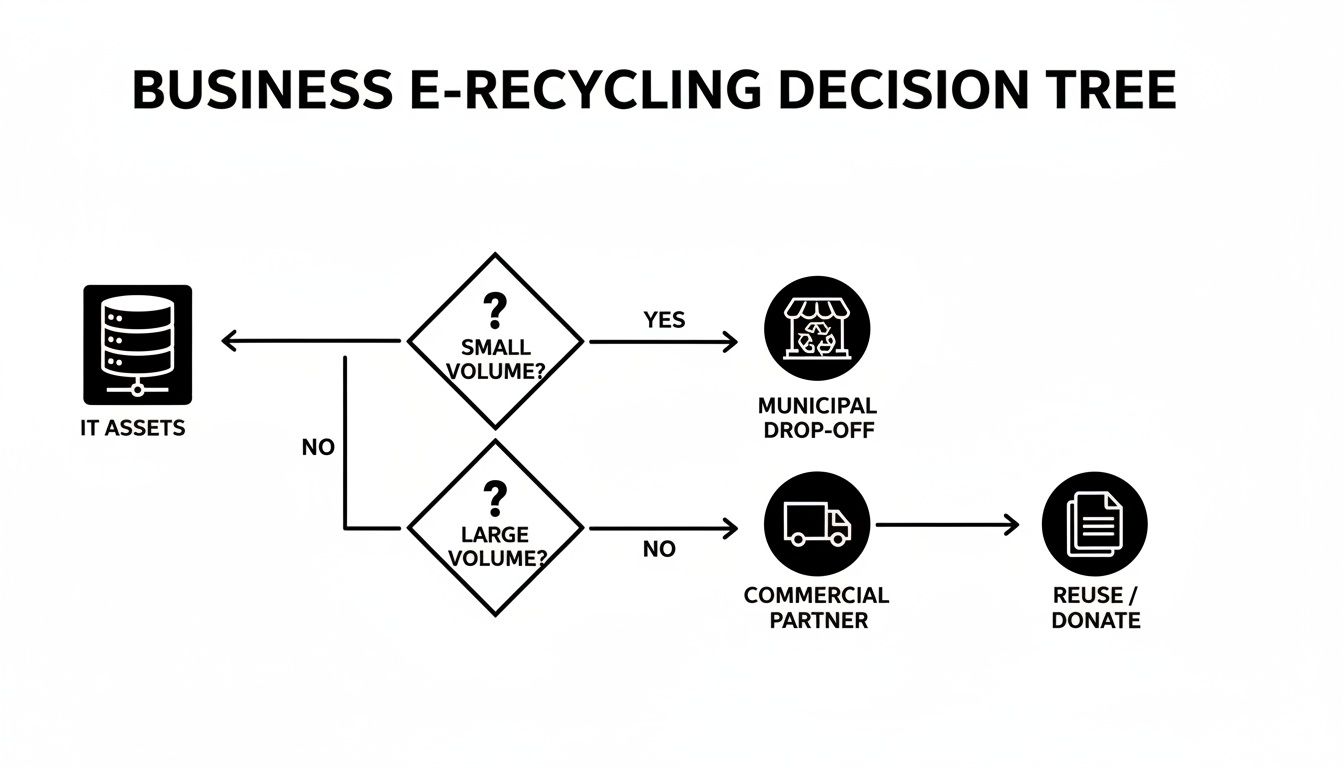
As shown, while municipal options may suffice for a few devices, any significant volume of IT equipment requires a commercial partner to ensure comprehensive security and compliance.
Irreversible Methods for True Data Security
To safeguard your organization, you must employ methods that render data completely unrecoverable. The industry standards for achieving this are physical destruction and certified data wiping.
Physical Shredding: This method provides the ultimate security. Hard drives are fed into an industrial shredder that reduces them to small, irreparable metal fragments, making data recovery impossible.
NIST-Compliant Data Wiping: For devices that may be refurbished and reused, certified data erasure software is used. This software overwrites the entire drive multiple times with random data, in accordance with standards set by the National Institute of Standards and Technology (NIST), permanently destroying the original information.
A professional partner like Reworx Recycling offers both solutions. We can perform on-site hard drive shredding at your location, allowing you to witness the destruction. Alternatively, we can transport your devices in secure, GPS-tracked vehicles to our facility for certified wiping or shredding.
Upon completion, you receive a Certificate of Data Destruction. This official document is your auditable proof of compliance. It details the serial numbers of every destroyed device and verifies that your data was handled according to industry best practices.
This documentation is crucial for your internal records and serves as a key defense in a compliance audit. Learn more about our certified secure data destruction services and how they protect your business.
Turning E-Waste Into a Strategic Business Asset
Traditionally, businesses have viewed retired electronics as a liability—an operational cost and a logistical challenge. It's time to shift this perspective. A modern approach to IT Asset Disposition (ITAD) transforms end-of-life equipment from a disposal problem into a strategic asset.
A comprehensive ITAD program is more than just recycling. It's a managed process that safeguards your data, recovers financial value from used equipment, and aligns with your corporate social responsibility (CSR) objectives.
Beyond Basic Recycling to Value Recovery
Basic recycling ensures compliance with Massachusetts environmental laws. Strategic ITAD elevates this process by unlocking the financial, operational, and social value embedded in your retired assets.
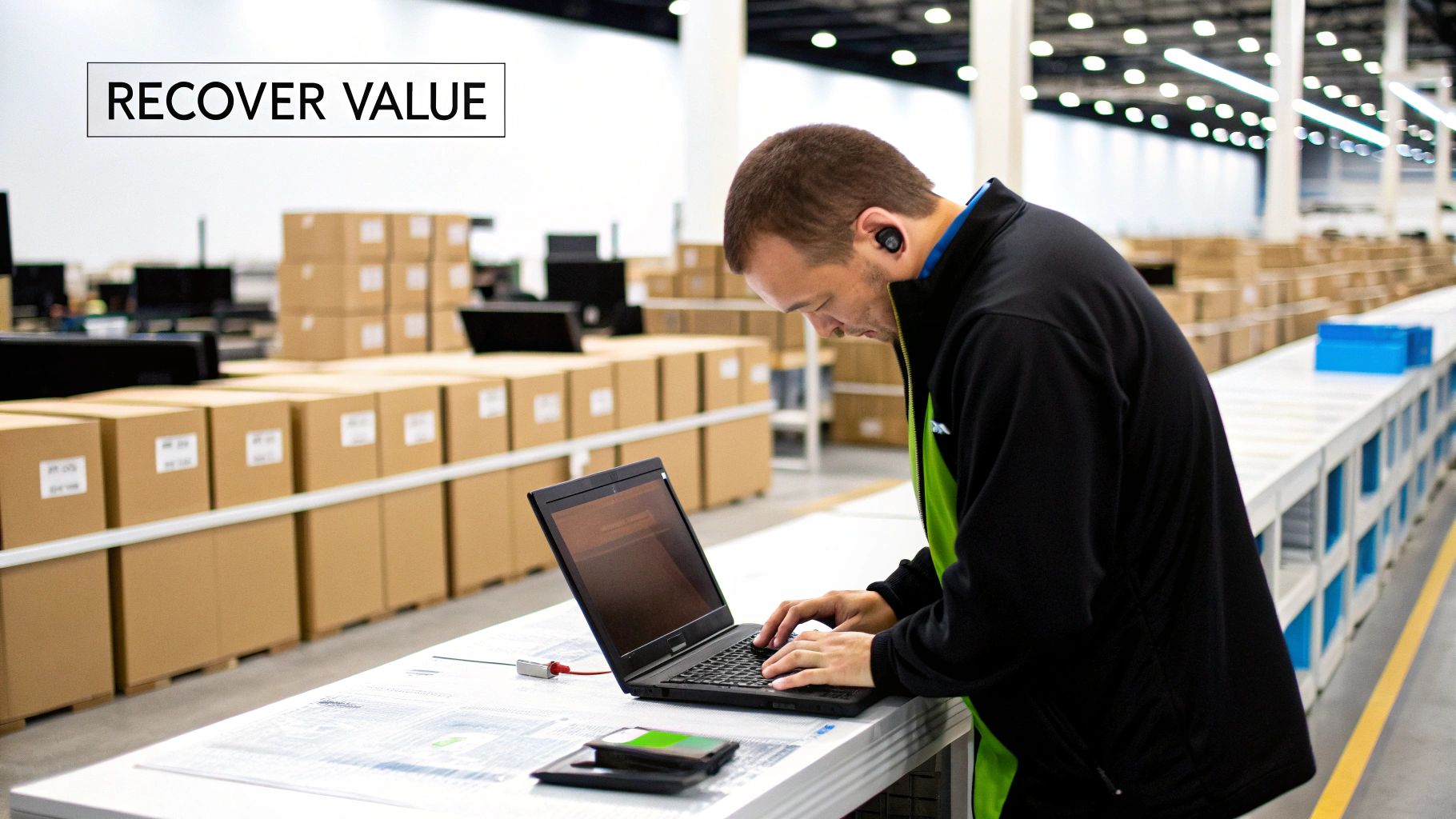
An ITAD partner like Reworx Recycling integrates several key services to maximize this value. The process begins with meticulous asset tracking and secure logistics, followed by certified data destruction to eliminate all security risks. Next, equipment is evaluated for its potential for refurbishment and resale.
Devices with remaining market value—such as recent-model laptops, servers, or specialized medical and laboratory equipment—can be remarketed. This generates a financial return for your business, converting a disposal cost into a revenue stream and improving the economics of your technology refresh cycle. Discover how your business can get money for old electronics through a structured ITAD program.
Operational Efficiency and Social Impact
A strategic ITAD program also delivers significant operational benefits. By consolidating services with a single partner, you simplify complex logistics. Instead of managing separate vendors for pickup, data destruction, and recycling, you have one point of contact for the entire process.
This streamlined approach is particularly valuable during large-scale projects like an office cleanout, data center decommissioning, or a company-wide technology upgrade, freeing up your internal resources to focus on core business activities.
Furthermore, partnering with a donation-based social enterprise like Reworx adds a powerful dimension of community impact. When your equipment is refurbished, it can be donated to support local schools, non-profits, and workforce development programs, helping to bridge the digital divide.
By embracing a strategic ITAD model, your business transforms a regulatory chore into a multi-faceted asset. You recover value, boost operational efficiency, and make a real contribution to social good—all while ensuring bulletproof compliance and data security.
This table highlights the key differences between basic recycling and a strategic ITAD approach.
Comparing Disposal Methods For Business IT Equipment
| Feature | Basic Electronics Recycling | Strategic ITAD (e.g., Reworx) |
|---|---|---|
| Primary Goal | Environmental compliance and disposal. | Maximize value, security, and social impact. |
| Value Recovery | Minimal to none. Focus is on scrap material. | Actively seeks remarketing opportunities for financial return. |
| Data Security | May offer basic data wiping, often without certification. | Certified, auditable data destruction (shredding/wiping). |
| Asset Tracking | Limited or no detailed inventory reporting. | Full serialization, inventory, and chain-of-custody reporting. |
| Logistics | Often requires self-transport or limited pickup services. | Full-service logistics, including on-site packing and removal. |
| Social Impact | Primarily environmental (avoids landfills). | Includes digital inclusion and community donation programs. |
Choosing the right partner for your Massachusetts electronics recycling needs means looking for a provider who can elevate the process from a simple task to a strategic advantage.
Selecting a Certified Electronics Recycling Partner
Choosing the right partner for your electronics recycling is a critical business decision. You are entrusting a vendor with your sensitive data, your legal compliance, and your corporate reputation. A poor choice can lead to data breaches, regulatory fines, and reputational damage.
Therefore, it is essential to vet potential partners thoroughly, focusing on certifications, transparency, and security protocols. The objective is to find a vendor whose processes are secure, verifiable, and aligned with your company's risk management strategy.
The Gold Standard Certifications
The most reliable indicators of a reputable e-recycling vendor are industry certifications such as R2 (Responsible Recycling) and e-Stewards. These certifications are not merely marketing badges; they represent a rigorous, ongoing commitment to the highest operational standards, verified by independent, third-party auditors.
These certifications demonstrate that a provider adheres to strict criteria across all aspects of their operations:
- Environmental Safety: Certified recyclers must prove they handle hazardous materials safely and prevent toxic components from polluting the environment.
- Data Security Protocols: They are required to maintain and document robust procedures for secure data destruction, safeguarding your confidential information.
- Downstream Accountability: Certified vendors must track all materials throughout the recycling chain, ensuring that no e-waste is illegally dumped or exported.
Partnering with an R2 or e-Stewards certified company provides auditable proof that your retired assets are managed ethically and securely.
Key Criteria Beyond Certifications
While certifications are a crucial starting point, further due diligence is necessary. A professional vendor should be able to provide clear answers to key operational questions.
Evaluate potential partners based on the following criteria:
- Transparent Reporting: Can they provide detailed, serialized reports for every asset they process? This chain-of-custody documentation is essential for your internal audits and compliance records.
- Certificates of Data Destruction: Do they issue a formal certificate verifying the destruction of all data-bearing devices? This document is your legal proof of due diligence in protecting sensitive information.
- Flexible and Secure Logistics: Do they offer secure, GPS-tracked transportation and flexible pickup schedules suitable for business needs, including large-scale projects like data center decommissioning or an office cleanout?
- Insurance and Liability Coverage: A reputable vendor will carry comprehensive insurance, including coverage for data breach liability, to protect your organization.
A vendor’s willingness to provide comprehensive documentation and answer tough questions says everything about their professionalism. If a potential partner gets vague about their processes or who they work with downstream, consider it a giant red flag.
Aligning with a Socially Responsible Partner
Finally, consider the vendor's mission. A social enterprise like Reworx Recycling not only meets the highest technical and security standards but also adds a powerful layer of community impact to your recycling program. Our donation-based model, focused on refurbishment and reuse, extends the life of usable technology, supporting digital inclusion for schools, non-profits, and underserved communities.
Choosing a partner like Reworx ensures your ITAD program is secure, compliant, and socially responsible. It transforms a routine operational task into a meaningful contribution to your community. For a deeper understanding of industry standards, explore our guide on the importance of electronics recycling certifications.
How Massachusetts Sets the National Standard for E-Waste
Massachusetts' progressive approach to electronics recycling serves as a national benchmark for corporate sustainability. The state's stringent regulations and ambitious environmental goals provide a model that forward-thinking businesses are adopting nationwide, regardless of local laws.
By aligning your company's practices with the high standards set in Massachusetts, you position your brand as a leader in environmental responsibility and data security. This commitment resonates with clients, investors, and employees, enhancing your corporate reputation and building a more resilient business.
A Statewide Vision with National Impact
Massachusetts' e-waste policies are integral to its broader climate and resource conservation objectives. The state aims to reduce total waste disposal from 5.7 million tons (2018) to 4 million tons by 2030. This 1.7 million ton reduction is projected to prevent 1.7 million metric tons of CO2 equivalents from entering the atmosphere—comparable to removing 370,000 cars from the road for a year. The state's success is evident: e-waste's share of landfilled material has fallen from 3.3% in 2010 to just 0.4% today. Explore the state’s comprehensive waste reduction strategy for more details.
Given that global e-waste generation is outpacing recycling efforts by a factor of five, adopting these high standards is a critical step toward a more sustainable, circular economy.
Implementing a Consistent National Strategy
For businesses with operations in multiple states, managing a patchwork of local recycling laws can be a significant challenge. The lack of uniform regulations creates logistical and compliance complexities.
A national partner like Reworx Recycling can help you develop and implement a single, high-standard ITAD program that applies across all your locations. This unified strategy ensures that every facility, regardless of local regulations, adheres to the most stringent compliance and security benchmarks. It simplifies operations and solidifies your company's commitment to responsible e-waste management, turning it into a core component of your corporate strategy.
Common Questions About MA Electronics Recycling
Business owners and IT managers in Massachusetts often have specific questions when developing an electronics recycling strategy. Here are answers to some of the most common inquiries.
What Does Electronics Recycling Typically Cost For Businesses?
The cost of corporate electronics recycling can vary depending on the vendor and the type of equipment. Items with low commodity value or hazardous materials, such as old CRT monitors, often incur a recycling fee. Conversely, newer equipment with resale potential, like recent-model laptops or servers, may be collected at no charge.
Reworx Recycling operates on a donation-based model. For many businesses, particularly those with valuable IT assets, services such as facility cleanouts and equipment pickups can be provided at no cost. Our focus is on maximizing the value of your retired assets through refurbishment and reuse.
What Items Are Accepted In Corporate Recycling Programs?
Corporate electronics recycling programs are designed to handle a comprehensive range of equipment found in modern business environments, including specialized hardware from various industries.
Accepted items typically include:
- IT Equipment: Laptops, desktops, servers, monitors, and peripherals.
- Data Center Hardware: Server racks, networking switches, storage arrays, and uninterruptible power supplies (UPS).
- Office Electronics: Printers, copiers, scanners, and telecommunication systems.
- Specialized Assets: We frequently manage medical equipment disposal and laboratory equipment disposal.
Always confirm with your recycling partner to receive a detailed list of accepted items.
Why Choose A Donation-Based Social Enterprise?
Partnering with a donation-based social enterprise like Reworx Recycling delivers benefits that extend beyond simple compliance. Instead of prioritizing scrapping, our primary goal is refurbishment and reuse. This model channels functional technology to schools, non-profits, and community organizations, directly supporting digital inclusion and workforce development.
For your business, this transforms an operational necessity into a powerful demonstration of corporate social responsibility. Your retired equipment not only complies with environmental regulations but also creates a positive and measurable social impact, enhancing your company's brand and community standing.
Ready to develop a secure, compliant, and socially responsible IT asset disposition program for your Massachusetts business? The team at Reworx Recycling specializes in managing corporate e-waste, from secure pickup and data destruction to value recovery and community impact. Schedule a pickup today or contact us to learn how your old technology can become a valuable asset for your business and the community. Explore our Recycling Blog for more insights.