
A Dallas tech refresh usually starts with optimism. New laptops arrive, old docking stations pile up, network gear gets boxed, and someone realizes the storage room now holds years of retired equipment that nobody wants to touch.
That moment is where ESG Electronics Recycling Programs in Dallas stop being an abstract sustainability goal and become an operational test. IT cares about chain of custody. Legal cares about data exposure. Facilities wants the space back. Finance wants cost clarity. Sustainability wants proof that the company did more than move a problem offsite.
For Dallas businesses, that pressure is familiar. The metro area has large corporate offices, healthcare systems, schools, logistics operations, and public agencies cycling through devices constantly. If end-of-life electronics are handled casually, the risks are immediate. If they're handled strategically, the same material stream can support landfill diversion, secure data destruction, circularity, and community benefit.
From E-Waste Obligation to ESG Opportunity
A practical example makes the point. A Dallas IT manager approves a refresh for employee laptops, conference room screens, and a stack of aging servers. The original assumption is simple: get the old gear out fast. Then key questions emerge. Which devices still hold sensitive data? Which assets still have residual value? Which items can be reused, donated, or harvested for parts? Which ones trigger handling fees if the recycler's proposal wasn't read closely?
That shift matters. Electronics recycling isn't just cleanup. It's part of governance, risk management, and brand credibility.
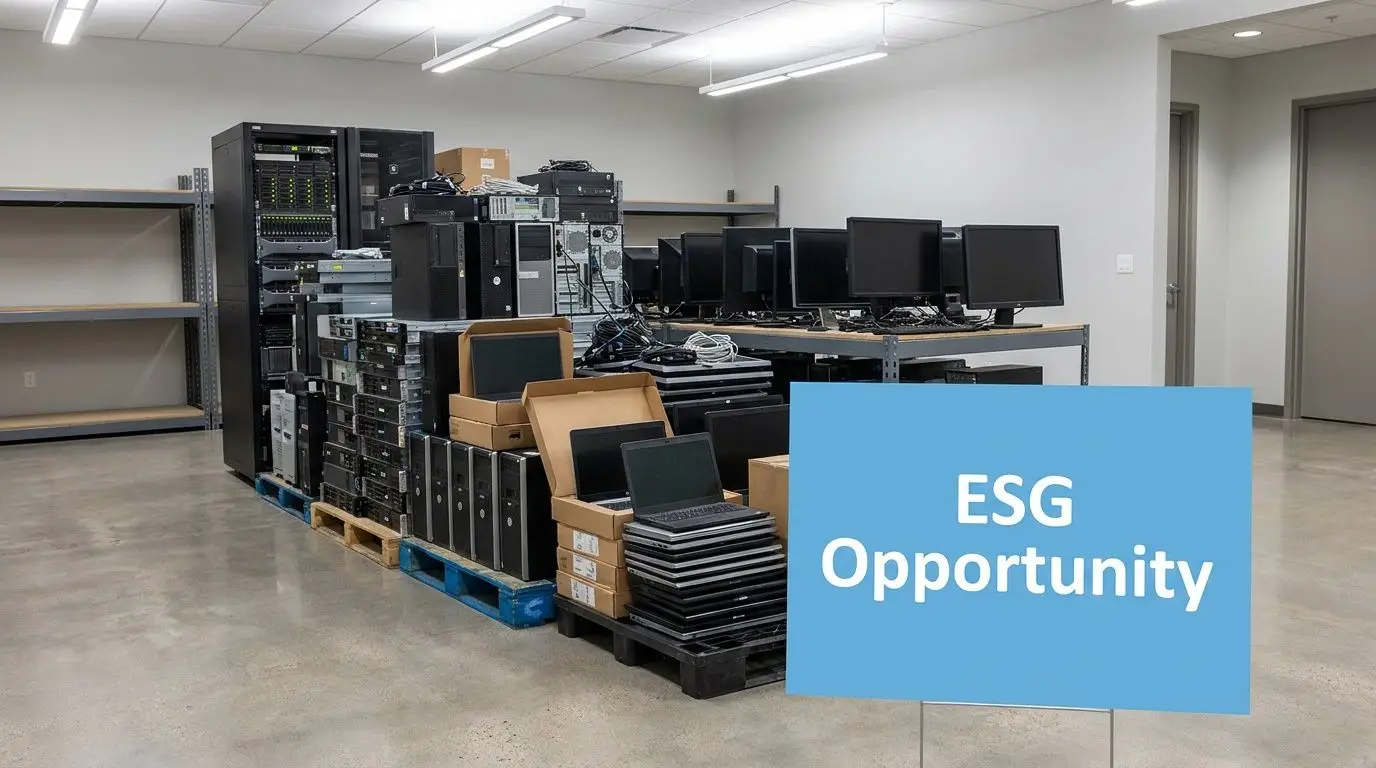
Dallas companies also deal with a broader mix of devices than most internal policies account for. It's not just desktops and monitors. It's rugged tablets from field teams, VoIP phones from office consolidations, lab equipment, point-of-sale hardware, surplus accessories, and old mobile fleets. In some cases, organizations also look for secondary value channels for usable devices. For example, teams managing mobile refreshes sometimes compare recycling against resale options like guides on how to sell used phones for top dollar before deciding which assets belong in a formal ITAD workflow.
What changes when ESG leads the process
When a company frames retired electronics as an ESG issue, the conversation gets better fast. Instead of asking only, "Who can pick this up?" the team starts asking better questions:
- What can be reused: Devices with remaining useful life may fit redeployment, refurbishment, or donation pathways.
- What must be destroyed: Storage media and regulated data environments need documented destruction protocols.
- What can be recovered: Asset recovery can offset program cost when equipment still has resale value. That's why many teams build a process around IT asset recovery services rather than treating everything as scrap.
- What can be reported: ESG teams need evidence, not assumptions.
Field observation: The companies that struggle most aren't the ones with the most e-waste. They're the ones that wait until a move, audit, merger, or refresh deadline forces a rushed decision.
A mature program turns a storage-room problem into a repeatable operating model. It gives IT a chain of custody, finance a clearer budget picture, sustainability a documented impact stream, and leadership a stronger story about responsible operations in Dallas.
Navigating the Dallas Regulatory and Stakeholder Landscape
Texas doesn't leave electronics recycling entirely to improvisation. For Dallas organizations, the starting point is the state framework managed through the Texas Commission on Environmental Quality. In 2025, Texas manufacturer-sponsored electronics recycling programs collected 17,392,335 pounds of electronics, including 3,880,360 pounds of computers, under the Texas Recycles Computers and Texas Recycles TVs programs, according to the Texas Commission on Environmental Quality program data. Those programs serve the entire state, including the Dallas-Fort Worth metroplex, and they matter because they create a documented, compliant path for electronics diversion.

Dallas doesn't operate under a separate city-only e-waste law for businesses, but local sustainability expectations still shape procurement and disposal choices. That means companies can't treat e-waste as a back-office issue. It sits inside a wider waste-diversion and responsible-materials conversation, especially for organizations with public commitments, board reporting, or institutional oversight.
What Texas rules mean in practice
For most business clients, the state framework doesn't remove the need for vendor due diligence. It just sets the backdrop. A Dallas company still needs to know:
- Which materials are covered by formal programs
- Which items require a specialized commercial ITAD process
- How documentation will be retained
- Whether downstream handling aligns with internal ESG policy
That's where many programs go sideways. Teams assume "recycling available" means "program solved." It doesn't. Household-oriented options and manufacturer take-back channels don't replace enterprise controls for serialized assets, secure transport, documented media destruction, and internal audit requirements.
If your organization handles batteries, lamps, certain peripherals, or mixed hazardous streams during office cleanouts, the electronics plan should also align with broader universal waste management practices. That prevents a narrow recycling project from creating a compliance gap somewhere else.
The strongest Dallas programs are built like procurement projects, not cleanup events. They define scope, documentation rules, approval authority, and reporting outputs before the first pallet is loaded.
Stakeholder mapping inside a Dallas organization
Most failed programs don't fail because of bad intent. They fail because ownership is fragmented.
A practical stakeholder map usually includes these groups:
- IT leadership handles asset inventory, device status, serial tracking, and data-bearing equipment decisions.
- Information security sets rules for wiping, shredding, chain of custody, and destruction evidence.
- Facilities or operations manages dock access, internal staging, pickup scheduling, and site safety.
- Legal and compliance reviews contractual language, audit needs, and risk allocation.
- Finance and procurement evaluates cost structure, asset recovery, and vendor terms.
- Sustainability or ESG teams define reporting requirements and impact narratives.
- HR or internal communications helps if the program includes employee collection events or donation messaging.
Where internal alignment usually breaks down
The tension is rarely philosophical. It's procedural.
IT may want speed. Security may insist on on-site destruction. Facilities may want a single pickup date. Finance may ask why one recycler charges less than another. Sustainability may want donation pathways that increase community impact. All of those concerns are valid, but they need a decision hierarchy.
A simple operating rule helps: let the most sensitive asset class drive the control standard. If part of the load includes regulated data-bearing devices, then the whole event should be managed at that standard unless assets are clearly segregated.
Practical rule: Don't launch a recycling event until someone owns the final asset list, someone signs off on data destruction requirements, and someone approves the vendor's documentation package.
For Dallas schools, healthcare groups, financial firms, and public sector offices, this discipline isn't bureaucracy. It's what turns a disposal project into a defensible ESG program.
Choosing Your Partner How to Vet ESG Recyclers in Dallas
The recycler you choose determines whether your program is credible or cosmetic. Vendor selection is the control point that affects data risk, environmental handling, reporting quality, resale recovery, and total cost. Once equipment leaves your site, your options narrow fast.
Dallas businesses often start with the wrong filter. They compare pickup availability or assume that "free recycling" is the main sign of a good deal. That's a mistake. Cost matters, but hidden cost matters more.
A real example from the Dallas market makes this clear. While many Dallas e-waste providers advertise "free" services, mid-sized businesses often face unexpected costs. Some local recyclers charge convenience fees like $.15 per pound or special handling fees of $5-$10 per CRT monitor. The Green Source Texas pricing reference is a useful reminder that you need a detailed quote with pickup minimums and volume discounts before comparing vendors.
The non-negotiables
Start with a short list of requirements. If a vendor can't satisfy these, move on.
- Certified data destruction: If your load includes hard drives or other storage media, demand a documented destruction process that aligns with NAID AAA expectations.
- Clear chain of custody: You need to know how assets are tagged, handled, transported, and reconciled.
- Documented downstream practices: Responsible handling matters after initial pickup, not just at your loading dock.
- Transparent pricing: Every handling fee, special item surcharge, pickup minimum, and service add-on should be disclosed in writing.
- Reporting discipline: The vendor should be able to provide weight summaries, serialized asset records where applicable, and certificates tied to the job.
Vendor Evaluation Checklist for Dallas Businesses
| Evaluation Criterion | What to Look For | Why It Matters |
|---|---|---|
| Certifications | R2v3, NAID AAA, and other relevant compliance credentials | Reduces risk around environmental handling and data security claims |
| Quote clarity | Written breakdown of pickup terms, item-specific fees, and any exceptions | Prevents budget surprises and false comparisons |
| Data destruction process | Defined wiping and shredding procedures, with documentation | Supports legal, security, and audit requirements |
| Asset tracking | Inventory reconciliation and serial-based reporting where needed | Helps prove custody and disposition |
| Reuse capability | Ability to sort for refurbishment, donation, or recovery before scrap | Supports circularity and social impact goals |
| Downstream transparency | Explanation of where materials and components go after processing | Helps validate ESG claims |
| Service fit | Experience with office cleanouts, IT refreshes, data center work, or specialized streams | Ensures the vendor matches your real operating environment |
One more useful resource when building your shortlist is this guide to selecting a reliable e-waste recycling partner, which aligns closely with what procurement teams should be screening for.
What works and what doesn't
What works is boring on paper. A strong recycler asks for an asset profile, clarifies data-bearing devices, flags items with special handling requirements, and gives you a quote that can survive a finance review.
What doesn't work is the vague promise. "We take everything." "We'll figure it out onsite." "Most of it is free." Those phrases usually mean the sorting logic, reporting expectations, or cost assumptions haven't been thought through.
If a recycler can't explain the difference between reuse, harvesting, and final recycling in plain language, they probably can't produce the documentation your auditors will want later.
The ESG difference between disposal and partnership
Many Dallas companies leave value on the table. They choose a recycler only for removal, not for mission fit.
A donation-based or social-enterprise model can strengthen the social side of ESG when usable equipment is directed toward community benefit instead of immediate destruction. That doesn't replace security controls. It comes after proper triage, data handling, and eligibility review. But when done well, it gives organizations a stronger narrative around digital inclusion, workforce development, and responsible reuse.
That distinction matters in boardrooms. "We recycled obsolete electronics" is acceptable. "We securely processed retired equipment, recovered usable assets, and extended community access to technology through a vetted social-impact model" is far stronger.
Questions procurement should ask before signing
Use direct questions. Don't settle for marketing language.
- Which devices will incur extra handling fees, and where are those listed in the quote?
- How do you document chain of custody from pickup through final disposition?
- What proof of destruction will we receive for storage media?
- How do you determine whether equipment is reused, refurbished, harvested, or recycled?
- Can you support office cleanouts, recurring pickups, or data center decommissioning without changing your controls?
- What does your final reporting package include?
A Dallas ESG electronics recycling program is only as strong as the vendor behind it. Pick the wrong partner and you'll spend the next quarter cleaning up exceptions. Pick the right one and the entire program gets easier to run, easier to defend, and easier to report.
The Playbook in Action Launching Your Recycling Program
Execution starts before pickup day. The best programs don't begin with a truck schedule. They begin with scope control.
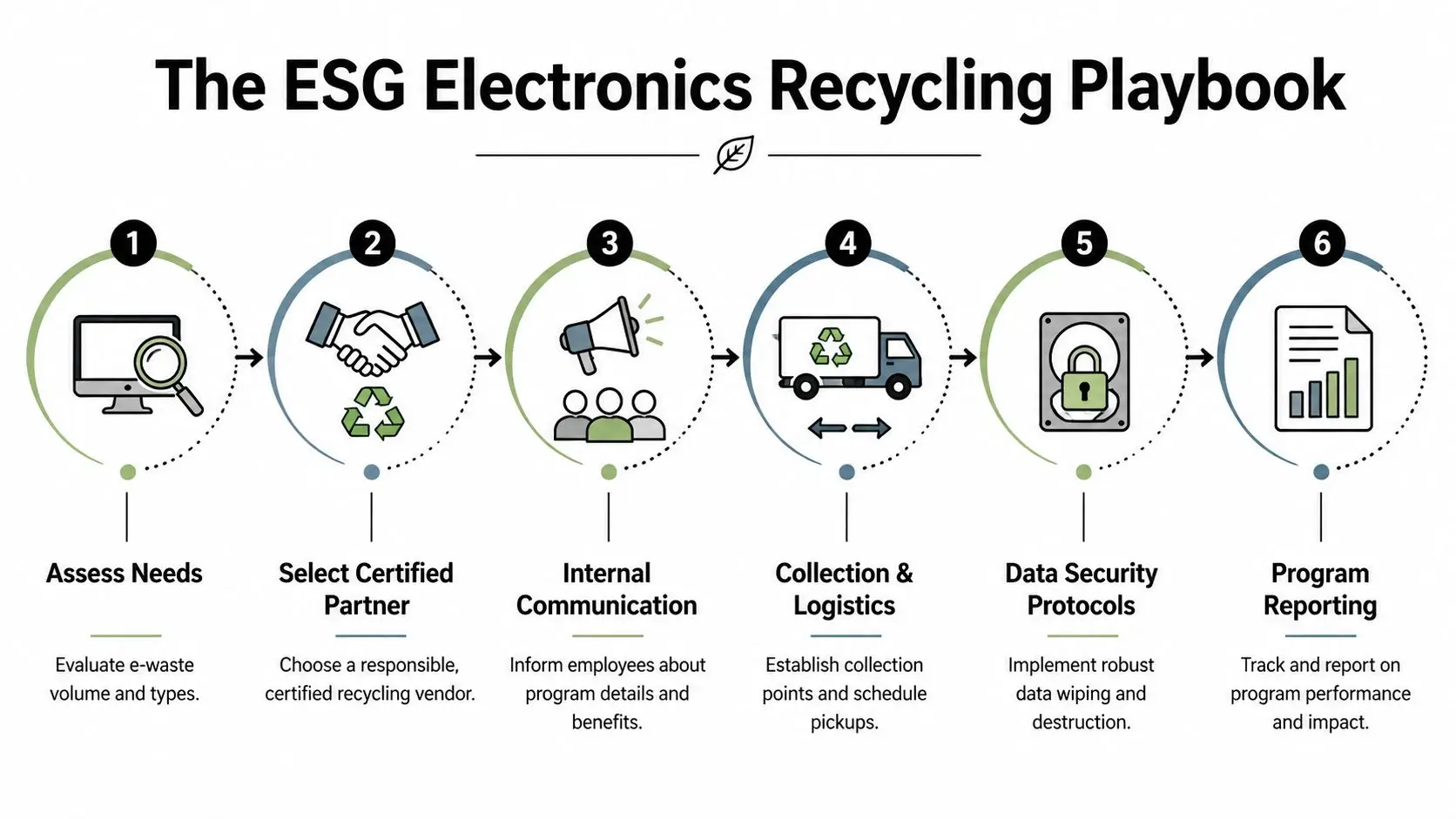
The most reliable framework for business electronics recycling follows a standard ITAD process. According to the First America e-waste methodology summary, a structured program includes detailed inventorying and asset tagging, secure data destruction via certified shredding to NAID AAA standards, functional testing to identify assets suitable for reuse, component harvesting, and downstream processing. That process is designed to ensure 100% data sanitization, and it notes that 20-30% reuse rates in commercial programs are common, while over 90% of material can be diverted from landfills when the workflow is managed properly.
Pick the right program model
Not every Dallas business needs the same setup. Three common models cover most situations.
Scheduled recurring pickups
Best for companies with steady device turnover. This works well for corporate offices, multi-site operations, and healthcare or legal environments where assets retire continuously.One-time office or facility cleanout
Useful during relocations, remodels, lease exits, and post-merger consolidations. This model needs stronger staging discipline because equipment is often mixed with furniture, cables, batteries, and miscellaneous storage-room debris.Special collection event
Good for employee engagement or campus-style settings. These events can support ESG visibility, but they need stricter acceptance rules so personal electronics don't get mixed into business-controlled assets without proper intake.
For many organizations, the right answer is a hybrid. A one-time purge clears backlog. After that, recurring pickups prevent the same pileup from returning.
Build the chain of custody before removal
A secure program lives or dies on intake discipline. Before any pallet leaves the site, create a clean internal handoff.
Use a preparation checklist like this:
- Create an asset list: Include device type, location, and serial number when required by your policy.
- Separate data-bearing equipment: Laptops, desktops, servers, phones, and removable media shouldn't be mixed casually with low-risk peripherals.
- Label exceptions clearly: Mark broken devices, damaged batteries, or equipment needing special handling.
- Assign pickup-day authority: One person from IT or operations should reconcile what leaves the site.
- Confirm reporting outputs in advance: Don't wait until after pickup to ask what documents you'll receive.
For organizations with larger rollouts, business electronics recycling support can help frame the logistics questions that matter most before launch.
Secure recycling starts with inventory discipline. If you can't reconcile what left the building, you can't prove what was destroyed, reused, or recycled.
Why data destruction isn't optional
Dallas has too many data-sensitive industries for a casual approach. Financial services firms, healthcare providers, law offices, schools, and public agencies all retire devices that may hold regulated or confidential information.
Teams often confuse wiping with destruction. Wiping can be appropriate in a managed process for certain reuse pathways, but only when the vendor's controls, documentation, and validation process meet your internal standard. Physical shredding remains the clearest option when the risk tolerance is low or the media condition is uncertain.
That decision should be made by policy, not by convenience on pickup day.
Operational details that separate smooth programs from messy ones
The difference between a clean event and a chaotic one usually comes down to a few practical details:
- Dock scheduling: Reserve building access and loading windows early.
- Internal staging: Keep processed assets in a controlled area, not in open hallways or shared storage.
- Mixed-load control: Don't let facilities scrap and IT assets mingle without review.
- Documentation timing: Get service confirmations, inventory reconciliation, and destruction records on a defined timeline.
A strong launch looks routine because the thinking happened upfront. That's a defining hallmark of a mature ESG electronics recycling program in Dallas.
Measuring What Matters KPIs for ESG Reporting
If the only proof of your program is that the old equipment is gone, you don't have an ESG outcome. You have a hauling event.
The reporting side is where operations become strategy. Sustainability teams, auditors, procurement leaders, and executive sponsors all need a record that ties disposal activity to environmental and governance results. In many cases, they also want evidence that the program supported community outcomes, not just waste removal.
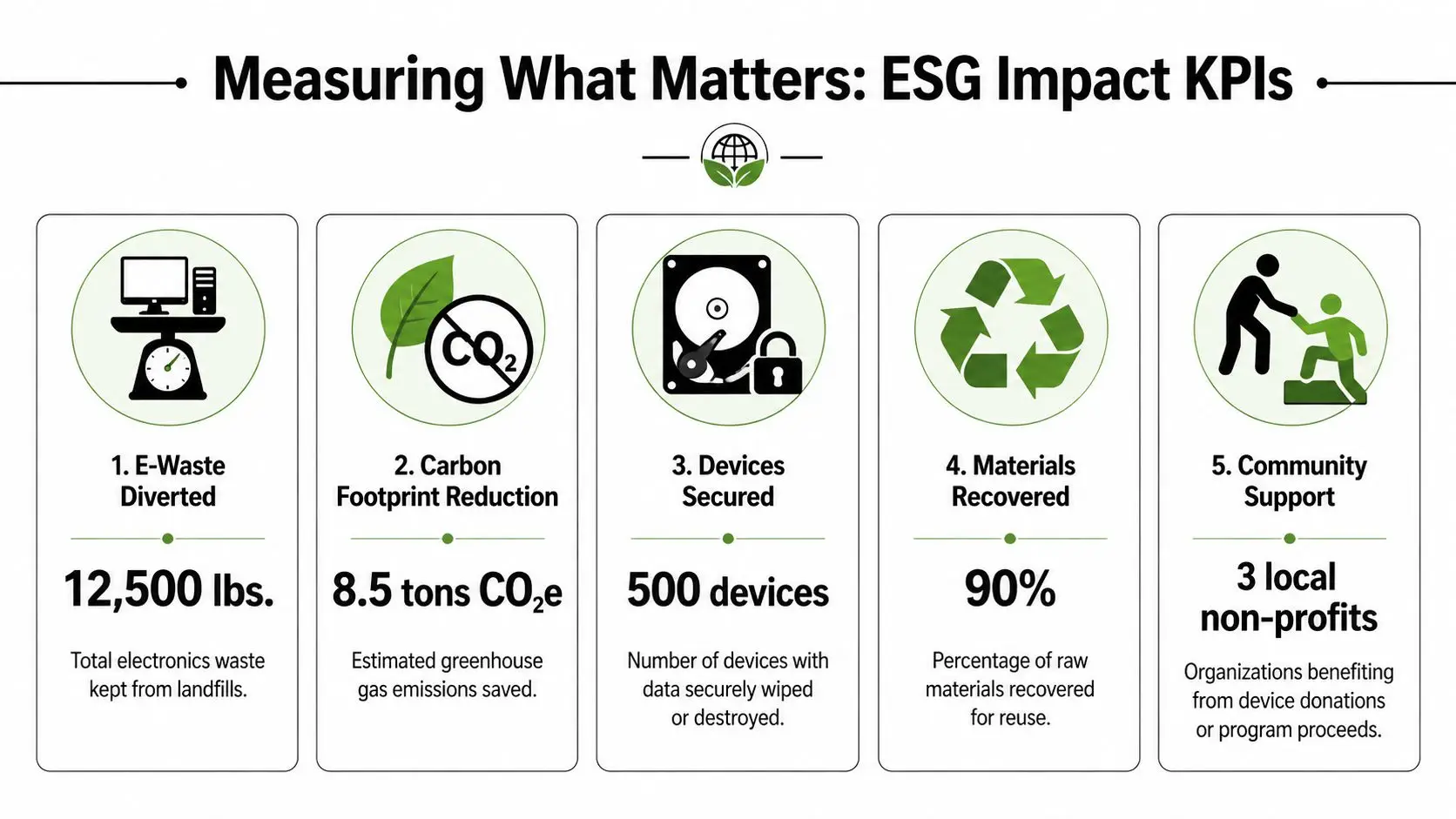
A useful local benchmark comes from North Texas. According to the United Electronic Recycling 2024 impact report, one recycler in the Dallas-Fort Worth area processed approximately 5 million pounds of electronics in 2024 and did so through efforts that included 65 community recycling events. That matters because it shows what verifiable local reporting can look like. Businesses can point to partnership outcomes tied to landfill diversion and community engagement rather than relying on generic sustainability language.
The KPIs that actually matter
A strong dashboard usually includes a mix of operational and ESG-facing indicators:
- Total electronics diverted: Report the total weight or categorized volume handled through the program.
- Data-bearing assets processed: Track the number of devices that went through secure destruction or approved sanitization workflows.
- Reuse versus recycling split: Show how much material was directed to reuse pathways instead of immediate shredding.
- Documentation completion: Confirm whether certificates, inventory reconciliations, and downstream records were received for each event.
- Community impact narrative: Capture whether eligible equipment supported donation or broader social-enterprise outcomes.
How to make the numbers useful
Raw totals aren't enough. Put the data in a form that leadership can use.
For example, sustainability teams can connect electronics diversion to broader waste-reduction goals. Procurement can use the same records to evaluate vendor consistency. Information security can verify destruction evidence against retired asset counts. Investor or board reporting teams can use the narrative to support governance and circularity claims, especially when the program follows a defined policy and produces repeatable records.
A practical framework for this sits inside broader corporate sustainability with e-waste solutions, where the emphasis is on translating operational handling into report-ready evidence.
Good ESG reporting doesn't exaggerate. It documents what happened, who handled it, how risk was controlled, and what environmental or community value resulted.
A reporting package worth keeping
At minimum, retain these records in a central file:
| Record | Why it belongs in the ESG file |
|---|---|
| Pickup or service confirmation | Establishes timing and scope of the event |
| Asset or serial reconciliation | Supports chain of custody for tracked equipment |
| Certificate of destruction | Confirms data security controls were completed |
| Weight summary or disposition report | Documents environmental handling outcomes |
| Internal approval trail | Shows governance over vendor use and process decisions |
The best KPI set is the one your company will consistently maintain every quarter. Simple, auditable, and repeatable beats ambitious but inconsistent. That's especially true for Dallas companies trying to move electronics recycling out of facilities management and into formal ESG reporting.
Turn Your Dallas E-Waste Into a Force for Good
Dallas companies don't need another vague sustainability slogan. They need a system that works when offices relocate, servers are retired, laptops are refreshed, and auditors ask for proof.
That's why the strongest ESG Electronics Recycling Programs in Dallas are built on a few disciplined choices. Know the regulatory backdrop. Map internal stakeholders early. Vet recyclers hard, especially on certifications, data destruction, and fee transparency. Run the collection process with real chain-of-custody controls. Then keep the reporting package tight enough that finance, legal, IT, and sustainability can all rely on it.
The payoff is larger than waste removal. A good program reduces exposure, supports circularity, and gives leadership a credible story about environmental responsibility and community impact. When the process also includes a donation-based or social-enterprise pathway for appropriate equipment, the value of the program expands beyond compliance.
Retired electronics don't have to remain a storage-room liability. Managed well, they become part of how your company demonstrates governance, protects data, and contributes to a more responsible local economy.
If your organization is planning a tech refresh, office cleanout, data center decommissioning, laptop disposal initiative, medical equipment disposal project, or a broader corporate donation program, Reworx Recycling can help you build a secure, practical path for electronics recycling, IT equipment disposal, secure data destruction, and donation-based recycling. Partner with Reworx Recycling to schedule a pickup, discuss sustainable recycling options, or turn retired equipment into community impact through a social enterprise recycling model.