Northern Virginia handles so much digital activity that the region’s 250+ data centers carry roughly 70% of global internet traffic, making it the highest concentration of data centers in the world, according to the Northern Virginia Regional Commission’s data center overview. That scale changes how you should think about decommissioning. In this market, Data Center Equipment Recycling in Northern Virginia isn’t a back-end housekeeping task. It’s an operational discipline tied to security, environmental performance, audit readiness, and budget recovery.
Facilities managers in Ashburn, Sterling, Manassas, and the wider corridor already know the pattern. Hardware refreshes happen faster than lease cycles. A network upgrade creates a pileup of switches, rails, copper, optics, PDUs, and racks. Storage gear might still hold value, but only if it’s tracked, sanitized, and moved correctly. If you wait until shutdown week to sort it out, the project usually gets more expensive and less defensible.
The teams that handle this well treat retirement planning like they treat uptime planning. They map assets early, separate reuse candidates from scrap, document every handoff, and choose vendors that can prove where every device ended up. That’s what turns old equipment from a liability into recovered value, cleaner reporting, and fewer unpleasant surprises.
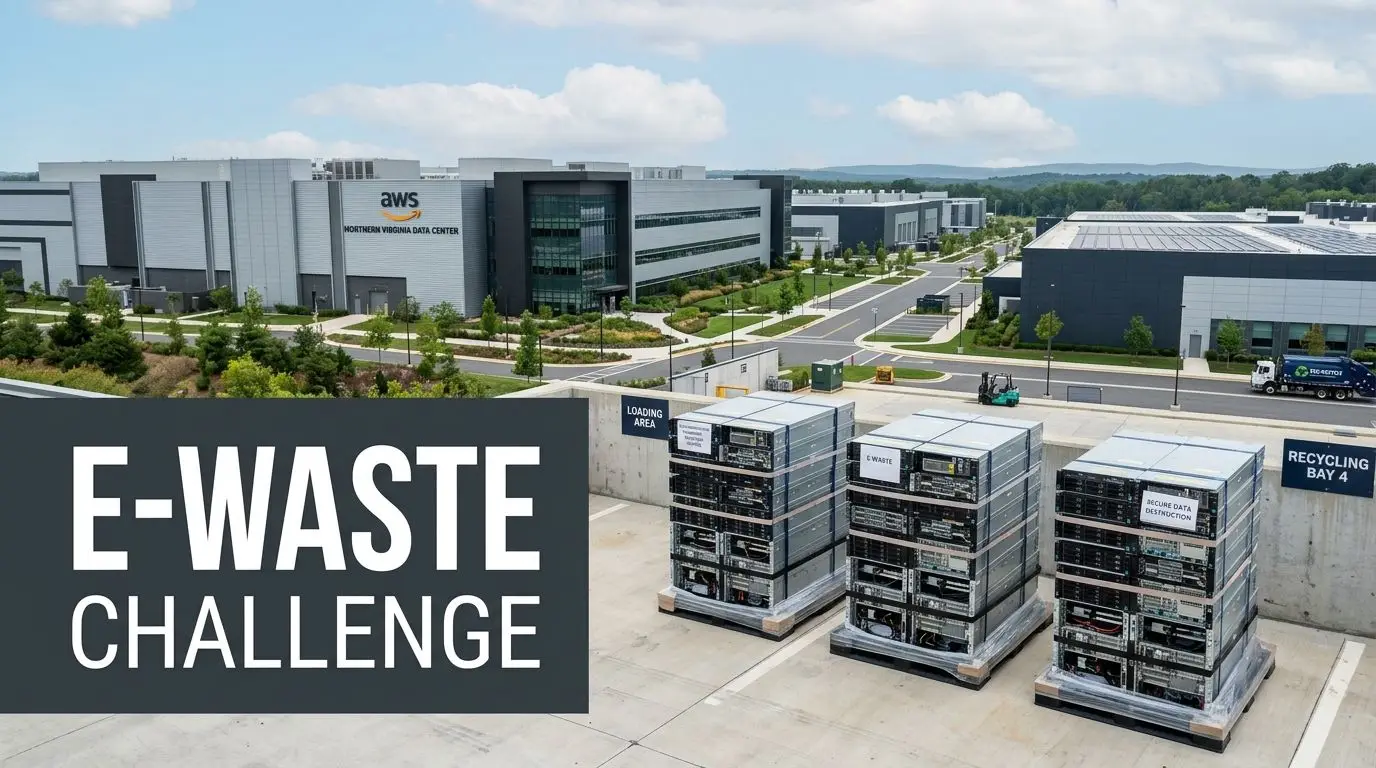
The E-Waste Challenge in Data Center Alley
Northern Virginia’s concentration of data centers creates a constant retirement stream of servers, storage, network gear, batteries, rails, cabling, and support electronics. For facilities teams, that volume changes the job. Equipment recycling is not an occasional cleanout. It is an ongoing risk, cost, and compliance function that has to keep pace with refresh cycles and phased decommissions.
Why scale changes the recycling conversation
In a typical office, e-waste builds slowly. In Data Center Alley, it shows up by pallet, by cage, and sometimes by phase of a larger migration. That distinction matters. A mid-market business in Loudoun or Prince William may not be shutting down an entire hall at once. More often, it is retiring one pod, one room, or one hardware class at a time while production stays live. Large national ITAD firms do not always optimize for that cadence.
That creates a different operating problem. You need a recycling and disposition plan that works in stages, protects resale value, and does not force your team to mix good assets with scrap just to clear space.
Generic haul-away service falls short in this market because the trade-offs are sharper:
- Security risk: Drives, firewalls, appliances, and embedded storage often leave the floor with data still present unless sanitization is planned asset by asset.
- Compliance risk: Missing serials, vague pickup records, or broken custody documentation weaken your audit position.
- Financial risk: If technicians load resale candidates into bulk scrap gaylords, recovery drops fast.
- Operational risk: Poorly timed removals interfere with live work, shared loading areas, and landlord or campus access rules.
- Environmental risk: Downstream handling still matters after the truck leaves your site.
Facilities managers who handle this well make decisions earlier. They separate remarketing, redeployment, destruction, and recycling before the first pickup window is booked. They also acknowledge that some categories have resale value for only a short period, while others cost money to process if they sit too long or move without proper sortation.
One point gets missed in generic ITAD advice. Northern Virginia projects often need phased decommissioning because budgets, leases, and migration timelines rarely line up neatly. That is where ROI is either protected or lost. A provider that can support smaller, scheduled pulls often delivers better net recovery for mid-market organizations than a vendor built mainly for infrequent, all-at-once enterprise events.
Sustainability expectations are rising at the same time. Community scrutiny around data centers already covers power, water, and local impact. End-of-life equipment is one of the few areas a facilities team can directly control with documentation to prove it. Reworx outlines that broader operational context in its guide to reducing the environmental impact of data centers.
The practical takeaway is simple. Treat retired equipment the same way you treat uptime-sensitive assets. Track it, classify it, control custody, and move it with a plan. That is how operators reduce exposure, preserve recoverable value, and keep decommissioning from turning into an expensive cleanup project.
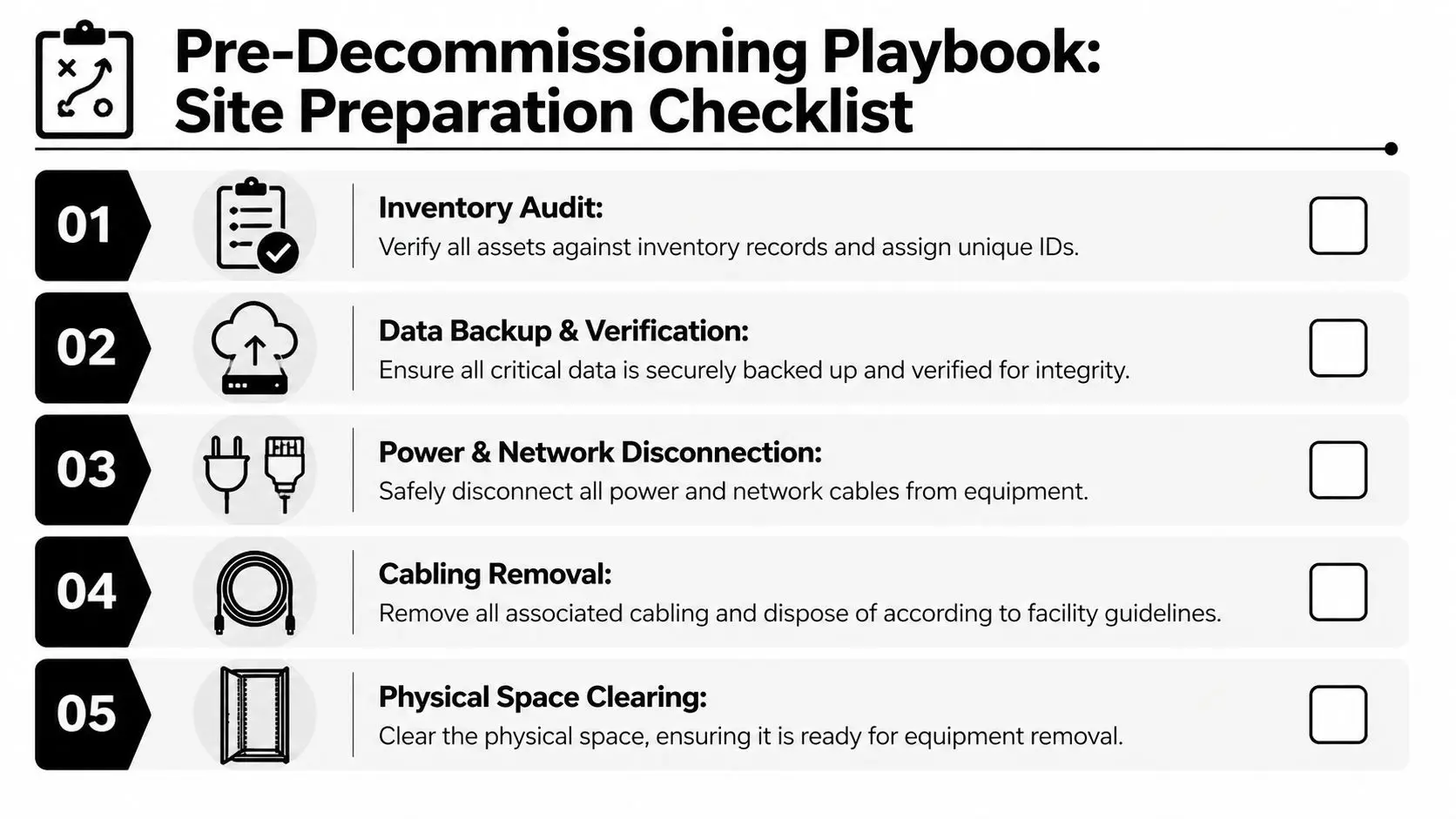
Your Pre-Decommissioning Playbook and Site Prep
Most decommissioning problems start before the vendor arrives. They start with incomplete asset lists, fuzzy ownership, blocked access paths, and internal teams that assumed someone else was handling the details. If you want a clean project, your preparation has to be specific.
Northern Virginia buyers also face a market gap. The local ITAD market often gives plenty of attention to large one-time enterprise projects, but less practical guidance for organizations that need removals in stages. The SAMR data center decommissioning page highlights that need for scheduled pickups and modular project delivery for buyers working around budget cycles and operational windows. That’s especially relevant for schools, municipalities, regional enterprises, and facilities with multiple rooms or campuses.
Build an asset list that’s usable in the field
An inventory spreadsheet isn’t enough if nobody can use it on the floor. Your list needs to match what technicians will see in the room. That means serial numbers where available, rack locations, ownership status, power state, and a simple disposition category.
Use categories that help teams act:
- Redeploy for equipment you plan to keep in-house.
- Remarket for assets with likely residual value.
- Destroy for data-bearing devices or regulated equipment that can’t leave intact.
- Recycle for end-of-life material with no reuse path.
- Hold for disputed ownership, lease review, or pending legal signoff.
If those labels aren’t assigned in advance, field crews usually end up staging everything together. That slows removal and hurts recovery.
Prepare the room, not just the paperwork
A lot of site delays come from basic physical constraints. Freight elevators, loading docks, security escorts, badge access, and cut sheets for rack dimensions all matter. So do floor conditions and path-of-travel issues if you’re pulling heavy gear out of older rooms.
Before project day, confirm these items:
- Access controls: Who opens doors, signs visitors in, and escorts crews?
- Lift path: Can racks, pallets, and bins move from white space to dock without improvisation?
- Power status: Which circuits are already de-energized, and which still need facilities signoff?
- Network dependencies: Has the networking team verified that abandoned-looking gear isn’t still carrying traffic?
- Staging area: Where will equipment wait before loading, and is that area covered by your security process?
Practical rule: If a device can’t be traced from rack position to loading dock on paper, you’re not ready to move it.
Coordinate with the teams that usually get pulled in late
Facilities managers often inherit decommissioning projects that were scoped by IT alone. That creates predictable misses. Security may require witnessed handling for drives. Procurement may need signoff for leased assets. Compliance may require a specific reporting format. None of those issues are hard, but they become hard when discovered at the dock door.
A short internal review meeting is worth the time if it includes these groups:
| Team | What they need to confirm |
|---|---|
| IT operations | Shutdown timing, dependencies, retained equipment |
| Security or infosec | Data-bearing asset handling, witness requirements |
| Facilities | Access routes, electrical isolation, staging rules |
| Procurement or finance | Ownership status, lease returns, asset records |
| Compliance or legal | Documentation requirements, retention policy |
One simple discipline helps more than people expect. Assign one internal owner for asset disposition decisions and one internal owner for site logistics. When one person tries to own both, details get missed.
Plan phased removal if downtime and budget are tight
Phased decommissioning works well in Northern Virginia, especially for organizations with constrained maintenance windows, quarterly budget releases, or multi-site operations. But it only works if each phase stands on its own from a documentation and security perspective.
For phased projects, I advise keeping each cycle small enough to validate completely. Every batch should have a clear start point, a defined set of assets, and a closure packet that includes pickup records, disposition reporting, and any internal approvals. Don’t build a rolling project with vague boundaries. That’s how assets fall into “temporary storage” and stay there.
Some teams use quarterly pickups for branch rooms and annual removals for core facilities. Others tie decommissioning to hardware refresh waves by business unit. Both can work if the rules stay consistent.
A useful planning resource is Reworx Recycling’s server decommissioning checklist. It’s the kind of operational checklist that helps prevent the common problem in these projects: everyone thinks the site is prepared because the assets are identified, but the physical and administrative handoffs still haven’t been lined up.
Executing Secure Data Destruction and Sanitization
This is the step that decides whether your project is merely tidy or defensible. Once equipment leaves the rack, the central question becomes simple: can anyone recover data from it?
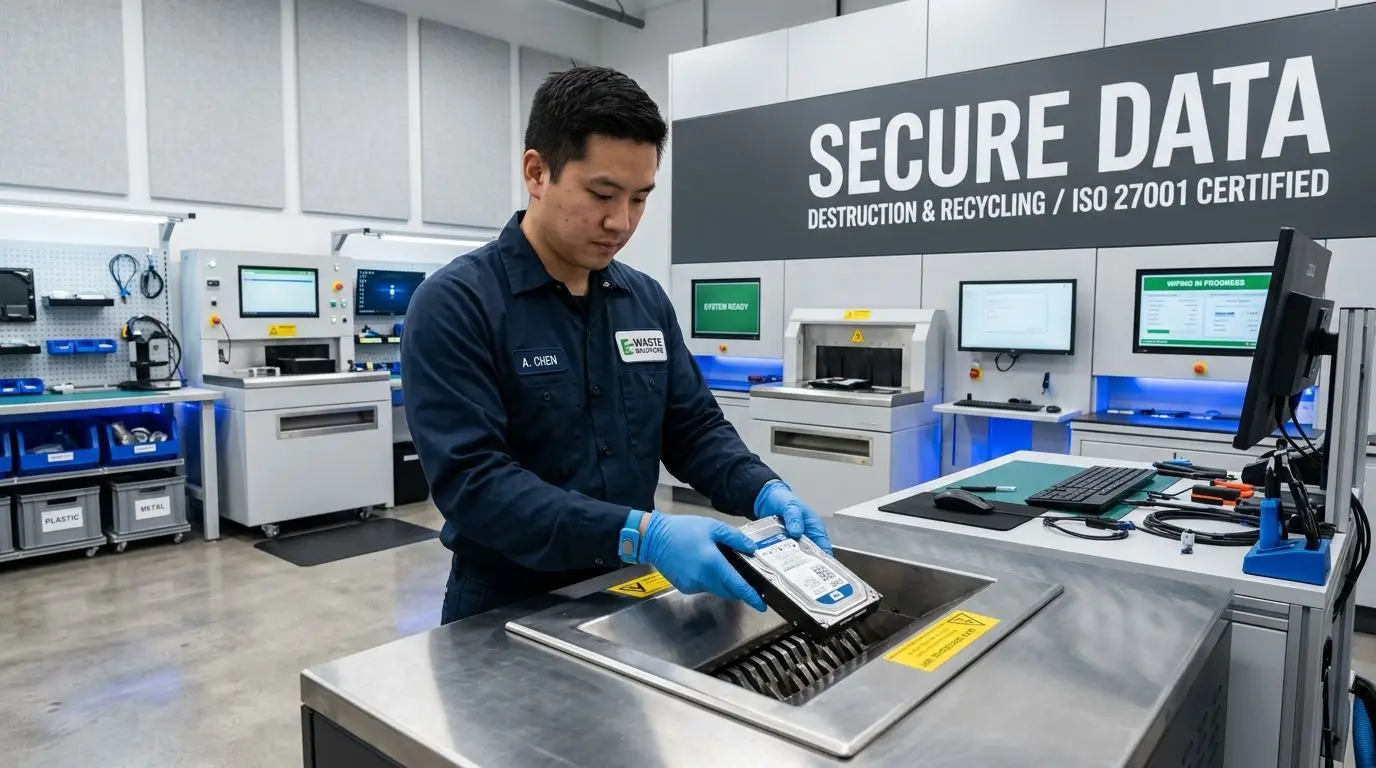
The answer depends on the media type, your security requirements, and whether the asset is headed for reuse or destruction. The Human-I-T data center recycling guidance states that compliant software wiping under DoD 5220.22-M or NIST 800-88 can achieve 99.9% data eradication rates for reusable drives, while non-reusable drives should be physically shredded to particles smaller than 2mm through NAID AAA-certified processes.
When wiping makes sense
Software sanitization is the right choice when the drive is healthy enough for reuse and your policy allows it. That usually applies to remarketable enterprise drives and some internal redeployment programs. The benefit is obvious. You preserve asset value instead of destroying it.
But wiping only works when the process is verified and documented. A “we ran a tool on it” approach isn’t enough. You want logs tied to the device identity, confirmation that the wipe completed successfully, and a report that can survive an audit.
Good use cases for wiping include:
- Remarketing enterprise HDDs or SSDs with clear model and serial tracking
- Internal redeployment to non-production environments after approved sanitization
- Donation pathways where the recipient receives usable hardware only after verified erase
When physical destruction is the better call
Some devices should never enter a resale stream. Failed media, heavily regulated data-bearing assets, damaged SSDs, and equipment under strict contractual controls are better handled by physical destruction. In such instances, organizations often make bad trade-offs. They try to salvage marginal value and take on unnecessary risk.
Shredding is straightforward. If the device can’t be trusted, reduce it to material that can’t be reconstructed. That matters even more for solid-state media, where storage behavior differs from legacy magnetic drives and residual data concerns are harder to evaluate by appearance alone.
A certificate is useful. A witnessed, documented, serial-linked destruction event is what actually protects you.
Match the method to the media
Not every data-bearing component is obvious. Storage can sit in servers, arrays, laptops, backup appliances, firewalls, copiers, and certain embedded systems. One of the most common mistakes in decommissioning is treating the visible hard drive count as the full data scope.
Use this decision view:
| Asset condition | Likely disposition | Security approach |
|---|---|---|
| Healthy and suitable for resale | Reuse or remarketing | Verified software sanitization |
| Failed or unstable | Destruction | Physical shredding |
| High-security or regulated environment | Usually destruction | Witnessed physical destruction |
| Unknown condition or unclear custody history | Conservative handling | Segregate and evaluate before release |
If your team isn’t sure whether a device contains data, treat it as if it does until proven otherwise.
Don’t separate destruction from documentation
Data destruction fails as a control if the paperwork is weak. You need device-level accountability from collection through final disposition. That means sealed containers or controlled staging, logged handoffs, and reports that identify what was wiped, what was shredded, and what was excluded.
A lot of organizations also benefit from deciding in advance whether destruction must happen on-site or whether secure off-site destruction is acceptable. The answer usually comes down to policy, witness needs, and how much confidence you have in the transport chain.
For organizations that want to review service options and process expectations, Reworx Recycling outlines its secure data destruction services. Whether you work with Reworx or another partner, the standard should be the same: the sanitization method must fit the media, and the documentation must fit the audit.
Navigating Logistics Compliance and Chain of Custody
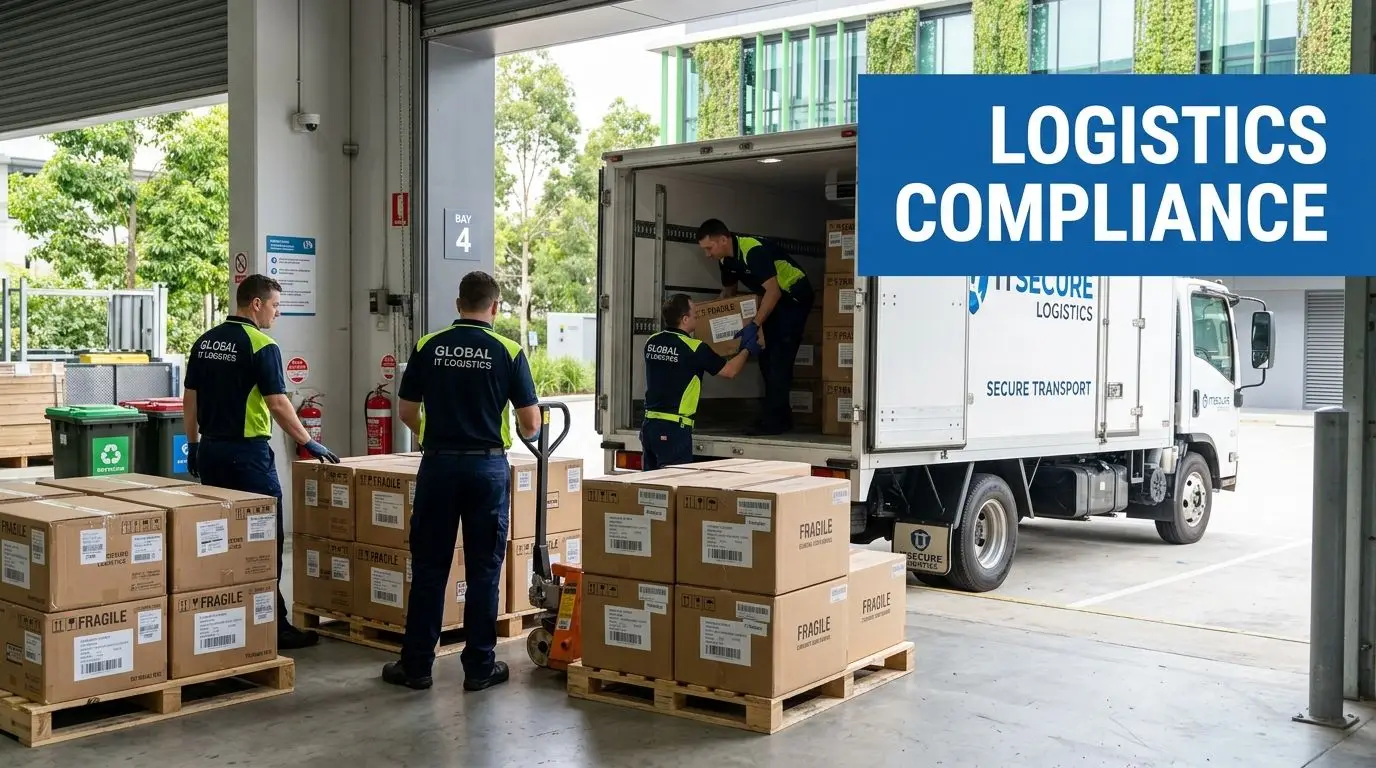
Once equipment leaves your controlled space, logistics becomes a compliance function. At this stage, many otherwise solid projects lose their defensibility. A pallet gets relabeled by hand. Devices are consolidated without clear counts. Material reaches a downstream processor with incomplete transfer records. None of those failures look dramatic in the moment, but they create liability later.
The benchmark is clear. Proper ITAD requires complete chain of custody with ISO 9001, ISO 14001, and ISO 45001 compliance tracking 100% of material flows, and certified processes can push landfill diversion to over 95% compared with the global e-waste recycling rate of 22.3%, as described in the earlier Human-I-T guidance.
What chain of custody should actually look like
A real chain of custody is not just a signed pickup ticket. It’s a documented sequence showing who handled the asset, when they handled it, where it went next, and what happened at the end. That applies to data-bearing devices, but it also applies to non-data equipment if you need environmental reporting, lease return evidence, or internal audit support.
At a minimum, your records should account for:
- Pickup identification: Date, location, personnel, and shipment reference
- Asset traceability: Counts or serial-level records based on the project scope
- Transfer events: Each handoff from site to transport to processing
- Final disposition: Reuse, resale, destruction, or recycling outcome
- Certificates and summaries: Destruction documentation and disposition reporting
Liability test: If a regulator, customer, or internal auditor asks where a specific asset went, your answer should come from records, not memory.
Logistics in Northern Virginia need tighter planning
Northern Virginia adds practical constraints that matter. High-security campuses, limited loading access, traffic congestion, and mixed-use commercial properties can complicate transport windows. The right logistics plan accounts for those realities before pickup day.
Secure handling usually includes staged packing, sealed bins for media, labeled gaylords or pallets for commodity material, and documented custody transfers at the dock. For some clients, GPS-tracked transport and restricted route handling are also part of the control environment. The exact method depends on the sensitivity of the equipment, but the principle stays the same. Every handoff should narrow risk, not introduce ambiguity.
Environmental compliance is part of the same system
Too many organizations split data security and environmental compliance into separate conversations. In practice, they’re linked. The same discipline that tracks custody also supports proper downstream processing and landfill diversion.
You should expect your recycler or ITAD provider to explain how material is sorted, where it goes, and what standards govern hazardous components and end-of-life handling. If you need a regulatory baseline on electronics and hazardous waste responsibilities, the EPA’s electronics donation and recycling guidance is a useful reference point for internal policy conversations.
This is also where certifications matter, but only if they show up in the actual workflow. A vendor can list standards on a website and still deliver sloppy field execution. Ask to see sample reports, handoff forms, and downstream accountability processes. The paper trail should be routine, not something the vendor has to assemble after the fact.
Vendor Selection and Maximizing Your Financial Return
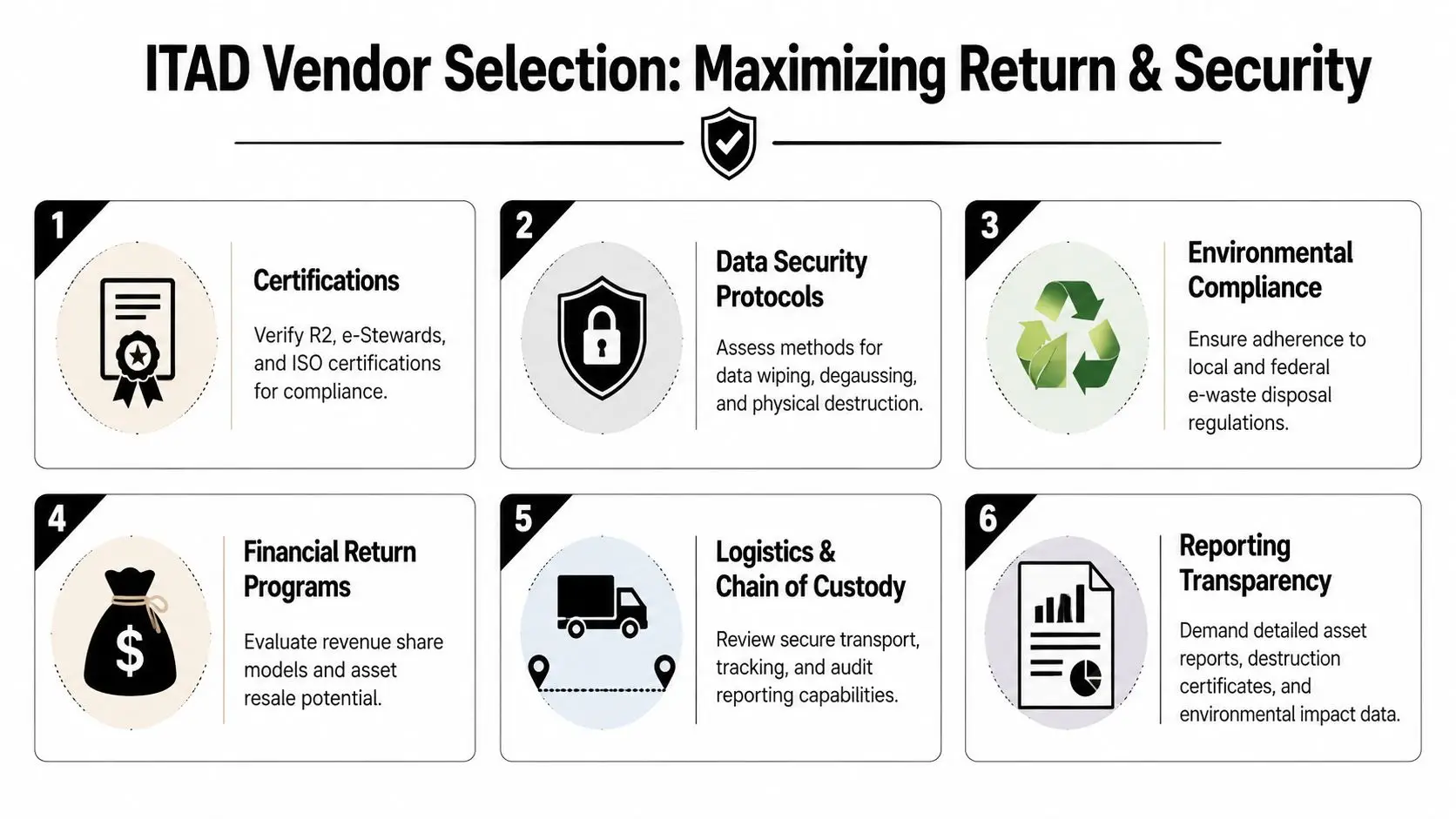
Vendor selection is where many organizations underspend attention and overspend money. They compare pickup pricing, confirm a few certifications, and assume the rest will work itself out. That approach misses the two variables that matter most in a Northern Virginia decommissioning project: risk transfer and value recovery.
The local market has a known gap here. Many providers emphasize compliance, but they don’t give mid-sized organizations transparent pricing logic or clear ROI modeling. The Securis Northern Virginia location page reflects that broader decision-making problem. Buyers often hear about secure processing and certifications, but not enough about how to estimate resale potential, disposition costs, and net recovery before the project starts.
What to ask beyond certifications
Certifications matter. So do insurance, process maturity, and downstream accountability. But if you stop your evaluation there, you still won’t know whether the vendor can protect value in your asset mix.
Ask questions that reveal operational discipline:
- How do you separate resale candidates from scrap on intake? If the answer is vague, value will leak.
- What reporting do you provide at the asset level versus the pallet level? Aggregated reporting hides too much.
- How do you handle mixed loads with drives, servers, network gear, and commodity metal together? The answer should show sorting logic, not just transport capability.
- Who are your downstream processors, and how do you vet them? If they can’t explain that, your compliance trail is weak.
- What deductions or service fees reduce recovery payouts? Such fees often cause “good resale value” to disappear.
Build your RFP around outcomes
A decent ITAD RFP doesn’t ask only “Can you recycle this?” It asks, “How will you document, secure, and monetize this?” That’s a different conversation, and it usually produces a better shortlist.
Here’s a practical framework:
| RFP area | What you want to see |
|---|---|
| Security controls | Clear destruction options, witness procedures, documented custody |
| Environmental controls | Downstream transparency, certified handling, reporting quality |
| Financial model | Defined fee structure, recovery methodology, settlement timing |
| Operations | Site readiness review, phased pickup capability, scheduling flexibility |
| Reporting | Asset-level detail where needed, certificates, final disposition summaries |
A strong proposal should make trade-offs visible. For example, physical destruction may reduce remarketing potential but tighten risk controls. Off-site processing may lower cost but require stronger transport documentation. The vendor should be able to discuss those trade-offs directly.
You’re not hiring a truck. You’re hiring a process that should survive scrutiny from security, finance, and sustainability at the same time.
Mid-market firms need a different buying lens
Large hyperscale projects get attention because of volume. Mid-market organizations need a different kind of support. They often have mixed asset quality, tighter downtime windows, and more pressure to show whether disposition costs can be offset by recovery.
That’s why transparency matters more than headline promises. If a vendor talks about value recovery but can’t explain how they assess remarketable servers, laptops, network switches, and accessories, you’re still guessing. If they can’t support phased pickups, your internal teams may keep hoarding retired equipment in closets, cages, and staging rooms until the project becomes harder and riskier.
This is one reason asset recovery programs matter. Reworx Recycling provides an overview of asset recovery solutions that reflects what buyers should look for from any partner: clear disposition paths, practical value recovery, and enough transparency to help finance teams make decisions before equipment is moved.
What usually works and what usually doesn’t
What works:
- Early triage of assets by value and risk
- Clear handling rules for data-bearing equipment
- Phased scheduling for buyers with budget or uptime constraints
- Settlement and reporting terms defined before pickup
What doesn’t:
- Single blended pricing for everything
- Unsorted bulk loads
- Verbal promises about resale with no methodology
- Reporting that arrives too late to help with internal closeout
The practical goal isn’t to force every asset into a recovery model. It’s to avoid wasting assets that had value and to avoid paying premium processing costs for equipment that should have been categorized correctly from the start.
The Social Enterprise Advantage with Reworx Recycling
A retired server, switch, or workstation doesn’t have only two possible outcomes. It doesn’t have to be either monetized or shredded. In the right program, some equipment can support a second life that matters outside your balance sheet.
That social dimension is becoming more important as Northern Virginia’s data center footprint keeps expanding. The Northern Virginia data center market forecast from Mordor Intelligence projects capacity growth from 20.32 gigawatts in 2026 to 43.52 gigawatts by 2031, at a 3.38% CAGR. The practical implication is straightforward. As capacity rises, so will the volume of retired equipment that needs secure, responsible handling.
What a second life can look like
In well-run disposition programs, the asset path is intentional. High-risk media is sanitized or destroyed. End-of-life material goes through compliant recycling. Equipment with useful life left can be refurbished, reassigned, or directed into donation-based channels where it supports digital access rather than becoming premature scrap.
That matters for organizations with ESG goals, but it also matters for organizations that want a better answer to a common internal question: “What happened to the equipment after it left?” A social enterprise model gives a fuller answer. Some assets are recycled responsibly. Some generate recovery. Some help people who need working technology.
Why the model fits this region
Northern Virginia’s data center market is highly developed, but many organizations still want more from their recycling partner than a certificate and a truck schedule. They want secure data destruction, dependable pickup, and reporting they can use. They also want the option to align retirement programs with community impact.
That’s where Reworx stands apart. Reworx Recycling operates as a social enterprise with a donation-based mission tied to environmental responsibility, technology access, and community support. For organizations managing electronics recycling, computer recycling, office cleanout projects, secure data destruction, and broader IT asset disposition, that adds a third layer of value beyond compliance and recovery.
Old equipment can still do useful work. The question is whether your disposition program is designed to find that use.
A better standard for end-of-life equipment
For facilities managers and IT leaders, the standard should be higher than “disposed of properly.” The better standard is this: equipment leaves your control securely, moves through a documented process, and creates the best available outcome for each asset category. That may be resale. It may be destruction. It may be sustainable recycling. It may be community reuse.
Reworx describes that broader mission in its overview of partnering for impact. For companies in Northern Virginia, that’s a useful way to think about end-of-life hardware. The project doesn’t end when the rack is empty. The final disposition still reflects on your organization’s security practices, environmental standards, and community priorities.
If your organization is planning Data Center Equipment Recycling in Northern Virginia, Reworx Recycling offers a practical path that supports secure IT equipment disposal, donation-based recycling, computer recycling, office and facility cleanout needs, and community impact. If you need to retire old servers, schedule a pickup, evaluate asset recovery, or build a more responsible electronics recycling program, contact Reworx Recycling to start the conversation.