Your phones are quiet. Teams can't reach customers. A branch office is online, but performance is unstable. Someone reports that the issue started with “just one circuit,” and now your help desk is fielding complaints from sales, operations, and leadership at the same time.
That's the point where many Chicago companies realize they don't have a telecom maintenance strategy. They have vendors, they have equipment, and they have internet service. What they don't have is a disciplined plan for keeping communications infrastructure available, supportable, and recoverable when something fails.
For businesses operating in a dense market like Chicago, telecom maintenance services Chicago shouldn't be treated as a break-fix line item. It belongs in the same conversation as continuity planning, facilities risk, cybersecurity hygiene, and end-of-life equipment control. The organizations that handle this well don't just restore service faster. They make better decisions before the outage, during the outage, and after the hardware leaves the rack.
Why Every Chicago Business Needs a Telecom Maintenance Plan
A telecom outage rarely stays confined to telecom. Voice issues turn into customer service delays. Circuit instability affects cloud access. A bad fiber handoff or failing power shelf can disrupt phone systems, badge access dependencies, call routing, and day-to-day coordination between offices and field teams.
That's why maintenance planning matters before anything breaks. A solid plan defines who responds, what gets tested, how incidents escalate, which spare parts matter, and what happens outside standard office hours. Without that structure, businesses lose time just figuring out ownership while the outage keeps expanding.
The labor market tells you something important here. Telecommunications equipment installers and repairers remain a specialized field, with a median annual wage of $64,310 in May 2024 and projected employment decline of 3 percent from 2024 to 2034, yet about 23,200 openings per year are still projected largely from replacement needs, according to the U.S. Bureau of Labor Statistics occupational outlook for telecommunications technicians. For Chicago businesses, that means maintenance is not casual labor you can source at the last minute. It's a recurring operational need that depends on skilled technicians and realistic support models.
What a plan actually prevents
A maintenance plan doesn't guarantee perfection. It reduces chaos.
- Faster triage: Your team knows whether to check carrier demarcation, LAN handoff, optical signal, power, or application behavior first.
- Clear ownership: Facilities, IT, telecom, and vendors know who opens the ticket and who authorizes after-hours access.
- Less expensive downtime: You avoid wasting the first hour on guesswork and duplicate dispatches.
- Better replacement decisions: You can decide whether to repair, swap, upgrade, or retire equipment based on condition and risk.
Practical rule: If your first response to an outage is “Who even supports this system?”, you don't have maintenance coverage. You have hope.
The same principle shows up in other building systems. If you've seen how facility teams use preventative maintenance inspections to avoid winter failures in physical infrastructure, the telecom lesson is similar. Waiting for failure is always the most expensive operating model.
Businesses that want a more structured local starting point often look at providers handling telecommunications support in Chicago as part of a broader uptime and asset planning strategy.
The Core Components of Telecom Maintenance Services
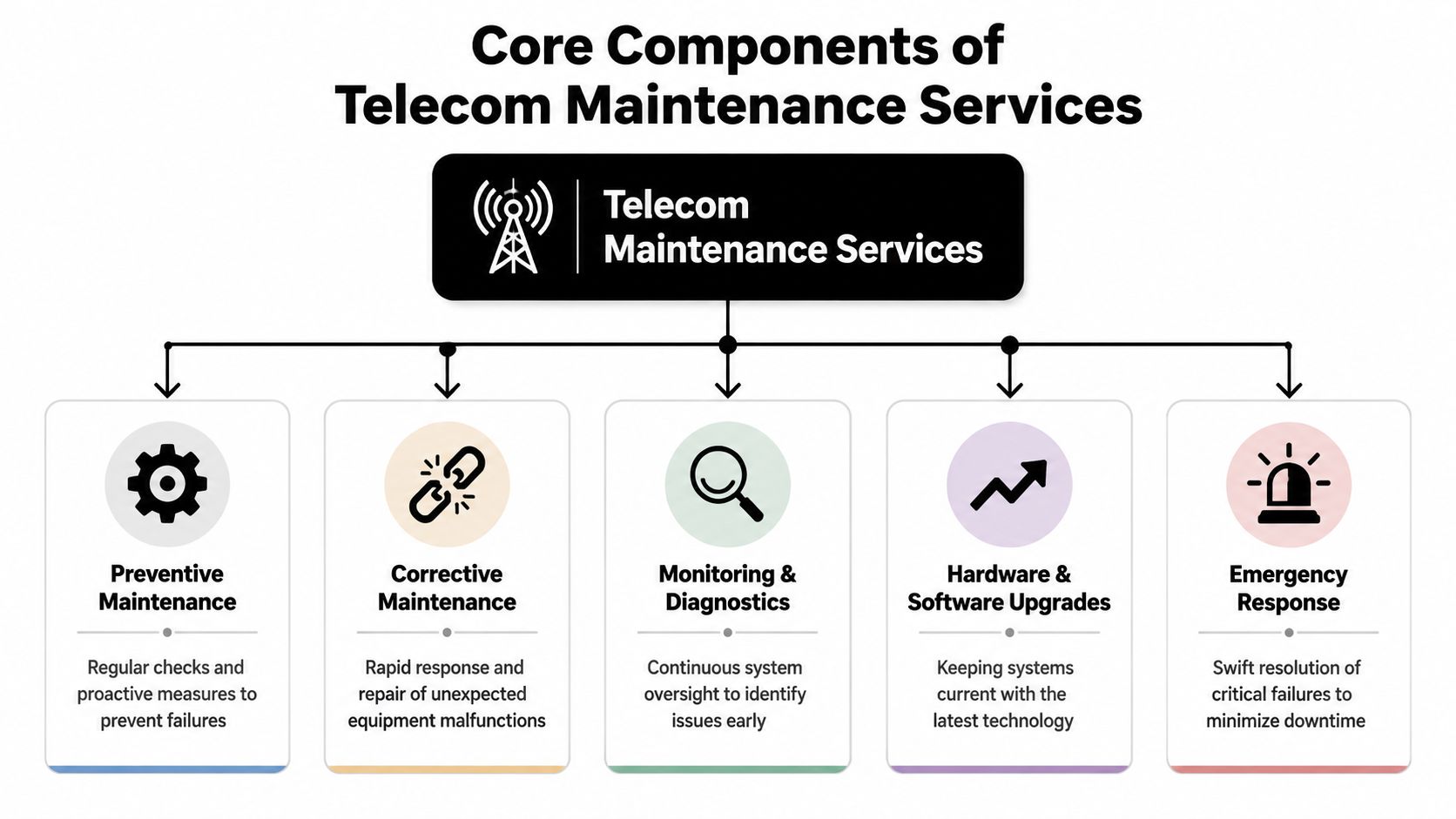
The phrase “maintenance services” gets used loosely. In practice, good telecom maintenance is a bundle of operating disciplines, not just a number to call when the phones go down.
Preventive work and routine checks
Preventive maintenance is the part most companies underfund because nothing appears broken. That's a mistake. Preventive maintenance involves technicians inspecting fiber condition, verifying power health, reviewing alarms, confirming environmental conditions in closets and MDFs, and identifying equipment that's drifting toward failure.
A preventive visit should produce decisions, not just a checklist. Which UPS-backed elements are unstable? Which optics are marginal? Which patching practices are creating avoidable risk? If your vendor can't answer those questions clearly, they're not doing meaningful preventive work.
Corrective repair and emergency response
Corrective maintenance starts when service is already degraded or down. The quality gap between providers shows up here fast. Some firms merely dispatch a body. Better firms dispatch a technician with enough context to isolate the issue efficiently.
Illinois' public-sector support model is useful because it reflects how serious telecom support is organized. The Illinois Department of Innovation and Technology states that after-hours and holiday calls are automatically routed to a central command structure providing 24x7x365 service for voice, wireless, data, and IWIN repair calls, as described in the Illinois Telecom Coordinator Guide. That's the benchmark. Business-hours support alone is not enough for critical communications.
If your SLA only looks strong from 8 to 5, it won't protect you when a weekend failure affects Monday operations.
Monitoring, testing, and controlled upgrades
Monitoring matters because many telecom failures don't start as complete failures. They start as intermittent loss, rising error rates, optics drift, or unstable power behavior. A provider should be able to catch patterns early, not just react to outage tickets.
Upgrades belong in maintenance too. Firmware, software loads, hardware refreshes, and circuit turn-ups all affect reliability. A poorly executed “improvement” often causes the incident that the maintenance team then has to fix.
A practical maintenance scope usually includes:
- Alarm and performance review: Looking for early signs of optical, packet, or power-layer issues.
- Configuration verification: Confirming changes match approved design and rollback paths.
- Spare parts planning: Identifying what should be stocked locally and what can wait for shipment.
- Lifecycle coordination: Flagging retired or replaced gear for proper handling instead of leaving it in storage.
When equipment is being swapped out, businesses should also think ahead about telecom equipment recycling in Chicago so removed hardware doesn't pile up in closets with no chain of custody.
Business Benefits Beyond Just Fixing Broken Phones
Value of maintenance shows up in operations, not in a service report. Good maintenance protects workflow, keeps support costs more predictable, and reduces the number of emergencies that absorb your team's attention at the worst possible time.
Better uptime starts with better diagnosis
Chicago telecom field service is technical work. Job requirements in the local market regularly call for experience with OTDR testing, DC power systems, circuit testing, RFC 2544, RFC 6349 TruSpeed, iPerf, Y.1564, optical power meters, digital multimeters, fiber identifiers, and fiber scopes, as reflected in Chicago-area telecom technician listings. That matters because these tools help technicians determine whether the fault sits in the optical layer, packet-performance layer, or power path.
A business owner doesn't need to know every protocol. You do need to know what competent troubleshooting looks like. If a provider can only say “we'll take a look,” that's weak. If they can explain how they verify service turn-up, isolate impairment, and validate restoration, that's a stronger operating partner.
The benefits executives actually care about
Maintenance helps in ways that finance and leadership teams notice quickly:
- Reduced business interruption: Faster fault isolation means less idle time for customer-facing teams.
- More controlled support costs: Planned maintenance is easier to budget than repeated emergency dispatches.
- Lower change risk: Updates and replacements happen with testing discipline instead of rushed improvisation.
- Stronger compliance posture: Systems stay more current, and decommissioned hardware can be handled with fewer loose ends.
Strong telecom maintenance isn't just about restoring dial tone. It's about limiting the blast radius when one technical issue starts affecting multiple departments.
Maintenance also improves decision quality
One of the least discussed benefits is better decision timing. When a provider documents recurring alarms, failing components, and unstable legacy dependencies, you stop arguing about whether a refresh is necessary. You can prioritize upgrades based on operational risk instead of frustration after the latest outage.
That's why mature organizations treat maintenance as a management input. It gives leadership cleaner choices about renewals, consolidation, migration, and retirement.
Navigating Chicago's Unique Telecom Environment
Chicago adds its own layer of complexity. Urban density, older buildings, mixed carrier footprints, and harsh seasonal conditions all shape how telecom maintenance services Chicago should be planned and delivered.

Building conditions matter more than many IT teams expect
Chicago businesses often operate in a patchwork of environments. One office may be in a modern high-rise with well-managed risers and conditioned telecom rooms. Another may sit in an older property where pathways are tight, grounding is inconsistent, and years of adds and changes have left behind unlabeled cabling and mystery patch panels.
That affects maintenance in practical ways. A simple replacement can take longer because access is restricted, documentation is incomplete, or the physical plant creates avoidable troubleshooting noise. Providers who know Chicago building realities tend to ask better questions before dispatch.
Weather and logistics change the support model
Winter exposes power weaknesses, cable vulnerabilities, and access delays. Summer heat can punish poorly ventilated IDFs and edge locations. Storms don't just create outages. They complicate travel, loading dock access, rooftop work, and carrier coordination.
Chicago also has mixed infrastructure histories. Some businesses run relatively current fiber and Ethernet environments. Others still depend on combinations of PBX, copper handoffs, legacy carrier hardware, wireless backhaul, and phased migrations that never fully finished. The result is a lot of mixed-generation infrastructure in active use.
A local maintenance partner should understand how to work across those conditions, especially when wireless overlays and building connectivity intersect with broader wireless network installation in Chicago.
Questions worth asking your provider
Use location-specific questions during vendor review:
- Access planning: How do you handle downtown building access, freight coordination, and after-hours entry?
- Physical environment: Do you assess room cooling, rack conditions, and DC power as part of maintenance?
- Legacy coexistence: Can you support environments where old and new telecom platforms are still connected?
- Carrier handoff experience: How do you separate internal faults from carrier-side issues in dense urban sites?
Chicago doesn't forgive generic support models. The more complex your facilities footprint, the more your maintenance partner needs local field judgment, not just remote ticket management.
How to Choose the Right Maintenance Partner in Chicago
Most vendor evaluations start with response times, hourly rates, and broad claims of expertise. Those matter, but they don't tell you enough. The right partner has to be technically credible, operationally disciplined, and realistic about what happens to your equipment when repair is no longer the right answer.

What to verify before you sign
Start with field capability. Ask what platforms they support, what test equipment they use, how they handle after-hours events, and whether they can work in mixed environments without escalating every issue to a third party.
Then ask the harder question. What do they do with removed equipment?
That question matters because a lot of maintenance vendors stop at uptime. They replace the failed unit, leave the retired one with your staff, and move on. Your team is then left with shelves of old phones, PBX cards, routers, gateways, and appliances that may still contain configuration data or operational history.
A useful screening checklist looks like this:
- Legacy repair support: Can they maintain older systems instead of forcing premature replacement?
- Parts strategy: Do they offer advance replacement, exchange options, or realistic sourcing paths?
- Documentation discipline: Will they record serials, removals, and chain of custody for retired gear?
- End-of-life process: Can they coordinate secure disposition instead of treating decommissioned hardware as your problem?
Chicago organizations with mixed-generation infrastructure should pay close attention to legacy support. Chicago Tech states that it provides repair for more than 100 OEM platforms, including both discontinued and current network equipment, in its overview of telecom repair services for legacy and active platforms. That kind of capability can extend asset life and avoid forcing a rushed capital project just because OEM support has changed.
The overlooked selection criterion
A maintenance contract should connect to an IT asset disposition process. If a provider replaces a voicemail appliance, gateway, or aging telecom server, you need to know where it goes next, who handles data-bearing components, and whether disposal aligns with your environmental and governance requirements.
Ask this directly: “When you remove telecom hardware from service, how do you document transfer, data handling, and final disposition?”
That's where a separate ITAD partner often belongs in the workflow. For example, Reworx Recycling's telecom services resources describe support categories businesses use when they need structured handling of retired communications equipment alongside broader electronics recycling, secure data destruction, and asset disposition planning.
The point isn't to make your maintenance vendor do everything. It's to ensure your maintenance plan doesn't stop at the loading dock.
Decoding SLAs and Pricing Models for Telecom Services
Pricing gets attention because it's visible. SLAs deserve more attention because they determine what your money buys when service is impaired.
Telecom maintenance pricing models compared
Different models fit different environments. A small office with stable infrastructure may choose one approach. A multi-site organization with older equipment may need another.
| Model | Best For | Pros | Cons |
|---|---|---|---|
| Monthly retainer | Businesses with critical uptime needs and recurring support activity | Predictable billing, easier planning, usually clearer coverage structure | You may pay for capacity you don't fully use in quiet periods |
| Block hours | Organizations with occasional projects and moderate support needs | More flexible than a full retainer, can work well for planned tasks | Emergency work can consume hours quickly, coverage rules may vary |
| Time and materials | Small environments with low incident frequency | Pay only when work is performed, simple to understand | Least predictable during outages, usually weak for urgent or after-hours response |
| Per-incident support | Very small businesses or noncritical systems | Low commitment, straightforward for isolated issues | Often the slowest and most expensive way to handle recurring problems |
What to read in the SLA
Many buyers focus on “response time” and stop there. That's not enough. A vendor may respond quickly by acknowledging the ticket while taking much longer to put the right technician on the problem.
Read for these distinctions:
- Response time: When the provider first engages the issue.
- Dispatch commitment: When field resources are assigned, if on-site work is needed.
- Resolution framework: Whether the contract defines restoration targets, workarounds, or only best effort.
- Coverage window: Standard hours, after-hours, holidays, and any exceptions.
- Escalation path: Who gets involved when first-line support can't restore service.
- Excluded equipment: The gear, software, or carrier dependencies not covered under the agreement.
A practical way to sharpen your review is to compare telecom SLAs with broader managed support contract language. Networking2000's guide to IT contracts is helpful for understanding how contract wording can differ between response promises, support scope, and commercial terms.
Match the contract to the business impact
A low-cost SLA that excludes after-hours support, legacy components, or parts coordination may be fine for a noncritical site. It's a poor fit for operations that rely on constant voice and data availability.
If you're evaluating broader service coverage, local businesses often compare maintenance structures with managed telecom services options to see whether support should remain narrowly break-fix or move into a more managed operating model.
Frequently Asked Questions About Telecom Maintenance
Do we still need a maintenance contract if we use cloud VoIP
Usually, yes. Cloud calling removes some on-prem PBX burden, but it doesn't remove your local dependencies. You still rely on connectivity, switching, cabling, power, session routing components, handsets, and facility conditions. When users say “the phones are down,” the fault may still be local.
Does telecom maintenance include inside cabling
Sometimes, but not automatically. Some providers cover active equipment only. Others include structured cabling checks, patching review, MDF and IDF cleanup, and carrier demarcation troubleshooting. Ask for that scope in writing.
We have an old PBX or telecom server in a closet. What should we do with it
Don't leave it there indefinitely, and don't send it into general disposal streams. Retired telecom hardware may contain stored configuration data, voicemail data, or drives and media that need controlled handling. Many local providers focus on uptime but don't address what happens after hardware is removed from service, which leaves businesses exposed to disposal and data-handling risk, as noted by this Chicago telecom repair discussion highlighting lifecycle gaps.
Should we repair legacy telecom gear or replace it
It depends on failure frequency, parts availability, integration risk, and how close the system is to a planned migration. If the platform is stable and the provider can support older hardware responsibly, repair may buy useful time. If the system is causing repeated incidents or blocking critical changes, replacement may be the cleaner option.
Old telecom equipment becomes a risk twice. First when it starts failing. Then again when no one owns the retirement process.
What should our team prepare before a vendor visit
Have current contact details, site access instructions, rack locations, circuit identifiers, change history, and any recent symptoms ready. The faster your team can distinguish “this site has no service” from “this application is failing over a healthy link,” the better your provider can respond.
How often should we review our maintenance strategy
Review it whenever you add locations, change carriers, migrate platforms, or retire legacy systems. Telecom environments drift over time. Contracts, inventories, and disposal procedures need to keep up.
If your business is replacing phones, gateways, PBX hardware, network appliances, or related communications equipment, Reworx Recycling can be part of the post-maintenance plan. The company supports electronics recycling, IT equipment disposal, secure data destruction, and pickup coordination for organizations that need a cleaner process for retired hardware. If you're planning an office cleanout, data center decommissioning, or broader IT asset disposition effort tied to a telecom refresh, schedule a pickup or explore partnership options so aging equipment doesn't become your next unmanaged risk.