A Chicago telecom upgrade usually ends the same way. The new system is live, call quality is better, the network team moves on, and old hardware starts piling up in a back room, IDF, or loading area.
That pile is where risk starts. PBX shelves, VoIP handsets, routers, switches, firewalls, and network appliances aren't just clutter. They may still hold configurations, credentials, call records, or other sensitive information. They also can't be treated like generic scrap if your company cares about compliance, chain-of-custody, and environmental handling.
For Chicago businesses, R2 certified telecom recycling Chicago is less about “getting rid of equipment” and more about controlling a retirement process from rack removal through final disposition.
Why Chicago Businesses Must Rethink Telecom Equipment Retirement
A common Chicago scenario goes like this. A company in the Loop finishes a telecom migration across several floors. A suburban office in the western corridor replaces aging network gear during a broader office cleanout. A healthcare practice swaps communications equipment while trying not to interrupt patient operations.
The technical cutover gets the attention. The retired hardware usually doesn't, at least not until facilities asks what to do with it.

That's a mistake for three reasons. First, telecom equipment often leaves behind security exposure. Second, removal in Chicago can be operationally awkward, especially in high-rises, shared docks, and buildings with strict move windows. Third, older gear may still have reuse value or require specialized downstream handling, which means the wrong disposal path creates both compliance problems and wasted recovery opportunities.
What fails in practice
The weakest retirement projects usually fall into one of these patterns:
- Storage without ownership: Equipment gets boxed and moved to a closet “for later,” then no one can confirm what's there or whether any item still contains sensitive data.
- Pickup without documentation: A general hauler removes gear fast, but the business never receives useful records tying the outbound equipment to final destruction or recycling.
- One-size-fits-all destruction: Everything gets treated as waste, even when some assets could have been assessed for controlled reuse.
Practical rule: If your telecom equipment leaves the building without a documented custody trail, you've turned retired hardware into an unmanaged liability.
Chicago hasn't been late to certified electronics recycling. A 2012 EPA-certified recycler list that included Chicago, Illinois among R2-certified recyclers shows the city has been part of the certified e-waste ecosystem for more than a decade. That matters because it means certified infrastructure isn't a novelty here. Buyers can set a higher bar.
What a better process looks like
A disciplined telecom retirement process starts before pickup day. IT, facilities, and compliance need the same operating picture.
Use this checklist before you release any telecom hardware:
| Internal task | What your team should confirm |
|---|---|
| Asset review | Identify routers, switches, PBX gear, handsets, firewalls, and any other network devices being retired |
| Sensitivity screening | Flag anything that may store configurations, credentials, logs, or user data |
| Building coordination | Confirm dock access, elevator rules, after-hours windows, and certificate of insurance requirements |
| Records plan | Decide what manifest, destruction record, and final reporting you expect back |
Chicago businesses that need a broader local framework can review this business leader's guide to electronics recycling in Chicago before they scope a telecom cleanout.
The practical shift is simple. Stop treating telecom retirement like junk removal. Treat it like a controlled IT asset disposition event.
What R2v3 Certification Means for Your Telecom Hardware
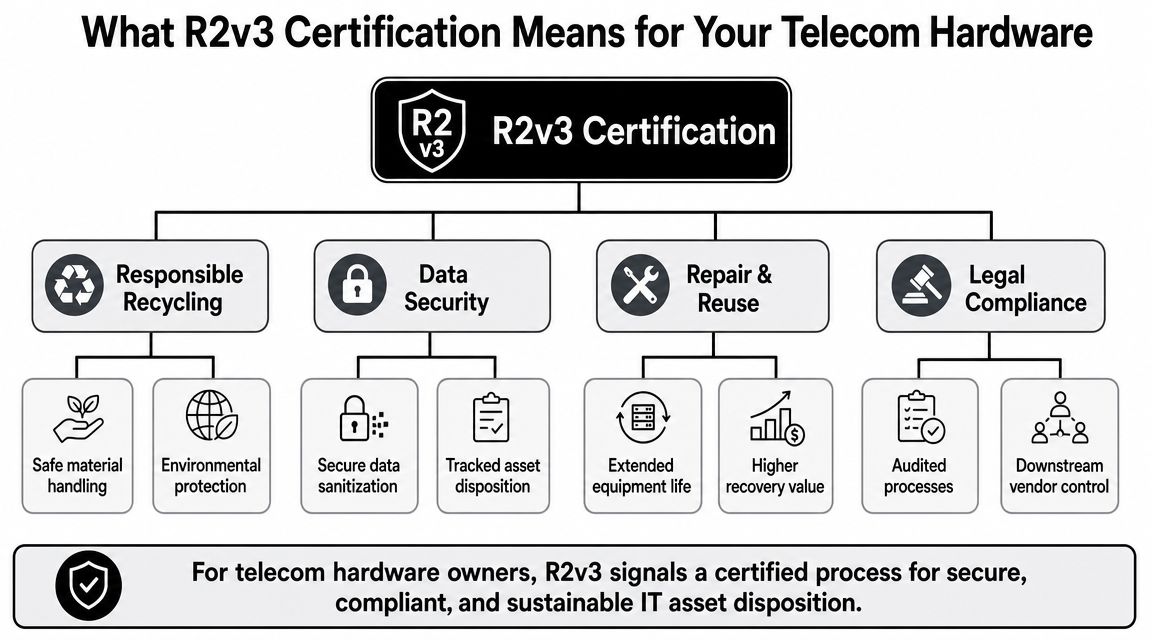
R2v3 certification is the closest thing this industry has to a working control system for electronics disposition. For a Chicago IT manager, the useful way to think about it is not as a logo. Think of it as a chain-of-custody framework for quality, security, environmental handling, and downstream accountability.
If a recycler is operating under R2v3, you're not just asking whether they can take your equipment. You're asking whether they run a documented process that covers storage, security, data destruction, legal compliance, worker protections, and what happens after the first facility touch.
The four pillars that matter most
For telecom hardware, these are the parts that deserve your attention:
- Environmental controls: The recycler should manage electronics under defined environmental and legal requirements, not informal scrap practices.
- Health and safety controls: The standard ties electronics processing to environmental, health, and safety management systems, which matters when dense mixed-material loads are dismantled.
- Data security controls: Retired equipment has to move through a process that addresses secure handling and documented destruction.
- Downstream management: Responsibility doesn't stop at the first dock. R2 extends oversight into the downstream chain, which reduces leakage risk when equipment moves across multiple vendors.
Many non-certified providers break down at this stage. They may be able to pick up and sort equipment, but they can't explain downstream controls with enough precision for a serious audit.
Why Appendix D matters for telecom gear
R2v3 is especially relevant to telecom because R2 specifically recognizes specialty electronics reuse and handling for commercial-grade equipment such as telecom and medical devices through Appendix D. That matters for organizations decommissioning switches, routers, and similar infrastructure because the framework is designed to support de-installation, reuse assessment, and controlled return-to-use rather than default shredding.
That isn't a minor distinction. Telecom assets often have useful life left if they're tested, sanitized, and handled correctly. A good R2 process helps preserve that option without sacrificing auditability.
Don't accept “we recycle telecom gear” as enough. Ask whether the provider's R2 scope and operating process actually fit commercial network equipment and controlled reuse decisions.
What to verify during due diligence
A practical R2 review should focus on evidence, not marketing copy.
Here's what I'd want to confirm:
Current certification status
Ask for the active certificate and make sure the dates are current.Scope of services
Confirm whether the provider handles de-installation, data destruction, sorting for reuse, and final recycling under documented procedures.Telecom-specific handling
Ask how they treat routers, managed switches, PBX systems, VoIP equipment, and network appliances.Downstream visibility
Require a clear answer on who receives non-reusable material after first processing.
Businesses comparing standards can use this overview of e-waste certification standards to sharpen those vendor questions.
The main point is straightforward. For telecom assets, R2v3 is useful because it supports a controlled decision tree. Reuse where viable. Destruction where necessary. Recycling under documented environmental and security controls when the asset reaches end of life.
Navigating Data Destruction and Compliance in Chicago
For most Chicago organizations, data destruction is the part of telecom recycling that carries the most immediate executive risk. Healthcare groups worry about protected information. Financial firms worry about customer data and internal controls. Law firms worry about client confidentiality. Public entities worry about records, procurement discipline, and public scrutiny.
Telecom gear complicates this because it doesn't always look like classic data-bearing equipment. A firewall, call system component, managed switch, or network appliance may still retain settings, logs, credentials, or system details even when it seems obsolete.
Why compliance language matters
Chicago's telecom and electronics recycling market has already moved toward secure ITAD, not simple disposal. For example, STS Electronic Recycling describes its Chicago service as R2 certified and HIPAA compliant, offering NIST-compliant data destruction and a zero-landfill policy. That tells you something important about buyer expectations in this market. Serious customers aren't asking only for removal. They're asking for documentation, standards alignment, and proof.
If you're building internal policy around broader risk reduction, this guide to cybersecurity for small businesses is a useful outside resource for framing how operational controls and disposition controls fit together.
Wiping versus physical destruction
The right destruction method depends on the asset, the policy environment, and whether reuse is realistic.
A workable decision model looks like this:
| Asset condition | Practical disposition choice | Why it works |
|---|---|---|
| Functional and suitable for second life | Documented sanitization | Preserves reuse potential while maintaining control |
| Sensitive asset with high risk tolerance concerns | Physical destruction | Reduces residual exposure when reuse isn't worth the risk |
| Mixed loads with uncertain device history | Segregate for review before final decision | Prevents accidental over-destruction or under-securing |
What doesn't work is letting convenience drive the method. “Factory reset” is not the same as documented sanitization. “It's too old to matter” is not a control. “We shred everything” may be safe in one sense, but it can also destroy legitimate reuse value without a policy reason.
The strongest ITAD programs make the destruction decision before pickup, not after the assets disappear into a truck.
The paperwork that protects you
A secure process has to produce a record trail. That usually means a manifest at collection, controlled transport, intake verification, and a certificate tied back to what was processed or destroyed.
When I review telecom retirement programs, I look for these documents:
- Pickup records: What left the site, when, and under whose custody.
- Asset identification: Enough detail to match collected equipment to internal records.
- Destruction documentation: Certificates that identify what was destroyed and when.
- Exception handling: A defined process for mismatched, missing, or extra items.
Chicago businesses that need a local service path for this can review secure hard drive destruction services in Chicago. The larger point applies beyond hard drives. If the vendor can't explain how they document destruction for telecom-related assets, the process isn't mature enough for regulated environments.
How to Vet and Choose an R2 Certified Partner in Chicago
Most vendor selection mistakes happen because teams ask soft questions. “Are you certified?” “Do you destroy data?” “Can you handle telecom gear?” Those questions are too easy to answer with a yes.
A stronger approach is to test the operating system behind the sales pitch. If the provider can't show paperwork, explain handoffs, and define exception handling, the process is weak even if the website sounds polished.
Vetting your R2 certified telecom recycler
| Verification Area | Key Question to Ask | The Reworx Recycling Standard |
|---|---|---|
| Certification proof | Can you provide a current R2 certificate and explain what operations it covers? | Provide current certification documentation and explain the service scope in plain language |
| Telecom asset handling | How do you process switches, routers, PBX systems, handsets, and mixed network equipment? | Separate by asset type and condition so reuse, destruction, and recycling decisions are intentional |
| Chain of custody | What documentation do we receive at pickup and after final processing? | Use collection records, asset tracking, and final reporting that support audit review |
| Data destruction | Do you provide sample certificates of destruction and explain when wiping versus shredding is used? | Match destruction method to asset risk and provide supporting documentation |
| Downstream controls | Who receives material after your facility, and how do you manage that chain? | Treat downstream visibility as part of due diligence, not an afterthought |
| Logistics capability | Can you handle high-rise pickups, multi-site collections, or facility cleanouts with timing constraints? | Plan around site access, building rules, and packaging needs before pickup day |
| Social and environmental impact | Do you have a documented reuse or donation pathway for suitable equipment? | Support donation-based recycling when assets are appropriate for second-life use |
That last row matters more than many buyers think. If a provider has no path other than bulk destruction or commodity recycling, your options shrink fast.
Questions that separate operators from haulers
During a vendor call, ask questions that force operational answers:
- Ask for sample records: A serious provider should be able to show a sample manifest or destruction certificate without hesitation.
- Ask how discrepancies are handled: Missing serials, extra devices, and mixed loads happen. Mature operators have a process for that.
- Ask who owns the next step: If equipment leaves the site and no one can clearly explain the next custody point, stop there.
- Ask about site realities: Can they work with dock restrictions, elevators, security desks, and after-hours access?
If a vendor answers every hard question with “we'll work with you,” keep pressing. Good partners describe procedures. Weak ones describe intentions.
Businesses building a due diligence checklist can use this guide on selecting a reliable e-waste recycling partner to structure internal reviews.
The core trade-off here is speed versus control. Fast pickup sounds attractive when old telecom equipment is eating up space. But if fast means vague records and unclear downstream handling, you've solved a storage problem by creating a compliance problem.
Managing Logistics for Your Office or Facility Cleanout
Telecom retirement projects often stall on logistics, not policy. The equipment is approved for disposition, but no one has planned how it gets from an active office, closet, or data room to secure transport without losing control.
In Chicago, this gets more complicated quickly. Downtown buildings may have freight reservations, dock limits, elevator restrictions, and narrow pickup windows. Suburban sites may be easier to access but harder to coordinate if assets are spread across multiple rooms or offices.

Start with site prep
Before anyone schedules a truck, your team should answer five questions:
Where is the gear now
Don't rely on “it's mostly in storage.” Confirm room by room.Is it still installed
Racked equipment, loose handsets, cable bins, and battery-backed units need different removal planning.Who controls access
Building management, security desks, and facilities teams may all need notice.How will assets be staged
Pallets, carts, labeled gaylords, and segregated sensitive items reduce confusion on pickup day.What must be tracked individually
Not every cable needs serial-level handling. Firewalls and network appliances might.
What works on pickup day
A smooth office or facility cleanout usually follows this sequence:
- Inventory first: Even a simple list is better than loose verbal counts.
- Segregate sensitive hardware: Keep data-bearing telecom gear separate from low-risk accessories and bulk material.
- Use controlled packaging: Palletize, wrap, label, and keep similar equipment together.
- Assign one release owner: One internal person should sign off on what leaves the site.
- Reconcile quickly: Review pickup records while the event is still fresh.
Industrial processing capacity matters significantly behind the scenes. Chicago supports large enterprise electronics streams. One SIMS West Chicago site reports a processing capacity of 40,000,000 pounds per annum, which shows the market has the throughput to handle dense telecom refresh cycles under controlled, R2-certified conditions.
Common mistakes during cleanouts
The failures are usually ordinary, not dramatic:
- Mixed pallets: Sensitive network gear gets loaded together with scrap metal and office junk.
- Late inventorying: Teams try to count equipment while the truck is already being loaded.
- No building coordination: Pickup crews arrive without dock clearance or elevator access.
- Unclear internal ownership: IT assumes facilities is tracking the load. Facilities assumes IT is.
A cleanout goes well when the logistics plan is boring. The moment people start improvising at the dock, documentation quality usually drops.
The best telecom cleanouts are routine because the preparation is disciplined. That's what makes them secure.
Partnering with Reworx for Community and Environmental Impact
Most ITAD discussions stop at risk control. That's necessary, but incomplete. A retirement decision can also support broader business goals if the provider has a credible reuse and donation model.
That's where a donation-based social enterprise approach stands apart from a pure disposal model. If a retired telecom or related electronics stream includes equipment that can be refurbished or directed into second-life use after proper handling, the organization isn't just reducing waste. It's extending utility and supporting community access to technology.
Why the model matters
For sustainability leaders, the strongest outcome usually combines three things:
- Responsible recycling: Non-reusable equipment goes through controlled electronics recycling.
- Secure disposition: Data-bearing assets follow documented destruction and custody procedures.
- Community benefit: Suitable devices can support digital inclusion or organizational donation programs.
This changes the internal narrative. The project is no longer only about removing obsolete gear from a closet or server room. It becomes part of ESG reporting, community partnership, and more defensible resource stewardship.
Where Reworx fits
One option businesses may evaluate is Reworx Recycling, which operates as a donation-based electronics recycling and IT equipment disposal social enterprise and provides information on partnering for impact. For buyers that want a disposition process tied to environmental handling and community outcomes, that model can be relevant alongside standard ITAD criteria.
The trade-off is that social impact should never replace process discipline. It has to sit on top of it. A community-minded outcome only counts if the chain-of-custody, data destruction, and downstream controls are still sound.
A donation story is valuable only when the underlying ITAD process would still satisfy your auditor, compliance lead, and security team.
Chicago businesses often have a mix of priorities. They need office cleanout support, secure data destruction, sustainable recycling, and a credible answer when leadership asks what happened to retired equipment. A social enterprise model can connect those goals, but only if it's built on the same operational rigor you'd expect from any serious telecom disposition program.
Your Next Steps for Responsible Telecom Recycling
A Chicago telecom refresh can break down at the end, not the beginning. The new system is approved, installation is scheduled, and the retired switches, handsets, firewalls, and PBX equipment start piling up in a closet or IDF room. Then the practical questions hit at once. Who owns the asset list, who approves pickup access, which devices may still store configuration data, and what paperwork will your team have if audit or legal asks six months later?
That is the point to run the retirement process like an ITAD project, not a cleanup job.
For Chicago businesses, the strongest telecom recycling plans are built around control. Control of inventory. Control of pickup timing. Control of chain-of-custody. Control of what gets reused, destroyed, or held back for review. In a dense downtown office tower or a multi-floor facility with shared docks and restricted freight access, those details matter as much as the recycler's certifications.
A simple three-step plan
Build a usable asset list
Identify what is leaving service, where it is located, and whether it may retain call records, credentials, network settings, or internal logs. A rough count is not enough if your team needs serialized reporting later.Define disposition rules before removal
Separate equipment that can be evaluated for reuse from equipment that must be destroyed. Confirm what records your security, compliance, and facilities teams need to close the job cleanly. That usually includes pickup documentation, chain-of-custody records, and data destruction reporting.Run site logistics in advance
Assign one internal owner and confirm loading dock access, elevator reservations, parking limits, certificate of insurance requirements, and after-hours procedures with building management. In Chicago, missed logistics windows can create delays and custody gaps fast.
Keep the priorities in the right order:
- Protect data and stored configuration information
- Maintain documented custody from pickup through final disposition
- Approve reuse only when the asset, policy, and reporting support it
- Confirm how downstream vendors handle material after collection
There is a real trade-off. Full destruction can reduce risk for some categories of telecom hardware, especially equipment with uncertain storage history or weak asset records. Reuse can support cost recovery, sustainability goals, and donation outcomes, but only if the provider can document testing, handling, and final disposition at a standard your security team will accept.
If you are evaluating Reworx Recycling for a Chicago project, start with your internal requirements and use those to test fit. Review Reworx Recycling's contact page to start the conversation around your asset mix, building constraints, pickup needs, and reporting expectations.
A responsible telecom recycling plan should do two things well. It should remove retired hardware from your site under documented control, and it should leave your team with records you can defend later.